PakAlumni Worldwide: The Global Social Network
Pakistani Academia's Growing Interest in Decolonizing Minds
There is increasing recognition in Pakistan and other nations colonized in the past by the West of the need to "decolonize knowledge" and to deal with the entrenched "injustices inherited" from colonial masters. Language is being recognized as a "library of ideas" essential for creation and transmission of knowledge in former colonies.
Habib University Conference:
Habib University, Pakistan's leading liberal arts institution of higher learning, is leading the way forward with "Postcolonial Higher Education Conference (PHEC)", an annual conference held each year at the university's Karachi campus since 2014. The conference attracts scholars from around the world.
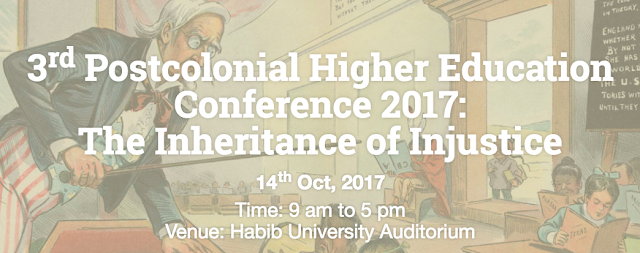
This year’s PHEC's theme was “Inheritance of Injustice” to highlight the results of historical injustices seen today in many facets across the world, from economic and ecological to geo-political, according to report in Newsline Magazine. The conference featured top global academics from South Asia, Africa, the US and the UK.
The keynote at this year's conference was delivered by Dr. Mwangi wa Githinji professor of economics at the University of Massachusetts at Amherst.
Dr. Githinji discussed how “inherited economic, social, language and ecological structures have transmitted colonial injustice into the present.”
He suggested that “development still is understood in a deficit model based on dualities with the aim to move countries to be more like the ‘modern’ and ‘industrialized’ world” and called for education systems to also break out of their post-colonial inheritance to indigenizing systems in which “language is a library of ideas and telling a story allows us to create our own histories.”
Answering questions at the conference Professor Githinji said “liberal arts and sciences education allows us to become knowledge creators rather than just consumers. Part of this process requires a rethinking of our history, even before colonialization. Telling of a story is the creation of a memory.”
South African scholar Dr. Suren Pillay of the University of the Western Cape who also attended the conference said that the “intellectuals must struggle to decolonize knowledge, by not taking progress and civilization at face value, but by telling more multiple and messy stories that co-constitute the story of the modern state.”
Education to Colonize Minds:
Dr. Edward Said (1935-2003), Palestine-born Columbia University professor and the author of "Orientalism", described it as the ethnocentric study of non-Europeans by Europeans. Dr. Said wrote that the Orientalists see the people of Asia, Africa and the Middle East as “gullible” and “devoid of energy and initiative.” European colonization led to the decline and destruction of the prosperity of every nation they ruled. India is a prime example of it. India was the world's largest economy producing over a quarter of the world's GDP when the British arrived. At the end of the British Raj, India's contribution was reduced to less than 2% of the world GDP.
In his "Prison Notebooks", Antonio Gramsci, an Italian Marxist theorist and politician, says that a class can exercise its power not merely by the use of force but by an institutionalized system of moral and intellectual leadership that promotes certain ideas and beliefs favorable to it. For Gramsci "cultural hegemony" is maintained through the consent of the dominated class which assures the intellectual and material supremacy of the dominant class.
In "Masks of Conquest", author Gauri Viswanathan says that the British curriculum was introduced in India to "mask" the economic exploitation of the colonized. Its main purpose was to colonize the minds of the natives to sustain colonial rule.
Kenyan writer Ngugi wa Thiong’o in his book "Decolonizing the Mind" talks about the "culture of apemanship and parrotry" among the natives trained by their colonial masters to maintain control of their former colonies in Africa. He argues that "the freedom for western finance capital and for the vast transnational monopolies under its umbrella to continue stealing from the countries and people of Latin America, Africa, Asia and Polynesia is today protected by conventional and nuclear weapons".
Cambridge Curriculum in Pakistan:
The colonial discourse of the superiority of English language and western education continues with a system of elite schools that uses Cambridge curriculum in Pakistan.
Over 270,000 Pakistani students from elite schools participated in Cambridge O-level and A-level International (CIE) exams in 2016, an increase of seven per cent over the prior year.
Cambridge IGCSE exams is also growing in popularity in Pakistan, with enrollment increasing by 16% from 10,364 in 2014-15 to 12,019 in 2015-16. Globally there has been 10% growth in entries across all Cambridge qualifications in 2016, including 11% growth in entries for Cambridge International A Levels and 8 per cent for Cambridge IGCSE, according to Express Tribune newspaper.
The United Kingdom remains the top source of international education for Pakistanis. 46,640 students, the largest number of Pakistani students receiving international education anywhere, are doing so at Pakistani universities in joint degree programs established with British universities, according to UK Council for International Student Affairs.
At the higher education level, the number of students enrolled in British-Pakistani joint degree programs in Pakistan (46,640) makes it the fourth largest effort behind Malaysia (78,850), China (64,560) and Singapore (49,970).
Teach Critical Thinking:
Pakistani educators and policy makers need to see the western colonial influences and their detrimental effects on the minds of youngsters. They need to promote liberal arts education and to do serious research to create knowledge. They need to improve learning by helping students learn to think for themselves critically. Such reforms will require students to ask more questions and to find answers for themselves through their own research rather than taking the words of their textbook authors and teachers as the ultimate truth.
Summary:
There is increasing recognition in Pakistan and other nations colonized in the past by the West of the need to "decolonize knowledge" and to deal with the entrenched "injustices inherited" from the colonial masters. Part of this post-colonial conversation is to stop being uncritical consumers of knowledge and narratives produced by the West and to encourage creation of local knowledge in the former colonies. This is a positive welcome trend toward real decolonization in Asia and Africa that I hope gathers serious momentum with more liberal arts centers of learning like the Karachi-based Habib University in the near future.
Here's an interesting discussion of the legacy of the British Raj in India as seen by writer-diplomat Shashi Tharoor:
https://www.youtube.com/watch?v=dN2Owcwq6_M
Related Links:
Haq's Musings
Pakistan Day: Freeing the Colonized Minds
Alam vs Hoodbhoy
Inquiry Based Learning
Dr. Ata ur Rehman Defends Higher Education Reform
Pakistan's Rising College Enrollment Rates
Pakistan Beat BRICs in Highly Cited Research Papers
Launch of "Eating Grass: Pakistan's Nuclear Program"
Upwardly Mobile Pakistan
Impact of Industrial Revolution
Hindutva: Legacy of British Raj
Habib University Conference:
Habib University, Pakistan's leading liberal arts institution of higher learning, is leading the way forward with "Postcolonial Higher Education Conference (PHEC)", an annual conference held each year at the university's Karachi campus since 2014. The conference attracts scholars from around the world.

This year’s PHEC's theme was “Inheritance of Injustice” to highlight the results of historical injustices seen today in many facets across the world, from economic and ecological to geo-political, according to report in Newsline Magazine. The conference featured top global academics from South Asia, Africa, the US and the UK.
The keynote at this year's conference was delivered by Dr. Mwangi wa Githinji professor of economics at the University of Massachusetts at Amherst.
Dr. Githinji discussed how “inherited economic, social, language and ecological structures have transmitted colonial injustice into the present.”
He suggested that “development still is understood in a deficit model based on dualities with the aim to move countries to be more like the ‘modern’ and ‘industrialized’ world” and called for education systems to also break out of their post-colonial inheritance to indigenizing systems in which “language is a library of ideas and telling a story allows us to create our own histories.”
Answering questions at the conference Professor Githinji said “liberal arts and sciences education allows us to become knowledge creators rather than just consumers. Part of this process requires a rethinking of our history, even before colonialization. Telling of a story is the creation of a memory.”
South African scholar Dr. Suren Pillay of the University of the Western Cape who also attended the conference said that the “intellectuals must struggle to decolonize knowledge, by not taking progress and civilization at face value, but by telling more multiple and messy stories that co-constitute the story of the modern state.”
Education to Colonize Minds:
Dr. Edward Said (1935-2003), Palestine-born Columbia University professor and the author of "Orientalism", described it as the ethnocentric study of non-Europeans by Europeans. Dr. Said wrote that the Orientalists see the people of Asia, Africa and the Middle East as “gullible” and “devoid of energy and initiative.” European colonization led to the decline and destruction of the prosperity of every nation they ruled. India is a prime example of it. India was the world's largest economy producing over a quarter of the world's GDP when the British arrived. At the end of the British Raj, India's contribution was reduced to less than 2% of the world GDP.
In his "Prison Notebooks", Antonio Gramsci, an Italian Marxist theorist and politician, says that a class can exercise its power not merely by the use of force but by an institutionalized system of moral and intellectual leadership that promotes certain ideas and beliefs favorable to it. For Gramsci "cultural hegemony" is maintained through the consent of the dominated class which assures the intellectual and material supremacy of the dominant class.
In "Masks of Conquest", author Gauri Viswanathan says that the British curriculum was introduced in India to "mask" the economic exploitation of the colonized. Its main purpose was to colonize the minds of the natives to sustain colonial rule.
Kenyan writer Ngugi wa Thiong’o in his book "Decolonizing the Mind" talks about the "culture of apemanship and parrotry" among the natives trained by their colonial masters to maintain control of their former colonies in Africa. He argues that "the freedom for western finance capital and for the vast transnational monopolies under its umbrella to continue stealing from the countries and people of Latin America, Africa, Asia and Polynesia is today protected by conventional and nuclear weapons".
Cambridge Curriculum in Pakistan:
The colonial discourse of the superiority of English language and western education continues with a system of elite schools that uses Cambridge curriculum in Pakistan.
Over 270,000 Pakistani students from elite schools participated in Cambridge O-level and A-level International (CIE) exams in 2016, an increase of seven per cent over the prior year.
Cambridge IGCSE exams is also growing in popularity in Pakistan, with enrollment increasing by 16% from 10,364 in 2014-15 to 12,019 in 2015-16. Globally there has been 10% growth in entries across all Cambridge qualifications in 2016, including 11% growth in entries for Cambridge International A Levels and 8 per cent for Cambridge IGCSE, according to Express Tribune newspaper.
The United Kingdom remains the top source of international education for Pakistanis. 46,640 students, the largest number of Pakistani students receiving international education anywhere, are doing so at Pakistani universities in joint degree programs established with British universities, according to UK Council for International Student Affairs.
Teach Critical Thinking:
Pakistani educators and policy makers need to see the western colonial influences and their detrimental effects on the minds of youngsters. They need to promote liberal arts education and to do serious research to create knowledge. They need to improve learning by helping students learn to think for themselves critically. Such reforms will require students to ask more questions and to find answers for themselves through their own research rather than taking the words of their textbook authors and teachers as the ultimate truth.
Summary:
There is increasing recognition in Pakistan and other nations colonized in the past by the West of the need to "decolonize knowledge" and to deal with the entrenched "injustices inherited" from the colonial masters. Part of this post-colonial conversation is to stop being uncritical consumers of knowledge and narratives produced by the West and to encourage creation of local knowledge in the former colonies. This is a positive welcome trend toward real decolonization in Asia and Africa that I hope gathers serious momentum with more liberal arts centers of learning like the Karachi-based Habib University in the near future.
Here's an interesting discussion of the legacy of the British Raj in India as seen by writer-diplomat Shashi Tharoor:
https://www.youtube.com/watch?v=dN2Owcwq6_M
Related Links:
Haq's Musings
Pakistan Day: Freeing the Colonized Minds
Alam vs Hoodbhoy
Inquiry Based Learning
Dr. Ata ur Rehman Defends Higher Education Reform
Pakistan's Rising College Enrollment Rates
Pakistan Beat BRICs in Highly Cited Research Papers
Launch of "Eating Grass: Pakistan's Nuclear Program"
Upwardly Mobile Pakistan
Impact of Industrial Revolution
Hindutva: Legacy of British Raj
Riaz Haq
The Enlightenment’s Dark Side
How the Enlightenment created modern race thinking, and why we should confront it.
By JAMELLE BOUIE
https://slate.com/news-and-politics/2018/06/taking-the-enlightenmen...
The Enlightenment is having a renaissance, of sorts. A handful of centrist and conservative writers have reclaimed the 17th- and 18th-century intellectual movement as a response to nationalism and ethnic prejudice on the right and relativism and “identity politics” on the left. Among them are Jordan Peterson, the Canadian psychologist who sees himself as a bulwark against the forces of “chaos” and “postmodernism”; Steven Pinker, the Harvard cognitive psychologist who argues, in Enlightenment Now, for optimism and human progress against those “who despise the Enlightenment ideals of reason, science, humanism, and progress”; and conservative pundit Jonah Goldberg, who, in Suicide of the West, argues in defense of capitalism and Enlightenment liberalism, twin forces he calls “the Miracle” for creating Western prosperity.
In their telling, the Enlightenment is a straightforward story of progress, with major currents like race and colonialism cast aside, if they are acknowledged at all. Divorced from its cultural and historical context, this “Enlightenment” acts as an ideological talisman, less to do with contesting ideas or understanding history, and more to do with identity. It’s a standard, meant to distinguish its holders for their commitment to “rationalism” and “classical liberalism.”
But even as they venerate the Enlightenment, these writers actually underestimate its influence on the modern world. At its heart, the movement contained a paradox: Ideas of human freedom and individual rights took root in nations that held other human beings in bondage and were then in the process of exterminating native populations. Colonial domination and expropriation marched hand in hand with the spread of “liberty,” and liberalism arose alongside our modern notions of race and racism.
It took the scientific thought of the Enlightenment to create an enduring racial taxonomy and the “color-coded, white-over-black” ideology with which we are familiar.
These weren’t incidental developments or the mere remnants of earlier prejudice. Race as we understand it—a biological taxonomy that turns physical difference into relations of domination—is a product of the Enlightenment. Racism as we understand it now, as a socio-political order based on the permanent hierarchy of particular groups, developed as an attempt to resolve the fundamental contradiction between professing liberty and upholding slavery. Those who claim the Enlightenment’s mantle now should grapple with that legacy and what it means for our understanding of the modern world.
To say that “race” and “racism” are products of the Enlightenment is not to say that humans never held slaves or otherwise classified each other prior to the 18th century. Recent scholarship shows how proto- and early forms of modern race thinking (you could call them racialism) existed in medieval Europe, with near-modern forms taking shape in the 15th and 16th centuries. In Spain, for example, we see the turn from anti-Judaism to anti-Semitism, where Jewish ancestry itself was grounds for suspicion, versus Jewish practice. And as historian George Fredrickson notes in Racism: A Short History, “the prejudice and discrimination directed at the Irish on one side of Europe and certain Slavic peoples on the other foreshadowed the dichotomy between civilization and savagery that would characterize imperial expansion beyond the European continent.” One can find nascent forms of all of these ideas in antiquity—indeed, early modern thinkers drew from all of these sources to build our notion of race.
Jun 6, 2019
Riaz Haq
The Churchill Cult, by Jingo
Tariq Ali
Lionized in the age of Brexit and Boris Johnson as the epitome of bulldog spirit, Britain’s wartime leader was often reviled in his own time as a blundering reactionary—and rightly so.
https://www.nybooks.com/daily/2022/04/18/the-churchill-cult-by-jingo/
Over the last forty years, the English cult of Winston Churchill has reached near-absurdist levels of adulation in England, provoking a backlash from anticolonial critics of British imperialism. It received a further boost in March this year when President Volodymyr Zelensky addressed the UK Parliament over Zoom and paraphrased one of Churchill’s more famous World War II utterances (from his “fight them on the beaches” broadcast), linking it to the Russian assault on the Ukrainian leader’s country.
Russian president Vladimir Putin was assigned the role of Hitler. Zelensky took the part of Churchill. Members of Parliament from all four parties drooled with pleasure. NATO-land may have conferred a temporary sainthood on Zelensky, but we should not overlook how misplaced his analogy is. The spinal cord of the Third Reich was, after all, crushed at Stalingrad and Kursk by the determination and courage of the Red Army (in which many Ukrainians fought, in far greater numbers than those who deserted to Hitler). The strength of the US war industry did the rest.
As a result, there was no fighting on English beaches or anywhere else in the UK. The Luftwaffe bombed Britain, but Hitler’s feared invasion never materialized, as his ambitions foundered on the Eastern Front. Not to be too mean-spirited, let the House of Commons and the British media networks swoon over Zelensky and his impersonation of Churchill, though I would hardly be surprised to learn that the gambit was recommended by the British Foreign Office in the first place. But I wonder if Zelensky is aware that a tsarist general much favored by Churchill and armed by him, Anton Denikin, who fought viciously against the Bolsheviks in the civil war that followed the Russian Revolution, is hero-worshipped by Putin today.
And what of the hero-worship of Churchill? In the immediate postwar period, Britons decisively voted him out of power. The Churchill cult, an essentially English phenomenon, would not take off for nearly forty years. It was first propagated in 1982, almost two decades after his death in 1965, by Margaret Thatcher, who, with moral support from President Reagan and General Pinochet, won the ten-day Falklands war against Argentina. Churchill had been much invoked by all sides in Parliament before the war. The Argentinian dictator, General Leopoldo Galtieri, was compared to Hitler and those who opposed the war were referred to as Chamberlainesque “appeasers.”
May 19, 2022
Riaz Haq
Indian Education Was Designed To Kill Original Thought
https://youtu.be/Zz23UcvdxVY?si=lfOKKiQbas1-CYtp
“We are derived intellectuals – we just recycle Western knowledge here.”
Professor Arun Kumar argues that India never escaped Macaulay’s design: our universities were built to churn out clerks and civil servants, not original thinkers who can solve Indian problems. From teachers proudly saying they don’t need libraries because they “only teach,” to AIIMS surgeons waiting for Pittsburgh and London protocols to copy, this is an indictment of a country that imports both Diwali lights and pharmaceutical APIs from China while spending 0.65% of GDP on R&D against China’s 3%. When World Bank-funded poverty studies call markets the cure, then quietly admit their policies need “safety nets” because they deepen poverty, you realise the real crisis isn’t just money – it’s that we’re running on non-solutions built for someone else’s economy.
3 hours ago