PakAlumni Worldwide: The Global Social Network
Will Gwadar Grow to Become a Major Metropolis Like Shenzhen?
"We believe Gwadar is following in the footsteps of Shenzhen which represented a historic population rise, from a population of 30,000 in 1980 to 11 million people in 2017. Gwadar is poised to see massive population growth due to incoming industries, and we expect this to be one of the most strategic cities in South Asia." Hao-Yeh Chang, China Pak Investments Corporation
Gwadar: The Next Shenzhen?
Gwadar is booming. It's being called the next Shenzhen by some and the next Hong Kong by others as an emerging new port city in the region to rival Dubai. Land prices in Gwadar are skyrocketing, according to media reports. Gwadar Airport air traffic growth of 73% was the fastest of all airports in Pakistan where overall air traffic grew by 23% last year, according to Anna Aero publication. A new international airport is now being built in Gwadar to handle soaring passenger and cargo traffic.
|
Recent Aerial View of Gwadar Hammerhead Growth |
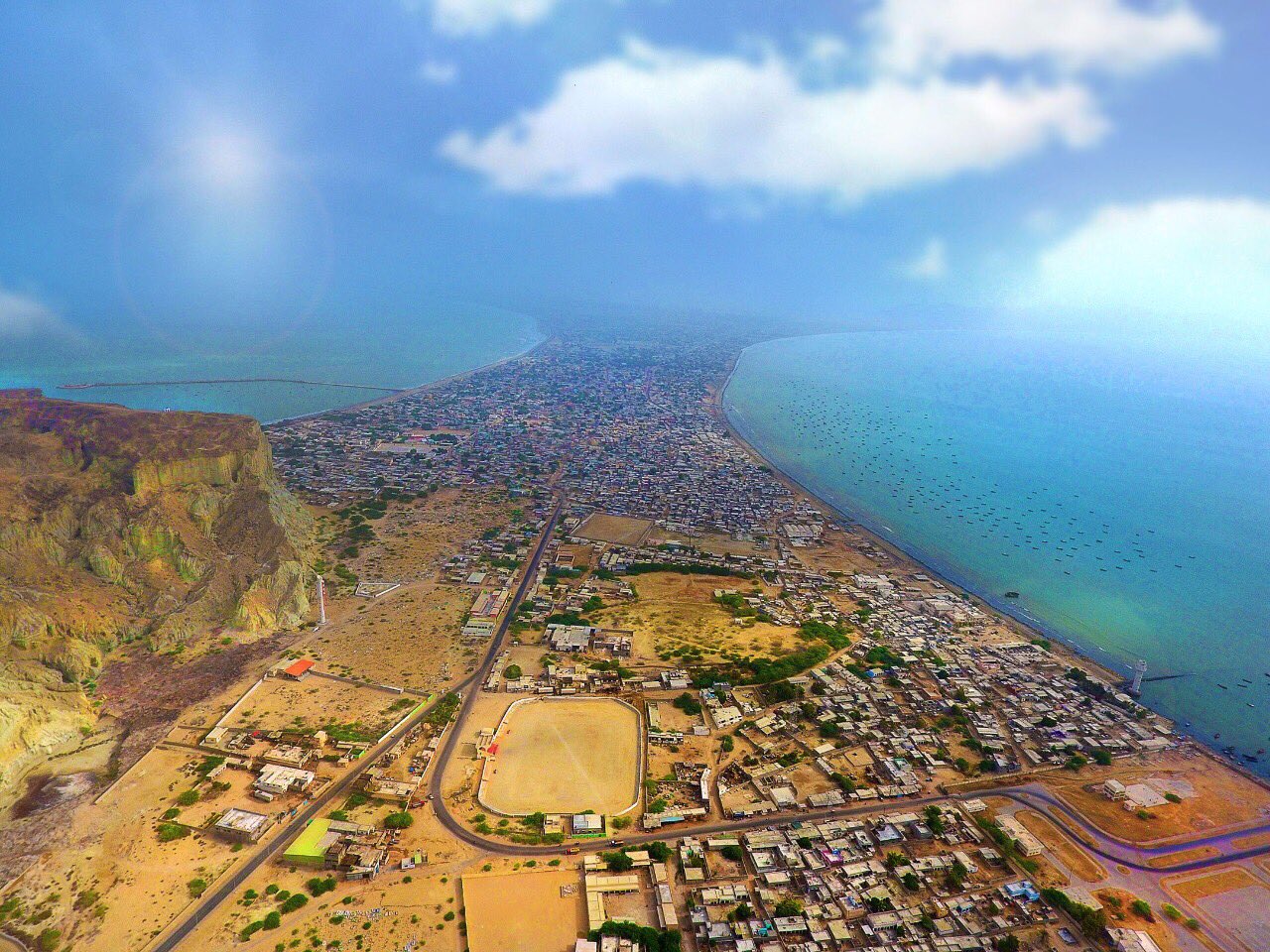
Gwadar Property Boom:
The volume of Gwadar property searches surged 14-fold on Pakistan’s largest real estate database, Zameen.com, between 2014 and 2016, up from a prior rate of a few hundred a month. “It’s like a gold rush,” said Chief Executive Zeeshan Ali Khan to an Express Tribune newspaper reporter. “Anyone who is interested in real estate, be it an investor or a developer, is eyeing Gwadar.”
Chinese private investment company China Pak Investment Corporation has recently announced it is acquiring 3.6 million square foot International Port City project in Gwadar. It plans to develop a $150 million gated community to handle the influx of 500,000 Chinese professionals expected in Gwadar by 2022.
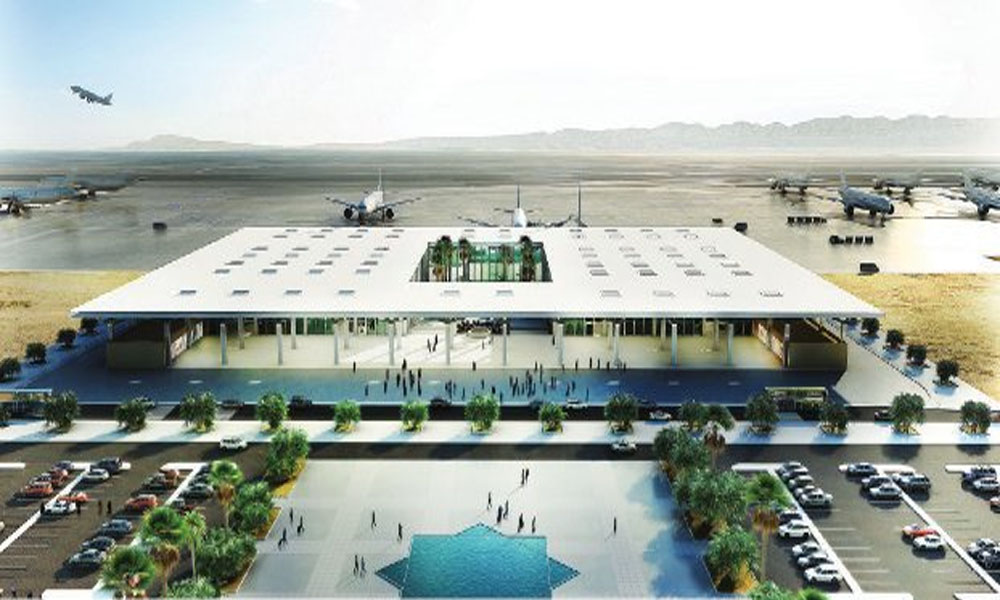 |
| Proposed Gwadar International Airport |
China Pak Investment Announcement:
On October 20, 2017, Pakistan's Geo TV news reported that China Pak Investment Company plans to increase its commitment to invest $500 million in Gwadar in the first phase of a project aimed at building homes for around 500,000 incoming Chinese professionals expected in Gwadar by 2023. An earlier September 29, 2017 press release by China Pak Investment Corporation said as follows:
"The final master plan for China Pak Hills is currently being refined in Hong Kong, and will feature a range of state-of-the-art amenities including an open-air shopping boulevard; indoor shopping mall; restaurants and eateries; an international school and nursery; six community parks; indoor and outdoor sports facilities including tennis courts and a resident's gymnasium; a water desalination plant and recycling centre. China Pak Hills will also be home to the Gwadar Financial District, catering to the growing financial sector and adding much needed A Grade office space to Gwadar's growing market."
Gwadar Port Development:
Gwadar port's planned capacity when it is completed will be 300 to 400 million tons of cargo annually. It is comparable to the capacity of all of India's ports combined annual capacity of 500 million tons of cargo today. It is far larger than the 10-12 million tons cargo handling capacity planned for Chabahar.
To put Gwadar's scale in perspective, let's compare it with the largest US port of Long Beach which handles 80 million tons of cargo, about a quarter of what Gwadar will handle upon completion of the project. Gawadar port will be capable of handling the world's largest container ships and massive oil tankers.
Gawadar port is being built in Pakistan by the Chinese as part of the ambitious $46 billion China-Pakistan Economic Corridor (CPEC) that will eventually serve as Hong Kong West for growing Chinese trade with the Middle East and Europe. CPEC will also enable Pakistan to bypass Afghanistan to trade with Central Asia through China across China's borders with Tajikistan, Kyrgyzstan and Kazakhstan.
India's Strong Opposition:
Pakistan suspects that India's real objective in Afghanistan and Iran is to locate its intelligence agents under the cover of Chabahar port construction workers to sabotage China-Pakistan Economic Corridor (CPEC) and support Baloch insurgency to destabilize Pakistan. These suspicions were strengthened when Indian spy Kulbhushan Yadav, operating under the fake name Husain Mubarak Patel, was arrested in Balochistan in March, 2016. Yadav confessed he was operating as an undercover RAW agent from his base in Chabahar, Iran. Indian Prime Minister Narendra Modi has made no secret of his strong opposition to CPEC and his support for Baloch insurgents.
Chinese Commitment to Pakistan:
Unlike US-Pakistan ties that have been essentially of a transactional nature, Pakistan-China relationship appears to truly strategic. A recent book "The China Pakistan Axis: Asia's New Geopolitics" by American policy analyst Andrew Small quotes a top Chinese official as saying to his American counterparts that "Pakistan is China's Israel". Earlier, in 2011, some news reports quoted Chinese officials as warning that "any attack on Pakistan would be construed as an attack on China". Growing Chinese investment commitments in Pakistan now exceed $100 billion, a further indication of the importance China attaches to Pakistan as one of its closest allies.
Summary:
China-Pakistan ties appear to be truly strategic. The strength of Chinese commitment to Pakistan is increasing with growing investments in China-Pakistan Economic Corridor related projects. It is now highly visible in terms of the influx of the Chinese money and citizens into Pakistan. China's actions on the ground reinforce the credibility of Chinese officials' reported quotes describing Pakistan as "China's Israel" and warnings to the United States that "any attack on Pakistan would be construed as an attack on China".
Related Links:
Riaz Haq
Pakistan Looks to Host Crude Reserve Sites of Gulf Oil Producers
https://oilprice.com/Latest-Energy-News/World-News/Pakistan-Looks-t...
Pakistan is encouraging oil producers from the Persian Gulf to set up crude reserve buffers at a planned Energy City near one of its ports, The Express Tribune reported on Friday.
"In case of emergencies like the breakout of war, Pakistan will have the first right to utilise the oil reserves," a Pakistani official told the publication.
Pakistan, which doesn't have crude reserves at present to act as a buffer in case of emergencies, has been reeling from the Middle East crisis and negotiating with Iran to secure the passage of cargoes through the Strait of Hormuz.
Pakistan plans to set up a so-called Energy City at the Gwadar Port, and Kuwait has already expressed interest in building up crude reserves there, according to The Express Tribune.
Pakistan "plans to set up an Energy City where strategic oil reserves will be built along with establishing LNG and LPG terminals," the official told the outlet.
Pakistan's Federal Minister for Maritime Affairs, Muhammad Junaid Anwar Chaudhry, has asked Kuwaiti officials to explore crude, LPG, and LNG storage sites with the potential creation of rental-based bonded storage facilities, which could support regional trade flows and improve the supply-chain efficiency of energy trade.
Pakistan – which has been mediating U.S.-Iran talks in recent weeks – has been negotiating to have Qatari LNG moved out of the Persian Gulf for the first time since the war began.
Pakistan has relied on Qatar’s term LNG supply for years, but the war in the Middle East and the closure of the Strait of Hormuz have led to the shutdown of Qatari LNG production and exports.
Without Qatar’s LNG, Pakistan has been reeling from an intensifying energy crisis with power outages and fuel rationing.
Thanks to a bilateral Pakistan-Iran agreement, two vessels carrying Qatari LNG are now en route to Pakistan after successfully passing through the Strait of Hormuz in recent days.
May 22
Riaz Haq
Gwadar shipping activity picks up momentum | The Express Tribune
https://tribune.com.pk/story/2610989/gwadar-shipping-activity-picks...
ISLAMABAD:
Trade and shipping activity at Gwadar Port has got a boost in the backdrop of US-Iran war as port utilisation reaches 30% amid optimism about further increase in business.
The Middle East war is reshaping the region and its surroundings where different blocs are emerging. The United States, the United Arab Emirates (UAE) and Israel are on the one side whereas Saudi Arabia, Iran, Turkey, Qatar and Egypt are on the other.
This scenario has prompted the creation of new trade and energy corridors and has also encouraged Gwadar Port to highlight its geographical position that can bypass the Strait of Hormuz. During the war, hundreds of ships were stranded in the sea and to facilitate them, Pakistan offered both on-dock and off-dock facilities – the first such initiative to boost activity at the country's ports. Additionally, the government opened six land routes for 3,000 containers of Iran stuck at Pakistani ports. This step also offered an opportunity to establish connectivity with Central Asia at a time when Afghanistan had halted transit trade for Pakistan.
In a major incentive, sweeping reductions in tariff rates were announced for Gwadar Port aimed at strengthening the deep-sea facility's position as a competitive regional logistics and transshipment hub. Under the revised tariff structure, berthing fee for container vessels and ships carrying transit or transshipment cargo was slashed by 25%. Similarly, the international transshipment container cargo charges were cut by 40% while transit container cargo charges were reduced by 31%. A one-month free storage was announced for general cargo versus the standard five-day allowance at other national ports. At present, three ports are considered competitors in the region, which include the Dubai Port, Iran's Chabahar Port and Gwadar Port. The recent measures are targeted at making Gwadar Port more competitive, which may give a tough time to the Dubai Port.
In the midst of the war, Pakistan and Iran came closer to each other due to Pakistan's efforts to arrange peace talks. A plan is being studied to connect ports of Iran, Pakistan and Oman as the US and Iran have extended their ceasefire agreement. However, the question is how Pakistan will be able to sustain the momentum or increase activity at Gwadar Port after the war dust settles. "We have been able to operate Gwadar Port at 20-30% capacity. We will continue taking measures to utilise the remaining 70% capacity under a master plan," Muhammad Junaid Anwar Chaudhry, Minister for Maritime Affairs, told The Express Tribune.
Jun 3
Riaz Haq
USA Destroyed India Built Chabahar Port in Iran - its Deliberate Attack by Trump Army
https://www.youtube.com/live/hc4Q0Aw5P1Y?is=A0PPIRDZH-gqJXSZ
on Friday