PakAlumni Worldwide: The Global Social Network
Bumper Crops And Soaring Credit Drive Pakistan's Tractor Sales Boom
First seven months of the current fiscal year have seen tractor sales soar 45% to 38,173 units, according to data of the Pakistan Automotive Manufacturers Association. It is driven by a combination of soaring credit availability and bumper harvests of Pakistan's top three crops by area: wheat, cotton and rice.

Tractor Sales:
First seven months of the current fiscal year have seen tractor sales soar 45% to 38,173 units, according to data of the Pakistan Automotive Manufacturers Association. This is good news for Pakistan's tractor industry that has been in slump for several years as the agriculture output was stagnant.
Pakistani farmers use tractors for a variety of usual tasks ranging from tilling and planting to harvest and transport. Tractor owners recover their costs from more efficiently working their farms and renting out equipment when they are not in their own use.
Agriculture Credit Growth:
Pakistani banks provided Rs 500 billion (nearly $5 billion) worth of agricultural credit during the first seven months, July-January period, of current fiscal year. It represents a 45% jump from the same period last year, according to media reports.
According to State Bank of Pakistan (SBP), commercial banks, specialized banks, Islamic banks, domestic private banks, microfinance banks and other microfinance institutions have together disbursed Rs 499.645 billion during the period under review, up Rs. 351.358 billion in the same period of last fiscal year.
Top Three Crops:
Wheat output is expected to be near all time high of 26 million tons. Cotton production is forecast to exceed 11.5 million bales, up from 10.6 million bales last year.
|

Pakistan rice exports have reached 2.59 million tons worth US$ 1.224 billion in the first 7 months, up from 2.27 million tons worth US$.961 Million last year, recording growth of 27% in value and 14% quantity.
Pakistan ranks among the world's biggest producers of a variety of crops including wheat, cotton, rice, corn, sugarcane, onions, chickpeas and fruits, according to Food and Agriculture Organization Stats (FAOSTAT).
Crops vs Livestock:
Livestock farming contributes 53% while crops make up about 42% of Pakistan's agriculture output. The rest comes from fishing and forestry.

Pakistani livestock sector has growing much faster than the crop sector and more recent estimates show its contribution has increased to 56.3% of the value of agriculture and nearly 11% to the agricultural gross domestic product (AGDP). It's driven by growing domestic demand for meat and dairy products.
Crop Yields:
Pakistan's crop yields are comparable to India, among the lowest in the world, according to FAO (Food and Agriculture Organization) data.
|
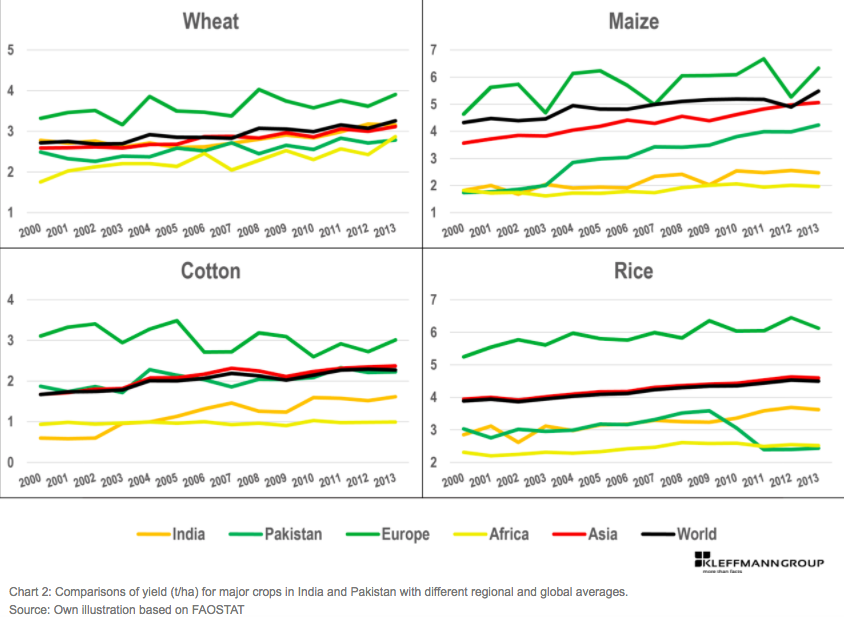
World's highest crop yields are seen in Europe while the lowest are in Africa.
 |
| Maize, Potato, Rice and Wheat Yields in Hectograms/Hectare. Source: FAOSTAT |
Value Added Agriculture:
Livestock revolution enabled Pakistan to significantly raise agriculture productivity and rural incomes in 1980s. Economic activity in dairy, meat and poultry sectors now accounts for just over 50% of the nation's total agricultural output. The result is that per capita value added to agriculture in Pakistan is almost twice as much as that in Bangladesh and India.
Although Pakistan's value added to agriculture is high for its region, it has been essentially flat since mid-1990s. It also lags significantly behind developing countries in other parts of the world. For example, per capita worker productivity in North Africa and the Middle East is more than twice that of Pakistan while in Latin America it is more than three times higher.
CPEC Long Term Plan:
Beyond the current phase of China Pakistan Economic Corridor (CPEC) focus on energy and infrastructure projects, there is a long term plan that deals with modernizing Pakistan's agriculture. CPEC LTP outlines a more comprehensive effort involving the entire supply chain from agriculture inputs like seeds, fertilizer, credit and pesticides to logistics such as storage and transportation systems.
Summary:
Pakistan ranks among the world's top producers of a number of major crops including wheat, cotton and rice. Soaring tractor sales are being driven by a combination of rising credit availability and bumper harvests of major crops in the country this year. But the farm productivity and yields are still among the lowest in the world. CPEC LTP (long term plan) offers hope of significant improvements in agriculture sector to reach its full potential.
Related Links:
Value Added Agriculture in Pakistan
Agribusiness Drawing Investors to Pakistan
China Pakistan Economic Corridor
An Indian Farmer Commits Suicide Every 30 Minutes
Riaz Haq
Tractor assembling increases 16.22pc during last fiscal year
https://pakobserver.net/tractor-assembling-increases-16-22pc-during...
Local tractor assembling witnessed about 16.22 percent growth during last fiscal year (2021-22) as compared the corresponding period of last year.
During the period from July-June, 2021-22, about 58,922 tractors were locally assembled as against the assembling of 50,700 tractors of same period last year, according the data of Large Scale Manufacturing Industries.
During last fiscal year, the upsurge of tractor assembling was mainly attributed to the government’s incentives for the farming communities to mechanization local agriculture sector by reducing tax on locally manufacturing tractors.—APP
Sep 6, 2022
Riaz Haq
Pakistan sets up center to boost agricultural growth with $500 million Saudi assistance
https://www.arabnews.pk/node/2333736/pakistan
The center will work in collaboration with Saudi Arabia, the UAE, Qatar, Bahrain and China on various projects
It aims to enhance modern agro-farming in Pakistan by utilizing over 9 million hectares of uncultivated state land
ISLAMABAD: Pakistan has established a Land Information and Management System, Center of Excellence ((LIMS-CoE) to enhance modern agro-farming by utilizing over 9 million hectares of uncultivated state land, a senior official said on Thursday, adding that Saudi Arabia provided an initial $500 million investment to set up the facility.
Pakistan, an agriculture-based economy contributing 23 percent to the GDP and employing 37.4 percent of the labor force, faces recurrent economic hardships. Currently, the productivity remains below par, with a decreasing cultivation area, a population-production gap, and agricultural imports amounting to $10 billion.
According to the World Food Program, around 36.9 percent of Pakistanis are food insecure, with 18.3 percent experiencing severe food crises. The country faces a shortfall of 4 million metric tons in wheat production against a total demand of 30.8 million metric tons, while cotton production has fallen by 40 percent to around 5 million bales in the last decade.
“As far as the high efficiency irrigation system is concerned, Saudi Arabia has already given us [Pakistan] $500 million,” Maj. Gen. Shahid Nazeer, who heads the LIMS-CoE, told reporters at a briefing on Thursday.
“Aimed at enhancing modern agro-farming utilizing over 9 million hectares of uncultivated waste state land, LISM-CoE has been established under the Director General Strategic Projects of Pakistan Army.”
The state-of-the-art system will revolutionize means to steer agricultural development through real-time information about land, crops, weather, water resource and pest-handling under one roof, according to the official.
The center will work in collaboration with Saudi Arabia, the United Arab Emirates, Qatar, Bahrain and China on various agri projects to enhance Pakistan’s exports.
“In the next 3-4 days, a very high-powered Saudi delegation is coming to Pakistan to explore this kind of investment in four major sectors including agriculture, mines and minerals, information technology (IT) and defense production,” he said, adding this would be done under the umbrella of the Special Investment Facilitation Council (SIFC) that was recently established to revive the Pakistani economy.
Nazeer said the LIMS-CoE was aimed at ensuring food security and optimizing agricultural production in Pakistan through innovative technologies and precise, sustainable agricultural practices based on agro-ecological potential of the land, while ensuring the well-being of rural communities and environment preservation.
“The main objectives of the center included consolidation and reclamation of uncultivated waste land, optimal decision; what and where to grow, development of a master plan for modern farming, implementation of state-of-the-art agriculture management practices, practicing agro-intelligence for digital and precision agriculture, better utilization of technology to enhance yield and effective decision support system,” he explained.
The LIMS-CoE recently initiated modern agri-farming projects in Punjab, according to the official. Efforts were being made to use certified hybrid seeds with concurrent development involving joint ventures with multi-national companies, which could pay rich dividends. In agriculture and gardening, a hybrid seed is produced by deliberately cross-pollinating plants that are genetically diverse.
“Hybrid seed gives 30-50 percent more yield, world is using 80 percent hybrid seed, while Pakistan currently uses only 8 percent of hybrid seed,” he added.
Jul 28, 2023
Riaz Haq
Pakistan's tractor fleet has more than doubled in twenty years, but the market powering that growth has barely changed shape.
The 7th Agricultural Census 2024 counted 986,998 tractors across the country, and just two brands, Massey Ferguson and Fiat, account for 863,322 of them. That is 87 percent of every tractor working Pakistani soil, a duopoly that has now survived six decades of farm mechanization.
Massey Ferguson is the undisputed leader with 519,653 tractors, more than half the national fleet. Its numbers have tripled since the 2004 machinery census, rising 202 percent from 171,943 units. Fiat, which includes Al Ghazi and locally branded New Holland Fiat models, stands second at 343,669 tractors, up 108 percent from 164,941 two decades ago.
Read More: https://propakistani.pk/2026/07/10/just-2-brands-dominate-nearly-90...
22 hours ago