PakAlumni Worldwide: The Global Social Network
Bumper Crops And Soaring Credit Drive Pakistan's Tractor Sales Boom
First seven months of the current fiscal year have seen tractor sales soar 45% to 38,173 units, according to data of the Pakistan Automotive Manufacturers Association. It is driven by a combination of soaring credit availability and bumper harvests of Pakistan's top three crops by area: wheat, cotton and rice.

Tractor Sales:
First seven months of the current fiscal year have seen tractor sales soar 45% to 38,173 units, according to data of the Pakistan Automotive Manufacturers Association. This is good news for Pakistan's tractor industry that has been in slump for several years as the agriculture output was stagnant.
Pakistani farmers use tractors for a variety of usual tasks ranging from tilling and planting to harvest and transport. Tractor owners recover their costs from more efficiently working their farms and renting out equipment when they are not in their own use.
Agriculture Credit Growth:
Pakistani banks provided Rs 500 billion (nearly $5 billion) worth of agricultural credit during the first seven months, July-January period, of current fiscal year. It represents a 45% jump from the same period last year, according to media reports.
According to State Bank of Pakistan (SBP), commercial banks, specialized banks, Islamic banks, domestic private banks, microfinance banks and other microfinance institutions have together disbursed Rs 499.645 billion during the period under review, up Rs. 351.358 billion in the same period of last fiscal year.
Top Three Crops:
Wheat output is expected to be near all time high of 26 million tons. Cotton production is forecast to exceed 11.5 million bales, up from 10.6 million bales last year.
|

Pakistan rice exports have reached 2.59 million tons worth US$ 1.224 billion in the first 7 months, up from 2.27 million tons worth US$.961 Million last year, recording growth of 27% in value and 14% quantity.
Pakistan ranks among the world's biggest producers of a variety of crops including wheat, cotton, rice, corn, sugarcane, onions, chickpeas and fruits, according to Food and Agriculture Organization Stats (FAOSTAT).
Crops vs Livestock:
Livestock farming contributes 53% while crops make up about 42% of Pakistan's agriculture output. The rest comes from fishing and forestry.

Pakistani livestock sector has growing much faster than the crop sector and more recent estimates show its contribution has increased to 56.3% of the value of agriculture and nearly 11% to the agricultural gross domestic product (AGDP). It's driven by growing domestic demand for meat and dairy products.
Crop Yields:
Pakistan's crop yields are comparable to India, among the lowest in the world, according to FAO (Food and Agriculture Organization) data.
|
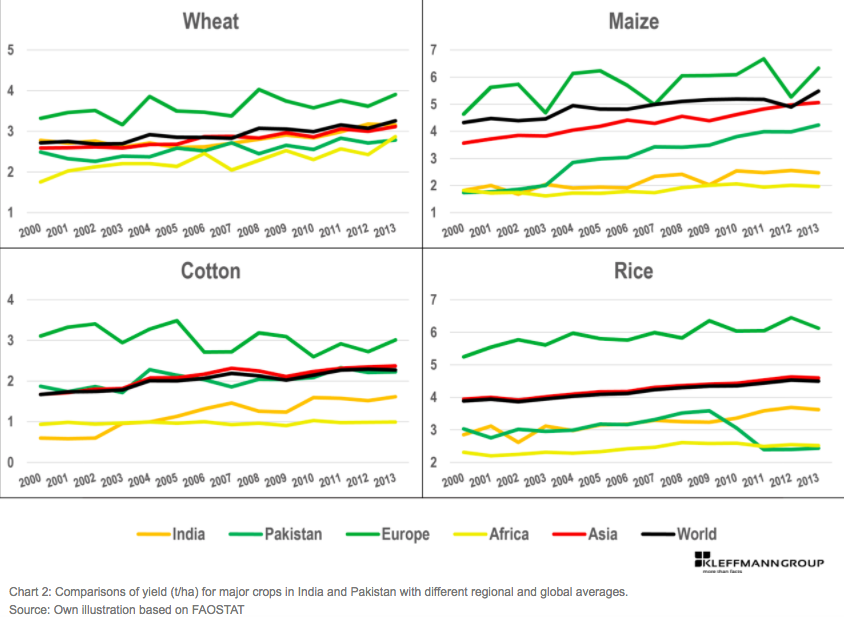
World's highest crop yields are seen in Europe while the lowest are in Africa.
 |
| Maize, Potato, Rice and Wheat Yields in Hectograms/Hectare. Source: FAOSTAT |
Value Added Agriculture:
Livestock revolution enabled Pakistan to significantly raise agriculture productivity and rural incomes in 1980s. Economic activity in dairy, meat and poultry sectors now accounts for just over 50% of the nation's total agricultural output. The result is that per capita value added to agriculture in Pakistan is almost twice as much as that in Bangladesh and India.
Although Pakistan's value added to agriculture is high for its region, it has been essentially flat since mid-1990s. It also lags significantly behind developing countries in other parts of the world. For example, per capita worker productivity in North Africa and the Middle East is more than twice that of Pakistan while in Latin America it is more than three times higher.
CPEC Long Term Plan:
Beyond the current phase of China Pakistan Economic Corridor (CPEC) focus on energy and infrastructure projects, there is a long term plan that deals with modernizing Pakistan's agriculture. CPEC LTP outlines a more comprehensive effort involving the entire supply chain from agriculture inputs like seeds, fertilizer, credit and pesticides to logistics such as storage and transportation systems.
Summary:
Pakistan ranks among the world's top producers of a number of major crops including wheat, cotton and rice. Soaring tractor sales are being driven by a combination of rising credit availability and bumper harvests of major crops in the country this year. But the farm productivity and yields are still among the lowest in the world. CPEC LTP (long term plan) offers hope of significant improvements in agriculture sector to reach its full potential.
Related Links:
Value Added Agriculture in Pakistan
Agribusiness Drawing Investors to Pakistan
China Pakistan Economic Corridor
An Indian Farmer Commits Suicide Every 30 Minutes
Akhtar Hussain
Impressive stuff. And they said Pakistan is a failed state ??
Mar 25, 2018
Riaz Haq
Pakistan’s economy set to surpass last year’s growth rate
https://dailytimes.com.pk/224735/pakistans-economy-set-to-surpass-l...
Pakistan’s economy is set to surpass last year’s growth rate, with continued strong performances by agriculture and services, and a four-year record high large-scale manufacturing growth during the first half of FY18. Inflation and the fiscal deficit were both contained, whereas revenue growth has outpaced last year’s level.
The report pointed out that increased consumer spending has led to a strong growth in durables such as automobile and electronics, while the ongoing infrastructure and construction activities have stimulated the allied sectors of cement and steel.
Encouragingly, various industrial players across different sectors are investing in capacity expansions and product diversification. The private sector also continued its borrowing from scheduled banks for long-term projects.
On the agriculture front, while all major kharif crops performed well, wheat production came under pressure due to lower area under cultivation.
With adequate inventory of key food items, such as wheat, sugar and pulses, prices of these commodities remained low, keeping food inflation in check.
Favorable adjustment in the duty structure of cigarettes led to a sharp fall in its price. Meanwhile, core inflation remained higher on average in H1-FY18 due to continuously rising education and healthcare costs. However, its pace has stabilized in recent months.
The report highlighted that the growth in revenue collection outpaced the increase in expenditures in H1-FY18, which led to a broad-based improvement in fiscal indicators.
The overall fiscal deficit was contained at 2.2 percent of GDP, down from last year’s 2.5 percent. Revenue growth gained impetus from greater real economic activity, rising imports (both quantum and prices), and higher sales volumes of POL products.
Non-tax revenues also rose over last year, led by higher SBP profit and a surge in receipts from property and enterprise, civil administration and other miscellaneous receipts.
On a cautionary note, the report added that while the real sector of the economy was performing well, the external account presented challenges.
The 8-month-long consecutive export growth and a rebound in workers’ remittances were welcome developments, but they were overshadowed by rising imports.
Resultantly, the current account deficit increased to $ 7.4 billion in H1-FY18, from $ 4.7 billion last year. Even though financial inflows were higher this year, they were insufficient to offset the rise in the current account deficit.
Consequently, SBP’s liquid reserves came under pressure, and the PKR/USD parity depreciated by 5.0 percent in H1-FY18.
While concluding, the report referred to the Pakistan economy having reached a familiar juncture, where Balance of Payments challenges warrant concerted and timely measures to preserve the macroeconomic stability and growth momentum.
If the external challenges are addressed, other fundamentals are strong enough to put it on a sustainably high growth path.
Apr 8, 2018
Riaz Haq
#Pakistan's #manufacturing growth increases 6.24% for 8 months of FY 2017-18. #LSM Quantum Index Numbers (QIM) rose to 145.28 points July 2017 to Feb 2018 compared with 136.75 points in same period in prior fiscal year. #economy #industry - Xinhua | http://www.xinhuanet.com/english/2018-04/11/c_137101207.htm#0-twi-1... …
Pakistan's large scale manufacturing (LSM) industries grew by 6.24 percent during the first eight months of the fiscal year of 2017-18 on a yearly comparison, the Pakistan Bureau of Statistics (PBS) said on Tuesday.
According to the official data, the South Asian country's LSM Quantum Index Numbers (QIM) were clocked at 145.28 points during the period for July 2017 to February 2018 when compared with 136.75 points recorded during the same duration of the previous fiscal year.
The Pakistan Bureau of Statistics, which is Pakistan's premier government institution to release official economic data, said Pakistan recorded the highest growth of 4.08 percent in the indices monitored by the Ministry of Industries, followed by 1.54 percent growth in the products monitored by the Provincial Bureau of Statistics, and 0.62 percent growth in the indices of the Oil Company Advisory Committee (OCAC).
In the month of February 2018, the South Asian country's industrial growth surged by 5.52 percent when compared with the same month of last year. On the other hand, the industrial growth shrank by 1.51 percent in February 2018 when compared with the growth posted in January 2018.
According to the official figures, the major sectors which posted growth during the reporting period were textiles with 0.47 percent, food, beverages and tobacco with 2.33 percent and 10.26 percent in coke and petroleum products sector.
On the flip side, the LSM industries which remained in the red ink included chemicals production, fertilizers production, leather products, and wood products.
The Pakistan Bureau of Statistics computes the provincial QIM on the basis of the latest production data of 112 items, which is sourced from the OCAC, the Ministry of Industries and Production, and the Provincial Bureaus of Statistics.
Apr 12, 2018
Riaz Haq
Pakistan economy accomplished a decent growth rate of 5.79% April 16 2018 09:07 PM
http://www.gulf-times.com/story/589222/Pakistan-economy-accomplishe...
Maintaining a steady path and supported by an overall performance by key sectors, Pakistan’s economy has accomplished a decent growth rate of 5.79%, highest in 13 years since 2004-05 when it grew by 7.52%.
With the rate of inflation still below 4% in the first nine months of the current fiscal year, this high-growth-low-inflation scene can be compared to a text book description of an economy at the take-off stage unless rising external vulnerabilities revert back to a crash landing and need for stabilisation during the upcoming political transition.
Some critics may still like to highlight slippages on some targets including the GDP growth target itself 5.79% growth instead of the 6% target – and a particularly lower than anticipated output by the industrial sector.
Yet it is heartening that the agriculture and services sectors performed better than targeted. This in fact partly compensated for the industrial sector’s growth.
Most of the numbers approved by the National Accounts Committee for GDP performance are subject to the usual revision based on availability of actual numbers for the entire fiscal year.
--------------
The rise in production of three important crops namely rice, sugarcane and cotton was estimated at 8.7%, 7.4%, and 11.8% respectively. On the contrary, decline in production, although provisional, was estimated at 4.4% for wheat crop and 7.1% for maize.
Together, important crops posted a healthy growth rate of 3.57% against 2% target while other crops increased by 3.33% against 3.2% target. Cotton ginning also contributed significantly with a 8.72% growth rate compared to 6.5% target and last year’s growth of 5.6%. With 3.76% growth, livestock was close to 3.8% while forestry sub-sector stayed far behind the 10% target at 7.17% – almost half the 14.5% growth delivered last year.
On the whole, the industry is estimated to have grown 5.8% against a target of 7.3% and revised growth of 5% last year. Here the manufacturing showed a 6.24% growth instead of the targeted 6.4% and 5.3% growth last year.
Large scale manufacturing posted a 6.13% growth, slightly below its 6.3% target but much better than last year’s 5% increase. Major contributors to this growth were cement (12%), tractors (44.7%), trucks (24.41%) and petroleum products (10.26%).
Construction, another priority sector of the current government, also increased by 9.13%, against 9% increase last year, and missed by a wide margin the target of 12.1%.
The major contribution to 5.79% GDP growth rate came from 3.85% share from the services sector. The remaining 1.94% share to GDP came from industrial sector (1.21%) and agriculture (0.73%). The services sector has achieved 6.43% growth during current fiscal year second year in a row to have achieved above 6% growth but was primarily driven by general government services aka salary increases, inflation and other public sector expenditures.
Apr 16, 2018
Riaz Haq
Current account deficit increases and so do Pakistan’s worries
https://tribune.com.pk/story/1690144/2-current-account-deficit-incr...
Pakistan’s current account deficit continued to expand, adding to the worries of economic managers as the gap widened 50.6% year-on-year to $12.03 billion in the nine months of the current fiscal year.
The State Bank of Pakistan (SBP) reported that the deficit now stands at over $12 billion during July-March, just shy of last-year’s 12-month figure of $12.62 billion. The nine-month deficit for 2016-17 amounted to $7.99 billion.
The growth in the current account deficit suggests that measures taken by the government have yet to take effect, which includes devaluation of the currency in two phases, and imposing regulatory duty to curtail imports.
A widening deficit eats up a country’s foreign exchange reserves, putting it at risk of a balance of payments crisis.
Economists have estimated the full fiscal year’s deficit to stand at around $16 billion.
Analysts say the deficit may continue to increase by an additional $100 million per month on a year-on-year basis due to uptrend in international oil prices, as Pakistan remains a net oil and gas importing country.
Experts anticipated the government would further devalue the rupee against the dollar and other world major currencies during the ongoing fiscal year to bring the currency at par with its peers in order to create some sort of balance in external trade and the overall economy.
In a statement issued on Thursday, the central bank said exports of goods increased 11.97% to $18.26 billion in the nine-month period, compared with $16.31 billion in the same period last year.
However, the import of goods surged 16.60% to $40.56 billion from $34.79 billion in the corresponding period last year.
The influx of foreign shipments remains on the higher side due to heavy imports of machinery and other construction material for multi-billion dollar projects under the China-Pakistan Economic Corridor (CPEC).
The trade deficit (of goods and services) increased 22.48% in the period under review to $26.15 billion from $21.35 billion.
Workers’ remittances, which play a significant role in financing the current account deficit, has started showing positive trends in recent months due to deprecation of the rupee.
Current account deficit widens 50% in July-February
Total remittances for the first nine months of the current fiscal year amounted to $14.60 billion, 3.55% higher than $14.10 billion in the corresponding period last year, the central bank reported.
Foreign direct investment in the nine months improved 4.4% to $2.09 billion from $2 billion in the same period last year. However, a significant portion of the foreign investment in local businesses is coming from China.
Apr 20, 2018
Riaz Haq
Mutant Varieties Satisfy Market and add USD 6 Billion to Pakistan’s Economy
https://www.iaea.org/newscenter/news/mutant-varieties-satisfy-marke...
When Pakistani farmers harvested fields planted with a new mutant variety of cotton, not only did they have a higher yield, they also received a higher price at the market because of the improved fibre quality. Farmers who adopted mutant varieties of sesame released in 2016 saw yields double and income increase, and now these new varieties cover 50 percent of the area planted to sesame in the entire country. Those who planted a mutant variety of castor bean released in 2017, bred for early maturity and high oil content, have already planted it on 2 000 ha and are making an extra USD 618 per ha. These are just a few of dozens of advances made possible by Pakistan’s Nuclear Institute for Agriculture and Biology (NIAB) which, with the support of the Joint FAO/IAEA Division, has used mutation breeding to improve varieties of eight different crops – benefitting millions of Pakistani farmers and their families, and adding billions to the Pakistan economy.
Across the millennia, those entrusted with saving seeds for planting in future seasons have always made decisions related to the environment, choosing seeds from varieties that will give them the best chance of a good harvest. Even as science has advanced the field from simply saving seeds to cross breeding and now to mutation breeding, the crucial role of the plant breeder has remained largely unchanged – developing varieties that can thrive in whatever the local environment has to offer and be resilient enough to adapt to change. Since 1969, Pakistan’s Nuclear Institute for Agriculture and Biology (NIAB), an institute of the Pakistan Atomic Energy Commission, has overseen the development of 43 mutant crop varieties, ranging from sesame seed to castor bean to mandarin to cotton – all bred in response to what Pakistan’s farmers and their consumers need.
The government of Pakistan recognizes the importance of breeding crop varieties specifically for the Pakistan situation – its terrain, its climate, the needs and capacities of its farmers and, of course, when it comes to food crops, the taste and texture that will appeal to consumers. This government support of the NIAB mutant breeding programme has paid back in terms of increased yields and higher quality products, which have not only contributed to farmers’ livelihoods, it has meant more food for the marketplace and improved food security. Two sesame varieties released in 2016 and 2017 have double the yield of traditional varieties and are more suitable for modern cultivation techniques. The mutant mandarin variety, NIAB Kinnow, released in 2017, has an increased yield of more than 30 percent and reduced seed count from around 50 to just 3-5 seeds per fruit, which makes it more valuable and popular for export.
NIAB has received support from the Joint Division for more than 30 years, including equipment and technology packages for mutation breeding, individual staff trainingthrough fellowships, and national and regional training courses. The mutation breeding process calls for irradiating and then planting crop seeds, and then screening them as they grow in the following generations to see which induced changes that emerge could be helpful for breeding in future generations – from aesthetics of colour and texture to physiological changes that account for traits such as heat or cold tolerance, resilience or length of the growing period.
Aug 16, 2018
Riaz Haq
Hybrid wheat a success in Pakistan, to spread to B&R
By Cao Siqi Source:Global Times Published: 2018/8/21 23:01:48 Last Updated: 2018/8/22 0:45:10
http://www.globaltimes.cn/content/1116470.shtml
Drought, extreme heat post challenge to hybrid wheat: expert
China's hybrid wheat has been successfully grown in pilot areas in Pakistan, and will be introduced into more countries along the routes of the China-proposed Belt and Road initiative soon.
Song Weibo, vice president of Sinochem Group Agriculture Division, China's biggest agricultural inputs company and integrated modern agricultural services operator, told the Global Times on Tuesday that the company's hybrid wheat, using the two-line hybrid technique, has been harvested on a large scale in Pakistan, and is also highly praised in Bangladesh and Uzbekistan.
The company will continue to promote hybrid wheat in other Belt and Road countries and establish demonstration bases in Europe and North America, Song said.
An expert at the Beijing Academy of Agricultural and Forestry Sciences (BAAFS), Zhang Shengquan, who oversees the hybrid wheat project in Pakistan, told the Global Times on Tuesday that wheat production in northern Pakistan increased 50.1 percent between 2017 and 2018, citing data from Pakistan's University of Agriculture Peshawar.
Data from Pakistan-based Guard Agricultural Research and Services Company shows that during the same period, wheat production in the country's middle regions has increased by 45 percent, Zhang said.
Analysts hailed the project as a typical example of China's commitment to transfer advanced technologies and promote regional development in the framework of the Belt and Road initiative.
Providing food security
China is promoting domestically developed hybrid wheat for commercial purposes. The two-line hybrid technique is often used in hybrid rice and wheat. It can increase wheat production by 20 percent.
The technique was developed by BAAFS' Engineering Research Center for Hybrid Wheat in 1992. The hybrid wheat has been proven to outperform standard wheat in terms of yield, water usage and resistance to disease.
Song told the Global Times that Sinochem has sent many experts to Pakistan to teach local farmers how to grow the wheat. "Around 150 experts have been sent to Pakistan, where they visited over 20 cities."
Zhang said that drought and high temperatures are the major challenges to planting hybrid wheat in Pakistan. Frequent changes in Pakistan's governments also make it difficult to sustain the project, he noted.
University of Agriculture Peshawar professor Muhammad Arif told China Radio International that the world has been studying hybrid wheat but no one has achieved China's level of success.
With help from Chinese experts, the technique could yield around 6,000 kilograms per hectare, twice that of local wheat production, Arif said, adding it could free up land for other agriculture products.
Zhao Gancheng, director of the Shanghai Institute for the International Studies Center for Asia-Pacific Studies, said the project could help Pakistan ensure food security and also promote China-Pakistan ties.
"Pakistan's population has been rapidly increasing, but the country is short on farmland. The project is win-win cooperation," Zhao told the Global Times on Tuesday.
Sinochem said the company has also been promoting hybrid rice technology in Bangladesh since 2015.
In October 2016, the company launched the first overseas development center in Bangladesh and helped the country conquer agriculture obstacles by developing a variety that suits local cultivation conditions and consumption customs.
Aug 21, 2018
Riaz Haq
Driving Pakistan’s agri future
Syed Wajeeh ul Hasan Naqvi
The potential of and challenges to Pakistani tractors.
https://aurora.dawn.com/news/1143184
Agriculture is the mainstay of Pakistan’s economy; it therefore follows that agricultural machinery holds significant value for the country. Tractors account for most of the farm mechanisation in Pakistan and we are now on the verge of complete localisation in terms of production.
The tractor market is growing and in 2017, over 60,000 tractors were sold. The market is dominated by three manufacturers. Millat Tractors (Massey Ferguson), Al-Ghazi Tractors (New Holland – formerly Fiat) and IMT Tractors; their market share is 60, 35 and one percent respectively. Smaller brands, such as Belarus Tractors, John Deere and others, import tractors as completely built-up units (CBU) and semi knocked-down (SKD) units and cater to the remaining four percent. Production capacity stands at 70,000 units per annum and models range from 55 to 85hp. Thanks to an indigenisation programme initiated in the eighties by the Pakistan Tractor Corporation, the industry has achieved 95% localisation in terms of production.
“Labour is cheap and we indigenised production a long time ago. We are only importing five percent of the components, mainly pistons and fuel pumps as completely knocked-down (CKD) units. So there is no amortisation cost; hence, we only have the variable cost of production. This is why, Pakistan makes the lowest priced tractors in the world. A 55hp tractor that costs about $7,000 in Pakistan would cost in the region of $20,000 in Turkey, $25,000 in Europe and $30,000 in USA” said Saeed Mushtaq, Head of Marketing, Al-Ghazi Tractors.
The low prices of Pakistani tractors have given manufacturers an edge in international markets who are exporting to Afghanistan and many African countries. However, exports are limited to certain countries due to internal agreements between the brand owners and their Pakistani producers and because of the lack of technological advancement in Pakistani tractors.
Yet, despite the lower prices, penetration in Pakistan still stands at 0.9hp per hectare of cultivable land, much lower than the international norm of a minimum 1.7hp per hectare. This is because the sales depend on the interplay of numerous factors, including the availability of capital for the farmer, interest rates on lease, government subsidy programmes for the purchase of tractors and fertilisers as well as the presence of small and scattered landholdings.
Growth in this sector is still not stable and there are spells of extremely high and low sales. Sales decline considerably when farmers bear losses and bounce back when the government initiates farmer-friendly policies or there is a bumper crop. The average agricultural landholding size is approximately 12.5 acres, due to which it is not viable for most farmers to invest in a tractor unless banks provide leasing facilities on low mark-up rates or the government provides subsidies on their purchase.
Sep 3, 2018
Riaz Haq
Farm Power Available for Utilization in Philippine Agriculture
https://www.researchgate.net/publication/315783506_Farm_Power_Avail...
In 1992, the Regional Network for Agricultural Machinery (cited by PCARRD, 2002) reported the mechanization level of the Philippines to be 0.52 hp/ha. During the same period of time, the mechanization level of our neighboring countries were reported to be as follows: Japan, 7 hp/ha; Republic of Korea, 4.11 hp/ha; China, 3.88 hp/ha; Pakistan, 1.02 hp/ha; India, 1 hp/ha, and; Thailand, 0.79 hp/ha. Later, Rodulfo et al., (1998) determined the level of mechanization in rice and corn farms of the Philippines to be 1.68 hp/ha. Power from motorized machines contributed 80 percent while human and draft animals contributed 14 and 5 percent, respectively, of the total farm power. The most recent study on farm mechanization was the project on, “National farm mechanization needs survey and analysis” (Franco et al., 2001), which was implemented by the University of the Philippines at Los Baños and funded by the Bureau of Agricultural Research in 2001. The level of mechanization was expressed qualitatively as: low, intermediate, high and full mechanization to indicate the degree of utilization of mechanical power. The latest quantitative assessment of the level of mechanization was in 1992 with the
3 1991 Census of Agriculture as the main source of information on human, draft animals and machine power.
(PDF) Farm Power Available for Utilization in Philippine Agriculture. Available from: https://www.researchgate.net/publication/315783506_Farm_Power_Avail... [accessed Sep 03 2018].
Sep 3, 2018
Riaz Haq
Agriculture continues to constitute the backbone of Pakistan’s economy by contributing 21.4% tonational GDP raw material to important industries such as textile and sugar industry. 65% of its population isdirectly or indirectly involved with agriculture, but still farm productivity is much less as compared to othercountries. One the reason for low farm productivity is lack of farm mechanization. Farm mechanization impliesthe use of mechanical technology in the varied farming operations such as sowing, harvesting, threshing,leveling, watering, spraying, weeding and similar other farm operations. Farm mechanization is viewed aspackage of technology to ensure timely field operations, increased productivity, reduced crop losses andimproved quality of grain or product. So far, Pakistan has only experienced selective farm mechanization as thisconcept has remained limited to use of tractors only and currently Pakistan’s per hectare use of horsepoweris 1.50, India's 2.50, China's 3.88 and Japan's 7.0. The number of tractors in 2004 was 401 thousand against thefigure of 157 thousand, ten years back in 1994 and tractors of 50 to 85 horse power were available at the priceranging from Rs.619000 to Rs.166000. The number of combine harvester (Wheat + Paddy) was 6000 in 2004 andwheat thrashers were 137 thousand in the same year, while the number of tractor mounted sprayers was 40thousand in 2004. There is a need to adopt locality specific farm mechanization keeping in view the small landholdings and poor economic condition of farmers. Large scale farm mechanization can only be adopted ifcooperative farming gains roots in Pakistan
(PDF) In Pakistan, Agricultural Mechanization Status and Future Prospects. Available from: https://www.researchgate.net/publication/278019970_In_Pakistan_Agri... [accessed Sep 03 2018].
https://www.researchgate.net/publication/278019970_In_Pakistan_Agri...
Sep 3, 2018
Riaz Haq
PAKISTAN COUNTRY AREA
79,610
(1000 ha)
Official data, 2014
LAND AREA
77,088
(1000 ha)
FAO estimate, 2014
AGRICULTURAL AREA
36,252
(1000 ha)
FAO estimate, 2014
FOREST
1,515
(1000 ha)
FAO estimate, 2014
http://www.fao.org/countryprofiles/index/en/?iso3=PAK
INDIA COUNTRY AREA
328,725.9
(1000 ha)
FAO estimate, 2014
LAND AREA
297,319
(1000 ha)
FAO estimate, 2014
AGRICULTURAL AREA
179,721
(1000 ha)
FAO estimate, 2014
FOREST
70,503.6
(1000 ha)
FAO estimate, 2014
http://www.fao.org/countryprofiles/index/en/?iso3=IND
Sep 5, 2018
Riaz Haq
Why #farmers are key to the #Indian #elections. Rising #fuel prices and #fertilizer costs have sparked widespread protests from #agricultural workers. #India #Modi #BJP #agriculture http://www.theweek.co.uk/96903/why-farmers-are-key-to-the-indian-el...
Diesel prices have risen by 26% in India this year, making it significantly more costly for the nation’s 263 million farmers to work fields and harvest and transport crops.
Alongside rising petrol costs, prices of key fertilisers such as potash and phosphate have jumped nearly 15% and 17% respectively over the past year, “as companies pass on the rise in global prices and the impact of the weak rupee to farmers”, says Reuters.
India is the world’s second-biggest producer of staples including rice and wheat, but “imports all its potash needs and relies on foreign supplies for nearly 90% of the phosphate it uses”, adds the news site.
“It’s a double whammy for farmers, who have to bear the brunt of lower crop prices and higher input costs,” says Devinder Sharma, an independent food and trade policy analyst.
Earlier this week, thousands of protesters under the banner of the Bhartiya Kisan Union (Indian Farmers’ Union) marched to the capital, New Delhi, from adjoining states.
Union member Dharmendra Malik told Al Jazeera that police fired “tear gas and plastic bullets at unarmed farmers”, and turned water cannons on them, in order to prevent the demonstrators from entering the city. He said about 50 people had been injured, a claim that the police have denied.
With elections due to be held in April or May next year, “unions representing farmers and other groups have staged protests in an effort to secure sweeteners in exchange for support at the ballot box”, the news site says.
The majority of the demonstrators at Wednesday’s march were from Uttar Pradesh, which is India’s most populous state, with more than 200 million people, and the most important electorally.
Farmer Abhimanyu Kohar condemned the police response to the protest, and said that agricultural workers will continue to demonstrate until their demands are met.
“There should be dialogue within a democracy. But this government is in a denial mode, they are unwilling to accept that there is a farm crisis. They will pay heavily in the upcoming elections for what they have done today,” he told Al Jazeera.
Official economic data supports the claims of widespread suffering among the sector’s workers. “Rural wage growth started decelerating sharply in the middle of last year, and latest data shows that they are yet to show a credible recovery,” says the Hindustan Times.
“Agriculture alone can no longer sustain families dependent on farming in the villages of Uttar Pradesh,” opposition politician Yashpal Malik told New Delhi-based newspaper National Herald.
Malik also claimed that Prime Minister Modi’s government “is forcing farmers to keep the prices low to run state subsidy schemes”.
Modi and his right-wing Bharatiya Janata Party (BJP) “routed all opposition parties in Uttar Pradesh in the last elections”, says Al Jazeera.
The PM remains personally popular, according to recent polls, “but after four years in power, support for his party has been eroded by voter concerns about jobs and the spike in fuel prices”, the site reports.
Oct 4, 2018
Riaz Haq
#Tractors production in #Pakistan up 33.20%. During the period from July-June, 2017-18 about 71,894 tractors were manufactured as compared to the 53,975 tractors of same period of last year. #agriculture https://pakobserver.net/tractors-production-up-33-20pc/ via @pakobserver
The domestic production of tractors during fiscal year 2017-18 witnessed growth of 33.20 percent as compared the production of the corresponding period of last year.
During the period from July-June, 2017-18 about 71,894 tractors were manufactured as compared to the 53,975 tractors of same period of last year.
On month on month basis, the local production of tractors also grew by 15.21 percent as it was recorded at 3,926 units in June 2017 to 4,523 units in June 2018. according the Quantum Index Number of Large Scale Manufacturing.
It may be recalled that the overall Large Scale Manufacturing Industries (LSMI) of the country witnessed growth of 5.38 percent during the year 2017-18 compared to last year.The LSMI Quantum Index Numbers (QIM) was recorded at 147.07 points during July-June (2017-18) against 139.55 points during July-June (2016-17), showing growth of over 5.38 percent.
Meanwhile the production of trucks witnessed growth of 5.76 percent by going up from the output of 608 units in June 2017 to 643 units in June 2018.
The production of trucks also increased from 7,712 units last year to 9,187 units, showing growth of 19.13 percent while the production of tractors increased by 33.20 percent, from 53,975units to 71,894 units.
On year-on-year basis, the production of jeeps and cars increased by 40.90 percent during the month of June 2018 against the output of June 2017. During the period under review, Pakistan manufactured 16,234 jeeps and cars during June 2018 against the production of 11,522 units during June 2017.
During last financial year, the production of light commercial vehicles (LCVs) witnessed an increase of 19.74 percent in production during the period under review by growing from 24,265 units last year to 29,055 LCVs during 2017-18.
Oct 4, 2018
Riaz Haq
USAID to expand agri-tech-based private sector investment in Pakistan
October 16, 2018
https://pakobserver.net/usaid-to-expand-agri-tech-based-private-sec...
Dedicated to private sector agricultural technology innovation as a key to unlocking the full potential of Pakistan’s horticulture, dairy and livestock sectors, USAID Pakistan through the Pakistan Agricultural Technology Transfer Activity signed Memoranda of Understanding (MoUs) with 10 leading private sector agri-tech companies to help scale up investments in affordable new agricultural technologies. The project has signed MOUs with Ali Akbar Group Enterprises, CattleKit, Farm Dynamics, Haji Sons, Farm Solutions, Dairy Solutions, Solve Agri Pak, Matra Asia, Ravi Agriculture, and Noorani Industries.
The PATTA project partnership seeks to enable agri-tech knowledge transfer and eliminate the barriers to technology adoption, increasing awareness and ultimately enhancing farmers’ production, and profits. The results will improve Pakistan’s overall agriculture-fuelled economic infrastructure and contribute to food security.
PATTA’s partners demonstrate willingness to invest in technology expansion to convert agricultural innovation into commercial success with a pro-farmer approach. Chief of Party PATTA Dr. Daney Jackson stated, “These MOUs formalize PATTA’s partnership with leading private sector companies to support agricultural technology adoption across Pakistan.”
This local partnership-driven technical assistance is spearheading private sector development in the agricultural technology sector. USAIDPATTA will support at least 30 private sector companies to become more competitive and profitable by upgrading equipment, commercialising and marketing500 technologies and modernizing management practices. Technology, innovation and agriculture can increase agrarian production, profitability and expand the work forceby 3400 jobs. Private sector investment is expected to increase by USD 4.8 million and sector sales by USD 17.68 million in 4 years through PATTA’s initiatives.
In a recent MOU signing ceremony, CEO Farm Solutions Bilal Chaudhry stated that partnership with USAID will enable the private sector to accomplish gains that cannot be realized alone.
CEO Matra Asia Anwar-ul-Haq stated, “The partnership between Matra Asia and USAID will help increase farmer profitability by reducing the input costs and increasing yields.”
PATTA’s 10 private sector partners are also striving to narrow the gap between men and women by providing opportunities to women farmers and entrepreneurs. One of these partners – Haji Sons – has ensured that their technology demonstrations also reach female farmers, enabling them to adopt leadership positions in agricultural technology.
Oct 15, 2018
Riaz Haq
China ready to help boost Pakistan’s farming sector
https://www.thenews.com.pk/print/381300-china-ready-to-help-boost-p...
Pakistan and China have agreed to broaden agro-cooperation by adopting a comprehensive approach to fast-track communication and implementation to tap the immense potential of the most important sector, a statement said on Monday.
“Agricultural cooperation will set new and important direction that should focus on areas as well as the level of cooperation and finalisation of specific plans,” MA Aiguo, Vice Minister for Agriculture and Rural Affairs, China, said in a meeting with Makhdum Khusro Bakhtyar, Minister for Planning, Development & Reform (PD&R).
Aiguo said China was ready to share its expertise and successful agriculture models with Pakistan. Bakhtyar said Pakistan’s agriculture sector employed 45 percent of manpower and contributed about 24 percent in GDP. “It provides livelihood to 64 percent of the country’s rural population and shares 20 percent in total exports,” the minister added. The minister identified that Pak-China agricultural cooperation had to focus on the vertical increase in productivity of existing crops, transfer of knowledge and technologies, seed and plant protection as well disease control, value addition and marketing of agri products including dairy, livestock, and fisheries. “The mutual cooperation should cover the whole basket of agri-sectors,” he added.
Bakhtyar stressed there was a massive potential of developing Pakistan’s agriculture sector and achieving a win-win situation. He pointed out that joint ventures, value-addition, cold chain management for fruits/vegetables, marketing, and branding would help Pakistan overcome the past weaknesses and increase its exports to China and other nations of the world.
Oct 15, 2018
Riaz Haq
#Commercial #Olive #farming in #Pakistan gets boost with arrival of 100,000 plants from #Spain, #Turkey. A total of 550,000 plants will be imported under the project which is being implemented by the National #Agricultural Centre. http://www.radio.gov.pk/22-02-2019/olive-farming-gets-boost-with-ar...
The move is part of a project to promote cultivation of olive on commercial basis in the country.
A total of 550,000 plants will be imported under the project which is being implemented by the National Agricultural Centre.
The project for the promotion of cultivation of olive on commercial basis has been approved under the Public Sector Development.
Dr Bari said that a survey of the potential areas had been completed and it was found that these areas were best suited for olive plantation.
The olive cultivation will not only offer an ‘olive branch’ to peace in Fata, but will also serve as a source for livelihood of farmers in the entire Waziristan belt and agencies of Fata.
Feb 22, 2019
Riaz Haq
The world is literally a greener place than it was twenty years ago, and data from NASA satellites has revealed a counterintuitive source for much of this new foliage. A new study shows that China and India (and Pakistan) —the world’s most populous countries—are leading the increase in greening on land. The effect comes mostly from ambitious tree-planting programs in China and intensive agriculture in both countries.
https://earthobservatory.nasa.gov/images/144540/china-and-india-lea...
Ranga Myneni of Boston University and colleagues first detected the greening phenomenon in satellite data from the mid-1990s, but they did not know whether human activity was a chief cause. They then set out to track the total amount of Earth’s land area covered by vegetation and how it changed over time.
The research team found that global green leaf area has increased by 5 percent since the early 2000s, an area equivalent to all of the Amazon rainforests. At least 25 percent of that gain came in China. Overall, one-third of Earth’s vegetated lands are greening, while 5 percent are growing browner. The study was published on February 11, 2019, in the journal Nature Sustainability.
The maps on this page show the increase or decrease in green vegetation—measured in average leaf area per year—in different regions of the world between 2000 and 2017. Note that the maps are not measuring the overall greenness, which explains why the Amazon and eastern North America do not stand out, among other forested areas.
“China and India account for one-third of the greening, but contain only 9 percent of the planet’s land area covered in vegetation,” said lead author Chi Chen of Boston University. “That is a surprising finding, considering the general notion of land degradation in populous countries from overexploitation.”
Feb 22, 2019
Riaz Haq
#Pakistan among world's top 10 #rice producers with 7.4 million tons last year. 28% jump in rice #export last year earned $2 billion for Pakistan. https://www.dawn.com/news/1474525
IN Pakistan’s context, rice statistics are pretty impressive. Sown on 2.89 million hectares (about 10 per cent of total cropping area), it earned $2 billion (around 8pc of export income) for the country.
Put it in the agricultural context, it is second to wheat in acreage and, in economic terms, only second to cotton (and its allied products as per Pakistan Bureau of Statistics data) in export earnings. It accounts for 3.1pc of value-addition in the agriculture sector and varyingly contributes 1.3-1.6pc to the GDP.
Last year, it assumed added significance when production hit 7.4 million tonnes placing Pakistan on the list of the 10 largest producers on the world rice chart. According to the Economic Survey of Pakistan (2017-18), the area under rice increased by 6.4pc — 2.74 million hectares in 2016-17 to 2.89 million hectares and production swelled by 8.7 per cent — from 6.84 million tonnes to 7.44 million tonnes.
Both these factors helped Pakistan post a 28pc increase in rice export. According to data from the Rice Exporters Association of Pakistan (Reap), it sent out a little over four million tonnes (for $2 billion) in 2018, as compared to 3.44 million tonnes for $1.6 billion in 2017. This showed a significant growth of 27.7 per cent in terms of value and 17 per cent in terms of quantity.
As far as profiling of rice is concerned, its three board categories are: basmati (long grain and aromatic), coarse (IRRI type) and a generic term called “others.” The last type comprises of hybrid, unapproved and some smuggled varieties that have crept in due to relaxed official control.
What adds to national seed confusion is the fact that the country has approved 108 varieties in the last 15 years — from 2003 to 2018. All of them are now entitled to sale. However, only 48 of them are actually released and found in the field, depending on requirements of different ecological zones. It is the Chinese hybrids which have made the difference in the last two years.
Punjab (with all kinds of basmati, super, IRRI and hybrids) leads the national production scale with a contribution of 53pc. Sindh (IRRI and hybrids) follows with 26pc, Balochistan (IRRI, hybrids) with 12pc and the remaining 9pc comes from the Khyber Pakhtunkhwa, which has many local coarse varieties for hills and plains. Punjab’s contribution may increase as hybrid varieties are now getting more space while competing crops lose economic sheen.
However, this happy rice scenario has two sore points: it is still stuck in a low yield groove and failing in international retail markets. Despite a massive influx of seeds, Pakistan has not been able to break beyond 2.56 tonnes per hectares production. The world average is 4.7 tonnes per hectare production. With high yielding seeds and recommended practices, 4 tonnes per hectare is easily achievable.
The federal Ministry for Food Security and Research took an initiative in 2015 for improving yield and tradable surpluses and enlisted the Chinese for help. For the next two years, both sides made a beeline towards each others’ fields and laboratories. It resulted in better hybrid seeds arriving in Pakistan and making a difference the very next year i.e. 2018.
Last year’s three-pronged increase was the result of the same effort: the area increased by 6.4pc, production went up by 8.7pc and average yield jumped from 825 kilogram per acre in 2010-11 to over 1,000 kilograms.
Despite this, improvements on the supply side and corresponding initiatives on the marketing side — domestic and international — is still a distant dream. Exports are largely restricted to bulk dumping in Middle Eastern markets while brand development is encouraged for domestic markets. These brands can then go beyond national borders and claim a niche in the world market.
Apr 8, 2019
Riaz Haq
#Pakistan launches Rs. 309.7 billion #agriculture program. Focus on growing #exports and substituting #import. Pakistan’s import bill for major #agricultural commodities reached $4 billion last year https://tribune.com.pk/story/2004597/2-govt-unveils-rs309b-programm...
The government on Tuesday announced the launch of Prime Minister’s National Agriculture Emergency Programme worth Rs309.7 billion to uplift the agricultural economy.
As many as 16 projects in the agriculture sector would be launched at a cost of Rs309.7 billion under the prime minister’s agriculture programme to boost yields of major crops.
The prime minister’s programme will drastically increase agricultural spending over the next five years, by 360%. The share of federal government spending will be Rs85 billion, share of provincial governments will be Rs175 billion and the share of farmers will be Rs50 billion.
Under this programme, 16 projects will be initiated in the agriculture sector in five areas. Four of these projects will be launched at a cost of Rs44.8 billion, which would have a provincial share of Rs7.4 billion, in a bid to boost yields of major crops and encourage the production of oilseeds.
Three projects, costing Rs220 billion, will be focused on conserving and increasing water productivity. Another three projects, which will have a cost of Rs13.9 billion, will harness the untapped potential of fisheries.
The government plans to invest Rs44.8 billion with a federal share of Rs7.4 billion in four livestock projects for small and medium-scale farmers. Two projects worth Rs23.6 billion will be started without federal share to transform Punjab’s agriculture produce markets.
However, Sindh is shy of participating in the Prime Minister’s National Agriculture Emergency Programme as it has not responded despite repeated calls by the federal government.
At a joint press conference with Pakistan Tehreek-e-Insaf (PTI) leader Jehangir Tareen, Federal Minister for National Food Security and Research Mehboob Sultan said Prime Minister Imran Khan had taken initiatives to bring improvement in the agriculture sector.
He said more than 100 meetings were held in major cities across the country to formulate a strategy in consultation with the provinces to implement the emergency programme.
The minister lamented that previous governments had ignored the sector and allocation of funds for agriculture.
He added that Pakistan was importing cotton via Afghanistan and the government was negotiating with textile millers regarding duties on cotton import.
Speaking on the occasion, Tareen said the agriculture sector was Pakistan’s lifeline, however, it had been ignored by previous governments in the last 10 years.
He said post-18th Amendment in 2011, the total agriculture development spending started decreasing drastically by 60%. Provinces did not play their due role in taking initiatives meant for increasing crop yields, he said.
Pakistan’s import bill for major agricultural commodities peaked to around $4 billion last year, he said, adding that they would spend Rs309 billion under the emergency programme to enhance yields.
He invited Sindh to participate in the programme and set aside its political differences for the betterment of the sector.
“If Sindh participates, it will get an additional boost of Rs15 to Rs18 billion in agriculture development spending over five years from the federal government,” said Tareen.
Jul 6, 2019
Riaz Haq
#Pakistan, #US for enhanced #agriculture cooperation. #Agriculture mechanization, to augment the yield of #cotton, development of #oil seed and decrease the #import bill, #American market access to increase #mango and other #exports to #US. #trade #tech https://www.dawn.com/news/1492976
Ahead of Prime Minister Imran Khan’s visit to the United States of America, the two sides on Monday discussed measures for enhancing cooperation in the agriculture sector.
In a meeting, Minister for National Food Security and Research, Muhammad Mehboob Sultan and US Ambassador Paul Jones agreed that the forthcoming visit would be very important to highlight the preferred areas of cooperation especially in the field of agriculture.
Mr Sultan highlighted that the scope of Pakistani mangoes to the US market could be enhanced since the product meets all the international standards and is exported to almost 48 countries after vapour treatment.
This will give a great boost to mango exports and US could also work in collaboration for value-addition of mangoes in Pakistan which will be mutually beneficial. Mr Sultan further said that dates from Pakistan may also be granted market access in US. In view of the visit of the prime minister, dates and other products may also be granted market access on reciprocity.
US ambassador was of the view that Pakistan could import meat from the United States to which the federal minister explained that it could be explored after mutual consultation.
The agriculture minister said the two countries must explore venues for mutual cooperation especially when the prime minister’s agriculture emergency programme has already been launched.
He said the present government is making every effort to strengthen the agriculture sector, especially after the devolution. The government has identified few areas to be developed on priority and important of those areas are agriculture mechanisation, to augment the yield of cotton, development of oil seed and decrease the import bill.
He said the government as well as the agriculture ministry is open for cooperation from all provinces and friendly countries for mutually beneficial work in the agriculture sector.
Ambassador Jones said the United States is well aware that Pakistan is an important agricultural country, and exchange of technologies in the field of agriculture including cooperation in value-addition, and public-private partnership would be welcomed by both the sides.
Jul 9, 2019
Riaz Haq
Govt keen to promote agriculture, livestock sectors on modern lines
https://www.app.com.pk/govt-keen-to-promote-agriculture-livestock-s...
The initiative would also help in promoting the cultivation of minor crops like oil seed, pulses on which the country is spending billion of dollars every year, besides, it would also help in promoting the culture of growing high value fruit, vegetables and development of livestock sector to fetch handsome foreign exchange reserves for the country.
In this regard, the Central Development Working Party (CDWP) in its recent meeting has accorded approval to 13 mega development projects conceived under emergency program, whereas the final approval is likely to be given by the Executive Committee of National Economic Council (ECNEC) in its next meeting.
Commenting on the salient features of the program, Focal Person of Prime Minister Emergency Program Muhammad Ali Talpur said that out of the total Rs309 billion package, the federal government would provide Rs84 billion while the remaining amount of Rs225 billion would be shared by the provincial governments.
He said the current government, after assuming the power, had attached high priority to the development of agricultural sector and had enhanced overall allocations for this sector.
The federal government had increased its spending from Rs1 billion in its annual Development Plan last year to Rs12 billion and same was followed in Punjab and other provinces, adding that the government intended to take up the spending up to the record level of Rs70 billion during next four years.
He said that the program was a revolutionary step of the government and beside promoting the agricultural sector it would also be beneficial for the local farmers as the special efforts would be made to enhance the per acre yield of all major crops.
Special measures, he said would also be introduced to enhance per acre yield of wheat from 35-40 maunds, rice by 10-20 maunds, sugarcane by 650-800 maunds, adding that incentives were announced for the cultivation of oil seeds like canola and sunflower.
In order to make the agriculture produces more competitive, he said that special measures would be introduced for energy, water conservation and pest management to reduce the cost of production.
He further said that Rs220 billion would be spent on the construction of small dams and water courses development, adding that 70,000 water courses would be developed.
About 50% of total water courses would be upgraded and developed which would help save about 9 million acres feet water annually and this program would be completed with in next four years,he remarked
Meanwhile, Spokesman of Federal Ministry of National Food Security and Research Dr Javed Hammayun said that beside this program, the government was also negotiating with China for its cooperation in agricultural sector development by sharing its expertise and knowledge.
He said that in order to share the Chinese expertise in the field of agriculture and livestock farming, joint working groups had been formed for identifying the areas of cooperation.
Besides, he said that a frame work agreement and a Memorandum of understanding were also signed with China for establishing foot and mouth disease free zone for livestock production to fulfill the international standards that would help in enhancing the local meat and its products exports.
He said that a Joint Working Group of both the countries was formed under China-Pakistan Economic Corridor (CPEC), which would meet in October this year and finalize the areas of cooperation.
Dr Javed Hammayun said that in the JWG meeting, both the countries would finalize the cooperation in the areas of remote sensing technology, pre and post harvest handling and storage of agriculture commodities.
Both the countries were likely to set bilateral cooperation for establishing genetic resource of crops, livestock and poultry, he added.
Aug 25, 2019
Riaz Haq
What The Uber Of Tractors Means For The Future Of Agtech In Africa
https://www.forbes.com/sites/jennysplitter/2019/08/12/what-the-uber...
“Capitalism in agriculture, within sub-Saharan Africa, is alive and well,” says Jehiel Oliver. Oliver is the CEO of the agtech company Hello Tractor, whose smartphone app connects smallholder farmers with tractor owners looking to rent. Dubbed the "Uber for tractors," Hello Tractor first launched in Nigeria in 2014, and then quickly expanded into Kenya. The company is now poised for even further expansion, with testing underway in India, Pakistan and Bangladesh.
From Startup To Scaling Up
With the population of sub-Saharan Africa continuing to rise, many smallholder farmers want to scale up production. But there are challenges. Equipment is expensive, financing is out of reach and the scale is often too small, with many farmers looking for equipment for only a few days each growing season. That’s where Hello Tractor comes in.
The company’s farmer-to-owner matchmaking service quickly found success, but there were a few missteps along the way. For the first two years, Hello Tractor’s strategy was to make and sell the unit that goes on top of the tractor, but that turned out to be a mistake, at least according to Oliver. “We really struggled because we were basically trying to do something we had no business doing,” he says, “selling heavy equipment.”
It may have been a mistake, but the choice also proved a valuable lesson. “Throw everything you think you know out the window,” he says of the experience. He placed a lot of value on outside experts whispering in his ear back then, and the misfire forced him to shift his focus back to his farmer customers.
Aug 28, 2019
Riaz Haq
In Pakistan, banks urged to increase agri-credit disbursement
https://tribune.com.pk/story/2102876/2-underserved-areas-banks-urge...
Overall agriculture credit disbursement target of Rs1,350 billion has been assigned to banks for FY20, which is 89% of the total estimated credit requirement of Rs1,518 billion.
State Bank of Pakistan (SBP) Governor Dr Reza Baqir on Tuesday praised banks for their efforts to increase lending to the agriculture sector, which reached a historic high by the end of the fiscal year 2018-19.
“It is for the first time in Pakistan’s history that credit to the agriculture sector has surpassed Rs1 trillion,” said the governor in his keynote address.
He was chairing the annual meeting of the Agricultural Credit Advisory Committee (ACAC) held in Peshawar as part of efforts to enhance agriculture credit in the underserved provinces and regions.
Baqir, however, urged the banks to meet qualitative aspects of the assigned targets as well in line with the strategic shift and key policy actions taken by the SBP for agricultural financing.
He highlighted that most of the banks met their assigned targets except for some including Zarai Taraqiati Bank Limited (ZTBL), Punjab Provincial Cooperative Bank Limited (PPCBL), some domestic private banks and Islamic banks, which fell short of the targets.
Province-wise agriculture credit disbursement showed a double-digit growth across all provinces and regions but banks struggled to achieve the targets in underserved regions. He urged the banks and institutions to step up efforts and commitment to ensure the achievement of agriculture credit targets in the underserved provinces and regions. The central bank governor pointed out that the SBP was considering three policy actions to further promote financial inclusion in the agriculture sector.
First, it wants to enhance transparency through disclosure of bank-wise performance statistics on a monthly basis covering agriculture credit disbursement, geographical distribution, outstanding amount, number of borrowers and agriculture credit infrastructure. Second, it seeks to introduce a comprehensive scoring model for the ranking of banks based on key agriculture credit indicators and targets. Third, it will introduce incentives and penalties based on the performance scores of banks.
Baqir emphasised that there were huge lending opportunities for banks, which would promote financial inclusion and aid their profitability.
The governor’s speech was followed by a presentation where the performance of banks in agriculture financing in FY19 was reviewed.
It was shared that the overall agriculture credit disbursement target of Rs1,350 billion had been assigned to banks for FY20, which was 89% of the total estimated credit requirement of Rs1,518 billion.
It was highlighted that Islamic banks and Islamic branches of commercial banks had been assigned the disbursement target of Rs110 billion for FY20, which was in line with the previous year to help realise the potential of Islamic agriculture financing.
Furthermore, the overall target of outstanding borrowers was enhanced to 4.67 million with the addition of 650,000 new borrowers.
The committee deliberated on the new directions in agriculture financing by focusing on technology, especially the digitalisation of agriculture loan processes through the adoption of Land Record Information Systems, Electronic Warehouse Receipt Financing System and initiatives like the Kissan Digital Portal. These were key priorities under the National Financial Inclusion Strategy 2023.
Nov 21, 2019
Riaz Haq
#Pakistan to increase #olive production. In a project in Chakwal, the #agriculture dept of #Punjab planted more than one million trees on an area of 3200 hectares and 750 farmers of the district benefited from it. https://pakobserver.net/pak-pursuing-plan-to-increase-olive-product... via @Pakistan observer | Daily Newspaper
Pakistan had ambitious plans for increasing its olive production and it had the potential to take over Spain as the biggest producer of olives in the years to come
Under a project in Chakwal, the agriculture department of Punjab had almost planted more than one million trees on an area of 3200 hectares and 750 farmers of the district benefited from it.
According to Inamul Haq, an officer in Barani Agriculture Research Institute, the agriculture department of Punjab had launched the mega flagship programme to develop Potohar area into an olive valley in 2015-16.—APP
Dec 9, 2019
Riaz Haq
#Balochistan's Small #Farmers To Get 1,000 Locally Produced #Tractors under Green Tractor Program. #Pakistan - UrduPoint https://www.urdupoint.com/en/pakistan/balochistans-small-farmers-to...
In the first phase, 1,000 tractors would be awarded to the small farmers of the province on subsidized rate and the programme would be expanded to 3,000 tractors, the Spokesperson of Balochistan government, Liaqaut Shahwani said while talking to APP.
Shahwani said the Balochistan government had expanded the allocation for the project from Rs 500 million to Rs 1 bill to flourish the agriculture sector and facilitate the farmers.
The recovery will be made in a period of seven years, every beneficiary have to pay monthly installment of nine thousands, the spokesperson informed.
He further said that latest technologies would be introduced to enhance the productivity of agriculture in the province.
The Balochistan government had allocated Rs 9.098 billion for the development of irrigation system in the province to increase the agricultural production which would ultimately benefit the farmers.
He said that the provincial government had decided to construct small dams sprawling over a large area of the province to resolve the water scarcity issue of the province.
He said, "The government has allocated Rs 500 million for the construction of small dams to preserve rain water as the entire province was dependent on ground water.
" He said the government had also planned to build dam on the area of Shaghzai, Gwadar to resolve water issue in the area.
The plan to build dam on Bolan River was also under consideration to conserve water being dumped aimlessly with a cost of Rs 1.5 billion, he added.
In the current fiscal year 2019-20, he said the government had spent Rs 250 million on the development and expansion of command area of Kachhi canal to achieve the goal of irrigating more land of the province.
"The government has been taking the initiative to encourage farmers for cultivating olive trees whereas the government has allocated Rs 100 million for the development and boosting of olive farming in the province," he noted.
The province has huge potential in the agro sector but water scarcity and prolonged drought had badly destroyed the agriculture of the province, said Liaquat Shahwani.
The Balochistan government, he said was taking initiatives to resolve issues in agriculture sector in the province on priority.
Shahwani said that agriculture was the backbone of the country's economy and it provided 50 percent employment opportunities to the country's workforce.
He said the provincial government under the leadership of Chief Minister Jam Kamal Khan had been working to increase agricultural output by devising out of the box and effective solutions.
Dec 9, 2019
Riaz Haq
Long delayed first phase of 363 Km long Kachhi Canal completed to irrigate 102,000 acres of land in #Balochistan, #Pakistan. #water #farming https://www.dawn.com/news/1508140
The first phase of Kachhi Canal has been completed and work on the second phase is under way.
Presiding over a meeting, Chief Secretary Fazeel Asghar said that Balochistan would see a new era of development after the completion of the Kachhi Canal project.
He said farm production would increase after completion of this project, which in turn would boost economy and improve quality of life in the province.
The meeting was informed that after completion of the first phase of Kachhi Canal, 102,000 acres of land would come under cultivation.
Dec 9, 2019
Riaz Haq
FAO DG to visit #Pakistan this week. #FAO’s work globally and in Pakistan focusing on Zero hunger and Food Security issues related to climate change. #food #hunger #ClimateChange https://nation.com.pk/13-Feb-2020/fao-dg-to-visit-pakistan-this-week
The Director-General of the Food and Agriculture Organization of the United Nations (FAO), Qu Dongyu will be arriving in Pakistan on a three-day state visit on Friday as part of his vision to further strengthen the years’ long extraordinary collaboration of the country and FAO. During his visit, the Director General, FAO will call on the Prime Minister of Pakistan besides meeting with Federal Minister of Food Security and Research and other high-level officials, representatives from the private sector, youth representatives, academia, civil society and resource partners to apprise them of FAO’s work globally and in Pakistan, focusing on Zero hunger and Food Security in the context of the global climate change scenario. The Director-General will also travel to rural Punjab to meet with small-holder farmers who are most at risk from natural disasters, the UN information center said.
Qu Dongyu, a former Vice Minister of Agriculture and Rural Affairs of China, elected as FAO Director-General in June 2019, has stressed the crucial role that FAO, which has 194 member states, can play in addressing key global challenges and accelerate progress towards achieving Sustainable Development Goals for all.
The priority challenges requiring urgent attention remain; the increasing rates of hunger and malnutrition, climate change-related risks to agriculture, ongoing natural resource depletion and environmental pollution and the growing spread of trans-boundary animal and plant pests and diseases.
Feb 13, 2020
Riaz Haq
Zero-carbon hydro-ram water pumps turn #Pakistan's barren mountains green with apple trees. Pumps feed drip #irrigation system that delivers a steady, gentle flow of water to mountain-top crops, using less water than traditional irrigation #GilgitBaltistan https://reut.rs/2UrCyz3
GOJAL VALLEY, Pakistan (Thomson Reuters Foundation) - Shovel in hand, Naila Shah regularly walks two miles from her home to a newly planted apple orchard, high in the mountains of Khyber village in northern Pakistan.
Only two years ago, it would have been practically impossible to grow apples in this part of Pakistan, 2,500 meters (8,200 feet) up in Gilgit-Baltistan region’s Gojal Valley.
Although the Khunjerab River provides plenty of water to those living in the valleys below, local farmers used to have no efficient way to get it up the mountain-sides.
But the installation of a hydraulic ram (hydro-ram) pump has changed that. It harnesses the pressure of fast-flowing water, such as a river, to drive a share of that water uphill without needing any other power source.
Because the pumps work without electricity or fuel, they are cheap to run and produce no climate-heating carbon emissions.
“Previously, we used to survive on rainwater,” said Shah, a teacher and secretary of a local women’s development group.
“The land used to be barren, as water couldn’t be lifted from the river flowing right next to the area,” she said, digging out weeds from around the bases of young trees.
Low-cost, sustainable irrigation systems like hydro-ram pumps could be key to helping Pakistan’s mountain communities adapt as climate change drives more severe droughts and floods across the country, environmental experts said.
“The government cannot afford larger irrigation systems,” said Haider Raza of green group WWF-Pakistan, which installed the pump in Khyber village two years ago under a project led by the International Centre for Integrated Mountain Development (ICIMOD).
“But these high-efficiency irrigation systems, which aren’t an expensive technology, can be used to improve the livelihoods of local communities,” he told the Thomson Reuters Foundation.
Encouraged by the results, the United Nations Development Programme gave WWF-Pakistan additional funding to install 20 more hydro-ram pumps in 12 villages.
Each pump is connected to a drip irrigation system that delivers a steady, gentle flow of water to mountain-top crops, using less water than many traditional irrigation methods.
The pumps have helped revive about 60 acres (24 hectares) of previously barren land, benefiting nearly 300 households, Raza said.
Their simple design - consisting mainly of pipes and two valves - means few moving parts to maintain or repair.
Upkeep of the pumps, which cost up to 70,000 Pakistani rupees ($430) to build and install, is easy and affordable for communities, who have welcomed the new systems, Raza added.
Seeing the potential for low-cost irrigation to help mountain communities, Pakistan’s government last year approved funding for the Gilgit-Baltistan water management department to install 50 hydro-ram pumps, along with 150 solar-powered pumps.
Those systems should help irrigate 1,050 acres of orchards in nearly a dozen districts, according to Mudassar Maqsood, associate programme coordinator at ICIMOD.
The government’s efforts to bring water to high-altitude communities may also get a boost from nature itself.
Climate experts predict shifting rainfall patterns in Pakistan could in future move the wet season away from its southern and central plains to northern mountain regions.
Muhammad Irfan Tariq, who recently retired from his post as director general of Pakistan’s climate change ministry, said the plains might eventually get less monsoon rain than they do now.
Mar 29, 2020
Riaz Haq
#Pakistan's silent #olive revolution with increasing area under cultivation. 3m plants producing 1,415 tons of #oil worth Rs 4.416 billion by 2024. Pothwar has 1.2 million olive plants on 11,125 acres. More in #KP, #Balochistan, #GilgitBaltistan & #Kashmir https://www.dawn.com/news/1537650
The sector is rapidly moving the country towards self-reliance by introducing Pakistan’s national brand under the name of ‘PakOlive’ by 2021. The Pakistan Olive Oil Council will be established under the Ministry Of National Food Security and Research to suggest policy measures for the promotion of olive oil in the country. The government will also issue certifications for the marketing and branding of olive oil for the private sector.
“Certification is important as our local olive products can then become competitive in the international market,” said Dr Muhammad Tariq, national project director for the promotion of olive cultivation on a commercial scale in Pakistan. Furthermore, utilising marginal lands will help grow a cottage industry for olive products, he explained.
The project targets plantations of over 50,000 acres in the country by 2022. The available potential area for olive cultivation is about 10 million acres in Punjab, particularly the Pothwar region, Balochistan, Khyber-Pakhtunkhwa and erstwhile Fata, Azad Jammu and Kashmir (AJK) and Gilgit-Baltistan.
Given its potential for growing olive plantations, Pothwar has been termed as an ‘olive valley’ where over 1.2 million olive plants are being grown on an area of 11,125 acres, engaging about 1,300 farmers. More than half the plants will start bearing fruit in 2019-20’s cropping period, producing 5,118 tonnes of olive oil. By 2024, the value of oil olive production will increase to Rs1.727 billion.
In Khyber-Pakhtunkhwa, over a million olive plants are being grown on an area of 9,391 acres engaging 768 farmers. The production of olive oil is estimated to reach the value of Rs1.458bn in 2024.
In Balochistan, over half a million plants are being grown over an area of over 9,391 acres and it is expected that by 2024, the value of oil will be Rs1.160bn.
In Islamabad Capital Territory and AJK, over 50,000 plants are being grown on an area of 455 acres of land engaging 228 farmers. The value of oil by 2024 is expected to be Rs71 million.
Thus, by 2024, the country will have about 3m fruit-bearing olive plants producing roughly 1,415 tonnes of olive oil with an estimated value of Rs4.416bn. The climate change ministry also plans to plant 1m olive plants.
Edible oil is an every-day use food item. Pakistan has been chronically deficient in its production. More than 80 per cent of the domestic requirements are met through imports. Since the early-1970s, its imports have increased at the rate of 12.5pc annually and the trend is worsening.
In 2017 alone, more than $3.2bn was spent on the import of oil, oil meal and oilseeds to meet domestic needs. Pakistan imported 3,000 tonnes of olive oil worth Rs1.241bn during 2017-18.
Dr Tariq explained that utilising marginal lands will help the cottage industry of olive products grow. Thus, livelihoods will be improved through employment generation opportunities created by olive value-chains developed in less-favoured regions of the country.
Olive forests resist drought and help absorb greenhouse gases when the capability of other trees decrease, making them more efficient in taking in carbon dioxide.
They also provide permanent crop cover that not only saves land from erosion and further degradation but also minimises silt load to downstream water reservoirs. Olive orchards require less water, fertilisers, pesticides and fuel energy as compared to other major annual oilseed crops.
Mar 29, 2020
Riaz Haq
Pakistan's average daily per capita calorific intake was estimated by ADB at 2,440 kcal in 2013. Cereals accounted for 48% of daily calorific intake in 2013. Calorific intake from animal sources comprised 22%, while fruit and vegetables accounted for 2%. The average daily per capita protein consumption was estimated at 65.5 grams, while the average dietary energy supply adequacy was estimated to be 108% in 2015-2017.
https://www.brecorder.com/2020/01/08/559976/political-instability-d...
Approximately 46% of agricultural production comes from the cropping sector, compared with 54% from livestock. Buffalo meat was the single most valuable commodity produced in Pakistan in 2016 at around $9.8 billion. Other important commodities produced included buffalo's milk ($9.4 billion), wheat ($7.4 billion), beef ($5.5 billion), cotton ($3.3 billion), and chicken meat ($3.2 billion).
Sugarcane was the largest crop produced with 65 million tons in 2016. Other important products included wheat (26 million tons), rice (10.2 million tons), maize (6.1 million tons), and cotton (5.3 million tons). Around 4.5 million tons of fertilizers were used in Pakistan in 2016, and a further 913,000 tons were imported into the country that year.
Pakistan's livestock sub-sector, on the other hand, has demonstrated steady growth, especially in the face of increasing demand for livestock products due to a growing and rapidly urbanized population.
The country's livestock sub-sector represents approximately 56% of value addition in agriculture and employs roughly 30 million people. Despite the increased production of poultry products, its external trade is low and has not realized the potential experienced in other livestock sub-sectors. In 2016, total poultry exports were valued at $2.7 million.
Pakistan imported $7.1 billion worth of agricultural goods in 2016, compared with $3.7 billion in agricultural exports. Pakistan's main agricultural export commodities were rice ($1.7 billion), wheat flour ($173 million), tangerines and mandarins ($158 million), beef ($155 million), sugar ($123 million), and dates ($103 million). Palm oil was Pakistan's main food import at $1.7 billion, followed by cotton lint ($581 million), tea ($490 million), rapeseed ($464 million), soybeans ($383 million), and coffee ($329 million).
Apr 6, 2020
Riaz Haq
#Pakistan hired 63,000 people, unemployed by #COVID19, to plant 10 billion #trees while wearing masks & maintaining #SocialDistancing. Starts with 15,000 acres near #Islamabad to expand to #forest land throughout the country to fight #ClimateChange via @ https://www.upworthy.com/pakistan-hires-63000-people-to-plant-10-bi...
If there is a bright spot to the COVID-19 epidemic, it's the positive environmental impact that social distancing has had on the planet. There has been a steep drop in worldwide pollution and wildlife is returning to places that were once dominated by human activity.
The pandemic has also inspired many world leaders to champion a green recovery.
Pakistan has found a great way to help its laborers who've lost their jobs due to the health crisis by hiring them to plant saplings as part of the country's 10 Billion Trees program. The five-year project was launched by Pakistan's Prime Minister Imran Khan to counter the droughts, flooding, and rise in temperatures in the country caused by climate change.
Pakistan ranks fifth on a list of countries most affected by planetary heating over the past two decades by the Global Climate Risk Index 2020.
The country has been on lockdown since March 23, but the prime minster granted an exception for the 63,000 laborers it has hired for the program. The workers will be paid between 500 to 8000 rupees a day — about half of what a laborer would usually make —but it's enough to get by.
The work is a lifeline for the unemployed laborers but it will only put a small dent in Pakistan's unemployment rate. A recent assessment by the Pakistan Institute of Development Economics found that up to 19 million people could be laid off due to COVID-19.
Even though the work takes place in isolated areas, laborers still have to abide by social distancing rules. They must remain six feet apart from one another and wear masks.
Much of the planting is being done on 15,000 acres near the state capital of Islamabad as well as other pieces of state-owned forest land throughout the country.
"This tragic crisis provided an opportunity and we grabbed it," Malik Amin Aslam, climate change advisor to the prime minister, told the Thomson Reuters Foundation.
The United States should look into similar programs to help its unemployed citizens as well as the planet. During the Great Depression, president President Franklin Roosevelt mobilized the U.S. Forest Service, the Works Progress Administration, and the Civilian Conservation Corps to create a shelterbelt of trees that ran in a 100-mile-wide zone from North Dakota to the Texas panhandle.
The goal was to provide a natural barrier against the dust storms that ravaged the middle of the country during the Dust Bowl
Over seven years, 30,233 shelter belts were planted, stretching over 18,600 square miles, and containing over 220 million trees. It also provided much needed employment for thousands of workers who's livelihoods had been destroyed by the Dust Bowl and stock market crash.
In every great tragedy holds the seed of opportunity. The U.S. should follow Pakistan's lead and use that seed to plant a better future.
Apr 30, 2020
Riaz Haq
Tractors Industry is one of our most promising export-oriented area. I am glad to share that number of tractors sold in first half of FY 2020-21 increased by 43% to 21,800 units as compared to 15,200 units sold in same period of FY 2019-20, showing an increase of 6,600 units. 1/4
https://twitter.com/razak_dawood/status/1355055410538045441?s=20
Even more encouraging is the increase in export of tractors during the first half of FY 2020-21, especially Millat Tractors whose exports grew by 68% in value to USD 6.9 million compared to USD 4.1 million in the previous year...2/4
…In terms of quantity, Millat exported 850 tractors during the first half of FY 2020-21 as compared to 500 tractors in previous year showing a growth of 70% in quantity terms.
I congratulate the tractor manufacturing industry for this outstanding performance.. .3/4
…and encourage them to strive even harder to increase their footprint in the international market. 4/4
Jan 29, 2021
Riaz Haq
FY2020-21: Tractors assembling witnesses 59% growth in 11 months
https://dailytimes.com.pk/791852/fy2020-21-tractors-assembling-witn...
Owing to incentives offered by the government under its Agriculture Fiscal Package to mitigate the harmful impacts of COVID-19 pandemic and mechanization of agriculture sector, local tractor production witnessed about 59.03 percent growth in 11 months of current fiscal year as compared the production of corresponding period of last year.
During the period from July-May, 2020-21, 45,432 tractors were locally assembled as compared the assembling of 28,568 tractors of same period of last year, according the provisional quantum indices of Large Scale Manufacturing Industries (LSMI) for May 2021. The provisional quantum indices of Large Scale Manufacturing Industries (LSMI) for May 2021 with base year 2005-06 have been developed on the basis of latest data supplied by the source agencies. On month on month basis, the local production of tractors registered about 15,31 percent increase as about 4,105 tractors were locally manufactured in May, 2021 as compared the production of 3,560 tractors of same month of last year, according the data.
It is worth mentioning here that the government had initiated Rs1.5 billion sales tax subsidy on locally-manufactured tractors under agriculture package announced to revive the economically important sector and approved withdrawal of 5 percent sales tax on locally-manufactured tractors for one year. The government in May, 2020 announced a fiscal package of over Rs1.2 trillion in the wake of COVID-19 pandemic. Economic Coordination Committee of the cabinet division approved the package proposals. Out of the package, Rs50 billion was earmarked for relief to agriculture sector that contributes 18.9 percent to GDP and absorbs 42.3 percent of labor force. The package also includes Rs6.861 billion for provision of financial relief in terms of markup subsidy on bank’s loans to farmers, besides announcing sales tax relief measures to promote mechanization in agriculture sector to enhance per-acre crop yield. Pakistan produces tractors with a variety of working capacities in technical collaboration with foreign manufacturers, including New Holland Tractors and Massey Ferguson.
Jul 17, 2021
Riaz Haq
Pakistan Among Top 10 Producers Of Wheat, Rice, Sugarcane
https://www.bolnews.com/latest/2021/07/pakistan-among-top-10-produc...
Pakistan is blessed with a rich natural resource base for agriculture and is among the top 10 producers of wheat, rice, sugarcane and certain fruits, a government official said on Wednesday.
Addressing the participants of the international conference on “Best practices for building sustainable food systems in OIC Region”, held virtually, Federal Minister for National Food Security and Research Syed Fakhar Imam said that despite having one of the world’s best alluvial soils and the best irrigation system, the country could not fully harness the potential of the agricultural sector.
The main issues of the agriculture sector included the lack of quality seeds, cold storage facilities, farm mechanisation, trained manpower, post-harvest management, processing industries, and digital agricultural platforms, etc, he added.
The minister said under the dynamic leadership of Prime Minister Imran Khan, the government has prioritised the agriculture sector.
“We are working to diversify this sector, by enhancing focus on high value horticultural crops, oilseeds and pulses. Our government is also taking keen interest in livestock breed improvement, water conservation and promoting farm mechanisation. We are supporting farmers by furnishing quality seeds of improved varieties, providing farm machinery at subsidised rates, and disseminating improved production packages,” Imam said.
“Due to the excellent agricultural policies of our government; despite [the] Covid pandemic and locust attack, the production of wheat, rice, maize and sugarcane has increased to a record level. This year has been remarkable for [the] agriculture sector of Pakistan, and our economy got a boost with the record agricultural production, indicating a lesser reliance on food imports in 2021/22,” he added.
Additionally, due to the government’s favourable policies and interventions, the exports of agro-commodities have also increased significantly, the minister said, adding that considering the role of the provinces, the government is also engaging diversified stakeholders as the best tactic for building a sustainable food system in Pakistan. These strategic initiatives will help improve the public health situation, which is reflecting high rates of stunting, he added.
The conference was organised by the Islamic Organization for Food Security (IOFS) in collaboration with various international research organisations.
Jul 17, 2021
Riaz Haq
#Pakistan State Bank to offer discounted commercial lending for on-farm crop #storage. It will enhance the scope of #agriculture financing via EWRF (electronic warehouse receipts financing) for growers, increase crop yields & upgrade their social status. https://www.dawn.com/news/1676587/sbp-to-provide-unlimited-loans-fo...
The State Bank of Pakistan (SBP) is ready to provide unlimited loans for warehouse infrastructure projects in rural areas, central bank governor Dr Reza Baqir said on Tuesday.
Speaking at the Launch & Roadshow of Electronic Warehouse Receipt Financing (EWRF) for Maize Crop at Kasur’s district’s Chunian tehsil, the SBP governor said the commercial banks to provide loans for warehouse infrastructure development projects at six per cent markup. The aim is to support and enhance the scope of agri-financing via EWRF for farmers across the country, he added.
Dr Baqir said the central bank’s top priority is to help growers increase their per-acre yields, build and upgrade their social status. “The agriculture sector in Pakistan contributes 40-50pc in our economy (directly and indirectly). Among all growers, 90pc are the small ones out of which only 40pc become able to avail the credit facility.
That is why I have come here to tell the farmers to use the EWR financing facility as this will not only protect their produce but also make you able to get a better price in the market,” he explained.
He said the SBP, in the last fiscal year, had fixed Rs1.5 trillion agri loan target for all banks. However, the banks disbursed Rs1.365tr. This year’s target is Rs1.7tr, he added. The SBP chief requested the investors to come forward and build warehouses in rural areas in a bid to support the farmers.
Earlier he congratulated commercial banks – especially the Bank of Punjab and Habib Bank – on the initiation of EWRF for maize crop and advised them to extend credit to the farmers to full potential and make it easier for them to avail financing.
He said the system designed behind the EWRF is a win-win situation for all the three stakeholders including farmers, banks and the collateral companies as it offers a smooth and reliable process in terms of storage of the produce, receipts creation and provision of credit. He pointed out that last year only 59pc of the credit needs of the farmers were met through banks, which must now increase substantially.
On the occasion, heads of all commercial banks signed the system usage agreement with a private collateral management company that has digitised all of the accredited warehouses to enable farmers to keep their produce there, get EWRs and then apply and receive loans equaling to 70pc of the total production value from any bank within a couple of days. The core objective of the EWRF is not only to provide loans to the farmers but also to hold and protect their produce for a better price in the market.
Moreover, the facility also enables farmers to have a minimum loss of produce since 15-20pc of the total agri production (rice, maize, wheat, etc) goes to waste due to the non-availability of well-maintained warehouses in the rural areas. Lack of warehouses also forces the growers to sell their produce at cheaper rates to the commission agents, middlemen etc.
Senior SBP officials, presidents and CEOs of all commercial banks, senior Punjab government officers, businesspersons, farmers and notables of the area also attended the EWRF launch ceremony.
Feb 23, 2022