PakAlumni Worldwide: The Global Social Network
Modi's India: A Paper Elephant?
"Desh ka bahut nuksaan hua hai", acknowledged Indian Prime Minister Narendra Modi after his military's recent failures against Pakistan in Balakot and Kashmir. This marked a major shift in Modi's belligerent tone that has been characterized by his boasts of "chhappan inch ki chhati" (56 inch chest) and talk of "munh tor jawab" (jaw-breaking response) and "boli nahin goli" (bullets, not talks) to intimidate Pakistan in the last few years. The recent events are forcing India's western backers to reassess their strategy of boosting India as a counterweight to China.

Balakot and Kashmir:
Indian government and media have made a series of false claims about Balakot "militant casualties" and "shooting down Pakistani F16". These claims have been scrutinized and debunked by independent journalists, experts and fact checkers. There is no dispute about the fact that Squadron Leader Hasan Siddiqui of Pakistan Air Force (PAF), flying a Pakistan-made JF-17 fighter, shot down Wing Commander Abhinandan Varthaman of Indian Air Force (IAF) flying a Russia made MiG 21. Abhinandan was captured by Pakistan and then released to India.
 |
| Beautiful Balakot, Kaghan Valley, Pakistan |
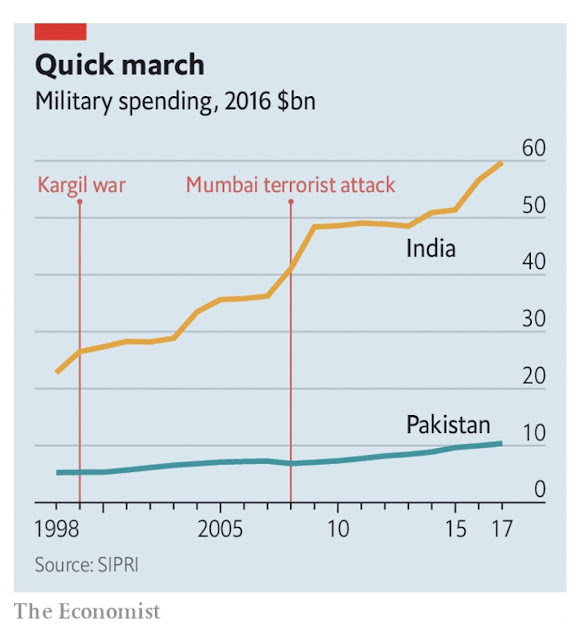 |
| India-Pakistan Military Spending: Infographic Courtesy The Economist |
India: A Paper Elephant?
In an article titled "Paper Elephant", the Economist magazine talked about how India has ramped up its military spending and emerged as the world's largest arms importer. "Its military doctrine envisages fighting simultaneous land wars against Pakistan and China while retaining dominance in the Indian Ocean", the article said. It summed up the situation as follows: "India spends a fortune on defense and gets poor value for money".
 |
| Pakistan Defense Spending. Source: Jane's Defense |
After the India-Pakistan aerial combat over Kashmir, New York Times published a story from its South Asia correspondent headlined: "After India Loses Dogfight to Pakistan, Questions Arise About Its Military". Here are some excerpts of the report:
"Its (India's) loss of a plane last week to a country (Pakistan) whose military is about half the size and receives a quarter (a sixth according to SIPRI) of the funding is telling. ...India’s armed forces are in alarming shape....It was an inauspicious moment for a military the United States is banking on to help keep an expanding China in check".
 |
| India-Pakistan Ratios of Tanks and Soldiers |
Ineffective Indian Military:
Academics who have studied Indian military have found that it is ineffective by design. In "Army and Nation: The Military and Indian Democracy Since Independence", the author Steven I. Wilkinson, Nilekani Professor of India and South Asian Studies and Professor of Political Science and International Affairs at Yale, has argued that the civil-military constraints that have helped prevent a coup have hurt Indian military effectiveness and preparedness in at least three important ways:
(1) the weakening of the army before the 1962 China war;
(2) the problems caused for defense coordination and preparation by unwieldy defense bureaucracy, duplication of functions among different branches and lack of sharing of information across branches and
(3) the general downgrading of pay and perks since independence which has left the army with huge shortage of officers that affected the force's discipline capabilities.
Summary:
India's international perception as a "great power rising" has suffered a serious setback as a result of its recent military failures against Pakistan which spends only a sixth of India's military budget and ranks 17th in the world, far below India ranking 4th by globalfirepower.com. "Desh ka bahut nuksaan hua hai", acknowledged Indian Prime Minister Narendra Modi after his military's recent failures in Balakot and Kashmir. This marked a major shift in Modi's belligerent tone that has been characterized by his boasts of "chhappan inch ki chhati" (56 inch chest) and talk of "munh tor jawab" (jaw-breaking response) and "boli nahin goli" (bullets, not talks) to intimidate Pakistan in the last few years. The recent events are forcing India's western backers to reassess their strategy of boosting India as a counterweight to China.
Here's a discussion on the subject:
https://youtu.be/tEWf-6cT0PM
Here's Indian Prime Minister Modi making excuses for his military's failures:
https://youtu.be/QIt0EAAr3PU
Haq's Musings
South Asia Investor Review
China-Pakistan Defense Production Collaboration Irks West
Balakot and Kashmir: Fact Checkers Expose Indian Lies
Is Pakistan Ready for War with India?
Pakistan-Made Airplanes Lead Nation's Defense Exports
Modi's Blunders and Delusions
India's Israel Envy: What If Modi Attacks Pakistan?
Project Azm: Pakistan to Develop 5th Generation Fighter Jet
Pakistan Navy Modernization
Pakistan's Sea-Based Second Strike Capability
Who Won the 1965 War? India or Pakistan?
Riaz Haq
Swedish Saab 2000 Erieye’s role in PAF Success
Search Labs | AI Overview
Learn more
Has Sweden given Pakistan more airborne early warning radar ...
The Erieye AEW&C system played a crucial role in the Pakistan Air Force's (PAF) success, particularly during the February 2019 aerial conflict with India. It enabled the PAF to effectively monitor airspace, direct and control fighter jets, and gather intelligence, contributing to its overall air defense capabilities.
Here's a more detailed look at the Erieye's impact:
Airspace Monitoring and Surveillance:
The Erieye's radar system, with a detection range of up to 450 km, allowed the PAF to monitor airspace and detect both air and sea threats. This was particularly important in countering India's terrain masking tactics, which made it difficult for other surveillance systems to detect low-flying aircraft.
Command and Control:
During the 2019 air conflict, the Erieye was used to direct and control 25 fighter jets towards Indian targets, showcasing its command and control capabilities. The Erieye also facilitated communication between the AEW&C and other air and ground assets, enabling coordinated operations.
Intelligence Gathering:
The Erieye's ability to gather intelligence, including electronic intelligence (ELINT), was also crucial for the PAF's overall success.
Decisive Impact:
In conclusion, the Erieye's role in the 2019 aerial conflict and its overall contribution to the PAF's air defense capabilities demonstrate its significant impact on Pakistan's military readiness.
------------------
https://youtu.be/508J-ougyIg?si=zLVQfOCTsJkpRQxe
In this in-depth analysis, we uncover how Sweden’s Saab 2000 Erieye Airborne Early Warning and Control (AEW&C) system became a game-changer for the Pakistan Air Force (PAF), reshaping the balance of power in one of the world’s most volatile military rivalries—India vs. Pakistan.
----------
Pakistan Quietly Inducts a New Erieye AEW&C System - Quwa
https://quwa.org/daily-news/pakistan-quietly-inducts-a-new-erieye-a...
With unit ‘23058’ the PAF’s Erieye fleet has grown to seven to nine aircraft. Quwa was able to visually verify seven aircraft, but public records list serials for eight active units.
To date, the PAF has acquired the Erieye across three orders. The PAF signed its first order in 2006 for six AEW&Cs (plus one standard Saab 2000) for $1.15 billion US. However, this order was reduced to four aircraft due to the 2005 earthquake in Kashmir. The cost dropped to $186 million, indicating that each Erieye (not inclusive of training and logistics costs) was priced at $93 million US in 2007.
May 27, 2025
Riaz Haq
India’s Great-Power Delusions
How New Delhi’s Grand Strategy Thwarts Its Grand Ambitions
Ashley J. Tellis
https://www.foreignaffairs.com/india/indias-great-power-delusions
Since the turn of the century, the United States has sought to help India rise as a great power.
--------
In military terms, it is the most significant conventional power in South Asia, but here, too, its advantages over its local rival are not enormous: in fighting in May, Pakistan used Chinese-supplied defense systems to shoot down Indian aircraft. With China on one side and an adversarial Pakistan on the other, India must always fear the prospect of an unpalatable two-front war. Meanwhile, at home, the country is shedding one of its main sources of strength—its liberal democracy—by embracing Hindu nationalism. This evolution could undermine India’s rise by intensifying communal tensions and exacerbating problems with its neighbors, forcing it to redirect security resources inward to the detriment of outward power projection. The country’s illiberal pivot further undermines the rules-based international order that has served it so well.
-------
An illiberal India is also likely to be less powerful. The BJP’s policies have polarized India along ideological and religious lines, and the unresolved issues about how India’s changing demography is to be represented in parliament threaten to exacerbate regional and linguistic divisions. This makes India look increasingly like the highly divided United States. Polarization has been bad enough for Americans, hobbling their institutions and fueling democratic decay. But it will be even worse for India, where the state and society are much weaker. Polarization, for example, could intensify the armed rebellions against New Delhi that have long been underway, creating opportunities for outside powers to sow chaos within India’s borders. Those conflicts could also spill over into India’s neighborhood, as the ideological animus against Muslims exacerbates tensions with both Bangladesh and Pakistan. Polarization would also increase India’s internal security burdens, consuming resources that New Delhi needs to project influence abroad. And even if polarization does not create more internal troubles, it will undermine New Delhi’s efforts to mobilize its population in accumulating national power.
----------
The United States has tolerated these Indian behaviors in the past in part because both countries were largely liberal democracies. As both proceed down the path of illiberalism, however, they will no longer be tied by shared values. Transactional habits may come to dominate the relationship, and Washington could demand more of New Delhi as the price of partnership. Trump’s approach to India in his second term has already signaled such an evolution. Indeed, India’s inability to match China in the future, as well as its commitment to multipolarity, which is fundamentally at odds with American interests, will be deeply inconvenient for the United States. India, it seems, will partner with the United States on some things involving China, but it is unlikely to partner with Washington in every significant arena—even when it comes to Beijing.
If New Delhi cannot effectively balance Beijing in Asia, Washington will invariably wonder how many resources and how much faith it should invest in India. A liberal United States might continue to support a liberal India because helping it would be inherently worthwhile (provided that the costs were not prohibitive and New Delhi’s success still served some American interests). But if either India or the United States remains illiberal, there will be no ideological reason for the latter to help the former.
Jun 17, 2025
Riaz Haq
Indian Tejas fighter jet crashes in a ball of fire at Dubai Airshow, killing pilot | Reuters
https://www.reuters.com/world/india/indias-home-built-fighter-jet-t...
NEW DELHI/DUBAI, Nov 21 (Reuters) - An Indian Tejas fighter jet crashed in a ball of fire in front of horrified spectators during an aerial display at the Dubai Airshow on Friday, and the Indian Air Force said it was setting up a court of inquiry to investigate the cause.
Video from the site showed black smoke rising behind a fenced airstrip. Dubai's government shared a photograph of firefighting teams dousing smouldering wreckage.
Jignesh Variya, 46, who was attending the show with his family, told Reuters the fighter jet had been flying for no more than eight or nine minutes and completed two to three laps when it went into a nose-dive, before flattening out but continuing to lose altitude and crashing at around 2:15 p.m. (1015 GMT).
"I could see three different fireballs when it collided with the ground," he said. "Everybody in the crowd stood up there on their feet, and then maybe in around 30 seconds, the emergency vehicles rushed over to the location at the crash site."
CRASH HAPPENED ON FINAL DAY OF AIRSHOW
It was the second known crash of the single-engine 4.5-generation fighter jet, which is built by state-owned Hindustan Aeronautics Ltd (HIAE.NS), opens new tab and powered by General Electric GE.N engines. The first crash was during an exercise in India in 2024.
The homegrown jet, whose name means "brilliance" in Sanskrit, is seen as crucial for India's efforts to modernise its air force fleet of mainly Russian and ex-Soviet fighters.
The crash happened during the last day of the airshow, the Middle East's largest aviation event, which started on Monday. Flying had resumed later on Friday, witnesses said, with jets back in the sky above the show site.
"A court of inquiry is being constituted to ascertain the cause of the accident," the Indian Air Force said in a statement. It confirmed the sole pilot had been killed.
The UAE aviation authority was not immediately available to comment on whether it would lead a local investigation. The Indian embassy said it was in touch with UAE authorities. Experts stressed it was too early to say what caused the crash.
GE said in a statement it was ready to support the investigation.
Dubai's government said emergency teams were managing the situation on-site.
First manufactured in 2001 but dating back to studies first carried out two decades earlier, the Tejas was designed as a light combat jet to replace India's fleet of Russian MiG-21s.
Nov 21, 2025