PakAlumni Worldwide: The Global Social Network
Is Pakistan's Social Sector Making Progress?
If you read Pakistan media headlines and donation-seeking NGOs and activists' reports these days, you'd conclude that the social sector situation is entirely hopeless. However, if you look at children's education and health trend lines based on data from credible international sources, you would feel a sense of optimism. This exercise gives new meaning to what former US President Bill Clinton has said: Follow the trend lines, not the headlines. Unlike the alarming headlines, the trend lines in Pakistan show rising school enrollment rates and declining infant mortality rates.
Key Social Indicators:
The quickest way to assess Pakistan's social sector progress is to look at two key indicators: School enrollment rates and infant mortality. These basic social indicators capture the state of schooling, nutrition and health care. Pakistan is continuing to make slow but steady progress on both of these indicators. Anything that can be done to accelerate the pace will help Pakistan move up to higher levels as proposed by Dr. Hans Rosling and adopted by the United Nations.
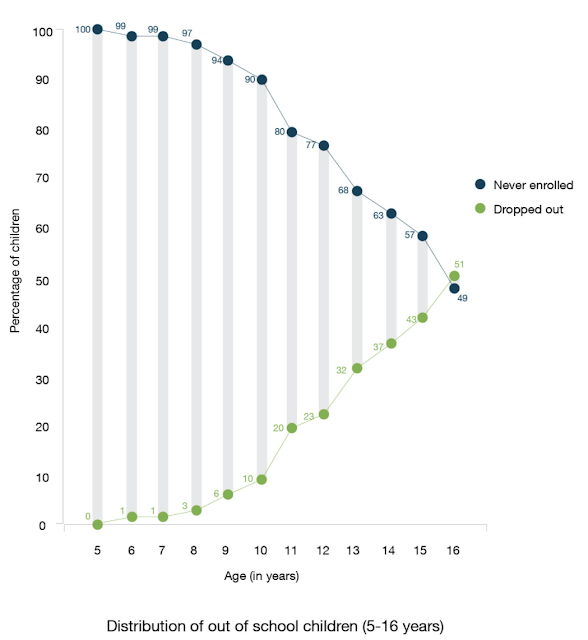 |
| Pakistan Children 5-16 In-Out of School. Source: Pak Alliance For Math & Science |
Rising Primary Enrollment:
Gross enrollment in Pakistani primary schools exceeded 97% in 2016, up from 92% ten years ago. Gross enrollment rate (GER) is different from net enrollment rate (NER). The former refers to primary enrollment of all students of all ages while the latter counts enrolled students as percentage of students in the official primary age bracket. The primary NER in Pakistan is significantly lower but the higher GER indicates many of these kids eventually enroll in primary schools albeit at older ages.
 |
| Source: World Bank Education Statistics |
Declining Infant Mortality Rate:
The infant mortality rate (IMR), defined as the number of deaths in children under 1 year of age per 1000 live births in the same year, is universally regarded as a highly sensitive (proxy) measure of population health. A declining rate is an indication of improving health. IMR in Pakistan has declined from 86 in 1990-91 to 74 in 2012-13 and 62 in the latest survey in 2017-18.
During the 5 years immediately preceding the survey, the infant mortality rate (IMR) was 62 deaths per 1,000 live births. The child mortality rate was 13 deaths per 1,000 children surviving to age 12 months, while the overall under-5 mortality rate was 74 deaths per 1,000 live births. Eighty-four percent of all deaths among children under age 5 in Pakistan take place before a child’s first birthday, with 57% occurring during the first month of life (42 deaths per 1,000 live births).
Human Development Ranking:
It appears that improvements in education and health care indicators in Pakistan are slower than other countries in South Asia region. Pakistan's human development ranking plunged to 150 in 2018, down from 149 in 2017.
There was a noticeable acceleration of human development in #Pakistan during Musharraf years. Pakistan HDI rose faster in 2000-2008 than in periods before and after. Pakistanis' income, education and life expectancy also rose faster than Bangladeshis' and Indians' in 2000-2008.
Now Pakistan is worse than Bangladesh at 136, India at 130 and Nepal at 149. The decade of democracy under Pakistan People's Party and Pakistan Muslim League (Nawaz) has produced the slowest annual human development growth rate in the last 30 years. The fastest growth in Pakistan human development was seen in 2000-2010, a decade dominated by President Musharraf's rule, according to the latest Human Development Report 2018.
UNDP’s Human Development Index (HDI) represents human progress in one indicator that combines information on people’s health, education and income.
Pakistan saw average annual HDI (Human Development Index) growth rate of 1.08% in 1990-2000, 1.57% in 2000-2010 and 0.95% in 2010-2017, according to Human Development Indices and Indicators 2018 Statistical Update. The fastest growth in Pakistan human development was seen in 2000-2010, a decade dominated by President Musharraf's rule, according to the latest Human Development Report 2018.
Pakistan@100: Shaping the Future:
Pakistani leaders should heed the recommendations of a recent report by the World Bank titled "Pakistan@100: Shaping the Future" regarding investments in the people. Here's a key excerpt of the World Bank report:
"Pakistan’s greatest asset is its people – a young population of 208 million. This large population can transform into a demographic dividend that drives economic growth. To achieve that, Pakistan must act fast and strategically to: i) manage population growth and improve maternal health, ii) improve early childhood development, focusing on nutrition and health, and iii) boost spending on education and skills for all, according to the report".
 |
| Pakistan Child Mortality Rates. Source: PDHS 2017-18 |
During the 5 years immediately preceding the survey, the infant mortality rate (IMR) was 62 deaths per 1,000 live births. The child mortality rate was 13 deaths per 1,000 children surviving to age 12 months, while the overall under-5 mortality rate was 74 deaths per 1,000 live births. Eighty-four percent of all deaths among children under age 5 in Pakistan take place before a child’s first birthday, with 57% occurring during the first month of life (42 deaths per 1,000 live births).
 |
| Pakistan Human Development Trajectory 1990-2018.Source: Pakistan HDR 2019 |
Human Development Ranking:
It appears that improvements in education and health care indicators in Pakistan are slower than other countries in South Asia region. Pakistan's human development ranking plunged to 150 in 2018, down from 149 in 2017.
 |
| Expected Years of Schooling in Pakistan by Province |
There was a noticeable acceleration of human development in #Pakistan during Musharraf years. Pakistan HDI rose faster in 2000-2008 than in periods before and after. Pakistanis' income, education and life expectancy also rose faster than Bangladeshis' and Indians' in 2000-2008.
Now Pakistan is worse than Bangladesh at 136, India at 130 and Nepal at 149. The decade of democracy under Pakistan People's Party and Pakistan Muslim League (Nawaz) has produced the slowest annual human development growth rate in the last 30 years. The fastest growth in Pakistan human development was seen in 2000-2010, a decade dominated by President Musharraf's rule, according to the latest Human Development Report 2018.
UNDP’s Human Development Index (HDI) represents human progress in one indicator that combines information on people’s health, education and income.
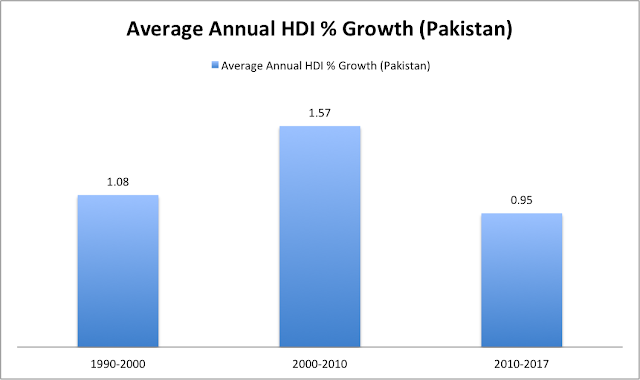 |
| Pakistan's Human Development Growth Rate By Decades. Source: HDR 2018 |
Pakistan saw average annual HDI (Human Development Index) growth rate of 1.08% in 1990-2000, 1.57% in 2000-2010 and 0.95% in 2010-2017, according to Human Development Indices and Indicators 2018 Statistical Update. The fastest growth in Pakistan human development was seen in 2000-2010, a decade dominated by President Musharraf's rule, according to the latest Human Development Report 2018.
 |
| Pakistan Human Development Growth 1990-2018. Source: Pakistan HDR 2019 |
Pakistan@100: Shaping the Future:
Pakistani leaders should heed the recommendations of a recent report by the World Bank titled "Pakistan@100: Shaping the Future" regarding investments in the people. Here's a key excerpt of the World Bank report:
"Pakistan’s greatest asset is its people – a young population of 208 million. This large population can transform into a demographic dividend that drives economic growth. To achieve that, Pakistan must act fast and strategically to: i) manage population growth and improve maternal health, ii) improve early childhood development, focusing on nutrition and health, and iii) boost spending on education and skills for all, according to the report".
 |
| Pakistani Children 5-16 Currently Enrolled. Source: Pak Alliance For Math & Science |
Summary:
The state of Pakistan's social sector is not as dire as the headlines suggest. There's reason for optimism. Key indicators show that education and health care in Pakistan are improving but such improvements are slower than in other countries in South Asia region. Pakistan's human development ranking plunged to 150 in 2018, down from 149 in 2017. It is worse than Bangladesh at 136, India at 130 and Nepal at 149. The decade of democracy under Pakistan People's Party and Pakistan Muslim League (Nawaz) has produced the slowest annual human development growth rate in the last 30 years. The fastest growth in Pakistan human development was seen in 2000-2010, a decade dominated by President Musharraf's rule, according to the latest Human Development Report 2018. One of the biggest challenges facing the PTI government led by Prime Minister Imran Khan is to significantly accelerate human development rates in Pakistan.
Related Links:
Haq's Musings
South Asia Investor Review
Pakistan's Expected Demographic Dividend
Can Imran Khan Lead Pakistan to the Next Level?
Democracy vs Dictatorship in Pakistan
Pakistan Child Health Indicators
Pakistan's Balance of Payments Crisis
Panama Leaks in Pakistan
Conspiracy Theories About Pakistan Elections"
PTI Triumphs Over Corrupt Dynastic Political Parties
Strikingly Similar Narratives of Donald Trump and Nawaz Sharif
Nawaz Sharif's Report Card
Riaz Haq's Youtube Channel
South Asia Investor Review
Pakistan's Expected Demographic Dividend
Can Imran Khan Lead Pakistan to the Next Level?
Democracy vs Dictatorship in Pakistan
Pakistan Child Health Indicators
Pakistan's Balance of Payments Crisis
Panama Leaks in Pakistan
Conspiracy Theories About Pakistan Elections"
PTI Triumphs Over Corrupt Dynastic Political Parties
Strikingly Similar Narratives of Donald Trump and Nawaz Sharif
Nawaz Sharif's Report Card
Riaz Haq's Youtube Channel
Riaz Haq
Education in Pakistan: Not good, but maybe good enough - Profit by Pakistan Today
https://profit.pakistantoday.com.pk/2024/08/05/education-in-pakista...
Not waiting for government favours
While part of this progress is certainly driven by improvements to the government’s own infrastructure, measured purely by proportion of the increase in student enrollment, the private sector has contributed just under 75% of the total growth in enrollment between 2009 and 2022, according to enrollment estimates published in the Pakistan Education Statistics reports published by the Pakistan Institute of Education. The public sector accounts for the remaining 25%.
In other words, Pakistanis are not waiting around for the government to fix the schools (even though the government is making some progress on that front). They are simply going ahead and paying for private schools themselves as soon as they have the ability to pay.
This phenomenon helps explain why the fastest progress in terms of increasing literacy happened in the decade after Pakistan’s dependency ratios – the ratio of prime working age adults to the number of children under the age of 15 and retirees over the age of 65 – peaked.
The dependency ratio peaked in 1995, and that year also represented the an inflection point in literacy improvements: for every year after that, the 10-year progress towards improving literacy kept on rising at a rising pace (the second differential was positive) for the next decade.
What does that mean? It means that once families started to find that they had a bit more spare cash to spend (with dependency ratios declining after 1995), they started investing that spare cash into private school fees for their children, especially in urban areas, and especially in the urban areas they did so at nearly identical rates for their sons and daughters.
Having spent the lead up to 1995 being increasingly cash strapped, the first thing that Pakistani families did when the pressure on their cash flows eased a bit was to invest in the future economic productivity of their households by educating their children. And in perhaps a scathing indictment of how bad the public schools were, they did so through private schools even when public schools were available in their areas.
Feb 28, 2025
Riaz Haq
Gallup Pakistan - Pakistan's Foremost Research Lab
https://gallup.com.pk/post/37337
Overall literacy rate improved by 1.8%, from 58.9% in 2017 to 60.7% in 2023; highest literacy rate recorded was among the 13-14 year olds living in urban areas (88.8%) – Literacy Rate – 7th Pakistan Population and Housing Census
Islamabad, September 5th, 2024
Gallup Pakistan, as part of its Big Data Analysis initiative, is looking at Literacy Rates for Pakistan. This data is part of a study conducted using the ‘7th Pakistan Population and Housing Census’.
The current edition looks at data from 7th Pakistan Population and Housing Census, which can be found HERE.
Today’s topic is “Literacy Rate in Pakistan” from tables 12 and 13a of the 7th Pakistan Population and Housing Census
Key Findings:
1.Literacy Rate for Pakistan: Overall literacy rate improved by 1.8%, from 58.9% in 2017 to 60.7% in 2023.
2.Literacy Rate by Province: From 2017 to 2023, the total literacy rate in Punjab, Sindh and ICT increased by 2.3%, 2.9% and 2.5% respectively, while it fell for KP by 2.9% and for Balochistan by 1.6%.
3.Literacy Rate by Region: Between 2017 to 2023, urban areas showed a modest increase of 0.9%, while rural areas saw a more substantial rise of 1.5% in their literacy rates.
4.Literary Rate by Age Group: Within age groups, the highest literacy rate recorded was among the 13-14 year olds living in urban areas (88.8%).
5.Gender and Regional Literacy Gaps narrow to 0.7% and 9.5% among Pakistan’s youngest age group (5-9 year olds).
Mar 14, 2025
Riaz Haq
AI Overview
15 million Pakistani families to get health card, contract ...
Pakistan's national health card, the Sehat Sahulat Program, aims for universal coverage, but its rollout in Sindh has been gradual, focusing on specific areas like Tharparkar initially, with current discussions and plans to expand it across the province, while Prime Minister Shehbaz Sharif recently relaunched it for Islamabad, AJK, and GB, emphasizing future integration in Sindh under provincial commitment. Beneficiaries get free, cashless treatment at empaneled hospitals for various ailments, but coverage details, like outpatient care or medication, can vary, requiring checking official sources for current status in Sindh.
Key Points for Sindh:
Partial Coverage: The program has covered areas like Tharparkar in Sindh, but full provincial implementation is pending.
Expansion Plans: Discussions are ongoing with the Sindh Chief Minister to extend the national program across the entire province.
Federal Relaunch: The recent relaunch by the PM focused on Islamabad, AJK, and GB, with future plans for Sindh mentioned.
How it Works (General):
Check Eligibility: Use your CNIC (Computerized National Identity Card) on the official website or via SMS (e.g., send CNIC to 8500).
Find a Hospital: Locate an empaneled hospital through the program website or helpline.
Get Treatment: Present your CNIC at the hospital's Sehat Card counter for cashless treatment.
What's Covered (Generally):
Hospitalization, surgeries, maternity, cardiac issues.
Some facilities (like specific tests, meds, or transport stipends) may be included in certain packages (e.g., Sehat Card Plus).
For Official Updates on Sindh:
Check the official PM Health Program website for the latest information on Sindh's inclusion and specific schemes.
8 hours ago