PakAlumni Worldwide: The Global Social Network
Silicon Valley's Indian-American Congressman Joins Pakistan Caucus, Rejects Hindutva
Democrat Ro Khanna representing Silicon Valley has joined US Congress's Pakistan Caucus and rejected Hindutva. His actions have angered Hindu American supporters of Indian Prime Minister Narendra Modi. Cracks are beginning to appear in the Hindu American community. Democrats from the Progressive Wing of the Party are finding it increasingly difficult to support Prime Minister Modi as he ferociously pushes his hateful Hindutva agenda to target minorities. However, vast majority of Hindu Americans, including those in Silicon Valley tech community, are solidly supporting Mr. Modi in spite of his extended lock-down and brutal actions in Kashmir.
|
Congressman Ro Khanna with Pakistan Prime Minister Imran Khan on Capitol Hill |

Khanna Rejects Hindutva:
Congressman Ro Khanna (D-Fremont) tweeted the following on Aug. 29: “It’s the duty of every American politician of Hindu faith to stand for pluralism, reject Hindutva, and speak for equal rights for Hindus, Muslims, Sikhs, Buddhist & Christians.” On August 17, Khanna became the first Indian-American to join US Congress's Pakistan caucus headed by Democratic Congresswoman Shiela Jackson of Texas and Republican Congressman Jim Banks of Indiana. Khanna's decision to join Pakistan caucus came after he met Pakistani Prime Minister Imran Khan during his July visit to Washington. After his July meeting with Khan Khanna tweeted: "Honored to meet PM Imran Khan. We spoke Hindustani, and I shared that my grandfather, an Indian freedom fighter with Gandhi, always had a hope for reconciliation. South Asian Americans of my generation hope for peace in the subcontinent in the 21st century."
Khanna Under Fire:
Khanna, a rising star in the progressive movement, who is vice-chair of the Progressive Caucus in the House, has come under fire by many right-wing Indian-American supporters of the RSS and BJP.
Majority of Hindu-Americans are ardent supporters of President Donald Trump and Prime Minister Narendra Modi.
|
Indian Ambassador Shringle (R) with White Nationalist Steve Bannon |

Most Hindu-Americans fail to see the irony that Srinivas Kuchibhotla who was killed by a white nationalist in Kansas in February 2017 was a victim of the same kind of hatred in America that Mr. Modi espouses against minorities in India. Kuchibotla himself was an ardent fan of Mr. Modi’s sweeping Hindutva politics as his wife related after this murder, according to and article published in the Hindu by Indian journalist and writer Varghese K. George. Here is an excerpt of Mr. George's article:
"The dualism of Indian-American politics has now become unsustainable as Democratic leaders find it increasingly impossible to side with Mr. Modi as he advances the Hindutva agenda. Many of these friends of India were mislead, and had misread Mr. Modi’s politics and they interpreted his success in 2014 as a turn in Indian politics towards more neo-liberal reforms and globalism. Such an image of Mr. Modi was also projected by Indian diplomacy in America. But one American thinker, who interpreted Mr. Modi’s victory as a nativist revolt against a global elite, was none other than Stephen Bannon, the most authentic interpreter of Mr. Trump’s nationalist politics. Mr. Bannon has also been particularly a critic of the H-1B visa and Indian-American immigration. That the Indian Ambassador to the U.S. retweeted a tweet that denounced Mr. Sanders and tweeted about his meeting with Mr. Bannon in glowing terms (he deleted the tweet later) in quick succession bears out the official Indian position on the emerging fault-lines in American politics and the role of Indian Americans in it."
Hindu Nationalism in America:
India's top Hindu Nationalist group Rashtriya Swayamsevak Sangh (RSS) has gone global with shakhas (branches) in 39 countries, including the United States, the United Kingdom and several Islamic middle eastern nations, according to Indian media reports.
In the United States alone, the RSS has 146 active chapters spread over all 50 states, according to Satish Modh who has been associated with RSS work abroad for over 25 years.
While shakhas in India take place in open public spaces, most shakhas meet on university campuses on hired parking lots in the US, says Modh. Most overseas shakhas are held once a week. In London, they are held twice a week. The UK has 84 shakhas.
A US report entitled "Hindu Nationalism in the United States: A Report on Non-Profit Groups" disclosed the following findings regarding the strength and nature of the Hindu nationalist movement in the United States:
a. Over the last three decades, a movement toward Hinduizing India--advancing the status of Hindus toward political and social primacy in India-- has continued to gain ground in South Asia and diasporic communities. The Sangh Parivar (the Sangh "family"), the network of groups at the forefront of this Hindu nationalist movement, has an estimated membership numbering in the millions, making the Sangh one of the largest voluntary associations in India. The major organizations in the Sangh include the Rashtriya Swayamsevak Sangh (RSS), Vishwa Hindu Parishad (VHP), Bajrang Dal, and Bharatiya Janata Party (BJP).
b. Hindu nationalism has intensified and multiplied forms of discrimination, exclusion, and gendered and sexualized violence against Muslims, Christians, other minorities, and those who oppose Sangh violations, as documented by Indian citizens and international tribunals, fact-finding groups, international human rights organizations, and U.S. governmental bodies.
c. India-based Sangh affiliates receive social and financial support from its U.S.-based wings, the latter of which exist largely as tax-exempt non-profit organizations in the United States: Hindu Swayamsevak Sangh (HSS), Vishwa Hindu Parishad of America (VHPA), Sewa International USA, Ekal Vidyalaya Foundation-USA. The Overseas Friends of the Bharatiya Janata Party - USA (OFBJP) is active as well, though it is not a tax-exempt group.
|
Congresswoman Tulsi Gabbard strongly supports Prime Minister Modi |

American Presidential Politics:
Congresswoman Tulsi Gabbard is a strong supporter of Indian Hindu Nationalist Prime Minister Modi. Her bid for Democratic presidential nomination is being bankrolled by Hindu Nationalist donors. Amongst Gabbard’s many donors are members of the US chapters of groups such as the Hindu Swayamsevak Sangh, the Overseas Friends of the BJP and the Vishwa Hindu Parishad of America, according to Pieter Friedrich. The Hindu Sangh Parivar in the United States has helped her come from nowhere to get elected to US Congress and set her sights on the White House.
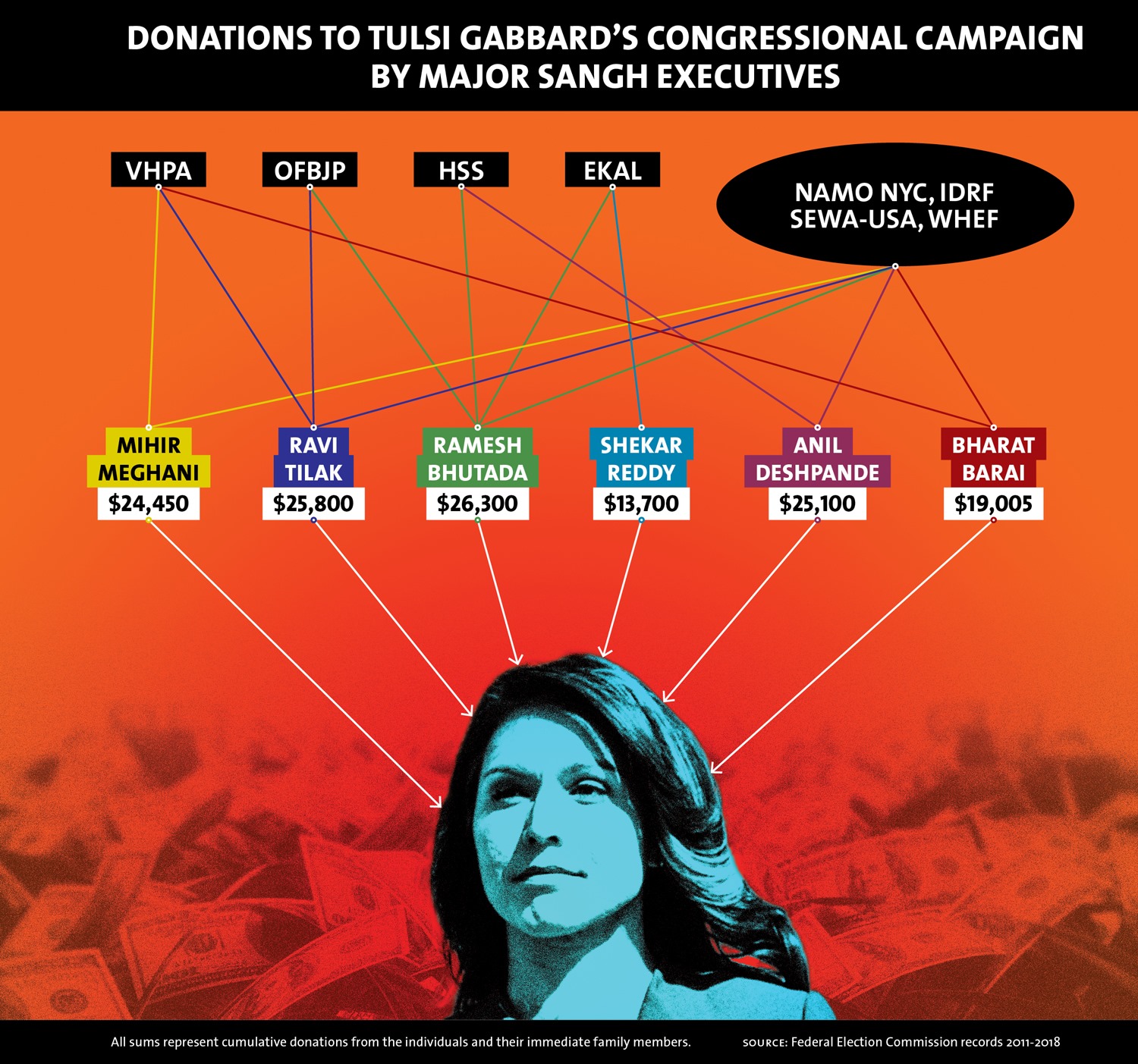 |
| US Presidential Candidate Congresswoman Tulsi Gabbard's Hindutva Donors |
Summary:
Cracks are beginning to appear in the Hindu American community. Democrats from the Progressive Wing of the Party are finding it increasingly difficult to support Prime Minister Modi as he ferociously pushes his hateful Hindutva agenda against minorities. Democrat Ro Khanna representing Silicon Valley has joined US Congress's Pakistan Caucus and rejected Hindutva. His actions have angered Hindu American supporters of Indian Prime Minister Narendra Modi. However, vast majority of Hindu Americans, including those in Silicon Valley tech community, are solidly supporting Mr. Modi in spite of his extended lock-down and brutal actions in Kashmir.
Related Links:
Modi's Extended Lockdown in Indian Occupied Kashmir
Riaz Haq
Why Does Ro Khanna Want Modi to Address Congress? – The Nation
https://www.thenation.com/article/politics/ro-khanna-modi-congress/
Over the last 12 years, Khanna’s congressional campaign has received at least $110,036 from individuals associated with US-based Hindu nationalist groups. Bharat Barai and his wife donated $36,000. (Bharai has also donated $1,250 to Jayapal.) Barai’s most recent donation to Khanna was in October 2022. Barai, a Chicago-based oncologist, is often described as a “confidante” of Modi. He sits on the advisory board of the Chicago chapter of the Vishwa Hindu Parishad of America, a Hindu far-right group and US offshoot of VHP India, a Hindu far-right group that has been at the forefront of violence against religious minorities in India. After Modi’s ban, Barai hosted video conferences to boost Modi’s popularity in the diaspora.
When I asked Khanna about his history of accepting donations from Barai, he said that he has never had a conversation with Barai about his views on Indian politics. Khanna added that he has thousands of donors in the South Asian community and that he doesn’t “ask each of those people what their views are on Indian politics.”
When I asked if Khanna will continue accepting money from Bharat Barai and other Hindu nationalist leaders in the US, Khanna’s spokesperson said, “Representative Khanna has thousands of Indian American supporters and has been vocal about his stance against nationalism and for pluralism.”
Khanna has also received donations from key members of the Hindu American Foundation (HAF), a Hindu right-wing advocacy organization. Arjun Bhagat, a member of HAF’s board of directors, has donated $27,100, with his most recent donation of $5,000 in March 2023. Recently, HAF has been spearheading a campaign to oppose the California SB 403 Bill, which would make caste a protected category against discrimination.
Khanna has not established a strong position on SB 403. When asked about SB 403 by Equality Labs founder Thenmozhi Soundararajan, Khanna stated that he “strongly opposes any form of caste discrimination” but also stated that the bill needs to be “fairly enforced” so it ”doesn’t selectively profile any community.” Some Hindu groups, including HAF, say SB 403 would expose Hindu Americans to racial profiling and harassment.
Khanna told me that he never takes a position on state bills, and reiterated that he “strongly opposes caste discrimination” and believes that the details of the bill “should be fair to all groups.” I then asked Khanna if he believes that SB 403 would unfairly persecute Hindu Americans—the dominant narrative on the American Hindu right. Khanna said, “Again, I don’t comment on the details of the bill, but I oppose caste discrimination.”
Khanna’s indecision regarding SB 403, says Karthikeyan Shanmughan of Ambedkar King Study Circle, is not unexpected. He says that upper-caste Indians dominate discussions about the South Asian diaspora and that this suppresses conversations about caste oppression. But Shanmughan said the growing anti-caste movement in America, which is led by those of caste-oppressed groups, is forcing Indian American politicians to take a stance. Political leaders, he said, “can’t continue their ‘manipulative’ position of fighting for racial equality and being neutral on caste discrimination.”
Deepa Iyer, a racial justice activist, tweeted at Khanna for supporting Modi’s address to Congress, criticizing the congressman for “providing a platform in this way.” Khanna responded by saying that he “will always stand for pluralism, liberal democracy and human rights while also calling for the strengthening of the US-India relationship.”
Jun 21, 2023
Riaz Haq
Why Does Ro Khanna Want Modi to Address Congress? – The Nation
https://www.thenation.com/article/politics/ro-khanna-modi-congress/
Deepa Iyer, a racial justice activist, tweeted at Khanna for supporting Modi’s address to Congress, criticizing the congressman for “providing a platform in this way.” Khanna responded by saying that he “will always stand for pluralism, liberal democracy and human rights while also calling for the strengthening of the US-India relationship.”
Some of Khanna’s constituents are grappling with the actions of their congressman. According to Anu Mandavilli, who lives in Khanna’s district and is a member of the Alliance of South Asians Taking Action, Khanna’s Bay Area district has one of the highest concentrations of South Asian Americans and Indian Americans in the country. While Khanna may need to listen to his Hindutva-leaning constituents as their elected representative, Mandavilli said, he still needs to fight their hateful views. She urged Khanna to endorse Jayapal’s letter asking Biden to raise human rights concerns in his conversations with Modi and demand accountability from the prime minister.
“Khanna must assure his constituents from caste-oppressed groups as well as his Muslim, Christian, Sikh, and other constituents from minority religious communities that he understands the threat that Hindu nationalism poses in the Bay Area as well as more broadly in California and in the US,” Mandavilli said. “He must initiate dialogues with those communities as well as with Hindus opposed to Hindutva and other progressive constituents to hear their concerns and learn from their experiences.”
Jun 21, 2023
Riaz Haq
After Rejecting Hindutva, Ro Khanna Cosponsors a Resolution Shielding It
The grandson of a man jailed beside Gandhi for India’s freedom is now lending his name to the movement that sat that fight out — an open letter, drawn from years of his own messages to me.
PIETER FRIEDRICH
https://pieterfriedrich.substack.com/p/after-rejecting-hindutva-ro-...
On June 1, 2026, Ro Khanna put his name on House Resolution 69, which condemns “Hinduphobia” without ever defining it — a word that shields India’s Hindu nationalist movement by recasting criticism of it as bigotry. In 2019, the same congressman publicly rejected that movement, Hindutva. For years his private messages with me showed how clearly he understood the danger. Now he’s advancing its agenda. On June 17, 2026, I delivered an open letter to him — drawn entirely from his own record — questioning his current stance, asking: "Ro, what are you so afraid of?" Read the letter here:
https://youtu.be/dAvHNCjmvLM?is=KsZ88m3GoGF6TJyk
on Thursday