PakAlumni Worldwide: The Global Social Network
Silicon Valley's Indian-American Congressman Joins Pakistan Caucus, Rejects Hindutva
Democrat Ro Khanna representing Silicon Valley has joined US Congress's Pakistan Caucus and rejected Hindutva. His actions have angered Hindu American supporters of Indian Prime Minister Narendra Modi. Cracks are beginning to appear in the Hindu American community. Democrats from the Progressive Wing of the Party are finding it increasingly difficult to support Prime Minister Modi as he ferociously pushes his hateful Hindutva agenda to target minorities. However, vast majority of Hindu Americans, including those in Silicon Valley tech community, are solidly supporting Mr. Modi in spite of his extended lock-down and brutal actions in Kashmir.
|
Congressman Ro Khanna with Pakistan Prime Minister Imran Khan on Capitol Hill |

Khanna Rejects Hindutva:
Congressman Ro Khanna (D-Fremont) tweeted the following on Aug. 29: “It’s the duty of every American politician of Hindu faith to stand for pluralism, reject Hindutva, and speak for equal rights for Hindus, Muslims, Sikhs, Buddhist & Christians.” On August 17, Khanna became the first Indian-American to join US Congress's Pakistan caucus headed by Democratic Congresswoman Shiela Jackson of Texas and Republican Congressman Jim Banks of Indiana. Khanna's decision to join Pakistan caucus came after he met Pakistani Prime Minister Imran Khan during his July visit to Washington. After his July meeting with Khan Khanna tweeted: "Honored to meet PM Imran Khan. We spoke Hindustani, and I shared that my grandfather, an Indian freedom fighter with Gandhi, always had a hope for reconciliation. South Asian Americans of my generation hope for peace in the subcontinent in the 21st century."
Khanna Under Fire:
Khanna, a rising star in the progressive movement, who is vice-chair of the Progressive Caucus in the House, has come under fire by many right-wing Indian-American supporters of the RSS and BJP.
Majority of Hindu-Americans are ardent supporters of President Donald Trump and Prime Minister Narendra Modi.
|
Indian Ambassador Shringle (R) with White Nationalist Steve Bannon |

Most Hindu-Americans fail to see the irony that Srinivas Kuchibhotla who was killed by a white nationalist in Kansas in February 2017 was a victim of the same kind of hatred in America that Mr. Modi espouses against minorities in India. Kuchibotla himself was an ardent fan of Mr. Modi’s sweeping Hindutva politics as his wife related after this murder, according to and article published in the Hindu by Indian journalist and writer Varghese K. George. Here is an excerpt of Mr. George's article:
"The dualism of Indian-American politics has now become unsustainable as Democratic leaders find it increasingly impossible to side with Mr. Modi as he advances the Hindutva agenda. Many of these friends of India were mislead, and had misread Mr. Modi’s politics and they interpreted his success in 2014 as a turn in Indian politics towards more neo-liberal reforms and globalism. Such an image of Mr. Modi was also projected by Indian diplomacy in America. But one American thinker, who interpreted Mr. Modi’s victory as a nativist revolt against a global elite, was none other than Stephen Bannon, the most authentic interpreter of Mr. Trump’s nationalist politics. Mr. Bannon has also been particularly a critic of the H-1B visa and Indian-American immigration. That the Indian Ambassador to the U.S. retweeted a tweet that denounced Mr. Sanders and tweeted about his meeting with Mr. Bannon in glowing terms (he deleted the tweet later) in quick succession bears out the official Indian position on the emerging fault-lines in American politics and the role of Indian Americans in it."
Hindu Nationalism in America:
India's top Hindu Nationalist group Rashtriya Swayamsevak Sangh (RSS) has gone global with shakhas (branches) in 39 countries, including the United States, the United Kingdom and several Islamic middle eastern nations, according to Indian media reports.
In the United States alone, the RSS has 146 active chapters spread over all 50 states, according to Satish Modh who has been associated with RSS work abroad for over 25 years.
While shakhas in India take place in open public spaces, most shakhas meet on university campuses on hired parking lots in the US, says Modh. Most overseas shakhas are held once a week. In London, they are held twice a week. The UK has 84 shakhas.
A US report entitled "Hindu Nationalism in the United States: A Report on Non-Profit Groups" disclosed the following findings regarding the strength and nature of the Hindu nationalist movement in the United States:
a. Over the last three decades, a movement toward Hinduizing India--advancing the status of Hindus toward political and social primacy in India-- has continued to gain ground in South Asia and diasporic communities. The Sangh Parivar (the Sangh "family"), the network of groups at the forefront of this Hindu nationalist movement, has an estimated membership numbering in the millions, making the Sangh one of the largest voluntary associations in India. The major organizations in the Sangh include the Rashtriya Swayamsevak Sangh (RSS), Vishwa Hindu Parishad (VHP), Bajrang Dal, and Bharatiya Janata Party (BJP).
b. Hindu nationalism has intensified and multiplied forms of discrimination, exclusion, and gendered and sexualized violence against Muslims, Christians, other minorities, and those who oppose Sangh violations, as documented by Indian citizens and international tribunals, fact-finding groups, international human rights organizations, and U.S. governmental bodies.
c. India-based Sangh affiliates receive social and financial support from its U.S.-based wings, the latter of which exist largely as tax-exempt non-profit organizations in the United States: Hindu Swayamsevak Sangh (HSS), Vishwa Hindu Parishad of America (VHPA), Sewa International USA, Ekal Vidyalaya Foundation-USA. The Overseas Friends of the Bharatiya Janata Party - USA (OFBJP) is active as well, though it is not a tax-exempt group.
|
Congresswoman Tulsi Gabbard strongly supports Prime Minister Modi |

American Presidential Politics:
Congresswoman Tulsi Gabbard is a strong supporter of Indian Hindu Nationalist Prime Minister Modi. Her bid for Democratic presidential nomination is being bankrolled by Hindu Nationalist donors. Amongst Gabbard’s many donors are members of the US chapters of groups such as the Hindu Swayamsevak Sangh, the Overseas Friends of the BJP and the Vishwa Hindu Parishad of America, according to Pieter Friedrich. The Hindu Sangh Parivar in the United States has helped her come from nowhere to get elected to US Congress and set her sights on the White House.
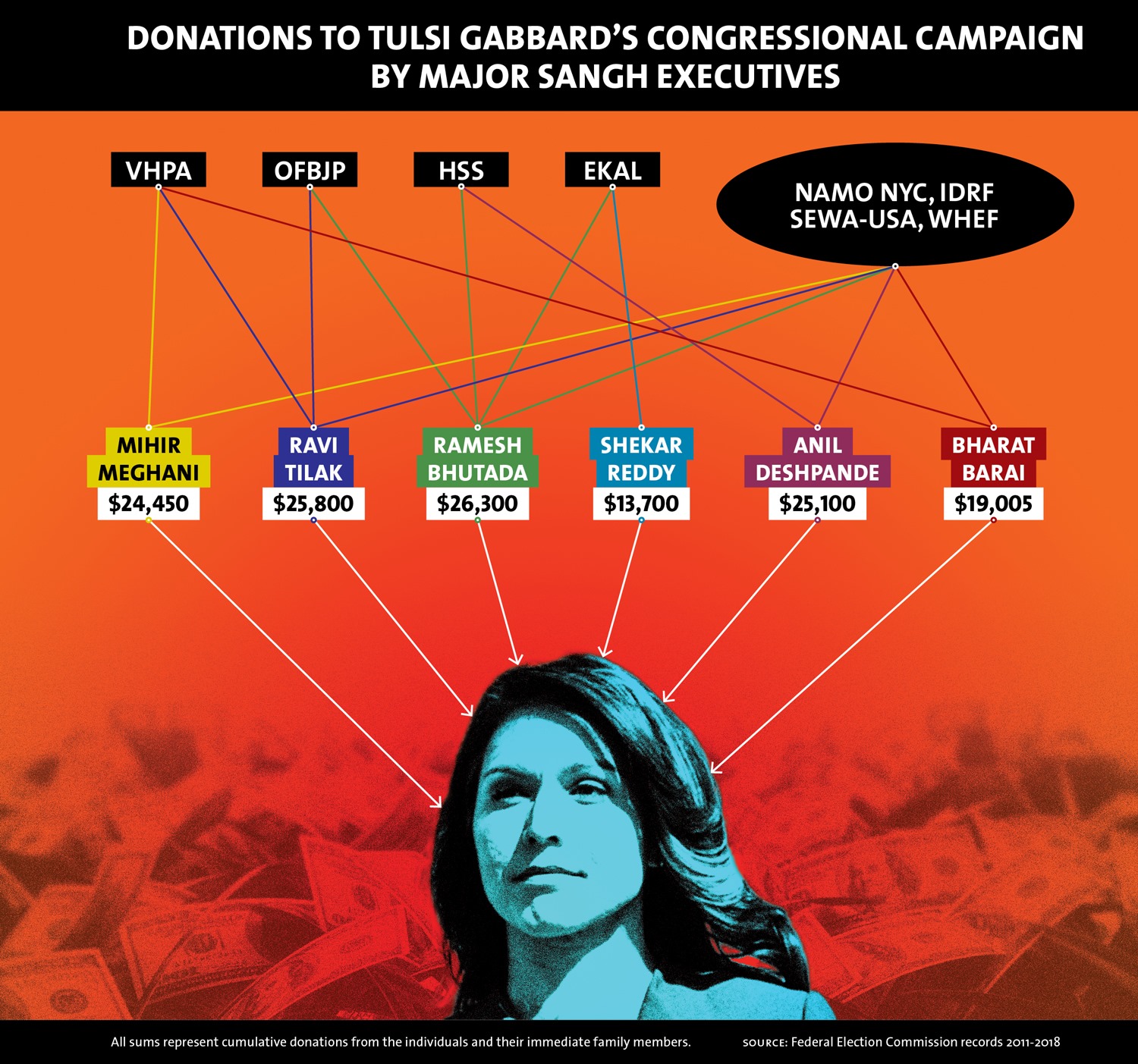 |
| US Presidential Candidate Congresswoman Tulsi Gabbard's Hindutva Donors |
Summary:
Cracks are beginning to appear in the Hindu American community. Democrats from the Progressive Wing of the Party are finding it increasingly difficult to support Prime Minister Modi as he ferociously pushes his hateful Hindutva agenda against minorities. Democrat Ro Khanna representing Silicon Valley has joined US Congress's Pakistan Caucus and rejected Hindutva. His actions have angered Hindu American supporters of Indian Prime Minister Narendra Modi. However, vast majority of Hindu Americans, including those in Silicon Valley tech community, are solidly supporting Mr. Modi in spite of his extended lock-down and brutal actions in Kashmir.
Related Links:
Modi's Extended Lockdown in Indian Occupied Kashmir
Riaz Haq
#American Anti-Fascism Group Coalition Against #Fascism in #India (CAFI) Calls for Protest on Sept 28 during #Modi's US visit to attend #UNGA against #BJP's “anti-minority and anti-poor politics” #KashmirBleeds #Islamophobia #Hindutva https://caravandaily.com/us-based-anti-fascism-group-calls-for-prot... via @caravandaily
“Modi’s government has been orchestrating a pogrom of hate and violence against Muslims and Dalits in India. His government has been cracking down on all forms of dissent and all those who question its politics of hate. Its economic policies have resulted in escalation of poverty and the highest unemployment rate in half a century.
“We call upon all anti-fascist, anti-racist,secular, and environmentalist groups in the United States to join us in protesting his visit and exposing the retrograde, near-fascist politics of Modi’s government,” reads the press statement issued by the CAFI.
The group cited many issues for the protest. These include his past role in 2002 Gujarat riots, the role of rightwing organisations, the RSS, VHP, Bajrang Dal and others, in violence against minorities, lynching of Muslims, Adivasi (tribals) and Dalits, his action on Kashmir, his policy on the NRC in Assam, killing and witch-hunt of activists under his regime and many more.
Talking about his role in 2002 Gujarat riots and the involvement of the RSS and the VHP in the violence and hate against minorities, they said “Modi, his party, the Bhartiya Janata Party (BJP), and their affiliates, including the Rashtriya Swayamsevak Sangh (RSS), the Vishwa Hindu Parishad (VHP) and Bajrang Dal, have a long history of violence and hate. They openly extol Hitler and Aryan supremacist views. In 2002, as chief minister, Modi oversaw pogrom of Muslim minority in Gujarat in which over a thousand people were killed women raped and thousands more were forced to leave their homes and businesses.”
Referring to the National Register of Citizen (NRC) which rendered millions of people stateless, they said, “The result is a kind of ethnic cleansing that has targeted Muslims and tribal populations in particular. As of July 2019, there are over 100 foreigner tribunals (FTs) in Assam, and 200 more are planned in the first phase by September 2019. These FTs are working with the Assam border police to render millions stateless.”
Drawing attentions towards mob lynching and hate crimes against Muslims under his regime, they said, “Since May 2019 when Modi’s second term as Prime Minister started, the violence against minorities has escalated to new heights. Violent mobs, mostly inspired by the atmosphere of hate perpetrated by the BJP, now attack and lynch Muslims (and Christians) on a daily basis with complete impunity”.
The CAFI also denounced Modi government’s decision to unilaterally revoke the special status of Jammu and Kashmir by resorting to “dictatorial means” like clampdown, communication blackout and putting their leaders under house arrest.
Sep 11, 2019
Riaz Haq
#US #lawmakers Pramila Jayapal, first and only #Indian-#American Congresswoman in the House of Representatives, and Rep James P McGovern want international media & independent #humanrights observers be allowed immediately to enter #Indian Occupied #Kashmir https://www.firstpost.com/india/us-lawmakers-write-to-mike-pompeo-o...
Two US lawmakers have expressed concerns over the human rights situation in Kashmir, and urged Secretary of State Mike Pompeo to press India to immediately end the communication blockade
In a letter to Pompeo dated 11 September, Pramila Jayapal, the first and the only Indian-American Congresswoman in the House of Representatives, and Congressman James P McGovern said the international media and independent human rights observers must immediately be allowed into Jammu and Kashmir
The two lawmakers told Pompeo that they have significant concerns about the humanitarian and human rights crisis in Kashmir
Two US lawmakers have expressed concerns over the human rights situation in Kashmir, and urged Secretary of State Mike Pompeo to press India to immediately end the communication blockade and release those who have been detained.
In a letter to Pompeo dated 11 September, Pramila Jayapal, the first and the only Indian-American Congresswoman in the House of Representatives, and Congressman James P McGovern said the international media and independent human rights observers must immediately be allowed into Jammu and Kashmir to investigate reports of abuse.
US lawmakers write to Mike Pompeo on Kashmir, seek immediate end of communication blackout
Representational image. AP
"We urge you to work across the Administration to press the Indian Government to immediately end its communications blackout of Kashmir, expedite the process of reviewing and releasing individuals 'preventatively' detained, ensure hospitals have access to life-saving medicines and protect the rights of the Kashmiri people to freedom of assembly and worship," reads the letter.
The two lawmakers told Pompeo that they have significant concerns about the humanitarian and human rights "crisis" in Kashmir.
"In particular, we are concerned about credible reports from journalists and advocates on the ground that the Indian government has detained thousands of people with no recourse, imposed defacto curfews and cut off internet and telephone access on the region," they said.
Restrictions were imposed when New Delhi had on 5 August crapped the state's special status under Article 370 of the Constitution and bifurcated in into Union territories -- Jammu and Kashmir, and Ladakh.
"We also urged the Indian Government at its highest levels to make it clear that religious tolerance long a principle of Indian history and democracy must be upheld," the two lawmakers wrote in the letter.
Tagging the letter in a tweet, Jayapal said: "I continue to be deeply concerned about credible reports of a humanitarian crisis in Jammu & Kashmir. Even in complex situations, we look to strong democratic allies like India to uphold basic human rights and due process."
Sep 12, 2019
Riaz Haq
Bipartisan group of 4 US Senators—Chris Van Hollen, Ben Cardin, Todd Young and Lindsey Graham—have urged President Trump to “act swiftly” to end humanitarian crisis in Kashmir.
“With each passing day, the situation for the people of Kashmir becomes increasingly difficult. Therefore, we ask that you call upon Prime Minister Modi it to fully restore telecommunications and Internet services, lift lockdown and curfew, rehearse Kashmiris detained pursuant to India’s revocation of Article 370”.
They also “hope the United States can play a constructive role in helping resolve the underlying disputes between the two nuclear powers, India and Pakistan”.
Sep 12, 2019
Riaz Haq
230 #Hindu-#American Organizations Urge US Congressman Ro Khanna To Leave #Pakistan Caucus, saying it was contrary to both American principles and #India's geo-strategic interests. https://www.ndtv.com/world-news/indian-americans-urge-us-congressma... via @ndtv
Ro Khanna, 42, became the first Indian-American to have joined the Congressional Pakistan Caucus last month. He is also the member Congressional Caucus on India and Indian-Americans, which is the largest country-specific caucus in the House of Representatives.
Mr Khanna, 42, became the first Indian-American to have joined the Congressional Pakistan Caucus last month. He is also the member Congressional Caucus on India and Indian-Americans, which is the largest country-specific caucus in the House of Representatives.
In a letter submitted to the Indian-American lawmaker on Monday, Indian-American organisations, professional associations and community leaders urged Mr Khanna to withdraw from the Congressional Pakistan Caucus.
A copy of the letter was released by the Hindu American Foundation (HAF).
"As a leading member of the House India Caucus, Foreign Affairs Committee, and a champion of human rights, we are deeply troubled that you joined the Congressional Pakistan Caucus," the letter stated.
The letter alleged that Pakistan continues to utilise terror to attack US interests in Afghanistan and wage a proxy war against India.
Pakistan has shown a complete and utter disregard for human rights and religious freedom and was recently labelled as a Country of Particular Concern by the US State Department for its "systematic, ongoing, [and] egregious violations of religious freedom" against Hindus, Sikhs, Christians, Shia and Ahmadiyya Muslims, they said.
"We believe that your membership in this Caucus is contrary to both American principles and our geo-strategic interests in the Indian Subcontinent and the broader South Asian region," the letter said.
"Accordingly, we urge you to withdraw from the Congressional Pakistan Caucus. We further urge you to write directly to Pakistani Prime Minister Imran Khan and meet with (Pakistan) Ambassador Asad Majeed Khan to address Pakistan's ongoing use of terrorism to destabilise the region and its rampant and severe human rights violations," it said.
The community members also urged Mr Khanna to make a formal statement for the Congressional record, highlighting the ethnic cleansing of Kashmiri Pandits, who were driven out from their homes by Pakistan-sponsored terror campaign three decades ago.
The members said that they looked forward to Mr Khanna following through on the assurances he made on Sunday about working to address the suffering of both Indian and Pakistani religious minorities at the hands of the Pakistan government.
Sep 17, 2019
Riaz Haq
#Modi is provoking #Pakistan and #China, and there's high potential for conflict...with the rising #Hindu #nationalism and intercommunal friction, #India is undergoing tremendous upheaval today, says #Israeli political scientist Ayelet Harel-Shalev.
https://www.haaretz.com/world-news/.premium.MAGAZINE-modi-is-provok...
Q: One of your areas of expertise is “deeply divided societies.” Examples are India and also Israel. Can you please first explain the meaning of the term?
A deeply divided society is one composed of a number of different communities that all see themselves as belonging to the state, and the state as belonging to them – but significant disagreements exist between these communities about the nature of that state. For example, whether it should be a state of all its citizens, or be defined as the state of a particular nationality. The case of India is interesting, because it shifts between two narratives. According to the first, it’s a state of all its citizens, a democratic, egalitarian state whose constitution is based on the democratic ethos; while the second narrative, which is currently undergoing rejuvenation and is gaining strength, is that India should be a Hindu and democratic state.
Meaning, a right-wing agenda. What is the difference between “national” and “nationalist” sentiment?
It’s elusive. If we assume that a national approach entails the aspiration that your state will possess a particular national character, take pride in the country’s achievements and have an affinity for members of the group – then nationalism deals with specific preferences for a specific people, with discrimination and racism against, and the pushing aside of, the Other. There are national movements that can be democratic or liberal, grant rights to minorities and not be swept up into nationalism. A case in point is the constitution of India, which is not nationalistic by nature. On the contrary: It promotes equality and defines minority rights. After the partition [in 1947, when independent India and Pakistan were created], which was violent and grim, [founding premier Jawaharlal] Nehru told the minorities: You are flesh of our flesh. This is an example of a particular route to the national that does not include nationalism.
Arguably, there was no other choice: The only way to create a bridge between so many streams and minorities is with pluralistic democracy.
“Uniformity and diversity” – that was the central slogan for India during the first decades of its existence, and it effectively dictated the country’s character.
But that wasn’t really its character. History in that country is rife with bloody clashes between Hindus and Muslims. And that also constituted the background to the assassination of Mahatma Gandhi.
During the initial years [of statehood] there were many movements that believed that the Hindus, as the majority, should lead the country. Gandhi was assassinated by a member of a nationalist movement, the RSS, who thought that he was “selling out” the country to the minorities.
That’s the movement from which Prime Minister Narendra Modi sprang. Do you attribute Modi’s rise to the universal trend of the strengthening of the right, or is it a local phenomenon?
It’s not disconnected from the universal trend, of course, but there are other contributing factors to Modi’s success. To begin with, the alternative, the left-center Congress Party, which was the ruling party in India for many decades, became weakened. It was perceived as corrupt, elitist, disconnected. The vacuum that was left made possible the rise and strengthening of nationalist parties that talked about restoring self-respect to the Hindus. Second, Modi is a very charismatic leader. His messages don’t deal only with nationalism; he also talks about the rights of farmers and of women, about recycling, about hygiene and sanitation in India. The public can relate to those messages.
Sep 19, 2019
Riaz Haq
Alison Redford, Ex Premier of #Alberta #Canada: "For too long, #Pakistan’s actions have been unreasonably characterized as aggressive. #India’s tactics have been increasingly violent...more international criticism of its conduct and occupation of #Kashmir" https://www.theglobeandmail.com/opinion/article-this-not-the-same-o...
First, in media reports, India refers to 40 years of terrorist attacks against India by Pakistan without equal mention of terror attacks perpetrated by India on Pakistani soil, as recently as three months ago in Karachi, or India’s support for independence insurgents operating in the Northwest of Pakistan over the past 10 years.
Second, although in the past there have been allegations that Jaish-e-Mohammed has been supported by Pakistan, the organization has been banned in Pakistan since 2002 and support for its operations and training activity was withdrawn. Yet, India continues to assert this position, without providing evidence to support it.
Third, it is against the fundamental principles of international law to launch a military attack on civilian targets, which can be considered an act of war. In those circumstances, one can argue that Pakistan had the right to defend itself and that its response was both measured and reasonable.
On the Kashmiri question, Pakistan has called for United Nations mediation, but India has refused, saying that it is an internal issue, while violently suppressing a growing, and younger, local insurgent movement. The UN High Commissioner for Human Rights criticized India for using excessive force in 2017. More than 500 people, including 100 civilians, have been killed in 2018.
In recent months, India’s tactics have been increasingly violent, leading to more international criticism of its conduct and occupation of Kashmir, including most recently by British parliamentarians, and two resolutions at the OIC this past weekend condemning its violent actions in Indian-occupied Kashmir. Prime Minister Narendra Modi also faces criticism domestically from Indian opposition leaders such as Rahul Gandhi, for manipulating these events to bolster Mr. Modi’s political support in an election year.
There have been times when both countries have been accused of being involved in unwarranted actions against the other and the international community is quick to ignore the complicated dynamics in the region and rely on history. Instead, each incident should be assessed on its own merits to avoid dangerous rivalries from being perpetuated. With a real nuclear risk, we cannot afford to be complacent.
Sep 22, 2019
Riaz Haq
#India's #Modi endorses #Trump in 2020: Modi said at his #Houston rally today: “Abki baar Trump sarkar” Trump's participation offered him chance to woo 4 million #American-#Indians whose support could prove helpful in re-election #HowdyModi #AdiosModi https://www.nytimes.com/2019/09/22/us/politics/trump-modi-houston-r...
The rally brought together two leaders with similar styles. Both rose to power by embracing right-wing populism, portraying themselves as champions of the masses fighting against an entrenched establishment. Both presented voters with a vision to make their respective countries “great again,” and both have fanned tensions along religious, economic and social fault lines.
Mr. Modi, who is in the United States for a week largely to attend the United Nations General Assembly in New York, won a landslide re-election in May. But Mr. Trump and Mr. Modi are also both polarizing figures among the people they lead. While many Indians see Mr. Modi as a strong, decisive leader, a small but vocal minority say he is becoming an autocrat, rapidly consolidating power, going after political enemies inside his country and sowing division between Hindus and Muslims.
In the United States, Mr. Trump is preparing to run for re-election in a bitterly divided country with polls regularly showing him receiving well short of 50 percent support. His participation in Sunday’s rally with Mr. Modi offered a chance to woo a constituency — the four million American residents of Indian descent — whose support could prove helpful.
Mr. Modi delivered in English an over-the top introduction of Mr. Trump, declaring that the president’s name is “familiar to every person on the planet” and “comes up in almost every conversation in the world on global politics.”
Standing next to Mr. Modi, the president beamed with pleasure as the prime minister delivered a twist on his own election slogan: “Abki baar Trump sarkar” or “This time, a Trump government.”
But earning votes from Indian-Americans will not be easy for Mr. Trump, even with Mr. Modi by his side.
Indian-Americans have supported both Democrats and Republicans in the past, though they have gravitated away from Mr. Trump’s party more recently. Although the president’s tax and economic policies appeal to many Indians, his tough stance on immigration, including legal immigrants from India, has caused great angst, especially in Silicon Valley, which relies heavily on Indian workers who come on H-1B visas.
An overwhelming majority of Indian-American voters are registered as Democrats and voted for Hillary Clinton in 2016, according to the Asian American Legal Defense and Education Fund.
M.R. Rangaswami, the founder of Indiaspora, a group that tries to organize Indian-Americans, said events like Sunday’s rally help the community become more relevant in the United States. He said Mr. Trump’s appearance here was an opportunity to increase his 14 percent showing among Indian-Americans in 2016.
--------------------
He has come a long way. Years ago, he was banned by American authorities from even entering the United States because of allegations that as chief minister in Gujarat in the early 2000s he was responsible for an explosion of religiously driven violence that claimed more than 1,000 lives, most of them Muslim.
The goal of this trip is to attract investment to India, and there is a little extra urgency: India’s economy is suffering its biggest downturn in years. Mr. Modi is also eager to shore up diplomatic support. But a controversy threatens to cast a shadow over his visit.
Human rights groups and three Nobel Peace Prize winners have criticized the Bill & Melinda Gates Foundation for a prestigious award they plan to bestow upon Mr. Modi this week. The peace activists say that under Mr. Modi’s leadership, “India has descended into dangerous and deadly chaos that has consistently undermined human rights.”
Sep 22, 2019
Riaz Haq
India is miles away but its tyranny is shaking, shaping American politics
American supporters of the BJP and its affiliated ultra right-wing, paramilitary organization Rashtriya Swayamsevak Sangh manage to steamroll anyone who calls out India’s abysmal treatment of Muslims, oppressed castes and other minorities.
By Rummana Hussain Jun 18, 2022, 2:00am PDT
https://chicago.suntimes.com/columnists/2022/6/18/23170018/india-il...
Last weekend, a Muslim activist in India was arrested and had his house bulldozed by authorities who suspected him of orchestrating demonstrations that turned violent in the northern state of Uttar Pradesh.
Javed Muhammad, whose daughter Afreen Fatima is also an organizer, wasn’t the only one whose family’s property was destroyed. At least two others protesting Islamophobic remarks made by members of Prime Minister Narendra Modi’s Hindu nationalist Bharatiya Janata Party had their homes razed.
“Bulldozer justice” has recently become commonplace against Muslim activists and business owners in India.
Meanwhile, American supporters of the BJP and its affiliated ultra right-wing, paramilitary organization Rashtriya Swayamsevak Sangh verbally steamroll and harass, like a swarm of agitated bees, anyone in the United States who dares to call out India’s abysmal treatment of its religious minorities, oppressed castes and other marginalized groups.
Then they retract their stingers in the presence of politicians and community leaders and lure them into a honey trap, convincing them that any criticism of India is offensive and divisive.
This is exactly how many City Council members were persuaded last year into shooting down a non-binding, bare-bones resolution that simply said discrimination in India is wrong. Chicago leaders shouldn’t weigh in on international matters, some argued. But less than a year later, a resolution supporting the “independence, sovereignty and territorial integrity of Ukraine” was passed by the City Council without controversy.
Many South Asians of all faiths, horrified by the bloodshed and bigotry overseas, believe a similar playbook has been pulled out with the recent statements issued in defense of U.S. Rep. Raja Krishnamoorthi, D-Ill., who has upset many of his former supporters for cozying up to Modi and other BJP/RSS leaders.
“The days ... of making threats against non-white people, especially because of the color of their skin, their religious affiliation, or their country of origin must remain behind us,” the Rev. Jesse Jackson tweeted after writer and activist Pieter Friedrich stood outside the congressman’s Schaumburg office on May 21 and said, “Nazis out, Raja must go” and a desi slogan that offended Krishnamoorthi.
Friedrich has been a thorn in Krishnamoorthi’s side since he moved to the western suburbs from California last month to shine a light on the influence of right-wing India in local politics. Friedrich’s style is brash, and his Nazi references can hurt the cause of Muslim rights.
Jun 18, 2022
Riaz Haq
India is miles away but its tyranny is shaking, shaping American politics
American supporters of the BJP and its affiliated ultra right-wing, paramilitary organization Rashtriya Swayamsevak Sangh manage to steamroll anyone who calls out India’s abysmal treatment of Muslims, oppressed castes and other minorities.
By Rummana Hussain Jun 18, 2022, 2:00am PDT
https://chicago.suntimes.com/columnists/2022/6/18/23170018/india-il...
The issue, though, isn’t about him. It’s about the persecution in India that has been swept under the rug by many American leaders because of the handiwork of their BJP/RSS-supporting donors.
Jackson said he took issue with language Friedrich used.
Curiously, Jackson’s four-part tweet echoed the talking points of Indian Americans who fought against the City Council resolution and failed to mention Friedrich has been speaking out against oppression in India.
Krishnamoorthi accused Friedrich of making death threats for chanting “Krishnamoorthi murdabad.”
Murdabad literally translates to “death to” in Hindi and Urdu.
However, when used in political discourse in India and Pakistan, murdabad means “down with,” according to Tyler Williams, an associate professor of South Asian languages and civilizations at the University of Chicago. “It is absolutely not a death threat,” Williams said.
Friedrich maintains he only referenced Hitler’s party because the most influential RSS leader was inspired by Nazi Germany.
Friedrich went on to say the homophobic and anti-abortion remarks Equality Illinois and Secretary of State Jesse White denounced him for in their support of Krishnamoorthi were made when he was a Christian fundamentalist as a teenager. “I own them and bear responsibility but I repudiate these views now,” said Friedrich, 36.
Krishnamoorthi, meanwhile, told me he is “very concerned” about the rhetoric being used against Muslims and other minorities by the BJP/RSS and that he condemns any violence carried out by them.
The congressman did rush out to O’Hare Airport in 2017 to join protesters and immigration lawyers when Donald Trump issued the “Muslim ban.” He also put out statements condemning the derogatory comments made about Prophet Muhammad by leading BJP members and the call for a genocide of Muslims at a conference in India earlier this year. Much appreciated.
But it is hard to ignore Krishnamoorthi’s reported attendance at several events organized by Hindu nationalists, including a 94th birthday commemoration of the RSS, a group Williams described as the Indian equivalent of the Proud Boys.
You can’t stand against someone when you are standing with them.
Krishnamoorthi is on the right side on domestic matters — Black Lives Matter, the environment, etc. — but when it comes to India, he’s “cheerleading for the Modi government” said Nikhil Mandalaparthy, the advocacy director of Hindus for Human Rights.
Krishnamoorthi said he is willing to meet with those worried about the tyrannical hold that has taken over India and conceded, “I need to do more in continuing to speak out.”
We’ll be waiting.
Jun 18, 2022
Riaz Haq
#SiliconValley's #Indian-#American Congressman Ro Khanna talks of the threat of growing #Hindu nationalism. Khanna: “It’s the duty of every American politician of Hindu faith to stand for pluralism, reject Hindutva" #Hindutva #Islamophobia #Modi #BJP
https://www.nbcnews.com/news/asian-america/rep-ro-khanna-will-first...
Khanna said that, having spent much of his career in Northern California's Silicon Valley, he has been immersed in Indian American issues for years. The rising tide of Hindu nationalism is on the forefront of the diaspora’s collective consciousness; from professional spheres to college campuses, reports of Islamophobia and casteism abound in South Asian spaces.
Khanna hasn’t shied away from such conversations, and his vocalness has sparked outrage from right-wing Indian Americans. In 2019, 230 Hindu and Indian American entities wrote letter criticizing Khanna for denouncing Hindu nationalism (also known as Hindutva) and for advocating religious equality on the subcontinent.
“It’s the duty of every American politician of Hindu faith to stand for pluralism, reject Hindutva, and speak for equal rights for Hindus, Muslims, Sikhs, Buddhist & Christians,” Khanna tweeted at the time.
They also criticized Khanna for joining the Congressional Pakistan Caucus and for speaking out against Indian Prime Minister Narendra Modi’s revoking the state of Kashmir’s autonomy.
“Of course, we have to fulfill the strategic partnership and we have to respect the democratically elected leadership in India,” Khanna told NBC News. “I will work to strengthen that while also upholding these human rights values.”
Feb 6, 2023
Riaz Haq
The world is now learning about the major threat Hindutva fascism poses today.
https://theloop.ecpr.eu/hindutva-fascism-is-threatening-the-worlds-...
In India, fascism is reinventing itself. It has crept through Hindu nationalism – Hindutva – and now poses a serious threat to Indian democracy, writes Amit Singh
Frequently framed as populist, nativist and nationalist, ‘Hindutva fascism’ has so far evaded the serious scrutiny of scholars and activists. But, as Luca Manucci has argued convincingly, mislabelling such a phenomenon could jeopardise the struggle against fascism and anti-democratic regimes.
Without accurate labelling, we will never develop an effective counterstrategy against fascism. Fascism is manifesting itself in India under the auspices of radical right-wing groups such as the Bharatiya Janata Party (BJP). Widespread public confusion, along with a silencing of the discussion around Hindutva's ‘fascistic roots’, is assisting the gradual death of Indian democracy.
What is Hindutva?
Hindutva is an ethnic form of nationalism. Since 1925, the right-wing Hindu nationalist paramilitary organisation Rashtriya Swayamsevak Sangh (RSS) has been its most staunch proponent. RSS is radically far-right, hierarchical, authoritarian, and founded on the premise of Hindu supremacy. Hindu nationalism seeks uniformity through the imposition of Hindi language, Hindu religion, Hindu mythology, and unquestioned loyalty to the nation. On different levels, it seeks to repress dissenting views, and to expunge religious pluralism and secularism from political discourse.
Current right-wing Prime Minister Narendra Modi, an active member of RSS, is notorious for his complicity in the post-Godhra riots. Modi claimed that the fire on the train which killed 59 Hindus in 2002 was an act of Islamist terrorism rather than an outbreak of communal violence. Under Modi, India is fulfilling RSS' Hindutva mission to make India a Hindu nation. Once a secular state, India has become an electoral autocracy, with Hindutva as its unofficial ideology.
Hindutva's fascistic roots
Veer Savarkar, one of Hindutva's earliest proponents, asserted:
India should follow the German example to solve the Muslim problem… Germany has every right to resort to Nazism and Italy to fascism – and events have justified those isms…
VEER SAVARKAR, 1938
Hindutva ideologue Madhav Sadashivrao Golwalkar applauded Hitler’s Germany for exterminating Jews to maintain the purity of the race and its culture. He strongly believed 'foreign races in Hindustan must lose their separate existence to merge in the Hindu race; [they] deserve no privileges… not even citizen's rights.'
BS Moonje, a politician close to the RSS, met with Mussolini on 19 March 1931. Moonje played a crucial role in moulding the RSS along Italian (fascist) lines, militarising Hindu youths. Hindutva ideologues consider a homogeneous identity a necessary foundation of nationhood. Thus, nationhood is inherently anti-plural.
Hindutva’s proximity to fascist ideas
The RSS shaped Hindutva ideology similarly to the way the Nazis and Italian fascists shaped fascist ideology in the 1930s. Hindutva rejects the liberal democratic conception of nation and citizenship. It is anti-democratic, and inherently Islamophobic. The cult of tradition and male chauvinism dominates Hindutva fascist policies. Under Modi, Hindutva fascism has crystallised.
Fascist politics aims to separate a population into 'us' and 'them'. In India, pre-existing communal divisions between Hindus and Muslims have been exacerbated by Hindutva forces such as the RSS and its political wing, the BJP. Since Modi came to power in 2014, his administration has fed Islamophobic propaganda to the Hindu masses. This has led to the public demonisation of Muslims, and even normalised violence against them.
Hindutva is obsessed with Hindus' inherent superiority. The Indian Ministry of Culture is even establishing a genetic database to 'trace the purity of races in India'
Feb 7, 2023
Riaz Haq
The world is now learning about the major threat Hindutva fascism poses today.
https://theloop.ecpr.eu/hindutva-fascism-is-threatening-the-worlds-...
Muslims have even been prosecuted for offering prayer in their own homes. A move to pass a Citizenship Amendment Bill, along with a proposed National Register of Citizens, are Modi's underhand attempts to exclude Muslims from Indian citizenship.
The Nazis were obsessed with 'racial purity', striving for a pure 'Aryan' German race. Hindutva, too, is consumed by the idea of Hindu superiority. In 1966, Golwalkar published a book alleging the 'purity' of Hindu blood. Today, the Indian Ministry of Culture is establishing a state-of-the-art genetic database to 'trace the purity of races in India'.
Disagreement is a crime in fascist discourse
In Modi's India, dissent at any level meets with ruthless punishment. This is a clear symptom of a fascist regime. Modi is a ‘predator of press freedom’. Under his government, freedom of the media and academic freedom have sunk to new lows. In many cases, parliamentary debate has been shut down, and laws passed without debate.
Under Modi's government, press freedom and academic freedom have sunk to new lows
The cult of Modi in India has parallels with Hitler’s leadership style. Images of the ‘Dear Leader’ are everywhere. Sensationalist, biased Godi media has replaced state media. This media never tires of demonstrating how hard Modi works. Instead, what they should be doing is criticising his disastrous mismanagement of the Covid pandemic, which has resulted in the deaths of millions of Indians. Godi media is normalising illiberalism and promoting hate speech, not only against Muslims, but against anyone who opposes Modi.
Fascism rewrites history. It promotes anti-intellectualism by attacking universities and educational systems that might challenge its ideas. Under Modi, chapters on protest and social movement have been excised from textbooks. Replacing them are Islamophobic Hindutva ideologies, and stories of Hindus' past glories. Academics and scholars are fired or attacked for criticising Hindutva or the Modi government. Government institutions, especially security and financial agencies, intimidate and harass opposition parties and anyone who dares to voice dissent.
Resisting Hindutva fascism
Current resistance against Hindutva is sporadic and disorganised. However, open resistance against Hindutva is apparent in various forms, and at different levels. Farmers, students, intellectuals, religious minorities, India's main opposition party, and members of civil society, are rising up to protest Modi’s Hindutva government policies.
‘Invisible defiance’ against Hindutva fascism is also taking shape in private discussion, even among Hindutva supporters. Hindutva may be hegemonic, but its gradual decline has already begun.
In 2005, the US banned Modi from entry because he had failed to act against anti-Muslim riots in India. However, when Modi became prime minister in 2014, Western leaders gave him the red-carpet treatment, possibly to nurture business interests. Once Hindutva gained respectability in the West, it boosted the morale of its proponents, and discouraged resistance.
If Western nations really want to save liberal democracy, they must isolate authoritarian leaders like Modi, and condemn their illiberal policies. Doing so is the only way to save a dying democracy like India.
Feb 7, 2023
Riaz Haq
#Indian-#Americans Rapidly Climbing in #US Politics. The relative wealth of Indian #immigrants and high #education levels have propelled a rapid #political ascent for 2nd & 3rd generations. #KamalaHarris #NikkiHaley #Hindu #SiliconValley #Tech #Pakistan https://www.nytimes.com/2023/02/27/us/politics/indian-american-poli...
In 2013, the House of Representatives had a single Indian American member. Fewer than 10 Indian Americans were serving in state legislatures. None had been elected to the Senate. None had run for president. Despite being one of the largest immigrant groups in the United States, Americans of Indian descent were barely represented in politics.
Ten years later, the Congress sworn in last month includes five Indian Americans. Nearly 50 are in state legislatures. The vice president is Indian American. Nikki Haley’s campaign announcement this month makes 2024 the third consecutive cycle in which an Indian American has run for president, and Vivek Ramaswamy’s newly announced candidacy makes it the first cycle with two.
In parts of the government, “we’ve gone literally from having no one to getting close to parity,” said Neil Makhija, the executive director of Impact, an Indian American advocacy group.
Most Indian American voters are Democrats, and it is an open question how much of their support Ms. Haley might muster. In the past, when Indian Americans have run as Republicans, they have rarely talked much about their family histories, but Ms. Haley is emphasizing her background.
Activists, analysts and current and former elected officials, including four of the five Indian Americans in Congress, described an array of forces that have bolstered the political influence of Indian Americans.
------
Indians did not begin moving to the United States in large numbers until after a landmark 1965 immigration law. But a number of factors, such as the relative wealth of Indian immigrants and high education levels, have propelled a rapid political ascent for the second and third generations.
Advocacy groups — including Impact and the AAPI Victory Fund — have mobilized to recruit and support them, and to direct politicians’ attention to the electoral heft of Indian Americans, whose populations in states including Georgia, Pennsylvania and Texas are large enough to help sway local, state and federal races.
“It’s really all working in tandem,” said Raj Goyle, a former state lawmaker in Kansas who co-founded Impact. “There’s a natural trend, society is more accepting, and there is deliberate political strategy to make it happen.”
------
In retrospect, the watershed appears to have been 2016, just after then-Gov. Bobby Jindal of Louisiana became the first Indian American to run for president.
That was also the year (2016) Representatives Pramila Jayapal of Washington, Ro Khanna of California and Raja Krishnamoorthi of Illinois were elected, bringing the number of Indian Americans in the House from one — Representative Ami Bera of California, elected in 2012 — to four. It was also the year Kamala Harris became the first Indian American elected to the Senate.
Feb 27, 2023
Riaz Haq
#US Congressman Jamaal Bowman, #Democrat, #NewYork, introduces resolution in House to designate March 23 as ‘Pakistan Day’. He initiated the “landmark resolution”. It is the first such resolution introduced in the US Congress. #PakistanDay2023 #Pakistan
https://economictimes.indiatimes.com/news/international/world-news/...
The resolution emphasised the importance of recognising and paying tribute to those who foster ethnic pride and enhance the profile of cultural diversity, which strengthens the fabric of the US communities.
Bowman in fact stated that it was an honour for him to introduce the resolution and stressed the importance of standing with the people of Pakistan during their time of crisis.
Bowman expressed his solidarity with Pakistan, which has been hit by a natural disaster and conveyed his message of peace and love to the people of Pakistan.
The resolution also highlighted that Pakistan Day provides an excellent opportunity for all US residents to learn more about Pakistan’s rich heritage and foster an appreciation for its ancient culture among future generations.
Pakistan’s ambassador to the US, Masood Khan, thanked Bowman for his initiative, which would bring the two countries and their people closer to each other.
Mar 25, 2023
Riaz Haq
Why Does Ro Khanna Want Modi to Address Congress? – The Nation
https://www.thenation.com/article/politics/ro-khanna-modi-congress/
Despite his condemnations of Hindu nationalism, Representative Ro Khanna pushed for Modi to speak to a joint session of Congress and has received more than $110,000 from Hindu nationalist figures in the US.
On June 22, Indian Prime Minister Narendra Modi, will be in Washington, D.C., for his first official state visit. And US political elites are busy preparing for his fete. The prime minister will address a joint session of Congress and attend a state dinner in his honor at the White House. This will only be President Joe Biden’s third state dinner. Just a few years ago—from 2005 to 2014—the US barred Modi from entering the country because of his alleged role as Gujarat’s chief minister in the 2002 Gujarat riots in which nearly 2,000 Indians, most of whom were Muslim, were murdered.
Representatives Ro Khanna (D) and Michael Waltz (R), cochairs of the bipartisan Congressional Caucus on India and Indian Americans, secured Modi’s address by writing a letter to House Speaker Kevin McCarthy, urging him to invite the prime minister.
Khanna’s role in Congress’s celebration of Modi disappointed many human rights advocates and supporters. The Indian American Muslim Council called on Khanna, who represents a district in the Bay Area, to rescind his letter, explaining that allowing the prime minister “to speak before Congress will help to legitimize Modi’s brand of Hindu nationalist politics and the systematic persecution of religious minorities, particularly Muslims and Christians, under his rule.”
In 2019, Khanna called for rejecting Hindu nationalism, tweeting, “It’s the duty of every American politician of Hindu faith to stand for pluralism, reject Hindutva, and speak for equal rights for Hindus, Muslims, Sikhs, Buddhist & Christians.”
Now four years later, he has helped secure Modi’s address to Congress.
“It’s disheartening to see Representative Khanna take the lead in asking the congressional leadership to invite Prime Minister Modi to address a joint session of the Congress,” Raju Rajagopal, a Bay Area activist and cofounder of advocacy group Hindus for Human Rights, told me
“As one of only two Indian American congresspeople to speak out against Hindu nationalism”—along with Representative Pramila Jayapal—“Khanna had symbolized the hopes and aspirations of India’s over 200 million religious minorities, who are in a virtual state of siege under Modi’s rule,” he said. “To now welcome Modi in the halls of Congress and completely ignore the escalating hate and violence under Modi’s rule, undermines Khanna’s own progressive credentials.”
Khanna has publicly condemned Hindutva, a Hindu supremacist movement, but his congressional campaigns have also received more than $110,000 from individuals associated with Hindu nationalist groups since 2011. When I asked about his decision to advocate for Modi’s presence at Congress, Khanna reaffirmed the Biden administration’s perspective of “India as a strategic ally” to the United States.
He told me, “I believe any elected prime minister of India at this moment from whatever party should be afforded the honor of addressing Congress, meeting the president, and a state dinner. I don’t think it’s about the person as much as it is about the office. It is about respecting the nation of India.”
Not all progressive members of Congress agree with him. Representatives Rashida Tlaib, Ilhan Omar, and Jamie Raskin said they will boycott Modi’s joint address. Jayapal will attend and will escort Modi to Congress but organized a letter urging Biden to “discuss the need to protect human rights and democratic values in India as he meets with Indian Prime Minister Narendra Modi.”
Jun 21, 2023
Riaz Haq
Why Does Ro Khanna Want Modi to Address Congress? – The Nation
https://www.thenation.com/article/politics/ro-khanna-modi-congress/
When I asked Jayapal about her decision to be in Modi’s escort team, she also emphasized the importance of engaging with India. Jayapal said if she has the opportunity, she will speak to Modi about her concerns and that she hoped the letter would encourage Biden to publicly comment on the need for India to address human rights.
Modi’s visit comes amid state persecution of religious minorities, such as Muslims and Christians, as well as growing authoritarianism of Modi’s ruling Bharatiya Janata Party. Hindu religious extremists have called for genocide against Indian Muslims, attacked mosques and churches, and demolished homes. The Biden administration has been largely silent on these issues, choosing to try and strengthen the US-India relationship and deepen the ties between the countries’ military and technology sectors. With Modi’s visit, for instance, Washington has been pushing Delhi to sign off on a military deal for dozens of US-made armed drones.
Several top US officials have even praised the Modi regime. In April, US Commerce Secretary Gina Raimondo described Modi as “unbelievable, visionary” and “the most popular world leader.” In the same month, Donald Lu, the assistant secretary of state for South and Central Asia, applauded press freedom in India: “You have India as a democracy in part because you have a free press that really works.”
These statements, however, contrast with the findings of the media watchdog Reporters Without Borders 2023 World Press Freedom Index, which ranked India 161 out of 180 countries due to its crackdown on the press.
Arjun S. Sethi, a community activist, civil rights lawyer, and author based in Washington, D.C., told me, “Under the Modi administration, we have seen countless human rights abuses against Muslims and other minorities, atrocities committed in Kashmir, and infringements on association, press, and speech.”
Parts of the US government do acknowledge widespread human rights violations in India. In May, the State Department released an International Religious Freedom report that highlighted the violence against religious minorities, discriminatory laws, and demolitions of Muslim homes. The US Commission on International Religious Freedom (USCIRF) echoed these concerns in its 2023 annual report. Last year, India’s government passed legislation against the wearing of hijabs, religious conversion, cow slaughter, and interfaith relationships. These policies specifically discriminate against Muslims, Christians, Sikhs, Dalits, and Adivasis, the Indigenous people of South Asia.
For four consecutive years, the USCIRF has recommended that the US government designate India as a “Country of Particular Concern” and impose strategic sanctions on Indian government officials and agencies involved in religious freedom violations.
The Biden administration’s decision to extend an invitation to Modi indicates a preference for trade and strategic gains over addressing human rights concerns.
Tahil Sharma, an interfaith activist from Southern California, told me it is hypocritical for politicians to espouse the importance of democratic values while celebrating Modi. “You are talking about pushing back against a narrative that doesn’t support pluralism or that doesn’t support democracy; then you give a platform to someone whose political party has done nothing but the opposite of promoting pluralism and democracy,” Sharma said.
Jun 21, 2023