PakAlumni Worldwide: The Global Social Network
India-Iran-Afghanistan Axis Against Pakistan?
A JIT (Joint Investigation Team) report recently released by Sindh government in Pakistan has revealed that the infamous Karachi gangster Uzair Baloch worked for Iranian intelligence. Apparently, Uzair Baloch was also in contact with Indian intelligence agents working in Iran, according to Indian media reports. Baloch's interrogation led to the discovery and arrest of Indian undercover agent Kulbhushan Jadhav in Balochistan shortly after Baloch's arrest. Kulbhushan Jadhav has confessed to orchestrating deadly terror attacks in Balochistan and Karachi.
He has said that India's RAW funneled money through Indian consulates in Jalalabad, Kandhar (Afghanistan) and Zahidan (Iran) to BLA and TTP for terror attacks in Balochistan and Karachi. Targets of terror attacks included people, mosques, roads, port and Balochistan's Hazara Shia community.
|
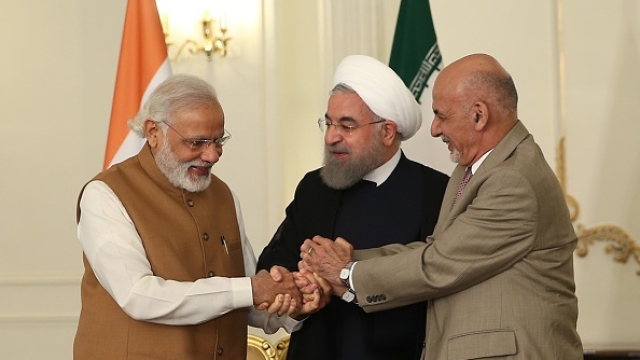
L to R: Indian Prime Minister Modi, Iranian President Rouhani and Afghan President Ghani |
Chabahar vs Gwadar:
Chabahar is a port being constructed by Indians in Iran. The stated goal of this project is to bypass Pakistan for India's trade with Afghanistan and Central Asia via Iran. Indian media have promoted Chabahar as a competitor to Gwadar Port which is a part of the China-Pakistan Economic Corridor (CPEC). Indian government is openly hostile to CPEC and declared support for Baloch insurgents. The leaders of Afghanistan, India and Iran have held regular summit meetings to promote Chabahar port project.
4,000 Indians in Chabahar:
There are 4,000 Indians working in Chabahar, Iran, according to Indian journalist Karan Thapar. Some of them, like Kulbhushan Jadhav, work undercover for Indian intelligence agency RAW. It is hard to believe that the Iranian intelligence is not aware of the presence of undercover Indian agents among the 4,000 Indians working in Chabahar. After all, Jadhav had two passports, one in his own name and another in the name of Hussein Mubarak Patel. The Indian Express and Asian Age, both Indian publications, suggest that Jadhav had links with Uzair Baloch who has been convicted by for working for the Iranian intelligence in Pakistan. Kulbhushan Jadhav has confessed to orchestrating deadly terror attacks in Balochistan and Karachi. He has said that India's RAW funneled money through Indian consulates in Jalalabad, Kandhar (Afghanistan) and Zahidan (Iran) to BLA and TTP for terror attacks in Balochistan and Karachi. Targets of terror attacks included people, mosques, roads, port and Balochistan's Hazara Shia community.
Pakistan's Complaint to Iran:
Paskistan has complained to Iran about allowing Baloch insurgents to use Iranian territory to launch terrorist attacks in Pakistan after an attack killed 14 people along Pakistan’s coast in 2019, according to Reuters.
“The training camps and logistical camps of this new alliance...are inside the Iranian border region,” Pakistan Foreign Minister Shah Mahmood Qureshi told reporters in Islamabad. Qureshi said he has spoken to his Iranian counterpart, Mohammad Javad Zarif, and conveyed to him the “anger of Pakistani nation”.
Karachi Stock Market Attack:
Four terrorists belonging to Baloch Liberation Army attacked the Pakistani stock exchange in Karachi on June 29, 2020, killing two guards and a policeman and wounding seven others before being shot dead. Pakistan believes that the attackers came from southeastern Afghanistan where they enjoy safe havens with the support of intelligence agencies like Afghan NDS and Indian RAW.
Qasem Soleimani:
Iranian Revolutionary Guard Corp (IRGC) commander General Qasem Soleimani who was assassinated by the United States in drone strike was particularly hostile toward Pakistan. In February, 2019, Soleimani threatened Pakistan. He boasted about Iran's "independent power and honor". Soleimani, known to be close to Supreme Leader Ayatollah Khanenai, reportedly had serious policy disagreement with the Rouhani government. He said:
"I warn you not to test Iran and anyone who has tested Iran has received firm response. We are speaking to Pakistan with a friendly tone and we are telling that country not to allow their borders to become a source of insecurity for the neighboring countries..... Iran enjoys independent power and honor. Some countries have wealth, but no prowess. Trump tells the Al-Saud that if it hadn't been for the US support, Saudi Arabia would not have survived and Saudi Arabia's coalitions in the region have all ended in failure."
Soleimani's tone in this message to Pakistan is anything but "friendly".
Summary:
Recent release of Sindh government report reveals that Karachi gangster Uzair Baloch spied for Iran in Pakistan. There are 4,000 Indians working in Chabahar, Iran, according to Indian journalist Karan Thapar. Some of them, like Kulbhushan Jadhav, work undercover for Indian intelligence agency RAW. Chabahar is a port being constructed by Indians in Iran. The stated goal of this project is to bypass Pakistan for India's trade with Afghanistan and Central Asia via Iran. Indian media have promoted Chabahar as a competitor to Gwadar Port which is a part of the China-Pakistan Economic Corridor (CPEC). The Indian Express and Asian Age, both Indian publications, suggest that Jadhav had links with Uzair Baloch. Kulbhushan Jadhav has confessed to orchestrating deadly terror attacks in Balochistan and Karachi. He has said that India's RAW funneled money through Indian consulates in Jalalabad, Kandhar (Afghanistan) and Zahidan (Iran) to BLA and TTP for terror attacks in Balochistan and Karachi. Targets of terror attacks included people, mosques, roads, port and Balochistan's Hazara Shia community.
Here's Kulbhushan Jadhav's confession video:
Related Links:
General Soleimani's Hardline Against Pakistan
Iran's Chabahar and Pakistan's Gwadar Ports
Indian RAW Agent Kulbhushan Jhadav Used Chabahar
Riaz Haq
EH
@ejazhaider
FINALLY, ISPR comes up with a pro forma, perfunctory statement on the Kech attk, hours AFTER i wrote my analysis. but missing from all this is a simple fact: BLF, for years, has used Iran's soil for mounting attacks in southwest Balochistan. why are we afraid of that discussion?
https://twitter.com/ejazhaider/status/1486776348223979528?s=20
EH
@ejazhaider
in my public debate with
@mosharrafzaidi
i constantly favoured a proactive CT policy. why wait for attacks on our soil; why not take the war to the enemies in Afghanistan and Iran? i can tell you we have the capability; not sure if we have the balls.
EH
@ejazhaider
ps: are we more engrossed in the Islamabad power politics shit than securing our interests? as i said on
@ZarrarKhuhro
's programme last night, state with balls could take out Mohsin Fakhrezadeh south of Tehran. you wanna deal with Tehran, deal from a position of strength.
Jan 27, 2022
Riaz Haq
#Pakistan is coming down hard on #Iran! On his recent visit, Iran’s interior minister Ahmad Vahidi was given the message that we know [about the use of Iranian soil by #Baloch insurgents]. If there are more attacks, we will take decisive action. @TRTWorld https://www.trtworld.com/magazine/why-pakistan-is-coming-down-hard-...
The country’s overstretched patience with its southwestern neighbour is wearing thin over the Baloch insurgency.
In the dead of night on January 25, dozens of militants bearing advanced assault rifles and night-vision devices swooped down on a solitary paramilitary checkpost in Kech, some 180 km from Pakistan’s border with Iran, in the southwestern province of Balochistan. The sudden assault lasted for more than five hours, claiming the lives of 10 Pakistani troopers. The attackers reportedly fled to Iran.
The attack was later claimed by the Baloch Liberation Front (BLF), one of the most lethal Baloch separatist groups stoking a decades-long armed struggle against the Pakistan Army, which operates out of southeastern Iran.
While relations between Iran and Pakistan have steadily deteriorated over cross-border militancy in the past few years, analysts assess that the sharp increase in terrorist attacks since last year, mainly in Pakistan’s restive Balochistan province, has put the country's security establishment on tenterhooks.
Three days after the attack in Kech, Pakistan’s Federal Investigation Agency stumbled upon a surprising discovery in the backroom of a money exchange company in Karachi. They found a network funneling millions of rupees from "a foreign intelligence agency" to proscribed militant groups in the country. Thirteen employees were rounded up, and days later, a senior bureaucrat was arrested in connection with the raid.
While the foreign intelligence agency behind the racket was barely identified in press conferences and local media coverage, a senior security official, on condition of anonymity, confirmed to TRT World that it belonged to Iran.
Then, on February 2, a coordinated attack on the paramilitary Frontier Corps headquarters in the towns of Panjgur and Noshki — areas close to the Iran border and the Baloch-majority regions in Afghanistan, respectively —stunned the nation. It took the army three days to clear the sites of the suicide attackers who, it said, were trained in Afghanistan by the Indian intelligence.
On February 14, Iran’s interior minister Ahmad Vahidi arrived in Islamabad for a day-long visit with the Commander of the Iranian Border Guards, Brigadier General Ahmad Ali Goudarzi, among other high-ranking officials.
While Pakistani leadership hailed the historic “brotherly ties” with Iran, privately the delegation was given a stern warning: “He was given the message that we know [about the use of Iranian soil by Baloch insurgents]. If there are more attacks, we will take decisive action,” says the security official, who is privy to details of the meeting.
The tri-border region of Nimroz in Afghanistan, an ethnic Baloch-dominated province straddling Pakistan and Iran in the south, is notorious for its powerful smuggling rackets dealing in weapons, opium, and human trafficking. To its east is the Helmand province, where vast poppy fields feed the global opium trade. This is also the region, along with Kandahar to its east, that welcomed fleeing Baloch brethren when former President General Pervez Musharraf ordered a military operation against Baloch insurgents in 2006. Many Baloch separatist leaders coordinated attacks on Pakistani security personnel and Chinese investments in Balochistan during the Afghan war.
When the Taliban took Kabul last year, they launched a swift crackdown on Baloch refugees and handed over many dissidents to the Pakistani authorities. Many Baloch rebels had already gone into hiding after assassination attempts in Kandahar, allegedly ordered by Pakistani officials over the past two years.
Mar 14, 2022
Riaz Haq
Reports on the status of former Balochistan Liberation Army (BLA) Commander-in-Chief Bashir Zeb Baloch indicate that he has stepped down from his role, amid unverified social media and intelligence claims that he was seriously injured in a poisoning incident. [1, 2]
The current details surrounding his situation include:
Official Leadership Transition: On November 3, 2026, the BLA announced that Bashir Zeb Baloch is no longer serving as the head of the organization following a constitutional transition decision made during a Senior Command Council meeting held on October 16, 2026. The group's statement did not disclose his current location or comment on health rumors. [1, 2]
Poisoning and Hospitalization Rumors: Unverified reports and social media claims circulating on platforms like X (formerly Twitter) and Telegram allege that Zeb was poisoned by a close associate in Kandahar, Afghanistan, admitted to Mohammand International Hospital in critical condition or a coma, and possibly moved to India for treatment. [1, 2, 3]
Lack of Independent Confirmation: There is no independent, official confirmation of the poisoning, coma, or hospital transfer. Other unverified historical rumors had previously speculated he was killed in a Pakistani airstrike in September. [1, 2, 3]
———-
BLA Removes Commander Bashir Zeb | Balochistan Pakistan Army Controversy
https://www.bhaskarenglish.in/international/news/bla-commander-bash...
The Baloch Liberation Army (BLA) has removed its commander-in-chief Bashir Zeb, transferring all his administrative, military and policy-making powers to the organisation's Senior Command Council. The decision was announced in a press release issued on November 3 and published by The Balochistan Post.
According to The Balochistan Post, the decision was taken at a meeting of the BLA's top committees on October 16, where commanders unanimously approved the leadership change. The organisation described it as a peaceful transition under its constitutional rules, adopted in 2018, which do not allow any commander to hold the top position for life.
The Senior Command Council will oversee the organisation's major decisions until a new commander-in-chief is appointed. The BLA claimed that Zeb's removal had not triggered any internal split or confrontation among its commanders.
However, the organisation has not disclosed the specific reasons behind his removal. His current whereabouts are also unknown, with no confirmation of reports suggesting that he was injured or receiving medical treatment.
Nov 7