PakAlumni Worldwide: The Global Social Network
Ambassador Kishore Mahbubani: America Does Not Respect India
"One hard truth that Indians have to contend with is that America has also had difficulty treating India with respect", writes former Singaporean diplomat Kishore Mahbubani in his latest book "Has China Won?". "If America wants to develop a close long-term relationship with India over the long run, it needs to confront the deep roots of its relative lack of respect for India", adds Ambassador Mahbubani. It's not just Mahbubani who suspects the United States leadership does not respect India. Others, including former President Bill Clinton, current US President Donald Trump, former Secretary of State Hillary Clinton and CNN GPS host Fareed Zakaria have expressed similar sentiments.
 |
| Kishore Mahbubani |
Kishore Mahbubani:
After the India-Pakistan aerial combat over Kashmir, New York Times published a story from its South Asia correspondent headlined: "After India Loses Dogfight to Pakistan, Questions Arise About Its Military". Here are some excerpts of the report:
"Its (India's) loss of a plane last week to a country (Pakistan) whose military is about half the size and receives a quarter (a sixth according to SIPRI) of the funding is telling. ...India’s armed forces are in alarming shape....It was an inauspicious moment for a military the United States is banking on to help keep an expanding China in check".
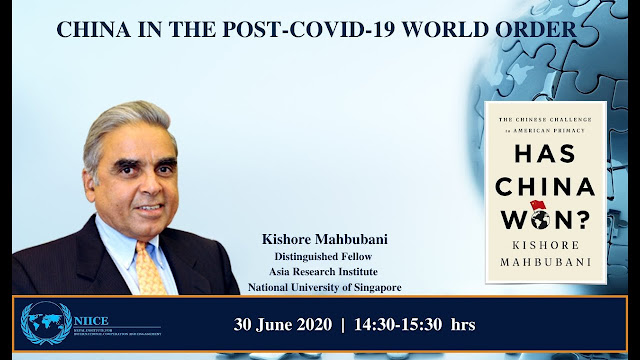
Kishore Mahbubani is a former top diplomat who served as the head of Singaporean mission at the United Nations. He was born in Singapore in 1948 to Hindu Sindhi parents who migrated from Pakistan to India in 1947, and then to Singapore in 1948. He is currently a Distinguished Fellow at the Asia Research Institute of the National University of Singapore. In 2019, Mahbubani was elected a member of the American Academy of Arts and Sciences. He is a frequent guest on CNN Global Public Square hosted by Fareed Zakaria. Here's an excerpt from Mahbubani's "Has China Won?":
"One hard truth that Indians have to contend with is that America has also had difficulty treating India with respect.....Many Americans, like many of their fellow Westerners, have a higher degree of respect for Chinese civilization than they do of Indian civilization. Many Americans will deny it because it is an uncomfortable truth. They will proclaim loudly that they respect India as much as they respect China. But you cannot feign respect: it is best demonstrated not through words but in deeds. Every country in the world demonstrates its respect for another country by the amount of time and attention it gives to that country, and America has devoted far more time and attention to China than it has to India".
 |
| Source: @BeltandRoadDesk |
Trump and Clinton:
There is some evidence to support Ambassador Mahbubani's assertion about America's lack of respect for India. For example, ex US President Bill Clinton said in 1990s that India has a Rodney Dangerfield problem: It can’t get no respect, according to his deputy secretary of state Strobe Talbott. In a diplomatic cable released by WikiLeaks in 2010, Hillary Clinton referred to India as "a self-appointed frontrunner for a permanent UN security council seat."
More recently, US President Donald Trump mocked Indian Prime Minister Narendra Modi about Indian contribution to Afghanistan. Trump said he got along very well with Prime Minister Narendra Modi, but the Indian leader was "constantly telling me he built a library in Afghanistan". "That's like five hours of what we spend... And we are supposed to say, 'oh, thank you for the library'. I don't know who is using it in Afghanistan," Trump said.
 |
| Spanish Newspaper Uses "Snake Charmer" Image For India's Economy |
Western Media:
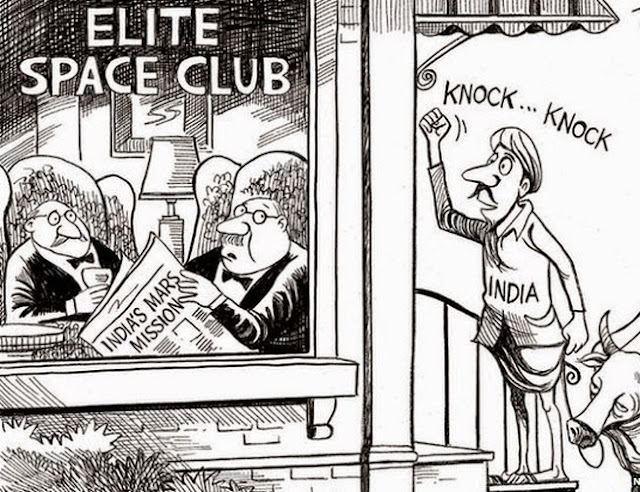
Indians were justifiably very proud of their great scientific achievement when the India Space Agency ISRO successfully launched the nation's Mars Mission back in 2013. The New York Times, America's leading newspaper, mocked India with a cartoon depicting the country as a dhoti-wearing farmer with his cow knocking on the door of the Elite Space Club.
 |
| New York Times Cartoon |
In an article titled "Paper Elephant", the Economist magazine talked about how India has ramped up its military spending and emerged as the world's largest arms importer. "Its military doctrine envisages fighting simultaneous land wars against Pakistan and China while retaining dominance in the Indian Ocean", the article said. It summed up the situation as follows: "India spends a fortune on defense and gets poor value for money".
 |
| Der Spiegel's Cartoon Comparing India and China |
After the India-Pakistan aerial combat over Kashmir, New York Times published a story from its South Asia correspondent headlined: "After India Loses Dogfight to Pakistan, Questions Arise About Its Military". Here are some excerpts of the report:
"Its (India's) loss of a plane last week to a country (Pakistan) whose military is about half the size and receives a quarter (a sixth according to SIPRI) of the funding is telling. ...India’s armed forces are in alarming shape....It was an inauspicious moment for a military the United States is banking on to help keep an expanding China in check".
Fareed Zakaria:
CNN GPS host Fareed Zakaria is known to be among the loudest cheerleaders for India and a sharp critic of Pakistan. While he still refuses to say anything that could even remotely be considered positive about Pakistan, it seems that he is souring on his native India.
Speaking with Indian journalist Shekhar Gupta on The Print YouTube channel, Fareed Zakaria called the Indian state an “inefficient state”.“Indian government functions very poorly, even in comparison to other developing countries. Coronavirus has highlighted that reality, " he added. He did not clearly speak about the lynchings of Indian Muslims by people affiliated with the ruling BJP and the brutality of Indian military against Kashmiri Muslims, but he did ask: “What I wonder about (Prime Minister Narendra) Modi is, is he really bringing all of India along with him? He noted sadly:”India seems like roadkill for China".
Has New Delhi's abject failure in containing the coronavirus pandemic finally done what Indian Prime Minister Narendra Modi's extreme brutality and open hatred against Zakaria's fellow Indian Muslims could not do? Has he really had it with Hindu Nationalist government? While he has not used his perch on CNN to do it, it appears that he has started expressing his disapproval of the performance on other platforms.
Here are a few of the key points Fareed Zakaria made while speaking with Shekhar Gupta:
1. There’s no doubt in my mind that the Indian government, and by that I mean the Delhi government, has handled this crisis (COVID19) very poorly.
2. Indian government functions very poorly, even in comparison to other developing countries. Coronavirus has highlighted that reality.
3. In a way, India seems like roadkill for China’s obsession with absolute control over their borders. I do think there is an opportunity here for diplomacy. I don’t think India needs to be confrontational about it (the LAC issue), but of course it should push back.
4. It is now a bipolar world. US and China are way ahead of the rest of the world. For the long term, India needs to decide it’s position with China.
4. Turkey under Erdogan has become more confident and independent. It is culturally proud. It is telling Americans to buzz off.
5. Popularity of political leaders around the world is linked to their performance on the coronavirus pandemic. In India, however, the issues of religion and caste are still dominating.
6. What I wonder about (Prime Minister Narendra) Modi is, is he really bringing all of India along with him? How many Muslims in Indian government? Or South Indians in BJP? It is much less diverse than Prime Minister Jawaharlal Nehru's cabinet.
7. I have been very sad to see how Indian democracy has developed over the last few years. It has become an illiberal democracy.
8. The India media is slavishly pro-government. Self-censorship is widespread in India.
9. The Indian courts fold in cases where government takes serious interest.
Speaking with Indian journalist Shekhar Gupta on The Print YouTube channel, Fareed Zakaria called the Indian state an “inefficient state”.“Indian government functions very poorly, even in comparison to other developing countries. Coronavirus has highlighted that reality, " he added. He did not clearly speak about the lynchings of Indian Muslims by people affiliated with the ruling BJP and the brutality of Indian military against Kashmiri Muslims, but he did ask: “What I wonder about (Prime Minister Narendra) Modi is, is he really bringing all of India along with him? He noted sadly:”India seems like roadkill for China".
Has New Delhi's abject failure in containing the coronavirus pandemic finally done what Indian Prime Minister Narendra Modi's extreme brutality and open hatred against Zakaria's fellow Indian Muslims could not do? Has he really had it with Hindu Nationalist government? While he has not used his perch on CNN to do it, it appears that he has started expressing his disapproval of the performance on other platforms.
Here are a few of the key points Fareed Zakaria made while speaking with Shekhar Gupta:
1. There’s no doubt in my mind that the Indian government, and by that I mean the Delhi government, has handled this crisis (COVID19) very poorly.
2. Indian government functions very poorly, even in comparison to other developing countries. Coronavirus has highlighted that reality.
3. In a way, India seems like roadkill for China’s obsession with absolute control over their borders. I do think there is an opportunity here for diplomacy. I don’t think India needs to be confrontational about it (the LAC issue), but of course it should push back.
4. It is now a bipolar world. US and China are way ahead of the rest of the world. For the long term, India needs to decide it’s position with China.
4. Turkey under Erdogan has become more confident and independent. It is culturally proud. It is telling Americans to buzz off.
5. Popularity of political leaders around the world is linked to their performance on the coronavirus pandemic. In India, however, the issues of religion and caste are still dominating.
6. What I wonder about (Prime Minister Narendra) Modi is, is he really bringing all of India along with him? How many Muslims in Indian government? Or South Indians in BJP? It is much less diverse than Prime Minister Jawaharlal Nehru's cabinet.
7. I have been very sad to see how Indian democracy has developed over the last few years. It has become an illiberal democracy.
8. The India media is slavishly pro-government. Self-censorship is widespread in India.
9. The Indian courts fold in cases where government takes serious interest.
Summary:
Singaporean diplomat, analyst and writer Kishore Mahbubani has argued in his latest book "Has China Won?" that America does not really respect India. Others, including ex US President Bill Clinton, current President Donald Trump, former Secretary of State Hillary Clinton and CNN GPS host Fareed Zakaria, have expressed similar sentiments. It has become increasingly clear that India's loudest cheerleaders like Fareed Zakaria are now starting to see the stark reality of Modi's India as a big failure on multiple fronts. Indian state has failed to contain the deadly COVID19 pandemic. India's economy is in serious trouble. The country's democracy is in decline. India seems like a roadkill for China. This turn of events has created serious problems for Pakistani "liberals" who have long seen and often cited India as a successful example of "secular democracy" at work in South Asia.
Here's a video clip from CNN GPS Show:
https://youtu.be/KpAMVLwBJkM
![]() https://www.youtube.com/embed/KpAMVLwBJkM"; width="200"></iframe>" height="40" src="https://img1.blogblog.com/img/video_object.png" width="200" style="cursor: move; background-color: #b2b2b2;" />
https://www.youtube.com/embed/KpAMVLwBJkM"; width="200"></iframe>" height="40" src="https://img1.blogblog.com/img/video_object.png" width="200" style="cursor: move; background-color: #b2b2b2;" />
Related Links:
Haq's Musings
South Asia Investor Review
Singaporean diplomat, analyst and writer Kishore Mahbubani has argued in his latest book "Has China Won?" that America does not really respect India. Others, including ex US President Bill Clinton, current President Donald Trump, former Secretary of State Hillary Clinton and CNN GPS host Fareed Zakaria, have expressed similar sentiments. It has become increasingly clear that India's loudest cheerleaders like Fareed Zakaria are now starting to see the stark reality of Modi's India as a big failure on multiple fronts. Indian state has failed to contain the deadly COVID19 pandemic. India's economy is in serious trouble. The country's democracy is in decline. India seems like a roadkill for China. This turn of events has created serious problems for Pakistani "liberals" who have long seen and often cited India as a successful example of "secular democracy" at work in South Asia.
Here's a video clip from CNN GPS Show:
https://youtu.be/KpAMVLwBJkM
Related Links:
Haq's Musings
South Asia Investor Review
Is India a Paper Elephant?
COVID19 in Pakistan: Test Positivity Rate and Deaths Declining
Fareed Zakaria Never Misses Any Opportunity to Bash Pakistan
Retired Justice Markanday Katju on Modi's India
Lynchistan: India is the Lynching Capital of the World
73 Year After Independence, Caste-Ridden India Dominated By Brahmins
Pakistan's Pharma Industry Among World's Fastest Growing
Is Pakistan's Response to COVID19 Flawed?
Pakistan's Computer Services Exports Jump 26% Amid COVID19 Lockdown
Coronavirus, Lives and Livelihoods in Pakistan
Vast Majority of Pakistanis Support Imran Khan's Handling of Covid19 Crisis
Pakistani-American Woman Featured in Netflix Documentary "Pandemic"
Coronavirus Antibodies Testing in Pakistan
Can Pakistan Effectively Respond to Coronavirus Outbreak?
How Grim is Pakistan's Social Sector Progress?
Pakistan Fares Marginally Better Than India On Disease Burdens
Trump Picks Muslim-American to Lead Vaccine Effort
Democracy vs Dictatorship in Pakistan
Pakistan Child Health Indicators
Pakistan's Balance of Payments Crisis
Panama Leaks in Pakistan
Conspiracy Theories About Pakistan Elections"
PTI Triumphs Over Corrupt Dynastic Political Parties
Strikingly Similar Narratives of Donald Trump and Nawaz Sharif
Nawaz Sharif's Report Card
Riaz Haq's Youtube Channel
COVID19 in Pakistan: Test Positivity Rate and Deaths Declining
Fareed Zakaria Never Misses Any Opportunity to Bash Pakistan
Retired Justice Markanday Katju on Modi's India
Lynchistan: India is the Lynching Capital of the World
73 Year After Independence, Caste-Ridden India Dominated By Brahmins
Pakistan's Pharma Industry Among World's Fastest Growing
Is Pakistan's Response to COVID19 Flawed?
Pakistan's Computer Services Exports Jump 26% Amid COVID19 Lockdown
Coronavirus, Lives and Livelihoods in Pakistan
Vast Majority of Pakistanis Support Imran Khan's Handling of Covid19 Crisis
Pakistani-American Woman Featured in Netflix Documentary "Pandemic"
Coronavirus Antibodies Testing in Pakistan
Can Pakistan Effectively Respond to Coronavirus Outbreak?
How Grim is Pakistan's Social Sector Progress?
Pakistan Fares Marginally Better Than India On Disease Burdens
Trump Picks Muslim-American to Lead Vaccine Effort
Democracy vs Dictatorship in Pakistan
Pakistan Child Health Indicators
Pakistan's Balance of Payments Crisis
Panama Leaks in Pakistan
Conspiracy Theories About Pakistan Elections"
PTI Triumphs Over Corrupt Dynastic Political Parties
Strikingly Similar Narratives of Donald Trump and Nawaz Sharif
Nawaz Sharif's Report Card
Riaz Haq's Youtube Channel
Akhtar Hussain
Excellent compilation of various extremely important issues and world opinions about them. I am amazed that you are able to decipher perceived reality; in other words dispel fake news and present facts that people can verify. I hope you have plans to grow Pakalumni and make it a channel for reputable Pakistani journalists to learn from and dispel damaging and negative propaganda spread against Pakistan by India. I am active on Facebook and you will not believe have much negativity there is against Pakistanis and poor Afghans believe it. This is what needs to be addressed I believe. There is another site; Quora that is awash with misguided and misleading propaganda against Pakistan.
Sep 22, 2020
Riaz Haq
Thank you Akhtar sahib.
Sep 22, 2020
Riaz Haq
Kishore Mahbubani on China; Tillerson (via Bob Woodward) on Russia
Tillerson added, “Putin feels like we treat Russia like a banana republic.” The year before, Tillerson said he had been tooling around the Black Sea on Putin’s yacht. “And he said to me, ‘You need to remember we’re a nuclear power. As powerful as you. You Americans think you won the Cold War. You did not win the Cold War. We never fought that war. We could have, but we didn’t.’ And that put chills up my spine.” There is a significant opportunity here, Tillerson said. “When Putin said the breakup of the Soviet Union was the greatest tragedy of the twentieth century, it wasn’t because he loved communism. It was because Russia’s stature had been destroyed. “Anybody who tries to think about Russia in terms of the Soviet era doesn’t know a thing about Russia. The seventy years of Soviet rule was a speed bump in Russian history and it had no lasting effect. “If you want to understand Russia, they haven’t changed much culturally in 1,000 years. They are the most fatalistic people on the face of the earth, which is why they’re willing to live under lousy leaders. If you ask them about it, they’d say they don’t like it, but they’d say ‘Das Russia’—‘That’s Russia.’ They’d shrug their shoulders. I would talk to my Russian employees about it. Only one time did Russians rise up in revolution. And that didn’t turn out so well. So they look back on that and they say, Don’t do that again.”
Woodward, Bob. Rage (pp. 9-10). Simon & Schuster. Kindle Edition.
For over two hundred years, Western civilization vastly outperformed the rest of the world, allowing it to overturn the historical precedent; from the year 1 to 1820, China and India were always the largest civilizations in terms of economic strength. The past two hundred years have therefore been an aberration. One reason the West can no longer dominate the world is that the rest have learned so much from the West. They have imbibed many Western best practices in economics, politics, science, and technology. As a result, while many parts of Western civilization (especially Europe) seem exhausted, lacking drive and energy, other civilizations are just getting revved up. In this respect, human civilizations are like other living organisms. They have life cycles. Chinese civilization has had many ups and downs. It should be no surprise that it is now returning in strength.
Having survived over two thousand years, China has developed strong civilizational sinews. Professor Wang Gungwu has observed that while the world has had many ancient civilizations, the only ancient civilization to fall down four times and rise again is China. As a civilization, China is remarkably resilient. The Chinese people are also remarkably talented. As the Chinese look back over two thousand years, they are acutely aware that the past thirty years under CCP rule have been the best thirty years that Chinese civilization has experienced since China was united by Qin Shi Huang in 221 BCE. For most of the past two thousand years, the large pool of brainpower available in the Chinese population was not developed under the imperial Chinese system. During the past thirty years, for the first time in Chinese history, it has been tapped on a massive scale. Cultural confidence, which the Chinese have had for centuries, combined with what China has learned from the West have given Chinese civilization a special vigor today. A Chinese American psychology researcher from Stanford University, Jean Fan, has observed after visiting China in 2019 that “China is changing in a deep and visceral way, and it is changing fast, in a way that is almost incomprehensible without seeing it in person. In contrast to America’s stagnation, China’s culture, self-concept, and morale are being transformed at a rapid pace—mostly for the better.”*
Mahbubani, Kishore. Has China Won? (pp. 11-12). PublicAffairs. Kindle Edition.
Sep 25, 2020
Riaz Haq
Is #Australia shooting itself in the foot by joining the #Quad military exercise at #Malabar, #India? Australia's dependence on China has never been so starkly illustrated. #China #Japan #US https://www.smh.com.au/world/asia/australia-s-dependence-on-china-h...
The budget forecasts tell the tale. Eight of Australia’s top 10 trading partners are expected to see a contraction in economic growth in 2020. China and Taiwan are the only exceptions.
The global economic massacre is laid out line by line in budget paper number one. India and Europe down by 9 per cent, Japan almost 6 per cent, the US 5.5 per cent. The world down 4.5 per cent. China? Up by 1.75 per cent.
Australia's dependence on China for economic growth is well known, but never has it been so starkly illustrated. The country where the coronavirus was first detected is now the sole major economy showing genuine signs of recovery. For that it needs Australian iron ore to make steel and build infrastructure.
The budget assumes a price of $US55 a tonne. It's currently at $US120, driven by supply restrictions on Brazilian iron ore and rampaging demand from China. The difference between the two prices? $47 billion, or almost twice the cost of the government's full personal income tax cut package between 2020 and 2022.
It's not just mining. It's food and merchandise, students and tourists. On all counts, China is Australia's number one market. Australia has been very good at doing business with China and very bad at diversifying.
That leaves it exposed. For all the federal budget's domestic stimulus, it is notable how little it focuses on initiatives outside Australia's borders.
The third largest item in the Foreign Affairs expenditure is $25 million to make sure prospective arrangements between state and territory governments and foreign governments (read: China) are consistent with Australian foreign policy. That is a domestic initiative delivered through a globally focused department.
Oct 19, 2020
Riaz Haq
Kishore Mahbubani, author of "Has China Won?":
US media is insular
Major American newspapers and TV channels reinforce each other in US distortions about the world
Last 200 years of western domination is an aberration in terms of the long human history of the world. It is coming to an end.
Many American intellectuals and policymakers don't seen to understand that China does not do this.
https://youtu.be/E_CwYCIqEgg
When it comes to analyzing political systems, American analysts tend to veer toward a black-and-white view of the world: open or closed society, democratic or totalitarian society, liberal or authoritarian. Yet, even as we move away from an aberrant two-hundred-year period of Western domination of world history, we are also moving away from a black-and-white world. Societies in different parts of the world, including in China and Islamic societies, are going to work toward a different balance between liberty and order, between freedom and control, between discord and harmony. The Chinese thinkers were also once convinced that the only way to succeed was for China to replicate Western societies. This is why, at the moment of greatest despair for Chinese society, in the 1920s, many Chinese intellectuals said (like the Japanese reformers in the Meiji Restoration) that the only path ahead for China was to copy the West in all dimensions. The Chinese historian Chow Tse-tsung documents: “Lu [Xun] declared that the Chinese should live for themselves instead of for their ancestors. To learn modern science and Western knowledge was more important than to recite the Confucian classics. […] Rather than worship Confucius and Kuan Kung one should worship Darwin and Ibsen. Rather than sacrifice to the God of Pestilence and the Five Classes of Spirits, one should worship Apollo. […] Lu [Xun] was sincere from his realistic and utilitarian point of view; if the new was more useful than the old, he asked, in effect, why should one bother whether it was Chinese or foreign?”* One hundred years later, China no longer lies prostrate. It has stood up and become self-confident. After all the recent travails in both Europe and America, few in China believe that China’s destiny in the twenty-first century is to mimic the West. Instead, they believe China should follow its own road.
Mahbubani, Kishore. Has China Won? (pp. 164-165). PublicAffairs. Kindle Edition.
Oct 30, 2020
Riaz Haq
The TED website describes Kishore Mahbubani, a career diplomat from Singapore, as someone who “re-envisions global power dynamics through the lens of rising Asian economies.” This description is not just apt for Mahbubani but also for his new book, “Has the West Lost It?” The title may appear controversial to a reader unfamiliar with world politics and history, but is is a treatise for the future. In less than 100 pages, the author carefully puts together reasons for the Western world’s demise and suggests a three-pronged solution for a better world, where the gap between East and West is bridged to a large extent
https://www.fairobserver.com/region/asia_pacific/us-uk-china-india-...
In “Has the West Lost It?” Mahbubani dispels myths around Asian countries such as Malaysia, Bangladesh and Pakistan, which have achieved tremendous growth in the last 30 years. On the other hand, the Western world has failed to take care of its working class, which has been forced to the fringes. Mahbubani argues that the rise of countries like China and India mean that the West is no longer the most dominant force in world politics, and that it now has to learn to share, even abandon, its position and adapt to a world it can no longer dominate.
Oct 30, 2020
Riaz Haq
Excerpts of "Has the West Lost It?" by Kishore Mahbubani
This is also why many Asian countries, including hitherto troubled countries like Burma (Myanmar) and Bangladesh, Pakistan and the Philippines, are progressing slowly and steadily. In each of these four countries, various forms of dictatorship have been replaced by leaders who believe that they are accountable to their populations. Many of their troubles continue, but poverty has diminished significantly, the middle classes are growing and modern education is spreading. There are no perfect democracies in Asia (and, as we have learned after Trump and Brexit, democracies in the West are deficient, too).
----------
Pakistan is one of the most troubled countries in the world. Virtually no one sees Pakistan as a symbol of hope. Yet, despite being thrust into the frontlines by George W. Bush after 9/11 in 2001 and forced to join the battle against the Taliban, ‘Pakistan experienced a “staggering fall” in poverty from 2002 to 2014, according to the World Bank, halving to 29.5 per cent of the population.’25 In the same period, the middle-class population soared.
-------------
When countries like Bangladesh and Pakistan have begun marching steadily towards middle-class status for a significant part of their populations, the world has turned a corner. Indeed, the statistics for the growth of middle classes globally are staggering. From a base of 1.8 billion in 2009, the number will hit 3.2 billion by 2020. By 2030, the number will hit 4.9 billion,27 which means that more than half the world’s population will enjoy middle-class living standards by then.
------------------------
No other region can show such a sharp contrast between its dysfunctional past and its functional future, but Southeast Asia is not an exception. South Asia, another strife-ridden area, now probably has only one dysfunctional government, Nepal. As documented earlier, even Pakistan and Bangladesh are progressing slowly and steadily. In the neighbouring Gulf region, the news focuses on the conflict in Yemen. Yet, next door to Yemen, another nation, Oman, has been gradually making progress for decades. Oman’s per capita GDP has increased from US $9,907 in 1980 to US $15,965 in 2015.33
-----------------
Take the Islamic world, for example. They feel that the West has become trigger-happy since the end of the Cold War, and they resent it. Even worse, most of the countries recently bombed by the West have been Muslim countries, including Afghanistan, Iraq, Libya, Pakistan, Somalia, Sudan, Syria and Yemen. This is why many of the 1.5 billion Muslims believe that Muslim lives don’t matter to the West. As indicated earlier, the West needs to pose to itself a delicate and potentially explosive question: is there any correlation between the rise of Western bombing of Islamic societies and the rise of terrorist incidents in the West? It would be foolish to suggest an answer from both extremes: that there is an absolute correlation or zero correlation. The truth is probably somewhere in the middle. If so, isn’t it wiser for the West to reduce its entanglements in the Islamic world? Some of these entanglements have been very unwise. During the Cold War, the CIA instigated the creation of Al-Qaeda to fight the Soviet occupation of Afghanistan. The same organization bit the hand that fed it by attacking the World Trade Center on 11 September 2001. Sadly, America didn’t learn the lesson from this mistake. In an effort to remove Assad in Syria, the Obama administration transported ISIS fighters from Afghanistan to Syria to fight Assad.58 To ensure that the ISIS fighters had enough funding, America didn’t bomb the oil exports from ISIS-controlled zones in Syria to Turkey. Through all this, America declared that it was opposed to ISIS. In fact, some American agencies were supporting them, directly or indirectly.59
------------------
Oct 30, 2020
Riaz Haq
Excerpts of "A Promised Land" by Obama:
“Expressing hostility toward Pakistan was still the quickest route to national unity (in India)”.
"(Manmohan) Singh had resisted calls to retaliate against Pakistan after the attacks, but his restraint had cost him politically. He feared that rising anti-Muslim sentiment had strengthened the influence of India’s main opposition party, the Hindu nationalist Bharatiya Janata Party (BJP)"
"Across the country (India), millions continued to live in squalor, trapped in sunbaked villages or labyrinthine slums, even as the titans of Indian industry enjoyed lifestyles that the rajas and moguls of old would have envied".
"Violence, both public and private, remained an all-too-pervasive part of Indian life”.
“Joe (Biden) weighed in against the (Usama Bin Laden) raid (on compound in Pakistan)”
Nov 16, 2020
Riaz Haq
#India’s #Economy Shrinks Sharply as #COVID19 Slams it. #China has come roaring back, #US , #Europe & Japan are finding their feet but
India’s economy shrank 7.5% last quarter on top 24% decline in previous quarter. #Modi #BJP #Hindutva |The New York Times https://www.nytimes.com/2020/11/27/business/economy/india-economy-c...
“India was expected to really step into China’s shoes and give that additional boost to globalization that was missing,” said Priyanka Kishore, head of South Asia at Oxford Economics. “And that’s where India didn’t really play out the role it was largely expected to play, and that role seems to be diminishing more and more.”
------------------
An estimated 140 million people lost their jobs after India locked down its economy in March to stop the outbreak, while many others saw their salaries drastically reduced, the Mumbai-based Center for Monitoring Indian Economy said. As the lockdown was eased, many went back to work, but more than six million people who lost jobs haven’t found new employment.
In a June survey by the All India Manufacturers Organization, about one-third of small and medium-sized enterprises indicated that their businesses were beyond saving. The industry group said that such a “mass destruction of business” was unprecedented.
-------
Just a few years ago, India, with a population of 1.3 billion people, was one of the world’s fastest-growing large economies. It regularly clocked growth of 8 percent or more.
Global businesses began to warm to the idea of India as a potential substitute to China, both as a place to make goods and to sell them. China’s costs are rising, and its trade war with the United States has complicated doing business there. The Chinese Communist Party is increasingly intruding into business matters, and local Chinese competitors have upped their game against international brands.
But India’s economy was facing headwinds well before the pandemic. Between April and December 2019, G.D.P. grew only 4.6 percent.
-------
One of Mr. Modi’s policies, called demonetization, banned large currency notes overnight in an effort to crack down on tax avoidance and money laundering. Under another, India replaced its welter of national and state taxes with a single value-added tax, in part to cut down on corruption among tax collectors.
Mr. Modi also increasingly turned India’s industrial policy inward, which many economists say has hurt overall growth. The country has long nurtured some of the steepest trade barriers of any major economy, to help its domestic industries develop. Mr. Modi added to that in areas like electronics. His government has also tightened rules around e-commerce, to assist Indian businesses that compete with companies like Amazon and Wal-Mart.
“The slowdown,” said Ms. Kishore, “is almost homegrown.”
Nov 27, 2020
Riaz Haq
Kishore Mahbubani makes several points in his interviews:
1. The United States with about 240-year history likes to pass judgement on China which has over 2,400 year history. What makes the US think China would listen to the American advice?
2. The West is in the habit of judging everyone, including the Chinese. The Chinese have just had the best 30 years of their history. Would the Chinese listen to the American advice on "democracy" and political freedoms after they have seen what happened to Russia when the Russians decided to adopt democracy in 1990s and their economy collapsed?
3. More than 120 million Chinese tourists go to other countries freely and willingly return to China every year. Would they return freely if China was an oppressive stalinist regime? The fact is that while the political freedoms have not increased there has been an explosion of personal freedoms in China over the last 30 years.
Aug 7, 2021
Riaz Haq
#India behaved badly as temp president of #UNSC. #Pakistan is not the only aggrieved party. #Russia also expressed disappointment that Friday’s meeting was devoted exclusively to indulging in diatribes against the #Taliban and Pakistan. - Indian Punchline
https://www.indianpunchline.com/dont-waste-the-opportunity-at-un-sc/
AUGUST 9, 2021 BY M. K. BHADRAKUMAR
Alas, India made a clumsy start to its long-awaited presidency. This farcical performance does no credit to India’s claim for permanent membership of the UN Security Council. There’s only 20 days left before the rotating presidency is passed on to Ireland. India’s nest turn will come only in December 2022, which is a long time in politics. Therefore, buckle up, mandarins. The country expects skilful, imaginative initiatives in the global commons from its diplomats.
----------
India’s thirty-day tenure through August as the president of the UN Security Council has got mired in needless controversy. The issue is about the “emergency meeting” regarding Afghanistan that India convened on Friday. According to Pakistan, it had made a “a formal request” for participation in the meeting but India turned it down.
Prima facie, it was a fair request from Pakistan, since it is a neighbouring country with vital stakes in Afghanistan, whom the international community acknowledges to be a key player in the search for peace.
Suffice to say, if the Pakistani allegation is true, India acted rather petulantly. After all, India and Pakistan had no problem to find common ground regarding Afghanistan at the recent SCO ministerial in Dushanbe!
The optics are bad since this bold Indian “initiative” to convene the meeting followed a phone call from the Afghan foreign minister to his Indian counterpart and it all looks like a pre-planned affair to put down Pakistan on the mat. The old “itch”?
This only leads to misperceptions that India is party to President Ashraf Ghani’s increasingly desperate fight for political survival. Besides, India is flexing its diplomatic muscles even as the American planes are once again bombing the daylight out of Afghans from the safety of the skies.
Unfortunately, Pakistan is not the only aggrieved party. Russia has also expressed disappointment that Friday’s meeting was devoted exclusively to indulging in diatribes against the Taliban and Pakistan. The Russian diplomat pointed out on Friday that settlement in Afghanistan is possible only via talks, not hostilities, and calls for flexibility should be addressed to “both sides of the conflict, not one of them”.
Indeed, India has a tradition of standing by its Afghan friends in distress. Prime Minister Narasimha Rao’s offer to give political asylum to Najibullah in 1992 was a famous instance. India can do some such thing today.
If (rather, when) Ghani is forced to relinquish power and if he and his aides fear for their personal safety, we may offer them refuge by all means. The Afghan bazaar will appreciate such behaviour that conforms to their own Pashtunwali!
To my mind, Delhi should offer refuge to anyone from out there who served Indian interests at any time — and, of course, is genuinely interested in living in our country at such a time in its current history. But, beyond that, to be a partisan in the Afghan fratricidal strife at this late hour will be an unwarranted interference that cannot have a good outcome for India’s long-term interests.
Discretion is always the better part of valour when the endgame comes in successful insurgencies. False pride should not come in the way. Losers can accept defeat with dignity. The current developments clearly show that Ghani’s writ is steadily shrinking to Kabul city and its immediate environs. America’s B-52 bombers and Spectre gunships cannot change this reality. Pity, like the Bourbons, Americans never forget, never learn.
Aug 9, 2021
Riaz Haq
Ghazala Wahab
@ghazalawahab
Two reasons why India's foreign policy always come up short.
1. Exaggerated sense of self.
2. Deep-rooted hatred against Pakistan, which translates into prejudice against Muslims; and repeated iteration of cross-border terrorism, when we know there is no such thing
#IndiaAt75
https://twitter.com/ghazalawahab/status/1430526871196684297?s=20
Aug 25, 2021
Riaz Haq
As extreme #poverty returns, #India sees surge in #child #slavery. Among many gains lost to the #COVID-19 #pandemic, child labour shows resurgence, worsened by inadequate rescue efforts. #Modi #BJP #Hindutva #Islamophobia_in_india https://aje.io/y7puts via @AJEnglish
Across the rural countryside in states such as Bihar that rank low on the Human Development Index, as families strained against widespread loss of livelihoods, India’s already fatigued child-protection mechanisms found more and more children rendered vulnerable to trafficking.
The government of India confirmed that the financial year 2020-21 recorded a small rise over the previous year in the number of children rescued from illegal work.
Children in destitute families are more vulnerable to trafficking than ever.
-----------
When 13-year-old child labourer Shashikant Manjhi died in May 2020, his body could not be transported to his family’s brick-and-mud home in the eastern state of Bihar, 1,126km (700 miles) from Rajasthan state’s Jaipur, where the boy had worked for over a year.
Lockdown restrictions made it impossible, explained the policeman who telephoned the news of the death to the boy’s family, promising to cremate the child respectfully.
Days later, Shashikant’s mother Sahuja Devi conducted the final rites of her last-born on an open field a few hundred metres away from their home. She used a doll fashioned out of paddy husk to represent the child she was consigning to the flames.
In one of a handful of telephone conversations, her son had told her he was bone-tired from placing sequins, stones and glitter on metal bangles for 14-15 hours a day. He was yearning to return.
“For weeks, his employer would not let him speak to us on the phone,” Sahuja told Al Jazeera, seated on the mud floor of her house.
She was stirring a large, blackened aluminium pot of rice that would be lunch for five adults and six children, with a tiny cup of watery dal.
Flies hovered over a small bowl of chopped bittergourd beside the wood-fired mud hearth.
Then her eldest son Mithilesh, 30, took ill and the family needed cash. They managed to get Shashikant on the phone.
“Photan said he would convince his employer to send money,” said Subbidevi, Mithilesh’s wife, using the whimsical name given to Shashikant by the employer.
“Photan’s money didn’t come, only the call came announcing his death.”
No cause of death was given. The family had no way of knowing if the body bore injuries, but they suspected that the child may have insisted upon money being wired home and been injured in an ensuing scuffle.
The employer was in a Jaipur jail briefly, they said, and subsequently released.
In Bhimpur Tola where they live, adjoining Sondiha village and 32km (20 miles) from the nearest town of Gaya, even getting more information would have meant an expensive day trip to Konch police station, 13km (8 miles) away.
“There wasn’t a rupee at home. Unless Photan sent us money, we had nothing,” said Subbidevi.
Shashikant was one of tens of thousands of trafficked child labourers who continued to work during the coronavirus lockdown, their traffickers and employers accustomed to ducking the law enforcers.
Sep 3, 2021
Riaz Haq
#India's Size Illusion by Arvind Subramanian. #Indian policymakers should avoid succumbing to the illusion of size, and reconcile themselves with their country's current status as a middling power. #Modi #BJP #Hindutva #Russia #Ukraine #China @ProSyn https://prosyn.org/hNyXBIw
True, India’s economy is undeniably large. According to the International Monetary Fund, India is the world’s third-largest economy in purchasing-power-parity terms, with a GDP of $10 trillion, behind China ($27 trillion) and the United States ($23 trillion). At market exchange rates, its GDP of $3 trillion makes it the sixth-largest economy, behind the US, China, Japan, Germany, and the United Kingdom.
But India’s economic size has not translated into commensurate military strength. Part of the problem is simple geography. Bismarck supposedly said that the US is bordered on two sides by weak neighbors and on two sides by fish. India, however, does not enjoy such splendid isolation. Ever since independence, it has been confronted on its Western frontier by Pakistan, a highly armed, chronically hostile, and often military-ruled neighbor.
More recently, India’s northern neighbor, China, also has become aggressive, repudiating the territorial status quo, occupying contested land in the Himalayas, reclaiming territory in the east, and building up a large military presence along India’s borders. So, India may have fish for neighbors along its long peninsular coast, but on land it faces major security challenges on two fronts.
Despite these challenges and its sizable economy, India has struggled to generate adequate military resources. Defense expenditure is notoriously difficult to estimate, especially for China and Pakistan, which have opaque political systems. But annual combined defense spending by India’s two adversaries is likely to be three times the $70-75 billion that India spends. And the effective gap is probably even larger, because India’s politically driven emphasis on military manpower has crowded out spending on military technology. In short, India may have a large economy, but dangerous geography and domestic politics have left it militarily vulnerable.
Then there is the question of market size. As Pennsylvania State University’s Shoumitro Chatterjee and one of us (Subramanian) have shown, India’s middle-class market for consumption is much smaller than the $3 trillion headline GDP number suggests, because many people have limited purchasing power while a smaller number of well-off people tend to save a lot. In fact, the effective size of India’s consumer market is less than $1 trillion, far smaller than China’s and even smaller relative to the potential world export market of nearly $30 trillion.
---------------
India needs to accept, and act in line with, its current status as a middling power. Over time, rapid and sustained economic growth could make India the major power it aspires to be. Until then, it must look past the illusion of size and reconcile itself with strategic realities.
Mar 17, 2022
Riaz Haq
America Has Never Really Understood India
The two countries conceptually seem destined to be partners, yet for decades have held remarkably divergent worldviews.
By Meenakshi Ahamed
https://www.theatlantic.com/ideas/archive/2022/05/joe-biden-narendr...
Partly as a result of all these factors, India came to rely heavily on the Soviet Union for its military equipment. The Pentagon, suspicious of the Indo-Soviet relationship, refused to sell India sophisticated weapons or computers and continued to strengthen Pakistan’s military. Nor would the U.S. permit India, which was keen to be an independent actor, to manufacture arms domestically through joint ventures or cooperation agreements. The Soviets were more accommodating to India’s goals and soon became the country’s primary arms supplier. India has long worried about its military dependence on Moscow, but though it has made recent moves to diversify its suppliers, Russian military equipment still accounts for the majority of India’s total defense stock.
-------
On the surface, this apparent distance between Washington, D.C., and New Delhi will seem odd. For more than a decade, the U.S. has sought to build a strategic partnership with India, and the two countries have much in common, including their democratic political systems and their shared concern over China’s rise. Analysts have largely attributed India’s unwillingness to turn against Russia to its reliance on Moscow for military equipment and energy exports. These are undoubtedly significant factors, yet they underplay just how uncertain and shallow the U.S.-India relationship remains.
In fact, the U.S. and India—two countries that conceptually seem destined to be partners—have for decades held remarkably divergent worldviews, finding themselves all too often pursuing conflicting objectives.
To make sense of the course India has taken in 2022, it is helpful to understand India’s relations with the U.S. during the Cold War.
When India became the world’s newest and largest democracy in 1947, its relations with the U.S., the world’s most powerful democracy, should by all accounts have been friendly. Both countries subscribed on paper to the same set of values—a commitment to a rules-based international order, a belief in free and fair elections, the rule of law, civil liberties, and free speech. Yet time and again, they saw things through very different lenses, misunderstanding each other’s goals in the process, ultimately leading to periods where they worked at odds with one another.
May 20, 2022
Riaz Haq
America Has Never Really Understood India
The two countries conceptually seem destined to be partners, yet for decades have held remarkably divergent worldviews.
By Meenakshi Ahamed
https://www.theatlantic.com/ideas/archive/2022/05/joe-biden-narendr...
America’s transactional approach to aid also disappointed Indians. Nehru felt that begging for assistance was demeaning, but he had hoped that as the richer, more established democracy, the U.S. would offer India a helping hand. The U.S. Congress was governed by different sentiments. Some lawmakers argued that any country receiving American aid should show gratitude and were irritated that India had not supported American positions at the United Nations on Israel and the Korean War. “Our relations with India are not very good, are they?” Tom Connally, the chair of the Senate Foreign Relations Committee, said in 1951. “Nehru is giving us hell all the time, working against us and voting against us.” The same year, Senator Henry Cabot Lodge asked, “What are the Indians going to do for us?” His conviction that India would show no appreciation for American help was shared by many on Capitol Hill.
Beyond aid, economic relations were fraught. Nehru had embarked on an ambitious plan after independence to industrialize India and make the country self-reliant, a key Indian goal, but a lack of capital and expertise required the country to partner with others. As part of these efforts, the U.S. held protracted negotiations with India to build a large steel plant in the eastern-Indian city of Bokaro, a project that had become a symbol of Indian national pride, but fundamental differences in economic ideology ruptured negotiations. In the end, the Soviet Union stepped in to rescue the plans.
After Nehru’s death, other disagreements over aid and economics exacerbated the distrust. When Prime Minister Indira Gandhi, Nehru’s daughter, traveled to Washington, D.C., in March 1966 to request food aid in the middle of India’s worst famine since independence, the World Bank and the White House put pressure on her to devalue the rupee as a precondition. Three months later, she did just that, though against the wishes of several members of the government who accused her of auctioning the country. The aid promised to India in return was slow to arrive and it wasn’t the economic success that she had hoped for. Domestically, the entire episode was a political disaster, and to recover support from the left, Gandhi criticized U.S. policy in Vietnam, which enraged then-President Lyndon B. Johnson. He responded by delaying food shipments to India that had already been approved by Congress. Indians were appalled that Johnson was using food aid as a weapon and began to sour on America.
Relations between the U.S. and India have warmed considerably in the past couple of decades. By 2000, India’s economic reforms had propelled growth, which, combined with the country’s military strength and nuclear capability, made it an attractive counter to China’s rise. George W. Bush, who sought to cultivate India as a potential strategic partner, undertook the herculean task of getting congressional approval for a special nuclear deal with India, and relations improved further when Modi was elected India’s prime minister in 2014: He made good relations with the U.S. a cornerstone of his foreign policy.
May 20, 2022
Riaz Haq
Should #US lower its expectations of #India? Instead of investing in #humancapital, #nuclear & #renewable energy, or #healthcare, #Modi’s gov't focus is on “correcting” history textbooks, attacking #Muslims, extoll #Hindu "virtues"! #Hindutva #Islamophobia https://thehill.com/opinion/international/3513889-should-the-us-tem...
By HUSAIN HAQQANI AND APARNA PANDE, OPINION CONTRIBUTORS
India is reprising its Cold War-era strategy of walking the tightrope between Russia and the United States. During the virtual summit between President Biden and Indian Prime Minister Narendra Modi in April, as well as the in-person Quad leaders’ summit in Tokyo in May, Biden requested India’s support on Ukraine. India has refused to stop purchasing oil from Russia, even if it has cancelled some Russian arms contracts.
India’s neutrality over Ukraine has dampened the enthusiasm even of those Americans who have projected India as the key American partner in its competition with China. Indians argue that they are only acting in their national interest and that even though their long-term interests remains tied to the U.S., they cannot forego the short-term advantage of neutrality towards Russia.
Instead of voicing frustration with India over its continued friendship with Russia, U.S. policymakers and commentators would do better to revise their expectations of India. The rhetoric about India being as important in U.S. plans for Asia as Great Britain was for standing up to the Soviet Union in Europe after World War II ignores India’s changing view of itself and the world.
Under Modi and his ruling Bharatiya Janata Party, India is in the process of redefining its nationalism, away from the legacy of Mahatma Gandhi and Jawaharlal Nehru. India’s rising Hindu nationalism (which has overtaken the secular nationalism of India’s early years) is centered on reviving India’s ancient Hindu glory. Ancient India was notoriously insular and not particularly interested in partnering with distant peoples.
While Modi’s India still wants to be recognized globally with respect, it hopes to earn that respect through celebration of an International Yoga Day, not through confrontation with China or Russia. That fundamentally different view of what is entailed in India becoming a global great power makes partnership with the West in accordance with Western expectations unlikely.
India’s economy is not growing at a rate that would position it to be China’s competitor. The expansion of India’s middle class has slowed down. Americans hoping to tap India as the next market of more than 1 billion consumers will have to wait to see that dream become a reality, both on account of its slower economic growth and its over-regulation.
Disappointment will be even greater for those expecting India to field its large military forces against China. Declining investment in military capabilities have made India’s military rather inefficient and inadequately modern. India might be able to face off against Pakistan, but it is still far from being in China’s league.
Around 60 percent of India’s military equipment is of Russian origin, and while India plans to purchase more equipment, it is keen on boosting indigenous capability and having a diverse basket of suppliers. That runs contrary to American expectations of being India’s supplier of choice.
Meanwhile, the U.S. expectation of an influx of orders for American-made nuclear reactors from India, which formed an important basis for the 2008 civil-nuclear deal, remains unfulfilled.
India wants to trade and acquire technology with the U.S. on its terms, which it believes are mutually beneficial. But is not about to become the western partner that successive U.S. administrations and many scholars have imagined.
Jun 7, 2022
Riaz Haq
Should #US lower its expectations of #India? Instead of investing in #humancapital, #nuclear & #renewable energy, or #healthcare, #Modi’s gov't focus is on “correcting” history textbooks, attacking #Muslims, extoll #Hindu "virtues"! #Hindutva #Islamophobia https://thehill.com/opinion/international/3513889-should-the-us-tem...
By HUSAIN HAQQANI AND APARNA PANDE, OPINION CONTRIBUTORS
Instead of investing in human capital, nuclear and renewable energy, or health care, the focus of Modi’s government has been on “correcting” history textbooks to change the portrayal of India’s Muslim and Western-colonial rulers while extolling the virtues of the ancient Hindu era.
Hyper-nationalism has also led to a new wave of protectionism and regulation, which impedes economic expansion. India has also lost the glow of being a success story for democracy and individual political rights. In 2021 and 2022 Freedom House downgraded India to “partly free,” citing attacks on religious minorities, suppression of media and weakening of institutions.
Comments by American officials about India’s direction inevitably attract charges from Indians of unwarranted interference in India’s internal affairs. Secretary of State Antony Blinken recently released the State Department’s 2021 Report on International Religious Freedom and spoke about “rising attacks on people and places of worship” in India. He was widely criticized in the Indian mainstream and social media.
Blinken also described India as “the world’s largest democracy, and home to a great diversity of faiths,” reminding everyone that the image of India as a pluralist and open society might be its great strength in external relations. That image, and the hope that India would be a global great power once it realizes its full economic and military potential, have suffered because of the ideological obsessions of India’s current leaders.
But what is unpopular in the U.S. is popular in India. Modi and his party have been repeatedly rewarded at the ballot box for talking about their civilization’s glorious past. As India postpones building a modern future or chooses to do it at its own pace and on its own terms, western cheerleaders for India’s rise may have no choice but to modify their expectation that India will help fight alongside the world’s democracies against totalitarian China or Russia.
Jun 7, 2022
Riaz Haq
In response to arguments like lowering expectations of India (above), pro-India think tankers want the US to have a policy of what they call "strategic altruism"!
https://www.riazhaq.com/2019/09/ashley-tellis-wants-trump-to-contin...
In a piece titled "The India Dividend: New Delhi Remains Washington’s Best Hope in Asia" published in Foreign Affairs journal, authors Robert Blackwill and Ashley Tellis argue that the Trump Administration should continue the US policy of "strategic altruism" with India that began with US-India nuclear agreement. They want President Trump to ignore the fact that the US companies and economy have only marginally benefited from this policy. They see India as a "superpower in waiting" and urge Washington to focus on the goal of having India as an ally to check China's rise. They see Chinese support for India's archrival Pakistan and China’s growing weight in South Asia and beyond as a threat to India.
Jun 7, 2022
Riaz Haq
The U.S. Is Losing Its Military Edge in Asia, and China Knows It
John Custer
https://www.nytimes.com/2022/06/15/opinion/international-world/us-m...
While the U.S. military is globally dispersed, China can concentrate its forces on winning a future conflict in its own neighborhood. It now has the capability. China has the world’s largest navy and Asia’s biggest air force and an imposing arsenal of missiles designed to deter the United States from projecting military power into the Western Pacific in a crisis. China’s third and most advanced aircraft carrier is nearing completion, and other new hardware is being developed or is already in service.
------
To turn things around, the United States must prioritize the threat from China, reinforce its military strength in Asia and provide Australia, Japan and India more sophisticated military and technological capabilities to bolster a strategy of collective defense.
-------
Washington should support Australian and Japanese aims to build long-range missiles on home soil by sharing intellectual property, provide more U.S. weaponry to India and beef up foreign military financing in the region, starting with a dedicated fund to boost Taiwan’s deterrence capabilities.
------
A Chinese fighter jet veered in front of an Australian military surveillance aircraft over international waters in the South China Sea last month and released metallic debris that was sucked into the Australian plane’s engines.
No one was reported hurt in the encounter, which Australia’s defense minister called “very dangerous,” but it added to a string of recent incidents that demonstrate China’s growing willingness to test the United States and its partners in Asia militarily.
China has systematically tracked U.S. warships in the region, its air force has staged intensifying incursions into Taiwanese and Japanese airspace, and its coast guard routinely harasses Philippine, Malaysian and Indonesian vessels. In recent weeks, Chinese fighter pilots have repeatedly buzzed Canadian military aircraft on a U.N.-sanctioned operation — sometimes raising their middle fingers at the Canadians.
As China’s armed forces grow in strength, sophistication and confidence, U.S.-led military deterrence in the Indo-Pacific is losing its bite.
Take the United States’ military presence in the region. It has about 55,000 military personnel in Japan and 28,000 in South Korea. Several thousand more are deployed across Australia, the Philippines, Thailand and Guam. This posture has barely changed since the 1950s. But plans to reinvigorate the U.S. presence have been stymied by inadequate budgets, competing priorities and a lack of consensus in Washington on how to deal with China.
The Pentagon has increased investments in cutting-edge technologies like artificial intelligence, and cyber- and space-based systems to prepare for a possible high-tech conflict with China in the 2030s. But the balance of power is likely to shift decidedly in China’s favor by the time they are deployed unless the United States brings new resources to the table soon.
President Biden this year submitted the largest defense budget ever in dollar terms, but much of the increase will be swallowed up by skyrocketing inflation. Mr. Biden, like former President Donald Trump, is thus falling short of a target of 3 percent to 5 percent real annual budget growth, a bipartisan goal set even before the Ukraine war and often cited as the minimum the Pentagon needs in today’s era of great-power competition.
Jun 16, 2022
Riaz Haq
#Spain's La Vanguardia newspaper uses #snake charmer's picture to show #India's #economy. Angry #Indians condemn it as "racist caricaturing". #Modi #BJP #Hindutva #hunger #poverty #LaVanguardia https://www.hindustantimes.com/india-news/spains-newspaper-uses-sna...
https://twitter.com/haqsmusings/status/1580977010028867585?s=20&...
A Spanish newspaper, La Vanguardia, has triggered an online storm after its front page featured a caricature of a snake charmer while reporting about the Indian economy. The article titled ‘The hour of the Indian Economy’ was published with the caricature.
Several Indians, including Nithin Kamath, who is the CEO of Zerodha, have slammed the Spanish newspaper.
Calling out La Vanguardia, Kamath tweeted, "Quite cool that the world is taking notice, but the cultural caricaturing, a snake charmer to represent India, is an insult. Wonder what it takes for this to stop; maybe global Indian products?"
Author Rajat Sethi wrote, "'The hour of the Indian economy," says La Vanguardia, a leading Spanish daily on its cover page. While the world is taking notice of India’s economic prowess, their racist caricaturing of Indian snake charmer continues unabated. Meanwhile, other Twitter users also called out the daily."
"Arguably India is still a very poor country. Leave the top 10 per cent of the population aside, the rest of India lives in miserable conditions. Until the time that changes, it is pointless to feel bad about such caricaturing. How the world perceives us, stems largely from how we actually are," a user wrote.
"How come it's an insult? Maybe it's our shortcoming that they don't see India more than that," another user tweeted.
Oct 14, 2022
Riaz Haq
Rotation of #G20 presidency from #Indonesia to #India may have met with indifference in the rest of the world.But in #Modi's India, it has been emblazoned on billboards & front-page advertisements in newspapers & breathlessly discussed on TV channels. #BJP https://www.washingtonpost.com/business/india-is-in-danger-of-missi...
The euphoria over India's G20 presidency shows that Hindu nationalists still need and often crave outside validation. This creates an insoluble problem for them
This month’s rotation of the G-20 presidency from Indonesia to India may have met with indifference in much of the world. In India, however, the news has been emblazoned on billboards and front-page advertisements in newspapers, and is breathlessly discussed on television channels.
The common theme of these celebrations is that the “mother of democracy” — in Prime Minister Narendra Modi’s phrase — is about to become a vishwa-guru, or teacher to the world. As the winter session of India’s parliament opened earlier this month, Modi asked its members to project a responsible face to the world in the months leading up to the next G-20 leaders’ summit in September 2023.
There is no question that for a few days that month, the eyes of the world’s media will be on India. But what will they see? And what international image does India want to project?
The common theme of these celebrations is that the “mother of democracy” — in Prime Minister Narendra Modi’s phrase — is about to become a vishwa-guru, or teacher to the world. As the winter session of India’s parliament opened earlier this month, Modi asked its members to project a responsible face to the world in the months leading up to the next G-20 leaders’ summit in September 2023.
There is no question that for a few days that month, the eyes of the world’s media will be on India. But what will they see? And what international image does India want to project?
Certainly, the emergence of a multipolar world opens up fresh opportunities for India to deploy its unused moral and intellectual capital. Preoccupied with internal troubles, the United States and Europe have left vast tracts of the Global South open to Chinese and Russian influence.
In particular, China dominates Asia, Africa and Latin America with its economic power. Last week, Chinese President Xi Jinping hailed a “new era” in his country’s relationship with Gulf nations as he met Saudi Arabia’s Crown Prince Mohammed Bin Salman in Riyadh. According to Xi, China and the Gulf countries “respect each other’s history and cultural traditions.”
Modi would have a hard time making a similar claim: He was forced to apologize earlier this year to Gulf rulers for the Islamophobic rants of one of his spokespersons. And even in countries with which India shares a Hindu-Buddhist heritage and trading links — Nepal, Sri Lanka, Thailand, Malaysia and Indonesia — India now plays second fiddle to China.
Dec 13, 2022
Riaz Haq
Nor has Modi seized the intellectual leadership of the Global South — a vacancy that is rapidly being filled by Brazil’s President Luiz Inacio Lula da Silva. Emerging from years in prison, Lula has moved fast to reposition Brazil in the avant garde of the global fight against climate change. He is on his way to affirming Barack Obama’s 2009 characterization of him as “the most popular politician on earth.”
In power for nearly a decade, Modi is still struggling to make a similar impact internationally, despite his bear-hugging of world leaders. And that is because the gap between what he says abroad and what he does at home is too wide and too obvious.
Modi is not wrong to claim that India’s core philosophy is vasudev kutamban — the idea that the world is one family. India is arguably the world’s most enduring experiment in cultural pluralism. Those culture-warriors who today belligerently police boundaries of race, religion and gender could learn a great deal from the long Indian experience of multiple, overlapping identities.
Modi’s Bharatiya Janata Party has been relentlessly hostile to this older idea of India, however, as it tries to recast India as a Hindu nation. In a recent study by the Pew Research Center, India fared worse than Taliban-ruled Afghanistan in an index measuring social hostilities involving religion. On other recent rankings — ranging from press freedom to hunger — the mother of democracy has fared equally poorly.
Not surprisingly, the international media has become more critical of India in recent months. Modi now routinely features together with Donald Trump, Boris Johnson, Rodrigo Duterte and Jair Bolsonaro in a gallery of elected demagogues (though perhaps a recent snub of Vladimir Putin may soften the Indian leader’s image somewhat).
Within India, such Western reports are attacked in unison by politicians, bureaucrats, media personalities, film actors and sports stars. These remarkably well-organized and successful campaigns suggest that the silo of fake news and sectarian opinion in India is more impenetrable than anything created by Trump and Fox News.
Nevertheless, the current euphoria over India’s G-20 presidency shows that Hindu nationalists still need — and often crave — outside validation. This creates an insoluble problem for them, as their heavily Hinduized idea of India hasn’t been endorsed by many people outside the country. Evidence came only last month, when Israeli director Nadav Lapid, invited to judge an international film festival in Goa, publicly ridiculed a controversial anti-Muslim film that had been zealously promoted by Modi’s government.
Under attack from Hindu nationalist trolls, Lapid dug in and amplified his scorn. It was then echoed by his fellow foreign jurors. Israeli diplomats got involved. Thus, some small commotion at a film festival blew up into an entirely unnecessary international incident.
Such embarrassments, likely as the world examines India more closely next year, are easily avoided. In the months ahead, the government could end its pressure on dissenters, abandon its dog-whistle rhetoric against Muslims and restore the independence of democratic institutions from the media to the judiciary.
Certainly, those claiming to have mothered democracy need to narrow the great gap between propaganda and reality. For India’s timeless moral — that the world is one family — is unlikely to resonate when broadcast by people trapped in silos.
Dec 13, 2022
Riaz Haq
US-India Relations Aren’t Playing Out Like a Bollywood Movie
Analysis by Bobby Ghosh
https://www.washingtonpost.com/business/us-india-relations-arent-pl...
In American foreign policy circles, where lazy hegemonic assumptions still abound, there is a widespread conviction that the US-India relationship will play out like a Bollywood film: There may be some resistance at the beginning, some friction in the middle and plenty of song and dance along the way, but in the end the protagonists will overcome all hurdles and live happily ever after.
-----------
This failure to communicate is in large part to blame for a growing suspicion among Indians of US foreign-policy objectives. A new survey shows that Indians view the US as the biggest military threat to their country after China — and, even more shocking, put it ahead of Pakistan. Conducted by Morning Consult, a US-based global business intelligence company, the poll also shows Indians are more likely to blame America and NATO than Russia for the war in Ukraine.
---------
But Washington has long since switched sides from Islamabad to New Delhi, and the US Navy now routinely conducts joint exercises with its Indian counterpart. India is a key member of the US-led Quad, a security grouping that includes Japan and Australia and is designed to check Chinese ambitions in the Pacific and Indian Oceans. Surely no Indian in their right mind perceives a real military threat from the US?
Rick Rossow, an India expert at the Center for Strategic and International Studies, reckons the fear is rooted in the consequences of American military adventures elsewhere: “The concern is that our actions threaten Indian interests.”
Rossow, who holds the Wadhwani Chair in US-India Policy Studies at CSIS, points out that as one of the world’s largest importers of hydrocarbons, India suffers collateral damage from American policies that lead to a spike in oil and gas prices. “You can make a strong case that the war in Iraq and the sanctions against Iran have hurt the Indian economy,” he says.
-------
Why hasn’t it? For one thing, it has not cared to. But perhaps more worrisome, it lacks the minimum means to communicate with the Indians. The State Department faces a chronic shortage of speakers in any of the Indian languages. It is also lacking an ambassador in New Delhi. The position has been unfilled since Biden became president.
This is hardly an exception: Republicans in the Senate have blocked a number of Biden appointees for ambassadorships. But even Democrats have questioned his choice of Eric Garcetti for the Delhi job. The former mayor of Los Angeles has faced allegations of ignoring a former top aide’s sexual harassment and bullying; he denies this.
That Biden has persisted with Garcetti’s candidacy for the last year and a half is baffling: The mayor has no special expertise on India. Worse, the State Department has been unable even to maintain a semblance of stability at the embassy, which has been run by five charges d’affaires over the past two years. The longest-serving of these had no India experience whatsoever. (In contrast, Taranjit Singh Sandhu, India’s ambassador to Washington, is on his fourth US stint.)
---------
There is no prominent India hand at the Biden White House, and although much was made of Harris’s ancestry during the election campaign, the administration has not capitalized on the enthusiasm she generated among Indians. Putting the vice president front and center of India policy would be a good place to start undoing the damage of long American neglect.
Jan 22, 2023
Riaz Haq
Ann Coulter tells Nikki Haley 'go back to your own country'
https://nypost.com/2023/02/17/ann-coulter-tells-nikki-haley-go-back...
“What’s with the worshipping of the cows? They’re all starving over there. Did you know they have a rat temple, where they worship rats?”
Haley’s ethnic background was fodder for left-leaning critics who took her to task for serving as UN ambassador during the presidency of Donald Trump.
-----------
Ann Coulter went on a racist tirade earlier this week in which she suggested that Nikki Haley “go back to [her] own country” where people are “starving” while “worshipping cows and rats.”
Coulter also referred to Haley as a “bimbo” and a “preposterous creature.”
Haley, the Indian American former governor of South Carolina who declared her candidacy for the GOP nomination for president earlier this week, has not commented on Coulter’s remarks, which she made on “The Mark Simone Show.”
Coulter told Simone she was particularly angered by then-Gov. Haley’s decision to remove the Confederate flag from the grounds of South Carolina’s Statehouse following the 2015 mass shooting at a predominantly black church in Charleston.
“This is my country, lady,” Coulter said. Her comments were cited by NBC News.
Haley, the daughter of Indian immigrants, was born in South Carolina. During her campaign kickoff event Wednesday, Haley called for a new generation to take the reins of the GOP.
“I stand before you as the daughter of immigrants, as a proud wife of a combat veteran and as the mom of two amazing children,” Haley said.
Coulter, who has a history of making incendiary comments about immigrants, did not hold back during Wednesday’s podcast appearance.
“Her candidacy did remind me that I need to immigrate to India so I can demand they start taking down parts of their history,” Coulter told Simone.
“What’s with the worshipping of the cows? They’re all starving over there. Did you know they have a rat temple, where they worship rats?”
Haley’s ethnic background was fodder for left-leaning critics who took her to task for serving as UN ambassador during the presidency of Donald Trump.
Trump, who has also made controversial remarks about immigrants and foreigners, is looking to recapture the GOP nomination for president in 2024.
Coulter’s rant against Haley nearly coincided with sexist comments made by disgruntled “CNN This Morning” co-host Don Lemon, who enraged his on-air colleague Poppy Harlow by declaring that the 51-year-old former UN ambassador was “not in her prime.”
Lemon, who was conspicuously absent from his co-host chair Friday morning, is skating on thin ice at CNN as a result of his latest blowup, network sources told The Post on Thursday.
Feb 17, 2023
Riaz Haq
Ashok Swain
@ashoswai
German cartoon on India overtaking China on population numbers - Has Jaishankar summoned the German ambassador?
https://twitter.com/ashoswai/status/1650168927580815362?s=20
-----------
German Magazine`s `Racist` Cartoon `Mocking` India Irks Netizens
https://zeenews.india.com/india/german-magazines-racist-cartoon-moc...
With India set to overtake China in terms of population, a 'racist' cartoon reportedly published by German magazine 'Der Spiegel' to depict the demographic change has irked Indians. The cartoon shows an overloaded train with people sitting atop it holding a tricolour while a Chinese bullet train is seen behind on another track probably showing China with technological advancement and India with old-age infra.
However, the cartoon has not gone well with Indians and several prominent leaders criticised the 'racist' depiction. Senior Adviser, Ministry of Information & Broadcasting, Kanchan Gupta said, "Hi Germany, this is outrageously racist. @derspiegel caricaturing India in this manner has no resemblance to reality. Purpose is to show #India down and suck up to #China. This is as bad if not worse than the racist cartoon in @nytimes lampooning India’s successful Mars mission."
Apr 23, 2023
Riaz Haq
Many Indians, including a minister, have been criticising a cartoon in German magazine Der Spiegel that they say was racist and in bad taste.
https://www.bbc.com/news/world-asia-india-65395860
The cartoon shows a dilapidated Indian train - overflowing with passengers both inside and atop coaches - overtaking a swanky Chinese train on a parallel track.
It is being seen as mocking India as the country overtakes China to become the world's most populous nation.
Der Spiegel is a weekly news magazine.
Many Indians have tweeted, saying that that the magazine was stuck with an outdated idea of India and hadn't recognised the progress made by the country in recent decades.
Federal minister Rajeev Chandrasekhar tweeted: "Notwithstanding your attempt at mocking India, it's not smart to bet against India under PM @narendramodi ji. In a few years, India's economy will be bigger than Germany's."
Kanchan Gupta, senior adviser in the ministry of information and broadcasting, tweeted that the cartoon was "outrageously racist". Another Twitter user said the cartoon showed the magazine's "elite mindset".
The magazine has not reacted to the criticism.
While overcrowded trains can still be seen in many parts of India, significant investments have been made to improve the country's railway network and its trains.
Cartoons published by Western media have caused outrage in the country earlier as well. The New York Times newspaper had apologised in 2014 for a cartoon on India's Mars Mission following readers' complaints that it mocked India.
The cartoon showed a farmer with a cow knocking at the door of a room marked Elite Space Club where two men sit reading a newspaper. It was published after India successfully put the Mangalyaan robotic probe into orbit around Mars.
Apr 26, 2023
Riaz Haq
OpenAI CEO Sam Altman: Pretty Hopeless for Indian Companies to Try and Compete with them
https://indianyug.com/openai-ceo-sam-altman-pretty-hopeless-for-ind...
Sam Altman, the creator of ChatGPT, expressed his belief that India’s attempt to develop a foundational AI model similar to ChatGPT may not be worth pursuing.
CEO of OpenAI and creator of ChatGPT Sam Altman was in India for the last couple of days. His visit was concentrated broadly on the way forward and regulation in the area of artificial intelligence (AI).
Meeting with the students of Indraprastha Institute of Information Technology (IIIT) Delhi on Thursday, June 8, 2023, for a one-on-one session with Prime Minister (PM) Narendra Modi, the 38-year-old techie’s emphasis was on the AI tool.
During his visit to India, Sam Altman’s one statement captured the attention of Indians, coinciding with the country’s efforts to formulate AI regulations under the Digital India Bill. The bill, which has been in progress since the previous year, signifies the timing of Altman’s visit.
Sam Altman claimed that Indians would be “totally hopeless” if they attempted to develop something akin to ChatGPT.
This observation gained widespread attention, particularly considering the challenges that tech enthusiasts often face in the country.
Altman’s remarks about the difficulty of freely expressing opinions without taking responsibility for their accuracy among Indian techies sparked a viral response on social media soon after he made them.
Jun 11, 2023
Riaz Haq
"I didn’t like India – the country," she (Dejana Radanovic) wrote on another Instagram Story. "I didn’t like the food, traffic, hygiene (worms in the food, yellow pillows and dirty bed linen in the hotel, not knowing how to use roundabout etc.)
https://www.foxnews.com/sports/tennis-star-called-racist-comments-a...
Professional tennis player Dejana Radanovic was accused of being racist after making comments about India following three ITF tournaments in the country.
Radanovic, the world No. 245 in women’s tennis, slammed the "food, traffic and hygiene" of the country on social media.
"I didn’t like India – the country," she wrote on another Instagram Story. "I didn’t like the food, traffic, hygiene (worms in the food, yellow pillows and dirty bed linen in the hotel, not knowing how to use roundabout etc.)
Another post in Munich, Germany read, "Hello civilization. Only those who have experienced something like India for 3 weeks can understand the feeling."
Radanovic, who is from Serbia, addressed the comments that she was racist by saying she was simply commenting about the country itself, not its people.
"I didn’t like India – the country," she wrote on another Instagram Story. "I didn’t like the food, traffic, hygiene (worms in the food, yellow pillows and dirty bed linen in the hotel, not knowing how to use roundabout etc.)
"If you come to my country, Serbia, and you don’t like all those same things, that means you are a racist??? What the hell that has to do with racism?! I have friends all nationalities and colors so don’t go there cause it’s an absolute NONSENSE!"
Radanovic continued with her Stories, saying she enjoyed the people of India.
"95% of the people who go to India from anywhere else in the world cannot adopt [sic] to that kind of life! Of course it’s different when you are born there and used to it! How does not liking mentioned things mean I didn’t like the people? Quite opposite, I liked the people there a lot."
Feb 12, 2024
Riaz Haq
Derek J. Grossman
@DerekJGrossman
India doesn’t buy what the US is selling.
NSA Sullivan: “Russia will side with China over India any day of the week.”
https://x.com/DerekJGrossman/status/1812155034391720024
Jul 14, 2024