PakAlumni Worldwide: The Global Social Network
Pakistan's Per Capita Milk Consumption Reaches 231 Liters
Per capita milk consumption in Pakistan reached 231 liters (231 Kg) in 2019, according to a new research report entitled ‘Asia – Whole Fresh Milk – Market Analysis, Forecast, Size, Trends and Insights’. It has almost doubled from 119 liters per person in 2011. Milk production in Pakistan is the second highest in Asia and the third highest in the world. Per capita milk consumption of 231 kg in Pakistan is the third highest in Asia, behind Uzbekistan's 339 Kg and Turkey's 281 Kg, according to the IndexBox report.
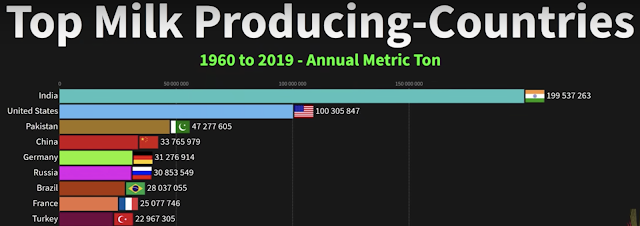 |
| Top Milk Producing Countries. Source: FAO |
Milk Production:
Pakistan produced 47 million tons of milk in 2019, the third largest in the world after top-ranked India's 198 million tons and the United States' 100 million tons. Pakistan’s milk production is projected to increase by an average of 3% a year due to an increase in the herd population. According to FAO projections, Asian production is expected to increase by 2% in 2020 due to expected growth in India, Pakistan, and China, while Turkey may experience a decline.
In value terms, India ($146.8B) led the market, alone. The second position in the ranking was occupied by Pakistan ($37.3B). It was followed by China.
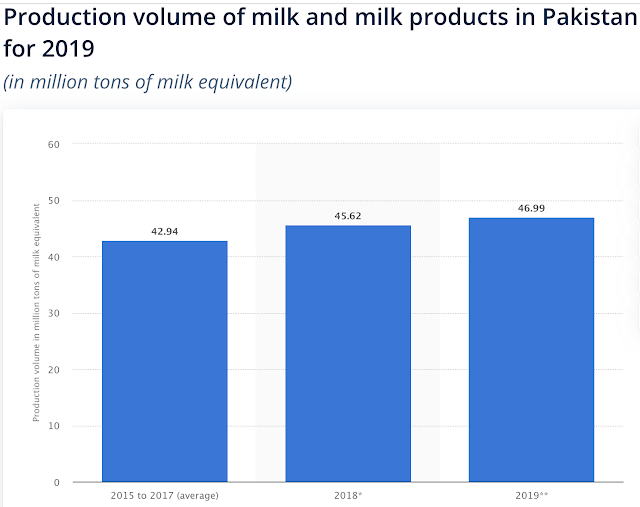 |
| Milk Production Growth in Pakistan |
Milk Consumption:
Milk consumption in Pakistan in 2019 was 231 Kg per capita. It has grown an average of 3.2% a year in the last decade. From 2009 to 2019, the average annual rate of growth in terms of volume in India totaled +5.4%. The remaining consuming countries recorded the following average annual rates of consumption growth: Pakistan (+3.2% per year) and China (-1.2% per year).
Pakistan Dairy Sector:
Vast majority of milk producers in Pakistan are small farmers who own a few cows or buffaloes and sell unprocessed milk. However, commercial scale dairy farming is starting to grow in the country. Since the year 2000, corporate sector has seen the potential and jumped in with brand names like Dawood's Engro and Nestle's MilkPak. This has led to the enlargement of herds with imports of high-quality milk germ plasm, the productivity per animal, milk collection, processing and marketing, the supply of dairy inputs (machinery, equipment, feeds, semen, and elite dairy animals), and farmers knowledge, and skills on modern management practices.
The size of the opportunity for selling dairy products in Pakistan has attracted significant investments from European giants like Nestle, FrieslandCampina and Unilever. Commercial dairy farms like JK Dairy.
Pakistan Agriculture Output:
As of 2016, Pakistan's agriculture output is $52.5 billion, the 10th largest in the world in terms of gross value of agricultural production at current prices, according to Food and Agriculture Organization (FAO). China leads with $1.2 trillion in agricultural output, followed by India's $365 billion, United States with $329 billion, Brazil's $167 billion, Indonesia $135 billion, Japan's $91 billion, Russia's $69 billion, Turkey's $69 billion, France's $65 billion and Pakistan's $52 billion.
 |
| Top 10 Countries by Agriculture Output. Source: FAO |
Summary:
Pakistan is among the world's largest dairy producing and consuming nations. Pakistan produced 47 million tons of milk in 2019, the third largest in the world after top-ranked India's 198 million tons and the United States' 100 million tons. Per capita milk consumption in Pakistan reached 231 Kg in 2019. Pakistan’s milk production is projected to increase by an average of 3% a year due to an increase in the herd population. Vast majority of milk producers in Pakistan are small farmers who own a few cows or buffaloes and sell unprocessed milk. However, commercial scale dairy farming is starting to grow in the country. Overall, Pakistan's agriculture output is the 10th largest in the world.
Related Links:
Haq's Musings
South Asia Investor Review
Chicken Cheaper Than Daal
Meat Industry in Pakistan
Bumper Crops and Soaring Tractor Sales in Pakistan
Meat and Dairy Revolution in Pakistan
Pakistanis Are Among the Most Carnivorous
Eid ul Azha: Multi-Billion Dollar Urban-to-Rural Transfer
Pakistan's Rural Economy
Pakistan Leads South Asia in Agriculture Value Addition
Riaz Haq
Nov 1
Riaz Haq
Nov 1
Riaz Haq
Pakistan's livestock sector is a foundational pillar of its national economy, engaging over 30 to 35 million rural laborers and supporting more than 8 million rural families.
Key Sector Overview
• Economic Contribution: Accounts for over 60% of agricultural value-added and a major share of national GDP.
• Animal Population: According to recent agricultural data, the country's livestock counts roughly 56 million cattle, 48 million buffaloes (including prized breeds like the Nili-Ravi and Kundi), 96 million goats, and 45 million sheep.
• Primary Breeds: Renowned dairy and dual-purpose breeds include Sahiwal and Red Sindhi cattle, alongside the Nili-Ravi buffalo.
• Export & Trade: Pakistan exports significant amounts of meat and live animals—particularly to Gulf countries (UAE, Saudi Arabia, Kuwait, and Qatar)—and recently introduced duty- and tax-free import schemes to expand commercial feedlots and export-oriented processing.
• Current Initiatives: The government has launched programs like duty-free fattening and export tracks under Dawn Business News, alongside bilateral disease-control partnerships with Turkiye to tackle Foot-and-Mouth Disease (FMD).
———-
Pakistan has an estimated total chicken and poultry population of 1.5 billion to over 1.57 billion birds, ranking it among the top poultry-producing countries globally (often cited around 3rd to 8th largest depending on whether total livestock inventory or commercial broiler/layer metrics are used).
Key facts about Pakistan's poultry and chicken numbers:
• Total Chicken Population: Roughly 1.58 billion according to recent livestock estimates.
• Annual Production: The country produces about 2.8 million tonnes of chicken meat and 28.2 billion eggs annually.
• Industry Scale: The poultry sector is a major pillar of Pakistan's agricultural economy, supporting over 1.5 million families.
12 minutes ago