PakAlumni Worldwide: The Global Social Network
Turkish and Israeli Drones Enable Azerbaijan's Decisive Victory Over Armenia
Defense analysts believe that Turkish and Israeli drones have helped Azerbaijan achieve decisive victory against Armenia. "Azerbaijan’s drones owned the battlefield in Nagorno-Karabakh — and showed future of warfare" says the Washington Post headline as tweeted by drone warfare expert Franz-Stefan Gady. Low-cost Azeri drones killed thousands of Armenian soldiers in Nagorno-Karabakh and destroyed hundreds of Armenian tanks and artillery pieces, giving a huge advantage to Azerbaijan and forcing the Armenian surrender. Armenian Prime Minister accused Pakistan of sending troops to help Azerbaijan in the conflict. Pakistan rejected Armenian allegations and congratulated Azerbaijan on its victory.
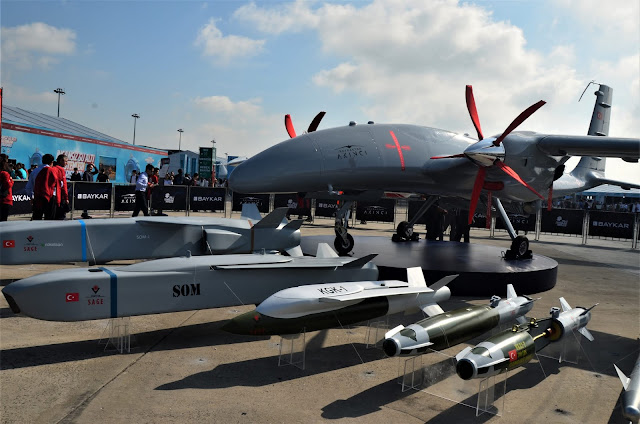 |
| Turkish Drones |
Azeris deployed a variety of drones in their war against Armenia to wrest control of Nagorno-Karabakh, a region that is legally part of Azerbaijan but controlled by Armenians. Azeris used Turkish Bayraktar drones which are large and reusable drones. They also Kamikaze drones made by Israel which are small and designed for one-time use in destroying targets. The small Israeli-made suicide drones are sometimes also referred to as "loitering munitions". Azeris used big old WW2 Antonov AN-2 biplanes as decoys to fool Armenian air defense systems.
Michael Kofman, military analyst and director of Russia studies at CNA, a defense think tank in Arlington, Va. is quoted by the Washington Post as saying, “Drones offer small countries very cheap access to tactical aviation and precision guided weapons, enabling them to destroy an opponent’s much-costlier equipment such as tanks and air defense systems.” “An air force is a very expensive thing,” he added. “And they permit the utility of air power to smaller, much poorer nations.”
In 2019, dozens of cheap drones were deployed against Abqaiq and Khurais oil fields to cut Saudi Aramco's production by half, according to multiple media reports. Saudi and US officials have blamed Iran for the destructive hit. This was the first time that cheap drone swarms loaded with explosives dodged sophisticated air defense systems to hit critical infrastructure targets in the history of warfare.
Small drones are hard to detect even by the most sophisticated radars. It's even harder to shoot down a drone swarm because of their small size and large numbers. After Abqaiq and Khurais attacks last year, Saudi sources revealed that 25 drones and missiles were used to hit the two sites that produced 5.7 million barrels of oil per day. The incoming low-flying small drones and missiles successfully evaded US-supplied sophisticated air defense system. Multi-billion dollar cutting edge American military hardware mainly designed to deter high altitude attacks has proved no match for low-cost drones and cruise missiles used in a strike that crippled its giant oil industry.
Related Links:
Haq's Musings
South Asia Investor Review
Pakistan-China Defense Industry Collaboration Irks West
Pakistan's Cyber Attack and Defense Capability
Is India a Paper Elephant?
Pakistan's Aircraft Exports
Pakistan Navy Modernization
IDEAS 2014 Arms Show
Pakistan Defense Industry
Silicon Valley Book Launch of "Eating Grass"
Pakistan's Human Capital
Pakistan Economy Nears Trillion Dollars
Pakistan's Sea-Based Second Strike Capability
Riaz Haq Youtube Channel
VPOS Youtube Channel
Riaz Haq
Pakistan And India Bolster Azerbaijan And Armenia’s Airpower
https://www.forbes.com/sites/pauliddon/2024/09/29/pakistan-and-india-bolster-azerbaijan-and-armenias-airpower/
Neighboring rivals India and Pakistan are helping two other rival countries in the South Caucasus region build up their modest air forces with fighter jet exports and upgrades.
Beaming and giving a thumbs up from the cockpit of a newly-delivered JF-17C Block III at Heydar Aliyev International Airport in Baku on September 25, Azerbaijani President Ilham Aliyev conclusively confirmed years of rumors that his country would acquire that combat aircraft from Pakistan. The following day, the Pakistani military announced the signing of a contract to sell the single-engine, multirole fighter jets to Azerbaijan but did not reveal the cost or how many fighters the contract covers.
Unconfirmed reports in Azerbaijani and Pakistani media in February claimed Azerbaijan had reached a $1.6 billion deal for the JF-17s but again did not disclose the number of jets.
Either way, induction of these modern fighters with their active electronically scanned array, AESA, radars marks a boost for Azerbaijan’s modest air force, which hitherto consisted of a mere dozen MiG-29s and less than 40 subsonic Su-25 Frogfoot attack planes.
The news came less than a week after Indian media confirmed that Armenia is seeking New Delhi’s help to upgrade its tiny fleet of just four Russian Su-30SM jets, the only fighters Yerevan has. India, which manufactures the Su-30MKI variant under license, is ideally suited for helping Armenia upgrade its four Flankers for reasons previously outlined in this space.
According to the Indian media reports, Armenia seeks the Uttam AESA radar, new avionics, and weapons. India produces the indigenous beyond visual range Astra air-to-air missile, which is compatible with the Su-30, and may well sell them to Armenia. Such upgrades could help Armenia’s twin-engine, sleek, and supermaneuverable Flankers maintain their technological edge against Azerbaijan’s shiny new JF-17s.
Armenia has already bought advanced weaponry from India, notably the Akash medium-range air defense system, and is reportedly considering other systems. In recent years, it has sought to diversify its military procurement sources to lessen its overwhelming reliance on Russian hardware. As part of this process, it also acquired Mistral short-range air defense missiles from France and Caesar howitzers.
More broadly, Armenia’s air defenses are undergoing a transitional phase. Iran International reported in July that Armenia had secretly reached a $500 million deal with Iran for the supply of indigenous long-range air defenses. On top of that, the Kyiv Post recently reported that Armenia signed a $232 million contract with the European Commission in late August to transfer Soviet-era munitions and equipment, including its strategic, long-range S-300 air defense missile systems, to Ukraine.
Both of those reports should, of course, be taken with a gigantic grain of salt. However, one thing is certain: the Armenian armed forces are doubtlessly undergoing a substantial and rapid transformation.
India can doubtlessly help Armenia get the best out of its Su-30s, which arrived in 2019 but were never used in the 2020 Nagorno-Karabakh conflict with Azerbaijan or during subsequent clashes. New Delhi may even be in a position to offer Armenia additional Su-30s.
The Diplomat recently reported that Indian-built Su-30s could be a game-changer in the international arms export market. The country recently entered talks with Russia on the potential joint production of Flankers in India for export. The Russian airframe, which is renowned for its maneuverability, coupled with Indian-made systems and weapons, would offer potential buyers a very unique combat aircraft.
“With a long list of potential clients for a jointly produced Su-30 fighter, the implications of such an agreement for both countries remain highly significant,” read the report.
Sep 30, 2024
Riaz Haq
Faseeh Mangi
@FaseehMangi
Turkey Plans Drone Facility in Pakistan in Global Defense Push | Exclusive
Talks over the project have advanced recently, which would see Turkey export stealth and long-endurance drones to be put together in Pakistan
https://x.com/FaseehMangi/status/1996908814323613836?s=20
---------------
Turkey Plans Drone Facility in Pakistan in Global Defense Push
https://www.bloomberg.com/news/articles/2025-12-05/turkey-plans-dro...
Turkey plans to set up a facility in Pakistan to assemble combat drones as part of its drive to boost its defense industry in international markets.
Talks over the project have advanced significantly since October, and would see Turkey export stealth and long-endurance drones to be put together in Pakistan.
The discussions are part of Turkey's efforts to grow its defense industry, which underpins President Recep Tayyip Erdogan's ambitions to strengthen his influence in the Middle East and further afield.
Turkey plans to set up a facility in Pakistan to assemble combat drones, part of Ankara’s drive to boost its defense industry in international markets, according to Turkish officials familiar with the matter.
Talks over the project, which would see Turkey export stealth and long-endurance drones to be put together in Pakistan, have advanced significantly since October, said the people, who spoke on condition of anonymity to discuss sensitive information.
Turkey’s Defense Ministry declined to comment. Pakistan’s Information Minister Attaullah Tarar didn’t respond to requests for a comment.
The discussions are part of Turkey’s efforts to grow its defense industry, a strategy that underpins President Recep Tayyip Erdogan’s ambitions to strengthen his influence in the Middle East and further afield. The country has announced deals this year including an order by Indonesia for fighter planes and has plans to supply more arms to Saudi Arabia and Syria.
Turkey’s defense exports increased 30% in the first 11 months of this year to a record $7.5 billion, Haluk Gorgun, who heads the presidency’s defense-industry body, said on Thursday.
Turkey has long-standing ties with Pakistan and is building corvette warships for its navy under a co-production deal, according to both countries. Turkey has upgraded dozens of Pakistan’s F-16s and now wants Islamabad to join its Kaan fifth-generation fighter program, the people said.
The talks to bolster Pakistan’s military capabilities come in the wake of a ceasefire with India following a four-day military clash between the nuclear-armed neighbors in May. Tensions are also high between Pakistan and Afghanistan, leading to a series of clashes, ever since Islamabad accused the Taliban of hosting militant groups that plan attacks on the country.
Dec 5, 2025
Riaz Haq
U.S. and Ukrainian Forces Went Head-to-Head in an Exercise. Ukraine’s Drones Won. - The Wall Street Journal.
https://www.wsj.com/politics/national-security/u-s-and-ukrainian-fo...
The exercise, coupled with U.S. casualties in Iran, shows American vulnerabilities to drones—years after the U.S. made uncrewed systems an essential part of warfare. America pioneered using long-range drones in war. The Pentagon has recently spent billions acquiring new drone and counterdrone technology and formed special units to operate it.
Still, in the Middle East this year, the U.S. has struggled to defend against Iran’s long-range drones, which have killed and injured soldiers and destroyed aircraft.
The drubbing in Germany conveyed lessons from Ukraine focused on short-range battlefield drones. The exercise, held in April and May, tested visiting troops’ ability to operate and defend against the proliferation of smaller, front-line drones that have dominated the conflict between Russia and Ukraine.
Exercises like Combined Resolve are run precisely so that forces can experience realistic combat conditions. Army leaders in Europe over recent years have taken advantage of having Ukrainian forces on hand to participate and impart their hard-won skills to U.S. and allied troops in practice, on simulated battlefields. The expectation is that failures are educational. British and Swedish exercises have also resulted in easy Ukrainian triumphs.
Eliot Cohen, a scholar at the Center for Strategic and International Studies think tank, said that recent battlefield experience shows how drones of all kinds are essential to modern war.
“It is vital that the U.S. military master that, and thus far, unfortunately, that does not seem to be the case,” he said.
———
Ukrainian drones were doing this so quickly with U.S. vehicles that they had to be sent back into the exercises as new units, or “re-spawned,” to keep the exercise going, a U.S. official briefed on the drill said.
The U.S. reran the training scenario over the two-week engagement. The rotating forces improved their performance, as they became more adept at dispersing and concealing themselves and using electronic warfare, said the Army official. The Ukrainians also switched sides midway through the exercises and helped them use drone technology offensively, which they did effectively, the official said.
Ukrainian troops have become expert in drone warfare over nearly 4½ years of fighting Russia, with operators and their support troops now skilled at continually repairing and adapting drones. Moscow’s forces have also gained invaluable skills. American drone operators lack experience fixing and arming drones under fire, said the person present at the exercise.
In Ukraine, so many tanks and other armor are destroyed in battle that large parts of the country’s vast front line is almost free of armor.
Some U.S. military officers, though, argue that drones are particularly deadly in this war because it has reached a stalemate with little battlefield movement. In a war of maneuver, the tank and other armor would come back into its own, they say.
But Ukrainian military thinkers such as former chief commander Valeriy Zaluzhniy argue that drone technology has made traditional maneuver warfare unfeasible, for now, explaining the largely static front line in Ukraine’s east. Both Russia and Ukraine are searching for the next breakthroughs in technology and tactics to restore movement to the battlefield.
The exercise showed that the U.S. may struggle to protect that armor as it moves.
This wasn’t the first time the U.S. has come across Ukrainian drone proficiency. In 2023, a U.S. infantry officer helping train Ukrainian troops realized the U.S. needed to learn from them about drone warfare and designed a training program that other Army units later followed, according to a U.S. official.
5 hours ago