PakAlumni Worldwide: The Global Social Network
Raast Aims to Create Pakistan's Unified Digital Payments Infrastructure
Pakistan's central bankers have taken the plunge into the world of digital payments with their own offering: Raast. It aims to create an instant low-cost payment system that can seamlessly and securely connect government entities, a variety of banks, including microfinance banks (MFBs), electronic money institutions (EMIs) and State Bank authorized payment service providers (PSPs) like 1Link and NIFT which may choose to take advantage of it. Currency and coins in circulation account for about 43% of Pakistan's total money supply. The introduction of Raast is part of the government's effort to modernize and document the nation's cash-based informal economy. Undocumented economy poses a serious threat to the country because it creates opportunities for criminal activities and tax evasion. Digital financial services will also promote e-commerce in Pakistan.
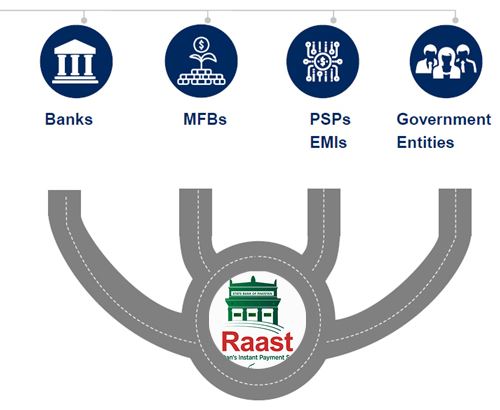 |
| Raast Digital Payment System. Source: State Bank of Pakistan |
Raast Digital Payments:
Raast is a system of digital payment infrastructure. It is essentially a pipe that is intended to connect government and financial institutions with consumers and merchants with each other to process payments instantly at very low cost.
Raast will be boosted by Pakistan government's decision to use it to pay salaries, pensions and pay welfare recipients under Benazir Income Support and Ehsaas Emergency Cash programs.

State Bank of Pakistan intends to demonstrate Raast's usefulness by first processing government payments to individuals, including government employees and Ehsaas welfare beneficiaries, before expanding it for business applications. SBP’s plan is to start person-to-person (P2P) payments using just the phone numbers in Q3/2021 and then bring merchants on board with QR codes by Q1/2022.
Pakistan's Sadia Zahidi Leads WEF Gender Equity Effort
Brothers From Rural Pakistan Teaching AI to American High Schoolers
Pakistan's Computer Services Exports Jump 26% Amid Coronavirus Lockdown
Pakistan Gig Economy Among World's Fastest Growing
Digital BRI and 5G in Pakistan
Pakistan's Demographic Dividend
Pakistan EdTech and FinTech Startups
State Bank Targets Fully Digital Economy in Pakistan
Campaign of Fear Against CPEC
Fintech Revolution in Pakistan
E-Commerce in Pakistan
The Other 99% of the Pakistan Story
FMCG Boom in Pakistan
Belt Road Forum 2019
Fiber Network Growth in Pakistan
Riaz Haq's Youtube Channel
Riaz Haq
In Pakistan, and elsewhere, the stars are aligning for greater use of digital banking and payments to improve financial inclusion. To that end, Amir Wain, CEO of i2c Inc., told PYMNTS CEO Karen Webster in an interview that the pandemic and the rise of mobile infrastructure have set the stage to bring people living in developing and emerging economies into the digital realm.
https://www.pymnts.com/news/payment-methods/2021/super-apps-rising-...
In commerce and in the great pivot away from cash, challenges remain — tied to acceptance. As eCommerce has become more firmly entrenched in countries such as Pakistan, buying and selling goods by digital means (moving away from the cash-on-delivery model) has generated at least a “reasonable acceptance level,” according to Wain, that gets some critical mass through a few large anchor eCommerce merchants in each market.
“You have these ‘local Amazons’ that are cropping up,” he told Webster, “and if you integrate with them, then you have merchants in meaningful numbers driving digital currency activity. Once you have some activity going, you have to think about, how to continue to expand the acceptance network.’ ”
Mobile plays a big part in increasing acceptance, said Wain, as it provides an alternative to point of sale (POS) terminals, land lines that’s easy to deploy and maintain.
QR codes and even peer-t0-peer (P2P) options are gaining favor, especially for smaller retailers.
Regulators are also getting on board with letting NFIs offer financial products in emerging economies, broadening the financial services ecosystem, said Wain. The greenfield opportunities are also attracting significant numbers of entrepreneurs and capital to countries like Pakistan.
All of these factors create a “perfect combination for digital payments to take off in these markets,” he said.
Issuance Matters, Too
Issuing plays a critical role too — as Webster stated, users need secure credentials in place to transact.
“This is where you will find weaknesses and hence will see a lot of improvement over the next few years,” predicted Wain, “People who do not have experience with the issuing business underestimate its complexities. To them, transferring $10 from one account to another appears fairly simple. But there is a lot more to having a secure and stable issuer processing system. System integrity, handling of leading-edge cases and compliance are some of the areas often overlooked. And let’s not forget there are plenty of fraudsters who are looking for system weaknesses that they can exploit.”
Bad actors may be lured by the relatively immature infrastructure. In other cases, apps are too slow, or user interfaces are clunky. In the end, though, evolution is inexorable — and we are evolving toward super apps. With a nod toward Pakistan as a specific market, Wain noted that there is no dominant super app yet — but the conditions now exist for such an offering to take root.
In terms of numbers, he said, the population of 220 million represents a significant market and there are 100 million mobile users (with approximately 70 million smartphones in the market), and counting.
Among the many features tied to the super app, due to launch in the first quarter, P2P proves to be especially useful for people sending money to rural areas — and which will help bring them toward using more services as time goes on. That functionality helps fill a vacuum left by larger, traditional financial institutions (FIs), said Wain, which tend to be slow in responding to consumers’ needs, and where it’s proven difficult to serve individuals’ “small ticket needs” through expensive branches.
Feb 2, 2021
Riaz Haq
It takes a certain kind of person to move in next door to their boss. Today the biggest question in Swiss banking is just what kind of person Iqbal Khan is.
https://www.ft.com/content/ba0d47be-e0fc-11e9-b112-9624ec9edc59
Three months ago, Mr Khan, whose rapid ascent at Credit Suisse had marked him out to many as the heir apparent to chief executive Tidjane Thiam, quit his senior position at the bank. This week, details emerged of a bitter row between Mr Khan, 43, and Mr Thiam, 57, triggered by a confrontation in central Zurich between the private banking prodigy and detectives Credit Suisse had hired to monitor him after he resigned.
It was a lurid end to a spectacular dispute between two of the most powerful men in finance — one from which Mr Khan may yet emerge triumphant. On Tuesday, he is due to take up a senior position at UBS, which would make him a likely successor to Sergio Ermotti as the bank’s chief executive. Mr Ermotti is known to admire Mr Khan’s relentless ambition, prizing it over the qualities of other more rounded contemporaries. Meanwhile, UBS’s chairman, Axel Weber, has taken a dimmer view of the spectacle, according to a person who knows him.
Bruising rows between big egos are not new in the world of finance. But the suburban dimension to Mr Khan’s collision with his boss has given it a distinctive flavour. After he boldly moved into the house next door to Mr Thiam’s two years ago, the pair channelled a simmering generational workplace conflict into bickering over house improvements and blocked views. The dispute climaxed in a row at a neighbourhood cocktail party in January.
“To me, moving in next door like that, there are two signals you might be wanting to send,” says one Credit Suisse executive. “Either: ‘We get along so well I’d like to spend more time near you,’ or else: ‘I’m coming for you.’”
Yet the image of an overweening princeling is only part of the picture. Many of those who have worked with Mr Khan recognise different sides to his personality.
Feb 2, 2021
Riaz Haq
A top adviser to UBS private bank co-head Iqbal Khan won a major promotion as part of a shake-up of the Swiss bank's strategy and corporate development team, finews.asia can reveal.
https://www.finews.asia/finance/33548-ubs-michael-bonacker-christia...
Zurich-based UBS is tasking Christian Zeinler with group strategy, from February 1, according to a memorandum seen by finews.asia. Zeinler is head of strategy and business development at UBS' flagship $2.6 trillion wealth management arm – a job he will retain – as well as chief of staff to Iqbal Khan, who co-runs the unit.
The change was set into motion by the departure of Michael Bonacker, who had held the top strategy job since 2017, and will leave by mid-year. Bonacker, an ex-McKinsey partner who held top roles at Deutsche Bank, Lehman Brothers, and Commerzbank before joining UBS, was instrumental in the Swiss bank's strategy reviews since 2017.
Feb 2, 2021
Riaz Haq
Pakistan govt planning to launch country’s first-ever IPG (International Payment Gateway)
https://www.brecorder.com/news/40061735/govt-planning-to-launch-cou...
The government is planning to launch Pakistan’s first-ever “International Payment Gateway (IPG)” to advance the nation’s digital infrastructure in order to provide ease of doing business to the digital users globally.
The Ministry of Information Technology and Telecommunication and the National IT Board (NITB) under the auspices of the government of Pakistan will launch Pakistan’s first-ever IPG.
“We are aiming for User’s Digital payments with ease, convenience, and enhanced safety. In this regard, we are adopting user sensitive inclusive approach and request our users to provide a detailed feedback regarding the features for enhanced usability of IPG,” the ministry added.
As a freelancer, an e-commerce retailer and as a small trader one has to define his or her needs for international payments.
The ministry has also asked the concerned people to share difficulties they are facing in receiving international payments. Further, the ministry has sought details of security-related aspects in receiving international payments, concerns related to fraud-related aspects in international and cross-border payments, and what they would like to have the government of Pakistan provide to meet their special and particular needs international and cross-border payments.
Feb 10, 2021
Riaz Haq
SBP, after approval of the Federal Government, has introduced three new categories of investment abroad under its revised policy governing equity investment abroad and banks have been authorized to allow remittances under newly introduced categories.
https://propakistani.pk/2021/02/10/sbp-modernizes-foreign-exchange-...
1. Establishment of Holding Company abroad by residents for raising capital from abroad: Pakistan’s investment regime is quite liberal that allows full freedom to repatriate profit, dividend, and capital. However, some international investors prefer to invest indirectly through a holding company established abroad specially in the Fintech and Startup firms. SBP’s revised policy will enable the Pakistani Fintech and startup companies to channelize foreign direct investment in the country by establishing a holding company abroad against remittance of up to USD 10,000 and subsequent swapping of shares to mirror the shareholding of a local company in the holding company.
2. Establishment of subsidiary/branch office abroad by export-oriented companies/firms for promoting exports: The policy will enable the export-oriented companies to establish subsidiary/branch office abroad against remittance of 10 percent of their average annual export earnings of last three calendar years, or USD 100,000 whichever is higher. This will facilitate exploring new and non-traditional markets and capturing more export orders, as international buyers prefer dealing with subsidiaries/representative offices of foreign companies present in their country. Accordingly, the proposed policy would help in the growth of export-oriented companies and boost the exports of the country.
3. Investment abroad by Resident Individuals: The policy will allow the Resident Individuals of Pakistan to acquire an equity stake in international firms through share option plans or investment in listed securities subject to observance of the annual ceiling of foreign exchange defined in the policy. In the case of sweat equity, a person can acquire up to twenty percent shareholding in a foreign company. These policy provisions will provide opportunities to individuals to earn foreign exchange for the country in the form of repatriation of dividend/ capital gains to Pakistan.
Feb 11, 2021
Riaz Haq
#Unilever’s #Pakistan #Delivery Service Partner blueEX Plans #IPO on #KSE to Expand Network. #Karachi-based courier service plans to sell new shares equal to 25% of the company within the next two months. #ecommerce #economy #tech https://www.bloomberg.com/news/articles/2021-02-19/unilever-s-pakis...
Universal Network System Ltd., a Pakistan courier service that counts the local units of Unilever Plc and Nestle SA as clients, is planning an initial public offering to expand its network and bolster its technology backbone.
The Karachi-based company, which operates the blueEX courier service, plans to sell new shares equal to 25% of the company within the next two months, said Chief Executive Officer Imran Baxamoosa. He didn’t disclose financial details.
The initial share sale will make it the first logistics company to list in Pakistan and lure investors to a business that’s crucial for the nation’s booming e-commerce industry, according to Topline Securities Pakistan Ltd., financial adviser for the IPO.
“There is some crazy exponential growth that is being foreseen right now,” Baxamoosa said in a phone interview. “We have grown organically so far but now it’s about time that we get aggressive.”
The courier company that started by handling cargo in 2005 entered the e-commerce business six years later by going door-to-door and convincing companies to start online sales. It even made websites, back-end software and set up a call center for its clients.
It now has about 1,000 employees and over 350 vehicles. The company will use the proceeds to boost its network fourfold. It will also add servers and other IT equipment.
The nation’s e-commerce industry is in its infancy but is growing rapidly as internet and smartphone penetration jump, according to Ruchir Desai, fund manager at Hong Kong-based Asia Frontier Capital Ltd. The pandemic could be a big trigger for the market, he said.
The company handled 2.1 million shipments and 4.5 billion rupees in cash deliveries in the year ended June. It has grown annually by about 70% on average since 2012. The company forecasts revenue will rise more than three times to 4.3 billion rupees in fiscal 2023, according to Baxamoosa.
Feb 20, 2021
Riaz Haq
China’s new digital yuan: Lessons for Pakistan
https://dailytimes.com.pk/719831/chinas-new-digital-yuan-lessons-fo...
Muhammad Zubair Mumtaz
FEBRUARY 3, 2021
As more and more nation contributes to and depend on the global economy, the process associated with routing payments smoothly so that they can be monitored by the central banks becomes important. Over time, various types of digital payments were introduced to facilitate business and household transactions. However, a lot more is required to be done by Central Banks to help build trust in digital payments.
China, being the leader, has launched a Central Bank Digital Currency (CBDC). An initiative was taken in September of 2020 to allow Digital Currency Electronic Payments (DC/EP). In simple words, the DC/EP is a digital version of the Chinese yuan backed by deposits held by the central bank. To take advantage of this form of digital payments, banks must replace a portion of yuan holdings with assets that are in digital form and then allocate it to businesses and the public using mobile technology.
In contrast, payments are also made using cryptocurrencies; what is different in DC/EP? The answer is the legal status that differentiates between DC/EP and cryptocurrencies. In terms of making payments through cryptocurrencies, the laws are vague in regards to whether it is legal to pay for goods and services in China using this form of payment; however, DC/EP is recognized as a legal tender to make transactions. The government will also control the digital yuan while cryptocurrencies are decentralized and do not have a single entity to manage their supply. Anonymity is another significant difference between the digital yuan and cryptocurrencies. Cryptocurrencies are anonymous whereas the digital yuan will be monitored, tracked, and backed by the government.
---------------
On January 11, 2021, Prime Minister, Imran Khan, launched the first digital payment system, ‘Raast,’ to promote financial inclusion and government revenue. This system will be implemented in three phases ending in early 2022. This timely initiative by the government is highly commendable as it will serve its purpose in many ways. Several private-sector digital cash transfer systems already exist that do not require a bank account like JazzCash, Easypaisa, Telenor Pakistan; however, Raast would be the first to connect government organizations and financial institutions. Businesses, fintechs, merchants, individuals, and government entities will utilize this system to receive and send real-time payments via the internet, mobiles, and agents. Using the Raast, the government will pay salaries, pensions, and financial support programs (e.g., the Benazir Income Support Program, the Ehsaas Emergency Cash program, etc.). This initiative is vital to restrict illegal financial transactions perpetuated by militant and extremist organizations. An essential requirement of the Financial Action Task Force (FATF) is fulfilled through digital payments which will help Pakistan come off of the grey list. Furthermore, Raast will automate the collection of taxes on transactions and tighten rules on banking.
Though Raast is not an alternative to digital currency it will be useful to align the transaction channels as the government will have full information about receipts and payments. Based on this information, the informal economy will be brought into the tax net and corruption can be reduced significantly. The government may also control the money supply and take fiscal and monetary measures accordingly.
Feb 28, 2021
Riaz Haq
Digital transactions boom in Pakistan
https://tribune.com.pk/story/2290192/digital-transactions-boom-in-p...
According to the (State Bank of Pakistan) report, during the Oct-Dec 2020 quarter, 296.7 million e-banking transactions, valuing at Rs21.4 trillion, were carried out, registering a growth of 24% in volumes and 22% in value compared to the same quarter of last year.
Most of the rise in e-banking transactions was seen in internet and mobile banking.
“Owing to Covid-19, it is no surprise that the country has seen a boom in digital financial transactions,” he said, adding that for most of the people before 2020, e-banking was a difficult process to handle, which carried with it significant security risks as well.
“Coronavirus lockdown was a forceful phenomenon, but it is now turning into a normal thing,” remarked DH Corporation Research Lead Karim Punjani.
The volume of mobile banking transactions stood at 44 million, up 147%, valuing at Rs1.12 trillion, up 192% in the quarter under review compared to 17.8 million transactions valuing at Rs382.5 billion in the same quarter of last year.
The number of registered mobile phone banking users reached 9.4 million, an increase of 5%. Similarly, 22 million internet banking transactions valuing at Rs1.3 trillion were recorded during the Oct-Dec 2020 quarter compared to transactions worth Rs1.1 trillion in the previous quarter.
“The decision taken by the central bank to waive inter-bank fund transfer (IBFT) charges is a good move and we hope this continues,” said Nouman Younas, who recently conducted online transactions.
“Decisions such as waiving the IBFT fee will lead to a reduction in the workforce in commercial banks,” said another digital transaction user Adeel Nazir.
In response to SBP’s measures to incentivise the installation of Point-of-Sale (POS) machines to facilitate digital payments through debit or credit cards, the number of POS machines grew 18% during the quarter under review, reaching 62,480 throughout the country, the report said.
With the help of these POS machines, 23 million transactions amounting to Rs115 billion were processed during the second quarter of FY21, which shows the positive impact of conducive policies adopted by the central bank, particularly targeted at increasing the payment acceptance infrastructure in the country.
Authorities should encourage banks to establish CDM (cheque/cash deposit machine) like ATMs as they eliminate human interaction and increase online banking efficiency, said a Karachi-based user of digital transactions Mubashir Mahmood.
Card-based transactions on e-commerce portals also increased substantially, with e-commerce merchants processing 5.6 million transactions through payment cards amounting to Rs15 billion in the second quarter of FY21 compared to 3.9 million valuing at Rs11.9 billion in the first quarter.
This marks a shift in the behaviour of Pakistan’s population and also complements government’s efforts to develop a more market-friendly landscape for acceptance of payments by e-commerce merchants.
Mar 19, 2021
Riaz Haq
#Pakistan #fintech SadaPay raises $7.2 million in country's largest seed round. #Islamabad-based fintech startup has raised $7.2 million in a seed round led by New York-based Recharge Capital. #technology #investment https://www.menabytes.com/sadapay-seed/ via @MENAbytes
It includes participation of returning investor Kingsway Capital, Raptor Group, and notable fintech angels, including Ualá’s founder Pierpaolo Barbieri, Ribbit Capital’s Brian McGrath, former General Catalyst partner Ilan Stern, and Valon Technologies’ founder Andrew Wang.
Starting with a digital wallet and a debit card, SadaPay aims to build a “neobank” for Pakistan. Currently available in private beta, its mobile wallet is one of the most anticipated fintech products in the country, with over 200,000 people on the waitlist. It launched the private beta a few months ago after receiving in-principle approval from the country’s central bank. In this pilot phase, SadaPay is allowed to operate with a maximum of 1,000 customers.
The startup will start its public rollout after receiving a full Electronic Money Institution license from the State Bank of Pakistan. SadaPay did not share a timeline, but its founder Brandon Timinsky has told MENAbytes that they would receive the license after successfully completing the audit and inspection from the regulator.
Brandon had started SadaPay in 2019 after selling his previous startup in the United States. He was visiting Pakistan on the invitation of a friend and was amazed by the opportunity that the country of over 220 million offered, “My first visit to Pakistan really opened my eyes to the amount of opportunity that has been hidden from the rest of the world due to the country’s difficult history from over a decade ago,” he stated in a conversation with MENAbytes.
As the statement by the company points out, Pakistan is the fifth most populous country in the world but has the third largest unbanked population after China and India. Brandon believes that the country is at an inflection point for digitization, “Pakistan has a refreshingly progressive regulator, a burgeoning unbanked middle class, widespread smartphone adoption, and over 70% of the population is under the age of 35. We believe that a combination of factors makes Pakistan one of the best places for emerging fintech in the world, and we are excited to be a leader in that ecosystem.”
SadaPay’s mobile app enables users to sign up for a mobile wallet account with a few taps in less than two minutes and start using it right away to make free transfers to any bank account in Pakistan. The signup process is seamless mainly because the company is connected to Pakistan’s National Database & Registration Authority (NADRA) – which means it can instantly verify any Pakistani’s identity from anywhere in the world, including the 15 million Pakistani expatriates living abroad.
The account comes with a virtual debit card powered by Mastercard that can be used for online transactions all around the world. SadaPay also offers a physical numberless debit card that the users can request from its app and receive at their doorstep in two business days (across Pakistan). The physical card allows users to make up to three free cash withdrawals (every month) from any ATM in Pakistan. The company also supports remittances from services like Transferwise, Remitly, and WorldRemit.
When launched, any overseas Pakistani will be able to sign up for a SadaPay account using their NADRA-issued ID card, the company’s CEO told MENAbytes, adding that will become the easiest way to send money to Pakistan, for free, at the best exchange rates in the world.
“Since SadaPay does not bear the high costs of managing the physical infrastructure of traditional banks, it passes those savings to its customers in the form of free financial services. The company will generate revenues from premium product offerings such as merchant services and remittances,” noted the statement.
Mar 31, 2021
Riaz Haq
India has the highest percentage of smartphone users, at 69 percent, followed by Sri Lanka with 60 percent, Nepal 53 percent and Pakistan 51 percent.
https://www.thedailystar.net/backpage/news/bangladesh-behind-nepal-...
The report was unveiled at a virtual roundtable organised jointly by GSMA (Groupe Spécial Mobile Association) and the Association of Mobile Telecom Operators of Bangladesh (AMTOB).
The report, titled "Achieving mobile-enabled digital inclusion in Bangladesh", said 4G network now covered 95 per cent of the population. Yet, there was still a significant usage gap of 67 per cent as only 28 per cent of the population had 4G connections.
"This suggests a lag between 4G coverage rollout and usage of 4G services. This lag in usage is largely explained by issues related to the affordability of devices, low levels of knowledge and digital skills, a perceived lack of relevance, as well as safety and security concerns."
High sector-specific taxes, a fragmented licensing regime, as well as issues with the pricing and usage restrictions on spectrum have been identified as barriers to expanding coverage.
Bangladesh, however, fares better compared to Nepal and Sri Lanka in terms of 4G connections. Only 17 per cent of the population has 4G connections in Nepal, and 18 per cent in Sri Lanka, according to the report.
India has the highest 4G connections at 63 percent of the population followed by Pakistan.
Bangladesh has 17 crore mobile connections. Of them, nine crore are unique subscribers, giving a penetration rate of 54 percent as of December 2020.
Some 47 percent of subscribers use 2G connections and 25 per cent 3G connections.
The report said internet and digital technology played a key role in helping drive economic growth and societal development in Bangladesh.
Digital technologies, mobile in particular, will be crucial to implementing the government's 2041 Perspective Plan, achieving the Sustainable Development Goals, and recovering economically in the aftermath of the Covid-19 pandemic, the report said.
Apr 4, 2021
Riaz Haq
Pakistan ready to adopt digital financial solutions on large scale, says Easypaisa CEO
https://nation.com.pk/06-Apr-2021/pakistan-ready-to-adopt-digital-f...
“Pakistan is rapidly progressing when it comes to mobile broadband. Our country has enormous potential with respect to widening financial inclusion through digital solutions. Currently, 95 million people across the country use mobile broadband, a number which has grown by 50 million in the past 5 years. A majority of adults have broadband connections in Pakistan serving as a backbone to developing a digital payments ecosystem in the country.” said M. Mudassar Aqil, CEO Easypaisa/Telenor Microfinance Bank, while talking about Pakistan’s financial services landscape.
“96% individuals have a biometrically verifiable ID issued by the government, indicating that a robust regulatory framework is in place which is supported by credit bureaus. Despite these fundamental factors, 70% of Pakistanis don’t have access to financial services when the rails to address these challenges are in place,” he added. During COVID-19, digital payments witnessed a boom. According to the SBP’s quarterly report, 296.7 million e-banking transactions, valuing at PKR21.4 trillion, were carried out during Oct – Dec 2020, growing by 24% in volume and 22% in value compared to the same quarter last year.
“During COVID-19 industry numbers of digital transactions grew at an exponential rate. At Easypaisa, our annual throughput increased by 64% as compared to the previous year reaching PKR 1.5 trillion in 2020. Similarly, the number of active Easypaisa App users reached 3.44 million, registering a 54% increase in comparison to previous year.” he commented. Pakistan is predominantly a cash-based economy. However, things are changing as the use of digital payments is taking center-stage.
Mudassar opined: “The Pakistani economy is ready to adopt digital financial solutions on a large scale as opening a mobile wallet account on a smartphone or feature phone takes less than a minute. Roughly PKR 6 trillion or about one-third of the country’s deposits are in circulation. This is one of the highest percentages anywhere in the world and the only way to reduce this is for every adult in the country to have a mobile wallet. Furthermore, all retail outlets in Pakistan should be mandated by law to accept digital payments from mobile wallets. Tax incentives should also be introduced making digital payments cheaper than cash.”
Apr 7, 2021
Riaz Haq
Pakistan: Central Depository Company (CDC) and National Institutional Facilitation Technologies (NIFT) signed an agreement to enable digital payments through NIFT ePay.
https://nation.com.pk/08-Apr-2021/cdc-signs-agreement-with-nift-to-...
CDC is recognised as the infrastructure backbone of Pakistan’s capital market and it is the sole securities depository in the country, while NIFT is one of the largest payment processors in Pakistan.
This collaboration will enable the investors to use NIFT ePay services for investing into Mutual Funds using CDC’s digital platform” “Emlaak Financials.” Furthermore, the solution will also be facilitating CDC’s IAS account holders to make IAS payments through CDC Access portal.
The agreement was signed by NIFT’s CEO Haider Wahab, and CDC’s CEO Badiuddin Akber at the CDC’s head office.
NIFT’s CEO stated, “We are delighted to be a part of CDC’s newly launched initiative for the Mutual Fund Industry. We understand that the “Emlaak Financials” platform has an aspiring roadmap, and we look forward to playing our role in enabling the platform and in making this service a success. NIFT will always focus to partner for unique and innovative ideas which will uplift the digital transformation in Pakistan.”
At the signing ceremony, CDC’s CEO Badiuddin Akber said, “As we embark on this collaboration with NIFT, it gives us immense pride that we are engaging NIFT’s payment gateway for the first of its kind mutual fund aggregator platform , being launched in the financial landscape of Pakistan. The launch of this platform and its integration with NIFT’s services to enable secure and swift payments for mutual fund investors is in-line with CDC’s vision of enhancing efficiency and ease of doing business.”
Apr 9, 2021
Riaz Haq
#Pakistani-#American founder's #SiliconValley payment processing company i2c vows to hire 500 employees in Pakistan as it continues to grow at exponential rate. The #fintech has 65% of its workforce based in #Lahore, #Pakistan. #technology
https://www.techjuice.pk/i2c-hire-500-people-pakistan/
i2c has recently hired Jon-Paul Ales-Barnicoat to lead its human resources development as the organization plans to massively scale and hire 500 resources in the next 12 months majorly from Pakistan making the total organizational headcount to over 2500.
Jon Paul is an industry veteran with experience of working at Silicon Valley tech companies including Fandom, Pixar, GE. Joining i2c is a new experience because the company is majorly driven by the workforce in Pakistan and most of the human capital too is based here. With the ongoing conversation about the future of remote work, we felt it would be interesting to understand Jon Paul, the new Chief Human Resource Officer’s perspective and how he visualizes that for i2c, given the organization has been working remotely before the rise of the term ‘future of work’ and ‘remote working’.
So, we sat with Jon Paul during his recent visit to Pakistan to discuss the tech ecosystem, i2c, and how the organization plans on scaling effectively right from the heart of Pakistan, Lahore.
Founded in 2001, and headquartered in Silicon Valley, i2c’s next-generation technology supports millions of users in more than 200 countries and territories. It is a common name in the tech circles of Pakistan. Specially fresh graduates in Computer Sciences, Software Engineering and other IT related fields are aware of the organization because of its large scale hiring drives in the north and center of Pakistan.
Jon tells me how he is excited to be visiting Pakistan for the first time and working from i2c’s Lahore office. I ask about how his experience has been so far. Jon tells me, “Pakistani people in particular have been very welcoming and sincere in their intention. The value system is very precious. The sense of community, and the family values are permeated into professional relationships as well. And there’s a tremendous amount of loyalty and respect for one another.” I was curious how i2c is unlocking that value system in the workplace.
Jon tells me,
“You see i2c is built on the shoulders of Pakistani employees. We understand their contributions and provide benefits which are very nurturing for our employees.
We give our employees cars. We have a daycare center. We feed our employees twice a day. Our medical benefits are amazing. And we have education benefits for our employees’ children. And now we have created a real cash plan where our employees are going to get a share in the success of the company. We contribute to the retirement fund as well. Very few companies of our size do that.”
i2c has been quietly setting its foot in different regions of the world. Right now the Pakistani offices have almost 1000 employees in total whereas outside the country, there are over 600 employees based in US, Canada, Europe, Latin America. The organization will be expanding across all regions with specific plans to hire over 500 employees in Pakistan in the next 12 months. I was curious if there is a process for rotational assignments, and internal transfer of employees between different countries. Jon told me that Amir, the founder, and he have been working on it and believe that this is a great differentiator and advantage for their employee base in Pakistan. Due to COVID situations, this program is on halt but there have been several examples of employees moving from Pakistan to the US and later to Canada.
Nov 18, 2021
Riaz Haq
SBP launches free P2P fund transfers under Raast
https://www.dawn.com/news/1673190
The State Bank of Pakistan (SBP) on Thursday directed banks to introduce free person-to-person (P2P) fund transfers under Raast, a digital payment system.
The central bank said it has issued instructions to banks that will enable P2P payments in the country through Raast.
The central bank has been working hard for reforms in the financial system through digitisation and improvement in the payment system. Several measures were taken to bring the payment system on a fast track with minimum time spent.
Developed by the SBP, Raast — an Urdu word that means correct and direct — offers an instant, reliable and zero-cost digital payment system to the people of Pakistan.
The SBP believes that the launch of Raast P2P service will not only provide a convenient and hassle-free digital fund transfer service to customers but will also provide an efficient and enabling payments infrastructure that would pave the way for digitisation of the economy and promotion of digital financial services in the country.
The SBP has provided an explanatory video on YouTube and SBP’s website that explains to the public in simple terms how to make payments and transfer funds using Raast.
“Under Raast P2P fund transfers and settlement services, bank customers would be able to send and receive funds in their accounts using their bank’s mobile application, internet banking, or over-the-counter services,” said the SBP.
For customers’ facilitation, they can set their registered mobile phone number as their Raast ID and link it to their preferred International Bank Account Number (IBAN) using the bank’s mobile application, internet banking, or visiting their bank branch.
“Once a customer has set her/his mobile phone number as the Raast ID, others can send money to her/him using her/his mobile phone number without the need to know the account number or any other details,” said the SBP.
Bank customers can still use Raast service for sending or receiving funds using their IBANs even if they do not have a Raast ID or prefer to use their IBAN.
The SBP has directed all banks to make Raast P2P fund transfer service available on at least three customer channels including mobile application, internet banking and branch counters.
The list of banks that have completed the necessary technological upgrades and other needed preparations and are offering Raast P2P services to their account holders as of today has been issued, said the SBP.
Feb 14, 2022
Riaz Haq
Raast is like Zelle in US
Qureshi@globosoftReplying to @UzairYounus and @haqsmusingsJust like
https://zellepay.com in USA. No need to disclose your bank account number to others. Just give/ publish your mobile number to receive payments. All you need is to attach/ register your mobile number with your bank account.
https://twitter.com/globosoft/status/1489462938234720257?s=20&t...
Feb 14, 2022
Riaz Haq
Sending money to family and friends used to be limited to cash or check. But the rise of digital banking apps and services has made it easier than ever to send money to loved ones quickly.
https://www.forbes.com/advisor/banking/sending-money-to-family-and-...
With an abundance of digital payment options available, choosing the best way to send money can get a little tricky. While many money transfer tools are free to use, some charge fees. And some solutions take longer to process transfers than others.
Here are eight ways you can send money to family and friends fast.
1. Zelle
Fees: None
Transaction limits: $500 weekly, may be subject to bank limits
Transfer time: Within minutes
Zelle is a popular peer-to-peer payment tool for sending and receiving money via bank transfers. The company managed roughly $519 million worth of transactions during the first half of 2020 alone. Individuals can enroll to use Zelle through their bank‘s mobile app or by downloading the Zelle app. Either the sender or the person receiving money must have access to Zelle through their bank or credit union.
Zelle payments are processed quickly, with the money accessible within minutes in most cases. If you’re looking to get money to loved ones fast, it doesn’t get much faster than Zelle. Zelle makes the process simple for the receiver, too, sending them a notification that explains what they need to do to receive their payment.
2. Venmo
Fees: 3% fee when using a credit card; other payment methods are free
Transaction limits: $4,999.99 weekly for person-to-person transactions after identity confirmation
Transfer time: Instant
Digital wallets are becoming more common, and Venmo is one of the most recognized wallet apps. Available on iOS and Android, Venmo makes instant payments to family and friends a breeze. Unlike Zelle, Venmo isn’t tied to specific banks. Both parties need a Venmo account, which is easily set up using a mobile phone number or email address.
Users can either add funds to their Venmo account or link an external payment method like a bank account or credit card. Venmo also allows users to sync their phone and Facebook contacts.
Once set up, users pay by inputting the contact name, including a reason for the payment and setting the transfer amount. The money shows up in the recipient’s Venmo account almost instantly. Users also can request money from other individuals.
3. PayPal
Fees: None for U.S. transfers funded by PayPal balance or a linked bank account
Transaction limits: $10,000 to $60,000 limit per single transaction for verified accounts; limits may vary by currency
Transfer time: Typically instant, eChecks may take up to six days
Millions of shoppers worldwide use PayPal, but it’s also a great way to send money to family and friends when needed. PayPal accounts are free to create and easy to use. All you need to do is sign up and then link a bank account or payment card. You only need the receiver’s email address or phone number. Senders can either transfer money into their PayPal account or just send money directly from their linked account or card.
Only some transfers are free, though, so be sure to check before sending money. For example, U.S. transfers funded with a credit card, debit card or PayPal Credit will pay 2.9% of the funded total plus a $0.30 fixed fee. For international transfers, the transaction fee is 5% of the sent total ($0.99 min to $4.99 maximum) for transfers made by cash or a linked bank account; for credit, debit or PayPal Credit, add 2.9% of the funded total and a fixed fee based on the currency.
PayPal is accessible online or via the PayPal mobile app. The app, available on iOS and Android, tracks all of your transactions for easy account management.
Feb 14, 2022
Riaz Haq
Raast Person-to-Person: PM believes SBP's latest initiative to enhance formal economy
Says launch will facilitate people in availing banking services
https://www.brecorder.com/news/40154585/raast-person-to-person-pm-b...
In the past fiscal year, e-banking transactions worth $500 billion took place in Pakistan. This is more than the size of our GDP, which is $370 billion: SBP Governor Dr Reza Baqir
---------
Prime Minister Imran Khan said on Tuesday that the rollout of Raast Person-to-Person, an initiative of the State Bank of Pakistan (SBP), would enhance the formal economy of the country by allowing people to utilise banking channels.
In his address at the launching ceremony of Raast Person-to-Person funds transfer and settlement services, Khan said the initiative is to facilitate the common man to avail banking services.
“The launch of this system would push people towards becoming part of the formal economy as banking system will be used.
“Furthermore, saving rates would improve,” said Khan, adding that countries only prosper when their saving rates are improved.
“However, Pakistan has one of the lowest saving rates in the world. The utilisation of our banking system is low. This results in a low tax-to-GDP ratio,” Khan added.
PM said that a population of 220 million is a major strength for any country as it offers a huge market.
“If this population is brought into the formal economy using modern tools, they can become a major strength. However, a major part of our population is out of the formal economy,” he said.
The prime minister informed that the government is using technological tools to enhance its tax system. “Only 2 million pay taxes out of the total population of 220 million,” he lamented.
“At the end of our five-year term, when our tenure will be assessed, I would look into only one factor and that is if we were able to reduce poverty level in Pakistan, and if we're able to reduce it we would see whether its effects were translated towards the bottom,” he said.
Food security: PM Imran emphasises importance of building dams
The PM said that he would consider it an achievement “if we were able to pull people out of poverty”.
He said that as per World Bank's latest report, despite the Covid-19 pandemic, the poverty levels have raised only marginally as compared to other countries.
“Lastly, I would urge the SBP to establish a cell, which would address concerns of Overseas Pakistanis, as they are our biggest assets,” he said.
Meanwhile, SBP Governor Dr Reza Baqir in his address stated, “Raast P2P initiative will bring a revolution in financial inclusion in Pakistan, and will ease making payments between persons.”
Talking about the features of Raast, the governor said that the payment system is fast, as it provides the end-user with a near real-time payment experience. “Secondly, Raast is free of cost, a bank cannot charge any sort of fee unlike other payment systems,” he said.
“Thirdly, we have made Raast simple to operate, all you need to register yourself through a banking app using one’s mobile number as a Raast ID, which will be linked to the bank account.
“Raast is available on all channels. Lastly, the customer is kept at the forefront, if the customer is not satisfied with the service of a bank, they can change their account and by delinking the Raast ID could connect with another bank, to avail the best banking features.
“We are confident that with these features the latest SBP initiative will be popular among the public,” he said.
Roshan Digital Account for overseas: PM asks SBP to provide online facility of real time money transfer
Feb 16, 2022
Riaz Haq
Raast Person-to-Person: PM believes SBP's latest initiative to enhance formal economy
Says launch will facilitate people in availing banking services
https://www.brecorder.com/news/40154585/raast-person-to-person-pm-b...
PM said that a population of 220 million is a major strength for any country as it offers a huge market.
“If this population is brought into the formal economy using modern tools, they can become a major strength. However, a major part of our population is out of the formal economy,” he said.
The prime minister informed that the government is using technological tools to enhance its tax system. “Only 2 million pay taxes out of the total population of 220 million,” he lamented.
“At the end of our five-year term, when our tenure will be assessed, I would look into only one factor and that is if we were able to reduce poverty level in Pakistan, and if we're able to reduce it we would see whether its effects were translated towards the bottom,” he said.
Food security: PM Imran emphasises importance of building dams
The PM said that he would consider it an achievement “if we were able to pull people out of poverty”.
He said that as per World Bank's latest report, despite the Covid-19 pandemic, the poverty levels have raised only marginally as compared to other countries.
“Lastly, I would urge the SBP to establish a cell, which would address concerns of Overseas Pakistanis, as they are our biggest assets,” he said.
Meanwhile, SBP Governor Dr Reza Baqir in his address stated, “Raast P2P initiative will bring a revolution in financial inclusion in Pakistan, and will ease making payments between persons.”
Talking about the features of Raast, the governor said that the payment system is fast, as it provides the end-user with a near real-time payment experience. “Secondly, Raast is free of cost, a bank cannot charge any sort of fee unlike other payment systems,” he said.
“Thirdly, we have made Raast simple to operate, all you need to register yourself through a banking app using one’s mobile number as a Raast ID, which will be linked to the bank account.
“Raast is available on all channels. Lastly, the customer is kept at the forefront, if the customer is not satisfied with the service of a bank, they can change their account and by delinking the Raast ID could connect with another bank, to avail the best banking features.
“We are confident that with these features the latest SBP initiative will be popular among the public,” he said.
Roshan Digital Account for overseas: PM asks SBP to provide online facility of real time money transfer
He said that Raast is part of the national payment strategy, which was launched back in November 2019. He added that this is a very advanced system and is available in only few countries including Malaysia, Turkey, Australia and UK.
Talking about the launch of digital banks, the SBP chief informed that the central bank would issue five licences. “These digital banks would cater to the common man,” he said.
Baqir said that due to the measures taken by the central bank to promote digital banking, in the past fiscal year e-banking transactions (non-cash based transactions) worth $500 billion took place in Pakistan.
"This is more than our GDP, which is $370 billion. Each year our e-banking transactions increased by 30% YoY.
“We are confident that these figures would improve further with the launch of Raast P2P initiative,” said Baqir.
Meanwhile, Finance Minister Shaukat Tarin in his address at the launching ceremony said that through Raast P2P, the country will see a boom in e-commerce activities.
“I believe that e-commerce would witness a boom with this initiative, and it will increase further in the next step when the SBP moves from person-to-person to person-to-merchant.
“The IT sector including freelancers is looking forward to this system, and they believe that this will bring a revolution, and growth in IT especially exports,” said Tarin.
Feb 16, 2022
Riaz Haq
Raast Person-to-Person: PM believes SBP's latest initiative to enhance formal economy
Says launch will facilitate people in availing banking services
https://www.brecorder.com/news/40154585/raast-person-to-person-pm-b...
---------
“The IT sector including freelancers is looking forward to this system, and they believe that this will bring a revolution, and growth in IT especially exports,” said Tarin.
1.2m new jobs expected: Over 70,000 housing projects worth Rs1.4trn approved: PM
He added that this system would also improve our savings rate, as people will use a bank account to avail this facility, and reduce the cash in circulation. “Saving rate has to go up to 30-40% in order to ensure sustainable growth,” he said.
Tarin informed that in the coming days the prime minister would announce further measures to help the lower, middle-class and salaried class, facing the brunt of rising inflation.
Raast (P2P)
Under Raast P2P fund transfers and settlement services, bank customers would be able to send and receive funds in their accounts using their bank’s mobile application, internet banking or over the counter services. To facilitate their customers, banks will also allow them to create a Raast ID by linking their preferred International Bank Account Number (IBAN) with their registered mobile phone number.
The customers can then share Raast ID with others to receive funds in their account. Bank customers can use Raast service for sending or receiving funds using their IBANs even if they do not have a Raast ID.
Feb 16, 2022
Riaz Haq
Digital cheque clearing, unified QR code for payments launched
https://www.dawn.com/news/1638880
KARACHI: In a move towards digitalisation of financial products and services, the State Bank of Pakistan (SBP) has introduced digital cheques clearing and a unified QR code for payments.
Announcing these initiatives at the 5th stakeholders’ meeting on Digital Financial Services, SBP Governor Dr Reza Baqir said the introduction of these digital services by the financial institutions will benefit all segments of society.
“The digital cheque clearing initiative will replace physical presentation and clearing of cheques thereby reducing the time involved substantially,” the SBP said on Wednesday.
Now one can send a scanned cheque and the bank would make payment or deposit the amount into the account of the receiver.
Speaking to Dawn, veteran banker Nadeem Hussain said the new clearing method will significantly reduce the cheque processing time, especially for ones deposited in bank branches of remote areas.
“Let’s not call it digital check clearing. It’s paperless clearing through a digital mechanism,” he said. It means a beneficiary can send the image of the cheque electronically to their bank instead of presenting it on the bank counter. The bank will then use the image of the cheque to process payment via NIFT, a pre-existing e-platform for clearing, processing, routing and switching of electronic transactions run by National Institutional Facilitation Technologies Ltd, a joint venture of six commercial banks.
Mr Hussain added that the move is a “big step” only in the local context as advanced economies adopted the paperless cheque processing mechanism 25 years ago.
“The second initiative, the introduction of a unified QR code, will allow payments by users from any digital application eliminating the need to use separate apps,” said the SBP.
As for the unified QR code, Mr Hussain said all banks that are in the merchant acceptance business will be required to adopt it. This will eliminate the need for retail shops to display different QR codes for different payment apps, he said. All banks will effectively have the same QR code, which will increase its usability.
At the Digital Financial Services meeting held on Aug 2, the stakeholders also announced formation of a joint task force of SBP and Pakistan Telecommunication Authority to work towards the prevention of digital financial services frauds.
In addition, the SBP and Federal Board of Revenue (FBR) have also agreed to form a joint committee to collaborate on a regular basis to increase digitisation in the economy.
“These and other initiatives have led to 30 per cent and 20pc growth in internet and mobile banking, respectively, in third quarter of FY21 compared to the same period last year.
Briefing on SBP’s Raast payment platform, the SBP governor said that the second phase of person-to-person payments would be launched by October for which banks are being integrated with Raast, a new instant payment system launched in January.
He said the SBP is actively exploring the development of open banking, which allows sharing, and leveraging of customer-permissioned information among financial institutions to facilitate consumer choice, promote competition and efficiency in the financial sector, and encourage the introduction of innovative products and services to benefit consumers.
Dr Baqir said that the SBP will continue to promote innovative digital financial services and is ready to facilitate these endeavors by resolving issues as far as possible. Governor Baqir appreciated stakeholders’ support in facilitating the digital initiatives of SBP, particularly by National Data Registration Authority (Nadra) and FBR in moving forward the drive for digital financial services.
Feb 17, 2022
Riaz Haq
E-banking transactions exceed GDP
https://tribune.com.pk/story/2343698/e-banking-transactions-exceed-gdp
Speaking at the launch of Raast Person-to-Person (P2P) Instant Payments System on Tuesday, the central bank governor said that e-banking transactions were considerably more than the country’s total gross domestic product (GDP), which currently stood at $370 billion.
“If the figure is $500 billion now, you can imagine the pace at which we are digitising,” he remarked, adding that those transactions showed a year-on-year growth of 30.6% in volume and 31.1% in value.
Baqir said that there were around 190 million mobile phone subscribers in the country whereas only 80 million people had bank accounts, meaning that there were over 100 million people who had mobile phones but they did not own a bank account.
“Therefore, there is a huge potential for enhancing financial inclusion,” he said and expressed hope that the Raast initiative would help bridge the gap.
The SBP governor pointed out that Raast was different from other programmes as it facilitated free-of-charge transactions within seconds. He was hopeful that people would take benefit of the revolutionary system.
The State Bank has taken many initiatives for ramping up the pace of digitisation. In this regard, the installation of Point of Sales (POS) machines has shown a growth of 50% and it is expected to rise further at a rapid pace.
In collaboration with the National Database and Registration Authority (NADRA), the SBP will also facilitate people in undergoing biometric verification remotely for opening bank accounts.
The new banking system will be established in line with the Roshan Digital Account that has been introduced for overseas Pakistanis.
“Individuals can use Raast platform in their daily transactions similar to cash and they will not have to pay any fees or charges for using this payment system,” Baqir said. “It is secure, convenient and free of risks compared to cash.”
Feb 17, 2022
Riaz Haq
Digital transactions record robust growth
https://www.dawn.com/news/1653511
According to the State Bank’s latest Annual Payment Systems Review (PSR) for FY21 issued on Friday, the transactions processed through the SBP’s large-value payments segment, known as Real-time Inter-Bank Settlement Mechanism (PRISM), recorded a growth of 60 per cent by volume and 12.8pc by value.
As of June 30 this year, the PRISM system had 51 direct participants — 34 banks, seven microfinance banks, nine development finance institutions and one non-bank entity (Central Depository Company). During FY21, PRISM processed 4.2 million transactions amounting to Rs444.6 trillion.
Feb 19, 2022
Riaz Haq
P2P payment system launched to boost financial inclusion
https://www.thenews.com.pk/print/930018-p2p-payment-system-launched...
Customers at some select banks will now be able to make P2P (person-to-person) transactions instantaneously through their mobile phones as central bank has started rolling out the second phase of Pakistan's first instant payment system, Raast.
The first phase—bulk payments, which enables government-to-person transfers instantly, was rolled out in January, 2021. Now, 21 banks and one mobile money services provider have kick-started the launch of the second phase of the system, allowing individuals to transfer funds to each other by creating their unique Raast ID, which is their mobile number, for receiving funds.
“A customer can login to his/her account via internet banking, mobile app and can create a Raast ID by linking his/her phone number with his/her account number,” Abid Qamar, chief spokesman SBP told The News in an email.
“This mobile phone number can then be used by a sender in place of a bank account number in the transfer of money through Raast. This will bring ease to the customers as typically people find it difficult to memorise or to have quick access to find the bank account number,” Qamar said.
In comparison, he said, remembering mobile number was easier and people had instant access to phone numbers on their mobile phones as well.
“However, it may be mentioned that even if receiving customers do not have a Raast ID, they can still receive funds in their accounts using the conventional interbank account number (IBAN) through Raast,” he explained.
“Few select banks, permitted by SBP, have already started to offer the facility of creating Raast ID and making payments using the Raast Service through their mobile apps or Internet Banking.” Qamar said.
The third phase would be focused on person-to-merchant payments (P2M).
Pakistan has had low electronic transactions for a number of reasons including low banking penetration, lack of trust and awareness of digital payment methods, limited interoperability, difficult accessibility, and high cost of transactions, according to the information posted by the SBP on its website about the payment system.
The real time gross settlement system of Pakistan provides instant payment settlements for large value and corporate transactions only. Raast would facilitate retail payment settlements, the central bank said.
Bankers and analysts, who closely track the payment system, say the addition of Raast to the existing payment gateways is a good development. They are watching whether it will pose a threat to the dominance of 1Link and National Institutional Facilitation Technologies—a platform for clearing, processing, routing and switching of electronic transactions.
The SBP has installed its own system and switch for this facility, while the Inter Bank Funds Transfers (IBFTs) use 1Link switch.
Pakistan is a country where a major chunk of the population is unbanked and relies heavily on cash-based transactions.
“Digital banking/payment in Pakistan is still a relatively new concept and the masses are not too keen to adopt – mostly due to an underlying fear of a lack of security with regards to digital payments as well as the reliability and dependency on cash,” said Khurram Mumtaz, digital and data analytics head at Standard Chartered Bank Pakistan.
“However, we see Raast as a gateway to make payments more seamless and connected, with a hassle-free experience between people, businesses, and organisations to disburse day-to-day low-ticket transactions and payments with a universal infrastructure,” he said.
P2P payments were made available to the clients for a while now via the IBFT. “The barrier to entry for new and upcoming payment systems providers and government entities would be much lower due to its low-cost nature,” Mumtaz added.
Feb 19, 2022
Riaz Haq
P2P payment system launched to boost financial inclusion
https://www.thenews.com.pk/print/930018-p2p-payment-system-launched...
Many countries, for example China with Alipay, has moved swiftly towards using digital payments for everyday usability and convenience and once the population builds confidence in the mode of digital payments, conversion towards the same would be easier and more secure than operating with cash.
“Standard Chartered Bank already had a P2P service available through the IBFT service. However, this service will supplement existing capabilities and will be available on Internet and mobile banking,” he replied to a query on whether his bank is providing this service (P2P payments) to the customers.
Apart from real-time settlement, the opportunity at hand is the convenience, speed, and ease-of-use. Transferring funds from one person to another can be accomplished through the click of a button. Another perk is the cost involved. Unlike many other payment solutions that involve several middlemen, P2P payments are between two parties. However, many platforms are beginning to use additional security features like biometrics and most send automatic notifications for every single transaction.
“One of the biggest challenges everyone will face is adoption of the service. People already using digital services will be more receptive to its usage; however, the real benefit will only come if people actually shift from cash. A concerted effort will be required from both the baking industry and the government to help educate people on the benefits and impacts,” Mumtaz said.
“Raast is expected to have API-based connectivity that will enable banks, fintech players, e-commerce platforms and utility companies to leverage this payment rail,” the Standard Chartered official added. Nameer Khan, Chairman MENA Fintech Association, said being a P2P system, it was an ideal facilitator for fintech players who were themselves working on enhancing the financial inclusion ratios across the country. With Raast, Khan said, the ecosystem for digital financial service providers was becoming extremely conducive, displaying a capacity for significant growth.
“Recently established EMIs, existing fintechs and upcoming fintechs are key enablers of a seamlessly connected payments ecosystem and P2P has been one of the strongest use cases of their platforms. All fintech players, local or global, will welcome this progressive step and upcoming future forward initiatives by the SBP,” MENA Fintech Association chairman said.
Feb 19, 2022
Riaz Haq
NayaPay secures $13 million, largest seed funding in South Asia for its messaging and payment app – TechCrunch
https://techcrunch.com/2022/02/23/nayapay-secures-13-million-larges...
Pakistan-based fintech platform, NayaPay, has raised $13 million in a seed round to rollout its multi-service messaging and payment app, and to build payment acceptance and financial management tools for businesses in the South Asian country.
NayaPay CEO and founder Danish Lakhani told TechCrunch that the super-app allows people residing in Pakistan to send and receive money, split bills and make payments conveniently from smartphones. They have also issued virtual and physical Visa cards linked to the NayaPay wallet further allowing its users to make POS payments, and businesses to accept payments.
Lakhani said that NayaPay is leading a digital payment revolution in Pakistan, a cash-heavy economy, where only 1% of $4 trillion payments are done electronically. This is in a country of 220 million people. But NayaPay’s goal is even bigger; to bank millions of adults that remain unbanked, with women affected the most — only one in three women holds a bank account. The youth and freelance communities in Pakistan are also majorly locked out by traditional banks. About 100 million people are unbanked in Pakistan, according to this World Bank report.
--------------
Pakistan’s NayaPay Pvt. has raised $13 million in early stage funding as it seeks to capture millions of users in one of the world’s largest under banked nations.
The Karachi-based startup’s seed round was led by Zayn Capital, MSA Novo and Silicon Valley early-stage investor Graph Ventures, Chief Executive Officer Danish Lakhani said in an interview. NayaPay became the first startup to offer financial services after receiving a license from the State Bank of Pakistan in August. The fintech’s chat-led payments app started by targeting students and freelancers.
https://www.bloomberg.com/news/articles/2022-02-24/startup-nayapay-...
Feb 24, 2022
Riaz Haq
#Careem Pay registered over 66 million transactions across six core markets in 2021. #Pakistan had the highest use of peer-to-peer #payments and #mobile recharge, with over 443,000 transactions. #P2P https://www.arabnews.com/node/2048396#.YjuuMBS689I.twitter
The ride-hailing company widened its offerings from food delivery to money transfer
Careem is, in its own words, ‘driven by the purpose of simplifying people’s lives and building an awesome organization’
Careem saw at least a two-fold increase in its services across 13 markets in the Middle East, North Africa and Pakistan in 2021.
It completed a total of 109 million rides, the firm said in its 2021 customer and business trends report.
Cars and bikes transactions grew by 2.6 times compared to December 2020, while delivery and bill payments services grew 2.4 times and 2 times respectively.
In 2021, one in seven customers in Saudi Arabia used multiple services on the app, and the most popular combination of services was ride hailing and food delivery.
The airports with the most Careem journeys in 2021 were Jeddah with 57,000 trips, Karachi with 211,000 trips, and Dubai with 207,000 trips.
In Q1 2021, Careem revealed a new, disruptive food delivery business model that replaced traditional high-percentage aggregator commissions with a 0 percent commission, giving restaurants of all sizes fair and transparent pricing to grow profitably. It reduced delivery bills by nearly 50 percent and increased the number of orders by up to 20 percent in some restaurants.
The number of the new restaurant outlets that joined Careem in 2021 increased by 58 percent over 2020.
Careem Pay registered over 66 million transactions across six core markets in 2021. Pakistan had the highest use of peer-to-peer payments and mobile recharge, with over 443,000 transactions. Careem Captains topped-up their phones 32.6 million times in 2021, amounting to a total of $1.5 billion.
Mar 23, 2022
Riaz Haq
Egypt-based fintech Paymob has partnered with Pakistan-based Bank Alfalah for digital payments acceptance across Pakistan.
https://thepaypers.com/online-payments/bank-alfalah-partners-with-p...
The fintech has signed an agreement with Bank Alfalah to activate and support merchant acquisition and integration services across the country. This collaboration will enable an instant onboarding feature in Pakistan using Paymob’s solutions such as payment gateway integration, POS terminals, and SoftPOS.
The instant onboarding feature is supported by the digital onboarding regulations recently published by the State Bank of Pakistan and comes as one of the steps the State Bank has led to enable MSME merchants in order to further digitise the ecosystem.
The partnership follows the launch of Paymob’s ‘Tap-on-Phone’ payment acceptance mechanism in Egypt. The Tap-on-Phone service will also be accessible for Pakistan-based merchants, enabling them to use mobile phones directly to service payments. The company aims to onboard over 100,000 merchants across Pakistan, until 2024, and improve ecommerce acceptance for online merchants.
The market opportunity in the country is increased given the range of retail outlets and SME businesses across the country’s cities. With over 4 million SMEs using just over 80,000 POS terminals and less than 3000 ecommerce payment gateways, the market is suited to meet Paymob’s criteria and strategy to expand globally, and bridge the digital financial gap, according to the press release.
Apr 18, 2022
Riaz Haq
The Indian economy is being rewired. The opportunity is immense
And so are the stakes
https://www.economist.com/leaders/2022/05/13/the-indian-economy-is-...
As the country emerges from the pandemic, however, a new pattern of growth is visible. It is unlike anything you have seen before. An indigenous tech effort is key. As the cost of technology has dropped, India has rolled out a national “tech stack”: a set of state-sponsored digital services that link ordinary Indians with an electronic identity, payments and tax systems, and bank accounts. The rapid adoption of these platforms is forcing a vast, inefficient, informal cash economy into the 21st century. It has turbocharged the world’s third-largest startup scene after America’s and China’s.
Alongside that, global trends are creating bigger business clusters. The it-services industry has doubled in size in a decade, helped by the cloud and a worldwide shortage of software workers. Where else can Western firms find half a million new engineers a year? There is a renewable-energy investment spree: India ranks third for solar installations and is pioneering green hydrogen. As firms everywhere reconfigure supply chains to lessen their reliance on China, India’s attractions as a manufacturing location have risen, helped by a $26bn subsidy scheme. Western governments are keen to forge defence and technology links. India has also found a workaround to redistribute more to ordinary folk who vote but rarely see immediate gains from economic reforms: a direct, real-time, digital welfare system that in 36 months has paid $200bn to about 950m people.
May 14, 2022
Riaz Haq
Pakistan to launch digital ID wallet this year
By Daniel Tost - March 8, 2022, 6:19 pm
https://www.globalgovernmentfintech.com/pakistan-to-launch-digital-...
Pakistan’s National Database and Registration Authority (NADRA) is planning to roll out a digital identity wallet later this year in a move that will end the need for physical ID.
NADRA is tasked with digitising all citizen data in the country, which – with more than 220 million citizens – is the fifth biggest in the world in terms of population.
As part of a digital push aimed at generating benefits including greater financial inclusion, the authority is working on a significant evolution of the existing ‘Pak-ID’ smartphone app – which was itself only introduced seven months ago, the authority’s chairman Tariq Malik told Pakistani media Dawn.
Launched last September, Pak-ID allows citizens to apply for a physical ID card remotely by using their Android or iOS device to scan documents and biometric data including their fingerprints and take a picture to verify their identity. When it was introduced, NADRA proclaimed that Pakistan had become ‘the first country in the world to introduce ID technology’. Two weeks later, the authority launched a similar biometric verification service for the banking and payments industry. With five banks initially participating, the service enables customers to open bank accounts and undertake biometric authenticated financial transactions using a mobile-phone camera.
Hailing Pak-ID’s debut, prime minister Imran Khan called the app “a revolutionary step in providing convenience, especially to overseas Pakistanis”. It seems these expats have at least partly driven the decision to launch the digital identity wallet by updating the Pak-ID app. “In a short span, 75,000 overseas Pakistanis have processed their national identity cards from the comfort of their homes by using the app,” Malik told Dawn. “With successful testing on 75,000 overseas Pakistanis, NADRA will go for a digital wallet.”
The wallet would be “a leap forward putting an end to the conventional physical ID” and is to be made available “later this year”, Malik said. “The digital dividends of such technology innovation will yield positive results in contactless banking, financial inclusion, ease of doing business and e-governance initiatives by offering remote identification and e-KYC [know-your-customer procedures].”
May 14, 2022
Riaz Haq
Pakistan to launch digital ID wallet this year
By Daniel Tost - March 8, 2022, 6:19 pm
https://www.globalgovernmentfintech.com/pakistan-to-launch-digital-...
Focus on unregistered citizens
As of January, 96 per cent of Pakistan’s adult (above 18) population, have a Computerised National Identity Card (CNIC), according to Islamabad-headquartered NADRA. Pakistan started rolling out its Smart National Identity Card (SNIC) in 2012 in a programme overseen by NADRA and aimed at replacing CNICs. Currently, both types of cards remain valid.
Recently, NADRA has focused on unregistered individuals (citizens without an identity card) by creating an ‘Inclusive Registration Department’. Its aim is to enhance registration, especially for women, minorities, transgender and unregistered persons. The agency targeted 80 districts with a gender gap of more than 10 per cent in registration figures. Eighteen female-only NADRA centres were opened to overcome socio-cultural barriers of women cautious about dealing with male staff. Additionally, 262 mobile registration vans and 80 ‘ManPack’ mobile units have been deployed countrywide for people living in remote areas or senior citizens who may struggle to travel. In total there are more than 700 registration centres operating countrywide and in all 154 districts of Pakistan. According to a NADRA press notice issued last month, the gender gap has been reduced by 40 per cent in targeted districts.
NADRA says it holds the largest biometric database of citizens in the world. The security of such a stock of citizen data is clearly important but the authority states that its SNIC is equipped with 36 security features, using a layering system to safeguard sensitive information.
Principles for interoperable ID
Pakistan’s move comes against the international backdrop of high-level principles to support the development of mutually recognised and interoperable digital ID systems and infrastructure having been drafted by a working group on digital identity comprising representatives from eight countries.
The 11 principles call for digital ID infrastructure to be open; transparent; reusable; user-centric; inclusive and accessible; multilingual; secure and private; technologically neutral and compatible with data portability; administratively simple; able to preserve information; and effective and efficient.
In its report, the Digital Identity Working Group (DIWG) said its goal is to enhance trade agreements and to ‘facilitate economic recovery from Covid-19, for example to support the opening of domestic and international borders’.
Established in 2020, DIWG comprises Australia, Canada, Finland, Israel, New Zealand, Singapore, the Netherlands and the UK. It is chaired by Australia’s Digital Transformation Agency.
May 14, 2022
Riaz Haq
SBP
@StateBank_Pak
Another milestone achieved by #SBP in the journey of digitization, as number of #Raast IDs registration crosses 10 million mark since its launch in Feb22. Aggregated value of Person to Person (P2P) Transactions using #Raast system by customers crosses Rs36bn.
https://twitter.com/StateBank_Pak/status/1526174517910986755?s=20&a...
May 16, 2022
Riaz Haq
Non-bank finance firms disbursed over Rs6.14bn loans digitally
https://www.dawn.com/news/1673391/non-bank-finance-firms-disbursed-...
Licensed digital lending Non-Bank Finance Companies (NBFCs) have made rapid progress and started to show disruption in Pakistan’s lending landscape and are proving to be significant in furthering the journey of financial inclusion, data shared by the Securities and Exchange Commission of Pakistan (SECP) showed on Friday.
The SECP has licensed six fintech-enabled NBFCs, which have collectively reached out to 365,239 borrowers with disbursement of over Rs6,139 million through 858,998 loans, which signifies that many borrowers have obtained more than one loan from these lenders.
The data released by the SECP shows that the average loans size of these digitally-enabled NBFCs ranges from Rs1,000 to Rs80,000 depending upon the nature of business and target market of these entities.
“These are small loans available easily for the borrowers, but since these are digital-based, the borrowers cannot default and ignore the repayment,” said a senior official of the SECP adding that the data of defaulters is shared with the State Bank of Pakistan as a result the defaulter cannot avail any other financial service.
The official added under this lending mode, the small amount request by the borrower is credited into the digital wallet of the borrower within few hours as digital processing of the loan is fast and does not require any guarantee.
Newly licensed digital lending NBFCs include Finja Lending Services Limited, SeedCred Financial Services Limited, Qisstpay BNPL Limited, Tez Financial Services Limited, Cashew Financial Services Limited and CreditFix Financial Services Limited. These NBFCs are providing financial solutions to otherwise unserved and underserved through digital means and include Nano lending, Peer-to-Peer (P2P) Lending and Buy-Now-Pay-Later models etc.
All of these licences have been issued during the last three years to NBFCs that are engaged in digital lending using innovative fintech solutions.
The first fintech-enabled NBFC licence was issued in 2019 and only 55,528 requests were honoured, disbursing Rs495 million, while by the end of 2021, the six licence holders disbursed a total of Rs6.13 billion to 365,239 borrowers.
“This is a solution to the traditional complaint that the banks were not interested in small loans, and the majority of borrowers were those who either did not possessed credit cards or wanted to spend the amount in any sector which does not deal in credit cards,” the official added.
The SECP has said that fresh applications have been received for NBFC licence from investors who intend to engage in fintech based lending.
Aug 10, 2022
Riaz Haq
NADRA Launches Digital Payment System to Replace ATM
NADRA (National Database and Registration Authority) just recently announced the arrival of its new e-payment system which is proclaimed as the final blow to ATM usage around the country. Claimed to be the replacement for ATMs, the e-payment solution will allow users to make easy electronic payments.
Alongside NADRA, 1Link also played an important role in building the e-payment solution. Once widely in use, this will be Pakistan’s biggest and most fully accredited payment gateway system. NADRA adds this new venture into its already successful catalog of solutions named as ‘e-sahulat’.
https://www.techjuice.pk/nadra-launches-digital-payment-system-to-r...
With the launch, NADRA will start its mission of transforming over 17,000 e-Sahulat locations into full-featured ATMs. These locations will then also provide users with a number of different online payment options.
NADRA Chairman Tariq Malik and 1Link CEO Najeeb Agrawal signed the contract on Monday. Chairman Malik on the occasion said that NADRA for a long time has been trying to enhance its e-governance services by empowering organizations from both the public and private sectors.
““We are enhancing state capacity to deliver digital public goods and move towards electronic financial transactions for transparency and accountability. This would enable financial inclusion as well.” said Malik about the new e-payment solution.
Malik in his speech also claimed for NADRA’s e-sahulat is the most cutting-edge digital service for financial payments. Now with an e-payment solution coming into play, around 17,000 NADRA e-sahulat centers will be able to quadruple their capacity.
According to NADRA, we will soon see the e-payment platform in rural areas of Pakistan as well. Now, this is a great initiative since it will allow ease of business and increase rural contribution to the digital economy.
Sep 12, 2022
Riaz Haq
Mobile banking doubles, internet banking grows by 51.7% in FY2021-22
As internet banking, POS, and eCommerce transactions post strong growth, the digital payments ecosystem is picking up steam
https://profit.pakistantoday.com.pk/2022/12/23/mobile-banking-doubl...
https://www.sbp.org.pk/PS/PDF/FiscalYear-2021-22.pdf
The past fiscal year has seen a massive increase in the size of the digital payments ecosystem, the State Bank of Pakistan’s (SBP) Annual Payment Systems Review for 2021-22 revealed. The report says that mobile phone banking increased by 100.4% to 387.5 million, while internet banking grew by 51.7% to 141.7 million during the year.
The impressive numbers come on the back of an important year for the ecosystem that saw a number of milestones. With the SBP backed Raast getting traction, and electronic money institutions (EMIs) gaining popularity among customers, the signs are pointing towards money quickly becoming digital. Cash transactions have also gained momentum with ATM networks proliferating and cash withdrawals from ATMs also posting double digit growth over last year.
The tools for growth
By value, mobile phone banking and internet banking grew strongly by 141.1% and 81.1%, thus, reaching to Rs11.9 trillion and Rs10.2 trillion respectively. Ecommerce transactions also witnessed similar trends as the volume grew by 107.4% to 45.5 million and the value by 74.9% to Rs106 billion.
During FY22, a total of 32,958 Point of Sales (POS) machines were deployed in the country which led to an expansion of its network by 45.8% to 104,865. The total number of transactions through POS, 137.5 million, were 54.5% higher than previous fiscal year with transaction value reaching Rs0.7 trillion growing by 56.1%.
E-commerce merchants registered with the banks increased to 4,887 in FY21-22, from 3,003 merchants during the previous year. In continuation of its efforts to promote and enhance the digital payment system in the country, SBP launched Raast Person-to-Person (P2P), which enabled payments among individuals, businesses and other entities to settle transactions in real-time. According to the report, as of June-22, there were 15 million registered P2P Raast users, carrying out 7.9 million transactions amounting to Rs 102.1 billion in value. Raast was launched in November last year.
The number of large-value transactions through the Real-Time Gross Settlement (RTGS) system of Pakistan reached 4.37 million by FY22 amounting to Rs 681.6 trillion with an annual growth of 53.3% in value. During FY22, paper-based transactions declined by 1.0% in volume though its value grew to Rs 190.4 trillion, almost 25.6% higher than last year.
According to the State Bank’s Annual Payment Systems Review, the number of conventional bank account holders increased by 4.5 million, from 63 million account holders in 2021 to 67.5 million in 2022. On the other hand, branchless banking accounts increased from 74.6 million to 88.5 million, a growth of 18.6%.
Give me the cash, but digitally
Considering cash transactions are still predominant, the ATM network in Pakistan needs to be strong to cater to needs. The ATMs network in the country also grew by 4.8% during the year reaching 17,133 ATMs.
A total of 692.3 million transactions were carried out through ATMs which amounted to Rs 9.6 trillion, 19.2% higher than FY21. Meanwhile, cash withdrawals from ATMs picked up from 577.3 million in volume and Rs7.29 trillion in value in 2020-21, to 670.6 million in volume and Rs8.6 trillion in value. That’s a growth of 16.1% in volume and 18% in value over the previous year.
Plastic money on my mind
There were 42.4 million payment cards in circulation in FY22 including 71.1% or 30.16 million debit cards; 24.3% or 10.3 million social welfare cards; 4.2% or 1.79 million credit cards and the rest were pre-paid and ATM only cards.
Dec 23, 2022
Riaz Haq
Mobile banking doubles, internet banking grows by 51.7% in FY2021-22
As internet banking, POS, and eCommerce transactions post strong growth, the digital payments ecosystem is picking up steam
https://profit.pakistantoday.com.pk/2022/12/23/mobile-banking-doubl...
https://www.sbp.org.pk/PS/PDF/FiscalYear-2021-22.pdf
The overall number of payment cards, however, decreased during the year, from 45.9 million in 2020-21 to 42.4 million in 2021-22.
Bring in the fintech
According to the State Bank’s annual report, the four fully licensed EMIs (electronic money institution); Sadapay, Nayapay, Finja and CMPECC, combined had 262,558 total active accounts and 514,961 payment cards issued to their customers. Last year’s numbers on EMIs were not available for a comparison on how these numbers have grown.
The SBP has in the past has often emphasised on the potential fintech can play to boost digital payments and financial inclusion.
During his speech at the Institute of Banking Pakistan Annual Award Ceremony, Jameel Ahmad, Governor SBP stressed on the need for banks to revisit their traditional approach to service delivery and adapt quickly as digitalization shifts the balance of power from banks to tech savvy entities, hinting at the growing trend in fintech.
“Leveraging digital technology is essential not only to promote financial inclusion, but also to ensure that the industry keeps pace with emerging global trends,” opined Ahmed.
Speaking on the importance of technology, Ahmad quotes M-Pesa, a Kenyan fintech. “An often-cited success story is that of M-Pesa in Kenya, where it single-handedly drove mobile financial services availability and successfully raised financial services access in Kenya. “
Ahmad pointed out that a number of factors already exist in Pakistan that can help drive digital financial innovation and proliferation of a tech-based financial ecosystem. He pointed out that the nation has a fully functional digital ID system, ubiquity of mobile devices, penetration of mobile and broadband services, availability of faster payment rails, remote account opening process, and facilitative regulatory environment for enabling the entry of non-bank entities into the financial arena.
The Central Banker also points out that while fintech has brought competition, it also presents the sector with an opportunity to create synergies and mutually beneficial partnerships.
“Banks and Fintechs can partner with each other to provide innovative products for customers that are otherwise not viable on a standalone basis. For banks, such partnerships can help with penetration in untapped segments like retail businesses and Micro and Small Medium Enterprises, yielding beneficial outcomes for all stakeholders,” he said.
Encouraging the banks that are yet to make consistent and sustained moves toward technological transformation, Ahmad told them to make use of the digital bank frameworks and the instant payment system, RAAST, to position themselves for the future.
Dec 23, 2022
Riaz Haq
SBP
@StateBank_Pak
#SBP journey of digitization achieves another significant milestone, as the Raast Person to Person (P2P) payments cross PKR 1 trillion in a span of just 11 months. SBP thanks all stakeholders who are part of this journey and especially the customers for using #Raast.
https://twitter.com/StateBank_Pak/status/1616098619668439043?s=20&a...
Jan 19, 2023
Riaz Haq
#DigitalIndia: #Digital #Payments, Even for a 10-Cent Chai, Are Colossal in Scale. #India’s homegrown payment system has remade #commerce, pulled millions into formal #economy. Digital IDs ease creation of bank accounts, the basis of UPI instant payment system https://www.nytimes.com/2023/03/01/business/india-digital-payments-...
The little QR code is ubiquitous across India’s vastness.
You find it pasted on a tree next to a roadside barber, propped on the pile of embroidery sold by female weavers, sticking out of a mound of freshly roasted peanuts on a snack cart. A beachside performer in Mumbai places it on his donations can before beginning his robot act; a Delhi beggar flashes it through your car’s window when you plead that you have no cash.
The codes connect hundreds of millions of people in an instant payment system that has revolutionized Indian commerce. Billions of mobile app transactions — a volume dwarfing anything in the West — course each month through a homegrown digital network that has made business easier and brought large numbers of Indians into the formal economy.
The scan-and-pay system is one pillar of what the country’s prime minister, Narendra Modi, has championed as “digital public infrastructure,” with a foundation laid by the government. It has made daily life more convenient, expanded banking services like credit and savings to millions more Indians, and extended the reach of government programs and tax collection.
With this network, India has shown on a previously unseen scale how rapid technological innovation can have a leapfrog effect for developing nations, spurring economic growth even as physical infrastructure lags. It is a public-private model that India wants to export as it fashions itself as an incubator of ideas that can lift up the world’s poorer nations.
“Our digital payments ecosystem has been developed as a free public good,” Mr. Modi said on Friday to finance ministers from the Group of 20, which India is hosting this year. “This has radically transformed governance, financial inclusion and ease of living in India.”
In simple terms, Indian officials describe the digital infrastructure as a set of “rail tracks,” laid by the government, on top of which innovation can happen at low cost.
At its heart has been a robust campaign to deliver every citizen a unique identification number, called the Aadhaar. The initiative, begun in 2009 under Mr. Modi’s predecessor, Manmohan Singh, was pushed forward by Mr. Modi after overcoming years of legal challenges over privacy concerns.
The government says about 99 percent of adults now have a biometric identification number, with more than 1.3 billion IDs issued in all.
Nandan Nilekani, a co-founder of the information technology giant Infosys who has been involved in India’s digital identification efforts since their early days, said the country could make a technological leap because it had little legacy digital infrastructure in place. “India was able to develop afresh with a clean slate,” he said.
Mar 2, 2023
Riaz Haq
Financial inclusion in Pakistan increases to 30% - Profit by Pakistan Today
https://profit.pakistantoday.com.pk/2023/02/08/financial-inclusion-...
https://portal.karandaaz.com.pk/dataset/financial-digital-inclusion...
KARACHI: Financial inclusion in Pakistan has increased by 9 basis points from 2020 to 2022 and women’s access, specifically has hit a double-digit percentage for the first time, as recorded by a survey conducted by Karandaaz Pakistan.
As defined by the World Bank, “financial inclusion means that individuals and businesses have access to useful and affordable financial products and services that meet their needs – transactions, payments, savings, credit and insurance – delivered in a responsible and sustainable way.” This means conducting transactions through banks, mobile money and fintech.
The Karandaaz Financial Inclusion Survey (K-FIS) measures the percentage of adults above the age of 15 who report having at least one account in their name with an institution that offers a full range of financial services that is also documented by the government of Pakistan.
Following a significant jump in financial inclusion between 2017 and 2020, K-FIS recorded a substantial rise in the level of financial inclusion from 21% in 2020 to 30% of adults in 2022. Registered mobile money users more than doubled with an increase from 9% to 19%, while registered bank users also increased by 4 basis points over the same period.
By region, Islamabad Capital Territory (ICT) recorded the highest level of financial inclusion at 45%, followed by Gilgit Baltistan at 35% and Azad Jammu & Kashmir at 34%.
Looking at the division by gender, male registration accounted for the bulk of financial account registrations in 2022 with 47% having at least one registered financial account. Comparatively, only 13% of women are recorded to have at least one registered financial account. Although women’s percentage accounts for less than half of their male counterparts, the financial account registration for women has reached double digits for the first time.
Overall, the largest increase was seen in mobile money wallet users, as active usage increased from 8% in 2020 to 16% in 2022. Active usage also saw an increase in bank account holders, indicating an increase from 12% in 2020 to 14% in 2022.
Addressing the webinar held by Karandaaz Pakistan on February 7, 2023, Noor Ahmed, Director of the Agri Finance and Financial Inclusion Department of the State Bank of Pakistan (SBP) said, “Over the years, there has been significant progress on financial inclusion. Key initiatives such as RAAST have been transformative in furthering the inclusion of the marginalised.”
Karandaaz Pakistan is a not-for-profit special-purpose vehicle set up under Section 42 in August 2014. The company is the implementation partner of the Enterprise and Asset Growth Programme (EAGR) and Sustainable Energy and Economic Development (SEED) programme of the UK’s Foreign, Commonwealth & Development Office (FCDO).
Mar 2, 2023
Riaz Haq
The Challenges of Pakistan’s Digital Banking Reality - Aurora
https://aurora.dawn.com/news/1144694
The much-anticipated wait for the coveted digital banking licenses from the State Bank of Pakistan (SBP) is finally over. The five recipients (out of 20) must now lead the way and showcase how effective digitally enabled banking can be in solving the financial inclusion conundrum (digital and otherwise) of the unserved and underserved segments of Pakistan.
They will also be expected to possess/create better digital strategies, architectures and approaches to benefit the financial services industry, and given that no local bank got the go-ahead (at least in this round), it will be interesting to see how many of those revert to applying again or opting for Plan B and protect their market share by digitally enhancing themselves, re-evaluating their HR strategies, aligning the right percentage points for the right products and services, taking a deeper look at their digital architecture, and renewing their go-to market approach.
Traditionally, leading digital outlets are mapped internally and externally and have the right processes and tools to make digital channels available for bank customers and their various divisions. They also will have to learn from fintechs (or partner with them) to enable new digital customer journeys and user experiences by leveraging automated/paperless workflows and environments for better acquisition, retention and growth. Unfortunately, in the Pakistani context, success in digital banking (thus far and for most) equates to their banking apps on mobiles, where one can pay bills or another. Beyond this, for all other banking needs, the parameters of real digital banking success are still hard to define, given that the public still relies on hard cash rather than digits on a screen.
So, who are these digital banking leaders? In my view, out of 33 operating banks, six have demonstrated at the very least a decent digital vision and the ability to lead, if not total prowess on their strategies, customer focus, and the value of their services through innovative channels. Bank Alfalah, HBL and Meezan Bank seem to be the clear market leaders, followed by Allied Bank, Standard Chartered Pakistan and United Bank. Another three to four are trying to up their game to stay digitally relevant. Time will tell if they succeed.
The top ones are better placed than the others in terms of digital capability, governance structures, and professional decision-making (as opposed to seth or state-driven) and have an overarching ‘doer’ attitude that is reflected in their products/services. They also have stronger working digital partnerships with the SBP; they try out new, technologically advanced techniques and comply with the requisite investments in digital and hire on mandated appointments to advise on, and lead, IT initiatives. Their leveraging of the Covid-19 pandemic as an opportunity to explore new digital methods, address customer needs and focus on banking initiatives such as Raast and Roshan Digital Accounts are also commendable.
The remaining digital laggards seem to have their own reasons for doing the bare minimum on this front. For them, going digital (in the true sense) is time-consuming, expensive and the ROI of effort versus the reward does not make strategic sense given their lack of experience in monetising digital channels. Their best option will be to opt for profitability through traditional branch deposits, knowing fully well that cost centre models that typically flow down from branch banking are the most expensive, followed by ATMs – digital channels being the cheapest.
Mar 2, 2023
Riaz Haq
The Challenges of Pakistan’s Digital Banking Reality - Aurora
https://aurora.dawn.com/news/1144694
In their quest to go completely digital, banks are also struggling in the following areas.
Customer Ownership: In the digital sense, customer journeys stemming from apps/digital channels that leverage the banking services and products available to them will be a challenge. And since HR structuring is done in an old-fashioned way, the back-end reconciliation is often not only an operational challenge, it becomes an office politics one.
Parallel Digital Structures: Many banks have opted for a parallel albeit small(er) digital infrastructure to test the digital waters (perhaps they were advised to do this). The jury is still out on this approach because many of them preferred to digitally transform themselves completely and achieve overall digital excellence, rather than do it for one division and then connect others to it. This often creates a caste system within banks, which can also be a cultural challenge to solve for the leadership.
Skill Sets and Talent: Digital thinking at banks is often led by a tech-savvy board member, a digital banking leader and a CIO – all of whom are not always in sync, partly because they rose in different working environments and sectors. CIOs have risen in the ‘networking’ or ‘application’ route and are a non-business-savvy tech resource at best. Digital banking leaders are typically non-bankers and the board member is a foreigner (no formal board-level technology governance education exists in Pakistan) and is not, therefore, always up to speed in terms of Pakistan knowledge. This challenge exists across the board, especially because digital talent is still being cultivated (including junior ranks) and it often opts for start-ups and freelancing so that banks are even more challenged when it comes to attracting/retaining top talent.
Tech Architecture: Digital prowess requires stellar digital architectures, and to my knowledge, none of the banks has conducted a deep forensic audit of their existing tech stacks in order to uncover vulnerabilities and test the strengths on which the digital architecture is to stand. Untested architectures can be exposed and insecure and as dimensions of digital apps/tools/security are added to the volumes of transactions and data that a modern digital bank enables, they can fall (and fail).
Tech Tools: T24 by Temenos seems to be a core banking darling among CIOs. Enterprise Resource Planning exists for accounting and finance mechanisms, and CRM is widely missing as they don’t see the value somehow (shocking). Furthermore, internet banking architectures are different from those of mobile banking and back-end integration on a single connected stack for efficiency is missing. The SBP’s latest framework to outsource to cloud service providers is a welcome gesture, but to leverage it, banks will have to rethink their architecture and stop relying on band-aid approaches.
What next? Regardless of how the new digital licensees do, local banks should transform customer journeys at the branch level by digitising end-to-end digital loan disbursements/underwriting and all human/paper-intensive areas. This will involve constant upgrading of their digital vision, automating processes/workflows, focusing on customer centricity, upgrading the tech stacks, and integrating and mimicking digital channels with traditional branches. There will also have to be a meticulous focus on employee training in new-era banking, data gathering, intelligent decision-making and coming up with out-of-the-box customer and culturally relevant products that Pakistanis need to survive and grow.
Javaid Iqbal is CCO (and Member and Executive Director), Special Technology Zones Authority, Cabinet Division, Government of Pakistan. The thoughts reflected in this article are entirely his own and do not represent the views of the government. He can be followed on http://linkedin.com/in/jiqbal and @jdiq
Mar 2, 2023
Riaz Haq
Navigating NADRA's Journey Towards Greater Inclusion and Digital Transformation: An Outsider's Perspective
Atyab Tahir
https://www.linkedin.com/pulse/navigating-nadras-journey-towards-gr...
3. Leverage RAAST:
NADRA's symbiosis with #RAAST, Pakistan's instant payment system, can redefine how government benefits reach citizens. Mirroring India's Aadhaar Enabled Payment System (AEPS) and Kenya's M-Pesa, this system can enhance the speed, security, and convenience of government-to-person (G2P) payments. #DigitalPayments #NADRA #RAAST
----------
A conversation with a friend recently propelled me towards an intriguing exploration. He asked for my perspective on enhancing the role of Pakistan's National Database and Registration Authority (NADRA), akin to India's Aadhaar system. That thought-provoking question led to the genesis of this article.
NADRA, since its inception in the 90s, has greatly influenced the landscape of data collection, storage, and usage in Pakistan. Representing one of the world's most comprehensive citizenship databases, it has facilitated various administrative and governance processes, from issuing the Computerized National Identity Card (CNIC) to passport services and beyond.
In the global #DigitalRevolution era, the Aadhaar system shines as a beacon of #PublicService transformation and inclusivity, urging us to recognize NADRA's transformative potential. With its comprehensive reach and capabilities, NADRA is poised to act as a significant change catalyst, steering us towards a more #DigitallyInclusive Pakistan.
1. Interoperability and Integration:
NADRA must facilitate seamless integration with other government systems, across national to local levels. Taking a leaf from Estonia's X-Road platform, a secure data exchange layer connecting multiple databases, NADRA can contribute to an efficient, citizen-centric administrative system. #DigitalIntegration
2. Financial Inclusion:
Aadhaar's success is tied closely to promoting #FinancialInclusion. NADRA, too, can kindle such progress in Pakistan. Facilitating default bank accounts linked to CNICs, NADRA can launch a financial revolution, integrating the unbanked into the mainstream financial realm.
Brazil used its citizen registry to deliver emergency COVID-19 aid to 67 million Brazilians, reflecting how such an integrated approach can create real impact. Similarly, NADRA, in sync with financial institutions, could provide Pakistani citizens with much-needed financial assistance. By leveraging its extensive database, NADRA can further aid in credit scoring and risk assessment for loans, extending credit facilities to previously underserved segments. #FinancialInclusion #DigitalBanking
3. Leverage RAAST:
NADRA's symbiosis with #RAAST, Pakistan's instant payment system, can redefine how government benefits reach citizens. Mirroring India's Aadhaar Enabled Payment System (AEPS) and Kenya's M-Pesa, this system can enhance the speed, security, and convenience of government-to-person (G2P) payments. #DigitalPayments #NADRA #RAAST
4. Privacy Protection:
Robust data protection measures are paramount as NADRA expands its influence. Fostering public trust requires a transparent mechanism for data access and sharing, coupled with guaranteed data encryption. The European Union's GDPR provides a robust framework for such an endeavor. #DataProtection
Aug 1, 2023
Riaz Haq
Pakistan's NayaPay Partners With Alipay+, A Cross-Border Digital Payments Service Operated By Ant International | Crowdfund Insider
https://www.crowdfundinsider.com/2024/01/220805-pakistans-nayapay-p...
NayaPay, a financial platform, has partnered with Alipay+, a cross-border digital payments and marketing platform operated by Ant International.
The collaboration between NayaPay and Alipay+ is set “to make a significant impact by deploying QR codes compatible with both RAAST and Alipay+ payment partners, including e-wallets and bank apps, thereby enhancing incoming foreign exchange flows and integrating the cashless payment systems of global markets and Pakistan.”
This strategic alliance is specifically designed “to streamline digital payments, tackling prevalent issues such as limited interoperability and elevated transaction costs.”
Through this partnership, NayaPay is well-positioned to “provide Pakistani businesses of all sizes, particularly SMEs, with a seamless connection to more than 25 Alipay+ global payment partners, which reaches a total of more than 1.5 billion consumer accounts, in addition to RAAST.”
This initiative ensures that transactions “are not only efficient but also secure, marking a major step forward in the digitization of commerce in Pakistan.”
Furthermore, this partnership is anticipated “to empower businesses in Pakistan to transact seamlessly with global visitors through a low-cost and fast payment system. This will foster documented and cashless trade and tourism between the two countries.”
This initiative is in line with the State Bank of Pakistan’s vision “for the nation’s economic advancement and digital evolution, setting a new benchmark in the region’s financial sector.”
As noted in the update, Alipay+ is “a suite of cross-border digital payment, marketing and digitalization solutions that help connect global merchants to consumers.”
Consumers enjoy seamless payment and “a broad choice of deals using their preferred payment methods while traveling abroad. Small and medium-sized businesses may use Alipay+ digital tools to enhance efficiency and achieve omni-channel growth.”
As covered in early 2022, Pakistan’s NayaPay Pvt. has reportedly acquired $13 million in early-stage capital as it aims to onboard consumers who an underbanked or financially underserved.
The Karachi-headquartered Fintech firm’s seed round has been led by Zayn Capital, MSA Novo and Silicon Valley’s early-stage investor Graph Ventures, CEO Danish Lakhani confirmed (in statements shared with Bloomberg).
NayaPay became the first startup to provide financial services after acquiring an operational license from the State Bank of Pakistan back in August 2021. The Fintech company’s chat-based payments app launched by focusing on freelancer workers and students.
Jan 29, 2024
Riaz Haq
Who owns Pakistan’s digital wallet throne? - Profit by Pakistan Today
https://profit.pakistantoday.com.pk/2024/07/15/who-owns-pakistans-d...
In 2008, a seismic shift occurred in Pakistan’s financial services landscape with the introduction of Branchless Banking (BB). This innovation sparked a digital revolution, reshaping how millions of Pakistanis access and use financial services. By the end of 2023, this transformation had reached new heights, with BB accounts soaring to 114 million—an 18.1% increase from the previous year. Even more striking, active accounts surged by 50.9% to 64.1 million, underscoring the growing adoption of digital financial solutions.
At the heart of this digital finance boom are two titans: Telenor Bank’s Easypaisa and Mobilink Bank’s JazzCash. These digital wallets have become household names, each carving out a significant portion of the market. While JazzCash leverages its vast customer base and market reach, Easypaisa, as a pioneer, boasts an extensive network of agents and merchants. Their rivalry not only fuels innovation but also raises a compelling question: In this rapidly evolving landscape, who truly leads the digital wallet revolution in Pakistan?
Both companies claim market leadership. VEON’s 2023 annual report states, “JazzCash was the largest domestic fintech platform and the most popular mobile fintech application in Pakistan.” Conversely, Telenor Bank’s annual report asserts, “The bank continued to solidify its position as a leading player in Pakistan’s digital financial sector in 2023.”
Given these competing claims, how can we determine which company truly leads the market?
History of Easypaisa and JazzCash
The advent of branchless banking in Pakistan can be traced back to the mid 2000s. We had Tameer Bank (Now rebranded as Telenor Bank) which was suffering from high delinquencies and was looking for a way out. As fate would have it, SBP was also looking to introduce the branchless banking regime in the country.
Aug 15, 2024
Riaz Haq
Visa aims for 10-fold rise in Pakistani use of digital payments | Reuters
https://www.reuters.com/business/finance/visa-aims-10-fold-rise-pak...
Visa targets 10-fold rise in Pakistan's digital payment acceptance
Partnership with 1Link to enhance remittances and payment security
IMF deal and regional policies support Pakistan's digital payment
KARACHI, Sept 11 (Reuters) - Visa (V.N), opens new tab plans to increase the number of businesses accepting digital payments in Pakistan tenfold over the next three years, the payments giant's general manager for Pakistan, North Africa and Levant told Reuters.
The comments from Leila Serhan came as Visa announced a strategic partnership with 1Link, Pakistan's largest payment service provider, aimed at streamlining remittances into the South Asia country and also encouraging digital transactions.
Pakistan, with a population of 240 million, is home to one of the world's largest unbanked populations. Only 60% of its 137 million adult population, or 83 million adults, have a bank account, based on central bank estimates.
Visa is investing in building digital payment infrastructure in the country, aiming to make digital payments less costly and more manageable.
Currently, Pakistan has 120,541 point of sales (POS) machines, according to central bank data.
Visa intends to significantly increase this number. "Some businesses have more than one POS machine. We're aiming at ten-folding businesses' acceptance (of digital transactions)," said Serhan.
The strategy involves technology that transforms phones into payment instruments and accepting various forms of payment, including QR and card tap. Visa aims to expand beyond large cities and mainstream businesses to include smaller merchants.
The 1Link deal aims to improve the process for sending and receiving remittances, including bolstering payments security, boosting such transactions via legal channels.
As one of the top remittance recipients globally, Pakistan relies heavily on funds from overseas Pakistanis, which constitute a vital source of foreign exchange and significantly contribute to the country's GDP.
"We're really looking forward to finishing this technical integration in the coming months, and I think it's going to be a game changer for a lot of the consumers in Pakistan," said Serhan.
The partnership with 1Link will also enable 1Link's PayPak cards to be accepted on Visa's Cybersource Platform for online transactions, despite PayPak being a competitor in digital payments.
Pakistan signed a $7 billion bailout deal with the International Monetary Fund in July, which includes reforms such as raising revenue and documenting the economy.
"Digital payments are going to be at the heart of what the government wants to do from a digitization perspective, and we will continue to partner with them," Serhan said.
Sep 11, 2024
Riaz Haq
Visa’s Leila Serhan says Pakistan presents significant opportunity for digital payments
https://www.thenews.com.pk/print/1234879-visa-s-leila-serhan-says-p...
KARACHI: Senior Vice President and Group Country Manager for North Africa, Levant and Pakistan (NALP) at Visa Leila Serhan highlighted the importance of cybersecurity measures in promoting the growth of digital payments in Pakistan during an interview with The News.
Following are excerpts of her conversation:
Q: What initiative is Visa taking to safeguard users and support partner banks to combat fraud and cybercrime in Pakistan?
A: Cyber security is a top priority for anyone in the financial services industry, especially for Visa. We provide cutting-edge artificial intelligence-powered risk and fraud management solutions to our users and partner financial institutions, which greatly assist in every step of the transaction process.
The technologies like tokenization not only enhance user experience but also strengthens security by converting the 16-digit card number into a token, significantly improving security. Visa aims to introduce tokenization technology to all its partners and the entire ecosystem to safeguard consumer data.
In Pakistan, security and fraud issues, such as social engineering, are common when making digital payments. Therefore, there is a need to educate users not to share their online transaction processing data or card information via email. Furthermore, the user card verification value is confidential and should not be shared with anyone.
Visa recently announced a strategic partnership with 1Link, the country’s largest payment service provider, to simplify remittances in the country and promote digital transactions. The partnership involves integrating the Visa Alias Directory Service within the 1LINK network to streamline incoming remittances, enhance user experience and protect sensitive payment credential information.
Remittances are crucial for the Pakistani economy, as the country is one of the top 10 remittance-receiving nations in the world, according to World Bank data. Visa has simplified the remittance process, allowing individuals whether in the United Arab Emirates, Saudi Arabia or any other market to send money back home to their parents or family using a mobile number. The Visa Alias directory facilitates fast and secure transactions, and users can conveniently send and receive money directly from their mobile phones.By providing a seamless user experience and ensuring convenience, security, and cost-effectiveness in remittance transactions, efforts are made to discourage the use of illegal remittance flows to the country. This is one of our key objectives.
Q: What efforts is Visa making to increase the acceptance of contactless payments by small businesses?
A: We are collaborating closely with banks and other stakeholders to offer customized financial products and low-cost acceptance solutions, enabling small and medium enterprises (SMEs) to accept payments in a cost-effective manner. Tap-to-phone is a key part of our strategy, and we aim to expand the reach of small and micro enterprises able to accept digital payments by 10 times. We are forming numerous partnerships to promote financial literacy, expand small businesses and enhance consumer financial inclusion.
Q: How does Visa collaborate with government entities like the State Bank of Pakistan?
A: We have had a very positive dialogue with the State Bank of Pakistan. It is great that there is an active dialogue and partnership between the government and companies like Visa in the private sector. We constantly discuss how to improve the consumer experience in Pakistan, both domestically and internationally.
Sep 29, 2024
Riaz Haq
This e-banking platform is narrowing Pakistan's financial gap | World Economic Forum
https://www.weforum.org/videos/edisonalliance-pakistan/
---------------
https://www.sbp.org.pk/Finc/AMAscheme.html
Through the Asaan Mobile Account (AMA) platform, any Pakistani holding a valid CNIC can open a bank account digitally in any AMA participating bank, from anywhere, at any time by using the SIM of any mobile operator. The scheme allows individuals to access AMA platform using a short code i.e *2262# and make transactions, through their basic/smart mobile phone without the need for internet connectivity.
Asaan Mobile Account (AMA) platform is a revolutionary initiative undertaken by State Bank of Pakistan (SBP) and Pakistan Telecommunication Authority (PTA), in collaboration with branchless banking (BB) providers, telecom operators and other development partners. The AMA platform has been launched under the National Financial Inclusion Strategy (NFIS) that aims to facilitate general masses, especially the low income segments, to digitally open their BB accounts and use the available financial services in a swift, easy and affordable manner.
Oct 20, 2024
Riaz Haq
Google Pay to launch in Pakistan by March 2025 - Profit by Pakistan Today
https://profit.pakistantoday.com.pk/2025/01/13/google-pay-to-launch...
Service to enable Pakistani users to link their bank-issued debit and credit cards to Google Pay for seamless contactless payments
Google Pay, the global contactless payment platform, is set to officially launch in Pakistan by mid-March 2025, marking a significant milestone in the country’s expanding digital payment landscape.
According to sources, the rollout, confirmed by Google in November 2024, will be facilitated through collaborations with Visa, Mastercard, and leading local banks.
The service will allow Pakistani users to link their bank-issued debit and credit cards to Google Pay via the Google Wallet app, enabling seamless contactless payments at compatible terminals.
While the launch will focus initially on enabling basic contactless payments, the full suite of Google Wallet features, including loyalty cards and public transport passes, will not be available in the first phase.
Sources confirmed that preparations for the launch are well underway, with four to six prominent banks working closely with Visa and Mastercard to meet technical requirements.
Pakistan’s payment infrastructure is well-positioned to support the service, boasting 133,000 point-of-sale (POS) terminals, 99% of which are already equipped to accept mobile contactless payments, according to the State Bank of Pakistan.
Industry experts see Google Pay’s entry as a boost for Pakistan’s burgeoning digital payments sector, which has witnessed rapid growth in recent years. According to Profit’s analysis of data published by the State Bank of Pakistan, electronic payments now account for 9.3% of the total value of all transactions that take place in the country, a number that has doubled over the past two years.
The launch of a digital application like Google Wallet, which is compatible with payment cards of any financial institution will accelerate the expansion of digital payments through POS machines and e-commerce websites.
Jan 15, 2025
Riaz Haq
Mastercard joins foodpanda to fuel digital payments in Pakistan
https://ibsintelligence.com/ibsi-news/mastercard-joins-foodpanda-to...
Mastercard has collaborated with foodpanda, a Delivery Hero-owned online food and grocery delivery platform, to boost digital payment in Pakistan and support the nation’s transition toward a cashless economy.
This collaboration with one of Pakistan’s delivery platforms highlights Mastercard’s commitment to advancing financial inclusion and strengthening the country’s digital ecosystem.
According to data from the State Bank of Pakistan, currency in circulation (CIC) in the country increased by 11.2% during the first half of 2024. By addressing the gap between cash and digital payments, Mastercard and foodpanda are positioned to accelerate digital payment adoption, enabling the growth of a cashless economy and fostering inclusive prosperity in one of the region’s most dynamic markets.
The partnership introduces initiatives designed to encourage the use of digital payment methods over cash on delivery (COD). By leveraging foodpanda’s extensive network, Mastercard will drive awareness and usage of secure, rewarding payment options for millions of consumers across the country.
“By combining our global expertise in seamless and secure payment technologies with foodpanda’s vast reach, we are making digital payments more accessible and convenient for consumers across the country. This collaboration marks a pivotal step in our efforts to drive the shift to digital payments in Pakistan and fuel the growth of the country’s digital economy,” said Muhammad Nana, Senior Vice President of Digital Partnerships, EEMEA, Mastercard.
“With high smartphone penetration and robust digital infrastructure, Pakistan is primed for rapid adoption of cashless solutions. Our partnership with Mastercard enables us to accelerate this transformation, turning COD users into active digital consumers. As we serve a significant percentage of the population, this initiative reflects our commitment to innovation and financial inclusion in untapped markets,” said Muntaqa Peracha, CEO, foodpanda Pakistan.
Additionally, Mastercard and foodpanda launched the Payment Switch initiative, which aims to convert COD users to online payments, boost Mastercard’s reputation as the preferred payment method, and drive customer trials through exclusive vouchers. This feature enhances conversion rates at the critical decision point of placing orders, thereby triggering a switch to online payments from COD via Mastercard.
Jan 24, 2025
Riaz Haq
Pakistani Fintech PayFast Partners with Google Pay
https://propakistani.pk/2025/03/13/payfast-becomes-the-first-paymen...
PayFast, a leading State Bank-licensed PSO/PSP and MSP for Raast P2M payments in Pakistan, has unveiled an exciting partnership with Google Pay, making it the first fintech in the country to launch this innovative payment solution. This milestone brings seamless, secure, and fast transactions to online shoppers, allowing them to check out with Google Pay on their favorite eCommerce platforms powered by PayFast.
With this partnership, PayFast merchants can now offer their customers a frictionless payment experience, enhancing convenience and security in digital transactions. Google Pay enables users to store their card details securely and make quick payments without manual card entry, significantly reducing checkout times and improving user satisfaction.
Additionally, Google Pay is seamlessly integrated with the Google Wallet app, allowing users to manage all their payment methods and transactions from a single platform. With Google Pay, users can:
✔️ Make fast and secure payments at online stores.
✔️ Pay bills directly from their smartphones.
✔️ Link their bank accounts or cards for easy transactiona
Mar 19, 2025
Riaz Haq
Pakistan eyes expansion of digital wallet coverage
https://coingeek.com/pakistan-eyes-expansion-of-digital-wallet-cove...
A digital wallet project that the Pakistani government initiated two months ago has been a massive success, closing the gender gap and reaching citizens with disability, the country’s prime minister says.
PM Shehbaz Sharif commissioned the distribution of the Ramazan Relief Package in early April, partly via digital wallets for the first time. The Rs 20 billion ($71 million) initiative was overseen by the IT & Telecommunications Ministry and sought to make welfare and aid distribution “efficient, transparent, and respectful.” It aligned with the Digital Nation Pakistan Bill, which was passed by parliament in January and seeks to transition Pakistan into a digitally empowered nation.
Speaking at a recent event, Sharif lauded the success of digital wallets in boosting efficiency and transparency in fund transfers.
“Through digital wallets, 79% of the funds in the relief program were transferred seamlessly and transparently,” the PM stated.
Starting 2026, all welfare distribution will be done via digital means, he added.
According to local outlets, over 900,000 Pakistanis received aid through their newly created digital wallets and conducted nearly 2 million transactions. Significantly, a sizable portion of the users were women, which the PM says plays a role in reducing the gender gap in the program. Over 2,500 disabled people also used the digital wallets, further underscoring the initiative’s importance in promoting diversity and inclusion.
“This is more than a one-time relief package. It’s about fostering long-term digital habits that empower individuals and integrate them into the formal economy,” commented IT Minister Shaza Fatima Khawaja.
Pakistan is undergoing a digital payment transformation. In the last three months of 2024, retail digital payments grew 12%, according to data from the central bank. Pakistanis made over three billion transactions worth Rs154 trillion ($554 billion).
This growth is attracting global giants. In March, Google Wallet (NASDAQ: GOOGL) announced its entry into the Pakistani market, partnering with half a dozen local banks to allow cardholders to make payments via the app.
“The launch of Google Wallet is a solid testament to Pakistan’s rising digital payments adoption and will serve as a signal to other global payment solutions about the market’s potential,” commented Mutaher Khan, whose Data Darbar provides market intelligence in the country.
However, the market still faces significant challenges. One of these is the country’s massive undocumented economy, which the government reckons is as big as the formal economy. Operators in this cash-based market operate beyond the scope of the government and pay no taxes; this makes digital payments a direct threat as they would expose the market.
May 12, 2025