PakAlumni Worldwide: The Global Social Network
Ambassador Kishore Mahbubani on US-China Competition
Kishore Mahbubani, a prolific writer, speaker and former Singaporean diplomat, believes that the western domination of the world over the last 200 years is "aberrant" when seen in the context of the last several thousand years of human history. In his book "Has China Won", he writes that "we are also moving away from a black-and-white world". "Societies in different parts of the world, including in China and Islamic societies, are going to work toward a different balance between liberty and order, between freedom and control, between discord and harmony".
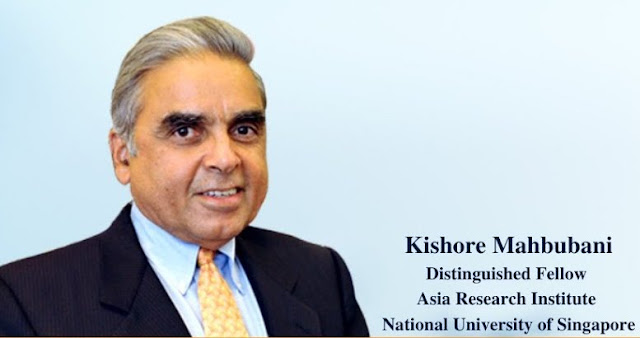 |
| Kishore Mahbubabi |
In a recent interview, Mahbubani made the following points about US-China competition:
1. The United States with about 240-year history likes to pass judgement on China which has over 2,400 year history. What makes the US think China would listen to the American advice?
 |
| Global Power Shift Since Industrial Revolution |
https://www.youtube.com/embed/KaPFmYxWMzI"; title="YouTube video player" width="560"></iframe>" height="112" src="https://img1.blogblog.com/img/video_object.png" width="200" style="cursor: move; background-color: #b2b2b2;" />
Haq's Musings
China-Pakistan Strategic Ties
China-Pakistan Defense Tech Cooperation Irks West
Pakistan-Russia-China vs India-Japan-US
Pakistan Rising or Falling? Myth Vs Reality
Facts and Myths About China-Pakistan Economic Corridor
China Emerges as Top Destination for Pakistanis Studying Abroad
Kishore Mahbubani: America Does Not Respect India
Chinese Communist Party Centennial Celebration
Riaz Haq's Youtube Channel
Riaz Haq
A recent post-COVID survey conducted by the Washington Post shows that Chinese citizens’ trust in their national government has jumped to 98%. Their trust in local government also increased compared to 2018 levels — 91% of Chinese citizens surveyed now said they trust or trust completely the township-level government. Trust levels rose to 93% at the county level, 94% at the city level and 95% at the provincial level.
An earlier 2018 World Values Survey reported that 95% of Chinese citizens said that they have a great deal or quite a lot of trust in national government. Comparatively, about 69% felt the same way about their local government.
The Chinese Communist Party (CCP) has demonstrated that the western style elections and democracy are not the only means to earn legitimacy in the eyes of the people. It has shown that it is far better to deliver results to earn "performance legitimacy".
https://www.riazhaq.com/2021/07/ccp-centennial-chinese-economic-mir...
Aug 9, 2021
Riaz Haq
#China's #Huawei accused of stealing trade secrets.#US #software company Business Efficiency Solutions has sued Huawei in #California federal court for allegedly stealing its trade secrets while working together on a project for the #Pakistani government. https://www.reuters.com/legal/transactional/huawei-accused-stealing...
Aug 12, 2021
Riaz Haq
How Britain stole $45 trillion from India
And lied about it.
Jason Hickel
Academic at the University of London and Fellow of the Royal Society of Arts.
https://www.aljazeera.com/opinions/2018/12/19/how-britain-stole-45-...
There is a story that is commonly told in Britain that the colonisation of India – as horrible as it may have been – was not of any major economic benefit to Britain itself. If anything, the administration of India was a cost to Britain. So the fact that the empire was sustained for so long – the story goes – was a gesture of Britain’s benevolence.
New research by the renowned economist Utsa Patnaik – just published by Columbia University Press – deals a crushing blow to this narrative. Drawing on nearly two centuries of detailed data on tax and trade, Patnaik calculated that Britain drained a total of nearly $45 trillion from India during the period 1765 to 1938.
It’s a staggering sum. For perspective, $45 trillion is 17 times more than the total annual gross domestic product of the United Kingdom today.
How did this come about?
It happened through the trade system. Prior to the colonial period, Britain bought goods like textiles and rice from Indian producers and paid for them in the normal way – mostly with silver – as they did with any other country. But something changed in 1765, shortly after the East India Company took control of the subcontinent and established a monopoly over Indian trade.
Here’s how it worked. The East India Company began collecting taxes in India, and then cleverly used a portion of those revenues (about a third) to fund the purchase of Indian goods for British use. In other words, instead of paying for Indian goods out of their own pocket, British traders acquired them for free, “buying” from peasants and weavers using money that had just been taken from them.
It was a scam – theft on a grand scale. Yet most Indians were unaware of what was going on because the agent who collected the taxes was not the same as the one who showed up to buy their goods. Had it been the same person, they surely would have smelled a rat.
Some of the stolen goods were consumed in Britain, and the rest were re-exported elsewhere. The re-export system allowed Britain to finance a flow of imports from Europe, including strategic materials like iron, tar and timber, which were essential to Britain’s industrialisation. Indeed, the Industrial Revolution depended in large part on this systematic theft from India.
On top of this, the British were able to sell the stolen goods to other countries for much more than they “bought” them for in the first place, pocketing not only 100 percent of the original value of the goods but also the markup.
After the British Raj took over in 1858, colonisers added a special new twist to the tax-and-buy system. As the East India Company’s monopoly broke down, Indian producers were allowed to export their goods directly to other countries. But Britain made sure that the payments for those goods nonetheless ended up in London.
How did this work? Basically, anyone who wanted to buy goods from India would do so using special Council Bills – a unique paper currency issued only by the British Crown. And the only way to get those bills was to buy them from London with gold or silver. So traders would pay London in gold to get the bills, and then use the bills to pay Indian producers. When Indians cashed the bills in at the local colonial office, they were “paid” in rupees out of tax revenues – money that had just been collected from them. So, once again, they were not in fact paid at all; they were defrauded.
Meanwhile, London ended up with all of the gold and silver that should have gone directly to the Indians in exchange for their exports.
Aug 16, 2021
Riaz Haq
#British Defense Secretary Ben Wallace: "It is obvious that Britain is not a superpower. But a superpower that is also not prepared to stick at something isn’t probably a superpower either. It is certainly not a global force" #USA #Afghanistan #superpower https://www.spectator.co.uk/article/britain-is-not-a-superpower-an-...
Britain’s 2007 decision to build and deploy two aircraft carriers — now accompanying the Americans in the Pacific — has been seen by many in the military as an absurd overstretch from a country in denial about still being a global power. Wallace sees it differently. ‘I think it really goes to what the definition of what a global power is,’ he says. ‘It is obvious that Britain is not a superpower. But a superpower that is also not prepared to stick at something isn’t probably a superpower either. It is certainly not a global force, it’s just a big power.’
Britain, meanwhile, can act with others. ‘I take the view that the future of foreign policy around the world will involve more bilateral than trilateral alliances depending on the problems we face. So, West Africa may be a more French/British thing, East Africa may be the same.
‘Britain hasn’t been able to field a mass army for 50 years — if not longer.’ At the back end of the Cold War, he says, he was in the British Army of the Rhine. 'It was always part of a massive international effort — so I think our defence paper is in exactly the right space.’ Britain, he says, still has ‘a huge range of tools at our disposal: from soft to hard power, economic power, scientific power and cultural power’.
Military intervention will still play a role. ‘Some countries in Africa are on the edge of being failed states.’ Stopping them from collapsing, he says, could stave off other conflicts. ‘What you need is an armed forces that can help the resilience of the [African] governments so things don’t get so acute that you end up having a proper fight,’ he says. ‘Fundamentally, I think that is what we need to be doing in the world.’ An important question is whether the intervention-weary public would be so keen for British forces to shore up African governments.
The United Nations, Wallace says, has been noticeable by its absence in Afghanistan and elsewhere. ‘If the UN isn’t for helping failed states, then what is it for?’ The question also arises in West Africa. ‘The anti-corruption, the deradicalisation, the education, all of the things the UN signed up to in the Algeria agreement haven’t been delivered. You don’t stop terrorism and security unless you deal with the other stuff.’
Difficult questions are also facing Europe. ‘We have risen to America’s challenge: to spend more on defence. I think the question is actually for Europe: is Europe prepared to put its money where its mouth is? To be fair to Donald Trump, he was straight as a die on that. There’s a difference between taking America for granted and depending on America. I think historically we have taken America for granted and that means we now need to step up to invest. The Prime Minister has made the biggest investment since the Cold War and we will continue to do that. Let’s hear what the others do.’
The other issue is staying power. ‘The question for the West — whether it is Ukraine, whether it is the South China Sea or upholding international laws — is resolve. That is the question: do we have resolve?’ Like Tony Blair, he dislikes the phrase ‘forever war’. ‘I think standing up for the values you believe in, standing up to protect your interests, is a forever commitment. It’s unending — so be prepared.’
He recently visited the Korean War memorial in Seoul, which is marked by the words ‘Freedom is not free’. ‘That is absolutely right — freedom is not free. Of course, we hope that standing up for it doesn’t involve the lives of our men and women. But when your adversary is constantly challenging you, then you have to constantly stand up for what you believe and constantly enable the defence of it. And that will be forever.’
Sep 2, 2021
Riaz Haq
ASEAN needs more Belt and Road money, say ministers - Nikkei Asia
https://asia.nikkei.com/Spotlight/Belt-and-Road/ASEAN-needs-more-Be...
Meeting online at a Belt and Road Summit, ASEAN ministers said the region has benefited from the infrastructure and digital connectivity already brought about by BRI, but new initiatives are needed to create opportunities amid pandemic-induced uncertainties.
"I am of the view that there are many tangible aspects that could be derived from the multinational partnership and cooperation under the BRI," said Sansern Samalap, Thailand's vice minister for commerce.
Sansern gave the example of the BRI flagship $5.75 billion China-Thailand high-speed railway project that will promote investments in the Greater Mekong Subregion, which includes Cambodia and Laos as part of the China-Indochina economic corridor.
Finally signed last October after numerous delays over terms and conditions, the initial 253 km line will connect Bangkok to Nakhon Ratchasima, the gateway to northeastern Thailand. Phase one of construction has already begun, and is slated for completion in late 2026. The final 873 km line will carry on up to Vientiane, the Laotian capital, and from there continue north to Kunming in China's Yunnan Province.
"Investors can grab this business opportunity and use Thailand as the gateway into the subregion and ASEAN," said Sansern.
Top Chinese officials participated in the summit, including Gao Yunlong, vice chairman of the national committee of the Chinese People's Political Consultative Conference, and Commerce Minister Wang Wentao.
The BRI was unveiled by President Xi Jinping in 2013. In 2020, China signed BRI cooperation agreements with nearly 140 countries to promote connectivity between Asia, Europe and Africa, mainly through infrastructure projects.
Tan See Leng, Singapore's minister for manpower, told the summit that accelerating ASEAN development plans has become more important if countries are to overcome the current economic slowdown,
"In such times, the BRI plays an even more important role in strengthening regional and multilateral cooperation by promoting connectivity in infrastructure, in finance and in trade," said Tan.
The Asian Development Bank recently downgraded its growth forecast for Asia to 7.2% from the 7.3% projected in April, citing the recent rapid spread of COVID-19 and low vaccination levels in Asian countries.
Tan said Singapore will partner China on some investments in BRI projects. Companies from the two countries are collaborating in various sectors, including logistics, e-commerce, infrastructure, finance and legal services.
Jerry Sambuaga, Indonesia's vice minister for trade, said BRI projects have boosted connectivity and created business opportunities.
"We must maintain this mutually beneficial partnership amidst uncertain global challenges," Sambuaga said. He called for more collaboration on Indonesian tourism projects that benefit local communities, and for the BRI to complement the Regional Comprehensive Economic Cooperation agreement.
RCEP, a 15-country multilateral free trade deal signed in 2020 by ASEAN along with Australia, China, Japan, New Zealand and South Korea, is due to take effect on Jan. 1, 2022. Some analysts expect a delay, however, as not all governments have ratified the agreement in their national legislatures.
Singapore's Tan said today that the city state expected the "timely" implementation of RCEP on schedule.
"We look forward to the implementation of the RCEP in order to realize the benefit to businesses [and] to people while contributing to Asia's economy recovery and strengthening of confidence in the longer-term economic prospects of Asia," he said.
Sep 10, 2021