PakAlumni Worldwide: The Global Social Network
Pakistan's Denim Exports to US Soared 62% in First Six Months of 2021
Pakistan exported $38 million worth of denim clothing to the United States in July, 2021. This figure represents 140% growth over July, 2020. Mexico's denim exports grew 58% while those of Bangladesh grew 24% in this period, according to the US Office of Textiles and Apparel.
 |
| US Denim Apparel Imports. Source: US Office of Textiles and Apparel |
Among the top Asian suppliers, Pakistan's exports to US jumped 62.16% year to date to $188.94 million. Bangladesh’s exports increased 42.82% to $362.38 million in this period while shipments from China were up 13.28% to $192.49 million.
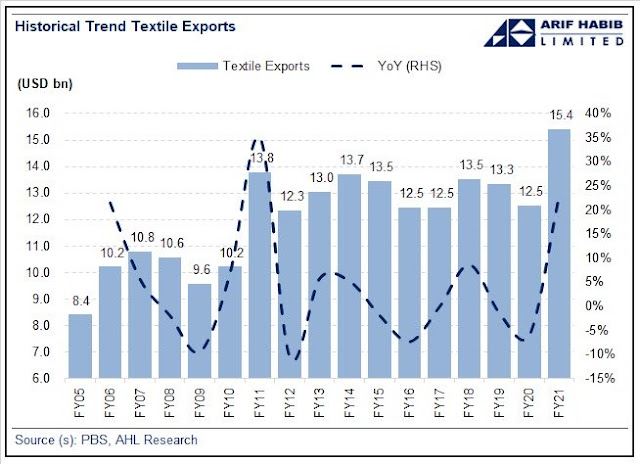
Pakistan’s textiles and clothing exports are expected to rise in the coming months as the US moves orders out of China and other neighboring Asian countries. The focus on more value addition and new textile policy of the country will support the organic growth in exports. The depreciation of PKR has also boosted textile exports.
The monthly average of apparel exports from Pakistan was $565.60 million in H1 2021, which is expected to rise by 13.44% in H2 2021 to reach $641.60 million, according to a report in Fiber2Fashion. The US, the UK, Germany, Spain and France were the top importers of Pakistani apparel in H1 and accounted for approximately 68.27% of total apparel exports of the country, according to Fibre2Fashion’s market analysis tool TexPro.
 |
| Pakistan Textile/Apparel Exports. Source: Arif Habib Ltd |
 |
| Pakistan Textile Exports FY 2006-2021. Source: APTMA |
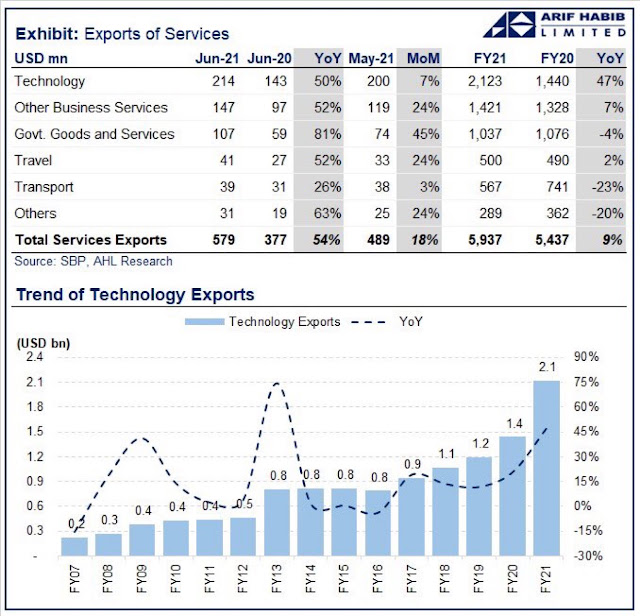
Overall, Pakistan's exports of goods for fiscal 2020-21 rose 13.7% to $25.63 billion. The nation's service exports increased 9.2% to $5.93 billion in fiscal 2021. Combined exports of goods and services added up to $31.56 billion in July 2020 to June 2021 period.
 |
| Pakistan Tech Exports. Source: Arif Habib Ltd. |
Imports grew 23.2%, much faster than exports as the economy recovered from the COVID-induced slump, widening the trade gap in the process. Energy demand drove imports of oil and gas to new highs.
 |
| Pakistan Current Account Balance. Source: Arif Habib Ltd. |
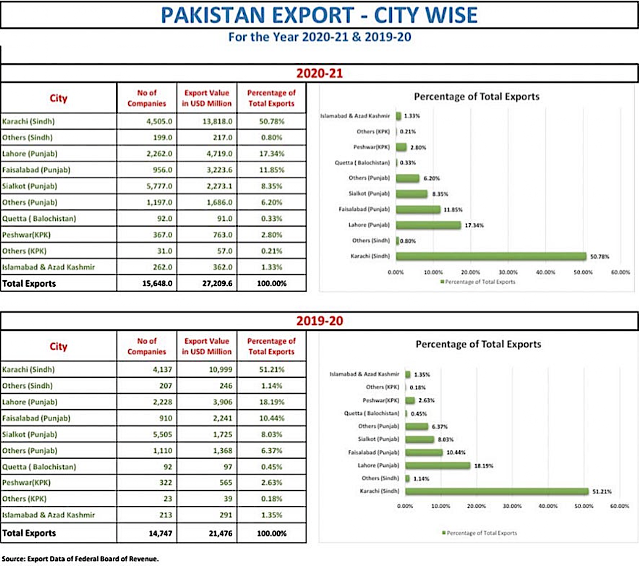
During the last two fiscal years, Karachi has accounted for 51% of Pakistan’s exports, Lahore came in 2nd with 18%, Faisalabad 3rd with 12% and Sialkot 4th with 8.5%.
 |
| Pakistan's Exports by Cities. Source: FBR |
Record inflow of nearly $30 billion in remittances from overseas Pakistanis helped reduce the current account deficit to $1.85 billion in FY 2020-21. It's down 58.4% from $4.45 billion in FY 2019-20.
Overseas Pakistanis' remittances represent 10% of the country's gross domestic product (GDP). This money helps the nation cope with its perennial current account deficits. It also provides a lifeline for millions of Pakistani families who use the money to pay for food, education, healthcare and housing. This results in an increase in stimulus spending that has a multiplier effect in terms of employment in service industries ranging from retail sales to restaurants and entertainment.
Over 10 million Pakistanis are currently working/living overseas, according to the Bureau of Emigration. Before the COVID19 pandemic hit in 2020, more than 600,000 Pakistanis left the country to work overseas in 2019. The average yearly outflow of Pakistani workers to OECD countries (mainly UK and US) and the Middle East has been over half a million in the last decade.

Haq's Musings
South Asia Investor Review
Pakistan's Debt Crisis
Declining Investment Hurting Pakistan's Economic Growth
Brief History of Pakistan Economy
Can Pakistan Avoid Recurring IMF Bailouts?
Pakistan is the 3rd Fastest Growing Trillion Dollar Economy
CPEC Financing: Is China Ripping Off Pakistan?
Information Tech Jobs Moving From India to Pakistan
Pakistan is 5th Largest Motorcycle Market
"Failed State" Pakistan Saw 22% Growth in Per Capita Income in Last 5 Years
CPEC Transforming Pakistan
Pakistan's $20 Billion Tourism Industry Boom
Home Appliance Ownership in Pakistani Households
Riaz Haq's YouTube Channel
PakAlumni Social Network
Riaz Haq
Cotton Production Expected To Cross 10 Million Bales
https://propakistani.pk/2023/07/12/cotton-production-expected-to-cr...
Cotton exports season is on a promising start with the ginning industry confirming early orders for 600 tons.
Chairman of the Cotton Ginners Forum Ihsanul Haq revealed that a major cotton ginner from Sindh has been able to confirm early orders for cotton exports of up to 600 tons to Indonesia and Vietnam with shipments scheduled in early August.
He explained that if the weather remains favorable, Pakistan’s cotton production is expected to cross 10 million bales in the upcoming year which is a sign of relief for the textile sector and reflects the potential of the cotton industry.
Though, Ihsanul Haq added that the delayed procurement by ginners is also increasing cotton prices with Rs. 17,500 per 40kg in Sindh and Rs. 17,000 per 40kg in Punjab while the dollar exchange rate fluctuation may further impact the prices in the coming days.
It is worth noting that cotton quality and quantity have improved significantly over the last year due to an ideal environment of low rainfall and warm temperatures in coastal Sindh. Because of this, the industry has confirmed early orders and is expecting record-breaking exports
Jul 14, 2023
Riaz Haq
AI Overview
Pakistan's textile sector demonstrates strong resurgence ...
Pakistan's textile exports reached $17.88 billion in FY2025, a 7.39% increase from the previous year, with recent strong growth in July 2025 driven by value-added products like knitwear and readymade garments. The sector is the backbone of the economy, but challenges like high energy costs and competition hinder more robust growth, though opportunities exist in technological advancements and product diversification. Major export markets include the United States, Germany, and the United Kingdom.
----------
Topline Securities Ltd
@toplinesec
Pakistan Monthly Textile Exports touched 3 year high of US$1.6bn in Sep 2025, as per provisional numbers released by State Bank of Pakistan. Within Textile, Knitted Apparel touched all time high monthly export of US$485mn. Textile sector contributes ~60% to Pakistan's total goods exports in Sep 2025.
https://x.com/toplinesec/status/1982326324598591515
--------------------
Pakistan’s textile exports have reached a three-year high of $1.6 billion in September 2025, signaling a strong rebound driven by renewed global demand and value-added production.
According to SBP data, knitted apparel alone hit a record $485 million, reflecting growing strength in Pakistan’s value-added textile segment. Despite challenges like energy costs and cotton shortages, the sector remains the backbone of the country’s export economy.
—————
Pakistan’s textile exports hit three-year high in September
textile sector accounted for nearly 60% of the country's total goods exports; value-added segment drives recovery
https://tribune.com.pk/story/2575078/textile-sector-regains-momentum
KARACHI:
Pakistan's textile exports surged to a three-year high of $1.6 billion in September 2025, marking a strong rebound driven by robust demand for value-added categories and renewed global orders, according to provisional data released by the State Bank of Pakistan (SBP).
Brokerage house Topline Securities reported that knitted apparel exports alone touched an all-time high of $485 million, underscoring the strength of Pakistan's value-added segment. The textile sector accounted for nearly 60% of the country's total goods exports during the month, which reaffirmed its role as the backbone of Pakistan's export economy.
The latest surge comes amid a gradual post-pandemic recovery, stronger trade linkages, and a relatively stable exchange rate. Yet, industry experts warn that persistent challenges such as high energy costs, expensive financing and cotton supply disruptions continue to weigh on long-term competitiveness.
A recent report of Taurus Securities projected that profitability across Pakistan's listed textile companies would rise by nearly 3.1 times year-on-year in the first quarter of FY26, supported by higher export volumes, lower borrowing costs, and Pakistan's competitive edge following US tariffs on regional peers.
The brokerage said margins were likely to expand by 11 percentage points year-on-year, citing cost control measures, renewable energy adoption, and a stable rupee-dollar parity. Taurus noted that textile exports rose 6% year-on-year in 1QFY26, aided by a 56% jump in local cotton production.
Among major players, Gul Ahmed Textile Mills is expected to post a profit after tax of Rs2.4 billion, up 6% from last year; Nishat Mills is projected to earn Rs1.3 billion, up 41%; and Interloop Limited is expected to record a tenfold increase in quarterly profit to Rs2.5 billion, driven by strong apparel and denim sales.
Oct 31, 2025
Riaz Haq
Artistic Milliners to invest over $18mn in Port Qasim 400-acre Garments City - Business & Finance - Business Recorder
https://www.brecorder.com/news/40435168
Pakistan will establish a 400-acre Garments City at Port Qasim in Karachi to expand textile exports and create jobs, Federal Minister for Maritime Affairs Junaid Anwar Chaudhry said on Monday.
Under the plan, a Pakistani textile and denim manufacturing company, Artistic Milliners, would establish a manufacturing unit with an investment of more than $18 million, incorporating vertical integration and green technologies, read a statement.
Chairing a meeting on a proposed garment city project, the minister said the export-oriented manufacturing cluster would focus on high-value apparel production and attract private investment.
According to the project plan, the first phase would cover 250 acres, with 35% allocated for internal roads, utilities and green areas. The project is envisaged as a public-private partnership.
The proposed commercial structure comprises 32 industrial plots of five acres each, although the plot size could be reduced to two or three acres to accommodate more investors and manufacturing units.
The Port Qasim Authority (PQA) would provide infrastructure and utilities. Each industrial unit would have access to up to 400,000 gallons of water per day, two megawatts of on-grid electricity, and 23,100 pounds of industrial gas per day at 8 pounds per square inch (PSI), enough to support the requirements for 10 tonnes of steam.
Pakistan to establish 150-acre auto processing zone at Port Qasim
For the overall project, planned utility capacity includes 13 million gallons of water a day, 64MW of on-grid electricity and 750,000 pounds of industrial gas a day.
Chaudhry said private-sector participation would be a key component of the project.
The project would also have a one-window mechanism for exporters, including streamlined export processing, specialised customs desks and dedicated transport corridors.
Projections presented at the meeting put first-phase employment at 138,125 jobs and annual exports at $2.2 billion. The project also aims to raise the average export value of garments to around $8 per piece.
The minister said the initiative was part of efforts to expand Pakistan’s industrial base and export capacity, with port infrastructure, utilities, customs facilities and private investment integrated into the proposed apparel zone.
Pakistan’s textile and garment sector is the country’s largest export earner but has faced challenges from high energy costs, outdated technology and competition from regional rivals. The government has been seeking to develop industrial zones and special economic areas to attract investment and move up the value chain.
Days ago, Chaudhry announced plans to establish an automotive processing zone on 150 acres at Port Qasim, Karachi, with the facility to be expanded in phases according to market demand.
yesterday