PakAlumni Worldwide: The Global Social Network
Farm Fires Make Pollution Worse in Delhi and Lahore
Why does the air quality in New Delhi and Lahore ranks among the world's worst at this time of the year? The answer to this oft-repeated question can be found in the satellite maps constantly updated by the US National Aeronautics and Space Administration (NASA). Indian government recently estimated that 36% of pollution was contributed by farm fires. Here's how NASA Earth Observatory explains it: "The haze visible in this image likely results from a combination of agricultural fires, urban and industrial pollution, and a regional temperature inversion. Most of the time, air higher in the atmosphere is cooler than air near the planet’s surface, and this configuration allows warm air to rise from the ground and disperse pollutants. In the wintertime, however, cold air frequently settles over northern India, trapping warmer air underneath. The temperature inversion traps pollutants along with warm air at the surface, contributing to the buildup of haze."
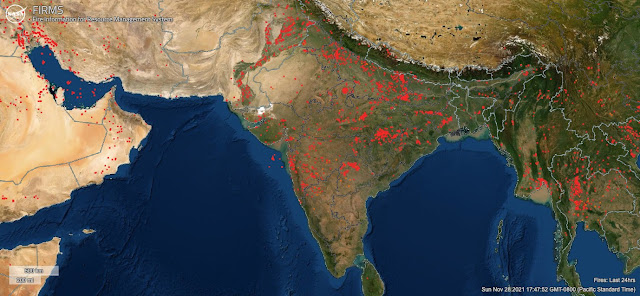 |
| Farm Fires Seen By NASA Satellite. Source: FIRMS |
Farm Fires:
The latest image downloaded from NASA's Fire Information for Resource Information System (FIRMS) show farm fires burning in both India and Pakistan. These fires are particularly intense in Indian and Pakistani provinces of the Punjab. These fires contribute significantly to the high level of particulates in Delhi and Lahore. Indian government recently estimated that 36% of the PM2.5 particulate matter was contributed by stubble burning by farmers.
South Asia's Vulnerability:
South Asia is particularly susceptible to pollutants that hang in the air for extended periods of time. The US National Aeronautics and Space Administration (NASA) satellite images show dull gray haze hovering over northern India and Pakistan, and parts of Bangladesh. It is believed that emissions from solid fuel burning, industrial pollutants and farm clearing fires get trapped along the southern edge of the Himalayas. NASA Earth Observatory explains this phenomenon as follows:
"The haze visible in this image likely results from a combination of agricultural fires, urban and industrial pollution, and a regional temperature inversion. Most of the time, air higher in the atmosphere is cooler than air near the planet’s surface, and this configuration allows warm air to rise from the ground and disperse pollutants. In the wintertime, however, cold air frequently settles over northern India, trapping warmer air underneath. The temperature inversion traps pollutants along with warm air at the surface, contributing to the buildup of haze."
 |
| Trapped Smog. Source: Al Jazeera |
Urgent Actions Needed:
South Asian governments need to act to deal with rapidly rising particulate pollution jointly. Some of the steps they need to take are as follows:
1. Crack down on stubble burning to clear fields. Incentivize use of machine removal of stubble.
2. Reduce the use of solid fuels such as cow dung, wood and coal to limit particulate matter released into the atmosphere.
3. Impose higher emission standards on industries and vehicles through regulations.
4. Incentivize transition to electric vehicles.
5. Increase forest cover by planting more trees.
6. Encourage the use of more renewable energy sources such as solar, wind, hydro, nuclear etc.
The cost of acting now may seem high but it will turn out to be a lot more expensive to deal with extraordinary disease burdens resulting from rising air pollution.
 |
|
|
Pakistan at COP26:
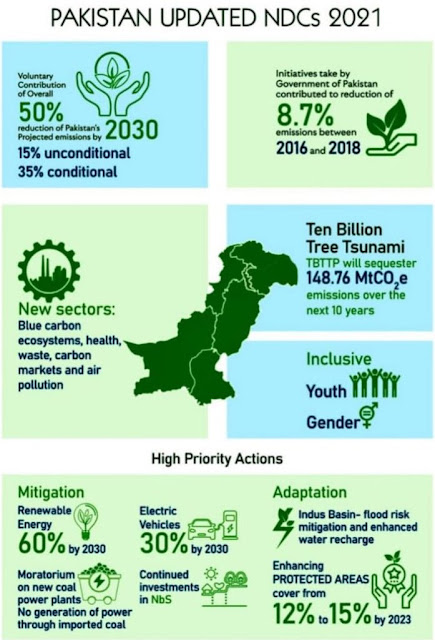
Malik Amin Aslam, Pakistan Prime Minister Imran Khan's special assistant on climate change, said recently in an interview with CNN that his country is seeking to change its energy mix to favor green. He said Pakistan's 60% renewable energy target would to be based on solar, wind and hydro power projects, and 40% would come from hydrocarbon and nuclear which is also low-carbon. “Nuclear power has to be part of the country’s energy mix for the future as a zero energy emission source for a clean and green future,” he concluded. Here are the key points Aslam made to Becky Anderson of CNN: |
1. Pakistan wants to be a part of the solution even though it accounts for less than 1% of global carbon emissions.
Movement of pollutants does not recognize national borders. It has severe consequences for both India and Pakistan. The only way to deal with it is for the two nations to cooperate to minimize this problem.
South Asia accounts for more than a third of all PM2.5 pollution related deaths in the world. The sources of particulate pollution range from solid fuel burning to crop clearing fires and use of dirty fuels in vehicles and industries. Recognition of the growing problem is urgent. Failure to act could be very costly in terms of impact on human health and economy. Pakistan needs to follow through on its commitments made at COP26 conference recently held in Glasgow, Scotland.
https://www.youtube.com/embed/Q_s4kQXChuM"; title="YouTube video player" width="200"></iframe>" height="40" src="https://img1.blogblog.com/img/video_object.png" width="200" style="cursor: move; background-color: #b2b2b2;" />
Related Links:
Haq's Musings
South Asia Investor Review
Pakistan's Response to Climate Change
Pakistan Electric Vehicle Policy
Cutting Methane Emissions From Cow Burps and Farts
India's Air Most Toxic
State of Air 2017
Environmental Pollution in India
Diwali in Silicon Valley
India Leads the World in Open Defecation
Heavy Disease Burdens in South Asia
Riaz Haq
#India's Pay-to-Breathe market is soaring. Facing #toxic #air, wealthy #Indians are buying air purifiers, creating a booming market. But 60% of India’s 1.3 billion people live on less than $3.10 a day, below the World Bank’s median #poverty line. https://www.wired.co.uk/article/breathing-is-a-luxury-in-indias-air...
Purohit says the purifiers create narrow columns of purified air that only really benefit people who are close to them for an extended period of time.
Following Mumbai’s air quality crisis this winter, critics accused the Maharashtra Pollution Control Board of moving air quality sensors to “cleaner” parts of the city.
Meanwhile, India’s wealthier residents have taken matters into their own hands. Air purifier brands have become a common topic of conversation among middle-class residents. People who can afford to do so move from air-purified homes (where each room often has its own purifier) to air-purified shops and malls, driven in air-purified cars. Brands have enlisted cricket stars and Bollywood celebrities, advertising in English-language newspapers, on social media, and on billboards.
If the combination of advertisements and news coverage is to be believed, breathing air in India’s capital is equivalent to 50 cigarettes a day during Diwali, a Hindu festival where many people burst firecrackers, and 10 cigarettes a day during the winter. For an Indian Independence Day advert, Sharp suggests “Impurities Quit India,” referring to the “Quit India” movement from India’s freedom struggle. News articles meet every spike in poor air quality with air purifier advice: “Delhi air quality turns severe: 5 Air purifiers that will help you breathe clean air,” reads one; “Planning To Buy An Air Purifier Amid Falling AQI? Know the Costs, Other Factors” reads another.
Deekshith Vara Prasad, founder and CEO of Indian-made air purifier AirOK Technologies, says his company’s sales have grown 18 percent since 2018. (AirOK Technologies’ air purifiers are largely used in hospitals and offices.)
Prasad says surging demand has led to substandard products in the market. To work on the air in India’s cities, purifiers need to filter out fine particulate matter, fungus, bacteria, viruses, and toxic gasses like sulfur and nitrous oxides. There are “hundreds” of pollutants, he says. “If I remove two pollutants, I can claim I ‘remove pollutants.’”
The borders of private spaces, like offices and, increasingly, hotels—which sometimes market themselves based on their air purification—are a stark illustration of the unequal access to clean air. Door attendants, valets, bellhops, and security guards working the entrances and exits to these buildings don’t breathe the purified air available to those inside.
Waghmore says this division intersects with India’s social inequalities around status and caste and that air purifiers only consolidate the ideology of “purity” as something that is central to the lives of dominant caste.
Such inequality has severe consequences, as those from disadvantaged castes already face considerable barriers in accessing health care.
Waghmore says the heightened sense of privileged individualism—where the rich have the means to fend for themselves—“has the worst consequences in poor countries, where governments are yet to invest morally and economically in public infrastructure and transport to counter environmental degradation.”
K, who regularly treats those suffering from India’s air pollution inequality, puts it more succinctly. “I don’t think people should live with this,” she say, adding that everyone needs to take demand solutions. “If you don’t get something as basic as fresh air, then what’s the point of living in our country?”
Mar 9, 2023
Riaz Haq
Rich cities #London, #Paris, #LosAngeles, #HongKong breathe cleaner #air. #India is host to 12 of top 15 most #polluted cities in central & south Asia regions. N’Djamena, #Baghdad and #NewDelhi are suffering higher levels of #pollution than last year https://www.ft.com/content/438562af-d815-4ed5-83ce-c65b85db5782
Residents of Paris, London, Los Angeles and Hong Kong are breathing cleaner air than a year ago, while N’Djamena, Baghdad and New Delhi are suffering higher levels of pollution, the latest report on global air quality shows.
Roughly 90 per cent of the world’s population is still breathing air that poses a risk to health but the gap between high and low income cities is widening, the annual study by IQAir, the Swiss-based air technology group found, using 30,000 ground level sensors from more than 7,000 cities.
The study measured the concentration of fine particulate matter with diameters of up to 2.5 microns, known as PM2.5, one of the most hazardous pollutants as it may be able to enter the bloodstream.
In richer countries, air quality was improved where industry was complying with stricter World Health Organization guidelines, and transport was being electrified, it concluded, but developing countries were struggling.
“Biomass and agricultural burning are the number one reason for stubbornly high air pollution levels in the developing world,” said Frank Hammes, IQAir chief executive.
In Europe, where Berlin and Rome had slightly worse air quality levels in 2022, household burning of wood accounted for a large proportion of winter smog.
China had managed to achieve impressive reductions in air pollution for the past seven years, Hammes said, based on a crackdown on polluting industry and a focus on renewable energy and electric vehicles, though continued burning of coal still caused serious air pollution.
In the most recent year, China’s air quality improved as extensive Covid lockdowns suppressed economic activity, leading to lower emissions.
“In 2023, it remains to be seen if China can further reduce air pollution, or if the pressure of increased economic activity leads to stagnation or an increase in air pollution,” Hammes cautioned.
The WHO estimates that poor air quality accounts for 7mn preventable deaths a year, while the World Bank has put the economic cost at more than $8tn.
New Delhi and Baghdad’s concentration of pollutants in 2022 were almost 18 times higher than the maximum safe level recommended by the WHO.
N’Djamena in Chad, one of the poorest countries in the world, earned the dubious accolade of being the most polluted capital, replacing New Delhi even though air quality there also continued to deteriorate. The surge in PM2.5 concentration in N’Djamena was attributed to massive dust storms from the Sahara Desert, the report found.
India remains host to 12 of the top 15 most polluted cities in the central and south Asia regions.
Vietnam’s capital Hanoi reported the second worst air quality in south-east Asia and was in the bottom 18 globally. Vietnam has been expanding its industrial activity rapidly in recent years as big tech companies such as Apple, Google, Dell and their suppliers invest in new factories to diversify away from China.
Several Middle Eastern capitals ranked among the 20 most polluted cities globally. These included Abu Dhabi, Riyadh and Doha, which all saw air quality worsen in 2022.
Meanwhile, Canberra in Australia overtook Nouméa, in the Pacific island of New Caledonia, to report the world’s best air quality last year. Fewer fires and dust storms helped to deliver its residents cleaner air, researchers found.
Other nations among the 13 out of 131 surveyed that met WHO’s air quality guidelines included Guam, New Zealand, Estonia, and Finland. Of the cities surveyed, Hamilton in Bermuda, Puerto Rico’s San Juan and Reykjavik in Iceland had the freshest air.
Mar 14, 2023
Riaz Haq
Tracking Seven Decades of Genotoxicity Research in India
https://bioengineer.org/tracking-seven-decades-of-genotoxicity-rese...
A comprehensive review of genotoxicity research in India has mapped the evolution of genetic toxicology over seven decades, providing a vital baseline for monitoring environmental mutagens and public health. As India continues its rapid industrial development and modernization, the resulting environmental pollution has contributed to significant public health crises, including rising incidences of cancer and various chronic diseases. The research tracks how scientists have assessed genetic damage resulting from diverse xenobiotic, chemical, and radionuclide exposures, highlighting the critical role that individual genetic makeup and socio-demographic contexts play in these health outcomes.
During this pre-sequencing era, researchers focused heavily on traditional bio-assay platforms aligned with standard Organisation for Economic Co-operation and Development (OECD) guidelines. Common markers studied included structural chromosomal aberrations, micronucleus formation, sister chromatid exchanges, and DNA strand breaks.
Foundational institutional work explored the anti-mutagenic potential of dietary spices and indigenous phytochemicals, demonstrating the importance of studying genotoxic effects both in vitro and in vivo.
India currently faces a complex burden of environmental challenges, including intricate chemical mixtures, atmospheric particulate matter, and diverse occupational exposures. While these issues require state-of-the-art screening techniques, researchers often operate within resource-limited settings.
Looking toward the future, the research highlights a shift toward more advanced technologies. Modern approaches now incorporate error-corrected sequencing, quantitative structure-activity relationship (QSAR) modeling, and in vitro predictive systems.
This review does not claim to be an exhaustive account of all findings, but it serves as a central reference point for national and international researchers. By illustrating the evolution of guidelines and the shift in technological capabilities, the research provides a clear perspective on how genetic toxicology has matured in India.
Subject of Research: Evolution and current status of genotoxicity research in India
22 hours ago