PakAlumni Worldwide: The Global Social Network
Ukraine's Lesson For Pakistan: Never Give Up Nuclear Weapons
Commenting on Ukraine, Russian analyst Alexey Kupriyanov told Indian journalist Nirupama Subramanian: "For us, Ukraine is the same as Pakistan for India". What he failed to mention is that Pakistan has developed and retains its nuclear arsenal while Ukraine gave up its nukes in the 1990s after the fall of the Soviet Union. Many Ukrainians now regret this decision. Ukrainians know that no country with nuclear weapons has ever been physically invaded by a foreign military. They now understand the proven effectiveness of nuclear deterrence. They realize that all the talk about "rules-based order" is just empty rhetoric. The reality is the Law of the Jungle where the strong prey on the weak. The US military invasions of Afghanistan and Iraq have shown that Washington is just as guilty of violating the "rules-based order" as Moscow.
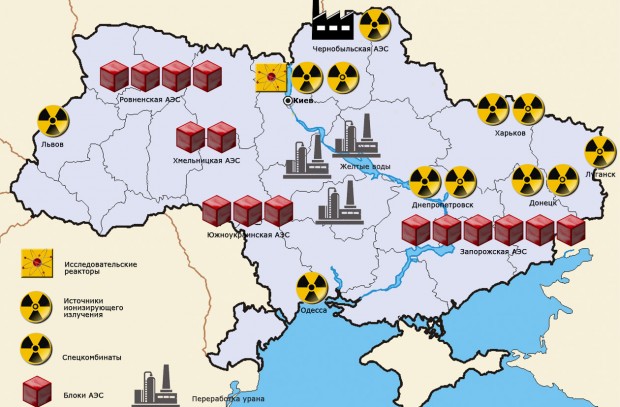 |
| Ukraine Gave Up Nukes in 1990s. Source: Utica Phoenix |
Denuclearization of Ukraine:
When Ukraine became independent in the early 1990s, it was the third-largest nuclear power in the world with thousands of nuclear arms. In the years that followed, Ukraine made the decision to denuclearize completely based on security guarantee from the U.S., the U.K. and Russia, known as the Budapest Memorandum. Ukrainian analyst Mariana Budjeryn explained in an interview with NPR's Mary Louise Kelly as follows:
"It is clear that Ukrainians knew they weren't getting the exactly - sort of these legally binding, really robust security guarantees they sought. But they were told at the time that the United States and Western powers - so certainly, at least, the United States and Great Britain, they take their political commitments really seriously. This is a document signed at the highest level by the heads of state".
US Efforts to Stop Pakistan's Nukes:
The order to conduct Pakistan's nuclear tests came from Mr. Nawaz Sharif who was Pakistan's prime minister in 1998. It came on May 28, just over two weeks after India's nuclear tests conducted May 11 to May 13, 1998. Pakistan went ahead with the tests in spite of the US pressure to abstain from testing. US President Bill Clinton called Prime Minister Nawaz Sharif immediately after the Indian tests to urge restraint. It was followed up by Deputy Secretary of State Strobe Talbott's visit to Islamabad on May 16, 1998.
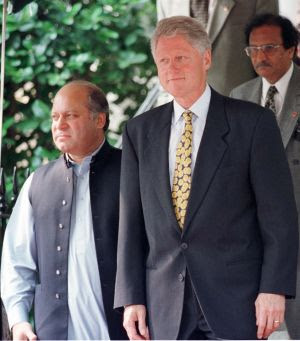
In his 2010 book titled "Engaging India: Diplomacy, Democracy, and the Bomb", Secretary Talbott has described US diplomatic efforts to dissuade Pakistan in the two weeks period between the Indian and Pakistani nuclear tests. Here are a few excerpts of the book divided into four sections covering Clinton's call to Sharif, Talbott's visits to the Foreign Office (FO), general headquarters (GHQ) and Prime Minister's House:
Clinton's Call to Sharif:
Clinton telephoned Sharif, the Pakistani PM, to whet his appetite for the planes, huge amounts of financial aid, and a prize certain to appeal to Sharif—an invitation for him to make an official visit to Washington.
“You can almost hear the guy wringing his hands and sweating,” Clinton said after hanging up.
Still, we had to keep trying. Our best chance was an emergency dose of face-to-face diplomacy. It was decided that I would fly to Pakistan and make the case to Nawaz Sharif.
Meeting at Foreign Office in Islamabad:
On arrival in Islamabad, we had about an hour to freshen up at a hotel before our first official meeting, which was with the foreign minister, Gohar Ayub Khan, and the foreign secretary (the senior civil servant in the ministry), Shamshad Ahmad.
When we got to the foreign ministry, we found that the Pakistani civilian leaders had finally figured out how to handle our visit, and the result was a bracing experience. My two hosts rolled their eyes, mumbled imprecations under their breath, and constantly interrupted.
They accused the United States of having turned a blind eye to the BJP’s preparations for the test.
As for the carrots I had brought, the Pakistanis gave me a version of the reaction I had gotten from General Wahid five years earlier. Offers of Pressler relief and delivery of “those rotting and virtually obsolete air- planes,” said Gohar Ayub, were “shoddy rugs you’ve tried to sell us before.” The Pakistani people, he added, “would mock us if we accepted your offer. They will take to the streets in protest.”
I replied that Pakistanis were more likely to protest if they didn’t have jobs. Gohar Ayub and Shamshad Ahmad waved the point aside. The two Pakistani officials were dismissive. The current burst of international outrage against India would dissipate rapidly, they predicted.
Visit to General Headquarter (GHQ) in Rawalpindi:
We set off with police escort, sirens blaring, to (Chief of Army Staff) General Karamat’s headquarters in Rawalpindi.
Karamat, who was soft-spoken and self-confident, did not waste time on polemics. He heard us out and acknowledged the validity of at least some of our arguments, especially those concerning the danger that, by testing, Pakistan would land itself, as he put it, “in the doghouse alongside India.”
His government was still “wrestling” with the question of what to do he said, which sounded like a euphemism for civilian dithering. There was more in the way Karamat talked about his political leadership, a subtle but discernible undertone of long-suffering patience bordering on scorn. For example, he noted pointedly “speculation” that Pakistan was looking for some sort of American security guarantee, presumably a promise that the US would come to Pakistan’s defense if it was attacked by India, in exchange for not testing. “You may hear such a suggestion later,” Karamat added, perhaps referring to our upcoming meeting with Nawaz Sharif. I should not take such hints seri- ously, he said, since they reflected the panic of the politicians. Pakistan would look out for its own defense.
What Pakistan needed from the United States was a new, more solid relationship in which there was no “arm- twisting” or “forcing us into corners.” By stressing this point, Karamat made clear that our arguments against testing did not impress him.
Meeting at Prime Minister's House:
I shared a car back to Islamabad with Bruce Riedel and Tom Simons to meet Nawaz Sharif.
What we got from the Prime Minister was a Hamlet act, convincing in its own way—that is, I think he was genuinely feeling torn—but rather pathetic.
On this occasion Nawaz Sharif seemed nearly paralyzed with exhaustion, anguish, and fear. He was—literally, just as Clinton had sensed during their phone call—wringing his hands. He had yet to make up his mind, he kept telling us. Left to his own judgment, he would not test.
His position was “awkward.” His government didn’t want to engage in “tit-for-tat exchanges” or “act irresponsibly.” The Indian leaders who had set off the explosion were “madmen” and he didn’t want “madly to follow suit.”
But pressure was “mounting by the hour” from all sides, including from the opposition led by his predecessor and would-be successor, Benazir Bhutto. “I am an elected official, and I cannot ignore popular sentiment.” Sharif was worried that India would not only get away with what it had done but profit from it as well. When international anger receded, the sanctions would melt away, and the BJP would parlay India’s new status as a declared nuclear weapons state into a permanent seat on UN SC. I laid out all that we could do for Pakistan, although this time I tried to personalize the list a bit more.
Clinton told me two days before that he would use Sharif’s visit to Washington and Clinton’s own to Pakistan to “dramatize” the world’s gratitude if Sharif refrains from testing. This point aroused the first flicker of interest I’d seen. Nawaz Sharif asked if Clinton would promise to skip India on his trip and come only to Pakistan. There was no way I could promise that. All I could tell Nawaz Sharif was that Clinton would “recalibrate the length and character” of the stops he made in New Delhi and Islamabad to reflect that Pakistan was in favor with the United States while India was not. Sharif looked more miserable than ever.
Toward the end of the meeting, Sharif asked everyone but me to wait outside. (Foreign Secretary) Shamshad (Ahmad) seemed miffed. He glanced nervously over his shoulder as he left. When we were alone I gave the prime minister a written note from Secretary Albright urging him to hold firm against those clamoring to test. The note warned about the economic damage, to say nothing of the military danger, Pakistan faced from an escalating competition with India. Sharif read the note intently, folded the paper, put his head in his hands for a moment, then looked at me with desperation in his eyes.
At issue, he said, was his own survival. “How can I take your advice if I’m out of office?” If he did as we wanted, the next time I came to Islamabad, I'd find myself dealing not with a clean-shaven moderate like himself but with an Islamic fundamentalist “who has a long beard.” He concluded by reiterating he had not made up his mind about testing. “If a final decision had been reached I'd be in a much calmer state of mind. Believe me when I tell you that my heart is with you. I appreciate and would even privately agree with what you're advising us to do.”
Summary:
After the Russian invasion of Ukraine, many Ukrainians are now regretting the decision to give up their nuclear weapons in 1990s based on western security assurances. In 1998, Pakistan flatly refused to do what the Ukrainians did. It is clear from Secretary Talbot's description that Prime Minister Nawaz Sharif did not want to go forward with the nuclear tests but he had no choice. Fearing that he would be removed from office if he decided not to conduct atomic test, he told Talbott, “How can I take your advice if I’m out of office?” Summing up the failure of the US efforts to stop Pakistan's nuclear tests, US Ambassador to Pakistan Ann Patterson said the following in a cable to Washington in 2009 : "The Pakistani establishment, as we saw in 1998 with the nuclear test, does not view assistance -- even sizable assistance to their own entities -- as a trade-off for national security vis-a-vis India".
Related Links:
Haq's Musings
South Asia Investor Review
US-Pakistan Civilian Nuclear Deal?
India's Hostility Toward Pakistan
Modi's India: A Paper Elephant?
Debunking Haqqani's Op Ed: "Pakistan's Elusive Quest For Parity
Eating Grass: The Making of the Pakistani Bomb
Cyberwars Across India, Pakistan and China
Pakistan's Defense Industry Going High-Tech
Pakistan's Space Capabilities
India-Pakistan Military Balance
Scientist Reveals Indian Nuke Test Fizzled
The Wisconsin Project
The Non-Proliferation Review Fall 1997
India, Pakistan Comparison 2010
Can India "Do a Lebanon" in Pakistan?
Global Firepower Comparison
Evaluation of Military Strengths--India vs. Pakistan
Only the Paranoid Survive
India Races Ahead in Space
21st Century High-Tech Warfare'
Riaz Haq
Ukraine, Nuclear Weapons, and Security Assurances at a Glance | Arms Control Association
https://www.armscontrol.org/factsheets/Ukraine-Nuclear-Weapons
In late April 1993, 162 Ukrainian politicians signed a statement to add 13 preconditions for ratification of START, frustrating the ratification process. The preconditions required security assurances from Russia and the United States, foreign aid for dismantlement, and compensation for the nuclear material. Additionally, they stated that Ukraine would dismantle only 36 percent of its delivery vehicles and 42 percent of its warheads, leaving the rest under Ukrainian control. Russia and the United States criticized these demands, but Ukraine did not budge. In May 1993, the United States said that if Ukraine were to ratify START, Washington would provide more financial assistance. This began subsequent discussions between Ukraine, Russia, and the United States over the future of Ukrainian denuclearization.
1993 Massandra Accords
Ukrainian and Russian officials reached a set of agreements, including protocols on nuclear weapons dismantlement, procedure, and terms of compensation. However, the two sides could not agree on the final document, and the summit ultimately failed.
1994 Trilateral Statement
The Massandra Accords set the stage for the ultimately successful trilateral talks. As the United States mediated between Russia and Ukraine, the three countries signed the Trilateral Statement on January 14, 1994. Ukraine committed to full disarmament, including strategic weapons, in exchange for economic support and security assurances from the United States and Russia. Ukraine agreed to transfer its nuclear warheads to Russia and accepted U.S. assistance in dismantling missiles, bombers, and nuclear infrastructure. Ukraine’s warheads would be dismantled in Russia, and Ukraine would receive compensation for the commercial value of the highly enriched uranium. Ukraine ratified START on February 3, 1994, repealing its earlier preconditions, but it would not accede to the NPT without further security assurances.
1994 Budapest Memorandum on Security Assurances
To solidify security commitments to Ukraine, the United States, Russia, and the United Kingdom signed the Budapest Memorandum on Security Assurances on December 5, 1994. A political agreement in accordance with the principles of the Helsinki Accords, the memorandum included security assurances against the threat or use of force against Ukraine’s territory or political independence. The countries promised to respect the sovereignty and existing borders of Ukraine. Parallel memorandums were signed for Belarus and Kazakhstan as well. In response, Ukraine officially acceded to the NPT as a non-nuclear weapon state on December 5, 1994. That move met the final condition for ratification of START, and on the same day, the five START states-parties exchanged instruments of ratification, bringing the treaty into force.
2009 Joint Declaration by Russia and the United States
Russia and the United States released a joint statement in 2009 confirming that the security assurances made in the 1994 Budapest Memorandum would still be valid after START expired in 2009.
2014 Russian Annexation of Crimea
Following months of political unrest and the abrupt departure of Ukrainian President Viktor Yanukovych, Russian troops entered the Crimean peninsula of Ukraine in March 2014. On March 18, over the protests of the acting government in Kiev, the UN Security Council, and Western governments, Russia declared the annexation of Crimea. The United States, the United Kingdom, and Ukraine called the action a blatant violation of the security assurances in the 1994 Budapest Memorandum. However, according to the Russian Foreign Ministry, “the security assurances were given to the legitimate government of Ukraine but not to the forces that came to power following the coup d'etat.”
Feb 24, 2022
Riaz Haq
Could #SWIFT be used to sanction #Russia? Swift as a weapon could erode the #dollar-dominated global financial system, including by fostering alternatives to Swift being developed by Russia and the world’s second largest economy, #China. #Trade https://www.wsj.com/articles/swift-banking-system-sanctions-biden-1... via @WSJ
Russia’s assault on Ukraine triggered a surge of calls for Western allies to completely sever Russia from the global financial system by disconnecting it from the so-called Swift global payment system. Fear in places like the U.S. and Germany of potential collateral damage have put the idea on hold for now.
What is Swift?
The Society for Worldwide Interbank Financial Telecommunication, or Swift, is the financial-messaging infrastructure that links the world’s banks. The Belgium-based system is run by its member banks and handles millions of daily payment instructions across more than 200 countries and territories and 11,000 financial institutions. Iran and North Korea are cut off from it.
Why is Swift important for countries, including Russia?
Cross-border financing is critical to every part of the economy, including trade, foreign investment, remittances and the central bank’s management of the economy. Disconnecting a country, in this case Russia, from Swift would hit all of that.
Who is advocating for such a move?
U.K. Prime Minister Boris Johnson has lobbied other Group of Seven members to flip the switch. Other proponents include countries along the European Union’s border with Russia and some members of Congress, including California Democratic Rep. Adam Schiff, chairman of the House Intelligence Committee. The move, they argue, would help cripple Russia’s economy in a way that more targeted sanctions can’t.
Why are other countries resisting it?
Critics say there could be economic blowback, not just in Europe, which has deep trade ties and relies heavily on Russia’s natural gas exports, but also the rest of the world. Some former U.S. officials say the move could severely hurt Russia’s economy, but also harm Western business interests such as the major oil companies. President Biden, while ruling it out for now, said the option isn’t off the table completely.
At an estimated $1.7 trillion last year, Russia’s gross domestic product makes it the 12th largest economy in the world. Even if the global economy wasn’t hobbled by a three-year pandemic, rising inflation, supply chain disruptions and escalating East-West political tensions, losing 2% of global GDP and one of the world’s top oil exporters would inflict severe damage to it.
Additionally, using Swift as a weapon could erode the dollar-dominated global financial system, including by fostering alternatives to Swift being developed by Russia and the world’s second largest economy, China. That could undermine Western power, especially the diplomatic leverage that sanctions offer.
What have Western nations done instead?
Besides halting a new natural gas pipeline and hurting Russia’s ability to raise debt, Western sanctions so far have blacklisted many of Russia’s biggest banks, affecting the majority of the country’s banking sectors assets. Those sanctions ban transactions with the targeted institutions, cutting off their access to U.S. dollars and financing.
Why would cutting Swift off be different?
President Biden said that with Thursday’s sanctions, allied efforts essentially amount to the same things as cutting Russia off from Swift. But there are differences.
Swift is a bludgeon in the economic warcraft arsenal compared with targeted sanctions that provide precision and diplomatic flexibility for policy makers.
Feb 25, 2022
Riaz Haq
China’s Cross-Border International Payments System could give Russia a lifeline and accelerate de-dollarization
By DAVID P GOLDMAN
https://asiatimes.com/2022/02/chinas-swift-alternative-may-undercut...
Washington’s new sanctions against Russia were no match for President Biden’s rhetoric, leaving out the most obvious measure that the United States might take to hurt Moscow, namely exclusion from the SWIFT international payments system.
Banks conduct virtually all hard-currency transactions via SWIFT, or the Society for Worldwide Interbank Financial Telecommunication. But a new Chinese alternative might allow Russia to conduct most of its trade in yuan rather than dollars.
China’s Cross-Border International Payments System (CIPS), founded in 2015, is still under development and includes only 80 foreign banks. But there is no reason in principle that CIPS can’t substitute for SWIFT. And if Russia successfully shifts its trade payments out of the dollar system, the blow to American prestige and power would be enormous.
De-dollarization of trade is under debate in Western Europe. Germany’s Manager Magazine wrote on February 14, “Exclusion from the international payment system SWIFT is considered the sharpest sword that the West could wield as an economic sanction against Russia.
“However, it is a double-edged sword: the economic consequences would not only be serious in Russia, but also in Western Europe. In addition, the decoupling of Russia and China from the US dollar would be accelerated. Both countries are already working on competing payment systems.”
Russia also has developed an interbank messaging system, which now covers about 20% of domestic financial payments.
China’s yuan has advantages and disadvantages as a dollar substitute. It has gained about 8% against the US dollar since the Covid recession began in early 2020.
China’s consumer inflation rate stands around 1% year-on-year vs. 7.5% in the US, and the yuan to some extent has acted as a hedge against dollar inflation, as I wrote on February 17.
Feb 25, 2022
Riaz Haq
Declassified documents show security assurances against NATO expansion to Soviet leaders from Baker, Bush, Genscher, Kohl, Gates, Mitterrand, Thatcher, Hurd, Major, and Woerner
Slavic Studies Panel Addresses “Who Promised What to Whom on NATO Expansion?”
https://nsarchive.gwu.edu/briefing-book/russia-programs/2017-12-12/...
Washington D.C., December 12, 2017 – U.S. Secretary of State James Baker’s famous “not one inch eastward” assurance about NATO expansion in his meeting with Soviet leader Mikhail Gorbachev on February 9, 1990, was part of a cascade of assurances about Soviet security given by Western leaders to Gorbachev and other Soviet officials throughout the process of German unification in 1990 and on into 1991, according to declassified U.S., Soviet, German, British and French documents posted today by the National Security Archive at George Washington University (http://nsarchive.gwu.edu).
The documents show that multiple national leaders were considering and rejecting Central and Eastern European membership in NATO as of early 1990 and through 1991, that discussions of NATO in the context of German unification negotiations in 1990 were not at all narrowly limited to the status of East German territory, and that subsequent Soviet and Russian complaints about being misled about NATO expansion were founded in written contemporaneous memcons and telcons at the highest levels.
The documents reinforce former CIA Director Robert Gates’s criticism of “pressing ahead with expansion of NATO eastward [in the 1990s], when Gorbachev and others were led to believe that wouldn’t happen.”[1] The key phrase, buttressed by the documents, is “led to believe.”
President George H.W. Bush had assured Gorbachev during the Malta summit in December 1989 that the U.S. would not take advantage (“I have not jumped up and down on the Berlin Wall”) of the revolutions in Eastern Europe to harm Soviet interests; but neither Bush nor Gorbachev at that point (or for that matter, West German Chancellor Helmut Kohl) expected so soon the collapse of East Germany or the speed of German unification.[2]
The first concrete assurances by Western leaders on NATO began on January 31, 1990, when West German Foreign Minister Hans-Dietrich Genscher opened the bidding with a major public speech at Tutzing, in Bavaria, on German unification. The U.S. Embassy in Bonn (see Document 1) informed Washington that Genscher made clear “that the changes in Eastern Europe and the German unification process must not lead to an ‘impairment of Soviet security interests.’ Therefore, NATO should rule out an ‘expansion of its territory towards the east, i.e. moving it closer to the Soviet borders.’” The Bonn cable also noted Genscher’s proposal to leave the East German territory out of NATO military structures even in a unified Germany in NATO.[3]
This latter idea of special status for the GDR territory was codified in the final German unification treaty signed on September 12, 1990, by the Two-Plus-Four foreign ministers (see Document 25). The former idea about “closer to the Soviet borders” is written down not in treaties but in multiple memoranda of conversation between the Soviets and the highest-level Western interlocutors (Genscher, Kohl, Baker, Gates, Bush, Mitterrand, Thatcher, Major, Woerner, and others) offering assurances throughout 1990 and into 1991 about protecting Soviet security interests and including the USSR in new European security structures. The two issues were related but not the same. Subsequent analysis sometimes conflated the two and argued that the discussion did not involve all of Europe. The documents published below show clearly that it did.
Feb 25, 2022
Riaz Haq
Dr. Taimur Rahman
@Taimur_Laal
·
9h
Interestingly, 14 countries have joined NATO since 1997. Who is this alliance against? Obviously it is against Russia.
Ironically there was a time when Russia wanted to be part of NATO.
https://twitter.com/Taimur_Laal/status/1497157622147035136?s=20&...
Feb 25, 2022
Riaz Haq
Late American South Asia expert Stephen Cohen of Washington's Brookings Institution
told his audience: "Not a few Indian generals and strategists have told me that if only America would strip Pakistan of its nuclear weapons then the Indian army could destroy the Pakistan army and the whole thing would be over."
http://www.riazhaq.com/2009/04/indias-hostility-toward-pakistan.html
Feb 25, 2022
Riaz Haq
PIA Repatriation Flights Head To #Poland Amid #Evacuation Efforts. The first flight left on Sunday for Warsaw, where it will pick up those #Pakistanis in #Ukraine who successfully reached the #Polish border. https://simpleflying.com/pia-poland-ukraine/
In total, officials estimate that 500-600 Pakistanis remain to be flown out of the country, which means it could take a few more flights before everyone is safely moved out of border countries. We can expect more details as groups slowly make their way through war-torn Ukraine in the coming days.
-------------------
Pakistan International Airlines is undertaking two evacuation flights to bring home citizens affected by the ongoing war in Ukraine. The first flight left on Sunday for Warsaw, where it will pick up those who successfully reached the Polish border. The flights come as countries globally step up efforts to evacuate citizens from the heart of the crisis.
Finalized
As reported by Tribune, PIA is flying two emergency flights out of Poland to rescue the hundreds of Pakistani students and others stuck in the country after the war broke out. The airline will deploy its largest plane, the Boeing 777, to pick up those who can be evacuated currently. Ukraine's airspace has been closed since February 24th, making any flights in and over the country impossible for the near future
To get people out of Ukraine, countries have been looking for alternate routes to reach the border countries of Poland and Romania and then sending in flights. Warsaw, Bucharest, and more cities have all played hosts to special flights this week to help thousands return safely. However, the task is not so simple.
PIA spokesperson Abdullah Hafeez added the details of coordinating this evacuation amid a war, saying,
"The preparations have been made to send two flights to Poland from Pakistan on Sunday. The Pakistani embassy in Ukraine is not only contacting all those Pakistanis who want to return to the country, but also providing them all-out information in this regard. The Pakistani embassy in Ternopil will transfer all the students to Poland by land route. PIA's Boeing 777 plane will then repatriate the students from Poland."
---------------
Stepping up
PIA is one of the dozens of airlines facing the consequences of Russia's invasion. For example, Air India has flown several missions to Bucharest and Budapest, and more are planned in the coming days to rescue citizens. However, in addition to evacuation, the political fallout of the war has altered the flight paths of several carriers.
Economic sanctions by the UK meant that British airlines had lost access to Russian airspace, creating longer, more costly flights for Asia-bound routes. Some cargo services have even been axed due to the changes. The EU took similar actions when it banned Russian carriers from its airspace, which is almost likely to result in a reciprocal ban. The airspace sanctions are some of the harshest seen since the Cold War and could reshape flight paths for a while.
For now, the coming days will see tense negotiations to protect foreign nationals as the war continues to rage in Ukraine.
Mar 1, 2022
Riaz Haq
#Indian student killed in #Ukraine amid criticism over evacuation. Medical student from southern state of #Karnataka killed by shelling in the eastern Ukrainian city of #Kharkiv, India’s foreign ministry says https://aje.io/qepcrb via @AJEnglish
An Indian student has been killed in shelling in the eastern Ukrainian city of Kharkiv, India’s foreign ministry says, as criticism over New Delhi’s evacuation of students from the war-torn country mounts.
“Foreign Secretary is calling in Ambassadors of Russia and Ukraine to reiterate our demand for urgent safe passage for Indian nationals who are still in Kharkiv and cities in other conflict zones,” ministry spokesman Arindam Bagchi posted on Twitter on Tuesday.
Russian forces are firing artillery and laying siege to Kharkiv and other major cities, a Ukrainian official said, as the invasion of the former Soviet republic entered its sixth day.
Indian media reports said the student, identified as Naveen Shekharappa, belonged to the southern state of Karnataka’s Haveri district and studied medicine in Ukraine.
The student died while he was trying to find his way out of Kharkiv, his roommate told India’s NDTV network.
“He lived near the governor’s house and had been standing in the queue for food. Suddenly there was an air strike that blew up the governor’s house and he was killed,” Pooja Praharaj, a student coordinator in Kharkiv, told NDTV.
A Ukrainian woman picked up his phone, according to the student coordinator. “Speaking from his phone, she said the owner of this phone is being taken to the morgue,” Praharaj said.
Indians make up about a quarter of the 76,000 foreign students in Ukraine, by far the largest number, according to Ukrainian government data.
New Delhi has evacuated about 4,000 Indians in the last month, but some 16,000 remain trapped, according to the latest data from India’s foreign ministry.
Earlier on Tuesday, the Indian embassy in Ukraine also issued an advisory, asking the Indian students to “leave Kyiv urgently”.
The Indian government has dispatched four federal ministers to Ukraine’s neighbouring countries to assist in the rescue efforts.
‘Screaming in terror’
But many stranded students in Ukraine have criticised the Indian government’s rescue efforts as they released a slew of videos on social media highlighting their plight.
According to Indian media, some Indian students are being prevented from crossing into neighbouring countries, with border guards reportedly refusing to let them pass and demanding money.
“I was standing near the Ukrainian border, awaiting my turn to enter Romania when I saw a few guards point guns at Indian students and start abusing them in their language,” the Times of India quoted one student as saying.
“Students, who were already scared, started screaming in terror.”
“(We) have been asked to reach the western border, which is impossible for us because the connecting bridges have been blown up due to bombardment… but we are not getting any kind of help in Ukraine,” he said.
Aruj Raj, a student in Kharkiv, told the newspaper that he has been in a hostel bunker with 400 other Indian students since Thursday.
“There is so much bombing happening outside. We can see street fighting through our windows. The city is still under curfew. It is impossible for us to step outside. We hardly have anything left to eat or drink,” he said.
India’s main opposition leader Rahul Gandhi on Tuesday slammed the government for not coming up with “a strategic plan for safe evacuation” of Indian students in Ukraine.
Mar 1, 2022
Riaz Haq
Opinion | Ukraine news coverage exposes racist biases in Western media - The Washington Post
https://www.washingtonpost.com/opinions/2022/02/28/ukraine-coverage...
By H.A. Hellyer
February 28, 2022 at 12:42 p.m. EST
H.A. Hellyer, a Carnegie Endowment for International Peace scholar, is a senior fellow at the Royal United Services Institute and Cambridge University.
“This double standard is so evident in how we as Westerners engage in intl relations…we dehumanize non-White populations, diminishing their importance, and that leads to one thing: the degrading of their right to live in dignity.”
------------------
“This isn’t a place, with all due respect, like Iraq or Afghanistan, that has seen conflict raging for decades,” Charlie D’Agata, a CBS correspondent in Kyiv, told his colleagues back in the studio. “You know, this is a relatively civilized, relatively European — I have to choose those words carefully, too — city where you wouldn’t expect that or hope that it’s going to happen.”
Putin’s criminal invasion of Ukraine has generated an inspiring wave of solidarity around the world, but for many — especially non-White observers — it has been impossible to tune out the racist biases in Western media and politics.
D’Agata’s comments generated a swift backlash — and he was quick to apologize — but he was hardly the only one. A commentator on a French news program said, “We’re not talking about Syrians fleeing bombs of the Syrian regime backed by Putin; we’re talking about Europeans leaving in cars that look like ours to save their lives.” On the BBC, a former deputy prosecutor general of Ukraine declared, “It’s very emotional for me because I see European people with blue eyes and blond hair ... being killed every day.” Even an Al Jazeera anchor said, “These are not obviously refugees trying to get away from areas in the Middle East,” while an ITV News reporter said, “Now the unthinkable has happened to them, and this is not a developing, Third World nation; this is Europe.”
British pundit Daniel Hannan joined the chorus in the Telegraph. “They seem so like us. That is what makes it so shocking. War is no longer something visited upon impoverished and remote populations. It can happen to anyone,” he wrote.
The implication for anyone reading or watching — particularly anyone with ties to a nation that has also seen foreign intervention, conflict, sanctions and mass migration — is clear: It’s much worse when White Europeans suffer than when it’s Arabs or other non-White people. Yemenis, Iraqis, Nigerians, Libyans, Afghans, Palestinians, Syrians, Hondurans — well, they are used to it.
The insults went beyond media coverage. A French politician said Ukrainian refugees represent “high-quality immigration.” The Bulgarian prime minister said Ukrainian refugees are “intelligent, they are educated. ... This is not the refugee wave we have been used to, people we were not sure about their identity, people with unclear pasts, who could have been even terrorists.”
It’s as if, in our anger and horror at the scenes of Russia’s aggression, we are incapable of recognizing a simple fact: We’ve seen this before.
A Vanity Fair special correspondent denied precisely that in a tweet: “This is arguably the first war we’ve seen (actually seen in real-time) take place in the age of social media, and all of these heart-wrenching images make Russia look utterly terrible.”
The tweet was erased — like the experiences of many who have documented the horrors of war in recent decades on social media and beyond.
Putin’s military also intervened ferociously in Syria, backing a murderous regime. That war unleashed a level of mass death, suffering, destruction and displacement not yet seen in Ukraine — but the West’s response was far less empathetic. The same can be said of the U.S. invasions and military operations in Afghanistan and Iraq; the catastrophic Saudi-led war in Yemen; the Israeli occupation of the Palestinians.
Mar 3, 2022
Riaz Haq
#Modi turns the trauma of #Indian students fleeing #Ukraine into a campaign prop.“Ye Putin hai, ghar mein ghuske maarega” (“This is Putin, it is his principle to take the attack home”) referring to #Modi's 2019 airstrikes in #Balakot, #Pakistan. #Russia https://www.washingtonpost.com/opinions/2022/03/06/indian-students-...
But it’s no secret that Putin and Modi are also kindred spirits. The two authoritarian leaders have met more than a dozen times since 2014. The two talk of blood and country and demand blind loyalty for their ultranationalist projects.
-----------
Two Indian students have already died in Ukraine. As of Friday, there were reports of about 700 students trapped in Sumy, near the border with Russia, and some 300 in the heavily bombed city of Kharkiv.
But instead of showing compassion for these students, right-wing supporters of the government of Prime Minister Narendra Modi have found ways to blame the victims instead of Vladimir Putin, India’s biggest provider of weapons and a close Modi ally.
Snide commenters asked why the students didn’t stay in their home countries. A ruling party minister felt the need to claim that the majority of students abroad had failed qualifier exams in India. The bereaved father of one of the victims was forced to justify the family’s decision while still waiting for his son’s remains: He simply could not afford the expensive fees charged by medical colleges in India.
On the morning Russia invaded Ukraine, many widely watched Indian news channels couldn’t help presenting Putin as a decisive and capable strongman. One graphic read, “Ye Putin hai, ghar mein ghuske maarega” (“This is Putin, it is his principle to take the attack home”) — a phrase adapted from a statement by Modi when he authorized airstrikes in Pakistan in 2019.
The mood among nationalists helps explain why India has not forcefully condemned Putin. On Wednesday, India abstained on a U.N. General Assembly resolution that strongly deplored Russia’s aggression, along with China and Pakistan.
It’s clear that India is caught in a tough balancing act, where it needs to be seen by the United States as sympathetic to the Ukrainian cause while not disturbing the relationship with Russia.
As China and Pakistan strengthen their strategic ties, Modi has been more reliant on Putin. Tensions between India and Pakistan have escalated since the 2019 attack against Indian paramilitary soldiers in Kashmir and the subsequent airstrikes by India. China and India, on the other hand, have been involved in border clashes over territory in the Himalayas.
-----------
As messages flooded Instagram, WhatsApp and other platforms from desperate Indians hunkered in shelters and basements in Ukraine, the prime minister kept campaigning for a high-stakes election in Uttar Pradesh, using the trauma and misery of the students as a political prop.
Modi claimed that the evacuation effort was only possible thanks to India’s new “rising power” status. (A foreign ministry spokesman told reporters Friday that more than 10,000 Indian nationals have already been flown back). The crowds cheered as a member of parliament claimed “everyone is pleading” for Modi to stop the war, saying: “He is regarded as a big world leader. It is a matter of pride.” On social media, Modi supporters spread fake news claiming Putin had stopped the war for six hours in response to Modi’s influence.
Mar 6, 2022
Riaz Haq
#US Sec of State #Kissinger to #Indian FM in 1976: "#Pakistan cannot balance conventional weapons. If they get 10, 15 #nuclear weapons, it will bring equality between #India & Pakistan. Your acquisition of nuclear equipment has created (this) situation" https://www.bbc.com/urdu/pakistan-60191769
f I were the Prime Minister of Pakistan, I would do what (Zulfiqar Ali) Bhutto is doing."
US Secretary of State Henry Kissinger made the remarks in a meeting with Indian Foreign Minister Yashwant Rao Chavan in the wake of pressure from the United States not to build a nuclear weapon on Pakistan following India's nuclear test.
The conversation stems from a secret memo that is one of thousands of leaked US foreign policy documents.
During the meeting in New York on the morning of October 8, 1976, Kissinger added, "The strange thing is that Pakistan cannot balance conventional weapons. If they get 10, 15 nuclear weapons, it will bring equality between India and Pakistan. Your acquisition of nuclear equipment has created a situation in which, once again, an equation that is not possible with conventional weapons is
But despite all this, the US attitude towards Pakistan in acquiring nuclear weapons remained strong.
"We are trying to get him (Pakistan) to give up this idea," Kissinger told the Indian foreign minister. I have told Pakistanis that if they are willing to give up their nuclear program, we will be able to increase their supply of conventional weapons.
India and Pakistan's nuclear advance spans nearly fifty years. Thousands of U.S. documents leaked over the past half-century show that Washington has always had a soft spot for India in its journey to acquire nuclear weapons, but for Pakistan, such as pressure, aid cuts and other sanctions. Steps taken.
, IMAGE SOURCEAFP
India and Pakistan's nuclear advance spans nearly fifty years. Thousands of U.S. documents leaked over the past half-century show that Washington has always had a soft spot for India in its journey to acquire nuclear weapons, but for Pakistan, such as pressure, aid cuts and other sanctions. Steps taken.
Whether it was Bhutto's government or General Zia-ul-Haq who overthrew him, these problems were solved only when the US needed Pakistan.
India built its first research reactor in 1956 with the help of Canada and the first plutonium reprocessing plant in 1964, while Pakistan set up the Atomic Energy Commission in 1956 with the idea that it would be an 'atom for peace' announced by the Eisenhower administration. 'Participated in the program.
In 1960, when Zulfiqar Ali Bhutto became Minister of Minerals and Natural Resources in Ayub Khan's cabinet, Dr. Ishrat H. Usmani was appointed Chairman of the Atomic Energy Commission.
Osmani initiated many important programs and founded institutions. One of his main tasks was to train talented young people and send them abroad for training.
In mid-1965, Bhutto vowed to equal India's nuclear capability: 'If India makes a bomb, we will eat grass or leaves, we will go to bed hungry, but we have to make our own bomb. We have no other choice.
But later that year, after banning arms supplies to Pakistan, President Lyndon Johnson cut off US military aid to Pakistan in the wake of the Pakistan-India war.
In the next 16 years, until 1982, Pakistan received very little help from the United States.
On September 9, 1965, US Secretary of State Dan Rusk sent a memorandum to President Johnson stating, "The bitterness between Pakistan and India makes it extremely difficult to maintain good relations with both countries. If we had to choose one of these, India would be better off because of its huge population, industrial base, democracy and other capabilities. However, we can never fully support the policy goals of India or Pakistan.
Mar 12, 2022
Riaz Haq
#US ally, #QUAD partner #India has not explicitly condemned the invasion of #Ukraine. It's distanced itself from #Putin, but its social-media platforms are awash with #misinformation. Supporters of PM Narendra #Modi have amplified false #Russian claims. https://www.businessinsider.com/pro-russia-misinformation-india-ukr...
Arun Pudur, the founder of an Indian software firm, has 78,000 followers on Twitter. On March 3, he tweeted that the Ukrainian army had captured Indian students and was "using them as Human shields" in its fight against Russia's invasion.
This misinformation racked up hundreds of likes and retweets.
The incendiary claim, which echoed untruths from Russian President Vladimir Putin, drew a swift rebuttal from Prime Minister Narendra Modi's government.
The Indian government's willingness to dismiss pro-Russia misinformation about Ukraine belies how complicated its position is on the issue. It abstained on a UN Security Council resolution condemning Russia. While its language on the war has hardened since the invasion, it's still the lone member of the 10 largest economies, other than China, that has yet to openly criticize Russia or join economic sanctions against the country.
While India's position has been evolving, pro-Russia, pro-Modi false claims have had their uses. They can blunt criticism that New Delhi has faced domestically for its failure to evacuate the 18,000 students trapped in Ukraine sooner, at a time when Indians have gone to the polls in regional elections.
Pudur, who did not respond to a request for comments from Insider, runs one of several thousands of Indian social-media accounts propagating Kremlin talking points about a conflict taking place more than 2,500 miles away.
The failure to evacuate the students sooner sparked criticism of the Modi administration. In response, pro-government handles began promoting untruths that promoted New Delhi's efforts and supported Putin, according to fact-checkers.
By March 9, #OperationGanga — the name of the Modi government's mission to rescue citizens from Ukraine — was the top-trending topic on Twitter in India, while #IStandWithPutin had more tweets than #StopPutinNOW. All of this played out as five Indian states voted for their legislatures through February and early March.
Mar 28, 2022
Riaz Haq
George W. Bush's Freudian Slip on #Ukraine: "Brutal Invasion of #Iraq". Ex #US president condemned #Putin's "brutal, unjustified invasion of Iraq" and then blamed the slip on age. #Russia https://youtu.be/bZKWn3RcPZU
May 18, 2022
Riaz Haq
Pakistan’s Policy of Credible Minimum Deterrence
July 12, 2022 Telegraph Nepal
-Zafar Khan and Rizwana Abbasi, Pakistan
http://www.telegraphnepal.com/pakistans-policy-of-credible-minimum-...
Empirical evidence suggests that Pakistan has successfully deterred India with its minimum deterrence capability. The policy statements of Pakistani leaders, however, indicate that minimum is not a static capability; it is flexible; and it would evolve in accordance with the changing strategic environment.
For example, Sattar et al stated: ―Minimum is open for debate. It has got an open interpretation. It remains flexible. There is no number game. It, thus, remains a non-fixed entity.‖14They added:
―Minimum nuclear deterrence will remain the guiding principle of our nuclear strategy. The minimum cannot be quantified in
Static numbers.
-------------
It would be extremely pessimistic, as the Carnegie-Stimson report suggests, that Pakistan would need to find an alternative nuclear future to become a ―normal nuclear weapons state, keep ―strategic deterrence based upon the principles of ―assured destruction and stop developing short range delivery vehicles in response to a limited war that could be imposed on Pakistan by India‘s proactive military doctrine. In other words, Pakistan would need to keep strategic weapons for the worst-case scenario and cap the short and longer-range deterrence capabilities against the adversary. This proposed alternative nuclear future does not fully serve Pakistan‘s security and national interests. Some reasons are highlighted below.
First, such a policy would undercut the credibility of its minimum deterrence if Pakistan did not develop a short-range deterrence capability to counter the CSD that aims at waging a limited war against Pakistan from eight integrated points31 under the nuclear overhang.
Second, plugging no gaps against the possibility of CSD operations for a ―limited conventional war, as the report suggests, would allow India to exploit Pakistan‘s vulnerabilities and deterrence weaknesses. This is not merely theoretical because India in pursuance of the CSD did contemplate a surgical strike against Pakistan in the aftermath of the Mumbai terrorist attacks in 2008. Conceptually, the development of Nasr as a low-yield battlefield weapon demonstrates what Lawrence Freedman once stated ―I exist; therefore, I deter. Nasr can, therefore, be seen as an instrument for nuclear peace in South Asian deterrence stability disrupted by India‘s Pragati/Prahaar short range nuclear capability. Therefore, the development of Nasr, specific to India‘s development of battlefield nuclear weapons and CSD, becomes part of Pakistan‘s deterrence capability without which its deterrence credibility could be extremely weakened.
Third, strategic deterrence, as defined by the Carnegie Stimson report in the worst-case scenario resulting in nuclear exchanges and major conventional warfare, cannot be a rational response to deter a limited war emanating from the CSD. If this was the case, both the Soviet Union and the US would not have crafted a strategy for building and deploying the TNWs to deter a limited war. Although neither the US nor the Soviet Union had used the TNWs, they still exist both in Europe and Russia, successor to the Soviet Union, for deterrence purposes. In fact, despite the end of the Cold War, TNWs still play a role in the United States‘extended deterrence in Europe.
Finally, Nasr’s development falls within the broader contours of Pakistan‘s declarations on credible minimum deterrence and full spectrum deterrence. It does not imply numerical expansion in deterrence forces. The increase within Pakistan‘s deterrence capability would be in proportion to India‘s planned expansion. This may, however, not exactly be within the parameters of weapon-to-weapon competitive strategy practiced during the Cold War. Whether Pakistan would practice recessed deterrence or follow the ready-arsenal strategy for some of its deterrence forces would depend on the prevailing strategic environment.
Jul 12, 2022
Riaz Haq
#Nuclear arsenals of #China, #India, #Pakistan are growing. But it's not an arms race—yet. Combined arsenals of China (350 warheads), India (160) and Pakistan (165) are much smaller than #US's & #Russia's but exceed #British & #French stockpiles. #Nukes https://www.economist.com/asia/2022/08/11/the-nuclear-arsenals-of-c...
https://twitter.com/haqsmusings/status/1558299909266149376?s=20&...
Yet, in many ways, all three countries were hesitant nuclear powers. China did not deploy a missile capable of hitting the American mainland until the 1980s. When India and Pakistan fought a war over Kargil, in the disputed region of Kashmir, in the summer of 1999, India’s air force, tasked with delivering the bombs if needed, was not told what they looked like, how many there were or the targets over which they might have to be dropped.
All that has changed. China has been adding hundreds of new missile silos in recent years. When Pakistan celebrated its 60th birthday in 2007 it had roughly 60 nuclear warheads. Fifteen years on, that number has nearly tripled (see chart). The combined arsenals of China (350 warheads), India (160) and Pakistan (165), though modest by American and Russian standards (several thousand each), now exceed British and French stockpiles in Europe (around 500 in total). All three countries are emulating the American and Russian practice of having a nuclear “triad”: nukes deliverable from land, air and sea. South Asia’s nuclear era is entering a more mature phase.
That need not mean a more dangerous one. A new report by Ashley Tellis of the Carnegie Endowment, a think-tank in Washington, explores the dynamics among Asia’s three nuclear powers. Since 1998, most Western attention has focused on the risk of a conflagration between India and Pakistan over Kashmir. That danger persists. Yet the risk of an arms race has been exaggerated, argues Mr Tellis, a former State Department official.
India’s arsenal has grown slowly, he observes—it remains smaller than Pakistan’s—and its nuclear posture remains “remarkably conservative”. The comparison with the nuclear behemoths is instructive. America and Russia both maintain huge arsenals designed to enable so-called counterforce strikes—those which pre-emptively target the other side’s nuclear weapons to limit the damage they might do. That means their arsenals must be large, sophisticated and kept on high alert.
In contrast, China, India and Pakistan, despite their manifold differences, all view nukes as “political instruments” rather than “usable tools of war”, argues Mr Tellis. Both China and India, for instance, pledge that they would not use nuclear weapons unless an adversary had used weapons of mass destruction first, a commitment known as “no first use”. America disbelieves China’s promise, much as Pakistan doubts India’s. But the Chinese and Indian arsenals are consistent with the pledges, insists Mr Tellis.
He calculates that if India wanted to use a tactical (or low-yield) nuclear weapon to take out a Pakistani missile on the ground, it would have to do so within a few minutes of the Pakistani launcher leaving its storage site. That is implausible. India does not have missiles that can launch within minutes of an order, nor those accurate to within tens of metres of their target. And, for now, China’s rocketeers also train and operate on the assumption that their forces would be used in retaliation. The result is that things are more stable than the swelling arsenals suggest.
Aug 12, 2022
Riaz Haq
In a 30-minute interview to Karan Thapar for The Wire to discuss his book ‘India’s Pakistan Conundrum’, Sharat Sabharwal ( ex Indian Ambassador to Pakistan) identified three preconceived notions that the Indian people must discard. First, he says it’s not in India’s interests to promote the disintegration of Pakistan. “The resulting chaos will not leave India untouched”.
Second, Indians must disabuse themselves of the belief that India has the capacity to inflict a decisive military blow on Pakistan in conventional terms. “The nuclear dimension has made it extremely risky, if not impossible, for India to give a decisive military blow to Pakistan to coerce it into changing its behaviour.”
Third, Indians must disabuse themselves of the belief that they can use trade to punish Pakistan. “Use of trade as an instrument to punish Pakistan is both short-sighted and ineffective because of the relatively small volume of Pakistani exports to India.”
https://youtu.be/GNapL0APNUY
------------
Historically, the relationship between India and Pakistan has been mired in conflicts, war, and lack of trust. Pakistan has continued to loom large on India's horizon despite the growing gap between the two countries. This book examines the nature of the Pakistani state, its internal dynamics, and its impact on India.
The text looks at key issues of the India-Pakistan relationship, appraises a range of India's policy options to address the Pakistan conundrum, and proposes a way forward for India's Pakistan policy. Drawing on the author's experience of two diplomatic stints in Pakistan, including as the High Commissioner of India, the book offers a unique insider's perspective on this critical relationship.
A crucial intervention in diplomatic history and the analysis of India's Pakistan policy, the book will be of as much interest to the general reader as to scholars and researchers of foreign policy, strategic studies, international relations, South Asia studies, diplomacy, and political science.
https://books.telegraph.co.uk/Product/Sharat-Sabharwal/Indias-Pakis...
Aug 19, 2022
Riaz Haq
What’s Cooking Between Ukraine and Pakistan? – The Diplomat
https://thediplomat.com/2023/07/whats-cooking-between-ukraine-and-p...
By Umair Jamal
The recent visit of Ukrainian Foreign Minister Dmytro Kuleba to Pakistan was far from ordinary. Not only was it the first visit by a Ukrainian foreign minister to Pakistan since the establishment of diplomatic relations between the two countries in 1992 but also it holds significant potential for revitalizing ties between Ukraine and Pakistan.
What sets this visit apart is the exceptional protocol extended to Minister Kuleba, a gesture rarely bestowed upon dignitaries from friendly nations visiting Pakistan.
An incident involving the expulsion of a Russian journalistfrom a joint presser of the Ukrainian and Pakistani foreign ministers led to Russia seeking an explanation from Pakistan. This action, seen by many as in bad taste, could potentially dent ties between Islamabad and Moscow. However, despite this risk, Islamabad complied with Ukraine’s wishes in this regard.
The Ukrainian foreign minister’s visit has sparked intrigue and speculation also because of his meetings with Pakistan’s senior intelligence officials. This is a significant development, as it is rare for a foreign minister of another country to meet with intelligence officials in Pakistan. The fact that Kuleba engaged in such meetings suggests that there may be more at play than just enhancing government-to-government ties. It raises the possibility of Ukraine seeking Pakistan’s assistance in areas such as training of its troops or gaining access to weapons.
----------
Furthermore, the visit of the Ukrainian foreign minister serves as a means for Islamabad to renew its diplomacy in Western capitals. By engaging with Ukraine at such a high level, Pakistan aims to expand its diplomatic outreach and forge new partnerships that can contribute to its strategic interests.
Overall, Minister Kuleba’s visit signifies a promising chapter in the relationship between Ukraine and Pakistan, with immense potential for collaboration and mutual benefit. Pakistan’s current policy suggests that it does not need to take sides and can work with both Russia and Ukraine at the same time and ease their concerns.
It is clear that both countries have strategic interests at play. As events unfold, it will be interesting to see how this visit shapes future exchanges between Ukraine and Pakistan, and how it impacts the geopolitical policies of the two countries.
Jul 27, 2023
Riaz Haq
Ukrainian President Volodymyr Zelensky's decision to replace his defence chief has been seen primarily as an attempt to clean up corruption. But the appointment of Rustem Umerov, a Crimean Tatar and a Muslim, is a signal that Ukraine is serious about returning Crimea, which Russia annexed from Ukraine in 2014.
https://www.bbc.com/news/world-66704769
Speculations about the replacement of Oleksii Reznikov, Ukraine's defence minister since November 2021, have been rife for months.
While personally not accused of any wrongdoing, the man by President Zelensky's side since day one of the Russian full-scale invasion was seen as unable to stop corruption penetrating his ministry.
Military procurement scandals and accusations of bribery against officials at enlistment centres made him damaged goods in the eyes of Ukrainian society, currently in need of a morale boost in the wake of a slower than expected offensive.
This is where Rustem Umerov comes in.
The 41-year-old is a government official who for the past year headed Ukraine's State Property Fund, but is best known for negotiating with Russia and for organising successful prisoner exchanges.
Not a complete unknown but not someone in the media spotlight either, he is a Crimean Tatar born in exile and an active member of this ethnic community, trying to reinstate its cultural identity and its place in the world.
Most importantly for Ukrainians, he has not been accused of corruption, embezzlement or profiteering.
Mr Umerov came into politics in 2019 when he ran for parliament with the reformist "Holos" party, which he later left to become a government official.
Before that he worked in the private sector, first in telecoms and later in investment.
In 2013, he founded a charity programme to help train Ukrainians at the prestigious Stanford University in the US.
But the defining part of his identity are his Crimean Tatar roots and the role they can play in Ukraine's firm intention to return Crimea.
Sep 6, 2023
Riaz Haq
Vijainder K Thakur
@vkthakur
How Russia Could Well Be Defeated
Ukraine's repeated attacks on Russian Black Sea fleet warships have inflicted a lot of pain on Russia, but the attacks are not going to help Ukraine win the war in any conceivable manner. Fleet warships are not participating in the war in any substantial way, other than some small warships occasionally launching cruise missile attacks against Ukraine.
The Ukrainian attacks are aimed at weakening Russia, which is not Ukraine's war aim in the conflict. Ukraine's war aim is to forcibly seize back its territories that have switched allegiance to Russia. So why is Ukraine repeatedly striking Russian air and naval assets in Crimea instead of focusing on its three months old counteroffensive which, despite huge personnel losses, has made little progress.
Weakening Russia is a US/NATO war aim and make no mistakes; indeed, the US & NATO are waging a low intensity war aimed at weakening Russia, particularly the Russian grip on the Black Sea and its influence in the region. Overly cautious Russia has chosen to turn a Nelson eye towards the US & NATO war being waged against it.
The attacks on Crimea by aerial and maritime drones, cruise missiles and saboteurs are being orchestrated by US/NATO personnel - weapon system specialists and data analysts - using US/NATO ISR, communication and navigation assets. In any given operation, more US/NATO personnel are involved than Ukrainian personnel.
The large number of US/NATO ISR assets committed to the attacks on Russian Naval bases in Crimea is testimony to the fact that the US and NATO are waging an altogether separate war on the side of the Ukraine conflict. A war that doesn't help Ukraine regain its lost territory. A war that is militarily weakening Russia.
If Russia doesn't challenge the US and NATO now it may not be in a position to do so a few months from now. The attacks on Russian Naval and air bases are not just likely to persist, they are likely to intensify and get more deadly. The US is on the verge of supplying ATACMS to Ukraine. It may well have supplied them already. Same could be true of the German Taurus missile.
US Secretary of State, Antony Blinken, speaking in the context of the ATACMS supply on ABC, clearly stated, "In terms of their targeting decisions, it's their decision, not ours." He was clearly overstepping a Russian red line.
How many more warships of the Black Sea fleet does Russia want to lose to US/NATO attacks? The fact is, once the Russian Black Sea fleet is debilitated, the next logical step for the US would be to move a carrier group into the Black Sea. Turkey's desire and ability to stop the US, Turkey's NATO ally, from moving a carrier group into the Black Sea, is questionable.
Once a US carrier group moves into the Black Sea, Ukrainians special forces, who currently get cluster bombed into oblivion in their high-speed boats when they make surreptitious attempts to beach in Crimea at night, will be able to arrive unscathed in Crimea in beachwear on sailboats during the day! A Russian defeat would be inevitable. It will be a grind to the last Ukrainian. It will take time. But it will be inevitable.
Russia's only option to prevent defeat would be to fight NATO by shooting down US/NATO ISR assets and if necessary, attacking their low earth surveillance and communication satellites. As I have said before, without the ISR assets and communication network, US forces cannot fight even Mexican drug lords.
So the big question for Russia is - Why not be prepared to fight NATO now when it still has its Black Sea fleet intact? The fact is Russian readiness to fight NATO is likely to bring peace, not war, because the US and NATO, even as they prepare for war, have no stomach for it. Russian readiness to fight US and NATO will bring peace a lot faster than continued Russian diffidence.
https://x.com/vkthakur/status/1701909661694431260?s=20
Sep 13, 2023
Riaz Haq
Pakistan nuclear weapons, 2023
By Hans M. Kristensen, Matt Korda, Eliana Johns, September 11, 2023
https://thebulletin.org/premium/2023-09/pakistan-nuclear-weapons-2023/
Pakistan continues to gradually expand its nuclear arsenal with more warheads, more delivery systems, and a growing fissile material production industry. Analysis of commercial satellite images of construction at Pakistani army garrisons and air force bases shows what appear to be newer launchers and facilities that might be related to Pakistan’s nuclear forces.
We estimate that Pakistan now has a nuclear weapons stockpile of approximately 170 warheads (See Table 1). The US Defense Intelligence Agency projected in 1999 that Pakistan would have 60 to 80 warheads by 2020 (US Defense Intelligence Agency 1999, 38), but several new weapon systems have been fielded and developed since then, which leads us to a higher estimate. Our estimate comes with considerable uncertainty because neither Pakistan nor other countries publish much information about the Pakistani nuclear arsenal.
With several new delivery systems in development, four plutonium production reactors, and an expanding uranium enrichment infrastructure, Pakistan’s stockpile has the potential to increase further over the next several years. The size of this projected increase will depend on several factors, including how many nuclear-capable launchers Pakistan plans to deploy, how its nuclear strategy evolves, and how much the Indian nuclear arsenal grows. We estimate that the country’s stockpile could potentially grow to around 200 warheads by the late 2020s, at the current growth rate. But unless India significantly expands its arsenal or further builds up its conventional forces, it seems reasonable to expect that Pakistan’s nuclear arsenal will not continue to grow indefinitely but might begin to level off as its current weapons programs are completed.
Sep 13, 2023