PakAlumni Worldwide: The Global Social Network
Ukraine War: Time For India To Rethink its Military Doctrine Modeled On Russia's?
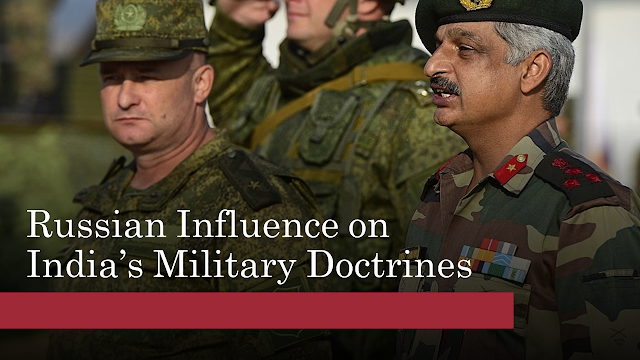
India's Russian-equipped and trained military is watching with great concern Russia's losses in the Ukraine war. Moscow has lost 20,000 soldiers, nearly 500 main battle tanks and a large warship so far, according to media reports. Ukraine's use of Turkish drones, US-made anti-tank guided missiles (ATGMs) Javelins and Ukrainian anti-ship Neptune missiles has taken a heavy toll on the Russian Army and Navy. It is notable that India's Cold Start Doctrine against Pakistan is modeled on the Russian formation known as the “operational maneuver group” (OMG).
 |
| Russian Influence On Indian Military Doctrine. Source: Air University, US Air Force |
Russian Influence on Indian Military Doctrine:
It is well known that the Indian Army relies on Russian tanks, artillery, rockets, and ammunition. The Indian Navy uses Russian ships, submarines and missiles and the Russian Su-30 MKI forms the backbone of the Indian Air Force. Like Russia, the Indian military doctrine is based on deploying large platforms (tanks, artillery, ships and fighter-bombers) with massive firepower. Here's an excerpt of an article by Dr. Vipin Narang, an Indian-American analyst, on the subject:
"In terms of doctrine and strategy, although it may be difficult to trace direct influence and lineage between Russia and India, there are several pieces in India’s conventional and nuclear strategy that at least mirror Russia’s behavior. On the conventional side, the core formation in the quick-strike concept known as “Cold Start” or “proactive strategy options” was modeled on the Russian formation known as the “operational maneuver group” (OMG). The idea was to have a formation that could be rapidly assembled from tank and armored divisions that could break through reinforced defenses—NATO for Russia, and Pakistan’s I and II Corps in the plains and desert sectors for India.
"On the nuclear side, India is currently seized with the same dilemma as the Soviet Union was during the Cold War: both NATO and Pakistan threaten battlefield nuclear weapons against conventional thrusts (India, at least, presumably would be retaliating following a Pakistan-backed provocation). While both states refined their conventional concept of operations, there may have also been corresponding adjustments to their nuclear strategies. It was long believed that, in response to NATO threats to use nuclear weapons first on the battlefield, the Soviet Union had strong preemptive counterforce elements in its strategy to try to at least disarm the United States of its strategic nuclear weapons for damage limitation. It is increasingly evident that at least some serious Indian officials are interested in developing the same sort of option: preemptive counterforce against Pakistan’s strategic nuclear forces, both for damage limitation and to reopen India’s conventional superiority. It is no surprise perhaps, then, that India chose to go ahead with acquiring Russia’s S-400 missile and air defense system, despite the threat of Countering America's Adversaries Through Sanctions Act (CAATSA) sanctions from the United States: the S-400 is key to India’s damage limitation strategy, capable of potentially intercepting residual ballistic and cruise missiles that a counterforce strike might miss".
 |
| Pakistani Military Official in Ukraine. Source: New York Times |
Turkish Drones:
Turkish Bayraktar TB2 has been highly effective in destroying Russian tanks and armor in Ukraine. It is playing a key role in Ukraine's counter offensives against Russia's invasion. It is proving so effective that "Ukrainian forces are singing its praises, literally", according to a CNN report.
Indian Army has nearly 6,000 tanks of Russian origin. These tanks are just as vulnerable to drone and anti-tank missiles as the Russian tanks that perished in Ukraine.
Pakistan has developed Baktar Shikan, a second-generation man-portable anti-tank guided missile (ATGM) system which uses optical aiming, IR tracking, remotely controlled and wire transmitted guidance signals. It can also be mounted on attack helicopters and Armored Personnel Carriers (APCs). Its long range, penetration power and a powerful anti-jamming capability form a potent defense against armored targets.
Pakistan is also reported to have already acquired Turkish Bayraktar TB2 drones recently. It was displayed in the Pakistan Day Parade on March 23, 2022, along with other military equipment acquired recently by the Pakistani defense forces.
Anti-Ship Missiles:
Ukraine claims that its Neptune anti-ship missiles hit and sank Moskva in Black Sea. It was a large 10,000-ton guided missile cruiser of the Russian Navy that was launching cruise missiles on targets in Eastern and Southern Ukraine. It is the largest warship to have been sunk in action since WWII.
Vast majority of Indian Navy ships, including its aircraft carriers and missile frigates, are designed, built and equipped by Russians.
Pakistan recently showcased its anti-ship missile Harbah at DIMDEX 2022, a defense expo in Qatar. It is a medium range ship launched subsonic cruise missile system capable of targeting sea as well as land targets in “all weather operation” at a maximum range of 280 kilometers, according to a report in NavalNews. The missile is fire and forget type. It relies on inertial navigation technologies with GPS and GLONASS systems. According to its manufacturer GIDS, the missile features the following guidance systems: a DSMAC camera, imaging infrared seeker, and radar seeker.
Summary:
The war in Ukraine is forcing a defense strategy rethink in countries such as India which rely on Russian equipment and training. Hindustan Times has quoted an unnamed former Indian Army Chief as saying: “War videos available show that the Russian Army has tactical issues in Ukraine war. Tell me, which tank formation goes to war in a single file without air or infantry cover when the opponent is equipped with the best anti-tank guided missile like Javelin or Turkish Bayraktar TB2 missile firing drones? There is question on Russian air supremacy with Ukraine Army armed with shoulder fired Stinger surface to air missiles as well as the night fighting capability of the Russian Air Force.”
Related Links:
Haq's Musings
South Asia Investor Review
Pakistan-China Defense Industry Collaboration Irks West
Pakistan's Cyber Attack and Defense Capability
Is India a Paper Elephant?
Pakistan's Aircraft Exports
Pakistan Navy Modernization
West's Technological Edge in Geopolitical Competition
Pakistan Defense Industry
Silicon Valley Book Launch of "Eating Grass"
Ukraine's Lesson For Pakistan: Never Give Up Nukes!
Pakistan Economy Nears Trillion Dollars
Pakistan's Sea-Based Second Strike Capability
Riaz Haq Youtube Channel
VPOS Youtube Channel
Riaz Haq
On 03 January, Pakistan’s Inter Services Public Relations (ISPR) announced that the Pakistan Air Force (PAF) test-fired the Taimoor air-launched cruise missile (ALCM).
https://quwa.org/pakistan-air-force-news/600km-low-altitude-flight-...
According to the ISPR, the Taimoor ALCM “is capable of engaging enemy land and sea targets with high precision at a range of 600 kilometres, carrying a conventional warhead.” In addition, the ISPR highlighted the Taimoor ALCM’s ability to fly at “very low altitudes” to circumvent enemy air defence systems.
Video footage released by the ISPR showed that the Taimoor ALCM was launched from a PAF Mirage 3 ROSE (Retrofit of Strike Element) aircraft, which had been the primary carrier of the PAF’s ALCMs (i.e., the Ra’ad) and stand-off weapon (SOW) systems (i.e., H-2 and H-4) until the mid-to-late-2010s.
Background on the Taimoor ALCM
The Taimoor ALCM is the conventional-use variant of the Ra’ad-II, developed by the National Engineering and Scientific Commission (NESCOM) and unveiled in 2017. Initially, the Taimoor was positioned primarily for the export market by Global Defence and Industrial Solutions (GIDS), the sales and marketing wing of NESCOM. However, in recent years, Pakistan has been working towards re-leveraging its cruise missiles, which had been limited to the strategic (i.e., nuclear) deployment role for conventional warfighting.
Like the Ra’ad-II, the Taimoor ALCM has a range of 600 km (capped to 280-290 km for export purposes) and features the same low-observable (LO) airframe. It has a length of 4.38 m, wingspan of 3.20 m, and a total weight of 1,100 kg to 1,200 kg. The Taimoor has a cruise speed of Mach 0.7 to Mach 0.8, and can be launched at altitudes ranging from 610 m to 7,620 m (i.e., 2,000 ft to 25,000 ft).
In effect, the Taimoor and Ra’ad-II are the same missile, but given different designations to demarcate their conventional and nuclear deployment roles, respectively.
This recent test was significant in its own right as it validated a new capability not previously seen in the Ra’ad-series, i.e., terminal-stage guidance through the new imaging infrared (IIR) seeker.
This IIR seeker is likely the same one GIDS had shown across different NESCOM solutions at the 2024 International Defence Exhibition and Seminar (IDEAS 2024), from the Taimoor and Harbah cruise missiles to the in-development Rasoob 250 and AZB-81LR. Thus, this test was crucial, as it not only validated a current capability but also a key subsystem that will integrate with future solutions.
Pakistan’s Conventional Capability Push
The PAF’s induction of the Taimoor ALCM (i.e., re-leveraging the strategic Ra’ad/-II for the conventional role) reflects the Pakistani military’s wider push to spread guided strike capabilities beyond the traditional confines of strategic or nuclear deployment.
Historically, Pakistan’s guided munitions ecosystem skewed in two ways: First, it treated precision strike as a specialized mission area – e.g., anti-ship warfare (AShW) and selective attacks aimed at high-value targets (HVT). Second, the lack of industrial-scale production capacity meant that NESCOM’s solutions – e.g., the Ra’ad/II, Babur, etc – could only be built in small numbers. The constraint in missile output then meant that cruise missiles and ballistic missiles were, by default, treated as strategic deterrence assets, not high-tempo conventional warfighting systems.
Jan 4
Riaz Haq
Bilal Khan
@bilal_quwa
Quite interesting that the #PakistanNavy tested a SAM, a USV, and a loitering munition on the same day -- i.e., 3 key weapon systems that have risen in importance since the Russia-Ukraine War. I think they were testing or validating a maneuver centered on these 3 types of systems: https://quwa.org/pakistan-navy-news/pakistan-navy-tests-unidentifie...
https://x.com/bilal_quwa/status/2010577508538724713?s=20
----------------
Pakistan Navy Tests New USV & Loitering Munition From Private Sector
https://quwa.org/pakistan-navy-news/pakistan-navy-tests-unidentifie...
On 10 January, the Pakistan Navy (PN) announced it had successfully tested a new unmanned surface vehicle (USV) and a loitering munition. In addition, a PN Tughril-class (Type 054A/P) frigate also carried out a successful live firing of a LY-80(N) surface-to-air missile (SAM).
The loitering munition was confirmed to be a Mudamir LR, produced by the private company Sysverve Aerospace based in Rawalpindi. The Mudamir LR is from a growing portfolio of Shahed-style munitions being developed and produced in Pakistan.
Regarding the USV, the design does not match any of Pakistan’s known USV platforms, including an unnamed platform developed by the National Engineering and Scientific Commission (NESCOM) and others by Stingray Technologies (also developed by NESCOM), Beyond Koncept, and Woot-Tech.
It is possible that the newly tested USV is a technology demonstrator, possibly developed by NESCOM (but not confirmed), which appears to be managing at least two such platforms (one revealed in 2024 and a newer, stealthier strike platform via Stingray Technologies in 2025).
The newly tested USV was equipped with a mast-mounted, stabilized electro-optical and infrared (EO/IR) camera turret mounted aft of the hull. This was likely a remote driving camera used to provide the operator with a visual feed and, potentially, basic surveillance and/or targeting capabilities.
In addition, there is a white vertical element near the bow, which could be a communications and/or GNSS antenna within a radome structure. This would likely be the line-of-sight (LoS) control link for the operator to remotely control the USV.
Overall, there are no indications that this USV is configurable for munitions or warheads, so it is probably intended as a simpler system for testing and validation. Thus, the intent of the tests likely had less to do with the hull design and was instead focused on validating the integrated subsystems, such as the datalink and the EO/IR turret, which would be configured into the actual service-ready products.
A Hint at the PN’s Future Defensive Posture
In one day, the PN tested a USV, a SAM, and a loitering munition – i.e., arguably the three core pieces of a scale-driven anti-access and area-denial (A2/AD) posture…
Jan 12
Riaz Haq
U.S. and Ukrainian Forces Went Head-to-Head in an Exercise. Ukraine’s Drones Won. - The Wall Street Journal.
https://www.wsj.com/politics/national-security/u-s-and-ukrainian-fo...
The exercise, coupled with U.S. casualties in Iran, shows American vulnerabilities to drones—years after the U.S. made uncrewed systems an essential part of warfare. America pioneered using long-range drones in war. The Pentagon has recently spent billions acquiring new drone and counterdrone technology and formed special units to operate it.
Still, in the Middle East this year, the U.S. has struggled to defend against Iran’s long-range drones, which have killed and injured soldiers and destroyed aircraft.
The drubbing in Germany conveyed lessons from Ukraine focused on short-range battlefield drones. The exercise, held in April and May, tested visiting troops’ ability to operate and defend against the proliferation of smaller, front-line drones that have dominated the conflict between Russia and Ukraine.
Exercises like Combined Resolve are run precisely so that forces can experience realistic combat conditions. Army leaders in Europe over recent years have taken advantage of having Ukrainian forces on hand to participate and impart their hard-won skills to U.S. and allied troops in practice, on simulated battlefields. The expectation is that failures are educational. British and Swedish exercises have also resulted in easy Ukrainian triumphs.
Eliot Cohen, a scholar at the Center for Strategic and International Studies think tank, said that recent battlefield experience shows how drones of all kinds are essential to modern war.
“It is vital that the U.S. military master that, and thus far, unfortunately, that does not seem to be the case,” he said.
———
Ukrainian drones were doing this so quickly with U.S. vehicles that they had to be sent back into the exercises as new units, or “re-spawned,” to keep the exercise going, a U.S. official briefed on the drill said.
The U.S. reran the training scenario over the two-week engagement. The rotating forces improved their performance, as they became more adept at dispersing and concealing themselves and using electronic warfare, said the Army official. The Ukrainians also switched sides midway through the exercises and helped them use drone technology offensively, which they did effectively, the official said.
Ukrainian troops have become expert in drone warfare over nearly 4½ years of fighting Russia, with operators and their support troops now skilled at continually repairing and adapting drones. Moscow’s forces have also gained invaluable skills. American drone operators lack experience fixing and arming drones under fire, said the person present at the exercise.
In Ukraine, so many tanks and other armor are destroyed in battle that large parts of the country’s vast front line is almost free of armor.
Some U.S. military officers, though, argue that drones are particularly deadly in this war because it has reached a stalemate with little battlefield movement. In a war of maneuver, the tank and other armor would come back into its own, they say.
But Ukrainian military thinkers such as former chief commander Valeriy Zaluzhniy argue that drone technology has made traditional maneuver warfare unfeasible, for now, explaining the largely static front line in Ukraine’s east. Both Russia and Ukraine are searching for the next breakthroughs in technology and tactics to restore movement to the battlefield.
The exercise showed that the U.S. may struggle to protect that armor as it moves.
This wasn’t the first time the U.S. has come across Ukrainian drone proficiency. In 2023, a U.S. infantry officer helping train Ukrainian troops realized the U.S. needed to learn from them about drone warfare and designed a training program that other Army units later followed, according to a U.S. official.
5 hours ago