PakAlumni Worldwide: The Global Social Network
New Gwadar International Airport: Pakistan's 2nd Greenfield Class 4F Airport Nearing Completion
The architecture of the New Gwadar International Airport (NGIA) is inspired by a rising Phoenix. It is Pakistan's second greenfield airport built from scratch in a new location. With a 3,650-meter long runway, it is a Class 4F airport. NGIA is scheduled to begin test flights in December this year. The only other airport with a 3,600-meter long runway is the New Islamabad International Airport that opened for commercial flights in 2018. Karachi and Lahore international airports have runways lengths of 3,400 meters and 3,360 meters respectively, putting them in 4E class. All four of these major Pakistani airports can handle landing of Airbus A380, the largest commercial airliner in operation today.
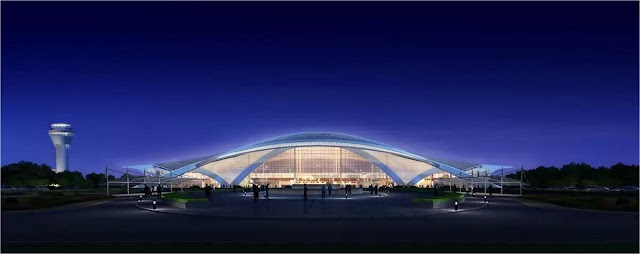 |
| New Gwadar International Airport Architecture Inspired by A Rising Phoenix |
New Gwadar International Airport (NGIA) is being built in Gwadar at a cost of $246 million on an area of 4,300 acres. Construction of NGIA started in October, 2019. The entire project is being built by the state-owned China Airport Construction Company funded by a Chinese government grant. It was originally scheduled for completion in 36 months. The work was slightly delayed due to the COVID19 pandemic. It is now expected to be ready for trial flights in December, 2022.
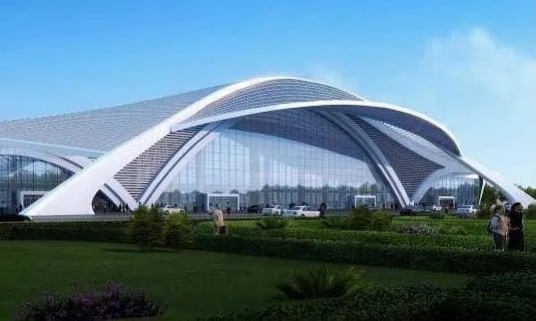 |
| New Gwadar International Airport, Gwadar, Pakistan |
NGIA is part of the China Pakistan Economic Corridor (CPEC) projects. Another key CPEC project recently completed in Gwadar is the 19-kilometer long six-lane East Bay Expressway. It was opened for traffic on June 3, 2022. East Bay Expressway connects to the Makran Coastal Highway which in turn is connected to the larger network of motorways and highways in the country as well as to China and the landlocked nations of Central Asia in CAREC.
 |
| East Bay Expressway, Gwadar, Pakistan |
The completion of New Gwadar International Airport and East Bay Expressway is an indication that the Western and Indian media headlines about the death of CPEC are not credible. To the contrary, the continuing progress on CPEC projects confirms the strong commitment of both the Chinese and the Pakistan government to move forward with their broad-based cooperation. Just yesterday, Pakistan's new Prime Minister Shehbaz Sharif reaffirmed that his government is determined to complete all the projects under the multi-billion-dollar China-Pakistan Economic Corridor (CPEC). Earlier, Chinese Foreign Ministry Spokesman Zhao Lijian said China would continue to support its companies in investing and operating in Pakistan to realize win-win results and shared development.
Related Links:
Riaz Haq
China Ports Chair Zhang Baozhong: #China gave 5b Yuan (1 billion US$) in grants for #socioeconomic uplift of #Gwadar over the last 7 years to improve living standard of local population under Corporate Social Responsibility Initiatives. #CPEC #Pakistan https://www.pakistantoday.com.pk/2022/05/22/china-grants-over-5b-yu...
He pointed out that the grant is dedicated to New Gwadar International Airport (NGIA), East Bay Expressway, 300-bed China-Pakistan Friendship Hospital, China-Pakistan Vocational and Technical Training Institute, China-Pakistan Gwadar Faqeer Middle School, China-Pakistan Fraternity Emergency Center, and the 1.2 MGD desalination plant so far.
“NGIA will have the longest runway, 3.78 km, in the region, equipped with a capacity to handle the largest aircraft. The tourism sector will inevitably boom,” Mr. Zhang said. With its operationalization, new resorts will be established attracting many tourists from China and other countries, he added.
While speaking at length about the experiences of his 7 years’ stay in Gwadar, the COPHC chairman said: “We are cognizant of the fact that Gwadar deserves more rapid development to live up to the expectations of the local people. There is no denying the fact that it has developed much during the past 7 years.”
He stated three reasons for the promising prospects of Gwadar: the cooperation of the Gwadar people, its vast resources, and its strategic location. “The inhabitants of Gwadar deserve respect and development”, Mr. Zhang undercored.
Mr. Zhang made it clear that Gwadar port is fully functional. Some problems do exist like logistics and lack of market demand, however, development is an evolutionary process and Gwadar is on its way towards industrialization, he mentioned.
After the completion of M8, he said, cargos will be able to reach Lahore and other major cities, reducing the distance significantly. “4 new Chinese investors are coming to Gwadar to explore opportunities and investment potentials in the refinery, textile, petrochemical and agricultural sectors,” acclaimed the chairman.
COPHC is one of the major players in Gwadar and has undertaken remarkable steps in Gwadar’s development. “Gwadar is my second home and we are ready to collaborate with local community in educational development. We can offer exchange programs for the students and academics of Gwadar. Through the scientific research laboratory we will impart sophisticated know-how to the local youth”, Mr. Zhang pronounced. It has been observed that for the pursuit of a clean and green Gwadar, more than 50,000 plants were planted, predominantly spearheaded by COPHC.
Co-organized by the Institute of Policy Studies (IPS) Islamabad, University of Gwadar, and COPHC, speakers included Commodore Jawad Akhtar, Advisor Maritime Affairs, Chairman COPHC Mr. Zhang Baozhong, Chairman Gwadar Port Authority Mr. Naseer Khan Kashani, Vice-chancellor University of Gwadar Prof. Abdul Razzaq Sabir, and Chairman IPS Mr. Khalid Rehman.
The conference was followed by a round-table discussion and a detailed question and answers session. Representatives of Gwadar civil society probed into the CSR initiatives undertaken by Chinese enterprises in Gwadar which were satisfactorily responded to by the authorities of COPHC.
Eventually, the media team visited China-Pakistan Vocational and Technical Training Institute and other sites under CSR to witness the pace of progress. They interacted with the local students to observe their views. The visitors were appreciative of the efforts of Chinese companies in overhauling the healthcare and education systems and in providing job opportunities to the locals of Gwadar.
Jun 17, 2022