PakAlumni Worldwide: The Global Social Network
Nehru's Secularism Was An Aberration; Modi's Islamophobia is the Norm For India
As India and Pakistan turn 75, there are many secular intellectuals on both sides of the border who question the wisdom of "the Partition" in 1947. They dismiss what is happening in India today under Hindu Nationalist Prime Minister Narendra Modi's leadership as a temporary aberration, not the norm. They long for a return to "Indian liberalism" which according to anthropologist Sanjay Srivastava "did not exist".
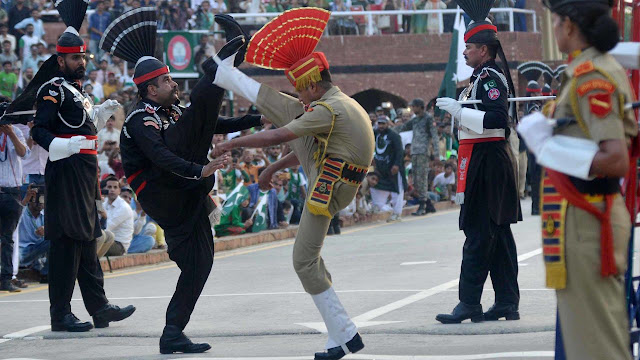 |
| India Pakistan Border Ceremony at Wagah-Attari Crossing |
American historian Audrey Truschke who studies India traces the early origins of Hindu Nationalism to the British colonial project to "divide and rule" the South Asian subcontinent. She says colonial-era British historians deliberately distorted the history of Indian Muslim rule to vilify Muslim rulers as part of the British policy to divide and conquer India. These misrepresentations of Muslim rule made during the British Raj appear to have been accepted as fact not just by Islamophobic Hindu Nationalists but also by at least some of the secular Hindus in India and Muslim intellectuals in present day Pakistan, says the author of "Aurangzeb: The Life and Legacy of India's Most Controversial King". Aurangzeb was neither a saint nor a villain; he was a man of his time who should be judged by the norms of his times and compared with his contemporaries, the author adds.
After nearly a century of direct rule, the British largely succeeded in dividing South Asians along religious and sectarian lines. The majoritarian tyranny of the "secular" Hindu-dominated Indian National Congress after 1937 elections in India became very apparent to Quaid-e-Azam Mohammad Ali Jinnah, the leader of All India Muslim League. Speaking in Lucknow in October 1937, he said the following:
"The present leadership of the Congress, especially during the last ten years, has been responsible for alienating the Musalmans of lndia more and more, by pursuing a policy which is exclusively Hindu; and since they have formed the Governments in six provinces where they are in a majority they have by their words, deeds, and programme shown more and more that the Musalmans cannot expect any justice or fair play at their hands. Whenever they are in majority and wherever it suited them, they refused to co-operate with the Muslim League Parties and demanded unconditional surrender and signing of their pledges."
Prime Minister Narendra Modi's Hindu Nationalist BJP party's appeal is the greatest among Hindus who closely associate their religious identity and the Hindi language with being “truly Indian.” The Pew survey found that less than half of Indians (46%) favored democracy as best suited to solve the country’s problems. Two percent more (48%) preferred a strong leader.
Indian anthropologist Sanjay Srivastava sums up the current situation as follows:
"Our parents practiced bigotry of a quiet sort, one that did not require the loud proclamations that are the norm now. Muslims and the lower castes knew their place and the structures of social and economic authority were not under threat. This does not necessarily translate into a tolerant generation. Rather, it was a generation whose attitudes towards religion and caste was never really tested. The loud bigotry of our times is no great break from the past in terms of a dramatic change in attitudes – is it really possible that such changes can take place in such few years? Rather, it is the crumbling of the veneer of tolerance against those who once knew their place but no longer wish to accept that position. The great problem with all this is that we continue to believe that what is happening today is simply an aberration and that we will, when the nightmare is over, return to the Utopia that was once ours. However, it isn’t possible to return to the past that was never there. It will only lead to an even darker future. And, filial affection is no antidote for it".
Disintegration of India
Dalit Death Shines Light on India's Caste Apartheid
Caste Discrimination Rampant Among Silicon Valley Indians
Rape: A Political Weapon in Modi's India
Hindutva: The Legacy of the British Rulers "Divide and Rule" Project
Will Modi's Hindutva Lead to Multiple Partitions of India?
Riaz Haq Youtube Channel
PakAlumni: Pakistani Social Network
Riaz Haq
Romila Thapar - India's Past and Present: How History Informs Contemporary Narrative (2010)
https://youtu.be/J8HhLJzpx3Y
In conversation with IDRC President David M. Malone, historian Romila Thapar, widely recognized as India's foremost historian challenged the colonial interpretations of India's past, which have created an oversimplified history that has reinforced divisions of race, religion, and caste.
Jul 18, 2023
Riaz Haq
India closes school after video of teacher urging students to slap Muslim classmate goes viral
https://www.cbsnews.com/news/india-teacher-viral-video-tells-studen...
New Delhi — Authorities in central India's Uttar Pradesh state have shut down a private school after video of a teacher asking her students to slap their Muslim classmate went viral and sparked outrage. The state police registered a case against the teacher, identified as Tripta Tyagi, as the video of the August 24 incident spread online.
The scandal erupted at a time of growing tension between India's predominantly Hindu population and its large Muslim minority.
The video, which was verified by police, shows Tyagi telling her students to slap their seven-year-old Muslim classmate. At least three students come up to the Muslim classmate one by one and hit him.
"Why are you hitting him so lightly? Hit him harder," the teacher is heard telling one child as the Muslim boy stands crying.
"Hit him on the back," she tells another student.
Satyanarayan Prajapat, a senior police officer in Uttar Pradesh's Muzaffarnagar district, said the teacher told students to hit the boy "for not remembering his times tables."
But the teacher also mentioned the boy's religion, according to Prajapat.
The teacher from the Neha Public School admitted she'd made a "mistake" by asking other students to hit the boy as she is disabled and couldn't do it herself, but she also defended her actions as necessary discipline.
"This wasn't my intention. I am accepting my mistake, but this was unnecessarily turned into a big issue," Tyagi told India's NDTV news network. "I am not ashamed. I have served the people of this village as a teacher. They all are with me."
The Muslim student's parents took their son out of the school and reported the incident to the police, but they were not pressing charges against the teacher.
"My seven-year-old was tortured for an hour or two. He is scared. This is not a Hindu-Muslim issue. We want the law to take its own course," the boy's father told Indian news networks.
Several politicians accused India's ruling Bharatiya Janata Party (BJP) of creating an atmosphere in which the incident was able to take place.
Rahul Gandhi, senior leader of the main opposition party, the Indian National Congress, accused the teacher of "sowing the poison of discrimination in the minds of innocent children."
"This is the same kerosene spread by BJP which has set every corner of India on fire," Gandhi wrote in a social media post.
The BJP, led by Prime Minister Narendra Modi, has consistently said it does not discriminate against the country's more than 200 million Muslims.
In June, during a visit to the U.S., Modi told journalists there was "absolutely no space for discrimination" in India.
Meanwhile, Uttar Pradesh government officials said the school was being shut as it did not meet the education department's "criteria," with all students set to be transferred to other schools.
Aug 28, 2023
Riaz Haq
In Prime Minister Narendra Modi’s most important speech of the year, his annual Independence Day address in August, he used the stage to honor the group that changed his life and is remaking India.
https://www.nytimes.com/2025/12/26/world/asia/india-hindu-right-rss...
That it was Mr. Modi’s most forceful and public nod in his 11 years in office to the Rashtriya Swayamsevak Sangh — the far-right Hindu nationalist group known as the R.S.S., which had molded his personal and professional life since he was a young boy — was a reflection of what a king-making power the group has become as it celebrated its 100th anniversary this year.
The R.S.S. originated as a shadowy cabal for the revival of Hindu pride after a long history of Muslim invasions and colonial rule in India, its early leaders openly drawing inspiration from the nationalist formula of Fascist parties in Europe during the 1930s and 1940s. It has survived repeated bans, including being accused in the assassination of Gandhi, to grow into the largest right-wing juggernaut in the world.
More than a decade of Mr. Modi, one of their most ambitious and capable recruits, at the helm of national power has brought the organization the kind of success and acceptability that many of its leaders say they never dared imagine. While there have at times been tensions with the strongman premier, the R.S.S. is closing in on its dream to rebuild India’s secular republic as a muscular, Hindu-first nation.
After a swath of the country was cleaved off to create the nation of Pakistan for Muslims when the British left in 1947, the Hindu right was furious that the new Indian state had not been given a similarly outright religious identity. The target of their fury was Gandhi, who was later shot dead at an evening public prayer.
The shooter was a right-wing Hindu activist with ties to the R.S.S., which distanced itself by saying he had quit years earlier. Still, the organization was banned and became a pariah for
India’s imagining as a secular republic was a top-down, idealistic project that left unaddressed the open wounds and humiliations of Muslim invasions and colonial rule. It was a fundamental grievance that the R.S.S. tapped into as fuel for expansion.
It began to inch into politics by launching a political wing in the 1950s that later recast itself as today’s ruling B.J.P. It got its first big break in the 1970s, and it kept building.
Rise to Power
When Indira Gandhi, India’s then prime minister and leader of the Congress party, suspended India’s democracy in 1975 to stay in power after a court had disqualified her election victory, her government’s persecution of the R.S.S. and other groups created a wave of sympathy for them. R.S.S. leaders were arrested in droves, and they began casting themselves as pillars of the effort to save Indian democracy.
“My mother voted for Congress, but my father was with the R.S.S.” S.M. Baghadka, 84, a retired government worker and longtime R.S.S. member, said during a morning exercise session in Nagpur. “After Indira jailed my father, my mother also changed sides.”
A campaign over a contested religious site in the 1990s gave the R.S.S. its second big break and forever changed the course of Indian politics.
A 16th-century mosque in the town of Ayodhya had become a symbolic target of the group, which claimed it had been built on land where a Hindu temple to the deity Ram once stood. The dispute had meandered through India’s judiciary, but the Hindu right had other ideas.
The president of the B.J.P. crisscrossed the country in a truck decked out as a chariot, stirring deadly local tensions as his caravan moved. The movement’s bigger goal was to unite Hinduism’s vast diversity in a way similar to the invading monoliths, R.S.S. leaders said. “Jai Shri Ram,” or hail to the Lord Ram, became its battle cry.
The buildup culminated in 1992 when mobs that included known R.S.S. affiliates — armed with rods, pickaxes and burning rage — climbed the mosque’s domes and tore it down.
7 hours ago