PakAlumni Worldwide: The Global Social Network
Do Indian Aircraft Carriers Pose a Serious Threat to Pakistan's Security?
India has recently inducted INS Vikrant, the South Asian nation's second aircraft carrier. This "indigenous" ship of the Indian Navy is powered by four American-made General Electric LM2500 marine gas turbines built in the US state of Ohio. It is a relatively small aircraft carrier with a displacement of 40,000 tons, top speed of 28 knots, cruise speed of 18 knots and 7,500 nautical miles (8,630 miles) range. INS Vikrant can carry up to 30 fixed-wing and rotary aircraft and 1600 sailors. India plans to equip it with Russian MiG-29K fighter jets and Westland Sea King helicopters, a British license-built version of the American Sikorsky S-61 helicopter of the same name. Does this latest addition to the Indian Navy pose a serious threat to Pakistan's security? Can Pakistan defend against it?
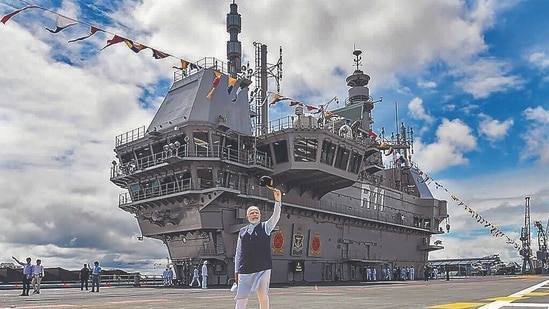 |
| Indian PM Modi Launched INS Vikrant Aircraft Carrier |
In a 2017 paper for the US Naval War College Review, defense analyst Ben Wan Beng Ho discussed how India might use its aircraft carriers against Pakistan and how the latter would respond. Here are some key excerpts from it:
"(I)t is doubtful that any attack force launched from an Indian carrier would pack a significant punch. “With aircraft available for strike duties barely numbering into the double digits, the Indian carrier simply cannot deliver a substantial ‘pulse’ of combat power against its adversary.”
“In any attempt to impose sea control in the northern Arabian Sea and to interdict Pakistani seaborne commerce by enforcing a blockade of major Pakistani maritime nodes, Indian carrier forces would have to devote a portion of their already meager airpower to attacking Pakistani vessels, thereby exacerbating the conundrum alluded to earlier. What is more, Pakistani ships are likely to operate relatively close to their nation’s coast, to be protected by Islamabad’s considerable access-denial barrier.”
Indian-American defense analyst Ashley Tellis has also raised serious questions about the Indian naval doctrine. He believes that the land-based fighter aircraft with refueling to extend range are a better option. He also says that aircraft carriers are highly vulnerable to sinking by stealthy submarines.
There are lessons for the Indian military from Ukraine-Russia war. In April this year, Ukraine's Neptune anti-ship missiles hit and sank Moskva in Black Sea. It was a large 10,000-ton guided missile cruiser of the Russian Navy that was launching cruise missiles on targets in Eastern and Southern Ukraine. It is the largest warship to have been sunk in action since WWII.
Pakistan has recently showcased its anti-ship missile Harbah at DIMDEX 2022, a defense expo in Qatar. It is a medium range ship launched subsonic cruise missile system capable of targeting sea as well as land targets in “all weather operation” at a maximum range of 280 kilometers, according to a report in NavalNews. The missile is fire and forget type. It relies on inertial navigation technologies with GPS and GLONASS systems. According to its manufacturer GIDS, the missile features the following guidance systems: a DSMAC camera, imaging infrared seeker, and radar seeker. More recently, Pakistan's ally China has successfully demonstrated its carrier-buster missile. A single round has to be slung underneath the fuselage. And its primary prey is likely to be enemy aircraft carriers. For this reason, it has been widely dubbed a ‘carrier killer’, according to Naval News.
In a YouTube video, Indian journalist Shekhar Gupta noted that the Indian Navy hid its aircraft carriers from Pakistan Navy submarines in both 1965 and 1971 wars. He also recalled that Pakistani Navy warships destroyed Indian Naval Base at Dwarka in 1965, and Pakistani sub Hangor sank an Indian warship INS Khukri in 1971 war.
General Kidwai on Pakistan's 2nd Strike Capability
Military Lessons From Russia-Ukraine War
Vast Majority of Indians Believe Nuclear War Against Pakistan is "Winnable"
Pakistan Navy Modernization
Hindutva: The Legacy of the British Rulers "Divide and Rule" Project
Will Modi's Hindutva Lead to Multiple Partitions of India?
Riaz Haq Youtube Channel
PakAlumni: Pakistani Social Network
Riaz Haq
Overmatched: Top secret US report warns American forces would be drastically outmatched by China | The Independent
https://www.independent.co.uk/asia/china/china-us-military-taiwan-w...
The U.S. military is most likely to suffer a defeat at the hands of China if it tried to intervene in a war over Taiwan, a top secret Pentagon assessment report has found.
Pentagon war games simulating a Chinese invasion of Taiwan have shown that Beijing could cripple U.S. fighter squadrons, major warships, and even satellite networks before they deploy effectively, the highly classified document, “Overmatch Brief”, warned.
The document, prepared by the Pentagon’s Office of Net Assessment, shows America's reliance on advanced and expensive weapons makes it vulnerable to China's rapidly manufactured cheaper ones, reported the New York Times.
The report warned that China has developed the capacity to neutralise critical American assets at the outset of a conflict.
————————
The report notes that China could destroy many U.S. advanced weapons, such as aircraft carriers before they even reach Taiwan, using missiles amassed over the past 20 years.
In wargames simulating battlefield scenarios, even the latest U.S. Navy carrier is often not able to sustain an attack, the assessment said.
The report cited the example of America’s latest U.S.S Gerald R. Ford, built at a cost of $13 billion and deployed in 2022. Despite the new technologies, including more advanced nuclear reactors, the carrier would be unable to survive a Chinese attack.
The Ford, which would be effective if matched against weaker powers like Venezuela, is “fatally vulnerable to new forms of attack”, it said.
The report also drew from real-world examples as the war in Ukraine against Russia continues to test Western weaponry on the battlefield and the adversaries of America are learning of the shortcomings and strengths.
“The war in Ukraine demonstrated how vulnerable tanks have become,” it said.
The assessment also warned that the U.S. no longer has the industrial capacity to produce weapons and munitions at the speed and scale required for a prolonged conflict with a major power.
Washington is falling behind in rapidly developing advanced weapons compared to Beijing and Moscow as it “over-relies on expensive and vulnerable weapons”, it said.
Previously, Pete Hegseth, the Secretary of Defense, said in the Pentagon’s war games against China, “we lose every time” and predicted that China’s hypersonic missiles could easily destroy aircraft carriers within minutes.
The U.S. is vulnerable because the missile stockpiles have already been strained by support for Israel and Ukraine, it said.
National Security Adviser Jake Sullivan has previously cautioned that the U.S. would run out of key munitions quickly in a war with China.
Internal Pentagon assessments indicate that China now far surpasses the U.S. in nearly every category of cruise and ballistic missiles, even though both countries retain around 400 intercontinental ballistic missiles (ICBMs).
Dec 15, 2025
Riaz Haq
The Pakistan Navy’s fourth Hangor-class submarine, named Ghazi, was launched at Shuangliu Base in Wuhan, China, the Inter-Services Public Relations (ISPR) announced on Wednesday.
https://www.dawn.com/news/1961663
With the Ghazi’s launch, the ISPR hailed “another significant milestone” by the navy, where all four submarines being built in China are currently undergoing “rigorous sea trials and are in the final stages of being handed over to Pakistan”.
“The Government of Pakistan signed an agreement with China for [the] acquisition of eight Hangor-class submarines. Under this contract, four submarines are being built in China and [the] remaining four will be constructed in Pakistan by Karachi Shipyard and Engineering Works Ltd (KS&EW), under Transfer of Technology (ToT),” the ISPR said in a statement.
The military’s media wing added that the submarines will be fitted with advanced weaponry and sensors capable of engaging targets at standoff ranges.
“Hangor-class submarines will be pivotal in maintaining peace and stability in the region,” the statement read, adding that the launch ceremony was attended by senior officials from China and Pakistan, exemplifying deepening bilateral cooperation.
The navy launched the first of the new submarines in April 2024, while the second and third were launched on March 15 and August 15 this year, respectively.
The submarine class, named after the PNS Hangor, is a diesel-electric attack submarine with air-independent propulsion technology, which allows it to travel over greater distances before resurfacing.
During the 1971 Pakistan-India war, the then-PNS Hangor became the first submarine to sink a warship after World War II, sinking an Indian frigate. After being decommissioned, the Hangor is now on display at the Pakistan Maritime Museum in Karachi.
Dec 17, 2025
Riaz Haq
Pakistan rattles India with new Chinese-built stealth submarine | South China Morning Post
https://www.scmp.com/week-asia/politics/article/3358523/pakistan-ra...
Pakistan has not maintained a meaningful naval presence east of India since its forces were routed there more than half a century ago.
Since the 1971 war, in which India’s navy blockaded what was then East Pakistan, severed supply lines and accelerated the surrender of Pakistani forces that led to the creation of Bangladesh, Islamabad’s naval ambitions have been effectively confined to the northern Arabian Sea.
For it to now signal an intention to operate in the Bay of Bengal – home to India’s Eastern and Nicobar naval commands – is “strategically significant less for its immediate military effect than for its audacious geopolitical symbolism”, according to independent maritime security analyst Swaran Singh.
The Hangor class comes equipped with air-independent propulsion (AIP) technology, enabling the submarines to remain submerged for extended periods – making them stealthier and harder to track than the ageing Agosta vessels they replace.
Unlike conventional diesel-electric submarines, which must regularly surface or snorkel to recharge batteries, AIP-equipped vessels can operate silently at depth for weeks at a time, dramatically increasing their survivability and strike potential in contested waters.
Pakistan currently operates a core fleet of five diesel-electric attack submarines and three midget submarines primarily used for special operations. India’s fleet stands at around 19 active submarines, consisting of roughly 16 conventional diesel-electric vessels and three nuclear ballistic missile submarines.
A parity play?
Abdul Moiz Khan, a research officer at the Centre for International Strategic Studies in Islamabad, said the Hangor class offered Pakistan “parity” with the growing and much larger Indian fleet through precision rather than numbers.
“Instead of a quantitative arms race with India, it [Pakistan] aims to maintain a qualitative parity to maintain balance of power and mutually assured destruction,” he said.
If India were ever to blockade or strike Pakistani naval assets in the Arabian Sea, Khan said the Hangor class would give Pakistan a credible retaliatory reach extending to India’s eastern seaboard.
But the capability question cannot be separated from its strategic context. Singh points to timing: PNS Hangor’s arrival coincides with the deepening of a China-Pakistan naval partnership that now encompasses joint drills and co-production agreements, as well as China’s expanding Indian Ocean presence.
The two navies have conducted regular exercises in the Arabian Sea in recent years and the Hangor programme itself reflects a broader pattern of Chinese arms transfers to Pakistan that includes JF-17 fighter jets, frigates and missile systems.
China permanently stations up to eight warships in the Indian Ocean, operates a military base in Djibouti and has access to ports at Gwadar in Pakistan and Hambantota in Sri Lanka. Its submarines and intelligence vessels have become a routine fixture in waters India once considered its preserve.
The prospect of Pakistani submarines operating in those same waters, potentially networked with Chinese platforms, raised what Singh described as the spectre of “coordinated strategic pressure on both India’s eastern and western seaboards.”
Sultan Mahmood Hali, a retired Pakistan Air Force group captain, read the Hangor’s arrival in similar terms: less a single tactical development than a strategic signal.
5 hours ago