PakAlumni Worldwide: The Global Social Network
Do Indian Aircraft Carriers Pose a Serious Threat to Pakistan's Security?
India has recently inducted INS Vikrant, the South Asian nation's second aircraft carrier. This "indigenous" ship of the Indian Navy is powered by four American-made General Electric LM2500 marine gas turbines built in the US state of Ohio. It is a relatively small aircraft carrier with a displacement of 40,000 tons, top speed of 28 knots, cruise speed of 18 knots and 7,500 nautical miles (8,630 miles) range. INS Vikrant can carry up to 30 fixed-wing and rotary aircraft and 1600 sailors. India plans to equip it with Russian MiG-29K fighter jets and Westland Sea King helicopters, a British license-built version of the American Sikorsky S-61 helicopter of the same name. Does this latest addition to the Indian Navy pose a serious threat to Pakistan's security? Can Pakistan defend against it?
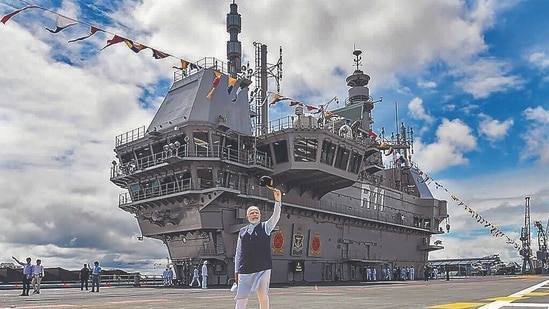 |
| Indian PM Modi Launched INS Vikrant Aircraft Carrier |
In a 2017 paper for the US Naval War College Review, defense analyst Ben Wan Beng Ho discussed how India might use its aircraft carriers against Pakistan and how the latter would respond. Here are some key excerpts from it:
"(I)t is doubtful that any attack force launched from an Indian carrier would pack a significant punch. “With aircraft available for strike duties barely numbering into the double digits, the Indian carrier simply cannot deliver a substantial ‘pulse’ of combat power against its adversary.”
“In any attempt to impose sea control in the northern Arabian Sea and to interdict Pakistani seaborne commerce by enforcing a blockade of major Pakistani maritime nodes, Indian carrier forces would have to devote a portion of their already meager airpower to attacking Pakistani vessels, thereby exacerbating the conundrum alluded to earlier. What is more, Pakistani ships are likely to operate relatively close to their nation’s coast, to be protected by Islamabad’s considerable access-denial barrier.”
Indian-American defense analyst Ashley Tellis has also raised serious questions about the Indian naval doctrine. He believes that the land-based fighter aircraft with refueling to extend range are a better option. He also says that aircraft carriers are highly vulnerable to sinking by stealthy submarines.
There are lessons for the Indian military from Ukraine-Russia war. In April this year, Ukraine's Neptune anti-ship missiles hit and sank Moskva in Black Sea. It was a large 10,000-ton guided missile cruiser of the Russian Navy that was launching cruise missiles on targets in Eastern and Southern Ukraine. It is the largest warship to have been sunk in action since WWII.
Pakistan has recently showcased its anti-ship missile Harbah at DIMDEX 2022, a defense expo in Qatar. It is a medium range ship launched subsonic cruise missile system capable of targeting sea as well as land targets in “all weather operation” at a maximum range of 280 kilometers, according to a report in NavalNews. The missile is fire and forget type. It relies on inertial navigation technologies with GPS and GLONASS systems. According to its manufacturer GIDS, the missile features the following guidance systems: a DSMAC camera, imaging infrared seeker, and radar seeker. More recently, Pakistan's ally China has successfully demonstrated its carrier-buster missile. A single round has to be slung underneath the fuselage. And its primary prey is likely to be enemy aircraft carriers. For this reason, it has been widely dubbed a ‘carrier killer’, according to Naval News.
In a YouTube video, Indian journalist Shekhar Gupta noted that the Indian Navy hid its aircraft carriers from Pakistan Navy submarines in both 1965 and 1971 wars. He also recalled that Pakistani Navy warships destroyed Indian Naval Base at Dwarka in 1965, and Pakistani sub Hangor sank an Indian warship INS Khukri in 1971 war.
General Kidwai on Pakistan's 2nd Strike Capability
Military Lessons From Russia-Ukraine War
Vast Majority of Indians Believe Nuclear War Against Pakistan is "Winnable"
Pakistan Navy Modernization
Hindutva: The Legacy of the British Rulers "Divide and Rule" Project
Will Modi's Hindutva Lead to Multiple Partitions of India?
Riaz Haq Youtube Channel
PakAlumni: Pakistani Social Network
Ameer Alam
What the hell is this? A sitting duck with a WWII design profile.
Sep 6, 2022
Riaz Haq
https://www.aljazeera.com/features/2022/9/8/ins-vikrant-why-indias-...
While keeping one eye on Pakistan, India’s strategic focus has increasingly been on China and its dramatic military expansion, with the People’s Liberation Army Navy, or PLAN, being the main beneficiary. Numerically, it is now the largest navy in the world, with all its ships now designed and built in Chinese shipyards. New designs are being developed at record speeds as China’s navy increases its power and reach to become a truly global force.
India is working hard to develop its own navy as a counter to China’s expansion as tensions between the two countries have risen, recently in the Doklam plateau on the borders of India, China and Bhutan, but also now that India has become a member of the four-nation maritime organisation, the QUAD, aimed at countering China’s influence.
Indian strategists are increasingly focused on what it will take to defeat China in a future naval conflict. Aircraft carriers will play a part in that conflict, but their designs have to be able to stand up to powerful weapons systems coming online. In short, long delays risk obsolescence.
The Vikrant, whilst a milestone for India’s military indigenisation programme, is an older design that is already almost out of date. It is better compared to China’s own first domestically-made aircraft carrier, the Shandong, commissioned in 2019. Both are modified Soviet-era designs.
At about 45,000 tonnes, the Vikrant is even smaller than the older Shandong and both carriers use the older technology “ski-jump” design to give aircraft taking off a much-needed lift.
The Vikrant and Shandong have both been important ships in terms of allowing local designers to develop their own ideas and start to think independently in terms of naval design and manufacture. However, India has been much slower than China in designing these huge warships.
The Vikrant is a generation behind the design of China’s latest aircraft carrier the high-tech Fujian, launched in June. The first supercarrier to be built outside the United States, it is far larger than the Vikrant, will be able to hold more aircraft, and most importantly uses an electromagnetic system to slingshot aircraft at takeoff. This allows the Fujian to launch far heavier aircraft, laden with weapons and fuel, at a far faster rate than the Vikrant.
The Vikrant’s ski-jump system forces its jets to launch to take off under their own power, which limits the amount of fuel, missiles and bombs the jets can carry. All this means a shorter range for its jets, the length of the Vikrant’s “punch” being significantly shorter than that of the Fujian. In a conflict between carriers, the Vikrant would be significantly outgunned and vulnerable to destruction.
The Vikrant’s woes do not stop there. The ship’s Russian Aircraft Flight Complex, the electronic suite the Vikrant uses to detect and manage the ship’s aircraft when in the air, has had installation issues and is proving hard to integrate into the mostly-Indian design. Planned visits by Russian technicians could be held up because of US-led sanctions imposed on Russia due to the war in Ukraine, further delaying the carrier’s completion.
The Vikrant’s air wing will be made up of Russian MiG-29Ks that are used on its sister ship the aircraft carrier INS Vikramaditya. On paper, these MiGs, adapted for carrier use, seem capable. But the jets have proven unreliable and are heavy, making takeoff and landing risky. The Indian navy is now looking for more advanced aircraft, with France’s Rafale M and the US-made F/A-18 Super Hornet being the likely choices.
Sep 8, 2022
Riaz Haq
As the world lurches through the growing pains of massive geopolitical change, the US’ relationship with India will increasingly take center stage. Washington likes to see itself as providing a geopolitical center of gravity that is inherently attractive to nations like India, especially against regional competitors such as China. As the US is about to discover, however, India and China have a shared ambition about who should dominate the Pacific in the coming century, and it doesn’t include the US. Op Ed by Scott Ritter
https://www.energyintel.com/00000183-21d9-d467-adc7-21fdd54f0000
On Aug. 19, India’s minister of external affairs, Subrahmanyam Jaishankar, gave a speech at a university in Thailand where he stated that relations between India and China were going through “an extremely difficult phase” and that an “Asian Century” seemed unlikely unless the two nations found a way to “join hands” and start working together.
For many observers, Jaishankar’s speech was taken as an opportunity for the US to drive a wedge between India and China, exploiting an ongoing border dispute along the Himalayan frontier to push India further into a pro-US orbit together with other Western-leaning regional powers. What these observers overlooked, however, was that the Indian minister was seeking the exact opposite from his speech, signaling that India was, in fact, interested in working with China to develop joint policies that would seek to replace US-led Western hegemony in the Pacific.
Struggle for Leadership
More than six decades ago, then-US Senator John F. Kennedy noted that there was a “struggle between India and China for the economic and political leadership of the East, for the respect of all Asia, for the opportunity to demonstrate whose way of life is the better.” The US, Kennedy argued, needed to focus on providing India the help it needed to win that struggle — even if India wasn’t asking for that help or, indeed, seeking to “win” any geopolitical contest with China.
Today, the relationships between the US, India and China have matured, with all three wrestling with complex, and often contradictory, policies that are simultaneously cooperative and confrontational. Notwithstanding this, the US continues to err on the side of helping India achieve a geopolitical “win” over China. One need only consider the Quadrilateral Security Dialogue, or “Quad,” conceived in 2007, but dormant until 2017, when it was resurrected under US leadership to bring together the US, Japan, Australia and India in an effort to create a regional counterweight to China’s growing influence.
There was a time when cooler heads cautioned against such an assertive US-led posture on a regional response to an expansive, and expanding, Chinese presence in the Indo-Pacific region. This line of thinking held that strong Indian relationships with Tokyo and Canberra should be allowed to naturally progress, independent of US regional ambitions.
These same “cool heads” argued that the US needed to be realistic in its expectations on relations between India and China, avoiding the pitfalls of Cold War-era “zero-sum game” calculations. The US should appreciate that India needed to implement a foreign policy that best met Indian needs. Moreover, they argued, a US-Indian relationship that was solely focused on China would not age well, given the transitory realities of a changing global geopolitical dynamic.
The Asian Century
The key to deciphering Jaishanker’s strategic intent in his Thailand comments lay in his use of the term “Asian Century.” This echoed the words of former Chinese reformist leader Deng Xiaoping, who, in a meeting with former Indian Prime Minister Rajiv Gandhi in 1988, declared that “in recent years people have been saying that the next century will be the century of Asia and the Pacific, as if that were sure to be the case. I disagree with this view.” Deng went on to explain that unless China and India focus their respective and collective energies on developing their economies, there could, in fact, be no “Asian Century.”
Sep 9, 2022
Riaz Haq
The Asian Century
The key to deciphering Jaishanker’s strategic intent in his Thailand comments lay in his use of the term “Asian Century.” This echoed the words of former Chinese reformist leader Deng Xiaoping, who, in a meeting with former Indian Prime Minister Rajiv Gandhi in 1988, declared that “in recent years people have been saying that the next century will be the century of Asia and the Pacific, as if that were sure to be the case. I disagree with this view.” Deng went on to explain that unless China and India focus their respective and collective energies on developing their economies, there could, in fact, be no “Asian Century.”
While Washington may not have heard the subtle implications of Jainshankar’s words, Beijing appears to have done so. Almost immediately after the text of the Indian minister’s comments was made public, the spokesperson for China’s foreign minister declared that both India and China “have the wisdom and capability to help each other succeed rather than undercutting each other.” The takeaway from this exchange is that while both China and India view their ongoing territorial disputes as problematic, they are able and willing to keep their eye on the bigger picture — the ascendancy of the so-called “Asian Century”.
The fact is that India and China have been working toward this goal for some time now. Both are critical participants in the Shanghai Cooperation Organization, which envisions the growth and empowerment of a trans-Eurasian economic zone that can compete with the economies of the US and Europe on a global scale. Likewise, India and China are actively cooperating within the framework of the Brics economic forum, which is emerging as a direct competitor to the Western-dominated G7.
While it is possible for India to navigate a policy path balancing the US and China in the short term, eventually it will need to go all in on China if its aspirations for an “Asian Century” are ever to be met. This narrative is overlooked by those in the US pursuing zero-sum policies with India when it comes to China.
Given the destiny inherent in the collective embrace of an “Asian Century” by India and China, the US could well find itself on the outside looking in when it comes to those wielding influence in the Pacific going forward. One thing is for certain — the “American Pacific Century” which encompasses the period between the Spanish-American War and the post-Cold War era, where US military, political, and economic power reigned supreme, has run its course. Whether or not India and China will be able to supplant it with an “Asian Century” is yet to be seen. But one thing is for certain — the strategic intent is certainly there.
Scott Ritter is a former US Marine Corps intelligence officer whose service over a 20-plus-year career included tours of duty in the former Soviet Union implementing arms control agreements, serving on the staff of US Gen. Norman Schwarzkopf during the Gulf War and later as a chief weapons inspector with the UN in Iraq from 1991-98. The views expressed in this article are those of the author.
Sep 9, 2022
Riaz Haq
Ukraine Routs Russian Forces in Northeast, Forcing a Retreat
Russia acknowledged that it had lost nearly all of the northern region of Kharkiv after a blitzkrieg thrust by Ukrainian fighters.
https://www.nytimes.com/2022/09/11/world/europe/ukraine-kharkiv-russian-retreat.html?smid=nytcore-ios-share&referringS...
Stunned by a lightning advance by Ukrainian forces that cost it over 1,000 square miles of land and a key military hub, Russia on Sunday acknowledged that it had lost nearly all of the northern region of Kharkiv after a blitzkrieg thrust that cast doubt on a premise — widely held in Moscow and parts of the West — that Ukraine could never defeat Russia.
Russia’s pell-mell retreat from a wide section of Ukrainian territory it seized in the early summer rattled Kremlin cheerleaders and amplified voices in the West demanding that more weapons be sent to Ukraine so that it could win.
Victory for Ukraine is still far from certain, particularly with a second Ukrainian offensive in the south making far less rapid progress. Russian forces are dug into strong defensive positions near the Black Sea port city of Kherson, forcing Ukrainian troops to pay heavily for every foot of territory they retake.
But the speed of Ukraine’s advances over the weekend in the northeast — an area used by Russia as a stronghold — has muted the gung-ho bluster of Kremlin cheerleaders. It has also undermined arguments in places like Germany that providing more and better arms to Ukraine would only lead to a long and bloody stalemate against a Russian military destined to win.
Late Sunday, in a strike that Ukrainian officials condemned as a fit of pique over its losses, Moscow attacked infrastructure facilities in Kharkiv, leaving many civilians without power and water. President Volodymyr Zelensky said there was a “total blackout” in the regions of Kharkiv and Donetsk.
“No military facilities,” he wrote on Twitter. “The goal is to deprive people of light and heat.”
-----
Speaking at a news conference with his German counterpart, Ukraine’s foreign minister, Dmytro Kuleba, said, “And so I reiterate: The more weapons we receive, the faster we will win, and the faster this war will end.”
---------
For months now, administration officials have said there is no hope of a diplomatic solution to the war unless Mr. Zelensky’s forces win back enough territory to have the upper hand in any negotiated cease-fire or armistice. But the fear is that if Mr. Putin believes he is losing the war, he may deploy unconventional weapons.
Sep 12, 2022
Riaz Haq
Harpoon Horror! US ‘Confirms’ Russian Vessel That Was Sunk By Ukraine In June Was Fired From Flatbed Truck
https://eurasiantimes.com/harpoon-horror-us-confirms-russian-vessel...
As Ukraine has received its first batch of truck-mounted Harpoon Anti-Ship Missiles (AShM) from the US, its top defense acquisition official said Russia’s Vasily Bekh support vessel was sunk on June 17 by a version of the missile fired from a flatbed truck.
This comes in the backdrop of Ukraine receiving the first batch of vehicle-mounted Harpoon missiles, which US officials said their Ukrainian counterparts consider essential for their coastal defense.
Secretary of Defense, Llyod Austin, announced the road-mobile Harpoons on June 15 as a part of a $650 million Ukraine Security Assistance fund.
US & Allies Team Up To Arm Ukraine
The Harpoon weighs under 700 kilograms and flies at subsonic speeds with a 225-kilogram fragmentation warhead at ranges of 90 to 220 kilometers (536 miles). It has a diameter of 34.4 centimeters and is about 12 feet long.
Following the sinking of the Vasily Bekh, Russia itself claimed to have destroyed Harpoons on July 18 and July 24. In the former, it claimed to have struck an “industrial enterprise” in Odesa that stored the missile. The second strike declared the sinking of a Ukrainian warship and Harpoon missiles in the Odesa port.
In a background briefing call with journalists in June after the package’s announcement, unnamed Department of Defense (DoD) and Pentagon officials surprisingly claimed that the missiles did not come from the US but its allies.
“For Harpoon systems specifically, working with allies and partners, we will provide truck-mounted launch capability and then supported by donations from other allies and partners,” the official added. Thus, combined efforts (from friendly nations) will support these two capabilities (launcher and rockets), with the launchers coming from the US and the missiles coming from NATO allies.
The consternation about not depleting their inventory in support of Ukraine worries the US military leadership. This is because the Pentagon officials said they are “pushing” such systems “to the front quickly” only after “taking into account other considerations such as their (own) readiness.”
Ukraine has long asked for long-range artillery, like more M-777 lightweight towed artillery (which Russia has claimed to have destroyed in large numbers).
Installing Harpoons From A Ship To A Truck
Speaking at the press conference, Undersecretary of Defense for Acquisition, Bill LaPlante, recalled the ad-hoc mid-June arrangement that involved taking the Harpoons off a ship and putting them on flatbed trucks.
“We got them off the ship, put the Harpoons, the modules on the flatbed truck, and then a different flatbed truck for the power source, connected a cable between it, figured out was exportable,” LaPlante was quoted as saying by Defense One. On June 17, Russia’s Vasily Bekh support ship was sunk. A week later, Pentagon said the ship was sunk using a Harpoon.
While LaPlante did not disclose the country the missiles were taken from, it is likely to have been Denmark, as Ukraine had said on June 9 about having deployed Harpoons from the Scandinavian country. “So, this is a capability that provides them significantly stronger deterrence,” the official was quoted in the transcript of the call released by the DoD.
The official also said the Ukrainians have ranked coastal defense “at the top of their list of urgent needs.”
He also responded to a query by a journalist on what appeared to be a minimal number of only two such systems. “(That’s) because of what’s readily available that industry has that can be supplied in the near-term process to, again, make and have an effect on the near-term on the battlefield,” the official said.
US has procured the Harpoon launchers through a Request for Information (RFI) tendering process. This will “marry up with allies and partners with missile capabilities.”
Sep 13, 2022
Ameer Alam
This is a battle between Russia and NATO. Top NATO equipment has been provided to Ukraine, Ukraine only supplies the manpower, however advisers and special forces are there from UK and US. Russia can put Ukraine to stone age anytime by bombing all their power plants and railways even the capital. There are political consideration for not doing so. For US it is a win-win situation they think they are weakening Russia at someone else's expense. However Russia is not using any top of the line equipment, it is training its forces and capturing a lot of intel on the NATO hardware. Remember we are only getting one side of the story.
Sep 15, 2022
Riaz Haq
Providing impetus to “Aatmanirbharta” (self-reliance) in defence production, the Ministry of Defence (MoD) signed a contract on Thursday with the Indo-Russian joint venture (JV) – BrahMos Aerospace Private Limited (BAPL) – for buying the latest version of the BrahMos missile for its newest warships.
https://www.ajaishukla.com/2022/09/navy-buys-enhanced-range-brahmos...
So far, BrahMos missiles have had a range of 295 kilometres, in order to adhere to the parameters of the Missile Technology Control Regime (MTCR), which restricts missile sales involving a non-MTCR country to a maximum range of 300 km.
However, with India’s admission into the MTCR, a new generation of BrahMos missiles, with ranges of 400 km and more, can legitimately be built by the Indo-Russian JV.
The surface-to-surface BrahMos missiles were bought for “an overall approximate cost of ₹1700 crore under the Buy-Indian category,” stated the MoD on Thursday.
These new BrahMos missiles will be “dual-role capable”, announced the navy, which means that its warships can fire them at targets on land, as well as at enemy warships.
“It is notable that BAPL [is] making a crucial contribution to augment the new generation surface-to-surface missiles (SSMs) with enhanced range and dual role capability for land as well as anti-ship attacks,” stated the MoD after signing the contract.
“These missiles are going to significantly enhance the operational capability of Indian Navy (IN) fleet assets,” it said.
BrahMos Aerospace JV was established through an Indo-Russian Inter-Government Agreement (IGA) in February 1998 for designing, developing, producing and marketing the BrahMos supersonic cruise missile.
The JV’s share capital of $250 million was contributed by India and Russia in the ratio of 50.5 per cent and 49.5 per cent respectively. The share capital was enhanced by $50 million to pay for developing the aircraft version of the missile, which is fired from the Sukhoi-30MKI fighter.
Additionally, the Defence R&D Organisation also contributed Rs 370 crores towards the infrastructure, technologies and production facilities for building the missile system.
Sep 23, 2022
Riaz Haq
India’s military relationship with Russia isn’t going away — it’ll ‘endure for decades,’ analyst says
PUBLISHED WED, SEP 28 20228:26 PM EDT
Lee Ying Shan
@LEEYINGSHAN
https://www.cnbc.com/2022/09/29/indias-military-ties-with-russia-wi...
Indian Prime Minister Narendra Modi may have publicly rebuked Russian President Vladimir Putin over the war in Ukraine, but the longstanding friendship between the two countries isn’t going away, analysts said.
“India is in a unique position where it needs Russia in the short term to manage China,” said Harsh V. Pant, vice president of studies and foreign policy at Observer Research Foundation, a Delhi-based think tank.
“The bulk of India’s conventional weapons are sourced from Russia,” said Sameer Lalwani, a senior expert at the U.S. Institute of Peace. ”[This] means that it relies heavily on Russia for force sustainment including spares, maintenance, and upgrades for years.
Ties will ‘endure for decades’
India’s longstanding friendship with Russia isn’t going away — and that’s thanks to its military dependence, according to Lalwani.
“Even while India seeks greater indigenization of its defense capabilities, absent a stunning and financially exorbitant overhaul of its force structure, it will continue to depend on Russian arms, munitions, and subcomponents for decades,” said Lalwani.
He added that India’s exports of cruise missiles to Southeast Asian states cannot function without Russian propulsion systems.
“Even if the India-Russia military relationship is on the downswing, it will still endure for decades.”
Sep 30, 2022
Riaz Haq
#America’s Bad Bet on #Modi.
#Delhi Won’t Side With #Washington Against #Beijing. #India’s significant weaknesses versus #China, & its inescapable proximity to it, guarantee that Delhi will never involve itself in any #US confrontation with Beijing. #BJP https://www.foreignaffairs.com/india/americas-bad-bet-india-modi
by Ashley Tellis
For the past two decades, Washington has made an enormous bet in the Indo-Pacific—that treating India as a key partner will help the United States in its geopolitical rivalry with China. From George W. Bush onward, successive U.S. presidents have bolstered India’s capabilities on the assumption that doing so automatically strengthens the forces that favor freedom in Asia.
The administration of President Joe Biden has enthusiastically embraced this playbook. In fact, it has taken it one step further: the administration has launched an ambitious new initiative to expand India’s access to cutting-edge technologies, further deepened defense cooperation, and made the Quad (Quadrilateral Security Dialogue), which includes Australia, India, Japan, and the United States, a pillar of its regional strategy. It has also overlooked India’s democratic erosion and its unhelpful foreign policy choices, such as its refusal to condemn Moscow’s ongoing aggression in Ukraine. It has done all of this on the presumption that New Delhi will respond favorably when Washington calls in a favor during a regional crisis involving China.
------
India’s priority has been to receive American assistance in building up its own national capabilities so it can deal with threats independently. The two sides have come a long way on this by, for example, bolstering India’s intelligence capabilities about Chinese military activities along the Himalayan border and in the Indian Ocean region. The existing arrangements for intelligence sharing are formally structured for reciprocity, and New Delhi does share whatever it believes to be useful. But because U.S. collection capabilities are so superior, the flow of usable information often ends up being one way.
--------
The fundamental problem is that the United States and India have divergent ambitions for their security partnership. As it has done with allies across the globe, Washington has sought to strengthen India’s standing within the liberal international order and, when necessary, solicit its contributions toward coalition defense. Yet New Delhi sees things differently. It does not harbor any innate allegiance toward preserving the liberal international order and retains an enduring aversion toward participating in mutual defense. It seeks to acquire advanced technologies from the United States to bolster its own economic and military capabilities and thus facilitate its rise as a great power capable of balancing China independently, but it does not presume that American assistance imposes any further obligations on itself.
As the Biden administration proceeds to expand its investment in India, it should base its policies on a realistic assessment of Indian strategy and not on any delusions of New Delhi becoming a comrade-in-arms during some future crisis with Beijing.
May 1, 2023
Riaz Haq
Indian view of Pakistan Navy Modernization
https://thediplomat.com/2023/07/china-is-helping-modernize-the-paki...
by Guarav Sen
Pakistan has been proactively procuring technologically advanced naval vessels from China, headlined by a $5 billion deal signed in 2016 for Pakistan to acquire Yuan class Type 039/041 diesel submarines by 2028. Pakistan is all set to acquire eight such submarines from China, with four of them scheduled for delivery by the end of 2023. The first four subs are being built by China Shipbuilding Industry Corporation; the other four will be built in Pakistan by Karachi Shipyard and Engineering Works, further bolstering Pakistan’s indigenous capabilities.
These submarines are equipped with advanced sensors and modern armaments, which tilts the tactical power balance slightly in favor of Pakistan. These diesel attack submarines align with the Pakistan Navy’s offensive sea denial strategy, which prioritizes the use of submarines and missile-carrying maritime patrol aircraft in naval warfare.
Apart from this, Pakistan is also expanding its surface fleet. It has commissioned Zulfiqar-class frigates, based on China’s Type 053H3 vessels, which serve multiple roles, including anti-submarine warfare. It carries YJ-82 missiles for anti-surface warfare and FM-90N short-range surface-to-air missiles for self-defense.
In January 2022, the Pakistan Navy commissioned its most advanced vessel, the guided missile frigate Tughril. The Tughril is the first of four powerful Type 054A/P frigates being built in Shanghai for the Pakistan Navy. The vessel is armed with surface-to-air missiles and supersonic surface-to-surface missiles (SSMs), is a versatile warship capable of undertaking multiple missions. The second such vessel, the Taimur, was commissioned in June 2022.
----
While the Tughril-class frigates represent a significant addition to Pakistan’s surface fleet, they do not pose a credible deterrent against the Indian Navy’s superior capabilities and numerical advantage. But still, India needs to monitor Pakistan’s shift toward power projection in the IOR. The addition of these advanced frigates enhances the Pakistan Navy’s capability to operate in distant waters, which is demonstrated by its ability to conduct joint drills with China’s navy in the East China Sea this year.
Besides China, Turkey is also playing a key role in stretching and modernizing Pakistan’s naval fleet. In 2018, Pakistan and Turkey signed a contract for the construction of four Milgem-class corvettes based on the design of Turkish Ada-class ships. Under the deal, Turkey will deliver four ships to Pakistan by February 2025.
Pakistan’s continued induction of higher-tonnage surface vessels reflects its ambition to enhance power projection in the region. The concerns for India lie not only in the naval imbalance but also in Pakistan’s first-ever maritime doctrine, “Preserving Freedom of Seas.”
Pakistan’s maritime strategy has evolved from an offensive sea denial approach to one focused on a sustained presence in the IOR. The Chinese-made J-10 fighter, which is part of China’s naval arm, can be used by the Pakistan Navy to carry out maritime operations in the Arabian Sea and the Indian Ocean. The warplane can carry anti-ship missiles, which could enable the Pakistan Navy to play a more responsive role in the Indian Ocean.
----------
Presently, Pakistan cannot come close to matching the maritime power of its archrival India, but the continued push for modernization and renewed strategic cooperation with China and Turkey could change the status quo by transforming Pakistan into a genuine regional naval power. A strong Pakistan Navy equipped with advanced frigates and other weapons is part of Beijing’s grand plan to ensure the security of Chinese oil imports coming from the Persian Gulf and attain control of the sea lanes traversing the Indian Ocean.
Jul 22, 2023
Riaz Haq
Pakistan Navy Tests Anti-Ship Ballistic Missile 'SMASH'
https://quwa.org/quwa-premium/pakistan-navy-tests-anti-ship-ballist...
On 04 November, the Pakistan Navy (PN) announced that it test-fired an anti-ship ballistic missile (ASBM) with a range of 350 km. Based on the video footage released by the PN, the ASBM is called the ‘SMASH’ (possibly an acronym for ‘Supersonic Missile Anti-SHip’).
The same video footage also indicates that the PN launched the SMASH ASBM from a Zulfiquar-class (F-22P) multi-mission frigate, of which the PN operates four ships.
It is not known if the SMASH is related to the P282, which the PN leadership first revealed in 2020 as a ‘hypersonic’ solution. Previously, SMASH seemed to be a supersonic-cruising anti-ship missile (AShM), similar to the CM-302 or BrahMos, for example. It is worth noting, however, that the PN recently inducted CM-302; these are being deployed from its Tughril-class (Type 054A/P) frigates.
The Pakistan Navy Builds its Missile Mix
After embarking on its large-scale modernization and fleet expansion program, the PN set out to build its AShM inventory. It used to mainly rely on subsonic-cruising AShMs, such as the RGM-84 Harpoon, MBDA Exocet, and Chinese C-802. Not only was the PN’s missile mix restricted to subsonic designs, but all of its munitions were imported from the United States, France, or China.
This changed in 2016, when the PN test-fired the ‘Zarb’, a shore-based subsonic AShM. This was the first time the PN had deployed a locally built AShM. In 2017, the PN announced that it test-fired the Babur 3, a submarine-launched cruise missile (SLCM) based on the Babur-series land-attack cruise missile (LACM).
The final piece of the PN’s indigenous subsonic attack capability was the Harbah, a dual-role AShM/LACM that was test-fired in 2018. The export variant of the Harbah has a stated range of 280 km, but the AShM’s reach was likely capped for compliance with the Missile Technology Control Regime (MTCR). Considering how the Babur 3 (which has size restrictions for deployment from submarine torpedo tubes) offers a stated range of 450 km, the Harbah AShM/LACM should match, if not exceed, 450 km.
The next step of the PN’s missile development program was to induct supersonic and hypersonic systems…
Nov 5, 2024
Riaz Haq
Chinese builder launches Pakistan Navy's second Hangor-class submarine
https://www.bairdmaritime.com/security/naval/naval-submersibles/chi...
The Wuchang Shipbuilding Industry Group of China has launched the second boat of a new class of diesel-electric attack submarines ordered by the Pakistan Navy.
The future PNS Shushuk ("River dolphin") and another three Hangor-class submarines, including class lead boat PNS Hangor, will be built in China while the remaining four boats will be constructed in Pakistan by Karachi Shipyard and Engineering Works.
All eight Hangor-class boats will be variants of the Type 039A or Yuan-class submarines being operated by the People's Liberation Army Navy of China.
Upon completion, the future Shushuk will have a length of 76 metres, a hull diameter of 8.4 metres, a displacement of 2,800 tonnes, air-independent propulsion, and armament consisting of torpedoes, cruise missiles, and anti-ship missiles.
The Hangor-class submarines will be operated on anti-access/area denial operations.
The second Hangor-class submarine is also the second Pakistan Navy submarine to be named Shushuk. The first was a French-built Daphné-class boat that operated under the Pakistani flag from 1970 to 2006.
Mar 17, 2025
Riaz Haq
Are Pakistan Navy assets networked with Pakistan Air Force?
Search Labs | AI Overview
Yes, Pakistan Navy assets are networked with the Pakistan Air Force (PAF) as part of their efforts to achieve inter-services integration and enhance interoperability.
Evidence of Networking:
Joint Exercises: The Pakistan Air Force (PAF) and Pakistan Navy (PN) conduct joint exercises like "Sea Spark" and "RIBAT-2018" to validate war fighting concepts and enhance interoperability between naval and air assets.
Networking of Key Assets: There is evidence that Pakistan has an objective of integrating key assets such as AEW&C (Airborne Early Warning and Control) aircraft and surface warships through networking.
Data Link System: Pakistan has developed a homegrown data link system known as "Link-17" to facilitate data-link connectivity between the Army, Navy, and Air Force. This suggests an effort towards achieving tactical operational benefits through integrated communication.
Air Support and Interoperability: The Pakistan Air Force provides essential air support to the Pakistan Navy to cover aerial threats, especially for the PN which lacks a credible medium-to-long-range anti-air warfare capability from its surface fleet. Joint exercises like RIBAT-2018 contribute to improving interoperability between the two services.
JF-17 Integration: The PAF's JF-17 fighter aircraft have been tested and equipped to deploy anti-ship missiles like the C-802AK. This further indicates integration and coordination between the two services.
In summary, the Pakistan Armed Forces, including the Navy and Air Force, have taken steps towards greater integration and networking of their assets, conducting joint exercises and developing data link systems to enhance interoperability and operational effectiveness.
Jun 5, 2025
Riaz Haq
Zohaib Ahmed


@Zohaib_Author
Pakistan’s recent fielding and flight trials of the P-282 / “SMASH” anti-ship ballistic missile (ship-launched test reported at ~350 km range in Nov 2024) mark a concrete, near-term ASBM capability tailored for A2/AD operations and littoral denial. Technically, Pakistan’s ASBM approach emphasizes platform diversity and distributive launch (ship-launched P-282/SMASH plus sub-launched Babur-III SLCM), relatively compact ranges matched to Arabian Sea engagement geometry, and integration with naval ISR (UAVs, coastal radars, and satcom) to enable over-the-horizon targeting and terminal guidance, design choices that favour tactical surprise, salvo saturation, and rapid dispersal.
https://x.com/Zohaib_Author/status/1985455738446365056
--------
Zohaib Ahmed
@Zohaib_Author
The Zarb coastal battery’s core strength is its networked, mobile anti-ship strike package that pairs long-range cruise missiles with integrated maritime ISR and fire-control, enabling rapid, distributed salvoes from dispersed launchers rather than a single fixed battery.
Technically, it combines coastal AESA or shore radars, EO/IR cueing, secure datalinks to airborne and shipborne sensors, and missiles with INS/GNSS midcourse guidance plus a terminal seeker for sea-skimming approach and target discrimination.
That architecture gives you three decisive advantages: stand-off strike so your shooters stay outside hostile air-defence envelopes, salvo saturation that overwhelms layered interceptors, and shoot-and-scoot mobility that limits preemption.
https://x.com/Zohaib_Author/status/1985644915305693216
--------------
Zohaib Ahmed
@Zohaib_Author
Why Pakistan Isn’t Losing Sleep Over the BrahMos Missile?
Once hailed as a symbol of Indo-Russian engineering genius, the BrahMos was supposed to change South Asia’s strategic balance. But in the 2025 conflict, it barely scratched the surface, literally. Despite its Mach-3 speed, Pakistan’s defences absorbed the strike with minimal damage.
The data tells a blunt truth: speed without impact is just noise.
Pakistan’s integrated air defence systems, advanced electronic warfare, and hardened infrastructure have turned the BrahMos from a “game-changer” into a glorified firecracker.
Read how perception met performance, and lost.
https://zohaibauthor.com/2025/11/04/why-pakistan-is-least-worried-a...
https://x.com/Zohaib_Author/status/1985636867363258411
Nov 4, 2025
Riaz Haq
Christopher Clary
@clary_co
"Pakistan is trying to build its third leg of the nuclear triad by equipping its Agosta-90B boats with 450-km range Babur-3 cruise missiles. The Hangor-class boats will certainly have the Babur-3 missiles," an officer told Times of India.
https://x.com/clary_co/status/1985534168349163668
-----------
Rajat Pandit
@rajatpTOI
India’s major naval combat edge over Pakistan will begin to somewhat erode from next year onwards when the latter begins inducting eight advanced Hangor-class diesel-electric submarines from China.
https://x.com/rajatpTOI/status/1985530561495253379
------
https://timesofindia.indiatimes.com/india/india-will-have-to-conten...
India’s major naval combat edge over Pakistan will begin to somewhat erode from next year onwards when the latter begins inducting eight advanced Hangor-class diesel-electric submarines from China. India’s long-pending conventional submarine-building plan, in sharp contrast, is yet to even kick off.
Pakistan Navy chief Admiral Naveed Ashraf has confirmed in interviews to Chinese state media that the first Hangor-class submarine will enter active service next year. All eight boats, four each being built in China and Pakistan, under the estimated $5 billion deal, will be delivered by 2028. They will boost Pakistan’s ability to patrol the north Arabian Sea and Indian Ocean, he said.
The Hangor or Type 039A Yuan-class submarines, in addition t ..
Read more at:
http://timesofindia.indiatimes.com/articleshow/125072697.cms?utm_so...
Nov 4, 2025
Riaz Haq
AI Overview
Does Pakistan pose a bigger threat to India after Babur-III ...
Pakistan is integrating its nuclear-capable Babur-3 sea-launched cruise missile (SLCM) onto its new diesel-electric Hangor-class submarines to establish a submarine-based second-strike capability. These AIP (air-independent propulsion) equipped submarines are designed to remain submerged for longer periods, making the Babur-3 a more survivable nuclear deterrent. While the Hangor-class submarines are being built, the Babur-3 is expected to be integrated into the fleet once they are operational.
Key points on Pakistan's AIP subs and Babur-3
Nuclear triad: The integration of the Babur-3 missile on the Hangor submarines is seen as a key step to complete Pakistan's nuclear triad (land, air, and sea) and provide a credible second-strike capability.
Hangor-class submarines: These are modern, diesel-electric submarines with AIP systems, based on China's Type 039B (Yuan) class. The AIP allows them to stay submerged for longer, enhancing stealth and survivability.
Babur-3 missile: The Babur-3 is a subsonic cruise missile with a range of about 450–700 km and features terrain-hugging and sea-skimming capabilities. Pakistan successfully tested it from a submerged platform in 2017.
Integration status: The Hangor-class submarines are being built, with the first having been launched in 2024 and subsequent ones following. The Babur-3 missile is expected to be integrated into these submarines, though official confirmation of specific weapon system armaments is limited.
Strategic significance: The development adds a significant sea-based deterrent to Pakistan's naval capabilities, complicating regional naval power dynamics and providing a standoff strike option.
Nov 4, 2025