PakAlumni Worldwide: The Global Social Network
Hateful Hindutva Ideology Infects Indian Diaspora
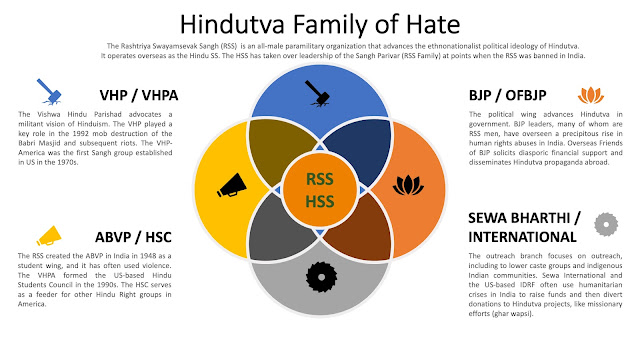
Hateful Hindutva ideology is spreading rapidly among the Indian diaspora. Individuals and organizations connected to the RSS (Rashtriya Swayamsevak Sangh) are actively working to promote India's divisive Islamophobic politics among the Non Resident Indians (NRIs) and their children. Hundreds of the RSS shakhas (branches) are now found in at least 39 countries around the world. Hindutva is a Hindu supremacist ideology inspired by 20th century Fascism and Nazism in Europe; it is very different from the ancient Hindu faith, according to American history professor Audrey Truschke who teaches Indian history at Rutgers University in the US state of New Jersey. Top Indian economists have raised alarm about it.
 |
|
|
False narrative of victimhood underlies Hindutva ideology. Indian historian Aditya Mukherjee characterizes the Hindutva victimhood as follows: “The great achievements of the past are then contrasted with a false sense of victimhood, the concept of a great threat the majority is supposedly facing from the minority. This is how fascism works, globally". "Hindutva was never meant to be understood as bounded by national borders; his (Savarkar's) ambition was always planetary", writes Vinayak Chaturvedi, author of "Hindutva and Violence". "He (Savarkar) gained notoriety for his programme to “Hinduise Politics and Militarise Hindudom” while also arguing for permanent war against Christians and Muslims", Chaturvedi adds.
Recent hate incidents in Leicester (UK), Edison (NJ) and Silicon Valley (California) all have connections to the far right Hindu organizations in India. Here's how a recent New York Times report "Tensions That Roiled English City Have Roots in India" explains what is going on with the Indian diaspora since Prime Minister Narendra Modi rose to power in India:
"Across the Indian diaspora, ugly divisions are emerging. A bulldozer, which has become a symbol of oppression against India’s Muslim minority, was rolled down a street in a New Jersey town during a parade this summer, offending many people. Last year, attacks on Sikh men in Australia were linked to extremist nationalist ideology. In April, Canadian academics told CBC News that they faced death threats over their criticism of growing Hindu nationalism and violence against minorities in India. Since India’s independence struggle, Hindu nationalists have espoused a vision that places Hindu culture and religious worship at the center of Indian identity. That view, once fringe, was made mainstream when Prime Minister Narendra Modi’s party came to power".
"We are all with you Modiji and Yogiji", said an Indian American man who tweeted a video clip of a recent car rally in Silicon Valley, California. Rally participants are shown carrying pictures of Prime Minister Narendra Modi and Uttar Pradesh Chief Minister Yogi Adityanath. Some also carried BJP's lotus flags. Hindu Americans enjoy the freedom to practice their faith and culture in the United States while at the same time they support Hindutva fascist rule in their country of origin.
 |
| 69% of Hindu Americans Support Modi. Source: Indian American Attitudes Survey 2020 |
The 2020 Indian American Attitudes Survey (IAAS) results confirm the anecdotal evidence of India's Hindu Nationalist Prime Minister Narendra Modi's massive popularity among Hindu Americans. The findings of a survey sponsored by Washington-based think tank Carnegie Endowment For International Peace reveal that 69% of Hindu Americans approve of Mr. Modi's performance. 70% of Hindu Americans agree or strongly agree that white supremacy is a threat to minorities in the United States, compared to 79% of non-Hindu Indian Americans. Regarding Hindu majoritarianism in India, however, the data point to a much sharper divide: only 40% of Hindus agree that Hindu majoritarianism is a threat to minorities, compared to 67% of non-Hindus, according to the 2020 IAAS Survey.
The 7 in 10 approval rating of Mr. Modi by Hindu Indian Americans stands in sharp contrast to that of barely one in five Muslim Indian Americans. Indian American Christians are almost evenly divided: 35 percent disapprove, 34 percent approve, and 30 percent did not express an opinion. Twenty-three percent of respondents without a religious affiliation and 38 percent from other faiths approve of Modi’s performance, respectively. The share of “don’t knows” is the smallest for Hindus and Muslims compared to other religious categories, suggesting that views among respondents of these two faiths are the most consolidated.
The IASS survey sample includes 54 percent Hindus, 13 percent Muslims, 10 percent Christians, 8 percent belonging to other faiths, and 16 percent do not identify with any religion.
a. Over the last three decades, a movement toward Hinduizing India--advancing the status of Hindus toward political and social primacy in India-- has continued to gain ground in South Asia and diasporic communities. The Sangh Parivar (the Sangh "family"), the network of groups at the forefront of this Hindu nationalist movement, has an estimated membership numbering in the millions, making the Sangh one of the largest voluntary associations in India. The major organizations in the Sangh include the Rashtriya Swayamsevak Sangh (RSS), Vishwa Hindu Parishad (VHP), Bajrang Dal, and Bharatiya Janata Party (BJP).
b. Hindu nationalism has intensified and multiplied forms of discrimination, exclusion, and gendered and sexualized violence against Muslims, Christians, other minorities, and those who oppose Sangh violations, as documented by Indian citizens and international tribunals, fact-finding groups, international human rights organizations, and U.S. governmental bodies.
c. India-based Sangh affiliates receive social and financial support from its U.S.-based wings, the latter of which exist largely as tax-exempt non-profit organizations in the United States: Hindu Swayamsevak Sangh (HSS), Vishwa Hindu Parishad of America (VHPA), Sewa International USA, Ekal Vidyalaya Foundation-USA. The Overseas Friends of the Bharatiya Janata Party - USA (OFBJP) is active as well, though it is not a tax-exempt group.
Silicon Valley's Indian-American Congressman Rejects Hindutva
Silicon Valley Hindu Americans Rally in Support of Yogi, Modi
Rape of 8-year-old Asifa Bano in Kashmir
Vast Majority of Hindu Americans Support Modi
Modi's Extended Lockdown in Indian Occupied Kashmir
Hinduization of India
Brievik's Hindutva Rhetoric
Indian Textbooks
India's RAW's Successes in Pakistan
Riaz Haq Youtube Channel
PakAlumni Social Network
Riaz Haq
Sex scene with Cillian Murphy and Florence Pugh in ‘Oppenheimer’ becomes latest target of India’s Hindu nationalists
https://www.cnn.com/2023/07/24/media/india-oppenheimer-backlash-hin...
New Delhi
CNN
—
Christopher Nolan’s latest blockbuster movie “Oppenheimer” has sparked controversy among the Hindu-right in India, with some calling for a boycott and demanding the removal of a sex scene in which the titular character utters a famous line from the religion’s holy scripture.
The film tells the story of the atomic bomb through the lens of its creator, Robert Oppenheimer, and the scene in question depicts actor Cillian Murphy, who plays the lead role, having sex with Florence Pugh, who plays his lover Jean Tatlock.
Pugh stops during intercourse and picks up a copy of the Bhagavad Gita, one of Hinduism’s holiest scriptures, and asks Murphy to read from it.
“Now I am become Death, the destroyer of worlds,” Oppenheimer’s character says, as they resume intercourse.
The scene has caused outrage among some right-wing groups, with a politician from India’s Hindu-nationalist Bharatiya Janata Party (BJP) calling the film a “disturbing attack on Hinduism” and accusing it of being “part of a larger conspiracy by anti-Hindu forces.”
In a statement Saturday, India’s Information Commissioner, Uday Mahurkar, said the scene was “a direct assault on religious beliefs of a billion tolerant Hindus,” likening it to “waging a war on the Hindu community.”
He added: “We believe that if you remove this scene and do the needful to win hearts of Hindus, it will go a long way to establish your credentials as a sensitized human being and gift you friendship of billions of nice people.”
The film has been received well in most quarters in India, which conducted its first nuclear test in 1974, with critics giving it rave reviews and people flocking to cinemas to watch it.
Ryan Gosling and Margot Robbie in "Barbie"
The 'Barbie' and 'Oppenheimer' double feature shouldn't be a one-off
“Oppenheimer” grossed more than $3 million in its opening weekend in the country, according to local reports, higher than filmmaker Greta Gerwig’s highly anticipated “Barbie,” which released on the same day and grossed just over $1 million.
India’s film board gave “Oppenheimer” a U/A rating, which is reserved for movies that contain moderate adult themes and can be watched by children under 12 with parental guidance. There are so far no bans on the film in any of the country’s states and union territories.
This isn’t the first time that the Hindu-right has taken offense to films, television shows or commercials for its portrayal of Hinduism. Some have been boycotted or even forced off air following outcry from conservative and radical groups.
In 2020, Netflix (NFLX) received significant backlash in India for a scene in the series “A Suitable Boy” that depicted a Hindu woman and Muslim man kissing at a Hindu temple. That same year, Indian jewelry brand Tanishq withdrew an advert featuring an interfaith couple following online criticism.
Meanwhile, analysts and film critics say there has been a shift in the tone of some Indian films, with nationalist and Islamophobic narratives gaining support from many within India, as well as the BJP.
Last year, filmmaker Vivek Agnihotri’s box office smash “The Kashmir Files,” based on the mass exodus of Kashmiri Hindus as they fled violent Islamic militants in the 1990s, polarized India, with some hailing the film as “gut-wrenching” and “truthful,” while others criticized it for being Islamophobic and inaccurate.
Similarly, the release this year of “The Kerala Story,” about a Hindu girl who is lured into joining ISIS, angered critics who called it a propaganda film that demonized Muslims.
Jul 25, 2023
Riaz Haq
Ashok Swain
@ashoswai
The UK Home office has identified Hindu nationalism (Hindutva) among nine emerging threats to the country's security. Finally, the West is realizing the dangers of Hindutva terror. I have been talking about it for ages.
https://x.com/ashoswai/status/1885298919371939901
----------------
Why saffron terror is not a myth
By shielding Hindu terror suspects, the Modi government is making a big mistake. It should learn from Pakistan’s blunders.
Ashok Swain
May 20, 2016 · 08:00 am
https://scroll.in/article/808306/why-saffron-terror-is-not-a-myth
Jan 31, 2025
Riaz Haq
https://religionunplugged.com/news/2026/6/22/why-indian-americans-a...
(ANALYSIS) A person who speaks warmly of democracy or equality may sound principled in general conversation, but the harder test comes when the question concerns the power, safety or identity of that person’s own group.
A new study of Indian Americans suggests that many respondents supported more liberal positions when they were thinking about the United States and more conservative positions when they were thinking about India. Muslim Indian Americans were more consistently liberal in both countries.
The study, “Home and Away, Explaining the Paradoxical Political Attitudes of Indian Americans,” was written by Sumitra Badrinathan, Devesh Kapur and Milan Vaishnav, and published in Political Behavior. The authors surveyed 1,200 Indian American adults before the 2020 U.S. election, including both U.S. citizens and non-citizens.
In U.S. politics, 56 percent identified with the Democratic Party, which is generally associated with more liberal positions on immigration, minority rights and religious inclusion. Only 15 percent identified with the Republican Party, which has in recent years been associated with more restrictive immigration policies and stronger support among white Christian conservatives.
The authors also asked respondents to rate parties and leaders on a scale from 0 to 100. A score of 0 meant very cold or unfavourable feelings, while 100 meant very warm or favourable feelings. The Democratic Party received an average score of 64. The Republican Party received an average score of 41.
However, many Indian American respondents who leaned Democratic in U.S. politics also supported Narendra Modi in Indian politics. Nearly half approved or strongly approved of his performance as prime minister.
To test whether this pattern also appeared in views on specific policies, the authors asked policy questions. They chose five issues that had comparable versions in India and the United States. These were religious equality, undocumented immigrants, police force against protesters, media freedom, and affirmative action, or reservations, in university admissions.
On religious equality, 60.2 percent supported the liberal position in the U.S. question, measured through opposition to President Trump’s 2017 Muslim ban. In the India question, 49.1 percent supported the equivalent principle, measured through opposition to the Citizenship Amendment Act. On undocumented immigrants, 54.5 percent supported the more permissive position in the U.S. question, while 45.3 percent did so in the India question, measured through opposition to the proposed National Register of Citizens (NRC).
yesterday