PakAlumni Worldwide: The Global Social Network
Hateful Hindutva Ideology Infects Indian Diaspora
Hateful Hindutva ideology is spreading rapidly among the Indian diaspora. Individuals and organizations connected to the RSS (Rashtriya Swayamsevak Sangh) are actively working to promote India's divisive Islamophobic politics among the Non Resident Indians (NRIs) and their children. Hundreds of the RSS shakhas (branches) are now found in at least 39 countries around the world. Hindutva is a Hindu supremacist ideology inspired by 20th century Fascism and Nazism in Europe; it is very different from the ancient Hindu faith, according to American history professor Audrey Truschke who teaches Indian history at Rutgers University in the US state of New Jersey. Top Indian economists have raised alarm about it.
 |
|
|
False narrative of victimhood underlies Hindutva ideology. Indian historian Aditya Mukherjee characterizes the Hindutva victimhood as follows: “The great achievements of the past are then contrasted with a false sense of victimhood, the concept of a great threat the majority is supposedly facing from the minority. This is how fascism works, globally". "Hindutva was never meant to be understood as bounded by national borders; his (Savarkar's) ambition was always planetary", writes Vinayak Chaturvedi, author of "Hindutva and Violence". "He (Savarkar) gained notoriety for his programme to “Hinduise Politics and Militarise Hindudom” while also arguing for permanent war against Christians and Muslims", Chaturvedi adds.
Recent hate incidents in Leicester (UK), Edison (NJ) and Silicon Valley (California) all have connections to the far right Hindu organizations in India. Here's how a recent New York Times report "Tensions That Roiled English City Have Roots in India" explains what is going on with the Indian diaspora since Prime Minister Narendra Modi rose to power in India:
"Across the Indian diaspora, ugly divisions are emerging. A bulldozer, which has become a symbol of oppression against India’s Muslim minority, was rolled down a street in a New Jersey town during a parade this summer, offending many people. Last year, attacks on Sikh men in Australia were linked to extremist nationalist ideology. In April, Canadian academics told CBC News that they faced death threats over their criticism of growing Hindu nationalism and violence against minorities in India. Since India’s independence struggle, Hindu nationalists have espoused a vision that places Hindu culture and religious worship at the center of Indian identity. That view, once fringe, was made mainstream when Prime Minister Narendra Modi’s party came to power".
"We are all with you Modiji and Yogiji", said an Indian American man who tweeted a video clip of a recent car rally in Silicon Valley, California. Rally participants are shown carrying pictures of Prime Minister Narendra Modi and Uttar Pradesh Chief Minister Yogi Adityanath. Some also carried BJP's lotus flags. Hindu Americans enjoy the freedom to practice their faith and culture in the United States while at the same time they support Hindutva fascist rule in their country of origin.
 |
| 69% of Hindu Americans Support Modi. Source: Indian American Attitudes Survey 2020 |
The 2020 Indian American Attitudes Survey (IAAS) results confirm the anecdotal evidence of India's Hindu Nationalist Prime Minister Narendra Modi's massive popularity among Hindu Americans. The findings of a survey sponsored by Washington-based think tank Carnegie Endowment For International Peace reveal that 69% of Hindu Americans approve of Mr. Modi's performance. 70% of Hindu Americans agree or strongly agree that white supremacy is a threat to minorities in the United States, compared to 79% of non-Hindu Indian Americans. Regarding Hindu majoritarianism in India, however, the data point to a much sharper divide: only 40% of Hindus agree that Hindu majoritarianism is a threat to minorities, compared to 67% of non-Hindus, according to the 2020 IAAS Survey.
The 7 in 10 approval rating of Mr. Modi by Hindu Indian Americans stands in sharp contrast to that of barely one in five Muslim Indian Americans. Indian American Christians are almost evenly divided: 35 percent disapprove, 34 percent approve, and 30 percent did not express an opinion. Twenty-three percent of respondents without a religious affiliation and 38 percent from other faiths approve of Modi’s performance, respectively. The share of “don’t knows” is the smallest for Hindus and Muslims compared to other religious categories, suggesting that views among respondents of these two faiths are the most consolidated.
The IASS survey sample includes 54 percent Hindus, 13 percent Muslims, 10 percent Christians, 8 percent belonging to other faiths, and 16 percent do not identify with any religion.
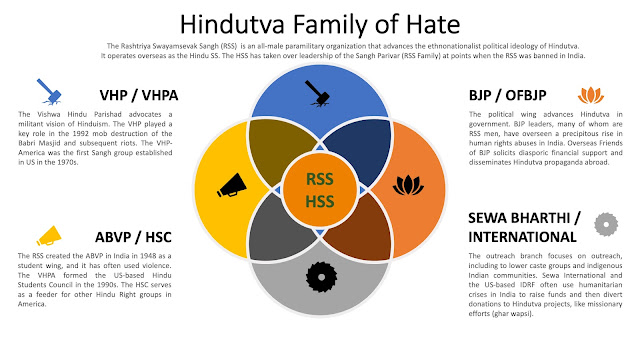
a. Over the last three decades, a movement toward Hinduizing India--advancing the status of Hindus toward political and social primacy in India-- has continued to gain ground in South Asia and diasporic communities. The Sangh Parivar (the Sangh "family"), the network of groups at the forefront of this Hindu nationalist movement, has an estimated membership numbering in the millions, making the Sangh one of the largest voluntary associations in India. The major organizations in the Sangh include the Rashtriya Swayamsevak Sangh (RSS), Vishwa Hindu Parishad (VHP), Bajrang Dal, and Bharatiya Janata Party (BJP).
b. Hindu nationalism has intensified and multiplied forms of discrimination, exclusion, and gendered and sexualized violence against Muslims, Christians, other minorities, and those who oppose Sangh violations, as documented by Indian citizens and international tribunals, fact-finding groups, international human rights organizations, and U.S. governmental bodies.
c. India-based Sangh affiliates receive social and financial support from its U.S.-based wings, the latter of which exist largely as tax-exempt non-profit organizations in the United States: Hindu Swayamsevak Sangh (HSS), Vishwa Hindu Parishad of America (VHPA), Sewa International USA, Ekal Vidyalaya Foundation-USA. The Overseas Friends of the Bharatiya Janata Party - USA (OFBJP) is active as well, though it is not a tax-exempt group.
Silicon Valley's Indian-American Congressman Rejects Hindutva
Silicon Valley Hindu Americans Rally in Support of Yogi, Modi
Rape of 8-year-old Asifa Bano in Kashmir
Vast Majority of Hindu Americans Support Modi
Modi's Extended Lockdown in Indian Occupied Kashmir
Hinduization of India
Brievik's Hindutva Rhetoric
Indian Textbooks
India's RAW's Successes in Pakistan
Riaz Haq Youtube Channel
PakAlumni Social Network
Riaz Haq
In #Britain and #India, we must resist the tragic thinking that pits #Hindus against #Muslims. The recent disorder in #Leicester echoes the ‘communalist’ politics that now dominates India thanks to the ruling #BJP | Opinion by Chetan Bhatt. #Hindutva https://www.theguardian.com/commentisfree/2022/oct/11/britain-india...
Chetan Bhatt is professor of sociology at the London School of Economics
he terrible events in Leicester last month saw several hundred young people marching to Green Lane Road on 17 September chanting, “Jai Shri Ram” (“Glory to Lord Rama”). Other youths, in response, gathered to chant “Allahu Akbar”. Both expressed heady allegiance to their god – not as a simple demonstration of faith, but as a combative slogan against others. Several British politicians have intervened, as have the governments of India and Pakistan. Social media “influencers” descended on Leicester to video themselves and their “patrols” and further provoke young people. With a few important exceptions, most of those intervening chose to enlarge, rather than contest, a dangerous logic of communalism. It is in their political interests to keep communities pitted against each other.
-----------
The RSS, the BJP and their affiliates have placed strong emphasis on working in the Indian diaspora, especially the UK, the United States and Canada. In Britain, for example, the RSS’s Indian organisational structure and its main affiliates are reproduced as religious, women’s, student and other wings that work alongside its regular training branches for children and young people. Among more recent migrants, including those who have arrived directly from Modi’s India, other Hindu right affiliations have reportedly emerged. Similar dynamics are found in the international organisation of the Jamaat-e-Islami from Bangladesh and Pakistan, the Muslim Brotherhood from Egypt and other sectarian political-religious movements. These organisations have worked doggedly in UK south Asian communities over many decades, and the growth of deep communalism is the outcome, one actively energised by local authority, national government and political party support for these groups and their charitable offshoots.
------
The Hindutva groups in the UK have tried to distance themselves from the Leicester violence, blaming it on “Muslims”. As with the tedious view of the Indian RSS when faced with repeated evidence of its atrocities, they say that Hindu protests, however provocative or violent, are always peaceful, and Hindus are eternally innocent. Locally, some of the established Gujarati communities have blamed recent arrivals from India. Sympathisers of Islamism have blamed the “Hindu right”. They are each following a communal script that is engraved on their political souls.
Oct 13, 2022
Riaz Haq
(British) Labour (Party) relegated to third place in North Evington (Leicester) amid accusations its candidate supported India’s ruling BJP
https://www.theguardian.com/uk-news/2022/oct/14/huge-swing-tories-l...
“North Evington was one of the jewels in the crown in Leicester East with the majority that Labour had, but that has been turned around completely,” said Abdul Osman, a former lord mayor of the city, who spent 20 years as a Labour councillor before defecting to the Conservatives.
“The fact that there was a big upsurge in the Green vote, that must have been a protest again at the Labour party. The trend nationally is against the Conservative government, but you have to look at a local administration that hasn’t delivered.”
The byelection came after the resignation of Labour’s Vandeviji Pandya, who took office following a byelection in May last year in a result that also showed a sharp swing towards the Conservatives.
The Tories also took a seat in the neighbouring Humberstone and Hamilton ward in a byelection last year, with 44% of the vote, giving the party its first council seat in two years.
A spokesperson for Tejura’s campaign team said: “This result is a wake up call for the Labour party. They have been in power for a very long time, not only in North Evington, but in the city itself, and it’s quite clear the council needs to do more and deliver for the people of Leicester if they want to continue with their support.
“We’re happy and proud of the campaign we’ve run, and we’re confident we can bounce back and win seats in May’s election.”
Oct 15, 2022
Riaz Haq
Religious Polarization in India Seeping Into US Diaspora
Clashes in India between Hindu nationalists and minority religious groups, particularly Muslims, have sparked tensions online and in person in the Indian American diaspora.
https://www.usnews.com/news/world/articles/2022-10-16/religious-pol...
By DEEPA BHARATH and MARIAM FAM, Associated Press
In Edison, New Jersey, a bulldozer, which has become a symbol of oppression of India’s Muslim minority, rolled down the street during a parade marking that country's Independence Day. At an event in Anaheim, California, a shouting match erupted between people celebrating the holiday and those who showed up to protest violence against Muslims in India.
Indian Americans from diverse faith backgrounds have peacefully co-existed stateside for several decades. But these recent events in the U.S. — and violent confrontations between some Hindus and Muslims last month in Leicester, England — have heightened concerns that stark political and religious polarization in India is seeping into diaspora communities.
In India, Hindu nationalism has surged under Prime Minister Narendra Modi and his Bharatiya Janata Party, which rose to power in 2014 and won a landslide election in 2019. The ruling party has faced fierce criticism over rising attacks against Muslims in recent years, from the Muslim community and other religious minorities as well as some Hindus who say Modi's silence emboldens right-wing groups and threatens national unity.
Hindu nationalism has split the Indian expatriate community just as Donald Trump’s presidency polarized the U.S., said Varun Soni, dean of religious life at the University of Southern California. It has about 2,000 students from India, among the highest in the country.
--------
Syed believes violence against Muslims has now been mainstreamed in India. He has heard from girls in his family who are considering taking off their hijabs or headscarves out of fear.
In the U.S., he sees his Hindu friends reluctant to engage publicly in a dialogue because they fear retaliation.
“A conversation is still happening, but it’s happening in pockets behind closed doors with people who are like-minded,” he said. “It’s certainly not happening between people who have opposing views.”
Rajiv Varma, a Houston-based Hindu activist, holds a diametrically opposite view. Tensions between Hindus and Muslims in the West, he said, are not a reflection of events in India but rather stem from a deliberate attempt by “religious and ideological groups that are waging a war against Hindus.”
Varma believes India is “a Hindu country” and the term “Hindu nationalism” merely refers to love for one’s country and religion. He views India as a country ravaged by conquerors and colonists, and Hindus as a religious group that does not seek to convert or colonize.
“We have a right to recover our civilization,” he said.
Rasheed Ahmed, co-founder and executive director of the Washington D.C.-based Indian American Muslim Council, said he is saddened “to see even educated Hindu Americans not taking Hindu nationalism seriously." He believes Hindu Americans must make “a fundamental decision about how India and Hinduism should be seen in the U.S. and the world over.”
Oct 16, 2022
Riaz Haq
Pieter Friedrich
@FriedrichPieter
Chandru Acharya of the HSS, the international wing of India’s fascist #RSS paramilitary, was appointed as advisor to a Department of Homeland Security council. “Acharya has often denounced reports highlighting the alleged religious intolerance in India.” https://www.thequint.com/us-nri-news/who-is-chandru-acharya-hindutv...
https://twitter.com/FriedrichPieter/status/1582488659344838656?s=20...
An Indian American member of the Hindu Swayamsevak Sangh (HSS), a Hindutva group, was appointed to the United States Faith-Based Security Advisory Council of Homeland Security, a press release said on Monday, 17 October.
Chandru Acharya, who lives in Michigan, is the lone Indian and Hindu voice in the committee of 25 faith leaders residing in the US.
The council, which includes prominent personalities from different faiths, has been set up to give advice to the secretary on matters related to the protection of houses of worship, and coordination between people of different
Several prominent Indian Americans have, however, denounced the appointment of Acharya to the Department of Homeland Security (DHS), and alleged that the HSS, whom he represents, is actually the overseas arm of the Rashtriya Swayamsevak Sangh (RSS).
The website of the HSS also says that it takes inspiration from several Hindutva groups, and specifically mentions the RSS in this regard.
"HSS USA is inspired by a long lineage of Hindu movements in India, including the Rashtriya Swayamsevak Sangh (RSS), which have helped rejuvenate the society and take Hindu civilisation forward," the website states.
Acharya, however, has denied any relation between the HSS and the RSS.
Who Is Chandru Acharya?
While Acharya was raised in India, he settled in the US as an Information Technology (IT) professional and served as the president of an IT firm called Imetris Corporation.
A yoga instructor and football coach, he teaches Hindu history, culture, and heritage at the Hindu Temple Balgokumal in Ohio's Canton, and is often invited to speak at several schools and colleges on the topic of Hinduism, according to The Interfaith Observer.
The press release confirming Acharya's appointment says that he is known in the Hindu American community and interfaith forums for building bridges with people from different faiths through dialogue and peace initiatives, news agency PTI reported.
Oct 19, 2022
Riaz Haq
Far-Right Hindu Nationalism Is Gaining Ground In The U.S.
Hindutva, an extremist ideology, takes many cues from white nationalism — and it’s endangering millions of Muslims and other religious minorities.
https://www.huffpost.com/entry/far-right-hindu-nationalism-is-gaini...
Audrey Truschke, a professor of South Asian history at Rutgers University, never thought her work could result in death threats and vicious vitriol.
Yet Truschke, a scholar, mom, wife and author of three books, now sometimes needs armed security at public events.
The publication of her first book, in 2016, challenging the predominant perception of 16th- and 17th-century Mughal kings — Muslim rulers who are widely vilified by Hindu nationalists — put a target on her back. Her email was bombarded with hate mail. Her Twitter account was inundated with threats. People wrote letters to news outlets about her.
“It felt like the world exploded at me,” said Truschke, pushing back her dark hair to reveal the salt and pepper streaks that frame her face. “This was my first brush with hate email. I’m sure it would seem like nothing to me now.”
Far-right Hindu nationalism, also referred to as Hindutva, is a political and extremist ideology that advocates for Hindu supremacy and seeks to transform a secular and diverse India into an ethnoreligious Hindu state. Hindu nationalism has been around for over 100 years and was initially inspired by ethnonationalism movements in early 20th-century Europe, including those in Germany and Italy. Champions of Hindutva have viciously targeted religious minorities including Muslims, Christians and Sikhs, and have sought to silence critics such as academics and activists.
Hinduism, the faith, is not Hindutva the far-right movement. But the label Hindu can be categorized as a religious, political or racial identifier depending on who is using it, explained Manan Ahmed, a professor and historian of South Asia at Columbia University. Hindu nationalists, he said, are morphing the religious, political and racial into one identity in order to advance a supremacist, majoritarian agenda.
People impacted by Hindutva in the U.S. say the movement has crept into their hometowns and workplaces, making life more dangerous for them and threatening to make their communities less diverse and tolerant. The ideology has deep ties to white nationalist movements across the globe, and the targets of nationalist groups warn that the impact could be deadly if Hindutva is not addressed and defeated.
“We see Hindu nationalism as an ideology which seeks to transform India from a pluralistic secular democracy to a Hindu state in which non-Hindus are seen at best as second-class citizens and at worst targets for extermination and disenfranchisement of all sorts,” said Nikhil Mandalaparthy, the deputy executive director of Hindus for Human Rights, a nonprofit organization dedicated to promoting pluralism and human rights in South Asia and in the U.S.
“It’s a vision that we think is in direct opposition to a lot of the values of Hindu religious traditions,” he added.
A Different Kind Of Extremism
In India, Hindu nationalism can be traced back to the 1920s. The formation of the Rashtriya Swayamsevak Sangh, or RSS, in 1925 fortified the core belief in a Hindu state for Hindus, despite India’s secular constitution and the long history of ethnic and religious minorities in the country. The RSS has been banned three times since it was established, including after a former party member assassinated Mahatma Gandhi in 1948.
It was out of the RSS that India’s ruling political party, the Bharatiya Janata Party, or BJP, emerged. It has held power since Prime Minister Narendra Modi was elected in 2014.
Since then, the crackdown on India’s minorities, particularly Muslims, has intensified with little to no accountability.
Oct 22, 2022
Riaz Haq
The hypocrisy of the Indian diaspora is overwhelming
VIDYA KRISHNAN
https://caravanmagazine.in/communities/hypocrisy-indian-diaspora-ov...
Earlier this month, the Indian actor and United Nations goodwill ambassador Priyanka Chopra expressed her support for Iranian women who have been removing their hijabs and chanting “death to the dictator” after 22-year-old Mahsa Amini’s death over a dress code violation. Chopra, who now lives in the United States, said she was in “awe” of the women fighting their government. She was immediately criticised for her “selective outrage” and “double standards,” and her deafening silence about a similarly awe-inspiring resistance being waged by India’s Muslim women, who are facing moral-policing under the Narendra Modi government for wearing a hijab.
The incident is, no doubt, revealing of the actor’s politics of convenience, but the larger issue at hand is how they moved in parallel with the growth of her international stature. It is a glance into the psyche of the vast, powerful and wealthy Indian diaspora, which suffers from an intellectual malady: being double-dealing and phoney in India and champions of democratic values as soon as they board an international flight.
Over the past few years, the Indian diaspora has become political—while keeping a safe distance from the storm centre of the toxic right-wing politics it spews—and Chopra is simply the high priestess of the blinding bourgeois hypocrisy it has come to typify. Like Chopra, the larger community of Indian immigrants to the United States and the United Kingdom have been in the news for what they choose to endorse and ignore. Indian-Americans in New Jersey recently apologised after including a bulldozer—now a symbol of anti-Muslim hate—in a parade to celebrate 75 years of Indian independence. The New York Times noted that, “to those who understood its symbolism, it was a blunt and sinister taunt later likened to a noose or a burning cross at a Ku Klux Klan rally.” In September, the diaspora in Leicester and Birmingham went on an angry march, threatening Muslim residents in the area. Wherever the diaspora is concentrated, it is now flexing its muscles to threaten South Asian Muslims. The seeds of hate sown in India have spread like a metastasising cancer, infecting all corners of the world where Indians live.
VIDYA KRISHNAN is a global health reporter who works and lives in India. Her first book, Phantom Plague: How Tuberculosis Shaped History, was published in February 2022 by PublicAffairs.
Oct 25, 2022
Riaz Haq
Pieter Friedrich
@FriedrichPieter
Dr.
@AudreyTruschke
, discussing the end goals of Hindu nationalist groups in the US, says the biggest goal is to normalize Hindu nationalism in America as well as to whitewash the crimes of Hindu nationalists in India. But... she says their job is becoming harder every hour.
https://twitter.com/FriedrichPieter/status/1585754659075117056?s=20...
Oct 27, 2022
Riaz Haq
IS HINDU NATIONALIST MONEY MAKING ITS WAY INTO MARYLAND’S GOVERNOR RACE?
Maryland’s Democratic gubernatorial ticket, Wes Moore and Aruna Miller, held a fundraiser with Trump supporters and people linked to the Hindutva movement.
https://theintercept.com/2022/10/27/maryland-governor-wes-moore-hin...
MARYLAND’S DEMOCRATIC GUBERNATORIAL candidate Wes Moore is widely expected to blow out his Republican opponent Dan Cox. But that won’t stop Moore from welcoming support wherever he can get it. Lately, the list of Moore’s supporters even includes the leaders of two organizations founded to support former President Donald Trump.
Last month, Moore, a political newcomer, and his running mate, former state Del. Aruna Miller, held a high-dollar fundraiser at the home of Jasdip “Jesse” Singh, the founder of Sikhs for Trump. The event was co-hosted by one-time Trump adviser Sajid Tarar, who founded Muslims for Trump and delivered a prayer for the then-candidate at the 2016 Republican National Convention. Singh and Tarar have strong connections to the current Republican governor, serving on his commission for South Asian issues.
The fundraiser was also organized in part by Dr. Sudhir Sekhsaria, a local allergist who referred to himself at the event as one of the campaign’s “finance chairs” and has given at least $12,000 to Moore and Miller since January. Sekhsaria had previously helped Miller as treasurer during her unsuccessful congressional run in 2018, soliciting thousands of dollars in donations from people affiliated with Hindu nationalism.
Adapa Prasad, the national president of the group Overseas Friends of the Bharatiya Janata Party, the U.S. outreach wing of Indian Prime Minister Narendra Modi’s Hindu nationalist party, also attended the fundraiser. The group, which Sekhsaria has also been linked to, was required in 2020 to register in the U.S. as a foreign agent.
A spokesperson for Moore and Miller’s campaign did not say how much money it raised from last month’s event, but the local news site Next TV reported a total haul of more than $100,000.
The fundraiser in Maryland for Moore and Miller appeared to be the latest instance of Hindutva, or a Hindu nationalist political ideology, creeping into American politics. As the global far right gathers power, Indian policy issues and Hindutva-affiliated money have increasingly shown up in U.S. elections. In Maryland, the combination of cozying up to allies of both Trump and Modi has raised questions among local activists and South Asian Americans as to what interest they might have in helping Democrats take back the governor’s mansion.
“We see this as a stepping stone for more folks with these right-wing connections to come into office,” said Gayatri Girirajan, a member of Peace Action Montgomery, a local chapter of the grassroots peace organization that has been advocating for transparency and accountability around the Moore campaign’s affiliations. “These are people who have a lot of influence, community power, money, and lobbying power to put policies in place that would have a significant effect on marginalized communities.”
Donors who are prominent members of groups associated with the U.S.-based Hindu right have funded Democratic politicians in recent years, including backing former Rep. Tulsi Gabbard, D-Hawaii; former Texas congressional candidate Sri Preston Kulkarni; and Rep. Raja Krishnamoorthi, D-Ill.
A spokesperson for the Moore campaign told The Intercept that the campaign is happy to accept support from people across the aisle, and that its success depends in part on bringing Republicans into the fold. They also said Sekhsaria is not employed by the campaign.
“In order to win elections, you have to build a broad coalition, and that often includes people who’ve previously supported Republicans,” the spokesperson said. “These donors have given to many Democrats here in Maryland and across the country, including every Democrat currently running for statewide office.”
Oct 28, 2022
Riaz Haq
Dr. Audrey Truschke
@AudreyTruschke
Invisibilizing Hindu terrorism through the “War on Terror” --
The latest in a series of essays on Hindutva and the Shared Scripts of the Global Right
https://twitter.com/AudreyTruschke/status/1590436023489949697?s=20&...
-----------------
https://tif.ssrc.org/2022/11/09/invisibilizing-hindu-terrorism-thro...
At a recent rally celebrating India’s Independence Day on August 15 in New Jersey, a bulldozer bearing images of the far-right Hindu monk Yogi Adityanath and the Indian Prime Minister Modi roamed the streets with Hindu nationalist slogans chanted in the background. Under Adityanath, who is currently the chief minister of India’s most populous state and a political stronghold in the country, Uttar Pradesh, instances of police brutality (popularly known as “encounter killings”) against Muslims and Dalits (so-called untouchables) have raised alarm among several transnational human rights organizations. Speaking about Muslim women protesting against discriminatory legislation in 2020, Adityanath asked his followers to “feed them bullets, not biryani” (traditional North Indian Muslim cuisine). Today many Hindu nationalists view Adityanath as an able politician who might eventually replace Indian Prime Minister Modi to head the Hindu nationalist Bharatiya Janata Party (BJP). In Uttar Pradesh nowadays, the bulldozer has become a potent instrument for demolishing Muslim homes when they protest against violence, humiliation, and discrimination. For Hindu nationalists, it has clearly become a celebratory symbol within and outside India.
While 9/11 has etched the figure of the Muslim terrorist in the Western imagination, the phenomenon of Hindu terrorism has received little scrutiny. In a strategic move to politically cement their power at the global stage, Hindu nationalist actors in both India and the Western diaspora have not only appropriated Islamophobic discourses of the “War on Terror” but actively thrived through it to wantonly mark disposable Muslim bodies for death, rape, violence, and statelessness through their support for an Indian state that enacts these brutalities as an active component of its Hindu nationalist/Hindutva ideology. Older histories have proved to be fertile grounds for the ongoing persecution of Muslims in India, following the colonial legacy of British institutional efforts to cause a schism between Hindus and Muslims, racializing Muslims as more masculine and violent than subservient and effeminate Hindus, and distorted school history textbooks that presented Muslims as medieval foreign invaders to the country. Today Muslims are problematically and singularly blamed for the Partition of India in 1947.
This anti-Muslim animus in postcolonial India gained further momentum under the country’s unique trajectory of Brahmin supremacist racializing, gendering, and demonizing of Muslims and Dalits through casteist lenses of desirability and belonging, propagated through popular mediums such as Bollywood movies, demographic myths, and, as some scholars have argued, the structures of liberal representative democracy itself. Importantly, Hindu privilege as a majority in India and Hindus as model minorities in the West, rather than being a monopoly of the Hindu right, is baked into Western liberalism. This is not to deny the century-old exceptionally violent project of Hindutva heralded by Savarkar and Moonje since the 1920s or the links between Nazism and the Rashtriya Swayam Sevak (RSS), or the fact that several Hindu nationalists were troublingly also members of the Congress Party prior to the Partition of 1947. Nor is it to downplay the racism that Hindus face in the West. However, scholars must reconsider how majority-minority dialectics are structurally implicit in representative liberal democracies and how these representations draw on national and international discourses.
Nov 9, 2022
Riaz Haq
Invisibilizing Hindu terrorism through the “War on Terror”
https://tif.ssrc.org/2022/11/09/invisibilizing-hindu-terrorism-thro...
India’s international standing insulates it from repercussions for discriminatory legislation and practices. The Citizenship Amendment Act (CAA) will prevent Muslim refugees like Ahmadis, Afghans, Rohingyas, and internally displaced Kashmiris from getting citizenship and equitable access to asylum in India as they flee persecution and conflict. This act will also expel and expunge India’s very own population of overwhelmingly poor and illiterate Muslims, who would be made to produce documents to prove their ancestry on the lands they have lived for centuries. Perhaps it should not come as a shock that India has violated the Geneva Convention and sent Rohingya refugees facing persecution back to Burma. Yet the United States continues to tout India’s reputation as the world’s largest democracy in diplomatic endeavors and for several reasons.
India’s geopolitical location and economy also make it a natural American ally. For the West, India is not a threatening or communist power like its neighboring country China. It is not deemed as a terrorist haven like Pakistan in popular representations. It is not a poor Muslim-majority country like Bangladesh which currently faces trade deficits due to neoliberal Western financial institutions. It is not a small crisis-ridden country like Sri Lanka or landlocked Nepal. Rather, India provides a large consumer market and cheap land for multinational corporations. Subsequently, savarna Hindus who advance the project of Hindutva have greatly benefited from the current international relations scenario, especially since 9/11, both as a community and as individuals.
Despite many cases of Hindu terrorism in India, the figure of the Muslim as a terrorist in Indian society lurks in no small part due to post 9/11 Western discourse of the “War on Terror.” That the Malegaon bombasts, Ajmer Dargah attack, and Mecca Masjid blast were carried out by Hindu terrorists is somehow comfortably forgotten in mainstream narratives. In each of the instances mentioned above, many Muslims were politically targeted and killed, yet young Muslim men were arrested and tortured in prisons for these poorly investigated crimes, often without evidence, and sometimes for decades. Much like white bodies that allegedly do not commit terrorism in mainstream media narratives, even when white supremacists shoot down Black people, so do Hindu extremist outfits allegedly not commit politically motivated acts of terror. For example, in 2007, the Samjhauta Express, a train running between New Delhi and Lahore, was attacked and bombed by Hindu terrorists. However, in 2019, all nineteen culprits, including Swami Aseemanand who had openly declared that he had masterminded the attack, were acquitted. There can be no Hindu terrorism if there is no court of law to recognize that Muslims can be victims of terrorism from non-Muslim perpetrators. Recently, some have claimed that other instances of bombings in India have been carried out by far-right Hindutva cells, with the intent to set up more “terror training camps.” Yet any reference to the term “saffron terror” to indicate growing Hindu terrorism in India can be used a disciplinary ground by the Election Commission of India for allegedly endorsing a “political conspiracy.”
Nov 9, 2022
Riaz Haq
Invisibilizing Hindu terrorism through the “War on Terror”
https://tif.ssrc.org/2022/11/09/invisibilizing-hindu-terrorism-thro...
Even in some liberal Indian media forums, articles have been published commending Muslims for using a secular discourse to assert their rights as citizens during the anti-CAA protests. The assumption here remains that the Muslim body is always on the brink of terrorism, and not choosing that route makes their nonviolent resistance commendable. It also implicitly seeks to regulate expressions that can be construed as forms of Muslimness, preventing the community from finding solace in their religious beliefs against very real oppression. In doing so, such liberal discourses like Hindu Nationalism do not permit Muslims to articulate a resistance that is a little more nuanced than simply violent and nonviolent. Muslims cutting off the roads to keep the army at bay, in order to protect themselves from being thrown into abysmal detention centers, are likened troublingly to Islamist terrorists. Moreover, many activists and academics are calling upon us to rethink the very term “terrorism,” seeing how certain nation-states, like the notorious Kingdom of Saudi Arabia, use the term to target dissenters and activists. But this should be distinguished from State monopoly on violence (and mechanisms to surveil and punish) against those who challenge it. The insidious violence by the genocidal Hindutva Indian State and its vigilantes is not interpreted as terrorism, just as the terrorism committed by the USA on innocent civilians of Afghanistan and Pakistan in South Asia.
Significantly, what gets overlooked in these contested terms and representational politics of Muslim terrorism in India is the issue of foundationally discriminatory institutions and laws that have become more emboldened under the current regime of Hindu Nationalists to harm marginalized communities. Meanwhile, Modi continues to use the discourse of terrorism to represent India in a favorable light internationally and to win elections repeatedly. Just before the 2019 Indian elections, Modi raised the familiar South Asian trope of the enemy within—the figure of the Muslim terrorist—following the controversial Pulwama case in Kashmir that witnessed the deaths of forty Indian army men. To date, international investigations of the case dispute any conclusive evidence over who was responsible for the incident. Tellingly, similar discourses of terrorism have been used against Sikhs, another religious minority in India, very recently when they protested and eventually succeeded against the passing of polemical agricultural laws that Hindu nationalists had initially sought to pass. In other words, all minorities in India except for the figure of the upper caste Hindu can be cast with aspersions over charges of terrorism.
Nov 9, 2022
Riaz Haq
Invisibilizing Hindu terrorism through the “War on Terror”
https://tif.ssrc.org/2022/11/09/invisibilizing-hindu-terrorism-thro...
Notably, consorted efforts to resist the label of terrorism among Hindu nationalists exceed India’s borders. Privileged diaspora Hindu nationalists in North America have happily catered to the White gaze as model minority immigrants who are successful doctors and engineers, or taxi drivers with PhDs. All the while, the largest funding for Hindu extremist projects has come from diaspora Indians in the West since the 1980s. Within the United States, Hindu Nationalists have also funded research scholarships and advocated for caste-based oppression to be removed from California school history textbooks. Significantly, they have sought to fund political campaigns of young right-wing cadres as representatives of the Indian community to the White House across the Democratic-Republican political aisle. Even in popular media representations, Hindus are represented as affable “people of color”/people without a caste, unlike images of the undesirable or dangerous Muslims that pervade most of Hollywood. India has successfully branded itself as “Incredible India,” a land ripe for Western tourism, with yoga serving as an important force for Modi’s ‘soft power’ diplomacy. Meanwhile Kashmir, the world’s most militarized region finds even less solidarity than Palestine when it comes to the draconian occupation and subjugation of its peoples and land. Secular and liberal Hindus are often unwittingly complicit in downplaying if not invisibilizing Hindu terrorism when they use questionable vocabularies or give endless warnings about India at the “brink” of “descending into fascism,” while Muslims in the country are already suffering without the need to portray the public calls for genocide and rape against them as “impending” in academia. For Indian Muslims and Kashmiris, the horror and suffering has already begun or started even before the Partition of 1947, yet their appeals as imperfect victims in the era of global Islamophobia falls short in most analyses of Hindutva State terrorism.
It needs to be vigorously asserted lest we forget: Modi came to power as a Prime Minister in 2014 in India after he was accused of being complicit in the Gujarat Massacre of 2002 that killed over a thousand Muslims by the government’s own conservative estimates. In recent times, Hindu leaders have been elected to the Indian Parliament after they have committed known acts of terrorism, including planting bombs in mosques that killed people. As India increasingly gets synonymized as Hindu, and academic-activist works interrogate Hindutva, we must investigate the pre- and post-9/11 impact of the “War on Terror” in invisibilizing Hindu terrorism and the consequences that has had within and outside India. In fact, an honest examination would require how overlooking the material consequences of naming Hindu terrorism, aka “certain activities,” has facilitated an openly fascist-inspired Hindutva movement to be elected twice to state power with historic majorities and unabashedly organize rallies in America to celebrate it.
Nov 9, 2022
Riaz Haq
Ravi Nair
@t_d_h_nair
This BJP spokesperson says that Savarkar wrote a series of mercy petitions to the British Crown because Chhatrapati Shivaji wrote five mercy petitions to Aurangazeb!!!
https://twitter.com/t_d_h_nair/status/1593985786042798080?s=20&...
Nov 19, 2022
Riaz Haq
India At 75: Hindu Faith Bottled And Home-delivered
https://www.barrons.com/news/india-at-75-hindu-faith-bottled-and-ho...
High in the Himalayas, where the mighty Ganges is still a frigid glacial stream, labourers fill jerry cans with its holy waters to be distributed to Hindus all over India.
Buyers sparingly use the precious liquid to bless important occasions, from births, weddings, and funerals to festivals such as Diwali or the purchase of a new car.
"This is for every faithful Hindu who can't get here personally," said one of the workers in the pilgrimage town of Gangotri, giving his name as Ramesh.
"It feels blessed to be part of a project that reaffirms our Hindu faith and delivers this divine water to all corners of the country," he told AFP.
The scheme is run by the Indian postal service and is one example of a raft of initiatives, from the symbolic to the gargantuan, launched by Prime Minister Narendra Modi promoting Hinduism in the country 75 years after independence.
The water is considered purest closest to its source so is collected in Gangotri, where the Ganges starts its roughly 2,500-kilometre (1,550-mile) journey across India, and trucked to a bottling plant 100 kilometres downstream.
After being left to settle for three or four days, it is filtered in tanks before workers decant it by hand into 250-millilitre plastic bottles.
Bought over the counter at post offices around India, they cost just 30 rupees ($0.37) each -- customers can also order them online for home delivery at 321 rupees for a pack of four.
Millions of the little containers have been sold since the scheme launched six years ago.
Since winning elections in 2014, Modi has put Hinduism front and centre of his government in the officially secular nation of 1.4 billion.
The core tenet of Modi's Bharatiya Janata Party (BJP), and its militaristic ideological parent the Rashtriya Swayamsevak Sangh, is that Hinduism is India's original religion.
This worries India's 210 million Muslims and other minorities. Social media is rife with hate speech and attacks on Muslims and Christians have risen, activists say.
Modi's biggest religious construction project is a grand temple being built in the ancient city of Ayodhya.
Hindu zealots destroyed a centuries-old mosque there three decades ago, triggering sectarian violence that killed more than 1,000 people -- most of them Muslims.
The government has also pushed a $1.5-billion highway project in the northern state of Uttarakhand, which will make it easier for Hindu pilgrims to reach Gangotri and three other Himalayan temples.
Nov 20, 2022
Riaz Haq
India At 75: Hindu Faith Bottled And Home-delivered
https://www.barrons.com/news/india-at-75-hindu-faith-bottled-and-ho...
The sites already receive hundreds of thousands of devotees each year, and environmental activists are concerned about building grand highways and tunnels in the ecologically sensitive region.
Modi's government has made clear it will not let up on its vision, however, channelling money into researching the properties of cow urine -- a sacred animal in Hinduism -- and finding "proof" of legends in Hindu scriptures.
Some school textbooks have been rewritten to airbrush the role played by Muslims in Indian history, while Islamic-sounding names of cities have been changed.
These "dramatic initiatives... create an ethos of a majoritarian nation and sublimely reinforce the feeling that we now see ourselves as a de-facto Hindu country," said Hartosh Singh Bal, political editor of The Caravan, an Indian English-language magazine.
"Modi knows exactly what he's doing," he added.
"If critics now raise concerns about minorities or injustice, they can be labelled as someone who's against such schemes delivering holy Ganges water -- and shut them up."
Recipients of the precious liquid, though, have no such concerns.
New Delhi postman Rupesh Kumar, 23, has made several deliveries of the holy water, including during the current auspicious festive period.
He feels "additional responsibility" whenever he is carrying it to a customer for their ritual needs, he told AFP.
"We also used Ganges water in the family for all special and religious occasions," he said.
"People are often very thankful and polite after I deliver these bottles to their homes."
Nov 20, 2022
Riaz Haq
The Guardian view on Modi’s India: the danger of exporting Hindu chauvinism
Editorial
New Delhi’s foreign policy won’t be insulated from its domestic politics, which demonise India’s 200 million Muslims
https://www.theguardian.com/commentisfree/2022/nov/27/the-guardian-...
hen the US state department recently told a court that the Saudi Arabian crown prince, Mohammed bin Salman, should have immunity in a lawsuit over the murder of the journalist Jamal Khashoggi, it portrayed its argument as a legal and not moral position. By way of evidence, it pointed to a rogues’ gallery of foreign leaders previously afforded similar protection. Nestling between Zimbabwe’s Robert Mugabe, who, it was claimed, assassinated political rivals, and Congo’s Joseph Kabila, whose security detail was accused of assaulting protesters in Washington, was India’s Narendra Modi.
Dropping Mr Modi into such a list was no accident. It is a reminder that while New Delhi basks in its diplomatic success at recent G20 and Cop27 summits, it might find the international environment less accommodating if Mr Modi and his Hindu nationalist Bharatiya Janata party (BJP) continue to stir up hatred to win elections. Washington’s gesture suggests that its strategic partnership with India cannot be completely insulated from domestic political issues. Mr Modi’s failure, as chief minister of Gujarat, to prevent anti-Muslim riots in 2002 that left hundreds dead saw him denied a US visa, until he became Indian prime minister. The message from Foggy Bottom was that the ban had not been withdrawn, but suspended, because Mr Modi ran a country that Washington wanted to do business with.
India is considered a geopolitical counterweight to China and, in many ways, an indispensable actor on the world stage. But Mr Biden’s team appears to see the position as more contingent, and will be less tolerant than the Trump administration of Mr Modi’s attempts to remould Indian democracy so that Hindus become constitutionally pre-eminent, with minorities reduced to second-class citizens. Last week, the US Commission on International Religious Freedom accused New Delhi of a “crackdown on civil society and dissent”, and “religious freedom violations”. The Indian foreign ministry hit back at “biased and inaccurate observations”. Officials would do better to reflect on where their country is going.
Nov 27, 2022
Riaz Haq
The Guardian view on Modi’s India: the danger of exporting Hindu chauvinism
Editorial
New Delhi’s foreign policy won’t be insulated from its domestic politics, which demonise India’s 200 million Muslims
https://www.theguardian.com/commentisfree/2022/nov/27/the-guardian-...
While a rising power, India’s ascent depends on building bridges with others. The Middle East is a key energy supplier and regional trade partner that supports 9 million Indian workers. India’s security depends on Arab states sustaining a hostile environment for terrorism. So when BJP functionaries made derogatory remarks about the prophet Muhammad this summer, Gulf states lodged formal protests with New Delhi. Chastened, the Modi government was spurred into action – suspending one party official and expelling another, as well as saying it accords “the highest respect to all religions”.
Bland assurances may not be enough. The intimidation of India’s 200 million Muslims is hiding in plain sight. State elections in Gujarat begin on Thursday, weeks after BJP ministers approved the premature release of 11 men convicted of rape and murder of Muslim women and children during the riots. On the campaign trail last Friday, India’s home minister claimed troublemakers had been “taught a lesson” in 2002. This sounded like a signal to Hindu mobs that they could do as they pleased.
Worryingly, there are signs that the communal clashes seen in India are being copied elsewhere. In Leicester, many south Asian Muslims – like the city’s Hindus – have Indian roots. Yet when violence erupted between these communities this September, escalating into attacks on mosques and temples, the Indian high commission in London condemned the “violence perpetrated against the Indian community in Leicester and vandalisation of premises and symbols of [the] Hindu religion”. Pointedly, there was no condemnation of Hindus’ violence against Muslims. Once careful to proclaim its secularism, India’s government appears content to export its Hindu chauvinism. That should trouble everyone.
Nov 27, 2022
Riaz Haq
Vice Chair Abraham Cooper: “The
@StateDept
’s failure to designate #India a CPC is inexplicable given their own reporting of the country’s religious freedom violations. Their documentation shows that India's violations are systematic, ongoing, & egregious."
https://twitter.com/USCIRF/status/1598805296771735560?s=20&t=3c...
-----------------
IFFI's Foreign Jurors Back Lapid on 'Kashmir Files', Say Their Criticism Is Artistic, Not Political
https://thewire.in/film/iffi-jury-members-nadav-lapid-kashmir-files
At the closing ceremony of IFFI, with Union ministers in attendance, Lapid had said his thoughts on the “propaganda” film were shared by the jury, but Sudipto Sen – the Indian jury member – later disputed this claim.
Breaking their silence, the three foreign members of the IFFI jury have now said they stand behind what Lapid said.
On December 3, fellow jury member Jinko Gotoh tweeted a statement expressing the support of all the foreign members of the jury for Lapid’s stance on the Kashmir Files.
Dec 3, 2022
Riaz Haq
Militant Hindus Raising Funds in America to Demolish Churches in India
What? Militant Hindus from #India are raising funds with a US-based 501C3 to demolish churches in Tirupati, India? And they have already demolished Mosques? And they hold Galas to celebrate this?
You get a tax deduction for giving to demolish churches & mosques?
https://twitter.com/nadinemaenza/status/1598823166557552640?s=20&am...
Dec 3, 2022
Riaz Haq
Hindu nationalist group, known for intolerant rhetoric, hosted a fundraiser in Frisco
By Nikhil Mandalaparthy and Tara Roy, Hindus for Human Rights
They wrote this column for The Dallas Morning News.
https://www.dallasnews.com/opinion/commentary/2022/12/13/hindu-nati...
“Christian pastors are like leeches.”
“Hindus are going to be condemned to hellish agony and persistent terror by Muslims.”
“The Christians in India … have no moral conscience.”
These hateful and provocative statements would shock anyone. But what’s even more shocking is that they come from a nonprofit organization based here in the Dallas area.
The Global Hindu Heritage Foundation is a Frisco-based nonprofit that just hosted its end-of-the-year gala dinner Nov. 27.
The dinner’s agenda items included seemingly innocuous-sounding items like food distribution and COVID-19 relief, alongside more alarming topics: demolition of “illegal” churches in India and the conversion of Indian Christians and Muslims to Hinduism.
The GHHF isn’t a new organization — it has been operating out of Frisco for 15 years, with a long track record of spewing hatred against Christians and Muslims along the way.
The fact that the GHHF has been able to operate for so long without drawing attention to its incendiary rhetoric tells us a lot about the growth of Hindu nationalism in America.
It’s time for all of us to take note and stand up to this hate in our community.Last week, Indian American activists from different faith backgrounds attended a Frisco City Council meeting demanding action against GHHF.Our organization, Hindus for Human Rights, reached out to GHHF for a comment but did not receive any responses.GHHF and rising Hindu nationalism in AmericaGHHF was founded in 2006 by a group of Hindu Americans from the Indian states of Andhra Pradesh and Telangana with the goal of advocating for various policies in India that advance the political ideology of Hindu nationalism. Hindu nationalism is an ideology that aims to transform India from a secular democracy to a Hindu nation. In recent years, under the rule of a Hindu nationalist party, India has seen a rise in attacks on religious and cultural minorities, including Christians, Muslims and Dalits, according to the U.S. Commission on International Religious Freedom.Just like white nationalists raise fears that racial minorities are “taking over” America —also known as Replacement Theory — Hindu nationalists argue that Muslims and Christians are plotting to take over India and convert India’s Hindu majority to Islam and/or Christianity. This is contradicted by survey data, which shows that religious conversion is extremely rare in India, and in fact Hindus gain as many people as they lose.
Another tenet of Hindu nationalism is the idea that Muslims and Christians cannot be “truly” Indian. Many Hindu nationalist groups engage in efforts to convert Indian Muslims and Christians “back” to Hinduism, an effort known as Ghar Wapsi (homecoming) in Hindi. GHHF has a team of 26 full-time staff in India who try to convert Christians and Muslims “back” to Hinduism, and their fundraising emails call on donors to sponsor a pracharak (missionary) for the cost of $3,000 per year.
GHHF’s missionary activities are accompanied by aggressive speech against Christians and Muslims. The organization has previously called Jesus an “angry, cruel, hateful and jealous God” and has said that “Christianity made many people illogical, irrational, and less objective.
Dec 13, 2022
Riaz Haq
Hindu nationalist group, known for intolerant rhetoric, hosted a fundraiser in Frisco
By Nikhil Mandalaparthy and Tara Roy, Hindus for Human Rights
They wrote this column for The Dallas Morning News.
https://www.dallasnews.com/opinion/commentary/2022/12/13/hindu-nati...
”The GHHF believes in the “othering” of Muslims and Christians and has said: “All religions are different, Hinduism is inclusive and other two major religions — Christianity and Islam — are exclusive. It is all about “We and THEY”.“If they [Christians] are coming to convert our Hindus, we should drive them away. We should not even allow them to talk about their religion,” according to a GHHF blog.
Hate has no place in Dallas. Given GHHF’s track record of discriminatory rhetoric, it’s alarming to see that it has had success raising funds here in the Dallas area, which was named America’s fourth most diverse city in 2021, according to Wallet Hub. And yet, across the country, we are seeing Hindu nationalist groups like GHHF spread hate in local communities.
In August, the annual India Day parade in Edison, N.J., featured posters of Hindu nationalist politicians along with a bulldozer, which has become a divisive symbol of hate against Indian Muslims. A month later, in September, Hindu nationalist organizations invited Hindu extremist leader Sadhvi Rithambara to deliver lectures across the country.
GHHF’s Frisco fundraiser is another grim reminder of how discriminatory attacks have become commonplace in the United States.
In September, Frisco saw a group of Indian American women verbally attacked and threatened — an incident the community is still reeling from, KTVT reported.
Beyond the Indian American community, anti-Semitic and anti-Asian hate crimes also continue to be on the rise in Dallas. While we speak out against these various forms of hate, we must also be vigilant against the rise of another violent ideology in our communities: Hindu nationalism.
Nikhil Mandalaparthy is the deputy executive director at Hindus for Human Rights where Tara Roy is the communication director. They wrote this column for The Dallas Morning News.
Dec 13, 2022
Riaz Haq
The Hindutva Threat Outside India
https://religionunplugged.com/news/2022/12/15/x7bww6c22tdb7mjm0z78q...
There have been Hindutva attacks on Muslims, Christians and Sikhs. The most horrific instance was the 2002 killing of some 2,000 Muslims in Gujarat after Muslim mobs were accused of having set fire to a train carrying Hindu nationalists, killing 58 people. Attacks against Christians are widespread and escalating.
Hindutva ideology can be distinguished from Hinduism itself. It demands neither a theocratic state nor Hinduism as a state religion. It is a national-cultural project — rather than religious in the strictly doctrinal sense used in the West — and self-identifies as the soul of India itself. Sangh Parivar militants maintain that religious minorities, including Muslims and secularists, could support Hindutva — and therefore if they do not, they are betraying the nation.
The mainstreaming of Hindutva politics, especially since the BJP returned to power in 2014 under Prime Minister Modi, has led to a widespread narrative that Hindus in India are in danger from Muslims as a result of population changes, interfaith marriage and illegal Muslim immigration. This has led to discriminatory laws on citizenship and marriage.
The potential impact of Hindutva does not necessarily end at India’s borders. Some Hindu nationalists believe that an accurate map of India should include Nepal, Bhutan, Afghanistan, Pakistan and Bangladesh and have campaigned to rewrite Indian textbooks to reflect this. If this sentiment grows and results in a future expansionist foreign policy, India will be more likely to clash again with Pakistan and other neighbors, including China.In recent years, there have been attempts to mobilize Indian emigrants, perhaps the largest diaspora in the world, in support of Hindutva goals. Because of British imperial history, many efforts are in the English-speaking world. Overseas Indians cannot vote but can retain strong connections with India and often wield much influence. As with other diasporas, most of these connections are simply retained links with the mother country and family. But the rise in the BJP’s global support, often through social media, has coincided with a rise of radical groups.
In 2019, EU DisinfoLab, an organization that tracks disinformation campaigns, reported the existence of a large network of fake local news sites set up to spread pro-Modi, pro-Hindutva, and anti-Pakistan misinformation. There were 265 of these sites in some 65 countries registered to just one entity, the Delhi-based Srivastava Group.
Overseas funding for the BJP is opaque but appears substantial. The Overseas Friends of the BJP claims 46 branches worldwide, significant political clout and substantial funds. Indians are the wealthiest ethnic group in the United States, and Merrill Lynch categorizes more than 200,000 Indian-Americans as millionaires. In 2020, Overseas Friends was required to register in the U.S. as a foreign agent. The Indian charity Sewa International appears be a wealthy affiliate of the RSS: the U.K. Charity Commission has investigated its classification of £2 million as “earthquake relief.” Laws introduced in 2017 by then-Minister of Finance and Corporate Affairs, Arun Jaitley designated donations from “foreign entities” as “unknown sources.” Half of the BJP’s 2019 campaign coffer was from such “unknown sources.” In 2018, the World Bank reported that $80 billion was remitted to India from its diaspora — but this would be mostly nonpolitical contributions.
Apart from funding, Hindu-related groups were active in the 2016 presidential elections in the U.S., especially with the Republican Hindu Coalition. Of course, Hindu groups are as free as Christian, Jewish, Muslim or any other groups to politically promote their views and interests, and much of this is simply interest-group politics. But there are signs of darker currents.
Dec 15, 2022
Riaz Haq
The Hindutva Threat Outside India
https://religionunplugged.com/news/2022/12/15/x7bww6c22tdb7mjm0z78q...
In August 2022, the Indian Business Association came under fire for bringing bulldozers, featured with the faces of Modi and Yogi Adityanath, a Hindu monk and BJP official who serves as the chief minister of the Indian state of Uttar Pradesh, to two India Day parades in New Jersey. Bulldozers have become a symbol of anti-Muslim activity in India as they have been used to demolish Muslim activists’ homes held to be illegal structures. Hindutva activists have celebrated Adityanath as “bulldozer baba” for these demolitions.
The Global Hindu Heritage Foundation, a nonprofit organization in Frisco, Texas, announced a Nov. 27 fundraiser at its annual dinner that included amongst its goals the intention to support “The Demolition of Illegal Churches in Tirupati, Gaushalas” and for a campaign to “reconvert” Christians to Hinduism. Several of the “reconversion” campaigns in India have been coercive, and churches have been deemed illegal — that is, not properly registered — while similarly situated Hindu temples and other structures have been tolerated. But, if we allow that there might be illegal churches, then any closure would be a matter for the authorities. In which case, the Global Hindu Heritage Foundation would be raising money to support Indian government actions, which apart from its support of a repressive program is not usually regarded as a charitable activity.
Some groups have been accused of trying to undermine academic freedom on university campuses by targeting scholars whose work on India differs from that purveyed by Hindutva writers. In September 2021, organizers of an American academic conference on Hindutva received rape and death threats.
After March 2021, when Audrey Truschke, a professor of South Asian history at Rutgers University in New Jersey, began researching Indian nationalism, she received many verbal attacks. She had received hate mail before, but the severity of this new abuse was unprecedented. She and her family were threatened, and after several credible threats, venues that hosted her hired armed security.
United Kingdom
In the U.K., in the lead-up to the 2016 London mayoral elections, Conservative candidate Zac Goldsmith sent what appeared to be anti-Muslim campaign literature to Hindus to undercut his Muslim Labour Party opponent Sadiq Khan. In the 2019 general election, British Hindus received many WhatsApp messages, which included videos by Hindu anti-Muslim activists. There were reports that Hindu nationalist groups actively campaigned for Conservative candidates, perhaps because Labour’s leader at the time, Jeremy Corbyn, had criticized the Modi government’s 2019 crackdown in Indian-administered Kashmir. Many of these groups are reported to be linked to the BJP, and thus their actions would be attempts to influence an overseas election.
In 2022, there was sporadic intercommunal violence. In May, a Muslim teenager in Leicester had to be hospitalized after an attack by a Hindu crowd. Things came to a head in August. After India’s win against Pakistan in a cricket match, a Hindu group walked through the streets in Muslim areas chanting “Death to Pakistan” before attacking a Sikh man. Similar events took place after a later cricket match between the two countries that India lost. In response, groups of Muslim men have also held protests — in one instance, pulling down a flag from outside a Hindu religious center.
On Sept. 17, some young Hindu men attacked Muslims as they marched through Leicester’s streets while screaming “Jai Sri Ram,” meaning “Hail Lord Raam,” which has become a war cry for some Hindu nationalists. Of course, in the U.K., violence after soccer games is neither new nor rare. But violence after cricket games, as distinct from celebrations, is new, especially riots that have pronounced national, ethnic and religious elements. This is a dangerous development.
Dec 15, 2022
Riaz Haq
The Hindutva Threat Outside India
https://religionunplugged.com/news/2022/12/15/x7bww6c22tdb7mjm0z78q...
In Canada, in December 2021, anti-Sikh slogans and a Hindu swastika were painted as graffiti on a Sikh school. As in the United States, Canadian academics have been harassed and faced death and rape threats from diaspora Hindutva supporters for criticizing the Modi government. In June 2022, Ron Banerjee, a Canadian Hindu nationalist openly called for the genocide of Muslims and Sikhs. “It is awesome what Modi is doing”, he said in a YouTube interview. “I support the killing of Muslims and Sikhs in the Republic of India because they deserve to die.”
In Australia, Vishal Sood was arrested for a series of attacks on Sikhs, and when he was convicted of the assaults, he was also deported since his visa had expired. When he returned to India, he received a hero’s welcome.
In Australia, as in other countries, there have been attempts to silence academics critical of Hindutva. These have included steps by Indian authorities in Australia to silence critics both of Modi and Hindu nationalist policies. Thirteen academic fellows resigned from the Australia-India Institute at the University of Melbourne, stating that there had been interference from the Indian High Commission in the Institute’s work, including attempts to censor research that might present an “unflattering” image of India.
In New Zealand, when Mohan Dutta, a Hindu professor at Massey University, expressed his fears over the rise of Hindu nationalism in the country, his concerns were derided by the New Zealand Hindu Council. He suffered a torrent of abuse from Hindutva extremists, including being told, “If you were in India, you would be burnt.” Dutta approached the police about this but was told there was little they could do since the worst abuse actually originated in India.
Conclusion
So far, Hindutva’s overseas influence is limited. It is usually manifest in seeking political influence in diaspora countries and support, financial and otherwise, for Hindutva activities in India itself. However, there are increasing threats to academics and others critical of the Sangh Parivar agenda. Finally, in the last two years, there have been incidents of violence. The situation is likely to worsen.
Dec 15, 2022
Riaz Haq
Affected by the inherently divisive nature of religious Hindu nationalism, the Indian diaspora is increasingly polarized in its view of India and the world. This September, communal violence broke out in the U.K. between Hindus and Muslims from the subcontinent. Meanwhile, anti-Muslim parades in New Jersey exposed fault lines in the U.S. Separatist sentiments are also more palpable amongst Sikhs in the West.
https://thediplomat.com/2022/12/india-is-squandering-its-two-big-ad...
Bollywood too is beginning to suffer a crisis of credibility. For several years, Indian films were building a cult following abroad, unparalleled by most foreign cinema. Between 2015 and 2019, Indian movies more than doubled their box office revenue overseas, according to Statista. But since then, that growth has gone flat.
In recent years, India’s ruling Bharatiya Janata Party (BJP) has actively promoted partisan movies in service of Hindu nationalist causes to devastating effect. Last month, things came to a head at the International Film Festival of India that was held in Goa. The head juror at the event, the renowned Israeli filmmaker Nadav Lapid, singled out “The Kashmir Files” — a movie purported to depict communal violence against Kashmiri Hindus and promoted by the BJP — for a scathing assessment. “It felt to us like a propaganda and vulgar movie that was inappropriate for an artistic and competitive section of such a prestigious film festival,” Lapid said.
Lapid’s comments elicited an angry backlash from Hindu nationalists, who accused him of downplaying a historical atrocity. But as Lapid later pointed out, his criticism did not deal with historical facts but with the artistic quality of the film, which he said whimsically portrayed good and evil like a “cartoon for kids.”
“Doesn’t an event like this, a tragic event, deserve a serious movie?” he asked pointedly.
The growing global perception that Bollywood is being coopted for partisan political purposes by the BJP is immensely costly for Indian foreign policy. For one, it makes those movies less appealing to a global audience — especially if New Delhi hopes that Bollywood will help build India’s influence overseas. But more importantly, it risks killing Bollywood’s tradition of creative freedom in the long run. And lack of creative freedom is precisely what has ailed China’s own efforts to use its film industry for foreign influence.
Over the last couple of years, New Delhi has prided itself on a newly adopted muscularity in foreign policy rhetoric, which it hopes will make India more powerful and respected overseas. But in the absence of the hard power elements that have characterized China’s rise, India ought to be expanding its traditional soft power — not squandering it away over domestic politics. It takes far more time and effort for a nation to build up its global brand value than it does to break it all down.
Dec 15, 2022
Riaz Haq
Hindu-Americans are in denial about caste. It's been in religious scriptures too long
From Kathmandu to California, South Asians are confronting caste
Dowry Was Banned 60 Years Ago. But Cases Are Rising ...
India: Freedom in the World 2022 Country Report
https://freedomhouse.org/country/india/freedom-world/2022
The Indian Dalits attacked for wearing the wrong shoes - BBC
'This Is It. I'm Going To Die': India's Minorities Are Targeted In Lynchings
India: Vigilante 'Cow Protection' Groups Attack Minorities
Spectre Of Mob Lynchings Continues To Haunt India Amid Lacklustre Laws
Dec 15, 2022
Riaz Haq
Foreign Minister Bilawal Bhutto Zardari took India to task on Thursday for calling Pakistan “the epicentre of terrorism”, saying India “demonises the people of Pakistan” to hide its Hindu-supremacist ideas.
https://tribune.com.pk/story/2391342/bilawal-hits-back-at-india-for...
The FM’s comments came minutes after his Indian counterpart had accused Pakistan of harbouring terrorists, including Osama bin Laden.
In his speech at the Security Council, the Indian minister had said that “India faced the horrors of cross-border terrorism long before the world took serious note of it” and has “fought terrorism resolutely, bravely and with a zero-tolerance approach".
Bilawal hit back at the comments saying “I am the foreign minister of Pakistan and Pakistan’s foreign minister is a victim of terrorism as the son of Shaheed Benazir Bhutto. The Prime Minister of Pakistan Shehbaz Sharif when he was chief minister of Punjab, his home minister was assassinated by a terrorist. Political parties, civil society, the average people in Pakistan across the board have been the victims of perpetrators of terrorism.”
“We have lost far more lives to terrorism than India has,” he added questioning why Pakistan would ever want to perpetuate terrorism and make “our own people suffer”.
“Unfortunately, India has been playing in that space […] where it is very easy to say ‘Muslim’ and ‘terrorist’ together and get the world to agree and they very skilfully blur this line where people like myself are associated with terrorists rather than those that have been and to this day are fighting terrorism,” he continued.
The FM then went on to say that New Delhi perpetuated this narrative not just against India but also Muslims in that country. “We are terrorists whether we’re Muslims in Pakistan and we’re terrorists whether we’re Muslims in India.”
“Osama bin Laden is dead,” said Bilawal, “but the butcher of Gujarat lives and he is the prime minister of India”.
“He [Narendra Modi] was banned from entering this country [the United States],” he continued, “these are the prime minister and foreign minister of the RSS [a right-wing Hindu nationalist organisation]”.
“The RSS draws its inspiration from Hitler’s SS [the Nazi Party’s combat branch, Schutzstaffel],” Bilawal added.
The FM went on to point out the irony in the inauguration of Gandhi’s bust at UN headquarters by the Indian FM and the UN Secretary-General Antonio Guterres. “If the FM of India was being honest, then he knows as well as I, that the RSS does not believe in Gandhi, in his ideology. They do not see this individual as the founder of India, they hero-worship the terrorist that assassinated Gandhi.”
“They are not even attempting to wash the blood of the people of Gujarat off their hands,” said Bilawal, lamenting that the “Butcher of Gujarat” was now the “Butcher of Kashmir”.
“For their electoral campaign, Prime Minister Modi’s government has used their authority to pardon the men who perpetuated rape against Muslims in Gujarat. Those terrorists were freed by the prime minister of India,” said Bilawal.
“In order to perpetuate their politics of hate, their transition from a secular India to a Hindu supremacist India, this narrative is very important,” said Bilawal, claiming Pakistan had “proof” that Modi’s government had facilitated a terrorist attack in Pakistan.
The minister was referring to the “irrefutable evidence” Pakistan had of the involvement of Indian intelligence agency Research and Analysis Wing (RAW) in the blast at Johar Town, Lahore last year as three terrorists had been arrested.
Dec 16, 2022
Riaz Haq
A United States court on Tuesday dismissed a defamation lawsuit filed by the Hindutva group Hindu American Foundation against four activists and historian Audrey Truschke for two articles published in Al Jazeera.
“The Hindu American Foundation’s SLAPP lawsuit against me and four other defendants is dismissed by Judge Mehta! I’ll comment more in the coming weeks, but this is a win against the far right!,” tweeted Truschke.
The US-based right wing group had filed the lawsuit in the United States District Court for the District of Columbia on 7 May last year. Besides Truschke, it had sued Indian American Muslim Council Executive Director Rasheed Ahmed, Hindus for Human Rights co-founders Sunita Viswanath and Raju Rajagopal and Federation of Indian American Christian Organizations of North America chairman John Prabhudoss.
Sunita Viswanath, Rasheed Ahmed and John Prabhudoss had been quoted in the Al Jazeera articles, while Audrey Truschke was named in the suit for tweeting about the story and the Hindu American Foundation.
The author of one Al Jazeera article and prominent young Muslim journalist Raqib Hameed Naik, was named as a co-conspirator in the lawsuit.
“A federal judge in Washington DC has dismissed a frivolous lawsuit filed by rightwing group Hindu American Foundation over one of my stories published in Al Jazeera last year. HAF had sued 5 people & named me as a co-conspirator,” Raqib tweeted.
Dec 21, 2022
Riaz Haq
It is likely an undercount, Indian political experts said. Still, the website has angered the increasingly authoritarian government of right-wing Prime Minister Narendra Modi, which critics charge promotes the idea that the Hindu majority is superior and tolerates deadly crimes against Muslims and Christians.
At least 11 times, Naik said, the government or Indian law enforcement have petitioned Twitter to suspend its account or take down some of its content, one of its most important venues for publicizing its findings. As of Sunday, its Twitter account remains active.
Until he agreed to an interview with The Washington Post, Naik, who is Muslim, ran both the site and its Twitter account anonymously from Cambridge, Mass., where he settled after fleeing India in 2020.
With Twitter now in the hands of Elon Musk, his work has become more complicated. In India, the third-largest market for Twitter, Musk has fired nearly 90 percent of the staff, according to news reports. Hindu extremists have been allowed back onto the site, and hate speech has soared. Naik worries that Musk might acquiesce to the Modi administration’s attempts to stifle Hindutvawatch.
Twitter did not immediately respond to a request for comment.
Despite that, he has decided to make his work public, hoping to build his homegrown site into a major operation aimed at warning the Indian government that its human rights violations are being catalogued.
“At some point, it becomes very important for you to come out in the public and look into the eye of your oppressor,” Naik said in an interview with The Post. To say: “I’m watching you, whatever you’re doing. And preserving evidence.”
After gaining independence from the British Empire in 1947, India aspired to be a secular nation where people of all faiths could live in peace. But religious tensions have repeatedly flared rarely with as much vitriol as under Modi.
Since Modi took control in 2014, hate crimes against minorities in India have skyrocketed by 300 percent, according to a 2019 study by Deepankar Basu, an economics professor who studies South Asian politics at the University of Massachusetts in Amherst.
Jan 16, 2023
Riaz Haq
How Desis in Illinois Fought Off a Law Altering the Definition of 'Indian'
https://www.thequint.com/us-nri-news/indian-american-advisory-counc...
Two things stood out in the Act:
How it defined an Indian: "Indian" means a person descended from any of the countries of the subcontinent that are not primarily Muslim in character, including India, Bhutan, Nepal, and Sri Lanka.
The Act said that the purpose of the council, among other things, is "to enhance trade and cooperation between Indian-majority countries and this state."
The Bill – HB4070 – was filed with the House clerk on 22 April 2021 by Lewis. It was eventually passed by both the chambers in April 2022 and became an Act on 10 June 2022 when Illinois Governor Jay Pritzker signed the Bill.
The law, however, came to the Illinois south Asian community's attention sometime in September, said Pushkar Sharma, Co-Founder of Chicago Coalition for Human Rights in India (CCHRI).
Subsequently, members of a group representing south Asian communities approached State Senator Ram Villivalam, a Democrat and the chief sponsor of the Bill in the State Senate.
"A group of Illinois citizens representing the Asian American community, particularly the south Asian American community, spoke with State Senators and Representatives to learn more about what had happened. We learned that community members had not been involved in drafting this text. As far as we know, Representative Seth Lewis also did not consult with the members of the community," Sharma said.
"Legislators we spoke with said that they receive 6,000 pieces of legislation, and advisory councils like this (and there are many of them) are not as urgent as other legislative priorities."
Pushkar Sharma
Senator Villivalam also admitted mistake but said that he did not read the text clearly as he receives many such legislations on his desk.
The amendment changed the name of the Act to the 'Illinois South Asian American Advisory Council Act', renamed the advisory council to the 'Illinois South Asian American Advisory Council', removed the term 'Indian', and defined 'South Asian' as "a person descended from any of the countries of the South Asian subcontinent."
South Asian American Advisory Council Act
The Trailer Bill was passed by the State Senate in late November 2022 and was approved by the House of Representatives on 11 January 2023. It will become a law after the governor signs the amendment.
Seth Lewis: The Republican Behind the Law
The brainchild behind the Indian American Advisory Council Act, Seth Lewis, was a member of the Illinois House of Representatives from District 45 for two years after being elected in 2020; he held office from January 2021 to January 2023.
Jan 17, 2023
Riaz Haq
The world is now learning about the major threat Hindutva fascism poses today.
https://theloop.ecpr.eu/hindutva-fascism-is-threatening-the-worlds-...
In India, fascism is reinventing itself. It has crept through Hindu nationalism – Hindutva – and now poses a serious threat to Indian democracy, writes Amit Singh
Frequently framed as populist, nativist and nationalist, ‘Hindutva fascism’ has so far evaded the serious scrutiny of scholars and activists. But, as Luca Manucci has argued convincingly, mislabelling such a phenomenon could jeopardise the struggle against fascism and anti-democratic regimes.
Without accurate labelling, we will never develop an effective counterstrategy against fascism. Fascism is manifesting itself in India under the auspices of radical right-wing groups such as the Bharatiya Janata Party (BJP). Widespread public confusion, along with a silencing of the discussion around Hindutva's ‘fascistic roots’, is assisting the gradual death of Indian democracy.
What is Hindutva?
Hindutva is an ethnic form of nationalism. Since 1925, the right-wing Hindu nationalist paramilitary organisation Rashtriya Swayamsevak Sangh (RSS) has been its most staunch proponent. RSS is radically far-right, hierarchical, authoritarian, and founded on the premise of Hindu supremacy. Hindu nationalism seeks uniformity through the imposition of Hindi language, Hindu religion, Hindu mythology, and unquestioned loyalty to the nation. On different levels, it seeks to repress dissenting views, and to expunge religious pluralism and secularism from political discourse.
Current right-wing Prime Minister Narendra Modi, an active member of RSS, is notorious for his complicity in the post-Godhra riots. Modi claimed that the fire on the train which killed 59 Hindus in 2002 was an act of Islamist terrorism rather than an outbreak of communal violence. Under Modi, India is fulfilling RSS' Hindutva mission to make India a Hindu nation. Once a secular state, India has become an electoral autocracy, with Hindutva as its unofficial ideology.
Hindutva's fascistic roots
Veer Savarkar, one of Hindutva's earliest proponents, asserted:
India should follow the German example to solve the Muslim problem… Germany has every right to resort to Nazism and Italy to fascism – and events have justified those isms…
VEER SAVARKAR, 1938
Hindutva ideologue Madhav Sadashivrao Golwalkar applauded Hitler’s Germany for exterminating Jews to maintain the purity of the race and its culture. He strongly believed 'foreign races in Hindustan must lose their separate existence to merge in the Hindu race; [they] deserve no privileges… not even citizen's rights.'
BS Moonje, a politician close to the RSS, met with Mussolini on 19 March 1931. Moonje played a crucial role in moulding the RSS along Italian (fascist) lines, militarising Hindu youths. Hindutva ideologues consider a homogeneous identity a necessary foundation of nationhood. Thus, nationhood is inherently anti-plural.
Hindutva’s proximity to fascist ideas
The RSS shaped Hindutva ideology similarly to the way the Nazis and Italian fascists shaped fascist ideology in the 1930s. Hindutva rejects the liberal democratic conception of nation and citizenship. It is anti-democratic, and inherently Islamophobic. The cult of tradition and male chauvinism dominates Hindutva fascist policies. Under Modi, Hindutva fascism has crystallised.
Fascist politics aims to separate a population into 'us' and 'them'. In India, pre-existing communal divisions between Hindus and Muslims have been exacerbated by Hindutva forces such as the RSS and its political wing, the BJP. Since Modi came to power in 2014, his administration has fed Islamophobic propaganda to the Hindu masses. This has led to the public demonisation of Muslims, and even normalised violence against them.
Hindutva is obsessed with Hindus' inherent superiority. The Indian Ministry of Culture is even establishing a genetic database to 'trace the purity of races in India'
Feb 7, 2023
Riaz Haq
The world is now learning about the major threat Hindutva fascism poses today.
https://theloop.ecpr.eu/hindutva-fascism-is-threatening-the-worlds-...
Muslims have even been prosecuted for offering prayer in their own homes. A move to pass a Citizenship Amendment Bill, along with a proposed National Register of Citizens, are Modi's underhand attempts to exclude Muslims from Indian citizenship.
The Nazis were obsessed with 'racial purity', striving for a pure 'Aryan' German race. Hindutva, too, is consumed by the idea of Hindu superiority. In 1966, Golwalkar published a book alleging the 'purity' of Hindu blood. Today, the Indian Ministry of Culture is establishing a state-of-the-art genetic database to 'trace the purity of races in India'.
Disagreement is a crime in fascist discourse
In Modi's India, dissent at any level meets with ruthless punishment. This is a clear symptom of a fascist regime. Modi is a ‘predator of press freedom’. Under his government, freedom of the media and academic freedom have sunk to new lows. In many cases, parliamentary debate has been shut down, and laws passed without debate.
Under Modi's government, press freedom and academic freedom have sunk to new lows
The cult of Modi in India has parallels with Hitler’s leadership style. Images of the ‘Dear Leader’ are everywhere. Sensationalist, biased Godi media has replaced state media. This media never tires of demonstrating how hard Modi works. Instead, what they should be doing is criticising his disastrous mismanagement of the Covid pandemic, which has resulted in the deaths of millions of Indians. Godi media is normalising illiberalism and promoting hate speech, not only against Muslims, but against anyone who opposes Modi.
Fascism rewrites history. It promotes anti-intellectualism by attacking universities and educational systems that might challenge its ideas. Under Modi, chapters on protest and social movement have been excised from textbooks. Replacing them are Islamophobic Hindutva ideologies, and stories of Hindus' past glories. Academics and scholars are fired or attacked for criticising Hindutva or the Modi government. Government institutions, especially security and financial agencies, intimidate and harass opposition parties and anyone who dares to voice dissent.
Resisting Hindutva fascism
Current resistance against Hindutva is sporadic and disorganised. However, open resistance against Hindutva is apparent in various forms, and at different levels. Farmers, students, intellectuals, religious minorities, India's main opposition party, and members of civil society, are rising up to protest Modi’s Hindutva government policies.
‘Invisible defiance’ against Hindutva fascism is also taking shape in private discussion, even among Hindutva supporters. Hindutva may be hegemonic, but its gradual decline has already begun.
In 2005, the US banned Modi from entry because he had failed to act against anti-Muslim riots in India. However, when Modi became prime minister in 2014, Western leaders gave him the red-carpet treatment, possibly to nurture business interests. Once Hindutva gained respectability in the West, it boosted the morale of its proponents, and discouraged resistance.
If Western nations really want to save liberal democracy, they must isolate authoritarian leaders like Modi, and condemn their illiberal policies. Doing so is the only way to save a dying democracy like India.
Feb 7, 2023
Riaz Haq
History As Politics
https://www.outlookindia.com/website/story/history-as-politics/219991
Links between knowledge and ideology do not justify the passing off of political agendas as knowledge as is being done in the rewriting of history by the present central government; and that too of a kind not based on the understanding of history...
The colonial interpretation was carefully developed through the nineteenth century. By 1823, the History of British India written by James Mill was available and widely read. This was the hegemonic text in which Mill periodised Indian history into three periods - Hindu civilization, Muslim civilization and the British period. These were accepted largely without question and we have lived with this periodisation for almost two hundred years. Although it was challenged in the last fifty years by various historians writing on India, it is now being reinforced again. Mill argued that the Hindu civilization was stagnant and backward, the Muslim only marginally better and the British colonial power was an agency of progress because it could legislate change for improvement in India. In the Hindutva version this periodisation remains, only the colours have changed : the Hindu period is the golden age, the Muslim period the black, dark age of tyranny and oppression, and the colonial period is a grey age almost of marginal importance compared to the earlier two. This also echoes the views of Sir William Jones and Max Mueller. It allows a focus on the Hindu and Muslim periods which as we shall see was part of the political stand of the religious nationalisms of the early twentieth century.
Anti-colonial nationalist historians, often referred to as secular nationalist historians, had initiated a critique of the colonial period, but tended to accept the notion of a Hindu ‘golden age’. They did not distance themselves to assess the validity of such descriptions. Many were upper caste Hindus, familiar with Sanskrit and sympathetic to the idea of a glorious Hindu past. This was in some ways an attempt to assuage the hurt of having been reduced to being a colony. Similarly, the argument that the Muslim period was based on Persian and Arabic sources tended to attract upper-caste Muslims to this study and they too were sympathetic to what was stated in the sources without questioning them too closely. Even those who critiqued Mill’s periodisation merely changed the nomenclature from Hindu-Muslim-British to Ancient-Medieval-Modern in imitation of the periodisation of European history. There was a debate over colonial interpretations, but with less effort to change the methods of analysis or the theories of explanation.
Mill’s projection was that the Hindus and Muslims formed two uniform, monolithic communities permanently hostile to each other because of religious differences, with the Hindus battling against Muslim tyranny and oppression. This was the view of many colonial writers on India and in terms of presenting historical sources is exemplified in Elliot and Dowson’s, History of India as Told by her Own Historians,published in the latter half of the nineteenth century. Chroniclers of the medieval courts writing in Persian and others writing in Arabic are included, the assumption being that there was no writing of Indian history prior to the coming of Islam. Nor was there concession to segmentation within the communities in terms of varying histories of castes and sects.
Feb 9, 2023
Riaz Haq
Edward Luce
@EdwardGLuce
"...India, which is jailing its opposition leader on a trumped up defamation charge; Netanyahu, who wants to quash Israel's independent courts; & Mexico, where Obrador aims to end free & fair elections. With pals like these, democracy needs no foes." Me.
https://twitter.com/EdwardGLuce/status/1641043796556238848?s=20
https://www.ft.com/content/8e1b7774-da4d-448d-aa3f-94d269e64c35
President Joe Biden’s second summit for democracy, which is taking place this week, is both virtual and surreal. Among the participants are India, which is in the process of jailing opposition leader Rahul Gandhi on a trumped up defamation ruling; Israel, whose leader, Benjamin Netanyahu, wants to shut down judicial independence; and Mexico, whose leader, Andrés Manuel López Obrador, is trying to end free and fair elections. With friends such as these, democracy hardly needs enemies.
Biden’s aims are noble, and it is noteworthy that neither Hungary nor Turkey, regarded in Washington and western Europe as illiberal democracies, was invited. But the president’s means are open to doubt. According to V-Dem, a Swedish research institute, almost three quarters of the world’s population now live in autocracies against less than half a decade ago. That vertiginous shift justifies the term “democratic recession”.
It is difficult to believe a liberal democratic Russia would have invaded Ukraine. It is equally hard to imagine the people of an autocratic Ukraine fighting as fiercely for their freedom as they are doing now. It is thus reasonable for the US to think that spreading democracy is in its national interest. The problem is that America is not very good at it.
Nowhere has the US expended more guns and butter than in the Middle East. The democratic returns have been almost uniformly negative. The Arab world’s only recent convert, Tunisia, was recently lost to a coup d’état. Israel’s democracy, meanwhile, hangs in the balance. That is without mentioning the fact that the Jewish nation state is not exactly democratic with the Arab territories it occupies.
Sarah Margon, whom Biden named to lead his administration’s efforts on democracy and human rights, withdrew her name in January after senators objected to her criticisms of Israel. Having a record of arguing for democracy seems like an odd rap against the person whose job that will be.
-----
As India’s foreign minister, S Jaishankar, put it last year: “Europe has to grow out of the mindset that Europe’s problems are the world’s problems, but the world’s problems are not Europe’s problems.” What Jaishankar really meant, of course, was the west as a whole. But he was careful to exclude the US, just as Biden is careful not to mention India’s democratic backsliding. Each needs the other to counter China.
Here it gets even muddier. India’s treatment of its Muslim minorities is arguably as bad as China’s policies in Xinjiang. The US State Department has labelled the latter “genocide” — the gravest charge possible. Yet barely a peep is heard from Washington about what is going on in Kashmir.
When the west can be bothered to listen, the global south’s consistent refrain is for more dollars to help their shift to clean energy, better infrastructure and modern healthcare. Which of the two great powers, China or the US, helps the most is likeliest to shape their political future and foreign policy alignment. One of the by-products of Russia’s invasion of Ukraine is that it has brought this pressing question to the fore.
Biden’s White House is trying to come up with a coherent US approach to the global south, but officials admit it is a work in progress. China has pumped more money into the developing world than all the west combined — with both good and bad effects. Whether the Malis, Cambodias and Bolivias of this world become democracies lies in their hands. The best way of nudging them down that path is to lecture less and listen more.
Mar 29, 2023
Riaz Haq
University Campuses in India Will Be a Tool in the Hands of Hindu Nationalists
https://jacobin.com/2023/03/india-university-academic-freedom-india...
BY
VINAYAK CHATURVEDI MARK LEVINE
Elite international universities have announced plans to open campuses in India. Yet Narendra Modi’s government has made it clear these won’t be oases of academic freedom — rather, they’ll help Hindu nationalists impose censorship even outside India's borders.
In 2022, sixteen academics based at the University of Melbourne resigned from their posts at the Australia India Institute, citing interference from the Indian High Commission. The complaint wasn’t just about Indian authorities themselves — for they also cited a lack of support from their own university authorities in protecting academic freedom.
Over in Canada, the Indian High Commission pressed the organizers of a student film festival sponsored by Toronto Metropolitan University to remove a documentary from the program because it hurt the sentiments of Hindus. The sponsoring faculty member and university administrators capitulated to the pressure, censoring the student’s work.
Again last year, there were suspicions of similar interventions when the University of Chicago withdrew an invitation for the head of Amnesty International India, Aakar Patel, to deliver a lecture on campus. He tweeted “[I] asked if someone close to the govt of [I]ndia had pressured them. [N]o response yet.” His passport was then confiscated by government authorities, and he was prevented from leaving India to deliver other invited lectures at US universities.
In India itself, attacks on academic freedom and government repression of students and faculty have increased dramatically since Narendra Modi’s rise to power in 2014. There has been a rash of government policies targeting academics who refuse to promote — never mind oppose — Hindu nationalism in the classroom and in their research. New “anti-terror” legislation has brought rising numbers of arrests of academics and students.
Student organizations linked to the Bharatiya Janata Party (BJP) and the Rashtriya Swayamsevak Sangh (RSS) not only openly hurl threats and abuses at academics researchers, but have attacked faculty members as well. In the most serious cases, scholars on the Left who have opposed the extremist ideology of Hindutva have been murdered. Studies of poverty, caste discrimination, women’s rights, Dalit politics, and histories of Muslims and Christians are viewed as direct threats to a glorious Hindu history, and increasingly prohibited.
In the midst of this academic landscape, on January 5, the University Grants Commission (UGC) in India unveiled its plan to allow foreign universities and institutions to establish campuses in India. According to the UGC, any university listed in the top 500 of global rankings is open to apply through a formal process. As university administrators and financial officers start modeling price/cost ratios for opening campuses in India, it’s vital to keep in mind that India today is experiencing the most profound and troubling education crisis in its history, one closely tied to the government’s ever more repressive policies — and the broader democratic backsliding they represent.
Silencing Critics
Indeed, according to the V-Dem Institute, one of the leading measures of democracy, India now ranks in the bottom 10-20 percent on its Academic Freedom Index.
To cite only the most recent example, in January, the government deployed emergency powers to ban the recently aired BBC documentary India: The Modi Question because of its criticism of the prime minister’s role in the infamous 2002 Gujarat riots; when students at Jawaharlal Nehru University in New Delhi organized a screening of the film on campus, the university administration cut the electricity, and the students were attacked by thugs associated with the Hindu right. At other campuses, students were arrested or suspended for watching it.
Mar 31, 2023
Riaz Haq
University Campuses in India Will Be a Tool in the Hands of Hindu Nationalists
https://jacobin.com/2023/03/india-university-academic-freedom-india...
The government’s long-term plan clearly seems to be the replacement of all administrators and academics who object to Hindutva. The other tactic is to shut down institutions, as demonstrated in the case of the prestigious Centre for Policy Research in New Delhi. The UGC has already eliminated topics at universities that are considered “anti-national” and “seditious.” Syllabuses are censored to remove histories, texts, and ideas that do not promote Hindutva. More broadly, academics, journalists, filmmakers, comedians, and NGOs have been warned that they would be the new targets of the state if they did not celebrate the greatness of Hindus.
We have already seen how direct attacks, censorship, and even expulsion of foreign academics occurred without any pushback from New York University (NYU) and other university administrations in China and the Persian Gulf, prompting universities to act like “careful guests” afraid to offend their hosts’ sensibilities. At NYU Shanghai, to take one example, there is a specific agreement to respect the laws of the host country, which in China’s case would clearly include prohibiting criticism of the government or conducting research on topics deemed too sensitive.
Further, in 2017 the United Arab Emirates denied visas to two NYU scholars who were invited to teach at the university’s Abu Dhabi campus; thereby, causing a furor within the US academy about academic freedom and censorship. There is little reason to imagine universities would behave differently in India, which would only further legitimize and reinforce such policies, to the detriment of students and the academic community alike. In these circumstances, opening a campus in India would be tantamount to giving a thumbs up to large-scale government-imposed censorship in the world’s most populous country.
The presence of elite US universities will only legitimize the ongoing crackdowns in higher education at a time when India now views its civil society as an “internal enemy.” The new security and military agreements between the United States and India will also provide a cover for increased violence and restrictions on free expression, peaceful assembly, and other basic rights guaranteed by India’s constitution. US universities’ involvement will legitimize increasingly aggressive policing of the speech and activities of “overseas” academics conducting research on India, as they are already regularly monitored and even threatened.
Israeli Precedent
The paradigm for this dynamic is the US-Israel relationship, where an increasingly close military, economic, and political partnership emboldened the Israeli government over several decades to intensify its repression of Palestinians, deepen its occupation and settlement program, and gradually wear away whatever democratic protections were previously the norm at least for Jewish citizens.
Indeed, the centrality of higher education and research to the US-Israel relationship made it a focus of the Palestinian-led Boycott, Divestment, and Sanctions (BDS) movement, precisely because of how powerfully the normalization of academic collaboration with Israel has functioned to deflect criticism of systematic Israeli human rights abuses, censorship, and violations of academic freedom, both within Israel and in Occupied Territories.
So-called “Israel supporters” have systematically worked to deny jobs, fellowships, and even tenure to critics of the government’s policies. The strong-arm tactics that led Harvard’s Kennedy School of Government to rescind the invitation to former Human Rights Watch director Kenneth Roth to take up a prestigious fellowship, and the donor-led pressure that successfully blocked the hiring of renowned human rights scholar Valentina Azarova as director of the University of Toronto’s International Human Rights Program are just the most recent high profile examples.
Mar 31, 2023
Riaz Haq
University Campuses in India Will Be a Tool in the Hands of Hindu Nationalists
https://jacobin.com/2023/03/india-university-academic-freedom-india...
Most recently, the Supreme Court has let stand an Arkansas law penalizing BDS supporters, despite it being a blatant free speech violation. Not surprisingly, corporations are already pressing states to enact similar anti-boycott laws against the long-cherished citizen-boycott tactics used to pressure corporations to stop environmental and other harmful practices.
There is little doubt that India hopes to replicate the success of Israel and its supporters in the United States, Canada, and Europe in creating a “Palestine exception to free speech” on campuses and in the public sphere more broadly. When Caltech, Chicago, Columbia, Duke, Georgetown, MIT, Princeton, and a dozen state schools all have collaborative agreements with Israeli universities, most of them involving STEM fields, that buys a lot of good will and support from academia at large, regardless of Israel’s policies toward Palestinians across the “Green Line” where few scholars ever venture.
The new clarion call for the Hindu right is to declare all critics of the Indian government policies as “Hinduphobic.” As India’s ambassador to the UN noted in 2022, Hinduphobia needed to be condemned in line with antisemitism as a form of religious hatred. Indian leaders have looked to the Jewish community as a model for organization since the beginning of this century, while leaders of both diaspora communities in the United States have reached out to each other in recent years to increase cooperation at the communal and, even more important, political levels, seeing their current or ancestral homelands as sharing similar military, strategic, and economic interests that can be bolstered by a united front against critics.
Already, during Modi’s tenure the India-Israel relationship has become increasingly close at the economic as well as security levels. That New Delhi will leverage its relationship with Washington and Tel Aviv to implement ever more repressive policies is no longer supposition; the only question is how successful it will be in doing so. Tellingly, however, the Biden administration has thus far refrained from commenting on the changing landscape facing India’s civil society.
In this context, opening American campuses in India will not just increase the prevalence of dangerous policies there, but further erode academic freedom in the United States. The question is ultimately whether the corporatized bottom line at American universities, which has already done so much harm to higher education at home, will continue to sacrifice academic freedom globally in the quest for ever more revenue.
Mar 31, 2023
Riaz Haq
Ashok Swain
@ashoswai
A Hindu supremacist yelled slurs, tore up a Quran, and attempted to run down worshippers in his vehicle at a mosque in Canada. I have been telling for years that saffron terror has gone global. https://cp24.com/news/man-charged-after-allegedly-driving-toward-wo... via
@cp24
https://twitter.com/ashoswai/status/1645433799428173824?s=20
-------
https://www.cp24.com/news/man-charged-after-allegedly-driving-towar...
Police say a man is in custody after a suspected hate-motivated incident in which he allegedly drove a vehicle directly toward a worshipper at a Markham mosque, yelled threats, and uttered racial slurs.
A release issued by York Regional Police Sunday said Toronto resident Sharan Karunakaran, 28, was located and arrested shortly after midnight on Friday.
On Thursday, officers responded to a call for a disturbance at a mosque on Denison Street, the release states. Witnesses reported that a male suspect, now alleged to be Karunakaran, had attended the mosque in a vehicle and drove directly at one of the worshippers, yelling threats and religious slurs. The suspect drove dangerously in the parking lot before leaving the property, police said.
Karunakaran has been charged with one count of uttering threats, one count of assault with a weapon, and one count of dangerous driving. The charges have not been proven in court.
The accused was held for a bail hearing. His next court appearance is scheduled for April 11 in Newmarket, Ont.
On Saturday, local member of parliament and federal trade minister, Mary Ng, says she was “deeply disturbed” to learn of the alleged attack.
Apr 10, 2023
Riaz Haq
Labour: Labour deselects 7 PIO councillors in Leicester
https://m.timesofindia.com/world/uk/labour-deselects-7-pio-councill...
Seven Indian-origin Labour councillors, six of whom are Hindu and one Christian, were deselected after the Labour national executive committee (NEC) parachuted into Leicester to choose who would stand, alongside the regional party and city mayor Sir Peter Soulsby, usurping the usual practice of local Labour branches selecting who should stand in their wards following a hustings.
Apr 13, 2023
Riaz Haq
'Hindutva Is Nothing But Brahminism'
https://www.outlookindia.com/website/story/hindutva-is-nothing-but-...
The author (Kancha Ilaiah) of Why I Am Not A Hindu on his view that 'Dalitisation' alone can effectively challenge the threat of Brahminical fascism parading in the garb of Hindutva.
How would you characterise contemporary Hindutva? What is the relationship between Hindutva and the Dalit-Bahujans?
As Dr.Ambedkar says, Hindutva is nothing but Brahminism. And whether you call it Hindutva or Arya Dharma or Sanatana Dharma or Hindusim, Brahminism has no organic link with Dalit-Bahujan life, world-views, rituals and even politics. To give you just one example, in my childhood many of us had not even heard of the Hindu gods, and it was only when we went to school that we learnt about Ram and Vishnu for the very first time. We had our own goddesses, such as Pochamma and Elamma, and our own caste god, Virappa. They and their festivals played a central role in our lives, not the Hindu gods. At the festivals of our deities, we would sing and dance--men, women and all-- and would sacrifice animals and drink liquor, all of which the Hindus consider 'polluting'.
Our relations with our deities were transactional and they were rooted in the production process. For instance, our goddess Kattamma Maisa. Her responsibility is to fill the tanks with water. If she does it well, a large number of animals are sacrificed to her. If in one year the tanks dry up, she gets no animals. You see, between her and her Dalit-Bahujan devotees there is this production relation which is central.
----
In fact, many Dalit communities preserve traditions of the Hindu gods being their enemies. In Andhra, the Madigas enact a drama which sometimes goes on for five days. This drama revolves around Jambavanta, the Madiga hero, and Brahma, the representative of the Brahmins. The two meet and have a long dialogue. The central argument in this dialogue is about the creation of humankind. Brahma claims superiority for the Brahmins over everybody else, but Jambavanta says, 'No, you are our enemy'. Brahma then says that he created the Brahmins from his mouth, the Kshatriyas from his hands, the Vaishyas from his thighs, the Shudras from his feet to be slaves for the Brahmins, and of course the Dalits, who fall out of the caste system, have no place here. This is the Vedic story.
What you are perhaps suggesting is that Dalit-Bahujan religion can be used to effectively counter the politics of Brahminism or Hindutva. But Brahminism has this knack of co-opting all revolt against it, by absorbing it within the system.
It is true that although Dalit-Bahujan religious formations historically operated autonomously from Hindu forms, they have never been centralised or codified. Their local gods and goddesses have not been projected into universality, nor has their religion been given an all-India name. This is because these local deities and religious forms were organically linked to local communities, and were linked to local productive processes, such as the case of Virappa and Katamma Maisa whom I talked about earlier. But Brahminism has consistently sought to subvert these religious forms by injecting notions of 'purity' and 'pollution', hierarchy and untouchability even among the Dalit-Bahujans themselves, while at the same time discounting our religious traditions by condemning them as 'polluting' or by Brahminising them.
Apr 23, 2023
Riaz Haq
What is the history of Hindutva?
ChatGPT answer:
Hindutva is a political ideology that emerged in the early 20th century in India. It is based on the idea that India is a Hindu nation, and that Hindus have a unique culture and way of life that should be protected and promoted. The term "Hindutva" was coined by Vinayak Damodar Savarkar in his book "Essentials of Hindutva" published in 1923.
Savarkar was a prominent Hindu nationalist leader who believed that Hindus were a distinct nation and that they needed to be united and empowered in order to resist the influence of other religions, particularly Islam and Christianity. He argued that India's history, culture, and civilization were all products of the Hindu religion, and that Hindus needed to take pride in their heritage and work towards establishing a Hindu Rashtra, or Hindu nation.
The ideas of Hindutva gained momentum in the 1920s and 1930s, as India was undergoing a period of intense political and social change. The Indian National Congress, which had been at the forefront of the freedom struggle against British rule, was dominated by secular leaders who believed in a pluralistic, democratic India that respected the rights of all religions and communities.
In contrast, the Hindutva movement saw itself as a radical alternative to the Congress, advocating a more assertive, aggressive approach to politics and society. Hindutva leaders were critical of what they saw as the Congress's appeasement of Muslims and other minority groups, and they believed that Hindus needed to take a more proactive role in shaping the future of India.
After independence in 1947, the Hindutva movement continued to evolve, with various organizations and parties promoting its ideas. The most prominent of these is the Rashtriya Swayamsevak Sangh (RSS), a right-wing Hindu nationalist organization that was founded in 1925 and remains influential in Indian politics today.
Over the years, the Hindutva movement has been associated with a number of controversial issues, including the demolition of the Babri Masjid in Ayodhya in 1992 and the ongoing persecution of religious minorities in India. While Hindutva remains a powerful force in Indian politics, it has also faced criticism and opposition from those who view it as a threat to India's secular and democratic values.
May 6, 2023
Riaz Haq
What is the history of Hindutva?
BARD answer:
Hindutva is a political ideology that advocates for Hindu nationalism. It was first formulated by Vinayak Damodar Savarkar in 1923. Hindutva is based on the belief that Hindus are a distinct nation with a shared culture, history, and religion. It seeks to create a Hindu Rashtra, or Hindu nation, in India.
Hindutva is a controversial ideology. It has been accused of being exclusionary and discriminatory towards non-Hindus. However, its supporters argue that it is a legitimate form of nationalism that seeks to protect the interests of Hindus.
The Hindutva movement has been gaining popularity in India in recent years. The Bharatiya Janata Party (BJP), a Hindu nationalist party, has been in power at the federal level since 2014. The BJP has been accused of promoting Hindutva policies, such as the construction of a Hindu temple in Ayodhya, which is a site of religious dispute between Hindus and Muslims.
The Hindutva movement is also active in the Indian diaspora. In the United States, for example, there are a number of Hindutva organizations that promote Hindu nationalism and work to influence American foreign policy towards India.
The Hindutva movement is a complex and controversial one. It is important to understand the different perspectives on Hindutva in order to have a meaningful discussion about it.
May 6, 2023
Riaz Haq
Violent ethnic clashes in Leicester last year were stoked by Modi's Hindu nationalist party | Daily Mail Online
https://www.dailymail.co.uk/news/article-12081129/Violent-ethnic-cl...
Ethnic community tensions on Britain's streets have been stoked by Indian political activists linked to Narendra Modi and his ruling Hindu nationalist party, UK security sources say.
The Mail on Sunday can reveal that elements close to Indian prime minister Mr Modi's Bharatiya Janata Party (BJP) are suspected of having incited British Hindus to confront Muslim youths in last summer's explosive riots in Leicester.
A UK security source said there was evidence of BJP-linked activists using closed WhatsApp groups to encourage Hindu protesters to take to the streets.
But the source warned that this was only the 'most egregious' example of Indian Hindu nationalists using private social media posts to interfere in the UK.
He warned: 'So far, it's mainly local politics - Modi and his BJP doing that they would do in Gujarat [Mr Modi's home state] to get this or that local councillor elected.
But it has to be stopped before it spreads to attempts to influence our national politics.'
The claims are likely to provoke a diplomatic storm between London and New Delhi at a time when Prime Minister Rishi Sunak – himself a practising Hindu - is trying to seal a lucrative post-Brexit trade deal with India.
Last summer's ethnic disturbances in Leicester followed months of simmering tensions between newly-arrived Hindu immigrants and the city's settled Muslim residents, tarnishing its reputation as a beacon of racial harmony in Britain.
Violent clashes broke out between Hindu and Muslim youths after an India-Pakistan cricket match in late August, grabbing international media attention, particularly in India where it was spun as Muslims attacking Hindu residents.
This newspaper was told that India-based BJP activists then started to issue messages and memes which were widely circulated within WhatsApp groups among Hindus in Leicester.
Since the India-Pakistan cricket match on August 28, there were several nights of protests in Leicester until September 22, with marauding youths marching on the streets shouting 'Jai Shri Ram,' [Victory to Lord Ram], which has become the rallying cry of the BJP in India.
There were reports of attacks on Muslims and their homes, as well as attacks and vandalism against Hindu temples and homes.
The security source said the alleged interference appeared to be part of Mr Modi's desire to pose as the leader of Hindus across the world.
After last year's riots, several studies were done in examining the role of social media in stoking up the Leicester disturbances.
Think tank the Institute for Strategic Dialogue published a study showing, as the clashes broke out in Leicester, the Indian media depicted the trouble as Hindus coming under attacks from Muslims, with the violence blamed on 'Pakistani organised gangs.'
On Twitter, a new hashtag emerged, #HindusUnderAttackInUK, which was a variant on the well-known BJP mantra, #HindusUnderAttack.
The report also mentioned that, within days of the cricket match fallout, pro-BJP activists and influencers framed the clashes as Hindus being the sole victims.
Separately, a report conducted by the US-based Network Contagion Research Institute also showed evidence of so-called bot-farms operating out of India, which were retweeting messages on the Leicester disturbances on an industrial scale.
Charlotte Littlewood, an expert at the Henry Jackson Society think tank which investigated the riots, said that the disturbances begun as a result of tensions between newly-arrived Hindu youths from India and the more settled Muslim community.
Ms Littlewood said that, although the reasons for the clashes were local, when they hit the international media, foreign pro-BJP elements began escalating the tensions for their own ends.
May 14, 2023
Riaz Haq
Albanese does The Boss’s bidding, no questions asked
https://www.smh.com.au/national/albanese-does-the-boss-s-bidding-no...
To the cheering of 20,000 fans in Sydney’s Qudos Arena, Anthony Albanese proclaimed his Indian counterpart Narendra Modi “The Boss”. Whether Modi is a Bruce Springsteen fan or not, light-heartedly or otherwise, it is impossible to imagine him ever calling an Australian prime minister his boss.
---------
It was hard not to stand back and appreciate the contrast. On the one hand, Australia is silent on India’s persecution of ethnic minorities, its imprisonment of human rights activists, the prospective jailing of the leader of its largest opposition party, its global leadership in internet shutdowns and its targeted political censorship, amid a long list of anti-democratic activities listed by Human Rights Watch and other organisations, not to mention its neutrality on Putin’s war in Ukraine. On the other hand, The Boss can raise the graffiti-ing of temples and receive warm reassurances that we will do better.
We have all arrived at social functions and found ourselves caught by surprise, conscripted into the service of our host’s personal agenda. But for Wednesday’s rally, an Indian political event on Australian soil, Albanese would have tied his own tie. It was saffron, a colour with deep religious significance for Hindus that has been appropriated by The Boss’s Bharatiya Janata Party, a socially conservative, economically neoliberal, stridently nationalist political movement. No doubt Albanese saw the tie as symbolising friendship with India, when in much of India it is seen as symbolising friendship with the BJP.
Questioned the next morning about what had appeared to be his role as The Boss’s wingman, Albanese said there were “1.4 billion reasons” for Australia to strengthen ties with India. And he is right – except that, at a politicised event, his actions and his choice of tie were taking sides against the 63 per cent of Indian voters who did not support Modi in the 2019 elections. By being used, while trying so hard to be non-partisan, Albanese unwittingly puts hundreds of millions of anti-Modi Indians offside.
At least Albanese answered questions. At his joint “press conference” with Modi in Sydney, no questions were permitted. Modi has not taken questions at media conferences for the past nine years. He simply does not submit to free media questioning in India. And even in Australia, he sets the ground rules.
A power asymmetry has revealed itself. India is the world’s biggest country, and in a generation it will be an economic superpower eclipsing China. India is not merely Australia’s useful ally in an alliance to counterbalance China’s influence. India is fast becoming the main player in our region. It knows this, hence The Boss setting the rules and the convivial host giving him what he wants.
This is not a criticism, nor anything like an assessment of Modi’s rule which has also brought economic prosperity to many in his country; it is simply an observation of where we stand, an asymmetry brought home so volubly at Homebush.
May 27, 2023
Riaz Haq
What’s fueling the rise in Hindu nationalism in the U.S.
https://www.nbcnews.com/news/asian-america/modis-popularity-grows-i...
To some, Modi represents the face of a new, better India. To others, his human rights violations are ushering in an era of Hindu nationalism — and it's rapidly spreading in the U.S.
Prime Minister Narendra Modi’s official state visit turned the nation’s capital into a microcosm of Indian politics on Thursday. Thousands of South Asians of every creed and community flooded the city’s landmarks — some to support the controversial leader, others to protest his visit, while many attended to simply take in the historic moment.
Chants of “Go Modi” and “Jai Hind” (“Long live India”), juxtaposed against “Killer Modi” and “no justice, no peace,” echoed through the streets and buildings. The South Asian American diaspora cares about Indian politics like never before, experts say, and the common denominator is Modi.
After nearly a decade in office, Modi, 72, is cited as the most popular leader in the world, according to a Morning Consult poll. But the diaspora has mixed feelings.
While his supporters credit him with making India a presence on the global stage, his critics accuse him of fanning the flames of Hindu nationalism in India and abroad. At its most extreme, the nationalist movement seeks to create a Hindu India, perpetuating the narrative that Hindus are oppressed in the country, and abetting violence and discrimination against Muslims and other minority groups, experts told NBC News.
In the U.S., Hindu nationalism can take the form of cultural youth groups, but also online doxxing and harassment campaigns against dissenters. Charity work might operate parallel to lobbies against bills aimed at protecting those born into lower castes in India’s caste system, according to experts.
“There is something that is very distinct about what’s happening now,” said Sangay Mishra, an associate professor at Drew University in New Jersey and author of “Desis Divided: The Political Lives of South Asian Americans.” “There’s something very specific about Narendra Modi: He wants to be liked in the Western world.”
Modi’s government and those that surround it — like his ruling Bharatiya Janata Party (BJP) and the right-wing Hindu nationalist organization the Rashtriya Swayamsevak Sangh (RSS) — have focused specifically on Indian Americans as the new frontier of political mobilization, Mishra, who teaches political science and international relations, said. And they’ve invested resources into spreading the word in schools, government offices and on social media.
India is now the most populous country in the world, with 1.43 billion people, and it also has the world’s largest diaspora, with 32 million living abroad. Modi’s government is trying to get the world on board in making India a global player, Mishra said.
Leading Hindu nationalists “always thought that Hindus anywhere are a part of India,” he said.
And the government's efforts seem to be effective, he said. Those who came to Washington to see Modi told NBC News that they simply love his energy and positivity. While many feel tied to the BJP, others lining the streets were less politically motivated, dressed in their best to witness the prime minister like they would any other celebrity.
But to those concerned about India’s direction, the historical significance of Modi’s visit isn’t the growing U.S.-India ties, but rather the human rights violations they say has defined his time both as chief minister of the state of Gujarat and now as prime minister. It’s an agenda supporting upper-caste Hindu supremacy, they say, and it’s seeping into Indians around the world.
“We claim as a diaspora we’re very connected to our heritage and we want to celebrate our culture,” said Harita Iswara, 23, who works with Hindus for Human Rights and protested during Modi’s visit. “But when people’s identities are under attack in India, we have to do as much, if not more, to speak up to protect them.”
Jun 27, 2023
Riaz Haq
Inspired by Jewish groups that cast criticism of Israel as antisemitism, Hindu American organizations are advancing a concept of “Hinduphobia” that puts India beyond reproach.
https://jewishcurrents.org/the-hindu-nationalists-using-the-pro-isr...
By Aparna Gopalan
EVERY AUGUST, the township of Edison, New Jersey—where one in five residents is of Indian origin—holds a parade to celebrate India’s Independence Day. In 2022, a long line of floats rolled through the streets, decked out in images of Hindu deities and colorful advertisements for local businesses. People cheered from the sidelines or joined the cavalcade, dancing to pulsing Bollywood music. In the middle of the procession came another kind of vehicle: A wheel loader, which looks like a small bulldozer, rumbled along the route bearing an image of Indian Prime Minister Narendra Modi aloft in its bucket.
For South Asian Muslims, the meaning of the addition was hard to miss. A few months earlier, during the month of Ramadan, Indian government officials had sent bulldozers into Delhi’s Muslim neighborhoods, where they damaged a mosque and leveled homes and storefronts. The Washington Post called the bulldozer “a polarizing symbol of state power under Narendra Modi,” whose ruling Bharatiya Janata Party (BJP) is increasingly enacting a program of Hindu supremacy and Muslim subjugation. In the weeks after the parade, one Muslim resident of Edison, who is of Indian origin, told The New York Times that he understood the bulldozer much as Jews would a swastika or Black Americans would a Klansman’s hood. Its inclusion underscored the parade’s other nods to the ideology known as Hindutva, which seeks to transform India into an ethnonationalist Hindu state. The event’s grand marshal was the BJP’s national spokesperson, Sambit Patra, who flew in from India. Other invitees were affiliated with the Hindu Swayamsevak Sangh (HSS), the international arm of the Hindu nationalist paramilitary force Rashtriya Swayamsevak Sangh (RSS), of which Modi is a longtime member.
Initially, New Jersey politicians—including Senators Cory Booker and Bob Menendez and Edison mayor Sam Joshi—decried the parade. In September, the Teaneck Democratic Municipal Committee, a local wing of the New Jersey Democratic Party, passed a resolution condemning the event and calling for a crackdown on what they described as Hindu nationalist groups’ operations in the state. The resolution alleged ties between several Hindu organizations—including a prominent Washington, DC-based advocacy group called the Hindu American Foundation (HAF)—and the RSS, and called on the FBI and CIA to “step up [their] research on foreign hate groups that have domestic branches with tax-exempt status.” It also called for the revision of anti-terrorism laws to “address foreign violent extremists with speaking engagements in the US.”
But soon after the Teaneck resolution was adopted, nearly 60 Hindu American groups released a statement that shifted the conversation away from rising Hindu nationalism toward fears of Hindu victimization. The signatories—who made no mention of the wheel loader, Modi, or the RSS—claimed that the “hate-filled” Teaneck resolution “[demonizes] the entire Hindu American community.” A couple of weeks later, Hindu activists sponsored ten billboards in north and central New Jersey calling on Democrats to “Stop bigotry against Hindu Americans.” Before long, lawmakers began to denounce the resolution. Teaneck mayor James Dunleavy and New Jersey Democratic Rep. Josh Gottheimer came out against the “anti-Hindu” Teaneck resolution; the New Jersey Democratic State Committee soon followed. In the coming weeks, Booker and Menendez both released statements condemning “anti-Hinduism.”
Jun 28, 2023
Riaz Haq
Inspired by Jewish groups that cast criticism of Israel as antisemitism, Hindu American organizations are advancing a concept of “Hinduphobia” that puts India beyond reproach.
https://jewishcurrents.org/the-hindu-nationalists-using-the-pro-isr...
The Teaneck incident is one of many in which Hindu groups have worked to silence criticism of Hindu nationalism by decrying it as anti-Hindu or “Hinduphobic.” In 2013 and again in 2020, a coalition of such groups used allegations of “anti-Hindu bias” to prevent the passage of House Resolutions 417 and 745, both of which criticized Modi. In 2020, when progressives objected to then-presidential candidate Joe Biden’s decision to appoint Amit Jani, a close supporter of Modi, as his director for Asian American Pacific Islander outreach, the HAF denounced these criticisms as an example of “Hinduphobia.” (Biden retained Jani despite the protests.) “The Hindu right wants to distract from India’s catastrophic human rights record,” Audrey Truschke, a South Asia historian at Rutgers University, told Jewish Currents. “So there’s a lot of value in portraying Hindus as victimized people.”
“The Hindu right wants to distract from India’s catastrophic human rights record. So there’s a lot of value in portraying Hindus as victimized people.”
The HAF, the most influential Hindu American advocacy group, has spearheaded a number of these campaigns. Since its founding in 2003, the organization has been known for its work on Hindu civil rights issues; it has pushed for workplace religious protections, school holidays during Hindu festivals, and immigration reform for skilled professionals. But in recent years, it has increasingly sought to raise awareness about what it describes as a new form of anti-Hindu bias. HAF executive director Suhag Shukla told Jewish Currents in an email that while anti-Hindu sentiment in the US used to be animated by “anti-immigrant xenophobia or rooted in colorism, rather than specifically being about Hindus or Hinduism,” recent manifestations of anti-Hindu hatred are “paralleling political tensions arising in India,” and include “terminology and tropes” that originate in sectarian conflict in South Asia.
“What the HAF is trying to do is to conflate Hindutva with Hinduism—to prove that a criticism of Hindutva is an attack on Hinduism,” said the Kashmiri American journalist Raqib Hameed Naik. “There is no doubt that the HAF subscribes to the ideology of Hindutva.” Asked to respond, HAF senior communications director Mat McDermott repeatedly called the allegation “nonsense.” “HAF does not, either officially or unofficially, ‘subscribe’ to Hindutva as an ideology,” he wrote in an email to Jewish Currents.
Jun 28, 2023
Riaz Haq
Inspired by Jewish groups that cast criticism of Israel as antisemitism, Hindu American organizations are advancing a concept of “Hinduphobia” that puts India beyond reproach.
https://jewishcurrents.org/the-hindu-nationalists-using-the-pro-isr...
Faced with rising scrutiny over India’s worsening human rights record, Hindu groups have used “the same playbook and even sometimes the same terms” as Israel-advocacy groups, “copy-pasted from the Zionist context,” said Nikhil Mandalaparthy of the anti-Hindutva group Hindus for Human Rights (HfHR). Hindu groups have especially taken note of their Jewish counterparts’ recent efforts to codify a definition of antisemitism—the International Holocaust Remembrance Alliance (IHRA) working definition—that places much criticism of Israel out-of-bounds, asserting that claims like “the existence of a State of Israel is a racist endeavor” constitute examples of anti-Jewish bigotry. In April 2021, the Rutgers University chapter of the Hindu Students Council (HSC)—which the RSS has referred to as its “torch bearers abroad”—held a conference to generate a “robust working definition” of the term “Hinduphobia.” (The HSC did not respond to questions.) In an email to Jewish Currents, the HAF’s Shukla wrote that the effort was “similar to members of the Jewish community coalescing around the IHRA working definition of antisemitism.” The resulting definition refers to Hinduphobia as “a set of antagonistic, destructive, and derogatory attitudes and behaviors towards Sanatana Dharma (Hinduism) and Hindus that may manifest as prejudice, fear, or hatred.” Its examples of Hinduphobic speech—which were reiterated at an event in December by HAF managing director Samir Kalra—include “calling for the destruction and dissolution of Hinduism” and using ethnic slurs (Kalra cited examples like “cow-piss drinker,” “dothead,” and “heathen”). Although the definition never names India or the political project of Hindutva, its examples also include “accusing those who organize around or speak about Hinduphobia . . . of being agents or pawns of violent, oppressive political agendas”—a characterization that is regularly applied to efforts to call out Hindu nationalist activity, such as the Teaneck Democrats’ resolution.
Although the Rutgers definition of Hinduphobia never names India or the political project of Hindutva, its examples include “accusing those who organize around or speak about Hinduphobia . . . of being agents or pawns of violent, oppressive political agendas”—a characterization that is regularly applied to efforts to call out Hindu nationalist activity.
On the HAF’s website, a glossary of Hinduphobic terms includes the word “Hindutvavadi,” or “someone who espouses or promotes Hindutva,” which the HAF says is “intended to demonize Hindu Americans and delegitimize the causes they advocate for.” It also contains the epithet “Bhakt,” or “devotee,” slang in India for die-hard supporters of the BJP, which the glossary says “presents Hindus through a simplistic, political binary of for or against,” adding that the term’s use “in conjunction with portrayals of Narendra Modi and his political party as supremacist or fascist” are “particularly egregious.” Naik called this logic “absurd”: “How can one take a criticism of a hateful ideology and conflate that with a religion?”
Despite such contradictions, the concept of Hinduphobia has enjoyed a meteoric rise in usage in the wake of the Rutgers conference, gaining ground against terms like “anti-Hindu” or “anti-India” in the US. “I saw it grow over the past three or so years,” said anti-Hindutva advocate and journalist Pieter Friedrich, whose activism has recently been labeled “Hinduphobic” by the HSS and its affiliates.
Jun 28, 2023
Riaz Haq
Modi and India’s Diaspora: A Complex Love Affair Making Global Waves
https://www.nytimes.com/2023/07/18/world/asia/india-diaspora.html
Prime Minister Narendra Modi has tried to fuse his image to the economic and political power of Indians abroad. They voice both pride and worry in return.
With an emphasis on national pride, Mr. Modi and his conservative Hindu-first Bharatiya Janata Party have cultivated a surprisingly strong relationship with India’s successful diaspora. The bond has been strengthened by a global political machine, supercharged under Mr. Modi with party offices in dozens of countries and thousands of volunteers. And it has allowed Mr. Modi to fuse his own image — and his rubric of elevating India — with superstar executives and powerful, often more liberal constituencies in the United States, Britain, Australia and many other nations.
No other world leader seems to draw such a steady flow of diaspora welcome parties, most recently in Paris, New York and Cairo, or giant audiences, including 20,000 fans at a rally in Australia in May. Mr. Modi was in France on Friday as the guest of honor at the annual Bastille Day parade, and with elections next year in India, the pattern has been set.
“The B.J.P. leadership wants to show its strength abroad, to create strength at home,” said Sameer Lalwani, a senior expert on South Asia at the U.S. Institute of Peace.
But in some corners of the diaspora, strains are emerging. Many Indian professionals who cheer when Mr. Modi boasts that India has become the world’s fifth-largest economy — who gush about new infrastructure and more modern cities — also fear that his government’s Hindu-supremacist policies and growing intolerance of scrutiny will keep India from truly standing as a superpower and democratic alternative to China.
Vinod Khosla, a prominent Silicon Valley investor, who has often pushed for closer U.S.-India relations, said in an interview that India’s greatest risk is a disruption to economic growth from the instability and inequality inflamed by Hindu nationalism. Others worry that Mr. Modi, in a bubble of political celebrity and religious certitude, is ignoring the fragility of positive momentum in a complex, diverse and volatile nation of 1.4 billion people.
“The demographics only work for India if there is progressivism and inclusion,” said Arun Subramony, a private equity banker in Washington with digital, health and other investments in India. “The party has to make an extra effort to make clear that India is for everyone.”
--------
political scientists believe that the B.J.P. and Hindu organizations draw a significant flow of money from the diaspora. In 2018, Mr. Modi’s government rushed through Parliament a law allowing Indians living abroad and foreign companies with subsidiaries in India to make undisclosed political donations. Spending on India’s 2019 campaign topped $8 billion, making it the most expensive election in the world.
“There’s an absence of transparency, and it’s by design,” said Gilles Verniers, a senior fellow at the Center for Policy Research in New Delhi.
In the United States, the B.J.P. registered its presence — a requirement for any foreign political party — only after questions were raised about the financing of a giant “Howdy Modi” celebration in 2019 in Houston with President Donald J. Trump.
In Australia, the organization still does not appear in the foreign transparency register, despite the costs associated with Mr. Modi’s rally in May at Sydney’s Qudos Bank Arena, where hundreds of people lined up outside for selfies with twin Modi cardboard cutouts framing a giant sign with “We ❤️ Modi” in bright white lights.
Jul 19, 2023
Riaz Haq
How did Rajiv Gandhi, applauded for his modernist ideologies, accelerate Hindu nationalism politics?
An excerpt from ‘India is Broken: And Why It’s Hard To Fix,’ by Ashoka Mody.
Ashoka Mody
https://scroll.in/article/1042462/how-did-rajiv-gandhi-applauded-fo...
In 1987, Indians owned just 13 million televisions. Friends and neighbours gathered around television sets in homes and at shopfronts. In villages, hundreds of people assembled around the one available set. On average, about 80 million people (almost 10 percent of the population) watched an episode. By the time the serial ended, almost all Indians had seen multiple episodes. More so than the Ekatmata yagna (the series of processions in late 1983), the Ramayana serial fused Savarkar’s view of India as the fatherland and holy land of the Hindus.
In a tribute Savarkar might have savored, the Indian Express’s media correspondent Shailaja Bajpai commented on August 7, 1988, a week after the series ended, “From Kanyakumari to Kashmir, from Gujarat to Gorakhpur, millions have stood, sat and kneeled to watch it.” Reflecting on that total absorption, she wondered: “Is there life after Ramayana?” No, she answered, there could be no life after Ramayana. Instead, echoing the void Jawaharlal Nehru sensed when Mahatma Gandhi died, Bajpai wrote: “the light has gone out of our lives and nothing will ever be the same again.”
For the 78 weeks that Ramayana ran, it presented a martially adept and angry Ram dispensing justice. The VHP projected its partisan view of the serial in its iconography of Ram. The author Pankaj Mishra described the Ram in VHP posters as an “appallingly muscle- bound Rambo in a dhoti.” Theatre scholar Anuradha Kapur lamented that VHP images showed Ram “far more heavily armed than in any traditional representation.”
In one image, Ram carried a dhanush (a bow), a trishul (trident), an axe, and a sword “in the manner of a pre-industrial warrior.” In another image, Ram, the angry male crusader, marched across the skies, his dhoti flying, chest bared, his conventionally coiled hair unrolling behind him in the wind. Accompanying those images, every VHP poster pledged to build a temple in Ayodhya. The dismayed Kapur noted that Ram, the omniscient and omnipresent Lord, was everywhere. Pinning him down to Ayodhya made no sense. “Hinduism,” she despairingly wrote, “is being reduced to a travesty of itself by its advocates.”
The Hindutva movement’s heavy reliance on young hypermasculine warriors to achieve its mission only exacerbated this travesty. In April and May 1987, when the Ramayana serial was in its early months, bloody Hindu-Muslim riots broke out in Meerut, a city in western Uttar Pradesh. By most accounts, Muslims provoked the riots. But then the Uttar Pradesh Provincial Armed Constabulary, infected by the Hindutva virus, killed hundreds of Muslims in cold blood.
Jul 19, 2023