PakAlumni Worldwide: The Global Social Network
Karachi Defense Expo 2022: Pakistan Military's Focus on AI, Connectivity and Drone Warfare
Pakistan displayed its latest drones at IDEAS 2022 (International Defence Exhibition and Seminar) Defense Expo held in November in Karachi. It also presented sessions on artificial intelligence (AI), machine learning (ML) and connectivity. The event attracted more than 50 countries, including large pavilions set up by Pakistan's closest friends China and Turkey. The four-day IDEAS 2022 opened on November 15, 2022 at Karachi Expo Centre, bringing together 300 leading national and international defense manufacturers and over 300 foreign delegates from 57 countries.
 |
| Pakistan's Shahpar 2 Attack Drone |
Shahpar 2 Drone:
On display at IDEAS 2022 was Shahpar-2 Medium Altitude Long Endurance (MALE) attack drone produced by Global Industrial and Defense Solutions (GIDS), a Pakistani state-owned defense conglomerate. It can fly at a maximum speed of around 222 kilometers per hour (kph) with maximum range of around 1,050 kilometers, and the data link range of 300 kilometers. It can contact satellites in day or night operations.
Shahpar 2 drone can locate, surveil, track and attack targets. Its Zumr-II (EO/IR) turret is an improved and lighter version of Zumr-I (EP) turret. It can also be equipped with SAR, COMINT/ELINT payload. For sensors and targeting systems drone has an internal hard-point where it carry 50 kg (110 lb) payload. (Zumr-I weighs 36.5 kg (80 lb) while Zumr-II weighs 49 kg (108 lb)). The drone has two external hard-points where it can carry laser guided weapons, AGMs 60 kg (130 lb) each. Shapar 2 has already been inducted into service with Pakistan’s Army, Navy, and Air Force.
 |
| Pakistan Navy's Cruise Missiles: Babur, Harba and Zarb. Source: Quwa |
Also on display were advanced Harbah anti-ship cruise missiles made by Pakistan's state-owned Global Industrial and Defence Solutions (GIDS) and electronic warfare system produced by National Radio and Telecommunication Corporation (NRTC). The locally developed Al-Khalid tanks and modern assault rifles manufactured by Pakistan Ordinance Factories (POF) were also exhibited. Visitors also got a close look at the Pakistan Air Force (PAF) JF-17 Thunder fighter jets produced jointly by China and Pakistan.
JF-17 Block III:
JF-Block-III is a BVR (Beyond Visual Range) multi-role fighter jet capable of firing long range air-to-air missiles like China's PL-10 and PL-15. It features active electronically scanned array (AESA) radar system, making it Pakistan Air Force’s first AESA-equipped fighter aircraft. Combination of AESA radar and 120-mile range PL-15 missiles make the JF-17 Block 3 an extremely lethal fighter for beyond visual range combat, considerably more capable than any fighter in Pakistani service including the F-16. It also has a new electronic warfare system, upgraded avionics including a three-axis fly-by-wire digital flight control system, and a helmet-mounted display and sight (HDMS) system. With its new integrated sensor package, the aircraft will have the capability for quick information sharing and network-enabled operations that facilitate earlier detection and interception of enemy aircraft.
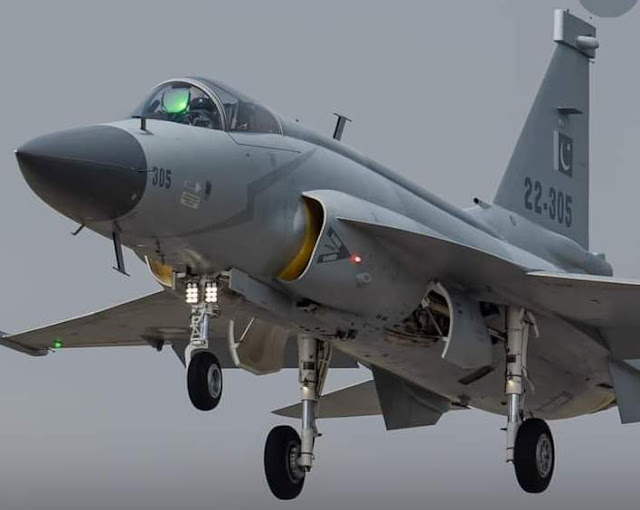 |
| Pakistan JF-17 Block 3 Fighter Jet |
Chinese and Turkish Pavilions:
Pakistan’s longtime allies China and Turkey had the largest foreign presence at IDEAS 2022. Chinese state-run defense conglomerate China North Industries Group Corporation Limited (NORINCO) displayed missiles and weapon systems including the Red Arrow 9A anti-tank guided missile.
Turkey displayed a scale model of its fifth-generation fighter, codenamed the TF-X, at Pakistan’s IDEAS expo 2022. Over two dozen Turkish defense manufacturers participated in Pakistan’s IDEAS defense expo this year.
Top Turkish defense manufacturers, including Roketsan, state-run STM and ASFAT, showcased their products ranging from modern armed drones to tactical mini-UAV systems. Turkish Aerospace exhibited the models of the T129 ATAK helicopter, Gokbey multirole helicopter, Gokturk-2 observation satellite, as well as Anka unmanned aerial vehicle (UAV) and Aksungur medium-altitude long-range endurance (MALE) UAV.
AI and Connectivity:
Pakistan Air Force (PAF) launched a Cognitive Electronic Warfare (CEW) program in 2020 at its Center for Artificial Intelligence and Computing (CENTAIC). Modern connected weapon systems generate vast amounts of data requiring artificial intelligence and machine learning software for speedy analysis and rapid decision-making on the battlefield.
A seminar titled ‘Artificial Intelligence (AI) in Defence Market: A Paradigm Shift in Military Strategy and National Security’ was organized as part of IDEAS-22. Also discussed was ‘One Network’, an advanced communication project, under which 3,000 kilometers of underground fibre optic cable is being laid along the motorways in Pakistan.
An example of connectivity and integration was demonstrated in Operation Swift Retort against India in February 2019. The success of this operation was the result of combat-proven PAF fighters which are fully integrated with the air defense system (e.g. AWACS), and are mutually data-linked, alongside all AEW (Airborne Early Warning) and ground sensors.
Rethink After Ukraine War:
The war in Ukraine is forcing a defense strategy rethink in countries around the world. This is particularly true of countries such as India that rely mainly on Russian equipment and training. Hindustan Times has quoted an unnamed former Indian Army Chief as saying: “War videos available show that the Russian Army has tactical issues in Ukraine war. Tell me, which tank formation goes to war in a single file without air or infantry cover when the opponent is equipped with the best anti-tank guided missile like Javelin or Turkish Bayraktar TB2 missile firing drones? There is question on Russian air supremacy with Ukraine Army armed with shoulder fired Stinger surface to air missiles as well as the night fighting capability of the Russian Air Force.”
Related Links:
Haq's Musings
South Asia Investor Review
Pakistan-China Defense Industry Collaboration Irks West
Pakistan's Cyber Attack and Defense Capability
Is India a Paper Elephant?
Pakistan's Aircraft Exports
Pakistan Navy Modernization
West's Technological Edge in Geopolitical Competition
Pakistan Defense Industry
Silicon Valley Book Launch of "Eating Grass"
Ukraine's Lesson For Pakistan: Never Give Up Nukes!
Pakistan Economy Nears Trillion Dollars
Pakistan's Sea-Based Second Strike Capability
Riaz Haq Youtube Channel
VPOS Youtube Channel
Riaz Haq
Pakistan launches first locally built assault boat
By Usman Ansari
https://www.defensenews.com/naval/2022/12/13/pakistan-launches-firs...
Pakistan’s Bahria Boat Building Yard launched its first 12T marine assault boat on Dec. 5 at its Karachi facility as part of a technology transfer deal with Polish shipbuilder Techno Marine.
The deal represents Techno Marine’s expanding presence in Pakistan; the company previously supplied 30 Chaser TM-1226 rigid inflatable boats for Pakistan’s naval special forces.
The contract for the marine assault boats was signed in 2018, but verifiable public information is limited. Available information notes the delivery in 2019 of two 12T vessels.
However, a spokesman with Bahria Boat Building Yard told Defense News the Pakistan Navy ordered 18 12T boats made up of two types. The Karachi Naval Dockyard is building those powered by outboard engines, and the Navy hired Bahria to make those powered by water jets. Bahria is currently building the remaining three of four vessels it is currently contracted to produce.
The spokesman also said efforts are underway to secure more domestic customers for the Bahria-built boats.
Around the 2003-2004 time frame, Thailand’s Marsun shipyard supplied M-16 fast assault boats — similar to the 12T — and the design for Pakistan’s locally built Jurrat-class missile boats. However, the M-16 vessels no longer meet the Pakistan Navy’s requirements.
The Bahria spokesman said the 12T “is for surveillance, policing purposes and [is] extremely swift in handling, as required, to operate in restricted/Creek areas,” but also around other sensitive areas such as the main naval base in Ormara and the commercial port of Gwadar.
The “Creek areas” refers to the disputed border with India around the Sir Creek, where the land border reaches the Arabian Sea. The tidal estuary is formed of marshland and shifting creeks. Conflicting claims over the border have resulted in a disputed maritime boundary in the Arabian Sea shaped like a large triangle, within which may be subsea energy resources.
Though the Pakistan Marines service patrols the Creeks area with British-built Griffon hovercraft, the 12T would enable a more effective patrolling presence into the disputed area of sea.
The 12T is equipped with twin inboard Cummins-powered Hamilton water jets. It can reach 42 knots (48 mph). It is also equipped with a navigational suite from British company Raymarine, and features ballistic protection by Danish company Scanfiber Composites.
Dec 13, 2022
Riaz Haq
Ukraine War Lessons For India: Big Wars Are Back, Terrorism Takes A Backseat
https://www.outlookindia.com/national/ukraine-war-lessons-for-india...
Defence analysts say that the two lessons from the Ukraine War are that, one, the big wars are back and terrorism has taken a backseat, and, two, the superiority of Western weapons is apparent from how Russian advances have been stalled by West-backed Ukraine.
When Russia launched a full-scale invasion of Ukraine on February 24, it was supposed to be a short war to be ended in a few days with the capture of Ukrainian capital Kyiv. Now even after 11 months, the war is on and military strategists across the world are trying to draw lessons from it as the Ukraine War has transformed modern warfare.
Indian defense analysts say India has to learn a lot from the Russia-Ukraine conflict, ranging from whether to use nuclear weapons on the battlefield and when to use them and whether to be in an alliance or not. They agree that terrorism no longer is an issue in the great power game and it has become a side issue while the war assumed prime position.
Defense analyst Pravin Sawhney says the first lesson from the Russia-Ukraine war is that big wars are back.
“Contrary to the claims of Prime Minister Narendra Modi that the era of the war is over, the reality is opposite of what Modi said — the big wars are back,” Sawhney tells Outlook.
Meeting on the sidelines of the Shanghai Cooperation Organisation Summit (SCO Summit) in Uzbekistan’s Samarkand, Modi had told Putin, “I know that today’s era is not an era of war, and I have spoken to you on the phone about this.”
Modi said democracy, diplomacy, and dialogue have kept the world together. Sawhney, whose latest book is The Last War: How AI Will Shape India’s Final Showdown With China, has been for long arguing that the Indian military is preparing for the wrong war. He says terrorism has taken a backseat in the great power game struggle and it is a side issue for the United States. The USA fought terrorism for 20 years but now it is not a major issue for them but the war is, says Sawhney.
He tells Outlook, “The war now will not be limited to battle space. It will be fought in the war zone and the whole nation could be a battle zone. We have seen cyberattacks, and we have seen Russians attack power stations and various other facilities. That is why I am saying wars will be fought all over the nation and communication will be a key issue as warring nations will try to keep their communication lines intact while disrupting the other.”
Sawhney says that Russia was the first to disrupt communication facilities in Ukraine. But later the arrival of Starlink satellite internet terminals made by Elon Musk’s SpaceX solved Ukraine’s communication problems. Starlink has been a vital source of communication for Ukraine’s military, allowing it to fight and stay connected even as cellular phone and internet networks have been destroyed in its war with Russia.
“If Starlink would have not provided communication, Ukraine would have been blinded in the war. This happens when the fight is between two equal powers. Here it is between Russia and NATO, so when the fight is between two major powers, it will be protracted war,” Sawhney argues.
“Recently Indian Army Chief said long protracted wars are back. But we must understand that they are back between the two major powers not between the two countries having huge disparity,” argues Sawhney citing example of China and India. He says every country has major red lines and these red lines have to be identified. “NATO expansion was a red line for Russia and this red line was known to all.”
Similarly, Sawhney urges that there needs to be an understanding of what Sun Weidong, who was the Chinese Ambassador to India till recently and is the Vice Foreign Minister of China, stated in his last press conference in New Delhi. Sun Weidong made Chinese red lines known in that press conference and it is the One-China policy, says Sawhney.
Dec 17, 2022
Riaz Haq
Ukraine War Lessons For India: Big Wars Are Back, Terrorism Takes A Backseat
https://www.outlookindia.com/national/ukraine-war-lessons-for-india...
Fifty-six-year old Sun, who recently returned to Beijing after a stint of over three years in New Delhi, in his rare briefing in New Delhi had said that the India-China relationship was based on the “One China” principle and called on India to “reiterate” it. Earlier, the Ministry of External Affairs Spokesperson Arindam Bagchi had called on all parties not to change the status quo over Taiwan, which appeared to be aimed at China for crossing the median line in recent military exercises.
“It is very clear that it is the US that has altered the status quo and undermined peace and stability. China’s measures are justified and legitimate,” Sun had said, referring to US House Speaker Nancy Pelosi’s visit to Taiwan.
“The outgoing Chinese Ambassador to India Sun Weidong made it clear that the foundation of India-China relations is on One China Policy. Since the Modi government came to power in India, it is not clear about One China Policy,” Sawhney adds.
He says another lesson for the Ukraine War is the extensive use of new technology like drones during the wars between major powers.
He adds, “It is applicable between Russia and NATO or between India and Pakistan but not between China and India as China has advanced cyber warfare capability.”
A month after the Russia-Ukraine War, Indian Army chief General Manoj Mukund Naravane in March had said the main lesson from the conflict was that India has to be ready to fight future wars with indigenous weapon systems.
“The biggest lesson is that we have to be ready to fight future wars with indigenous weapons and the steps towards Aatmanirbhar Bharat in defense should be taken more urgently. The wars of the future should be fought with our own weapon systems,” the then Army chief General Naravane said.
As the war in Ukraine has turned into a bloody stalemate with neither side possessing a decisive military advantage to achieve geopolitical objectives, many defense experts like Abhijit Iyer-Mitra say one has to see how Western weapons achieve their objective more quickly than Russian weapons and also how technology and willing to take risks has remodelled the war.
Mitra cites examples of the NATO bombing of Yugoslavia and achieving its objectives in 78 days and the NATO invasion of Iraq making Bagdad cave in early to point out the superiority of the western weapons.
He adds, “These wars and Ukraine War show initial victory with Western weapons happens very rapidly. The counter-insurgency is altogether a different matter that happened after the initial victories.”
Mitra argues that the Russia-Ukraine conflict has also shown “how obsolete Russian weapons are and how non-existent Russian intelligence has become.”
“An important lesson of the Russia-Ukraine conflict is one should have complete hold on the interpretation of imagery to target the adversary and if you are using Eastern weapons prepare for long-drawn war. The eastern weapons are effective but they require a lot of time. It is brutal and you have to be willing to accept deaths in thousands,” he adds.
Mitra says information warfare is another aspect that cannot be overlooked as at present the Ukraine-Russia conflict’s narrative has been completely captured by the Western media in general and the narratives have the ability to influence the morale of the troops and the nations fighting the war.
“In past wars between India and China or between Pakistan and India, infrastructure has not been targeted. They have been always military-to-military fights. But things started to change when Russia started targeting Ukrainian energy infrastructure. You need to be willing to take out energy and all kinds of infrastructure to assist your troops.
Dec 17, 2022
Riaz Haq
Ukraine War Lessons For India: Big Wars Are Back, Terrorism Takes A Backseat
https://www.outlookindia.com/national/ukraine-war-lessons-for-india...
“You have to seriously start thinking when you are going to use nuclear weapons on a battlefield. You have to also weigh the cost of being outside an alliance while using nuclear weapons. Because of what Poland, Latvia, and Estonia can do, Ukraine cannot do. Being in an alliance gives you a certain kind of deterrence which you don’t get outside an alliance even if you have nuclear weapons. These are lessons the Russia-Ukraine conflict teaches us,” Mitra says.
However, Mitra was dismissive of Aatmanirbhar Bharat in the defense industry, though he says the main lesson India should learn from the Ukraine conflict is to be Aatmanirbhar — self-reliant.
He adds, “We have been hearing this argument Aatmanirbhar for the past 25 years. Nobody knows it as no one understands it. This was possible twenty years ago but not now when the gap is narrowing. Besides, there are a lot of western weapons you cannot indigenise.”
Dec 17, 2022
Riaz Haq
What is ChatGPT? The AI chatbot talked up as a potential Google killer
After all, the AI chatbot seems to be slaying a great deal of search engine responses.
https://interestingengineering.com/science/chatgpt-ai-chatbot-googl...
ChatGPT is the latest and most impressive artificially intelligent chatbot yet. It was released two weeks ago, and in just five days hit a million users. It’s being used so much that its servers have reached capacity several times.
OpenAI, the company that developed it, is already being discussed as a potential Google slayer. Why look up something on a search engine when ChatGPT can write a whole paragraph explaining the answer? (There’s even a Chrome extension that lets you do both, side by side.)
But what if we never know the secret sauce behind ChatGPT’s capabilities?
The chatbot takes advantage of a number of technical advances published in the open scientific literature in the past couple of decades. But any innovations unique to it are secret. OpenAI could well be trying to build a technical and business moat to keep others out.
What it can (and can’t do)
ChatGPT is very capable. Want a haiku on chatbots? Sure.
How about a joke about chatbots? No problem.
ChatGPT can do many other tricks. It can write computer code to a user’s specifications, draft business letters or rental contracts, compose homework essays and even pass university exams.
Just as important is what ChatGPT can’t do. For instance, it struggles to distinguish between truth and falsehood. It is also often a persuasive liar.
ChatGPT is a bit like autocomplete on your phone. Your phone is trained on a dictionary of words so it completes words. ChatGPT is trained on pretty much all of the web, and can therefore complete whole sentences – or even whole paragraphs.
However, it doesn’t understand what it’s saying, just what words are most likely to come next.
Open only by name
In the past, advances in artificial intelligence (AI) have been accompanied by peer-reviewed literature.
In 2018, for example, when the Google Brain team developed the BERT neural network on which most natural language processing systems are now based (and we suspect ChatGPT is too), the methods were published in peer-reviewed scientific papers, and the code was open-sourced.
And in 2021, DeepMind’s AlphaFold 2, a protein-folding software, was Science’s Breakthrough of the Year. The software and its results were open-sourced so scientists everywhere could use them to advance biology and medicine.
Following the release of ChatGPT, we have only a short blog post describing how it works. There has been no hint of an accompanying scientific publication, or that the code will be open-sourced.
To understand why ChatGPT could be kept secret, you have to understand a little about the company behind it.
OpenAI is perhaps one of the oddest companies to emerge from Silicon Valley. It was set up as a non-profit in 2015 to promote and develop “friendly” AI in a way that “benefits humanity as a whole”. Elon Musk, Peter Thiel, and other leading tech figures pledged US$1 billion (dollars) towards its goals.
Their thinking was we couldn’t trust for-profit companies to develop increasingly capable AI that aligned with humanity’s prosperity. AI therefore needed to be developed by a non-profit and, as the name suggested, in an open way.
In 2019 OpenAI transitioned into a capped for-profit company (with investors limited to a maximum return of 100 times their investment) and took a US$1 billion(dollars) investment from Microsoft so it could scale and compete with the tech giants.
It seems money got in the way of OpenAI’s initial plans for openness.
Profiting from users
On top of this, OpenAI appears to be using feedback from users to filter out the fake answers ChatGPT hallucinates.
According to its blog, OpenAI initially used reinforcement learning in ChatGPT to downrank fake and/or problematic answers using a costly hand-constructed training set.
Dec 18, 2022
Riaz Haq
How the algorithm tipped the balance in Ukraine
https://www.washingtonpost.com/opinions/2022/12/19/palantir-algorit...
by David Ignatius
KYIV — Two Ukrainian military officers peer at a laptop computer operated by a Ukrainian technician using software provided by the American technology company Palantir. On the screen are detailed digital maps of the battlefield at Bakhmut in eastern Ukraine, overlaid with other targeting intelligence — most of it obtained from commercial satellites.
As we lean closer, we see can jagged trenches on the Bakhmut front, where Russian and Ukrainian forces are separated by a few hundred yards in one of the bloodiest battles of the war. A click of the computer mouse displays thermal images of Russian and Ukrainian artillery fire; another click shows a Russian tank marked with a “Z,” seen through a picket fence, an image uploaded by a Ukrainian spy on the ground.
If this were a working combat operations center, rather than a demonstration for a visiting journalist, the Ukrainian officers could use a targeting program to select a missile, artillery piece or armed drone to attack the Russian positions displayed on the screen. Then drones could confirm the strike, and a damage assessment would be fed back into the system.
This is the “wizard war” in the Ukraine conflict — a secret digital campaign that has never been reported before in detail — and it’s a big reason David is beating Goliath here. The Ukrainians are fusing their courageous fighting spirit with the most advanced intelligence and battle-management software ever seen in combat.
“Tenacity, will and harnessing the latest technology give the Ukrainians a decisive advantage,” Gen. Mark A. Milley, chairman of the Joint Chiefs of Staff, told me last week. “We are witnessing the ways wars will be fought, and won, for years to come.”
I think Milley is right about the transformational effect of technology on the Ukraine battlefield. And for me, here’s the bottom line: With these systems aiding brave Ukrainian troops, the Russians probably cannot win this war.
“The power of advanced algorithmic warfare systems is now so great that it equates to having tactical nuclear weapons against an adversary with only conventional ones,” explains Alex Karp, chief executive of Palantir, in an email message. “The general public tends to underestimate this. Our adversaries no longer do.”
“For us, it’s a matter of survival,” argues “Stepan,” the senior Ukrainian officer in the Kyiv demonstration, who before the war designed software for a retail company. Now, he tells me bluntly, “Our goal is to maximize target acquisitions.” To protect his identity, he stripped his unit insignia and other markings from his camouflage uniform before he demonstrated the technology. (The names he and his colleague used were not their real ones; I agreed to their request to protect their security.)
“Lesya,” the other officer, was also a computer specialist in peacetime. As she looks at the imagery of the Russian invaders, on a day when their drones are savaging civilian targets in Odessa on Ukraine’s southern coast, she mutters a wish for revenge — and a hope that Ukraine will emerge from the war as a tech power. Although the Ukrainians now depend on technology help from America, she says, “by the end of the war, we will be selling software to Palantir.”
Dec 19, 2022
Riaz Haq
How the algorithm tipped the balance in Ukraine
https://www.washingtonpost.com/opinions/2022/12/19/palantir-algorit...
A new deterrent
Kyiv was cold and snowy when I arrived just over a week ago. The power was out in some places. But the capital was relatively calm. There was a traffic jam entering the city on Friday. On Saturday night, restaurants were so packed it was impossible to get a reservation at one upscale spot.
As Ukraine moves toward the new year, the spirit of resistance and resilience is visible everywhere. Roadblocks have mostly disappeared. Children play near captured Russian tanks in St. Michael’s Square. Couples take walks in the park above the Dnieper River.
I visited here at year’s end to explore what I believe is the overriding lesson of this fight — and indeed, of the past several decades of war: A motivated partner like Ukraine can win if provided with the West’s unique technology. The Afghanistan army cracked in a day because it lacked the motivation to fight. But Ukraine — and, before it, the Syrian Kurdish fighters who crushed the Islamic State with U.S. help — has succeeded because it has both the weapons and the will.
I met with a senior team from Palantir that was visiting its Kyiv office. With the approval of Karp, the CEO, they agreed to show me some of the company’s technology close to the firing line. The result is a detailed look at what may prove to be a revolution in warfare — in which a software platform allows U.S. allies to use the ubiquitous, unstoppable sensors that surround every potential battlefield to create a truly lethal “kill chain.”
Palantir, which began its corporate life working with the CIA on counterterrorism tools, has many critics. That’s partly because its biggest funder, from the start, has been co-founder Peter Thiel, a successful tech investor who has also been a strong supporter of Donald Trump and other MAGA Republicans. Karp, by contrast, has supported many Democratic candidates and causes.
The critics have argued that Palantir’s powerful software has been misused by government agencies to violate privacy or serve questionable ends. For example, The Post wrote in 2019 that Palantir’s software was used by Immigration and Customs Enforcement to help track undocumented immigrants, which led to protests from some of the company’s employees. Tech community activists have asked whether Palantir is too close to the U.S. government and can “see too much” with its tools.
Karp responded to criticism of the company in an email to me last week: “Silicon Valley screaming at us for over a decade did not make the world any less dangerous. We built software products that made America and its allies stronger — and we are proud of that.”
And Ukraine has shifted the political landscape in Silicon Valley. For Karp and many other technology CEOs, this is “the good war” that has led many companies to use their tools aggressively. This public-private partnership is one of the keys to Ukraine’s success. But it obscures many important questions: How dependent should countries be on entrepreneurs whose policy views could change? We can applaud the use of these tools in “good” wars, but what about bad ones? And what about private tools being turned against the governments that helped create them?
We’ll be struggling with these questions about technology and warfare for the rest of this century. But after spending weeks investigating the new tools developed by Palantir and other companies, the immediate takeaway for me is about deterrence — and not just in Ukraine. Given this revolution in technology, adversaries face a much tougher challenge in attacking, say, Taiwan than they might imagine. The message for China in this emerging digital battle space is: Think twice.
Dec 19, 2022
Riaz Haq
How the algorithm tipped the balance in Ukraine
https://www.washingtonpost.com/opinions/2022/12/19/palantir-algorit...
Vast data battlefield
The “kill chain” that I saw demonstrated in Kyiv is replicated on a vast scale by Ukraine’s NATO partners from a command post outside the country. The system is built around the same software platform developed by Palantir that I saw in Kyiv, which can allow the United States and its allies to share information from diverse sources — ranging from commercial satellite imagery to the West’s most secret intelligence tools.
This is algorithmic warfare, as Karp says. Using a digital model of the battlefield, commanders can penetrate the notorious “fog of war.” By applying artificial intelligence to analyze sensor data, NATO advisers outside Ukraine can quickly answer the essential questions of combat: Where are allied forces? Where is the enemy? Which weapons will be most effective against enemy positions? They can then deliver precise enemy location information to Ukrainian commanders in the field. And after action, they can assess whether their intelligence was accurate and update the system.
Data powers this new engine of war — and the system is constantly updating. With each kinetic strike, the battle damage assessments are fed back into the digital network to strengthen the predictive models. It’s not an automated battlefield, and it still has layers and stovepipes. The system I saw in Kyiv uses a limited array of sensors and AI tools, some developed by Ukraine, partly because of classification limits. The bigger, outside system can process highly classified data securely, with cyber protections and restricted access, then feed enemy location data to Ukraine for action.
To envision how this works in practice, think about Ukraine’s recent success recapturing Kherson, on the Black Sea coast. The Ukrainians had precise intelligence about where the Russian were moving and the ability to strike with accurate long-range fire. This was possible because they had intelligence about the enemy’s location, processed by NATO from outside the country and then sent to commanders on the ground. Armed with that information, the Ukrainians could take the offensive — moving, communicating and adjusting quickly to Russian defensive maneuvers and counterattacks.
And when Ukrainian forces hit Russian command nodes or supply depots, it’s a near certainty that they have received enemy location data this way. Mykhailo Fedorov, Ukraine’s minister of digital transformation, told me that this electronic kill chain was “especially useful during the liberation of Kherson, Izium, Kharkiv and Kyiv regions.”
What makes this system truly revolutionary is that it aggregates data from commercial vendors. Using a Palantir tool called MetaConstellation, Ukraine and its allies can see what commercial data is currently available about a given battle space. The available data includes a surprisingly wide array, from traditional optical pictures to synthetic aperture radar that can see through clouds, to thermal images that can detect artillery or missile fire.
To check out the range of available data, just visit the internet. Companies selling optical and synthetic aperture radar imagery include Maxar, Airbus, ICEYE and Capella. The National Oceanic and Atmospheric Administration sells simple thermal imaging meant to detect fires but that can also register artillery explosions.
In our Kherson example, Palantir assesses that roughly 40 commercial satellites will pass over the area in a 24-hour period. Palantir normally uses fewer than a dozen commercial satellite vendors, but it can expand that range to draw imagery from a total of 306 commercial satellites that can focus to 3.3 meters. Soldiers in battle can use handheld tablets to request more coverage if they need it. According to a British official, Western military and intelligence services work closely with Ukrainians on the ground to facilitate this sharing of information.
Dec 19, 2022
Riaz Haq
How the algorithm tipped the balance in Ukraine
https://www.washingtonpost.com/opinions/2022/12/19/palantir-algorit...
A final essential link in this system is the mesh of broadband connectivity provided from overhead by Starlink’s array of roughly 2,500 satellites in low-earth orbit. The system, owned by Elon Musk’s SpaceX company, allows Ukrainian soldiers who want to upload intelligence or download targeting information to do so quickly.
In this wizard war, Ukraine has the upper hand. The Russians have tried to create their own electronic battlefield tools, too, but with little success. They have sought to use commercial satellite data, for example, and streaming videos from inexpensive Chinese drones. But they have had difficulty coordinating and sharing this data among units. And they lack the ability to connect with the Starlink array.
“The Russian army is not flexible,” Lesya, the Ukrainian officer, told me. She noted proudly that every Ukrainian battalion travels with its own software developer. Ukraine’s core advantage isn’t just the army’s will to fight, but also its technical prowess.
Fedorov, Ukraine’s digital minister, listed some of the military tech systems that Ukraine has created on its own, in a response to my written questions. These include a secure chat system, called “eVorog,” that has allowed civilians to provide 453,000 reports since the war started; a 200-strong “Army of Drones” purchased from commercial vendors for use in air reconnaissance; and a battlefield mapping system called Delta that “contains the actual data in real time, so the military can plan their actions accordingly.”
The “X factor” in this war, if you will, is this Ukrainian high-tech edge and the ability of its forces to adapt rapidly. “This is the most technologically advanced war in human history,” argues Fedorov. “It’s quite different from everything that has been seen before.”
And that’s the central fact of the extraordinary drama the world has been watching since Russia invaded so recklessly last February. This is a triumph of man and machine, together.
Next: How “algorithmic warfare” evolved over the past decade — and some very human worries.
Dec 19, 2022
Riaz Haq
IDEAS 2022: The JF-17 Reaches a Key Maturation Phase
https://quwa.org/2022/11/20/ideas-2022-the-jf-17-reaches-a-key-matu...
Taimoor Air-Launched Cruise Missile (ALCM)
At IDEAS 2022, the PAF revealed that it will induct a new air-launched cruise missile (ALCM), which it has named ‘Taimoor.’ The Taimoor ALCM seems virtually identical to the Ra’ad II ALCM, which has a range of 550-600 km. However, it seems that the PAF is planning to use the Taimoor ALCM as a conventional stand-off range weapon (SOW). Some observers who had attended IDEAS 2022 report that the PAF termed the Taimoor ALCM as a next-generation anti-ship missile as well.
The Taimoor ALCM could be a sign of the PAF investing in the JF-17 and, potentially, J-10CE’s SOW suite by adding a long-range, heavy-payload weapon. It is not known which of Pakistan’s in-house bureaus will be producing the Taimoor ALCM, but it is likely National Engineering & Scientific Commission (NESCOM).
GIDS (Global Industrial & Defence Solutions), which markets products on behalf of Pakistan’s state-owned enterprises (SOE), started promoting the “Harbah-NG” anti-ship cruising missile (ASCM). The Harbah-NG is the export variant of the Harbah, which was first announced in 2018.
There could be an intriguing scenario where the Taimoor ALCM leverages the same propulsion/engine or electronics stack as the Harbah-NG ASCM. This standardization could help with reducing the cost of these systems. In turn, standardization can them affordable enough for wide-scale conventional use. Until this point, Pakistan has largely positioned its cruise missiles for strategic use…
---------------
Air Warfare Syndicate
@AirWarSyndicate
JF-17C is being integrated with advanced Air Superiority Weapons and Avionics Package. The PAF Thunder Riders will have the privilege of using the same HMDS as that of J-20 of PLAAF
HMDS provide great advantage to its users in critical decision making during air battle.
https://twitter.com/AirWarSyndicate/status/1592460516202803206?s=20...
Dec 19, 2022
Riaz Haq
News From India:
Myanmar expands defence industrial partnership with Pakistan for JF-17
https://economictimes.indiatimes.com/news/defence/myanmar-expands-d...
Myanmar is indulging in a delicate balancing act by stepping up military engagement with the China-Pakistan axis on one hand and Russia on the other by near simultaneous hosting of military delegations from Pakistan and Russia.
While a Pakistani delegation led by Colonel Imran Khan visited Myanmar capital Naypyitaw last week to discuss military cooperation with the junta, in continuation of a series of visits from Pakistan military establishment to Myanmar since September, the junta al ..
The Pakistani team visited Myanmar regarding technical support for JF-17 aircraft jointly developed by China and Pakistan, ET has further learnt.
A 10-member team from Myanmar Air Force (MAF) is currently in Pakistan undergoing training for four weeks on precision targeting in air operations and on the JF-17 jet fighter.
Myanmar bought 16 JF-17’s from China. The first batch of six aircraft was delivered in 2018, but details about the delivery date for the other 10 remain unclear. Myanmar was the first country to buy the JF-17, sources told ET.
In October, a senior-level Pakistani military delegation visited Myanmar to provide technical assistance to manufacture weapons, ET had reported earlier
In September, a Myanmar military team had visited Pakistan to inspect delivery of bombs and bullets that it had ordered from Islamabad, according to persons familiar with the development. This team again visited Pakistan earlier this month for pre-shipment inspection of deliveries.
Pakistan was also reportedly considering selling heavy machine guns, 60 mm and 81 mm mortars and M-79 grenade launchers to Myanmar, ET had earlier reported.
Pakistan was formerly a strong critic of the Myanmar government for what it alleged was a “state-sponsored campaign” against Rohingyas in western Myanmar’s Rakhine state. Myanmar had in the past accused Pakistan of arming and training a radical group, the Arakan Rohingya Salvation Army.
Dec 24, 2022
Riaz Haq
Why Pakistan is not a walkover
https://www.youtube.com/watch?v=oGD6ZBKK3MY
FORCE editor Pravin Sawhney explains why India must take Pakistan military seriously. And how it is as professional a force as any. Visit us at www.forceindia.net
China-India military interoperability is a threat to India.
Professional Military:
1. Clearly defined threat
2. Balance at strategic and operational level.
3. Bring technologies and capabilities to the theater.
Pakistan meets all of the above criteria.
Bulk of India's attention is on Pakistan, not China.
Pakistan used proxy war in Jammu and Kashmir to keep Indian military engaged and to balance India's numerical advantage.
Both strategic and conventional forces report to Pakistan Army Chief.
Pakistan has created a strong air defense network.
Then Pakistan developed tactical nukes and refused to say "No First Use" to maintain ambiguity.
Pakistan has never lost in the western sector.
That's why India has failed to obliterate the Line-of-Control in Kashmir.
Pakistan developed and deployed nuclear weapons delivery system.
Now Pakistan is confident it can take on India.
Why? Because Pakistan and China have developed interoperability.
There is commonality of equipment, timely upgrades, ammunitions and spare parts.
China-Pakistan doctrinal compatibility.
CPEC has added the economic dimension to the relationship.
China now has an economic interest in defending its assets in Pakistan.
China can now shares non-kinetic capability cyber capability with Pakistan.
It makes no sense for Indian military leaders to make tall claims and issue threats to Pakistan.
Dec 25, 2022
Riaz Haq
Book Excerpt: How Will a India-China War Pan Out? In his book 'The Last War: How AI Will Shape India’s Final Showdown With China', Pravin Sawhney imagines how an AI-supported Peoples Liberation Army might target critical Indian military assets.
Sep 17, 2022 | Pravin Sawhney
https://thewire.in/books/book-excerpt-how-will-a-india-china-war-pa...
The PLA’s space war will destroy Indian intelligence, reconnaissance, surveillance, communications, and navigation satellites by groundbased or Direct Ascent Anti Satellite (DA-ASAT) missiles, co-orbital ASAT, satellite jammers, and offensive cyber capabilities. This will be done by SSF’s two deputy theatre command-level departments: the space systems department responsible for military space operations, and the information operations which comprise cyberwar, electronic war, and political war. Since 2019, the SSF has been participating in joint exercises and training throughout China, and with the WTC against India.In massive pre-emptive attacks with remarkable speed, lethality, and intense salvos, the Rocket Force with advanced and accurate missiles would wipe out the majority of IAF combat aircraft on the ground before they get airborne. The RF inventory comprises surface-to-surface missiles, air-launched ballistic missiles, subsonic and supersonic missiles, hypersonic cruise missiles, hypersonic glide vehicles, submarine launched ballistic missiles, fractional orbital bombardment system, LAWs or killer robots, and swarm of missiles.
The PLA will build its Rocket Force missiles surge needed for India over time. Just as China took three years to prepare for the 1962 war even as its leaders were hoping for peace with India, preparations for large numbers of indigenous missiles will start early. Based on AI-enabled mathematical modelling of identified targets, and with automated production capability, the PLA will calculate the surge requirement for long range rockets, and smart and precision munitions including missiles, and build them. On the Indian side, the IAF inventory will be finite with little possibility of making up attrition rates.The RF focus will be bases with Rafale and Su-30 MKI aircraft. The missiles will crater runways, blow up fuel storage tanks, ammunition underground bunkers, hardened shelters, forward maintenance areas, command and control centres, and forward logistics centres of the IAF’s main and diversionary bases. This would ensure that even if airstrips get repaired, aircraft, in absence of payloads and fuel, will not be able to get airborne. Moreover, units of S-400 air and missile defence system, BrahMos cruise missile, Smerch and Pinaka multi-barrel rocket launchers, radar sites, long-range artillery, and communication nodes would be destroyed. The PLA could use swarms of autonomous long-range missiles, which on reaching its target, say a S-400 unit or regiment, would on its own decide how best to destroy the air defence system in the least amount of time. Or destroy its kill chain by cyberattacks on indigenous Akash surface-to-air missiles which would be integrated with S-400 for broad air defence cover.
Moreover, all field headquarters of the IAF and the Indian Army will be flattened by missile rain. There will be no carpet bombing, but accurate targeting with least collateral damages. With an area of 84,000 sq km, Arunachal Pradesh has a population of just 16 lakh concentrated in urban areas.
Dec 25, 2022
Riaz Haq
Book Excerpt: How Will a India-China War Pan Out? In his book 'The Last War: How AI Will Shape India’s Final Showdown With China', Pravin Sawhney imagines how an AI-supported Peoples Liberation Army might target critical Indian military assets.
Sep 17, 2022 | Pravin Sawhney
https://thewire.in/books/book-excerpt-how-will-a-india-china-war-pa...
Priority would be accorded to communication towers, power centres, bridges, tunnels, radar sites, air defence systems, and command and control hubs. Since most Indian targets will be static, well-mapped, and watched, it will not be difficult for the PLA to hit them with precision. Political (information) warfare will be used to keep the enemy’s cognitive capabilities (decision-making) under pressure.
Considering that Rocket Force’s capabilities and employment is well documented and articulated by US and Chinese analysts, it is surprising that the IAF panel at the Military Literature Festival downplayed the fact that missiles will be the first line of attack in the PLA war. In September 2010, a three-star officer at the Eastern Air Command said as much. In an interaction with me at his headquarters in Shillong, he admitted that the IAF had no answer for the PLA’s surface-to-surface missiles.A decade later, IAF officials decided to downplay the monstrous missile threat in the absence of a corresponding response. This is what the US military does not do. The US INDOPACOM chief, Admiral Philip Davidson, said in March 2021 that the US will deploy its IndoPacific military presence far and wide rather than keep it concentrated at a handful of bases as it seeks to protect itself from China’s advanced missile capabilities. And yet, the former IAF chief Dhanoa thought that closeness of IAF main and diversionary bases would be an asset instead of being lucrative targets for the Chinese missiles.The IAF combat aircraft in the Indian hinterland (allocated for the Pakistani front) which manage to get airborne against China will find it impossible to penetrate the complex and compact A2/AD weapons bubble which will cover the spectrum from space to atmosphere with few gaps. In certain areas, such as some categories of hypersonic, ballistic, and cruise missiles, air defence, electronic warfare, and cyber capabilities, the PLA ranks among the world’s leaders. With ground communications jammed, Indian satellites disabled, destroyed, or thrown out of orbit, these combat aircraft will be blinded. The Indian armed drones and swarm drones that are touted to be game changers by the Indian military will meet a similar fate. The zone of operations of the A2/AD will be expanded by the PLA pushing IAF aircraft far away from the Chinese airspace.Incidentally, China’s ‘robust and redundant Integrated Air Defence System over land area and within 300 nautical miles (556 km) of its coast (within the first island chain in South China Sea) relies on an extensive early warning radar network, fighter aircraft, and a variety of surface to air missiles.’ As mentioned earlier, the PLA had created a similar A2/ AD firewall or counter invention force against India.Asked if it would be possible for Predator, the US drone, to carry out target killing inside Chinese airspace, similar to the killing of Irani general Qasem Soleimani at Baghdad airport in January 2020, Chinese analyst Wei Dongxu said:‘China has a complete air defence system, making it capable of defending surprise and targeted strikes from drones. Since China operates detection and early warning radars from multiple angles and levels, drones will face China’s aircraft interception network consisting of long, intermediate, and short range, as well as high, mid, and low altitude anti-aircraft missiles and guns. Soft kill is also an available option, which means China can jam enemy drones.’
Dec 25, 2022
Riaz Haq
Opinion A ‘good’ war gave the algorithm its opening, but dangers lurk
By David Ignatius
https://www.washingtonpost.com/opinions/2022/12/20/ukraine-war-russ...
NORTHEASTERN ENGLAND — To see the human face of the “algorithm war” being fought in Ukraine, visit a company of raw recruits during their five rushed weeks at a training camp here in Britain before they’re sent to the front in Ukraine.
They will soon have a battery of high-tech systems to aid them, but they must face the squalor of the trenches and the roar of unrelenting artillery fire alone. The digital battlefield has not supplanted the real one.
At the British camp, instructors have dug 300 yards of trenches across a frigid hillside. The trenches are 4 feet deep, girded with sandbags and planks, and slick with mud and water at the bottom. The Ukrainian recruits, who’ve never been in battle before, have to spend 48 hours in these hellholes. Sometimes, there’s simulated artillery fire overhead and rotting animal flesh nearby to prepare the trainees for the smell of death.
The recruits practice attacking the trenches and defending them. But mostly they learn to stay alive and as warm as they can, protecting their wet, freezing feet from rot and disease. “Nobody likes the trenches,” says Oleh, the Ukrainian officer who oversees the training with his British colleagues. (I’m not using his full name to respect concerns about his security.) “We tell them it will be easier in battle. If it’s hard now, that’s the goal.”
The paradox of the Ukraine conflict is that it combines the World War I nightmare of trench warfare with the most modern weapons of the 21st century.
“It’s hard to understand the brutality of contact in that front line. It’s Passchendaele in Donetsk,” explains Brigadier Justin Stenhouse, referring to one of the bloodiest battles of World War I. He oversees training for the British Ministry of Defense in Whitehall and arranged my visit to the training camp.
Silicon Valley Pentagon
The Ukraine war has fused the flesh-and-blood bravery of these Ukrainian troops on the ground with the stunning high-tech arsenal that I described in Part 1 of this report. The result is a revolution in warfare. This transformation, rarely discussed in the media, has been evolving for more than a decade. It shows the lethal ability of the United States and its allies to project power — and it also raises some vexing questions about how this power will be used.
One of the leading actors in this underreported revolution has been Palantir, which developed its software platform after the Sept. 11, 2001, attacks to help the CIA integrate data that was often in different compartments and difficult to share. News reports have frequently said that Palantir software helped track al-Qaeda leader Osama bin Laden, but the company won’t confirm that.
The Pentagon’s use of these ultramodern tools was encouraged by a very old-fashioned commander, Gen. Mark A. Milley, the gruff and often profane chairman of the Joint Chiefs of Staff. When he was Army chief of staff in 2018, the service began working with Palantir and other tech companies to integrate data through a program called Army Vantage. Milley was frustrated by an antiquated data system that made it hard to gather details about what units were ready for battle. The Army, like so many government institutions, had too many separate repositories for information.
Palantir technicians showed me an unclassified version of the Army database they helped create to address that problem. You can see in an instant what units are ready, what skills and experience the soldiers in these units have, and what weapons and ammunition are available. Logistics problems like this once took weeks to solve; now there are answers in seconds.
“The U.S. military is focused on readiness today and readiness in the future,” Milley told me in an email last week. “In defense of our country, we’re pulling together a wide variety of technologies to remain number one, the most effective fighting force in the world.”
Dec 25, 2022
Riaz Haq
Opinion A ‘good’ war gave the algorithm its opening, but dangers lurk
By David Ignatius
https://www.washingtonpost.com/opinions/2022/12/20/ukraine-war-russ...
The Army began testing ideas about algorithmic warfare with individual units around that time as well. The first choice was the elite 82nd Airborne, commanded in 2020 by Maj. Gen. Christopher Donahue; it was part of the XVIII Airborne Corps, then headed by Lt. Gen. Michael “Erik” Kurilla. These two worked with Palantir and other companies to understand how the Army could use data more effectively.
Simultaneously, the Pentagon was exploring the use of artificial intelligence to analyze sensor data and identify targets. This effort was known as Project Maven, and it initially spawned a huge controversy when it was launched in 2017. The idea was to write algorithms that could recognize, say, a Russian T-72 tank in drone surveillance images in the same way that facial recognition scans can discern a human face.
The military’s AI partnership with Silicon Valley got off to a bad start. In 2018, engineers at Google, initially the leading contractor for Maven, protested so angrily about writing targeting algorithms that the company had to withdraw from the program.
Maven has evolved. It’s now supervised by the National Geospatial-Intelligence Agency, and it generates AI models on a fast, one-month cycle. A tech executive explained to me that companies now compete to develop the most accurate models for detecting weapons — tuning their algorithms to see that hypothetical T-72 under a snowy grove of fir trees, let’s say, rather than a swampy field of brush — and each month the government selects a new digital array.
For a Pentagon that usually buys weapons that have a 30-year life span, this monthly rollover of targeting software is a revolution in itself.
When Russia invaded Ukraine on Feb. 24, the U.S. Army had these tools in hand — and commanders with experience using them. Donahue had moved up to become head of the XVIII Airborne Corps, which transferred its forward headquarters to Wiesbaden, Germany, just after the Russian invasion. The 82nd Airborne moved to forward quarters near Rzeszow, Poland, near the Ukraine border.
Kurilla, meanwhile, became head of Central Command and began using that key theater as a test bed for new technologies. In October, Kurilla appointed Schuyler Moore, a former director of science and technology for the Defense Innovation Board, as Centcom’s first “chief technology officer.”
For the Army and other services, the impetus for this technology push isn’t just the Russian invasion of Ukraine, but the looming challenge from China — America’s only real peer competitor in technology.
A tool for good and ill
In the age of algorithm warfare, when thinking machines will be so powerful, human judgment will become all the more important. Free societies have created potent technologies that, in the hands of good governments, can enable just outcomes, and not only in war. Ukrainian officials tell me they want to use Palantir software not just to repel the Russian invasion but also to repair Ukraine’s battered electrical grid, identify hidden corruption and manage the vast tasks of reconstruction.
Mykhailo Fedorov, Ukraine’s minister for digital transformation and vice prime minister, explained in written answers to my questions how he plans to use technology not just to beat Russia but also to become a high-tech superpower in the future.
Dec 25, 2022
Riaz Haq
Opinion A ‘good’ war gave the algorithm its opening, but dangers lurk
By David Ignatius
https://www.washingtonpost.com/opinions/2022/12/20/ukraine-war-russ...
Fedorov said Ukraine is “massively” using software platforms “to deal with power shortages and in order to ensure telecom connection.” To repair electricity cutoffs and damaged energy infrastructure, the country uses Starlink terminals, Tesla Powerwall systems, and advanced generators and lithium batteries. It backs up all its important data on cloud servers.
“For sure, I’m convinced that technologies will also allow us to build a bright and safe future,” Fedorov said. “Only the newest technologies could give us such an advantage to run and create the country we deserve as fast as possible.”
But these technologies can also create 21st-century dystopias, in the wrong hands. The targeting algorithms that allow Ukraine to spot and destroy invading Russians aren’t all that different from the facial-recognition algorithms that help China repress its citizens. We’re lucky, in a sense, that these technologies are mostly developed in the West by private companies rather than state-owned ones.
But what if an entrepreneur decides to wage a private war? What if authoritarian movements gain control of democratic societies and use technology to advance control rather than freedom? What if AI advances eventually allow the algorithms themselves to take control, making decisions for reasons they can’t explain, at speeds that humans can’t match? Democratic societies need to be constantly vigilant about this technology.
The importance of the human factor is clear with Silicon Valley entrepreneurs such as Elon Musk, who illustrates the strength — and potential weakness — of America’s new way of war. If Musk decides he isn’t being paid enough for his services, or if he thinks it’s time for Ukraine to compromise, he can simply cut the line to his satellites, as he briefly threatened this fall.
Dec 25, 2022
Riaz Haq
Opinion A ‘good’ war gave the algorithm its opening, but dangers lurk
By David Ignatius
https://www.washingtonpost.com/opinions/2022/12/20/ukraine-war-russ...
Looking at the Ukraine war, we can see that our freewheeling entrepreneurial culture gives the West a big advantage over state-run autocracies such as China and Russia — so long as companies and CEOs share the same democratic values as Western governments. That’s why we need a broader public debate about the power of the technologies that are being put to noble use in Ukraine but could easily be turned to ignoble purposes in the wrong hands.
Ukraine, which has suffered so much in this war, wants to be a techno-superpower when the conflict finally ends. Fedorov, who’s overseeing Kyiv’s digital transformation, explains it this way: “Let’s plan to turn Ukraine into the world’s ‘mil-tech valley,’ to develop the most innovative security solutions, so the world will become a safer and more digital place.”
But first, the Ukrainians freezing in the filthy trenches will need to prevail.
Lt. Col. Harris, the commander of the camp in northeastern England, says he’s humbled amid the recruits there. Through five combat tours in Afghanistan and one in Iraq, though, he knows he has never faced anything as horrifying as many of them will see in a month or two.
On the firing range, 10 Ukrainian recruits squeeze off shots from their AK-47s. They’re on the second day of live-fire exercises, with eight more to come. They’re accountants, cooks and college students; some unsteady with their weapons, others newly bold. As they take aim at targets 50 feet away, a British sergeant commanding the range barks at them through an interpreter: “You need to kill the enemy before he kills you.”
And it’s as simple as that. This is a war of survival for Ukraine. But it should comfort the recruits that whatever their misery in coming months, they will have a level of technological support beyond anything the world has seen.
Dec 25, 2022
Riaz Haq
12 Biggest Militaries in the World: Does Size Matter?
https://finance.yahoo.com/news/12-biggest-militaries-world-does-195...
1. US, 2. Russia, 3. China, 4. India, 5. UK, 6. Japan, 7. South Korea, 8. France, 9. Pakistan, 10. Israel, 11. North Korea, 12. Iran
9. Pakistan
Aircraft: 431
Tanks: 4148
Strategic Warships: 18
Submarines: 8
Nuclear Weapons: 165
Pakistan is one of the strongest military powers in Asia. The country has historically had a rocky relationship with neighboring India over Kashmir, leading to three wars.
This has led Pakistan to develop a powerful military arsenal. Its military doctrine was based on conventional war with India, but instability in the neighboring Afghanistan and the resulting insurgency in Pakistan’s FATA during War on Terror led the country to develop counter-insurgency capability as well.
Pakistan maintains 165 nuclear warheads as of 2021, a vast array of nuclear-capable ballistic missiles, nearly 4,200 tanks, 97 attack helicopters, 8 submarines and 18 strategic warships including 10 frigates, 2 destroyers and 6 corvettes.
Its aircraft inventory consists of 431 aircraft and spans attack, multirole, bomber and utility airplanes. Its notable fighters include the F-16 Falcon and JF-17 Thunder. Pakistan has 1.2 million military personnel, with more than half being on active duty.
------
4. India
Aircraft Carriers: 2
Aircraft: 2,186
Tanks: 4,740
Strategic Warships: 41
Submarines: 21
Nuclear Weapons: 160
Military Satellites: 15
India is the biggest military power in South Asia. The country has border disputes with both China and Pakistan and numerous insurgencies in its Northeastern region. This has led India to develop a robust military capability. In 2021, it spent 2.7% of its GDP on its military.
It has two aircraft carriers, 4,740 main-battle tanks, 41 strategic warships (10 destroyers, 12 frigates and 19 corvettes), 21 submarines (including 2 under-construction), 41 attack helicopters and 2,186 fixed-wing aircraft. Its aircraft inventory includes fighters like Su-30, Dassault Rafale and Mig-29. Currently, India does not have any fifth generation stealth aircraft in its air fleet.
The country has 160 nuclear weapons in service. It’s one of the only four countries that has based its nuclear force structure around the Nuclear Triad – the capability to launch nuclear warheads from sea, air and land. The other three countries are China, Russia and the US.
Dec 25, 2022
Riaz Haq
Pakistan Holds Keel-Laying And Cutting-Steel Ceremonies For The Hangor-Class Submarines
https://www.navalnews.com/naval-news/2022/12/pakistan-holds-keel-la...
The indigenous submarine development project in Pakistan has reached another milestone. The keel laying of the first HANGOR-class submarine (5th overall) and the steel cutting of the second submarine (6th overall) were carried out at Karachi Shipyard & Engineering Works (KS&EW) on December 24, 2022.
The defense agreement between Pakistan and China included the development of 08 x HANGOR-class Submarines including four submarines under construction at Wuchang Shipbuilding Industry Group (WSIG) in China and the remaining four being built at KS&EW under the Transfer of Technology (ToT) agreement. The construction work of the first submarine to be made at KS&EW Pakistan commenced on Dec 21 and now the Keel Laying is being laid which is a major milestone in the history of any naval vessel being constructed. Concurrently, construction work on the subsequent submarine has started with its Steel Cutting at the same shipyard.
HANGOR-class Submarine is capable to undertake a variety of missions as per operational dictates. The submarine possesses advanced stealth features and is fitted with state-of-the-art weapons and sensors to operate under a multi-threat environment and can engage targets at stand-off ranges.
The Pakistan Navy does not offer any details about the Hangor-class submarines’ subsystems or specific weapon systems. The Stirling AIP system is used in China Shipbuilding and Offshore International Company’s (CSOC) S26 design, on which many experts assume the Hangor is based, but Pakistani officials have not publicly revealed the propulsion system of Hangor-class sub
---------
Naval News comments on Hangor-class project:
The Hangor-class submarines are an export variant of the PLAN’s Type 039A/041 Yuan-class submarines. Pakistan accepted the purchase of eight submarines from China in April 2015. According to the agreement, four of the submarines will be built in Pakistan’s KSEW at the same time as the other four would be produced in China.
----
According to the Pakistani defense blog Quwa, Hangor-class submarines will be 76 meters long and have a displacement of 2800 tons, making them slightly shorter but heavier than the original S26 design.
Currently, PN operates three Agosta 90B air-independent propulsion (AIP) submarines and two Agosta 70 diesel-electric submarines. Three Agosta 90B subs have been undergoing a mid-life upgrade under a contract signed in 2016 with the Turkish STM Company as the prime contractor. STM delivered the first upgraded submarine, PNS Hamza, in 2020. The scope of modernization is the replacement of the Fire Control System, Sonar Suite, Electronic Warfare System, Radar, and Periscope System (Navigation and Assault).
The eight Hangor Class submarines will significantly strengthen the Pakistan Navy. Pakistan is likely to improve its A2/AD capabilities in the region after the project is completed. Though no official confirmation has been made on the weapon systems, it is clear that Pakistan would obtain deep strike capability if the Hangor-class submarines were outfitted with Babur-3 SLCMs.
Dec 26, 2022
Riaz Haq
ONE Network, Cybernet complete first phase of cross-country long-haul fiber network
https://www.brecorder.com/news/40211289
A new ultra-low latency long-haul fiber network is being deployed jointly by One Network, the largest ICT and Intelligent Traffic and Electronic Tolling System operator in Pakistan, and Cybernet, a leading fiber broadband provider. The network will span the entire length of the country and provide much-needed capacity and redundancy to the communications, internet, and media infrastructure in numerous cities, towns, and districts.
The first phase of the project, which includes 1,800 km of fiber network along motorways and road sections linking Karachi to Hyderabad (M-9 Motorway), Multan to Sukkur (M-5 Motorway), Abdul Hakeem to Lahore (M-3 Motorway), Swat Expressway (M-16), Lahore to Islamabad (M-2 Motorway) and separately from Lahore to Sialkot (M-11 Motorway), Gujranwala, Daska and Wazirabad have been deployed.
Both partners are now moving expeditiously to install and test a multi-terabit transport network and attain ready-for-service (RFS).
The second phase which includes Hyderabad to Sukkur, Multan to Pindi Bhattian (M-4 Motorway), Hazara Expressway (E-35), Hakla to D.I.Khan (M-14 Motorway), and Islamabad to Peshawar (M-1 Motorway) has commenced and is expected to go live by Q1 2023.
Based on learnings from disruptions due to infrastructure damages in recent floods, the project has implemented extra measures to withstand natural calamities. All critical components including optical networking equipment, distribution networks, and power systems are deployed in such a manner that they continue to function in a range of disaster scenarios. Furthermore, the network is being enhanced through multiple rings, and swap arrangements with other network providers to provide an unprecedented level of reliability.
Asif Siddique, CEO of One Network, said: “This national long-haul project is the backbone to enable One Network to deploy state-of-the-art platforms for electronic toll collection (ETC) and intelligent transportation systems (ITS) for our National Motorways – the economic backbone of our country. Built along the national motorways, the fiber transmission network will provide a robust information highway linking many Pakistani cities, towns, and districts. The infrastructure has been built, and will be maintained, by keeping in mind the capacity and communication needs for our nation and its citizens for the next 25 years”. The infrastructure shall also be available for all cellular mobile operators to provide quality of service to their 3G/4G subscribers along the motorway routes. “We are building safe and reliable long-haul fiber infrastructure with an aim to contribute to improving quality of service and digitalization efforts of the government of Pakistan,” added Mr. Asif Siddique.
Danish A. Lakhani, CEO of Cybernet, said, “Our goal is to provide a high-capacity fiber network that continues to function in critical times. With careful planning of the fiber plant including ring-based protection and regular, proactive maintenance we aim to construct a robust national fiber backbone for use by everyone – but one which will be owned and managed by local Pakistanis. Such a backbone will not only serve the people, businesses, and institutions of Pakistan but also meet the needs of international customers who require high-capacity, cross-border connectivity.”
The new long-haul network will also provide tremendous benefit to Cybernet’s own broadband service (StormFiber) by enabling the company to provide multi-terabit transmission uplink to its broadband access network.
“This transmission network will enable us to further our mission of transforming the Pakistani economy by bringing gigabit fiber broadband service –at an affordable price— to households and businesses in every major city of Pakistan. We are on track to roll out our FTTH-based triple play service to the 25th city in Pakistan by the end of the year”, added Lakhani.
Dec 26, 2022
Riaz Haq
Starlink’s technical plan being studied by PTA, other stakeholders
https://www.brecorder.com/news/40216864
ISLAMABAD: The Starlink Internet Services has yet to satisfy the Pakistan Tele-communication Authority (PTA) and other stakeholders over its technical plan—being evaluated for the launch of services in the country, official sources revealed to Business Recorder.
According to official documents of the Ministry of Information Technology and Telecommunication and the PTA, the technical plan submitted by Starlink is under evaluation by relevant stakeholders. The Government of Pakistan is in consultation with all stakeholders including SUPARCO, LEAs, PTA, and FAB to analyse the Starlink technical and business plan, as regional and various international countries are taking cautious approach to allow or deny Starlink due to respective satellite regimes as well as security aspects.
The documents further revealed that security clearance of Starlink and related technical vulnerabilities assessment especially its data hosting outside the country and utilization of laser technology from satellite to satellite without using Earth Gateways is being analyzed by Law Enforcement Agency. Further action of granting licence or otherwise will be taken by the PTA after clearance from all stakeholders.
In accordance with existing regulatory provisions, Long Distance and International (LD1) and Local Loop (LL) licencees of PTA are allowed to provide satellite-based telecommunication services in respective licenced region(s). Starlink Internet Services Pakistan (Pvt) Ltd (Starlink) which is owned by Starlink Holdings Netherlands BV, applied for LDI licence for Pakistan on 24th February 2022 along with 14 x LL licence for all Telecom Regions of Pakistan on 29th April 2022.
All stakeholders were intimated and Starlink case is being analysed from technical perspective on non-exclusive, non-interference, and non-protection basis.
Starlink Internet Services Pakistan (Pvt) Ltd (Starlink) approached Pakistan Telecommunication Authority (PTA) to permit Starlink (SpaceX) to operate in Pakistan. Traditional satellites are operating in Pakistan in Geo Stationary Orbit (GSO) (at an altitude of 36000 kms). However, Starlink differs from GSO technically, as it operates in Low Earth Orbit (LEO) at an altitude between 250 to 500 kms, thus, provides low latency connectivity.
Starlink/SpaceX satellites can also communicate with many Ground Stations at a time and conversely, one ground station can connect to many starlink satellites. Satellite-to-satellite connectivity also exists through laser technology to effectively expand footprint in all areas.
Internet bandwidth is normally accessed from ground station within the country, where services are extended through starlink thus, optical fiber cable bandwidth is up/down linked through space stations and internet services are provided to the end user in the country.
The PTA officials on Monday also briefed the Senate Standing Committee on Information Technology and Telecommunication on the Starlink issue which met under the chairmanship of Senator Kauda Babar.
Officials said that this technology is still in its early stages and further progress could not be made due to some security concerns. Senator Afnanullah Khan said it was an excellent technology for providing internet services in remote areas and it was not appropriate to forego it just because of security concerns.
Chairman Committee, Senator Kauda Babar, formed a sub-committee to settle the matter and bring it to a logical end. The Sub-committee will sit with all the stakeholders and resolve the issues.
The officials revealed that SpaceX’s Starlink currently uses beta version which is not fully secured. The committee was informed that the technology was reportedly used in a drone attack in Ukraine while it was also reported in Afghanistan as well. The committee constituted a sub-committee to look into the matter and report back to it.
Dec 26, 2022
Riaz Haq
Is Military Modernization inevitable for Pakistan?
September 15, 2022 Global Defense Insight
https://defensetalks.com/is-military-modernization-inevitable-for-p...
In today’s fast-moving world, technological advancements seem to affect all aspects of traditional and non-traditional security challenges. In this context, military modernization programs are considered to be the main driver that sets the direction to overcome these multidimensional security threats. Modern states are trying to adopt technological innovations to utilize them in military and battlefield dominance, which has created an imbalance of power and has further intensified strategic competition in the region. These disruptive technologies and strategies are true without any doubt a game-changer not just in warfare but also in geopolitics and diplomacy.
Powerful armies are modernizing their existing conventional and non-conventional military technology and weaponry systems to cope with emerging threats, challenges, and competition. This also includes the induction of new and advanced nuclear programs with modern delivery systems that may be portable, meaning very small in size. Cyber security tech is also considered to be a key part of national security today. Nonetheless, countries are investing heavily in military modernization programs as much as they can. South Asia seems to be no exception, our neighbor India is heavily investing in the modernization of their conventional weapons and programs.
The new technology-based military competition has become a major security challenge for the world. According to a SIPRI report, the US, despite having the largest defense expenditure in the world, had a net decrease in their military spending, while other countries had a 2 to 3 percent increase. The reason behind this phenomenon is that now the US focuses on military modernization and innovative technology such as weaponizing artificial intelligence rather than spending money on conventional weapons. Emerging technologies and innovations in military weaponry systems have curtailed military spending. The future seems to be infested with technology-based solutions even in traditional security threats and challenges.
National Security Policy of Pakistan and threat assessment:
According to former Ambassador Aizaz Ahmed Chaudhry, the national security policy of Pakistan is based on three tenets. Economic security, human security, and traditional security make it a comprehensive national security policy. In standard procedures, threat assessment is the first step that a state takes in order to formulate national security. If an accurate threat assessment is conducted specific to your country’s interests, we will be able to devise a good national security policy. This strategy should be applied by Pakistan as well, to correspond with that assessment and new challenges that are related to the rising technological arms race in the region and the world as a whole.
Every great power is compelled to adopt new military technology and upgrade its traditional policy framework hence it is imperative for Pakistan to cope up with the modern trends in military and warfare strategies. According to former Joint Chief of Staff Committee General Zubair Mehmood Hayat, technological optimization in national defense has changed the dynamics and character of war and modern battlefields. The use of technology in military matters gives you an asymmetrical advantage. It means a small power can utilize the use of technology in their desired priorities with cutting-edge and specific fields that can compete against a much more powerful force. Pakistan army fits perfectly with this strategy of competing with much more powerful rival forces despite having such limited resources.
Dec 27, 2022
Riaz Haq
Ukraine gets its tanks: Poland sending Leopard 2, and other nations may follow
“A company of Leopard tanks for Ukraine will be transferred as part of building an international coalition,” Polish President Andrzej Duda said in a Jan 11 social media post. “Such a decision [has] already [been taken] in Poland."
https://breakingdefense.com/2023/01/ukraine-gets-its-tanks-poland-s...
The supply of the main battle tanks arrives as Ukraine looks to mount a spring counteroffensive to reclaim territories lost to Russia and ahead of a new Ramstein Ukraine contact group meeting on Jan. 20 where Western leaders could agree on additional Leopards being transferred, potentially alongside US Stryker armored protection vehicles.
“The Leopard 2 supply will give Ukraine access to a suite of vehicles they haven’t had access to since the war with Russia started and by all accounts will be very effective against Russian armor,” said Ed Arnold Research Fellow for European Security at the UK-based Royal United Services Institute.
The Leopard 2 A4 variant is equipped with a 120 mm smoothbore cannon, fire control computer and offers a range of 450km, according to manufacturer KMW. Warsaw signed off on a A4 upgrade effort in December 2015.
Arnold added that the operational impact of the Leopard tanks will depend on how many are delivered.
“It’s a very logical step to focus on the Leopard because there are far more of them in use across Europe compared to [other main battle tanks like the British Army’s] Challenger 2,” a reference to reports this week linking the UK to a potential new agreement to send those vehicles to Kyiv.
“The Government has committed to match or exceed last year’s funding for military aid to Ukraine in 2023, and we will continue to build on recent donations with training and further gifting of equipment,” said a UK Ministry of Defence (MoD) spokesperson in a statement, declining to comment on Challenger 2 specifically.
At a capability level the Leopard 2 will offer Ukraine greater firepower, greater mobility and better protection from enemy fires supported by more modern countermeasures that Ukraine has been predominately relying on with the Soviet-era T-72 tanks, according to Arnold.
That considered, underfunding by the Bundeswehr and different standards among export customers mean that many Leopards lack the protection, weapon, and electronics upgrades of the latest version, the A7+.
Fielding the Leopard through a common logistics supply chain appears to be feasible because of how many European operators use the tanks, but a number of drawbacks include their size as they are considered relatively easy to spot from distance, require more fuel, and need a crew of four, one more than the T-72. Perhaps most problematic of all, at 55-plus metric tons, they are too heavy to safely cross many Ukrainian bridges.
In 2015, Ukrainian transportation authorities banned vehicles over 44 metric tons (49 US tons) citing potential damage to bridges and highways, an issue that could prove troublesome in terms of leading to excessive training for Ukrainian tank crews, commanders, staff planning, supply units, and maintenance on the Leopard 2, once deliveries have been made.
Jan 12, 2023
Riaz Haq
US tries to woo India away from Russia with display of F-35s, bombers
https://www.tbsnews.net/world/us-tries-woo-india-away-russia-displa...
The United States brought its most advanced fighter jet, the F-35, to India for the first time this week alongside F-16s, Super Hornets and B-1B bombers as Washington looks to woo New Delhi away from its traditional military supplier, Russia.
India, desperate to modernise its largely Soviet-era fighter jet fleet to boost its air power, is concerned about Russian supply delays due to the Ukraine war and faces pressure from the West to distance itself from Moscow.
The American delegation to the week-long Aero India show in Bengaluru, which ends on Friday, is the biggest in the 27-year history of the show and underlines the growing strategic relationship between the United States and India.
In contrast, Russia, India's largest weapons supplier since the Soviet Union days, had a nominal presence. Its state-owned weapons exporter Rosoboronexport had a joint stall with United Aircraft and Almaz-Antey, displaying miniature models of aircraft, trucks, radars and tanks.
At previous editions of the show, Rosoboronexport had a more central position for its stall, although Russia has not brought a fighter jet to Bengaluru for a decade after India began considering more European and U.S. fighter jets.
Boeing F/A-18 Super Hornets have already entered the race to supply fighter jets for the Indian Navy's second aircraft carrier and Lockheed Martin's F-21, an upgraded F-16 designed for India unveiled at Aero India in 2019, are also being offered to the air force.
A $20 billion air force proposal to buy 114 multi-role fighter aircraft has been pending for five years, brought into sharp focus by tensions with China and Pakistan.
The F-35 is not being considered by India "as of now", according to an Indian Air Force (IAF) source, but the display of two F-35s at Aero India for the first time was a sign of New Delhi's growing strategic importance to Washington.
It was "not a sales pitch" but rather a signal to the importance of the bilateral defence relationship in the Indo-Pacific region, said Angad Singh, an independent defence analyst.
"Even if weapons sales aren't the cornerstone of the relationship, there is a cooperation and collaboration at the military level between India and the U.S.," he added.
The United States is selective about which countries it allows to buy the F-35. When asked if it would be offered to India, Rear Admiral Michael L. Baker, defence attache at the U.S. embassy in India, said New Delhi was in the "very early stages" of considering whether it wanted the plane.
An IAF spokeperson did not respond to a request for comment on its interest in F-35s.
Ahead of the show, Russian state news agencies reported that Moscow had supplied New Delhi with around $13 billion of arms in the past five years and had placed orders for $10 billion.
The United States has approved arms sales worth more than $6 billion to India in the last six years, including transport aircraft, Apache, Chinook and MH-60 helicopters, missiles, air defence systems, naval guns and P-8I Poseidon surveillance aircraft.
India also wants to manufacture more defence equipment at home in collaboration with global giants, first to meet its own needs and eventually to export sophisticated weapons platforms.
Feb 18, 2023
Riaz Haq
Super Fast Gigabit Fiber Internet is Coming to 11 Cities in Pakistan Soon
https://propakistani.pk/2023/06/07/super-fast-gigabit-fiber-interne...
Pakistan is about to get ultra-fast gigabit fiber internet in eleven cities soon, as per government documents available with ProPakistani.
This document highlights the Public Sector Development Project (PDSP) budget during the period of 2022-2024. It includes a summary of current ongoing projects, future projects, and more under the Ministry of Planning, Development, and Special Initiatives.
Under the Information Technology and Telecom Division, it highlights a new scheme for a project that will expand Gigabit Passive Optical Network (GPON) Fiber to the Home (FTTH) services to eleven cities.
In simpler words, super fast gigabit internet is coming to more cities soon, as mentioned earlier. The project’s approval status is still “under process”, so it will probably be a while before it sees the light of day.
The government has approved a cost of Rs. 800 million and there is no foreign aid on this particular project. An additional Rs. 50 million will be allocated to this project during the course of 2023-2024.
Other Development Projects
The IT section of the document also highlights dozens of other projects the govt is working on at the moment, such as 4 more knowledge parks, a technology park development project, an online recruitment system for FPSC, smart offices for Federal Ministries and Departments, expansion of broadband services in Kashmir and Gilgit, and much more.
Jun 7, 2023
Riaz Haq
In a first, Pakistan sets up task force for ‘accelerated adoption’ of AI
https://www.arabnews.pk/node/2286746/pakistan
Key objective of task force is to develop roadmap for AI adoption in several government institutions
Minister says AI integration in governance, health care, education systems will revolutionize sectors
ISLAMABAD: The Pakistani government has formed a national task force to accelerate the adoption of artificial intelligence (AI) in different sectors, including business, development, governance, education, and health care, the Pakistani planning ministry said on Friday.
Governments as well as private sectors across the world are reaping exceptional benefits by integrating AI into their day-to-day functions. Global technology company, Intel, says that artificial intelligence can help companies and government institutions work efficiently, manage costs, and improve research, among other benefits.
The incorporation of AI in different government sectors will lead to improved decision-making processes, personalized medical treatments, and enhanced learning experiences and solutions that were previously unattainable, according to the planning ministry.
“Federal Minister for Planning, Development, and Special Initiatives Ahsan Iqbal has formed a 15-member National Task Force (NTF) on Artificial Intelligence (IA) for the country’s national development,” the planning ministry said in a statement.
“The key objective of the (NTF) is to develop a 10-year roadmap for accelerated adoption of AI in the business, development, governance, education, and health care sectors. The NTF force will comprise experts in artificial intelligence as well as representatives from the government and private sectors.”
The planning minister emphasized the importance of artificial intelligence for progress in the near future and stated that it would bring “transformative changes” in the fields of economy, governance, and education, according to the statement.
The task force aims to harness the power of AI for Pakistan’s development and growth while ensuring that the benefits are accessible to all segments of society.
“Establishing the NTF on AI is part of the government’s commitment to embracing AI and its potential to transform the country’s economic landscape positively,” the statement quoted Iqbal as saying.
By investing in AI, Iqbal said, Pakistan could unlock new opportunities for growth and development and improve the lives of its citizens.
“The integration of AI in our governance, health care, and education systems has the potential to revolutionize these sectors and bring about significant progress,” he added.
Jun 22, 2023
Riaz Haq
The future of war: A special report
https://www.economist.com/weeklyedition/2023-07-08
Big wars are tragedies for the people and countries that fight them. They also transform how the world prepares for conflict, with momentous consequences for global security. Britain, France and Germany sent observers to the American civil war to study battles like Gettysburg. The tank duels of the Yom Kippur war in 1973 accelerated the shift of America’s army from the force that lost in Vietnam to the one that thumped Iraq in 1991. That campaign, in turn, led China’s leaders to rebuild the People’s Liberation Army into the formidable force it is today.
The war in Ukraine is the largest in Europe since 1945. It will shape the understanding of combat for decades to come. It has shattered any illusions that modern conflict might be limited to counterinsurgency campaigns or evolve towards low-casualty struggles in cyberspace. Instead it points to a new kind of high-intensity war that combines cutting-edge tech with industrial-scale killing and munitions consumption, even as it draws in civilians, allies and private firms. You can be sure that autocratic regimes are studying how to get an edge in any coming conflict. Rather than recoiling from the death and destruction, liberal societies must recognise that wars between industrialised economies are an all-too-real prospect—and start to prepare.
As our special report explains, Ukraine’s killing fields hold three big lessons. The first is that the battlefield is becoming transparent. Forget binoculars or maps; think of all-seeing sensors on satellites and fleets of drones. Cheap and ubiquitous, they yield data for processing by ever-improving algorithms that can pick out needles from haystacks: the mobile signal of a Russian general, say, or the outline of a camouflaged tank. This information can then be relayed by satellites to the lowliest soldier at the front, or used to aim artillery and rockets with unprecedented precision and range.
This quality of hyper-transparency means that future wars will hinge on reconnaissance. The priorities will be to detect the enemy first, before they spot you; to blind their sensors, whether drones or satellites; and to disrupt their means of sending data across the battlefield, whether through cyber-attacks, electronic warfare or old-fashioned explosives. Troops will have to develop new ways of fighting, relying on mobility, dispersal, concealment and deception. Big armies that fail to invest in new technologies or to develop new doctrines will be overwhelmed by smaller ones that do.
Even in the age of artificial intelligence, the second lesson is that war may still involve an immense physical mass of hundreds of thousands of humans, and millions of machines and munitions. Casualties in Ukraine have been severe: the ability to see targets and hit them precisely sends the body-count soaring. To adapt, troops have shifted mountains of mud to dig trenches worthy of Verdun or Passchendaele. The consumption of munitions and equipment is staggering: Russia has fired 10m shells in a year. Ukraine loses 10,000 drones per month. It is asking its allies for old-school cluster munitions to help its counter-offensive.
Eventually, technology may change how this requirement for physical “mass” is met and maintained. On June 30th General Mark Milley, America’s most senior soldier, predicted that a third of advanced armed forces would be robotic in 10-15 years’ time: think of pilotless air forces and crewless tanks. Yet armies need to be able to fight in this decade as well as the next one. That means replenishing stockpiles to prepare for high attrition rates, creating the industrial capacity to manufacture hardware at far greater scale and ensuring that armies have reserves of manpower. A nato summit on July 11th and 12th will be a test of whether Western countries can continue to reinvigorate their alliance to these ends.
Jul 9, 2023
Riaz Haq
The future of war: A special report
https://www.economist.com/weeklyedition/2023-07-08
The third lesson—one that also applied for much of the 20th century—is that the boundary of a big war is wide and indistinct. The West’s conflicts in Afghanistan and Iraq were fought by small professional armies and imposed a light burden on civilians at home (but often lots of misery on local people). In Ukraine civilians have been sucked into the war as victims—over 9,000 have died—but also participants: a provincial grandmother can help guide artillery fire through a smartphone app. And beyond the old defence-industrial complex, a new cohort of private firms has proved crucial. Ukraine’s battlefield software is hosted on big tech’s cloud servers abroad; Finnish firms provide targeting data and American ones satellite comms. A network of allies, with different levels of commitment, has helped supply Ukraine and enforce sanctions and an embargo on Russian trade.
New boundaries create fresh problems. The growing participation of civilians raises legal and ethical questions. Private companies located outside the physical conflict zone may be subject to virtual or armed attack. As new firms become involved, governments need to ensure that no company is a single point of failure.
No two wars are the same. A fight between India and China may take place on the rooftop of the world. A Sino-American clash over Taiwan would feature more air and naval power, long-range missiles and disruptions to trade. The mutual threat of nuclear use has probably acted to limit escalation in Ukraine: nato has not directly engaged a nuclear-armed enemy and Russia’s threats have been bluster so far. But in a fight over Taiwan, America and China would be tempted to attack each other in space, which could lead to nuclear escalation, especially if early-warning and command-and-control satellites were disabled.
Silicon Valley and the Somme
For liberal societies the temptation is to step back from the horrors of Ukraine, and from the vast cost and effort of modernising their armed forces. Yet they cannot assume that such a conflict, between large industrialised economies, will be a one-off event. An autocratic and unstable Russia may pose a threat to the West for decades to come. China’s rising military clout is a destabilising factor in Asia, and a global resurgence of autocracy could make conflicts more likely. Armies that do not learn the lessons of the new kind of industrial war on display in Ukraine risk losing to those that do. ■
Jul 9, 2023
Riaz Haq
The PAF is finally phasing out its oldest fighter jet French-built Mirage III. Another fleet of Mirage 5 is also under the retirement plan.
https://www.financialexpress.com/business/defence-pakistan-air-forc...
Under the modernization plan, PAF has already purchased 22 J-10 CE fighter jets. In fact, according to the deal, PAF may acquire another 100 jets with specific enhancements.
The J-10C is a four-plus generation medium-sized fighter jet. The J-10C holds an upgraded jet engine than the China-Pakistan jointly developed lightweight fighter jet, the JF-17, currently being used by the PAF
While JC-10 comes with a fully integrated weapon, avionic and combat system, it lacks a bigger active electronically scanned array (AESA) radar than the one used by the JF-17 Block 3.
However, it can carry more advanced, air-to-air missiles including the short-range PL-10 and the beyond-visual-range PL-15.
The bulk purchase from China is also about the financing which Pakistan can leverage amid its economic turmoil.
The financial compulsion — cheaper loans from China—is the key factor for Pakistan’s modernization budget.
Besides, its existing fleet of US-built F-16s also demands overall upgradation and overhauling.
Reports suggest that Pakistan is also looking for KJ-500 early warning aircraft and Y-8 electronic warfare aircraft.
Jul 27, 2023
Riaz Haq
Pakistani official eyes cooperation with Türkiye on UAVs, advanced fighters
https://www.dailysabah.com/business/defense/pakistani-official-eyes...
Saying that the defense industries of Türkiye and Pakistan have been working together for more than two decades, the Pakistani secretary for defense production added that the two countries will consolidate their work and look ahead to new fields, including unmanned aerial vehicles (UAVs) and advanced fighters.
Turkish-Pakistani relations have expanded "exponentially" over the last decade, Humayun Aziz told Anadolu Agency (AA).
He stressed that Turkish Aerospace Industries (TAI), Pakistan Aeronautical Complex (PAC), Pakistani Karachi Shipyard, and Turkish defense firm STM have established ties.
Karachi Shipyard and STM are building Milgem Plus warships in Pakistan, and the two countries will work on submarines as well, he underlined during the 16th International Defense Industry Fair (IDEF) in Istanbul, Türkiye's commercial capital.
He added that new frontiers include unmanned aerial vehicles (UAVs) and advanced fighters, "because we are already progressing a lot in submarine and ship-building."
Türkiye and Pakistan are also cooperating militarily in regard to small arms and other projects, he noted.
Working on new capabilities
On the technological aspect, the two countries have a good understanding and are working on certain advanced designs, Aziz said.
He said, "The defense industry is actively cooperating with us for work on new design capabilities which also includes artificial intelligence and new techniques."
On the current IDEF defense fair, which runs through Friday, Aziz said the event is growing in strength.
"Our relations are continuous, but definitely these exhibitions provide us with an opportunity to assess a lot of products on one platform in one day," he highlighted.
He said many people visited Pakistan's pavilion at the event, adding, "We have some tremendous missile, aircraft, (and) unmanned combat vehicle technology capabilities. So I see a lot of interest from people in things we are presenting."
Jul 27, 2023
Riaz Haq
Pakistani defense conglomerate unveils new drone, missiles at IDEF
https://www.defensenews.com/industry/techwatch/2023/08/03/pakistani...
A Pakistani defense conglomerate has unveiled new missiles and a drone during Turkey’s IDEF defense conference.
During the event, which ran July 25-28, Global Industrial and Defence Solutions showed off its Faaz-RF and Faaz-IIR medium-range, air-to-air missiles, as well as the Shahpar III medium-altitude, long-endurance combat drone.
The Faaz missiles and the unmanned system on display were mockups, GIDS chief executive Asad Kamal told Defense News.
The Faaz-RF is an active radar-guided missile, while the Faaz-IIR features an imaging infrared seeker. Both have a range exceeding 100 kilometers (62 miles), can reach a speech of Mach 3.5 and can fly 6,000 feet above sea level, according to GIDS.
The Faaz-RF seeker has a 25-kilometer detection range, and the Faaz-IIR a 40-kilometer range.
The Faaz design appears to have been partly inspired by the Chinese SD-10/PL-12 weapon, which is produced under license by Pakistan Aeronautical Complex. GIDS said its products are locally developed and owns the intellectual property rights.
Shahpar III is a Group 4+ drone able to carry weapons, meaning it weighs more than 1,320 pounds.It has six hardpoints for up to 530 kilograms (1,168 pounds) of disposable stores; a 1,650-kilogram maximum takeoff weight; the option for an internal payload; indigenously developed avionics; anti-icing/deicing system; a 1553 architecture dual-redundant flight control computer; and multiple sensor options, including electro-optical/infrared, synthetic aperture radar, communications intelligence and signals intelligence.
Engine configurations of 140 horsepower and 170 horsepower are available, both with a 300-kilometer line-of-sight and 3,000-kilometer beyond line-of-sight range. However, the 140-horsepower option has a 30,000-foot ceiling when rigged for intelligence, surveillance and reconnaissance missions and a 24-hour endurance, and a 28,000-foot ceiling and 17-hour endurance when armed.
The figures for the 170-horsepower variant are 41,000 feet and 40 hours, and 35,000 feet and 35 hours, respectively.
The engines are foreign, but GIDS did not disclose the origin.
Shahpar III will be available for export next year after in-house trials, the organization said.
Aug 4, 2023
Riaz Haq
Ukraine’s drones (USVs) provide a lesson - Taipei Times
https://www.taipeitimes.com/News/editorials/archives/2023/08/04/200...
Russia’s invasion of Ukraine has been going on for nearly a year and a half. At the end of last year Ukraine started building the world’s first “naval fleet of drones” to counter Russia’s Black Sea fleet, news reports said. One of Ukraine’s maritime drones — an uncrewed surface vessel (USV) that resembles a speedboat — is 5.5m long and weighs one tonne. It has an operational radius of up to 400km and can operate autonomously for up to 60 hours. It can carry a combat load of up to 200kg and has a maximum speed of 80kph. The USV’s main functions include long-range maritime reconnaissance and coastal surveillance, escorting and supporting Ukraine’s conventional fleet and countering amphibious operations, among others. This Ukrainian-developed USV is believed to be the weapon that badly damaged the Kerch Bridge in Crimea on July 17, effectively blocking Russia’s logistical supply line, and had attacked the Crimean Black Sea port of Sevastopol the previous day.
Taiwan would do well to learn from this experience. To be ready for a war across the Taiwan Strait, the nation should develop a sea-drone fleet that is maneuverable, fast, cheap and effective. In recent years there have been several incidents of Chinese illegally crossing over to Taiwan on simple rubber dinghies. As well as favorable sea conditions and good luck, another reason they managed to reach Taiwanese territory is that a dinghy’s low profile on the sea surface makes it hard to detect using electronic devices. For the same reason, USVs have a “stealth” function. Despite their small size, they can be used to hit ships of the People’s Liberation Army Navy as they try to cross the Taiwan Strait, thus giving Taiwan a chance to win decisively outside its own territory.
Taiwan also needs to develop a system that can launch sea-to-air or sea-to-ground missiles from USVs. If China were to invade Taiwan, the first attack waves would destroy more than half of Taiwan’s military airfields, warships, naval harbors and missile bases, as well as a large number of the military personnel stationed at those sites. In such a scenario, easily concealed sea drones and their operators stationed in bunkers might well play a role in turning the tide of the war.
Aug 5, 2023
Riaz Haq
Turkey said nearly 200 Pakistani engineers and officials are involved in the Turkish Aerospace Kaan fifth-generation fighter project. (Turkish Aerospace)
https://www.janes.com/defence-news/news-detail/turkey-to-engage-pak...
The Turkish government has announced that Pakistan may officially join its fifth-generation Turkish Aerospace (TA) Kaan fighter aircraft programme.
In an announcement on 2 August in Karachi, Turkish Deputy Defence Minister Celal Sami Tüfekçi said Ankara and Islamabad would initiate discussions about Pakistan joining the project. “Pretty soon, within this month, we will be discussing with our Pakistani counterparts to officially include Pakistan in our national fighter jet programme (Kaan),” Tüfekçi said.
He also revealed that nearly 200 Pakistani officials and engineers were “already [taking] part in the development of this programme”.
Tüfekçi's announcement follows an early announcement by Turkish officials in February 2022 that Pakistan was a collaborative partner for the development of the fighter aircraft. At the time, the CEO of Turkish Aerospace (TUSAŞ), Temel Kotil, had said the TF-X (Kaan) was a “Turkish-Pakistani fighter programme”.
However, Tüfekçi's recent announcement suggests that Pakistan's involvement is not yet official. Both Pakistan and Turkey seek a fifth-generation fighter aircraft to replace their fourth-generation Lockheed Martin F-16 fighter aircraft.
According to information published by TA, the Kaan is intended to have a maximum speed of Mach 1.8 at 40,000 ft (12,192 m) and a service ceiling of 55,000 ft.
Turkey's interest in making Pakistan an official partner in the project reflects Ankara's ambition to enhance resources and expertise to mature the programme. Pakistan's potential involvement in the Kaan project will almost certainly be supported by the Pakistan Air Force's (PAF's) new National Aerospace Science and Technology Park (NASTP). This facility was established on 4 August at the PAF base at Base Nur Khan near Islamabad.
Aug 8, 2023
Riaz Haq
Pentagon pushes A.I. research toward lethal autonomous weapons
https://www.cbsnews.com/sanfrancisco/news/pentagon-pushes-ai-resear...
There is little dispute among scientists, industry experts and Pentagon officials that the U.S. will within the next few years have fully autonomous lethal weapons. And though officials insist humans will always be in control, experts say advances in data-processing speed and machine-to-machine communications will inevitably relegate people to supervisory roles.
That's especially true if, as expected, lethal weapons are deployed en masse in drone swarms. Many countries are working on them — and neither China, Russia, Iran, India or Pakistan have signed a U.S.-initiated pledge to use military AI responsibly.
It's unclear if the Pentagon is currently formally assessing any fully autonomous lethal weapons system for deployment, as required by a 2012 directive. A Pentagon spokeswoman would not say.
----------
NATIONAL HARBOR, Md. -- Artificial intelligence employed by the U.S. military has piloted pint-sized surveillance drones in special operations forces' missions and helped Ukraine in its war against Russia. It tracks soldiers' fitness, predicts when Air Force planes need maintenance and helps keep tabs on rivals in space.
Now, the Pentagon is intent on fielding multiple thousands of relatively inexpensive, expendable AI-enabled autonomous vehicles by 2026 to keep pace with China. The ambitious initiative — dubbed Replicator — seeks to "galvanize progress in the too-slow shift of U.S. military innovation to leverage platforms that are small, smart, cheap, and many," Deputy Secretary of Defense Kathleen Hicks said in August.
While its funding is uncertain and details vague, Replicator is expected to accelerate hard decisions on what AI tech is mature and trustworthy enough to deploy - including on weaponized systems.
There is little dispute among scientists, industry experts and Pentagon officials that the U.S. will within the next few years have fully autonomous lethal weapons. And though officials insist humans will always be in control, experts say advances in data-processing speed and machine-to-machine communications will inevitably relegate people to supervisory roles.
That's especially true if, as expected, lethal weapons are deployed en masse in drone swarms. Many countries are working on them — and neither China, Russia, Iran, India or Pakistan have signed a U.S.-initiated pledge to use military AI responsibly.
Nov 27, 2023
Riaz Haq
Türkiye, Pakistan, S. Arabia agree to enhance defense cooperation | Daily Sabah
https://www.dailysabah.com/business/defense/turkiye-pakistan-s-arab...
At the meeting, where possible collaborations in defense equipment technologies, including research and development, were discussed, Türkiye, Pakistan and Saudi Arabia agreed to increase trilateral defense cooperation, according to the ISPR, Pakistan military's media wing.
"The three sides reaffirmed the importance of combining the intellectual, technical, financial and human resources of the three friendly nations toward the achievement of shared objectives and attainment of self-sufficiency in the defense domain," it said.
The historical "brotherly relations" among the three countries were also acknowledged, and the need to enhance the pace of collaboration in pursuit of common goals was reiterated.
The statement added that it was decided that the three nations would convene their next meeting during the World Defense Show in Riyadh next month.
The inaugural meeting between the countries was also organized in the Saudi capital, in August 2023.
Jan 9, 2024
Riaz Haq
Photo Depicts Potential Nuclear Mission for Pakistan’s JF-17 Aircraft
https://fas.org/publication/pakistan-jf17-aircraft-nuclear-potential/
Implications For Pakistan’s Nuclear Forces
Given the lack of publicly available information from the government of Pakistan about its nuclear forces, we must rely on these types of analyses to understand the status of Pakistan’s nuclear arsenal. From these observations, it is likely that Pakistan has made significant progress toward equipping its JF-17s with the capability to eventually supplement–and possibly replace–the nuclear strike role of the aging Mirage III/Vs. Additionally, it is evident that Pakistan has redesigned the Ra’ad-II ALCM, but little information has been confirmed about the purpose or capabilities associated with this new design. It is also unclear whether either of the Ra’ad systems has been deployed, but this may only be a question of when rather than if. Once deployed, it remains to be seen if Pakistan will also continue to retain a nuclear gravity bomb capability for its aircraft or transition to stand-off cruise missiles only.
This all takes place in the larger backdrop of an ongoing and deepening nuclear arms competition in the region. Pakistan is reportedly pursuing the capability to deliver multiple independently targetable re-entry vehicles (MIRVs) with its Ababeel land-based missile, while India is also pursuing MIRV technology for its Agni-P and Agni-5 missiles, and China has deployed MIRVs on a number of its DF-5B ICBMs and DF-41. In addition to the Ra’ad ALCM, Pakistan has also been developing other short-range, lower-yield nuclear-capable systems, such as the NASR (Hatf-9) ballistic missile, that are designed to counter conventional military threats from India below the strategic nuclear level.
These developments, along with heightened tensions in the region, have raised concerns about accelerated arms racing as well as new risks for escalation in a potential conflict between India and Pakistan, especially since India is also increasing the size and improving the capabilities of its nuclear arsenal. This context presents an even greater need for transparency and understanding about the quality and intentions behind states’ nuclear programs to prevent mischaracterization and misunderstanding, as well as to avoid worst-case force buildup reactions.
Jul 1, 2024
Riaz Haq
Pakistan’s JF-17 Gets Nuclear Capability? US Report Says PAF Arms 'Thunder' With RAAD Nuke Missile
by Ritu Sharma
https://www.eurasiantimes.com/pakistans-jf-17-gets-nuclear-capabili...
Pakistan has consistently maintained ambiguity when it comes to its nuclear weapons program.
The JF-17 fighter jet, jointly developed by China and Pakistan, has long been rumored to have been assigned a nuclear mission. A recently released photograph confirms that the fighter jets manufactured in Pakistan have indeed been armed with tactical nuclear missiles.
---------
India’s Air-Launched Nuclear Deterrence
Fighter bombers were India’s first and only nuclear strike force until 2003 when the country deployed its first nuclear-capable ballistic missile. Despite developing land and sea-based nuclear deterrence, aircraft-delivered nuclear weapons are important to India’s nuclear posture.
It is speculated that three or four squadrons of Mirage 2000H and Jaguar IS/IB aircraft have been assigned nuclear strike missions against Pakistan and China.
The Mirage 2000 H fighter bombers are deployed at Gwalior, Madhya Pradesh. Mirage-2000 is a French-made fighter jet. France used its Mirages in a nuclear strike role for three decades until its retirement in 2018. The Indian Mirage 2000 H has undergone upgrades to extend its service life.
The IAF also operates five squadrons of the Jaguar (named Shamsher or Sword of Justice). The Jaguar, jointly designed by France and Britain, was nuclear capable when deployed by these countries. It got a Darin III precision-attack and avionics upgrade in 2016.
Observers of Indian nuclear forces have estimated that aircraft with both conventional and nuclear missions conduct operations from the Nal (Bikaner) Air Force Station and the Ambala and Gorakhpur Air Force bases. Satellites, too, are likely to serve both a civil and military role.
However, these two aircraft are getting old. India’s latest acquisition is the 36 Dassault Rafale aircraft from France. The Rafale is also used in nuclear mission roles in the French Air Force, and there have been speculations that the aircraft might be converted to a nuclear role in India as well.
Jul 2, 2024
Riaz Haq
Kaz


@kozamli
𝐂𝐮𝐭𝐭𝐢𝐧𝐠-𝐞𝐝𝐠𝐞 𝐄𝐱𝐜𝐞𝐥𝐥𝐞𝐧𝐜𝐞: 𝐏𝐚𝐤𝐢𝐬𝐭𝐚𝐧'𝐬 𝐌𝐨𝐬𝐭 𝐀𝐝𝐯𝐚𝐧𝐜𝐞𝐝 𝐈𝐧𝐝𝐢𝐠𝐞𝐧𝐨𝐮𝐬 𝐖𝐞𝐚𝐩𝐨𝐧 𝐒𝐲𝐬𝐭𝐞𝐦𝐬.
A thread 1/n
This thread sheds some light on the most technologically advanced weapons systems that have been made in Pakistan
https://x.com/kozamli/status/1812571261211472248
----------------
Kaz
@kozamli
·
8h
𝗝𝗙-𝟭𝟳 𝗧𝗵𝘂𝗻𝗱𝗲𝗿 𝗠𝘂𝗹𝘁𝗶-𝗿𝗼𝗹𝗲 𝗳𝗶𝗴𝗵𝘁𝗲𝗿
Developed jointly by the Pakistan Aeronautical Complex (PAC) and Chengdu Aircraft Corporation (CAC) of China. This Aircraft is assembled completely in Pakistan with ~60% of the components being made locally aswell.
------------------
Kaz
@kozamli
·
8h
A single engine, light weight, multirole combat aircraft, prioritizing extremely low operational and unit costs. It has tremendous export potential already being exported to Nigera and Myanmar with significant interest from other countries, too (notably Iraq & Azerbaijan).
------------
Kaz
@kozamli
·
8h
The Block 3 version comes with an AESA radar, a more powerful Klimov RD-93MA engine, a larger and advanced wide-angle Head-Up Display (HUD), electronic countermeasures, an additional hardpoint, and enhanced weapons capability truly making it one of the best jets in its class.
---------------
Kaz
@kozamli
The JF-17 Got its first Air to Air Kill in 2017 against an intruding Iranian drone in Balochistan.
https://www.dawn.com/news/amp/1340703
------------------
𝗛𝗮𝗶𝗱𝗲𝗿 𝗠𝗕𝗧
Tank Haider is a 3rd Generation Plus Tank which has been manufactured through collaboration with NORINCO China and various local industries of Pakistan. The Tank incorporates modern state of the art technologies.
-------------
With a crew of 3, its formidable arsenal includes a 125mm smoothbore gun, capable of firing a diverse array of ammunition such as APFSDS, HE, HEAT, and anti-tank guided missiles. With a total capacity of 38 rounds, the Haider ensures sustained firepower on the battlefield.
-----------
𝗮𝘁𝗮𝗵-𝟮 𝗚𝗠𝗟𝗥𝗦
The Fatah-II is a successor to Fatah-I and a new entry into Pakistan’s conventional strike package. It is distinct from its predecessor because of its long range and enhanced precision. This is widely believed to be Paks response to India's S-400 ADS.
--------------
Kaz
@kozamli
It can effectively engage adversaries’ targets within a 400 km range, with a circular error probable (CEP) of less than 10 meters. According to Pakistani news sources, the enhanced precision results from using a combination of inertial and satellite navigation systems
---------
Kaz
@kozamli
𝗦𝗵𝗮𝗵𝗽𝗮𝗿-𝗜𝗜 𝗕𝗹𝗼𝗰𝗸 𝗜𝗜
Shahpar-II Block II is a medium altitude, long endurance unmanned aircraft with armed capability. It has a modular airframe structural design comprising of advanced composite and metallic hybrid structure with improved aerodynamic design.
--------
Kaz
@kozamli
Features include autonomous take-off and landing system, a robust autopilot scheme, user friendly and a comprehensive mission planning and management software suite, reliable data links and the capability of integrating various types of EO payloads.
-------
Kaz
@kozamli
Interestingly, Pakistan became the 4th country in the world (behind the US, Isreal, and the UK) to deploy UCAVs in Combat Ops in 2015.
-----------
Kaz
@kozamli
𝗦𝗵𝗮𝗵𝗲𝗲𝗻 𝟯
The Shaheed 3 is a two-stage, solid-fueled medium-range ballistic missile. It is reportedly capable of carrying both nuclear and conventional payloads to a range of 2,750 km, which would make it the longest range missile in Pakistan’s strategic arsenal.
-------------
Kaz
@kozamli
The Shaheen-III, according to its program manager is designed to reach the Indian islands of Andaman and Nicobar so that India cannot use them as "strategic bases" to establish a second strike capability."
Jul 15, 2024
Riaz Haq
az
 1/n
1/n

 .
.
 .
.
@kozamli
Perhaps the most impressive part about this ballistic missile is its speed. According to the Program manager The Shaheen-III, is Mach 18, or 18 𝑻𝑰𝑴𝑬𝑺 𝑻𝑯𝑬 𝑺𝑷𝑬𝑬𝑫 𝑶𝑭 𝑺𝑶𝑼𝑵𝑫.
This makes it incredibly difficult to defend against.
https://x.com/kozamli/status/1812571450471317922
-----------
Kaz
@kozamli
·
8h
𝗔𝗯𝗮𝗯𝗲𝗲𝗹 𝗠𝗜𝗥𝗩 𝗠𝗶𝘀𝘀𝗶𝗹𝗲
This is an MIRV surface-to-surface medium-range ballistic missile developed by Pakistan in 2017. It is "aimed at ensuring survivability of Pakistan's ballistic missiles in the growing regional Ballistic Missile Defense (BMD) environment".
-----------
Kaz
@kozamli
·
8h
MIRV is a sophisticated technology that was originally developed in the early 1960s to enable a single missile to deliver multiple nuclear warheads and target multiple areas.
United States, the United Kingdom, France, China, Russia, Pakistan and India have MIRV technology.
------------
Kaz
@kozamli
A special mentions to the PAC MFI-17 Mushshak, which despite not being as much of a technological marvel as the rest of the aforementioned systems, has seen tremendous export success.
A thread covering that in more detail
--------
Kaz
@kozamli
MFI-17 Mushshak - An underrated export success story. a
While Pakistan's defence industries' recent feats like the JF-17 Thunder, Haider MBT, FATAH 2 GMLRS etc, grab headlines, a lesser-known champion quietly conquers the world: the Super Mushshak trainer.
-------
Kaz
@kozamli
This Pakistani aircraft manufactured by PAC is attracting air forces with it's affordability, durability amd other advanced features. Now the Super Mushshak can carry missiles for light attack missions too.
---------
Kaz
@kozamli
History:
The PAC Super Mushshak evolved from the MFI-17 Mushshak trainer, a license-built Saab Safari. Pakistan's PAC designed the Super Mushshak for improved performance amd with better features. In 1981, Pakistan acquired sole manufacturing rights to the Supporter
------------
Kaz
@kozamli
With a whopping 10 foreign customers, it can well and truly be called Pakistan's most successful product in the export market. In 2022 Flight International ranked it as the 6th most commonly trainer aircraft used after the T-6, F-16, Hawk, T-38 and L-39.
----------
Kaz
@kozamli
Foriegn Operators:
Turkish Air Force
Iraq Air Force
Nigerian Air Force
Qatar Emiri Air Force
Azerbaijani Air Force
Royal Air Force of Oman
Zimbabwe Air Force (confirmed)
Royal Saudi Air Force
Islamic Republic of Iran Airforce
Syrian Air Force
----------
Kaz
@kozamli
Some notable examples
Turkish Air Force
The largest (Foriegn) Operator of the MFI-17 Mushshak with 52 units on order.
--------------
Kaz
@kozamli
Islamic Republic of Iran Airforce
2nd largest (foriegn) operator of the MFI-17 Mushshak with 26 units.
----------------
Jul 15, 2024
Riaz Haq
While its flagship cruise missile programs – namely, the Taimur air-launched cruise missile (ALCM) and the Harbah anti-ship cruising missile (ASCM) – are drawing attention, Pakistan’s precision air-launched munitions portfolio is growing through the development of smaller systems.
For example, Global Industrial and Defence Solutions (GIDS) recently revealed se..., which took place in Malaysia earlier in the month of May. In parallel, the National Aerospace Science and Technology Park (NASTP) is developing a miniature ALCM by the name of KaGeM V3 in collaboratio....
The development of these small-sized air-launched munitions reflects a wider focus across the Pakistani military to leverage unmanned aerial vehicles (UAV) to expand its air surveillance and attack coverages in lieu of additional crewed aircraft. This is not to suggest that Pakistan will not acquire new crewed combat and special mission aircraft; rather, the expansion or net-growth of Pakistani airpower will likely be driven by new drones of a wide variety of sizes and capabilities.
Thus, the development of the BURQ, KaGeM V3, and others should be viewed in light of a broader set of investments, especially in space-based assets – such as satellite communications (SATCOM) and satellite navigation (SATNAV) – and proprietary data-link systems. The new air-launched munitions are a piece of a wider effort in Pakistan of advancing a robust and far-reaching drone program.
Aug 9, 2024
Riaz Haq
New weapons development in Pakistan: Post by Kaz on X
Kaz
@kozamli
𝘼𝙙𝙫𝙖𝙣𝙘𝙞𝙣𝙜 𝙩𝙝𝙚 𝘼𝙧𝙨𝙚𝙣𝙖𝙡: 𝙋𝙖𝙠𝙞𝙨𝙩𝙖𝙣'𝙨 𝙐𝙥𝙘𝙤𝙢𝙞𝙣𝙜 𝙈𝙞𝙡𝙞𝙩𝙖𝙧𝙮 𝙄𝙣𝙣𝙤𝙫𝙖𝙩𝙞𝙤𝙣𝙨 ⏭️⚔️
This thread sheds light on a few indeginous weapon systems that are under development in Pakistan - a testament to Pakistan's self-reliance in defence.
https://x.com/kozamli/status/1825684964651807207
𝟭.) 𝗦𝗵𝗮𝗵𝗽𝗮𝗿-𝗜𝗜𝗜 (𝗚𝗿𝗼𝘂𝗽 𝟰+ 𝗨𝗖𝗔𝗩)
Successor to the Shahpar 1 & 2,
The Shahpar 3 is a Medium Altitude Long Endurance (MALE) UCAV presenting a leap forward in Pakistan’s domestic drone capabilities and is set to be unveiled at the upcoming IDEAS 2024 exhibition
The Shahpar 3 can be armed with the Pakistani made "Burq," an Air Launched Laser Guided Missile, or Burq 2 (under development).
This is the same missile that Pakistan used with its Indeginously developed "Burraq" drone in 2015 to become the 4th country to use drones in combat.
𝗙𝗔𝗔𝗭-𝟮: 𝗟𝗼𝗻𝗴 𝗥𝗮𝗻𝗴𝗲 (𝗕𝗩𝗥) 𝗔𝗶𝗿 𝘁𝗼 𝗔𝗶𝗿 𝗠𝗶𝘀𝘀𝗶𝗹𝗲
Successor to the FAAZ-1 Missile. The FAAZ-2 is a major upgrade in terms of capability and especially range (FAAZ-1 is ~100km) relative to its predecessor, with an impressive range of 180km.
Pakistan already manufactures two Chinese-developed air-to-air missiles with licensed assembly/production: the beyond-visual-range PL-12/SD-10A and the infrared-guided PL-5EII missile.
The FAAZ-2 is likely being developed for the Indeginously manufactured JF-17 Thunder fighter.
𝗟𝗢𝗠𝗔𝗗𝗦 (𝗔𝗶𝗿 𝗗𝗲𝗳𝗲𝗻𝗰𝗲 𝗦𝘆𝘀𝘁𝗲𝗺 𝗙𝘂𝗹𝗹𝘆 𝗔𝘂𝘁𝗼𝗻𝗼𝗺𝗼𝘂𝘀 𝗦𝗲𝗹𝗳-𝗣𝗿𝗼𝗽𝗲𝗹𝗹𝗲𝗱 𝗧𝗿𝘂𝗰𝗸-𝗠𝗼𝘂𝗻𝘁𝗲𝗱 𝗦𝘆𝘀𝘁𝗲𝗺)
This low to medium air defence system would be the first of a kind that Pakistan is manufacturing.
In addition to the E-SHORADS (Extended short-range air defence system) based on the FAAZ air to air missile, these two systems would be a welcome addition to Pakistan's domestic AD capabilities...
...Which currently only comprises of the ANZA MANPADS (Man portable Airdefence system), which has seen both combat & export success.
https://x.com/kozamli/status/1802260291981332800?t=PgB-gatPgz8HfuLy...
Pakistans Domestic AD capabilities often pale in relativity to the rest of its thriving Mil-industrial capabilities.
𝗥𝗮𝗱𝗮𝗿𝘀
Pakistan is Also currently developing GRAD (Low/ Medium Altitude Air Surveillance Radar)
&
Multi-Function Air Defence Radar (MFADR) fully solid state, 3-D Active Phased Array Radar System
However, Pakistan already manufactures a wide array of radars in joint ventures (mostly with the Chinese). Including the prized KLJ-7A AESA radar used in its JF-17 Thunder Block 3 aircraft - Making Pakistan one of the few countries that manufacture AESA radars domestically
Aug 20, 2024
Riaz Haq
Kaz
@kozamli
𝗙𝗮𝘁𝗮𝗵- 𝟯&𝟰 (𝗦𝘂𝗿𝗳𝗮𝗰𝗲 𝘁𝗼 𝗦𝘂𝗿𝗳𝗮𝗰𝗲 𝗚𝘂𝗶𝗱𝗲𝗱 𝗠𝘂𝗹𝘁𝗶𝗽𝗹𝗲 𝗟𝗮𝘂𝗻𝗰𝗵 𝗥𝗼𝗰𝗸𝗲𝘁 𝗦𝘆𝘀𝘁𝗲𝗺 (𝗚𝗠𝗟𝗥𝗦))
After the FATAH-1 (150km range) & FATAH-2 (400km range), GIDS is now developing;
•FATAH-3, with a 450km range
•FATAH-4 with a 700km range
https://x.com/kozamli/status/1825685157535183302
the Fatah-2 fields a “supersonic glide vehicle” that separates from the propulsion system in the upper atmosphere. This alludes to a manoeuvring warhead capability - making it incredibly challenging to defend against.
Pakistans key rationale behind the development of longer ranged FATAH systems could also allude to how Pakistan might try to counter India's S400s - a tactic Ukraine used to destroy multiple Russian S400s via its ATACMS - a system similar to the FATAH.
𝑫𝒊𝒔𝒄𝒍𝒂𝒊𝒎𝒆𝒓:
This is not even 𝗖𝗹𝗼𝘀𝗲 to being an exhaustive list. There are many different weapons systems under development in Pakistan. Coincidently, this thread focuses on weapon systems under development at GIDS.
Read more at ⬇️
https://gids.com.pk/road-to-future
Aug 20, 2024
Riaz Haq
Ideas-2024 to be held in November
https://www.nation.com.pk/12-Jun-2024/ideas-2024-to-be-held-in-nove...
KARACHI - International Defence Exhibition and Seminar (IDEAS) is a mega event in South Asia; biennially organised in Pakistan by Defence Export Promotion Organization (DEPO), Ministry of Defence Production (MoDP). Since its inception in the year 2000, IDEAS has emerged as an international rendezvous for defence manufacturers, entrepreneurs, R&D specialists, financial experts and top level policy makers to promote cooperation, knowledge sharing and support ventures in the field of defence collaboration.
12th Edition of IDEAS-2024 is scheduled from 19-22 November 2024 at Karachi Expo Centre (KEC). To commence the preparations for this strategically important event, 1st Steering Committee Meeting was arranged by DEPO on 11 June 2024 at Karachi Expo Centre under auspices of Lieutenant General Babar Iftikhar, HI (M) (Commander 5 Corps, Karachi). It was attended by senior representatives from federal ministries, various departments of Government of Sindh, Armed Forces of Pakistan, Law Enforcement Agencies (LEAs), national electronic/print media and Badar Expo Solutions, the event manager. The meeting was aimed at bringing all stakeholders at one page for holding this major event of Pakistan at par with international standards.
In his opening address, Lieutenant General Babar Iftikhar, HI (M) highlighted that hosting the 12th edition of IDEAS is a testimony to our pledge for encouraging technological growth and exchange. The event will significantly contribute towards fostering and promoting Pakistan’s strategic relations with international fraternity and would serve to achieve the shared objectives of global peace, stability and balance. Director General DEPO, Maj General Asad Nawaz Khan, HI(M) in his closing remarks reiterated that successful conduct of all editions of IDEAS is attributed to overwhelming support of government departments, Armed Forces of Pakistan, public/private defence industry, trade bodies and largely to the people of Karachi.
Aug 20, 2024
Riaz Haq
How Pakistan Can Emulate Russia’s Use of Ballistic Missiles
https://quwa.org/pakistan-army-news/how-pakistan-can-emulate-russia...
On 02 July, Russia said that it destroyed five Ukrainian Air Force Su-27 Flanker fighter aircraft by using the Iskander-M tactical ballistic missile (TBM). The TBM strikes took place at Myrhorod airfield, which is located in Ukraine’s central Poltava region.
Though Russia’s claims are disputed by Ukraine, it still seems that the Russian military is finding success in its use of TBMs against Ukraine, notably the latter’s high-value targets (HVT), such as its airbases. In fact, Russia appears to specifically be targeting parked or stationary combat aircraft with its TBMs, hence speaking to a wider strategy of using the relatively low-cost munition to neutralize high-cost assets.
Not only are the strikes proving effective in depleting Kyiv’s air combat capabilities, but it also casts into question whether Ukraine is capable of protecting its forthcoming Western fighters, like the F-16. At the same time however, Russia is also vulnerable to similar action from Ukraine, which aims to use ballistic missiles, like the GM-140 Army Tactical Missile System (ATACMS), against the Russians.
-----------
Pakistan’s Army Takes Precision-Strike into its Own Hands
One of the most notable trends in Pakistan’s procurement policies has been the significant focus on giving the Pakistan Army (PA) its own precision-guided long-range strike capabilities. The Fatah-line of surface- to-surface missiles (SSM) is a key driver for achieving these capabilities.
The Fatah-1 is a guided multiple launch rocket system (MLRS) with a range of 140 km. Global Industrial Defence Solutions (GIDS) revealed an extended range variant of the MLRS with a range of 250 km. This was originally called the Fatah-2, but the designation was later given to a different platform, a TBM tested in 2024. The stated-range of the Fatah-2 is 400 km and, in March 2024, Pakistan revealed that it was also working on a Fatah-3 and Fatah-4 with ranges of 450 km and 700 km, respectively.
The Fatah-series adds to the Babur-line of land-attack cruise missiles (LACM), thereby providing the PA with a well-rounded stand-off strike capability that reaches up to 700 km. However, one should expect the PA to pursue even longer ranged designs, potentially in excess of 1,000 km, in the future.
Overall, the PA could be viewing the Fatah and Babur as important assets for deprecating India’s combat capabilities by targeting the latter’s air bases, air defence sites, and other HVTs that, at least in prior years, would have been the primary focus of the Pakistan Air Force (PAF).
Oct 16, 2024
Riaz Haq
IDEAS 2024: Haider tank in spotlight on first day of Pakistani mega defense expo
https://www.arabnews.com/node/2579961/pakistan
The third-generation Haider tank was in the spotlight on Tuesday as Pakistan’s premier defense exhibition, IDEAS, kicked off in Karachi, hosting 550 exhibitors, including 340 international defense companies, as well as 350 civilian and military officials from 55 countries.
IDEAS has been held biennially since 2000 and has since grown into a key event for the Pakistani defense sector.
This year’s exhibition, running from Nov. 19-22 at the Karachi Expo Center, is showcasing a wide range of modern and traditional defense equipment, weapons systems and vehicles.
“This tank is locally produced in Pakistan at the Heavy Industry Taxila in collaboration with our local and international technology partners,” Anza Aqeel, Assistant Director Heavy Industry Taxila, told Arab News, explaining that Haider had auto-tracking, a remote-control weapon system and a 470-kilometer cruising range.
“It has the capability of firing in both the day and night. It can fire up to eight rounds per minute due to its autoloading capability.”
Aqeel said the Haider tank was of export quality, with production currently underway.
“This tank has an auto tracker installed and both the gunner and commander can fire using the auto tracker,” he added.
The second day of the exhibition, Wednesday, will see the launch of the Shahpar-III drone, the third generation of the GIDS Shahpar unmanned aerial vehicle (UAV) built by Global Industrial Defense Solutions of Pakistan and used by the Pakistani military.
--------------------------------------
IDEF 2023: GIDS details Shahpar III UAV
https://www.janes.com/osint-insights/defence-news/air/idef-2023-gid...
Pakistan's state-owned defence conglomerate Global Industrial & Defence Solutions (GIDS) revealed further details of its new medium-altitude long-endurance (MALE) unmanned aerial vehicle (UAV) – Shahpar III – at the 16th International Defence Industry Fair (IDEF) held in Istanbul from 25 to 28 July.
GIDS displayed a model of the Shahpar III at the exhibition and according to company information, the aircraft features enhanced endurance, weapon carriage capacity, and service ceiling over the earlier platforms in the Shahpar family of UAVs. The Shahpar III will have a maximum take-off weight of 1,650 kg and can carry multiple weapons on six underwing hardpoints. It will feature domestically developed avionics and be equipped with a dual-redundant flight control computer (1553 architecture), enhancing the aircraft's reliability.
Speaking to Janes, an official from GIDS said the development of Shahpar III is ongoing with a maiden flight planned towards the end of 2023.
The Shahpar III design features a central fuselage equipped with shoulder-mounted high aspect ratio trapezoidal wings with a span of 64 ft. The fuselage has a bulbous nose section to accommodate satellite communication (satcom) equipment and antenna for beyond-line-of-sight (LOS) communication up to 3,000 km. The LOS range of Shahpar III is given as 300 km. The UAV also features a chin-mounted common sensor payload turret and a ground datalink antenna in the underbelly section. It will have an internal payload carrying capacity of 165 kg, according to GIDS.
Nov 20, 2024
Riaz Haq
Pakistan Unveils Long-Range Air Surveillance Radar at IDEAS 2024
https://propakistani.pk/2024/11/21/pakistan-unveils-long-range-air-...
The AM350S radar system, developed domestically, has a range of 450 kilometers and is mounted on a mobile platform, allowing for quick deployment. According to Awais Rauf, Director of Blue Search Private Limited, this advanced radar is a game-changer for monitoring airspace and anticipating enemy attacks.
Pakistan introduced its long-range air surveillance radar system at the International Defence Exhibition and Seminar (IDEAS) 2024 in Karachi, marking a significant milestone in its defense technology.
Highlighting the growing importance of radar systems, Rauf said modern conflicts, like the Russia-Ukraine war, have demonstrated the critical role of drones and missile systems in combat operations. These technologies have reshaped warfare, from surveillance to precision strikes on targets.
For years, Pakistan relied on imported radar systems, often facing international sanctions. However, the development of the AM350S represents a shift toward self-reliance. The project is a collaboration between the National Radio Telecommunication Corporation (NRTC) and the private sector.
Several friendly nations have shown interest in Pakistan’s cutting-edge radar system, which experts believe could pave the way for the country to develop a complete air defense system soon. This achievement underscores Pakistan’s commitment to enhancing its defense capabilities while reducing dependence on foreign technology.
Nov 21, 2024
Riaz Haq
Global Industrial & Defence Solutions (GIDS) has introduced the Sarkash Kamikaze drone during IDEAS 2024, held in Pakistan. The drone boasts a maximum range of 1,000 km, endurance of over 2 hours, a 50 kg warhead, and a total weight of 175 kg, powered by a turbojet engine. GIDS is also working on the Sarkas-1, a long-range loitering munition.
https://www.overtdefense.com/2024/11/21/gids-unveiled-the-1000-kilo...
Global Industrial & Defence Solutions (GIDS), a Pakistani state-owned defense company, showcased its latest breakthroughs in loitering munitions, also known as “kamikaze” or “suicide drones,” during the International Defense Exhibition and Seminar (IDEAS) in Karachi.
In line with the growing global adoption of loitering munitions technologies, whose low-cost and precision strike capabilities have proven their strategic usefulness in conflicts in the South Caucasus, Eastern Europe, and the Middle East, GIDS first long-range kamikaze UAV is called SARKASH.
According to GIDS’s product brochure, SARKASH, equipped with state-of-the-art guidance and seeker systems, is a long-range kamikaze UAV that offers extended battlefield surveillance and precision engagement of high-value targets. Powered by a turbojet propulsion system, this drone can reach a flight endurance of over 120 minutes and an operational range of 1,000 kilometers. Its payload capacity is 50 kg, and its weight is 175 kg. Thanks to its launch mechanism, which allows for fast deployment on various land—and sea-based platforms, it can adapt to diverse combat settings.
In addition to SARKASH, the company unveiled the Blaze Series of loitering munitions, consisting of Blaze 25, Blaze 50, and Blaze 75, for the first time at IDEAS 2024. The lightest of the series, the 25 kg Blaze 25 is ideal for short-range anti-tank operations with a range of 75 km and an endurance of 60 minutes, leaving minimal acoustic and thermal signature thanks to its electric propulsion system. In contrast, the Blaze 50, with its 50 kg weight, 180 km range, and 20 kg warhead, is an intermediate solution for medium-range attacks and reconnaissance missions. Designed for strategic, long-range engagements, the Blaze 75, the heaviest and most powerful model, boasts a 500 km range and a 30 kg warhead. A gasoline engine for long-term endurance powers it.
Global Industrial & Defense Solutions’ work on the SARKASH and Blaze Series will significantly strengthen the military, supporting Pakistan’s long-standing Multi-Domain Military Modernization program. Moreover, given the worldwide demand for loitering munitions, these technologies are likely to provide a positive impetus to the South Asian country’s growing influence in the global defense sector.
Nov 23, 2024
Riaz Haq
IDEAS 2024 fetches $36b MoUs for Pakistan's Potential Defense Exports
https://tribune.com.pk/story/2511375/ideas-fetch-36b-mous
KARACHI:
Pakistan has signed as many as 82 Memoranda of Understanding (MoUs) with friendly countries to export defence products and equipment including advanced drones, fighter jets, commercial and logistic ships, electronic warfare equipment and radars worth US$30 billion. The agreements were concluded during the four-day International Defence Exhibition and Seminar (IDEAS 2024) which ended at the Karachi Expo Centre on Friday.
Speaking at the closing ceremony of the 12th edition of IDEAS 2024, Ministry of Defence Production Secretary Lt Gen (Retd) Chiragh Haider said that, after the inclusion of the MoUs signed at previous editions of IDEAS, Pakistan had received potential export orders worth $36 billion.
"The country is negotiating MoUs worth about $36 billion to translate them into export orders over the years to come. They may turn into projects later which could happen in two years, or even a year.
MoUs take time to mature and turn into projects, as testing, trial, and sometimes further modification occurs."
He maintained the country has achieved defence exports worth $1.3 billion over the past three years or since the previous edition of IDEAS in 2022. "This translated into defence export close to. $450 million a year."
----------
Besides, a private firm has signed a MoU worth Rs10 billion with Switzerland. "The technology-driven defence startups, supported by the three forces of Pakistan, have won 15 MoUs to establish technology parks. That is very encouraging," he said.
----
NRTC MD Muhammad Asim said they signed 11 technology, communication, and radar MoUs with Middle Eastern and African countries, "NRTC has received a letter of intent (LOI) from a friendly county for air defence radars recently. It will translate into an export contract for the Pakistan defence industry in the future."
In addition, Pakistan has had new opportunities from the African and East Asian regions for defence exports. "There are five new export destinations which opened up during IDEAS. We have translated into formal MoUs in the domain of technology, surveillance, electronic warfare and radar," he said.
--------
IDEAS 2024: Turkish Firm to Establish Ammunition Production Line in Pakistan
https://thedefensepost.com/2024/11/27/turkey-ammunition-production-...
Turkish defense company Repkon has signed an agreement with Wah Industries Limited (WIL) to establish a production and filling line for 155mm artillery shells in Pakistan.
The collaboration aims to produce 120,000 units annually, according to Turkish state news agency Anadolu.
The agreement was finalized during the 12th International Defense Exhibition and Seminar held in Pakistan earlier this month.
WIL operates under the Pakistan Ordnance Factories, the organization responsible for manufacturing systems, ammunition, and military hardware to support the Pakistan Armed Forces and for export.
Repkon Facility in the US
Earlier this month, Repkon USA secured a $435-million contract with the US Department of Defense to establish a domestic TNT artillery production line.
Douglas Bush, Assistant Secretary of the US Army, emphasized the importance of this effort: “Reshoring TNT production gives us the ability to control and secure our supply chain for this vital component, especially in an era of increasing global challenges.”
Establishing a domestic supply chain marks a critical step in increasing the speed and scale of munitions production. Previously, the production line was heavily reliant on overseas sources.
In line with these efforts, the US is planning to boost its ammunition production from approximately 30,000 units per month to 100,000 by the end of next year to meet domestic demand and provide additional support to Ukraine, as reported by The Wall Street Journal.
Nov 28, 2024
Riaz Haq
Turkiye, Pakistan to establish joint factory for production of KAAN fighter jet – Middle East Monitor
https://www.middleeastmonitor.com/20250122-turkiye-pakistan-to-esta...
Turkiye and Pakistan are reportedly set to establish and operate a joint factory to produce the new Turkish KAAN fighter jet, in what would be a significant move between the two countries.
According to a number of Turkish and Pakistani news outlets, representatives from 32 institutions gathered at the 8th meeting of the Pak-Turkish Industrial Expo in Pakistan earlier this month and finalised plans for a partnership between Ankara and Islamabad for the production of Turkiye’s KAAN fighter jet.
At those talks, Turkish Defence Minister, Yasar Guler, reportedly confirmed that an agreement for Pakistan’s official participation in the KAAN jet project is almost reached, almost a year and half after the Minister initially revealed that the two countries would be cooperating in the aircraft’s development and production.
Pakistan’s participation, according to the reports, is set to come in the form of a factory jointly established and operated between the Turkish and Pakistani counterparts, intended to produce and manufacture the jet.
The fifth-generation aircraft, developed by Turkish Aerospace Industries (TAI), is intended to replace Turkiye’s dated fleet of F-16 fighter jets in an effort to boost the country’s defence capabilities and keep up with the advancement of other newly-developed jets, particularly after the US cut Ankara out of the F-35 fighter jet program back in 2019.
The reported plans for the joint factory mark a significant milestone in the rising defence and military cooperation between Turkiye and Pakistan, providing Ankara with the opportunity to increase the production of the KAAN jet a low cost and to expand its export, while giving Islamabad the ability to boost its own aerial defence capabilities and to advance engineering skills within its own domestic industries.
Jan 22, 2025