PakAlumni Worldwide: The Global Social Network
Has Silicon Valley Congressman Ro Khanna Abandoned His Principled Stand Against Hindutva?
Silicon Valley Congressman Ro Khanna has been instrumental in inviting Indian Prime Minister Narendra Modi to address the joint session of US Congress on June 22, 2023. This came as a surprise to many of his constituents who voted for him after he declared in 2019: “It’s the duty of every American politician of Hindu faith to stand for pluralism, reject Hindutva, and speak for equal rights for Hindus, Muslims, Sikhs, Buddhist & Christians.”
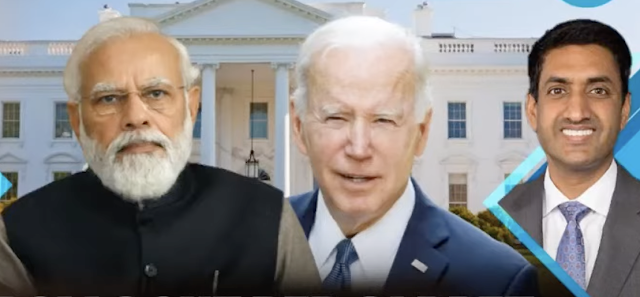 |
| L to R: Narendra Modi, JOe Biden, Ro Khanna |
What caused this change of heart? Is it the donation of $110,000 to his campaign by Hindu Nationalist donors in the United States, as reported by The Nation? Fellow Indian-American Congresswoman Pramila Jayapal has also supported Modi's invitation. She will be among members of Congress who will escort Modi to the podium. Ro Khanna and Pramila Jayapal are both supposedly "liberal" Democrats.
While Khanna says that he “strongly opposes any form of caste discrimination”, he has not endorsed California SB 403, a bill sponsored by Senator Aisha Wahab and supported by Dalit activist Thenmozhi Soundararajan, that outlaws caste discrimination in the state.
Modi’s US visit comes at a time of rising state persecution of religious minorities, including Muslims and Christians. Modi's BJP-affiliated politicians have called for genocide against Indian Muslims, attacked mosques and churches, and demolished homes, according to The Nation. The Biden administration has been silent on these issues, choosing instead to try and strengthen the US-India relationship and deepen the ties between the countries’ military and technology sectors. For the last four years, the Biden Administration has ignored the USCIRF (US Commission on International Religious Freedom) recommendation to designate India as a “Country of Particular Concern” and impose strategic sanctions on Indian government officials and agencies involved in religious freedom violations.
On the eve of Prime Minister Modi's visit to Washington, the USCIRF has urged President Biden to discuss with him its concerns about the lack of religious freedom in India. “With India’s upcoming state visit, the Biden administration has a unique opportunity to explicitly incorporate religious freedom concerns into the two countries’ bilateral relationship,” said USCIRF Commissioner David Curry. “It is vital the U.S. government acknowledge the Indian government’s perpetration and toleration of particularly severe violations of religious freedom against its own population and urge the government to uphold its human rights obligations.”
Instead of condemning India for allowing the oppression of minorities and denying media freedom, US officials have applauded the Modi government. US Commerce Secretary Gina Raimondo has described Modi as “unbelievable, visionary” and “the most popular world leader.” Donald Lu, the assistant secretary of state for South and Central Asia, has praised press freedom in India: “You have India as a democracy in part because you have a free press that really works.” This is in sharp contrast with the findings of the media watchdog Reporters Without Borders 2023 World Press Freedom Index, which has ranked India 161, out of 180 countries due to its crackdown on the press. India's neighbor Pakistan ranks 150, 11 places above India, on this Index.
Khanna's recent about-face is seen as a betrayal by many of his constituents who supported him because of his rejection of Hindutva. South Asian social justice activists Anu Mandavilli, Deepa Iyer, Karthikeyan Shanmughan and others have strongly criticized Khanna.
Related Links:
Haq's Musings
South Asia Investor Review
Pakistan's Bilawal Bhutto Lashes Out at India's Jaishankar
Ro Khanna Rejects Hindutva
India-Pakistan Nuclear Arms Race
Kashmir: 700,000 Indian Soldiers vs 7 Million Kashmiris
US Brackets India's Modi With Murderous Dictators Aristide, Kabila, Mugabe and MBS
Hateful Hindutva Ideology Infects Indian Hindu Diaspora
Caste Discrimination Rampant Among Silicon Valley Indians
Total, Extended Lockdown in Indian Occupied Kashmir
What is India Hiding From the UN Human Rights Team?
Indian JNU Professor on Illegal Indian Occupation of Kashmir, Manipur, Nagaland
Riaz Haq Youtube Channel
Riaz Haq's YouTube Channel
Riaz Haq
Dr. Audrey Truschke
@AudreyTruschke
Read for thinking about Hindu nationalist influences in US politics and how some “progressives” are quite the opposite, to the point of pushing far-right interests.
https://twitter.com/AudreyTruschke/status/1682504282908643329?s=20
----------
The Indian American congressman says he has a duty to reject Hindu nationalism. But does his record stand up to scrutiny?
https://www.middleeasteye.net/big-story/us-india-khanna-silicon-val...
When India was subject to intense international scrutiny following Narendra Modi's decision to annex Indian-controlled Kashmir in late August 2019, an article in The Caravan, India's premier long-form magazine, began doing the rounds on social media.
The long read, written by activist Peter Friedrich, detailed the role of the Hindu nationalist lobby in American politics, and focused on then-Congresswoman Tulsi Gabbard from Hawaii.
Friedrich forensically outlined how the Hindu right-wing paramilitary organisation, the Rashtriya Swayamsevak Sangh (RSS), had funded Gabbard in exchange for helping rehabilitate Modi's image in the United States.
But it wasn't just the article that caught the attention of South Asian Americans.
Instead, it was the unprompted interjection by an Indian American lawmaker from California.
"Important article," tweeted Congressman Ro Khanna from the 17th district in California, widely known as Silicon Valley, the only district in continental America with an Asian majority.
"It's the duty of every American politician of Hindu faith to stand for pluralism, reject Hindutva, and speak for equal rights for Hindus, Muslims, Sikhs, Buddhists and Christians. That is the vision of India my grandfather Amarnath Vidyalankar fought for," the Congressman added.
Vidyalankar was an Indian activist who became a member of the Indian National Congress and later an MP in post-independent India.
Until then, the question of rising Hindu nationalism in India under Modi was mostly limited to segments of the Indian-American community, particularly Muslims, Dalits and Christians, as well as the Kashmiri diaspora.
But in a single tweet, the pro-union Khanna, known for pushing for stronger gun legislation and a key voice, along with Senator Bernie Sanders, in pushing for an end to US support for the Saudi-led war in Yemen, had taken the spectre of the role of Hindu nationalism in US politics to the very seat of the US government.
Amar Shergill, an executive board member of the California Democratic Party (CDP) and chair of the CDP Progressive Caucus, described the moment as a "political shift" in the South Asian American community.
"It reverberated from its origin in the progressive wing of the Democratic Party with implications for the United States, India and world geopolitics," Shergill wrote.
Predictably, Khanna endured a blitz of criticism from Hindu nationalist groups and individuals. More than 200 Indian American organisations would go on to register complaints against him, forcing him to hold a town hall to address the allegations.
Khanna was even asked to resign from the Congressional Pakistan Caucus.
At the time Khanna stood firm. He called his detractors fringe elements and Trump supporters.
"I have no tolerance for right-wing nationalists who are affiliating with Trump. And let me tell you something - they're in an echo chamber, but their bigotry, their right-wing nationalism, their support for Trump or for white supremacy is a minority," Khanna said.
"But they will see that our district is pluralistic and I have no problem standing up against them," he added.
Jul 21, 2023
Riaz Haq
The Indian American congressman says he has a duty to reject Hindu nationalism. But does his record stand up to scrutiny?
https://www.middleeasteye.net/big-story/us-india-khanna-silicon-val...
Four years later, activists and observers say, Khanna appears to have adopted a more realist approach to the rise of Hindu nationalism.
When it became known that Modi would be travelling on his first state visit to the US in June, Khanna in his capacity as co-chair of the India Caucus, wrote a bipartisan letter calling for Modi to address a joint seating of Congress.
Ahead of the visit, activists and observers warned that Khanna's invitation was as good as an endorsement of Hindu nationalist policies.
Shergill, chair of the CDP Progressive Caucus, told Middle East Eye that although he understood the need for the US to strengthen ties with India, it was a mistake to have honoured Modi with a state dinner and an address to Congress.
"The India Caucus, the Sikh Caucus, and all South Asian congressional representatives have a special duty to hold Modi and the Bharatiya Janata Party (BJP) accountable," he said.
"Representative Khanna must do better," Shergill added.
Activists pointed out that during the four years where Khanna had pointedly rejected Hindu nationalism, the Hindu nationalist project had reached the higher echelons of the Indian state, in which it had become routine for right-wing Hindu monks to call for ethnic cleansing without consequence.
Several indicators, too, showed freedom of speech, along with religious and minority rights, were now in free fall. Indian democracy is now characterised as "flawed," according to the Economist Intelligence Unit's Democracy Indiex, and in its latest World Press Freedom Index, Reporters Without Borders has ranked India 161 out of 180 countries due to media suppression.
In response to the volley of criticism for his now purported endorsement of Modi, Khanna found himself repeating one of the central tenets of his approach to foreign policy: respecting and engaging a democratic elected leadership did not preclude speaking out on human rights.
"I believe that the prime minister is an elected leader of 1.4 billion people and the way to make progress on human rights is to engage with the Indian PM," Khanna told Democracy Now.
But it is an approach that has left activists facing up to Hindu nationalism perplexed.
American interests
Since joining Congress in 2016, Khanna has straddled a fine line between satisfying Silicon Valley entrepreneurs and the employees who work for them.
Not only has this allowed Khanna to position himself as a "progressive" politician, he has skillfully backed himself as an almost indispensible interlocutor between the tech giants and their needs in Washington.
Khanna describes himself as "a leading progressive voice in the House working to restore American manufacturing and technology leadership, improve the lives of working people, and advance US leadership on climate, human rights, and diplomacy around the world."
As a “progressive capitalist”, Khanna proselytises the benefits of democratising access to technology as a means to resurrect the innovative character of the American economy.
He also sees it as the United States' best chance to remain a world leader. As his bio reads: "Silicon Valley's CA-17. New economic patriotism & restoring American manufacturing. Pro working families. Ending endless wars. No PAC $. He/Him."
In an op-ed in 2018, he wrote about his journey from a small town in Bucks County, Pennsylvania, to congressman of the "most economically powerful congressional district in the world".
Jul 21, 2023
Riaz Haq
After Rejecting Hindutva, Ro Khanna Cosponsors a Resolution Shielding It
The grandson of a man jailed beside Gandhi for India’s freedom is now lending his name to the movement that sat that fight out — an open letter, drawn from years of his own messages to me.
PIETER FRIEDRICH
https://pieterfriedrich.substack.com/p/after-rejecting-hindutva-ro-...
On June 1, 2026, Ro Khanna put his name on House Resolution 69, which condemns “Hinduphobia” without ever defining it — a word that shields India’s Hindu nationalist movement by recasting criticism of it as bigotry. In 2019, the same congressman publicly rejected that movement, Hindutva. For years his private messages with me showed how clearly he understood the danger. Now he’s advancing its agenda. On June 17, 2026, I delivered an open letter to him — drawn entirely from his own record — questioning his current stance, asking: "Ro, what are you so afraid of?" Read the letter here:
https://youtu.be/dAvHNCjmvLM?is=KsZ88m3GoGF6TJyk
on Thursday