PakAlumni Worldwide: The Global Social Network
Has Silicon Valley Congressman Ro Khanna Abandoned His Principled Stand Against Hindutva?
Silicon Valley Congressman Ro Khanna has been instrumental in inviting Indian Prime Minister Narendra Modi to address the joint session of US Congress on June 22, 2023. This came as a surprise to many of his constituents who voted for him after he declared in 2019: “It’s the duty of every American politician of Hindu faith to stand for pluralism, reject Hindutva, and speak for equal rights for Hindus, Muslims, Sikhs, Buddhist & Christians.”
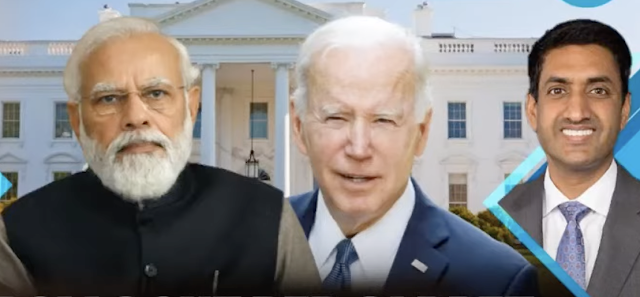 |
| L to R: Narendra Modi, JOe Biden, Ro Khanna |
What caused this change of heart? Is it the donation of $110,000 to his campaign by Hindu Nationalist donors in the United States, as reported by The Nation? Fellow Indian-American Congresswoman Pramila Jayapal has also supported Modi's invitation. She will be among members of Congress who will escort Modi to the podium. Ro Khanna and Pramila Jayapal are both supposedly "liberal" Democrats.
While Khanna says that he “strongly opposes any form of caste discrimination”, he has not endorsed California SB 403, a bill sponsored by Senator Aisha Wahab and supported by Dalit activist Thenmozhi Soundararajan, that outlaws caste discrimination in the state.
Modi’s US visit comes at a time of rising state persecution of religious minorities, including Muslims and Christians. Modi's BJP-affiliated politicians have called for genocide against Indian Muslims, attacked mosques and churches, and demolished homes, according to The Nation. The Biden administration has been silent on these issues, choosing instead to try and strengthen the US-India relationship and deepen the ties between the countries’ military and technology sectors. For the last four years, the Biden Administration has ignored the USCIRF (US Commission on International Religious Freedom) recommendation to designate India as a “Country of Particular Concern” and impose strategic sanctions on Indian government officials and agencies involved in religious freedom violations.
On the eve of Prime Minister Modi's visit to Washington, the USCIRF has urged President Biden to discuss with him its concerns about the lack of religious freedom in India. “With India’s upcoming state visit, the Biden administration has a unique opportunity to explicitly incorporate religious freedom concerns into the two countries’ bilateral relationship,” said USCIRF Commissioner David Curry. “It is vital the U.S. government acknowledge the Indian government’s perpetration and toleration of particularly severe violations of religious freedom against its own population and urge the government to uphold its human rights obligations.”
Instead of condemning India for allowing the oppression of minorities and denying media freedom, US officials have applauded the Modi government. US Commerce Secretary Gina Raimondo has described Modi as “unbelievable, visionary” and “the most popular world leader.” Donald Lu, the assistant secretary of state for South and Central Asia, has praised press freedom in India: “You have India as a democracy in part because you have a free press that really works.” This is in sharp contrast with the findings of the media watchdog Reporters Without Borders 2023 World Press Freedom Index, which has ranked India 161, out of 180 countries due to its crackdown on the press. India's neighbor Pakistan ranks 150, 11 places above India, on this Index.
Khanna's recent about-face is seen as a betrayal by many of his constituents who supported him because of his rejection of Hindutva. South Asian social justice activists Anu Mandavilli, Deepa Iyer, Karthikeyan Shanmughan and others have strongly criticized Khanna.
Related Links:
Haq's Musings
South Asia Investor Review
Pakistan's Bilawal Bhutto Lashes Out at India's Jaishankar
Ro Khanna Rejects Hindutva
India-Pakistan Nuclear Arms Race
Kashmir: 700,000 Indian Soldiers vs 7 Million Kashmiris
US Brackets India's Modi With Murderous Dictators Aristide, Kabila, Mugabe and MBS
Hateful Hindutva Ideology Infects Indian Hindu Diaspora
Caste Discrimination Rampant Among Silicon Valley Indians
Total, Extended Lockdown in Indian Occupied Kashmir
What is India Hiding From the UN Human Rights Team?
Indian JNU Professor on Illegal Indian Occupation of Kashmir, Manipur, Nagaland
Riaz Haq Youtube Channel
Riaz Haq's YouTube Channel
Riaz Haq
@pbhushan1
He should have stuck to Hindi. You can be a Viswaguru, yet refrain from showing off your English. Reading English from a teleprompter can also be difficult for an MA in 'Entire political science'
Ashok Swain
@ashoswai
This guy can’t even read from teleprompters but claims that he has a Master in Entire Political Science!
Jun 23, 2023
Riaz Haq
Satish Acharya
@satishacharya
We don't discriminate on the basis of religion-PM Modi in the US.
@moliticsindia
cartoon.
https://twitter.com/satishacharya/status/1672277338330140674?s=20
Jun 23, 2023
Riaz Haq
The Biden-Modi Meeting Was a Failure for Democracy | Time
https://time.com/6289932/the-biden-modi-meeting-was-a-failure-for-d...
by Knox Thames
Indian Prime Minister Narendra Modi received VIP treatment at both ends of Pennsylvania Avenue this week, including a state dinner with President Biden and an address to Congress. Modi’s red-carpet treatment was a significant endorsement of his governance, and one few world leaders have received. However, under Modi’s premiership, India has moved away from shared values and democratic norms, embracing Hindu nationalism and scapegoating religious minorities. While President Biden and Congressional leaders spoke about human rights and religious freedom, talk alone will not move Modi to change course.
Modi accomplished much during his brief time in Washington, at little cost to his political agenda. The Joint Statement from the United States and Indiacovers a laundry list of Indian priorities. While the document references human rights at the beginning, its 58 paragraphs overwhelmingly focus on technology and trade in ways hugely beneficial to India. Modi also scored a renewed pledge to permanently include India in a reformed United Nations Security Council and joint slap down of archrival Pakistan for terrorism.
But did Modi deserve this treatment? The U.S. secured little in hard security commitments from him or other items that could bolster democracy and human rights in the region. For instance, Modi has been lukewarm at best regarding support for Ukraine. During the White House press conference, Modi could only vaguely speak of ending the “dispute through dialogue and diplomacy.” There was no joint condemnation of Russian aggression, a low bar to meet.
In contrast, Modi’s visit vastly exceeded Prime Minister Rishi Sunak’s recent trip, who received neither coveted invitation of a state dinner or congressional speech, “special relationship” notwithstanding. In fact, when Modi took the rostrum before Congress on Thursday, it was his second address before a joint session, while the last British Prime Minister spoke in 2006.
But in the contest with Beijing, commitment to “shared values” was a constant refrain to justify Modi’s lavish treatment. Indeed, a democratic India would be a powerful partner in countering authoritarian China, but these values are under attack in India. Indian activists and political analysts I contacted all expressed deep concern about the state of affairs, most only agreeing to talk off the record. One highlighted, “Serious violations of human rights, especially of Muslims, Christians, and other minorities, and of human rights defenders and dissenters, have been increasing in India over the past years, some becoming widespread and systematic.” Another analyst described the defamation case against opposition leader Rahul Gandhi as “pure vendetta politics.” A third activist spoke of the ongoing “desecration, destruction and torching of over 300 Churches in Manipur [that] is unprecedented in the history of religious violence in India,” which continues in India’s far east.
Jun 25, 2023
Riaz Haq
The Biden-Modi Meeting Was a Failure for Democracy | Time
https://time.com/6289932/the-biden-modi-meeting-was-a-failure-for-d...
by Knox Thames
When a journalist asked Modi at the White House about declining respect for human rights and democracy, he dodged, saying, “I’m actually really surprised that people say so.” While Biden acknowledged our shortcomings, demonstrating humility but a commitment to civil rights, Modi offered no such concession, saying Indian democracy has delivered for all “regardless of caste, creed, religion, gender.” He added, “There’s absolutely no space for discrimination,” which would surprise religious minorities in India.
As the visit approached, many feared officials would overlook these issues, and 75 Democratic Members of Congress wrote Biden to urge him to raise human rights. To his credit, the President did so repeatedly, but always as a joint endeavor. For instance, he said, “Equity under the law, freedom of expression, religious pluralism, and diversity of our people—these core principles have endured and evolved, even as they have faced challenges throughout each of our nations’ histories, and will fuel our strength, depth, and future.” At another point, he noted, “Indians and Americans are both peoples who … cherish freedom and celebrate the democratic values of universal human rights, which face challenges around the world and each—and in each of our countries but which remain so vital to the success of each of our nations: press freedom, religious freedom, tolerance, diversity.”
While understandable Biden wouldn’t be too pointed with his guest, Modi is savvy enough to know that nods towards human rights will be shunted aside for commercial and military relations. He’s seen it before, as silence towards problems in India is not unique to this administration. Then-President Trump ignored riots against Muslims in New Delhi during his 2020 visit, and his administration resisted calls to designate India a “country of particular concern” for the persecution of Christians.
Consequently, to counter India’s drift away from shared values, the U.S. must decide to visibly support Indian civil society, publicly discuss our concerns, and establish consequences for abuses. Aakar Patel, Chair of Amnesty International’s India Board, stressed to me the importance of U.S. human rights advocacy. Amnesty’s India office was forced to close in 2020, and the Indian government tried to prevent him from traveling internationally in 2022. Patel underscored how “India’s friend must press it to do the right thing because often it works.” Jesuit Priest Cedric Prakash, a long-time human rights and peace activist, also agreed. Despite our complicated history in the region, Fr Prakash said, “it’s imperative that the U.S. raise these sensitive issues with the PM and stop pretending that all is well in India.”
India is too important for U.S. policymakers to ignore these trends, and Modi’s damaging policies should not lead to self-censorship. The U.S.’s recent criticism of important partners like Poland, Bangladesh, and Israeldemonstrates we can raise concerns and deepen relationships simultaneously. In addition, we can learn from our disastrous all-carrots-and-no-stick approach to China in the early 2000s. Many believed preferential trade could encourage China in a positive direction when the Senate voted for most-favored-nation status in September 2000. Instead, the Chinese Communist Party gained technology and resources while nose diving on human rights and consolidating power. Modi’s windfall of trade policies absent consequences for rights abuses risks repeating the same mistake.
Jun 25, 2023
Riaz Haq
Speaking at an event, (Bollywood Actor) Kajol said, “…Chnage especially in a country like India is slow. It’s very very slow because for one we are steeped in our tradition, steeped in our thought process and, of course, it has to be with tradition. You have political leaders who do not have educational system background. I’m sorry I’m going to go out and say that.”
https://www.jantakareporter.com/entertainment/kajol-issues-clarific...
She added, “We are being ruled by leaders, so many of them, who do not have that viewpoint which I think education gives you.”
Kajol’s comments evoked angry reactions from BJP supporters who felt that the popular actor was taking a potshot at Prime Minister Narendra Modi whose educational qualification has been a matter of intense scrutiny for many years. Delhi Chief Minister Arvind Kejriwal had recently accused him of being ‘uneducated’ while others raised questions on his alleged fake degree.
Modi and his administration have refused all attempts to make his degree public fearing that this could expose the Indian PM’s educational qualification.
BJP supporters launched brutal attack on Kajol for her comments. Many accused her being influenced by the thought process of Muslim actors particularly Shah Rukh Khan. The pair of Shah Rukh and Kajol ruled the box office in the late 90s and 2020s.
Facing backlash from BJP supporters, Kajol issued a clarification stating that she wasn’t pointing at anyone in particular. She wrote, “I was merely making a point about education and its importance. My intention was not to demean any political leaders, we have some great leaders who are guiding the country on the right path.”
Kajol, meanwhile, has found plenty of support from netizens, who wondered why her comments had irked only Modi supporters even though the actor did not name anyone.
Shiv Sena MP Priyanka Chaturvedi wrote, “So Kajol says we are governed by leaders who are uneducated and have no vision. Nobody outraging since its her opinion not necessarily a fact and also has named nobody but all Bhakts are outraged. Please don’t Yale your Entire Political Science knowledge.”
Comedian Kunal Kamra tweeted, “Everyone is pointing out that Actress Kajol hasn’t finished her education & I believe that’s the only reason that she feels an educated leadership can help our country.”
Jul 8, 2023