PakAlumni Worldwide: The Global Social Network
Pakistani-American Journalist Questions Modi About Treatment of Minorities in India
Wall Street Journal's White House Correspondent Sabrina Siddiqui, a Pakistani-American Muslim journalist, got to ask the only question posed by an American journalist to Indian Prime Minister Narendra Modi during his recent visit to the White House in Washington, DC. This was the first time in 14 years that Mr. Modi took an unscripted question from any journalist anywhere in the world. In fact, it was his first press conference since taking office as the prime minister of India in 2014.
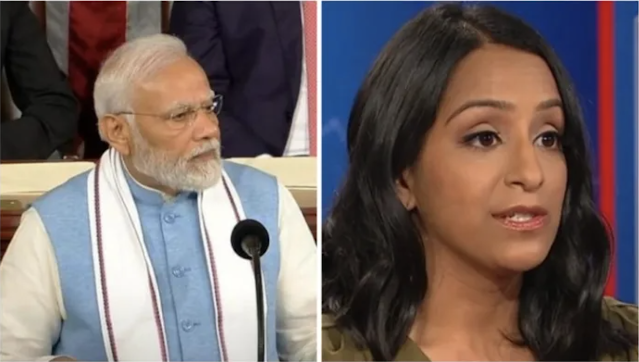 |
| Narendra Modi (Left), Sabrina Siddiqui (R) |
Sabrina Siddiqui asked the Indian leader about rights groups’ assessments that his government is discriminating against religious minority groups and quashing dissent. She asked," What steps are you and your government willing to take to improve the rights of Muslims and other minorities in your country and to uphold free speech?"
The Islmophobic Indian prime minister feigned “surprise” at the question and said democracy is core to India. He then went to lie in front of the whole world claiming that there's ”absolutely no space for discrimination” in India.
 |
| Cartoonist Mocks Modi's Answer at the White House. Source: Satish Acharya |
Modi’s mendacious answer is in sharp contrast to rising state persecution of religious minorities, including Muslims and Christians, in India. Modi's BJP-affiliated politicians have called for genocide against Indian Muslims, attacked mosques and churches, and demolished homes, according to The Nation. The Biden administration has remained silent on these issues, choosing instead to try and strengthen the US-India relationship and deepen the ties between the countries’ military and technology sectors, as a counterweight to rising China.
For the last four years, the Biden Administration has ignored the USCIRF (US Commission on International Religious Freedom) recommendation to designate India as a “Country of Particular Concern” and impose strategic sanctions on Indian government officials and agencies involved in religious freedom violations.
Cartoonist Satish Acharya exposed Modi's lie in a cartoon by referring to a statement he made during the protests against the BJP-sponsored discriminatory CAA (Citizenship Amendment Act) in 2019. "They (Muslims) can be identified by the clothes they are wearing," he said without elaborating.
Even though Modi did not know the exact question that would be posed to him at the press conference, he had a readymade answer regardless. Sabrina Siddiqui's question and Modi's answer illustrated how the BJP's lies are being shamelessly promoted and spread in India and elsewhere in the world. The Hindutva rulers of India are living a lie.
In a recent interview to CNN, former US President Barack Obama has pointed out the consequences of BJP's anti-Muslim policies. “If the (US) President meets with Prime Minister Modi, then the protection of the Muslim minority in a Hindu majority India is worth mentioning. If I had a conversation with Prime Minister Modi, who I know well, part of my argument would be that if you don't protect the rights of ethnic minorities in India, there is a strong possibility that India would at some point start pulling apart,” Obama had said.
“We have seen what happens when you start getting those kinds of large internal conflicts. So that would be contrary to the interests of not only the Muslim India but also the Hindu India. I think it is important to be able to talk about these things honestly,” said Mr. Obama.
Sabrina Siddiqui is one of many high-profile Pakistani-American journalists. Amna Nawaz is the co-anchor of the popular PBS NewsHour. Zohreen Adamjee Shah is a national correspondent for ABC News. Imtiaz Tyab is a foreign correspondent for CBS News. Asma Khalid covers the White House for National Public Radio. Wajahat Ali writes columns for New York Times and The Daily Beast.
Sabrina Siddiqui has an illustrious background. She is a great-great grand-daughter of Sir Syed Ahmad Khan, the founder of the Aligarh Muslim University (AMU) in India. She has come under vicious attacks by right-wing Hindu Nationalist trolls since Modi's press conference at the White House.
Related Links:
Haq's Musings
South Asia Investor Review
Silicon Valley Congressman Ro Khanna Abandons Anti-Hindutva Stance
China's Rise as a Global Power
India: The Epicenter of Islamophobia
Indian Hindu Nazis Join Forces With Western Neo-Nazis
US Brackets India's Modi With Murderous Dictators Aristide, Kabila, Mugabe and MBS
Hateful Hindutva Ideology Infects Indian Hindu Diaspora
Caste Discrimination Rampant Among Silicon Valley Indians
Total, Extended Lockdown in Indian Occupied Kashmir
What is India Hiding From the UN Human Rights Team?
Indian JNU Professor on Illegal Indian Occupation of Kashmir, Manipur, Nagaland
Riaz Haq Youtube Channel
Riaz Haq's YouTube Channel
Masood Ahmed Malik Bazmi
25-6-2023/6-12-1444-Sunday at 8:16am
Very useful important question asked the Pakistani Muslim Journalist Sabrina from Indian Prime Minister Narendra Modi. I have copied it & now going to publish it in my Facebook 2 accounts pages.
Jun 24, 2023
Akhtar Hussain
Salaam Riaz Sb,
America is creating a monster to oppose China, just like they created the Taliban to fight the Soviets. But China and America are dependent on each other economically. Modi comes to America and Blinkin goes to China. I believe the major concern is that India is funding the Russia - Ukraine war by buying oil from Russia, refining it, and selling it to Europe. I am sure Blinkin has requested China to stop buying Russian oil as well, but China is not reselling the oil. American sanctions on Iran and Libya force even Pakistan to import oil from Russia. America has moved away from the middle east but it has not rebuilt Iraq, Syria, Libya, or Yemen.
We have people from Afghanistan, Pakistan, Africa, Indian Punjab, Somalia, Kurdish Iraq, and others drowning in the Mediterranean Sea, as they try to escape to Europe to feed and clothe their families.
America, Britain, and France have a responsibility to rebuild these war-torn countries before they create another problem by arming India to counter China. Also, giving weapons and technology to the most populous country that is beating the drums of democracy, while killing the minorities is a recipe for disaster. As this will change the balance in the region.
America has a moral obligation to do right what it has done wrong. A man who was banned from traveling to America has been given the red carpet-treatment.
Has America finally realized that it cannot be the only superpower in the world ?
Jun 25, 2023
Riaz Haq
‘Love Jihad’: How India’s favourite conspiracy theory adds to the hatred against Muslims--- France 24 English
https://youtu.be/8aRt-oegojI
For years, Hindu nationalist groups have been spouting a conspiracy theory that claims Muslim communities in India are planning a takeover through “love jihad”. The theory goes that there’s an organised campaign for Muslim men to seduce Hindu women, force them to convert to Islam, and have children to enlarge the Muslim population of India. The conspiracy theory is deeply ingrained: there’s a non-stop flow of disinformation online, and Muslim men who dare talk to Hindu women often find themselves targets of real-life violence.
Using firsthand accounts from victims of love jihad accusations and an analysis of the flood of cartoons, fake stories, news articles and dramatised videos circulating online, the FRANCE 24 Observers team unravels the disinformation and propaganda associated with this divisive narrative.
#India #LoveJihad #Disinformation
Jun 25, 2023
Riaz Haq
The Biden-Modi Meeting Was a Failure for Democracy | Time
https://time.com/6289932/the-biden-modi-meeting-was-a-failure-for-d...
by Knox Thames
Indian Prime Minister Narendra Modi received VIP treatment at both ends of Pennsylvania Avenue this week, including a state dinner with President Biden and an address to Congress. Modi’s red-carpet treatment was a significant endorsement of his governance, and one few world leaders have received. However, under Modi’s premiership, India has moved away from shared values and democratic norms, embracing Hindu nationalism and scapegoating religious minorities. While President Biden and Congressional leaders spoke about human rights and religious freedom, talk alone will not move Modi to change course.
Modi accomplished much during his brief time in Washington, at little cost to his political agenda. The Joint Statement from the United States and Indiacovers a laundry list of Indian priorities. While the document references human rights at the beginning, its 58 paragraphs overwhelmingly focus on technology and trade in ways hugely beneficial to India. Modi also scored a renewed pledge to permanently include India in a reformed United Nations Security Council and joint slap down of archrival Pakistan for terrorism.
But did Modi deserve this treatment? The U.S. secured little in hard security commitments from him or other items that could bolster democracy and human rights in the region. For instance, Modi has been lukewarm at best regarding support for Ukraine. During the White House press conference, Modi could only vaguely speak of ending the “dispute through dialogue and diplomacy.” There was no joint condemnation of Russian aggression, a low bar to meet.
In contrast, Modi’s visit vastly exceeded Prime Minister Rishi Sunak’s recent trip, who received neither coveted invitation of a state dinner or congressional speech, “special relationship” notwithstanding. In fact, when Modi took the rostrum before Congress on Thursday, it was his second address before a joint session, while the last British Prime Minister spoke in 2006.
But in the contest with Beijing, commitment to “shared values” was a constant refrain to justify Modi’s lavish treatment. Indeed, a democratic India would be a powerful partner in countering authoritarian China, but these values are under attack in India. Indian activists and political analysts I contacted all expressed deep concern about the state of affairs, most only agreeing to talk off the record. One highlighted, “Serious violations of human rights, especially of Muslims, Christians, and other minorities, and of human rights defenders and dissenters, have been increasing in India over the past years, some becoming widespread and systematic.” Another analyst described the defamation case against opposition leader Rahul Gandhi as “pure vendetta politics.” A third activist spoke of the ongoing “desecration, destruction and torching of over 300 Churches in Manipur [that] is unprecedented in the history of religious violence in India,” which continues in India’s far east.
Jun 25, 2023
Riaz Haq
The Biden-Modi Meeting Was a Failure for Democracy | Time
https://time.com/6289932/the-biden-modi-meeting-was-a-failure-for-d...
by Knox Thames
When a journalist asked Modi at the White House about declining respect for human rights and democracy, he dodged, saying, “I’m actually really surprised that people say so.” While Biden acknowledged our shortcomings, demonstrating humility but a commitment to civil rights, Modi offered no such concession, saying Indian democracy has delivered for all “regardless of caste, creed, religion, gender.” He added, “There’s absolutely no space for discrimination,” which would surprise religious minorities in India.
As the visit approached, many feared officials would overlook these issues, and 75 Democratic Members of Congress wrote Biden to urge him to raise human rights. To his credit, the President did so repeatedly, but always as a joint endeavor. For instance, he said, “Equity under the law, freedom of expression, religious pluralism, and diversity of our people—these core principles have endured and evolved, even as they have faced challenges throughout each of our nations’ histories, and will fuel our strength, depth, and future.” At another point, he noted, “Indians and Americans are both peoples who … cherish freedom and celebrate the democratic values of universal human rights, which face challenges around the world and each—and in each of our countries but which remain so vital to the success of each of our nations: press freedom, religious freedom, tolerance, diversity.”
While understandable Biden wouldn’t be too pointed with his guest, Modi is savvy enough to know that nods towards human rights will be shunted aside for commercial and military relations. He’s seen it before, as silence towards problems in India is not unique to this administration. Then-President Trump ignored riots against Muslims in New Delhi during his 2020 visit, and his administration resisted calls to designate India a “country of particular concern” for the persecution of Christians.
Consequently, to counter India’s drift away from shared values, the U.S. must decide to visibly support Indian civil society, publicly discuss our concerns, and establish consequences for abuses. Aakar Patel, Chair of Amnesty International’s India Board, stressed to me the importance of U.S. human rights advocacy. Amnesty’s India office was forced to close in 2020, and the Indian government tried to prevent him from traveling internationally in 2022. Patel underscored how “India’s friend must press it to do the right thing because often it works.” Jesuit Priest Cedric Prakash, a long-time human rights and peace activist, also agreed. Despite our complicated history in the region, Fr Prakash said, “it’s imperative that the U.S. raise these sensitive issues with the PM and stop pretending that all is well in India.”
India is too important for U.S. policymakers to ignore these trends, and Modi’s damaging policies should not lead to self-censorship. The U.S.’s recent criticism of important partners like Poland, Bangladesh, and Israeldemonstrates we can raise concerns and deepen relationships simultaneously. In addition, we can learn from our disastrous all-carrots-and-no-stick approach to China in the early 2000s. Many believed preferential trade could encourage China in a positive direction when the Senate voted for most-favored-nation status in September 2000. Instead, the Chinese Communist Party gained technology and resources while nose diving on human rights and consolidating power. Modi’s windfall of trade policies absent consequences for rights abuses risks repeating the same mistake.
Jun 25, 2023