PakAlumni Worldwide: The Global Social Network
The Great Indian Brain Drain Accelerates
India is losing its best and brightest to the West, particularly to the United States, at an increasingly rapid pace. A 2023 study of the 1,000 top scorers in the 2010 entrance exams to the Indian Institutes of Technology (IIT) — a network of prestigious institutions of higher learning based in 23 Indian cities — revealed the scale of the problem. Around 36% migrated abroad, and of the top 100 scorers, 62% left the country, according to a report in the science journal Nature. Nearly two-thirds of those leaving India are highly educated, having received academic or vocational training. This is the highest for any country, according to the Organization for Economic Co-operation and Development.
 |
| Example of The Great Indian Brain Drain. Source: Boston Political Review |
Brain drain is defined as the loss of precious human capital of a nation. It is a “consequence of an education system designed for ‘selecting’ the best and brightest in an economy that is still too controlled and cannot create opportunities for its best and brightest”, according to Indian economist Shruti Rajagopalan. High-profile examples of India's human capital loss include Satya Nadella (Microsoft), Sundar Pichai (Google), Shantanu Narayen (Adobe), Arvind Krishna (IBM) and Ajay Banga (World Bank).
 |
| Foreign-Born STEM Workers in America. Source: American Immigration Council |
Growing number of Indian students are going abroad for higher education each year and 90% of them never return home after completing their studies. In 2022, the number of Indian students leaving the country for higher education reached a six-year high of 770,000. And a 2021 report estimated that around two million Indian students would be studying abroad by 2024.
Many developing countries are experiencing brain drain. But India is losing its best brightest at a much faster rate than others. Some call it "The Great Indian Brain Drain". This is the reason why Indians in the United States are the best educated and the highest earning group. In a recently published book titled "The Other One Percent", authors Sanjoy Chakravorty, Devesh Kapur and Nirvikar Singh explain this phenomenon.
They write that the vast majority of Indians who migrate to the United States are from privileged backgrounds in terms of caste, class and education. They have gone through “a triple selection” process that gave Indian-Americans a boost over typically poor and uneducated immigrants who come to the United States from other countries. The first two selections took place in India. As explained in the book: “The social system created a small pool of persons to receive higher education, who were urban, educated, and from high/dominant castes.” India’s examination system then selected individuals for specialized training in technical fields that also happened to be in demand in the United States. Kapur estimated that the India-American population is nine times more educated than individuals in the home country. Here's an excerpt of it:
"A major focus of this book is on demonstrating and understanding the multiple selections that shaped the Indian-American population. These selections applied not only to education (that, in terms of attaining college degrees, made the India-born population three times more educated than that in the host country and nine times more educated than the home country’s population) but also to class and caste (favoring, by large margins, the “upper” and dominant classes and castes of India), profession (engineering, IT, and health care), and both the region of origin (Gujarati and Punjabi were overrepresented in the first two phases, and Telugu and Tamil in the third phase) and region of settlement (in specific metropolitan clusters in and around New York City, the San Francisco Bay Area, Chicago, Washington, D.C., and Houston and Dallas). In addition to direct selection is what we call the “selection+” advantage: we suggest that group characteristics or norms, such as the fact that Indians had the highest propensity to live in married-couple households of any major immigrant group, added to the advantages of being an already selected group. We show, in particular, how family norms were useful in keeping the Indian-American poverty level low (under 5 percent) and family income high (the highest in the United States). It is also likely that the selection process enabled, without explicitly intending to, the generation of high levels of social capital (through linguistic/ professional networks such as Gujarati entrepreneurs in the hotel industry, Telugu and Tamil workers in the IT industry, IIT engineers, Malayali nurses, Bengali academics, etc.)"
 |
|
|
Asian Americans are the best educated among all Americans of various races and ethnicities, including whites. Within Asian Americans, the Indians (three quarters) have the highest educational attainment with at least a bachelor's degree, followed by Koreans and Pakistanis (about 60% each).
 |
| Asian American Educational Achievement by Countries of Origin. Source: US Census |
Asians, including Chinese/Taiwanese, Indians and Pakistanis, tend to be concentrated in STEM (Science, Technology, Engineering and Technology) fields where incomes are generally much higher than in other occupations.
As of 2019, there were 35,000 Pakistan-born STEM workers in the United States, according to the American Immigration Council. They included information technologists, software developers, engineers and scientists. These figures do not include medical doctors and healthcare workers.
Foreign-born workers make up a growing share of America's STEM workforce. As of 2019, foreign-born workers made up almost a quarter of all STEM workers in the country. This is a significant increase from 2000, when just 16.4% of the country’s STEM workforce was foreign-born. Between 2000 and 2019, the overall number of STEM workers in the United States increased by 44.5 percent, from 7.5 million to more than 10.8 million, according to American Immigration Council.
 |
| India and Pakistan Among Top 10 Countries Receiving US Immigrant Visas. Source: Visual Capitalist |
India topped the top 10 list of foreign-born STEM workers with 721,000, followed by China (273,000), Mexico (119,000), Vietnam (100,000), Philippines (87,000), South Korea (64,000), Canada (56,000), Taiwan (53,000), Russia (45,000) and Pakistan (35,000). Enormous number of Indian STEM workers in the United States can at least partly be attributed to the fact that India's "body shops" have mastered the art of gaming the US temporary work visa system. Last year, Indian nationals sponsored by "body shops" like Cognizant, Infosys and TCS received 166,384 H1B visas for work in the United States. By comparison, only 1,107 Pakistanis were granted H1B visas in Fiscal Year 2022. In addition to H1B work visas, 9,300 Indian nationals and 7,200 Pakistani nationals received immigrant visas to settle in the United States as permanent residents in 2021.
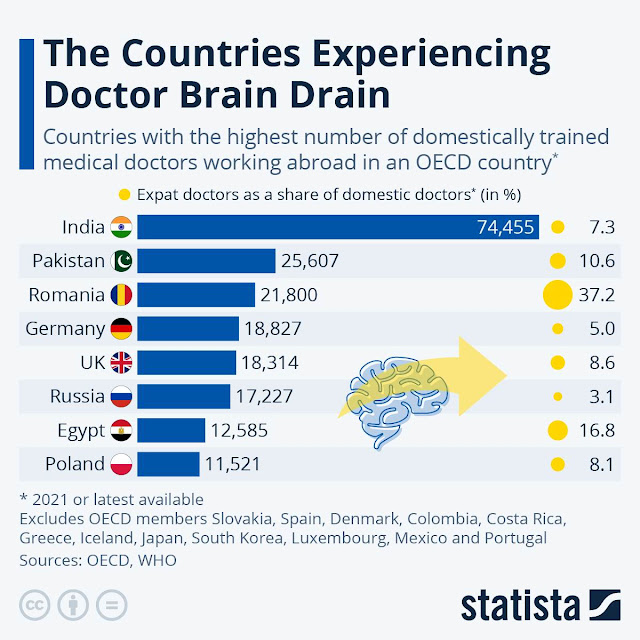
In addition to 35,000 Pakistan-born STEM workers, there were 12,454 Pakistan-born and Pakistan-trained medical doctors practicing in the United States, making the South Asian nation the second largest source of medical doctors in America. Pakistan produced 157,102 STEM graduates last year, putting it among the world's top dozen or so countries. About 43,000 of these graduates are in information technology (IT).
Related Links:
Google Names Indian-American CEO
Pakistani-Americans in Academia
Top One Percent: Are Hindus the New Jews in America?
Growing Share of Working Age Population in Pakistan
Pakistan Scientific Output is World's Fastest Growing
India's Chandrayaan 3 Success: Can Pakistanis Explore Space?
Digital Pakistan 2022
Pakistan's Large and Growing Civil Nuclear Program
Riaz Haq's Youtube Channel
Riaz Haq
The India shock: exporting workers to the world
Emigration has helped New Delhi manage its labour surplus, but the strategy has limits
https://www.ft.com/content/afb910e4-5425-4d3e-b0ef-c1d260f29945?syn...
India has its own version of the “China shock”. Instead of exporting high volumes of competitive manufacturing goods across the globe, the world’s most populous nation sends millions of workers abroad. India churns out roughly 5mn graduates each year and around 1mn people enter its workforce every month. But just as the Chinese economy lacks the demand to absorb more of its industrial production at home, India’s cannot produce enough suitable jobs to employ its expanding labour supply. Youth underemployment is rife, despite the country’s rapid growth rate.
As a result, many Indians, often well-educated and English-speaking, move abroad to pursue careers. The country is the world’s largest source of international migrants, with an estimated 18.5mn living abroad in 2024. The Anglosphere and United Arab Emirates are common destinations.
Indeed, over the past decade, Indian nationals have accounted for the vast majority of approved H-1B petitions, a US visa for global professionals in selected fields. In the UK, about 1mn Indian nationals arrived between 2021 and 2025. Meanwhile, last year Indians overtook the English for the first time to become Australia’s largest overseas-born group.
Under Prime Minister Narendra Modi, the country has positioned its large labour force — which includes the world’s second-biggest pool of science, technology, engineering and mathematics (Stem) graduates — as an answer to skills shortages and ageing demographics abroad. S Jaishankar, India’s foreign minister, recently said the country had signed labour-mobility pacts with 26 countries, with more in the pipeline. Such arrangements have been a central pillar of India’s bilateral trade negotiations. An overseas mobility bill also aims to help Indians access the “global workplace”. This strategy has several upsides for New Delhi. At around $150bn last year, 3 per cent of its GDP, the country is by far the largest recipient of remittance payments. Returnees and the overseas community are sources of foreign exchange, investment and knowhow for the country. This summer, domestic banks raised more than $50bn by encouraging the diaspora, the world’s largest, to shift savings to India as part of measures to shore up the rupee.
Crucially, as with China’s overproduction, overseas markets provide a release valve. The export of workers enables the Indian government to ease socio-economic strains at home, where frustration abounds over the lack of good job opportunities.
But there are drawbacks to the worker-export model. For example, one estimate suggests brain drain costs India between $35bn and $50bn per annum, owing in part to lost productivity growth. Many Indians end up settling abroad. And just as China is experiencing a worldwide backlash against its exports, India faces one as well. Scepticism about immigration continues to animate politics in the rich world. And the recent surge in arrivals from the subcontinent, who join historical waves of emigration, puts a growing spotlight on people of Indian origin abroad.
Relative to native-born citizens and other migrant populations, Indian-born migrants and people of Indian heritage tend to obtain higher levels of education and earnings. Their rising prominence in public life — as chief executives, politicians and heads of prestigious organisations — can drive animosity. And though Indian nationals often dominate high-skilled immigration routes, family members and less-skilled individuals have emigrated too, in some cases by abusing the rules. This all provides fuel for anti-immigrant narratives.
7 hours ago
Riaz Haq
The India shock: exporting workers to the world
Emigration has helped New Delhi manage its labour surplus, but the strategy has limits
https://www.ft.com/content/afb910e4-5425-4d3e-b0ef-c1d260f29945?syn...
Indeed, anti-Indian sentiment is on the rise. Just this month, the Republican nominee for a seat on Texas’s oil and gas regulator sparked allegations of racism for a social media post aimed at South Asian students. Last year, Indian-origin migrants were explicitly targeted in “March for Australia” rallies. Anti-South Asian slurs in online spaces in the US have also surged. The backlash could hinder the Modi government’s strategy. As it happens, US President Donald Trump has raised scrutiny of and fees for H-1B visas.
The “India shock” has implications for both sides. Rich economies need talented young workers. But a policy of immigration warrants robust administration, investment in housing and public services and initiatives to encourage integration and cohesion. Otherwise it won’t be sustainable. India, meanwhile, cannot rely on remittances and its diaspora alone. The worker-export model reflects a deeper challenge facing New Delhi, which must strive to create enough productive work to better harness the country’s demographic dividend. China lacks consumer confidence. India lacks jobs. Neither can export its way out of domestic problems.
7 hours ago
Riaz Haq
https://x.com/milanv/status/2104287928524419222?s=46&t=Uy6jyUH6...
2 hours ago