PakAlumni Worldwide: The Global Social Network
Pakistan EV Launches to Accelerate Clean Energy Transition
Pakistani automobile joint ventures with Chinese automakers BYD and Changan have recently launched several all-electric and plug-in hybrid models of automobiles in Pakistan. Earlier, Honda Atlas Cars Pakistan Limited announced plans to build a hybrid electric vehicles plant in the country. Other major brands like Toyota, Haval, and Hyundai are already offering similar models in the country. It all began with the 2019 electric vehicle policy approved by the government of Prime Minister Imran Khan to incentivize the electrification of the auto industry. Pakistan EV policy goal is to achieve 30% of new cars sales, 50% of new 2-wheeler and 3-wheeler sales and 30% of new truck sales by 2030. By 2040, the target is 90% of all new vehicle sales to be electric. The main incentive is the reduction of sales tax from 17% for internal combustion engine (ICE) vehicles to 1% for all-electric (EV) vehicles.
 |
| BYD EV. Source: CNBC |
 |
| Soaring Imports of Chinese Solar Panels in Pakistan. Source: Bloomberg |
Pakistan has contributed only 0.28% of the CO2 emissions but it is among the biggest victims of climate change. The US, Europe, India, China and Japan, the world's biggest polluters, must accept responsibility for the catastrophic floods in Pakistan and climate disasters elsewhere. A direct link of the disaster in Pakistan to climate change has been confirmed by a team of 26 scientists affiliated with World Weather Attribution, a research initiative that specializes in rapid studies of extreme events, according to the New York Times.
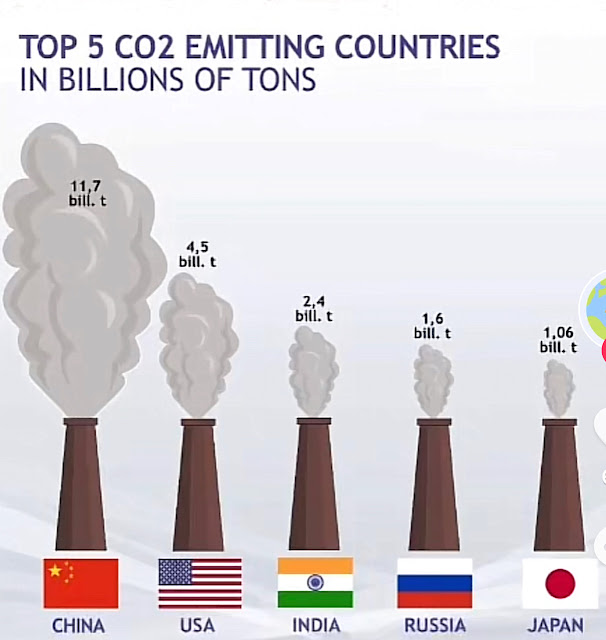 |
| Top 5 Current Polluters. Source: Our World in Data |
Currently, the biggest annual CO2 emitters are China, the US, India and Russia. Pakistan's annual CO2 emissions add up to just 235 million tons. On the other hand, China contributes 11.7 billion tons, the United States 4.5 billion tons, India 2.4 billion tons, Russia 1.6 billion tons and Japan 1.06 billion tons.
 |
| Pakistan's Annual CO2 Emission. Source: Our World in Data |
The United States has contributed 399 billion tons (25%) of CO2 emissions, the highest cumulative carbon emissions since the start of the Industrial Revolution in the late 18th century. The 28 countries of the European Union (EU28), including the United Kingdom, come in second with 353 billion tons of CO2 (22%), followed by China with 200 billion tons (12.7%).
Related Links:
Haq's Musings
South Asia Investor Review
Solar Power Boom in Pakistan
Pakistan Electric Vehicle Policy
Nuclear Power in Pakistan
Can Urban Forests Beat the Heat in Pakistani Cities
Pakistan's Response to Climate Change
IPP Contacts Bankrupting Pakistan
Renewable Energy for Pakistan
Net Metering in Pakistan
Pakistan's Digital Public Infrastructure Transforming Lives
My Family's Contribution to Climate Action
China-Pakistan Economic Corridor
Ownership of Appliances and Vehicles in Pakistan
CPEC Transforming Pakistan
Pakistan's $20 Billion Tourism Industry Boom
Riaz Haq's YouTube Channel
PakAlumni Social Network
Riaz Haq
Faseeh Mangi
@FaseehMangi
Signs are emerging that the latest conflict is hastening Pakistan’s transition to EVs
VLEKTRA Electric Motorcycles expects battery-powered two-wheelers to account for 10% to 15% of the market in 2026, up from less than 1% two years ago.
https://x.com/FaseehMangi/status/2037545212139188341?s=20
-----------------
Iran War Is Pushing Consumers to Break Up With Fossil Fuels
EVs, solar panels, induction stoves and heat pumps, now cheaper than ever, are becoming more attractive as the conflict upends oil and gas markets.
By Todd Woody
https://www.bloomberg.com/news/features/2026-03-26/war-oil-price-sh...
Just weeks ago, the US electric car market looked moribund. Amid plummeting EV sales, dealers were offering discounts as Detroit automakers scrapped electric lineups to make more gas-guzzling SUVs.
Then oil prices surged after the US and Israel attacked Iran.
Now, a used electric car showroom in San Francisco suggests the tide is turning again. As gasoline prices climb — hitting $6.81 a gallon at a nearby station on Wednesday — a flurry of drivers are making appointments to check out Ever’s lightly used EVs, many priced under $30,000.
“Gas prices are coming up in almost every customer conversation,” said Maximilian Quertermous, Ever’s co-founder and chief operating officer. “The momentum of the last few weeks is among the strongest we’ve seen.”
Ever is just one dealership, but signs of a shift are playing out across the world. In Southeast Asia, buyers are flocking to Chinese EV giant BYD Co.’s stores, while electric rickshaws are selling out in Pakistan. A shortage of cooking oil in India is driving a run on electric stoves. From Germany to Nigeria, interest in rooftop solar is surging. And in the UK, some homeowners are taking the plunge on expensive heat pumps.
---------
In neighboring Pakistan, solar took off after the Ukraine war. Now, signs are emerging that the latest conflict is hastening the nation’s transition to EVs after the price of gasoline jumped more than 20%.
Syed Raza Mohsin, founder of VLEKTRA Electric Motorcycles, said he expects battery-powered two-wheelers to account for 10% to 15% of the market in 2026, up from less than 1% two years ago. “Solar is a very good example of how private citizens themselves found a solution for high energy prices,” he said. “We are seeing similar trends in motorcycles.”
Electric rickshaw maker Tezmo Motors has already sold out its March inventory, according to founder Moez Naseer, and is expecting a “very huge surge of orders.” Naseer said two fleet operators have placed orders since the Iran war started. “We are so petrol reliant, so people are finally figuring it out that we cannot rely on this anymore,” he said.
In the Philippines, the government is stepping in to fill the gap. This week, a state-owned pension fund started offering loans of up to 500,000 pesos ($8,300) for home solar panels after President Ferdinand Marcos Jr. declared a national energy emergency due to the war.
Mar 28
Riaz Haq
https://www.arabnews.com/node/2643232/pakistan
KARACHI: Pakistan is in discussions with China’s CATL, the world’s largest electric vehicle battery manufacturer, over potential investment and cooperation in advanced battery technologies, Pakistan’s ambassador to Beijing said this week, as Islamabad pushes to attract industrial investment under the next phase of the China-Pakistan Economic Corridor (CPEC).
China remains Pakistan’s largest strategic and economic partner, with the two countries deepening cooperation through CPEC, the flagship Pakistan arm of China’s Belt and Road Initiative launched in 2015. The first phase of CPEC focused largely on power generation, roads and transport infrastructure, while the second phase has increasingly shifted toward industrial cooperation, technology transfer, manufacturing, agriculture and special economic zones.
Pakistan has recently intensified efforts to attract Chinese private-sector investment as it seeks to stabilize its economy under an IMF-backed reform program and position itself as a regional manufacturing and logistics hub.
“Pakistan and China have made significant progress in strengthening bilateral economic cooperation with more than 300 Memorandums of Understanding (MOUs) and over three dozen joint venture agreements signed during the last two years, carrying a cumulative value exceeding $13 billion,” Pakistan’s Ambassador to China Khalil Hashmi said during a meeting on Monday with a Chinese business delegation at the Karachi Chamber of Commerce and Industry.
Highlighting emerging opportunities in energy and technology, Hashmi said Pakistan was “currently engaged in active discussions with CATL,” which he described as one of the world’s largest battery manufacturers specializing in lithium-ion and increasingly sodium-based battery technologies.
“He said Pakistan is encouraging the company to establish cooperation and investment initiatives in the country, expressing optimism that concrete developments may emerge during the forthcoming visit of the Prime Minister to China,” according to a statement released by the Karachi Chamber.
Global demand for EV batteries and energy storage systems has surged in recent years as governments and industries transition toward cleaner energy and electric mobility. CATL, headquartered in China, is the world’s dominant EV battery producer and supplies major global automakers including Tesla, BMW, Volkswagen and Ford.
Pakistan has increasingly positioned itself as a potential destination for battery manufacturing and mineral processing investment, particularly as global attention shifts toward supply chains linked to electric vehicles, renewable energy and energy storage.
Hashmi said the global market was gradually moving from lithium-ion batteries toward sodium-based battery technologies and noted that Pakistan possessed “abundant raw materials required for such industries.”
“Pakistan aims to capitalize on the first-mover advantage in this evolving sector and is working steadily toward attracting investment in advanced battery manufacturing and new energy technologies,” the statement said, quoting the ambassador.
Hashmi also said Pakistan had established a mechanism to improve implementation of Chinese investment agreements, adding that nearly 30 percent of signed MoUs were now being converted into practical contracts and business ventures.
5 hours ago
Riaz Haq
Pakistan says China’s Dongjin Group to invest $15 million in battery plant in Faisalabad
https://www.arabnews.com/node/2643228/amp
Move expected to help Pakistan meet growing demand for batteries, driven by increasing number of electric vehicles, solar systems
Plant likely to create jobs, support allied industries, including electronics, automotive components, packaging, chemicals, says official
ISLAMABAD: Chinese company Dongjin Group recently announced its plan to invest $15 million in a dry battery facility in the eastern city of Faisalabad, state-run Associated Press of Pakistan (APP) reported on Monday.
Dongjin Group designs, manufactures and sells lead acid batteries and chargers used in UPS systems, telecom, medical equipment, electric vehicles, solar and wind power systems and others. The Chinese company recently announced its plan to invest $15 million in the facility, APP said, adding that it will be established in the Special Economic Zone near Faisalabad.
The investment agreement was signed with the Punjab Board of Investment and Trade (PBIT), the state-run media reported.
“Chinese company Dongjin Group’s plan to establish a dry battery manufacturing facility in Allama Iqbal Industrial City is expected to help Pakistan meet growing demand for batteries, driven by the expansion of electric vehicles and solar energy systems,” APP said.
Sharqui Ali Tipu, director of marketing at PBIT, said Dongjin Group decided to establish the plant after observing the increasing demand of batteries in Pakistan, particularly due to the growing use of electric vehicles and solar energy solutions in the country.
He said the project is expected to generate economic and industrial activity across multiple sectors, while facilitating the transfer of modern technology.
Tipu said the battery plant is likely to support allied industries, including electronics, automotive components, packaging, chemicals and engineering support services. He added that it would also create employment opportunities in Faisalabad and its surrounding areas.
“Under Pakistan’s Special Economic Zone incentive package, the company will be eligible for a 10-year income tax holiday and a one-time exemption from customs duties and taxes on the import of plant and machinery,” APP said.
Almas Hyder, former chairman of the Engineering Development Board, an apex government body under the Ministry of Industries & Production, noted that Pakistan is moving toward localizing lithium-ion battery manufacturing to strengthen energy security and reduce import dependence.
Hyder said batteries have become strategically important globally due to their growing demand linked to renewable energy, electric vehicles and grid stability.
“The greater the battery production in Pakistan, the higher the chances of reducing dependence on expensive electricity and imported fossil fuels,” Hyder was quoted as saying by the APP.
4 hours ago