PakAlumni Worldwide: The Global Social Network
BAPS in France: Modi's Hindu Supremacy Boasts Come Under Scrutiny
"When you claim that your civilization is superior, is older, is the mother of democracy, is the mother of science....you antagonize others". Christophe Jaffrelot, French Political Scientist, speaking to Indian journalist Karan Thapar after expressions of outrage against BAPS Hindu leader’s recent visit to Eiffel Tower.
In an article published by Carnegie Endowment, Jaffrelot explained that "the majoritarian inferiority complex is to some extent irrational—in India like elsewhere. The Hindu complex of inferiority vis-à-vis others (including the Muslims) crystallized in the 19th century when the British not only emphasized the division of Hindus along caste lines and sectarian lines but also invented communal stereotypes". He has noted that Indian Prime Minister Narendra Modi has close ties to BAPS which is building massive temples around the world. Many of these temples have been inaugurated by Mr. Modi.
 |
| BAPS Guru’s Photo at Eiffel Tower, Paris, France |
There has been a powerful backlash against Indian Hindu groups in the West after BAPS, an Indian Hindu religious group, demanded that women be kept out of sight during the Eiffel Tower visit by their leader. Arnaud Bertrand, a French Journalist, expressed the outrage shared by many in the West in an X post, excerpted below:
"Long story short, they just opened a new mega-temple in France - specifically in Bussy-Saint-Georges (30km away from Paris) - presented as "the biggest Hindu temple built in continental Europe in a traditional style". Their guru was there for the inauguration and, as you do, wanted to visit the Eiffel Tower while in France. But, thing is, his doctrine dictates that women must not be in his presence. And here is where it gets unreal: when his entourage requested a private visit, the Eiffel Tower's management actually agreed to the terms and ordered all female employees - including subcontractors - to hide. This was on Saturday and, France being France (in a good way), on Monday the women who'd been told to make themselves invisible made themselves very, very visible: the staff went on strike and shut down the Eiffel Tower. So there you have it, unreal but true: the Eiffel Tower, symbol of the French Republic, is closed because a 93-year-old Hindu guru refuses to be in the presence of women".
Another top Hindu Indian leader Mohan Bhagwat, the chief of Hindu Nationalist organization Rashtriya Swayamsevak Sangh (RSS), has also been in the news recently. He visited New York as part of his organization's outreach in the West. During his August, 2026 North America tour, Bhagwat faced major accusations of duplicity and deception. Bhagwat delivered the keynote address at the "One World, One Humanity" interfaith event in New York City on August 29, 2026, as part of his multi-nation tour across the United States, Canada, and the United Kingdom. Various US faith leaders invited to meet him said they were misled into attending an RSS-affiliated event in New York. Critics called his speech at Madison Square Garden (MSG) in New York hypocritical and a public relations strategy that contrasts sharply with the divisive politics and violence linked to Hindu nationalist groups in India. The RSS is considered the ideological parent organization of India's ruling BJP party.
Multiple polls indicate that the Indian diaspora supports Prime Minister Modi and the RSS/BJP ideology. Hateful Hindutva ideology is spreading rapidly among the Indian diaspora. Individuals and organizations connected to the RSS (Rashtriya Swayamsevak Sangh) are actively working to promote India's divisive Islamophobic politics among the Non Resident Indians (NRIs) and their children. Hundreds of the RSS shakhas (branches) are now found in at least 39 countries around the world. Hindutva is a Hindu supremacist ideology inspired by 20th century Fascism and Nazism in Europe; it is very different from the ancient Hindu faith, according to American history professor Audrey Truschke who teaches Indian history at Rutgers University in the US state of New Jersey. Top Indian economists have raised alarm about it.
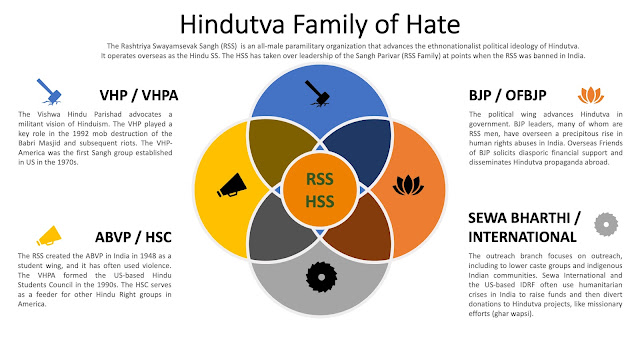 |
| Global Hindutva Sangh Parivar. Source: Audrey Truschke |
False narrative of victimhood underlies Hindutva ideology. Indian historian Aditya Mukherjee characterizes the Hindutva victimhood as follows: “The great achievements of the past are then contrasted with a false sense of victimhood, the concept of a great threat the majority is supposedly facing from the minority. This is how fascism works, globally". "Hindutva was never meant to be understood as bounded by national borders; his (Savarkar's) ambition was always planetary", writes Vinayak Chaturvedi, author of "Hindutva and Violence". "He (Savarkar) gained notoriety for his programme to “Hinduise Politics and Militarise Hindudom” while also arguing for permanent war against Christians and Muslims", Chaturvedi adds.
Prime Minister Modi's Hindutva rhetoric has influenced the behavior of the Indian diaspora in the US, UK and elsewhere. It has hurt India's international image. In the United States, 45% of adults view India favorably while 50% view it unfavorably, according to the Pew Research Center Spring 2026 Global Attitudes Survey. The arrogance of the Indian diaspora was highlighted in 2024 when Vivek Ramaswamy, then a candidate for the Republican Party's presidential nomination, said Americans don't have a good enough work ethic as American culture "venerated mediocrity over excellence." He offered it as a key justification to bring in more Indians to work in the United States. The backlash in the United States was immediate and strong. The essence of the response to the Hindu supremacist criticism of the US culture went like this: People from India, a "shit-hole" country, are jealous of America. Earlier, Professor Amy Wax of University of Pennsylvania, told Tucker Carlsen that “the role of envy and shame in the way the third world [sic] regards the first world […] creates ingratitude of the most monstrous kind.” She also said that ‘Brahmin women’ of India are taught that they are better than everybody.
Many liberal Indian intellectuals dismiss what is happening in India today under Hindu Nationalist Prime Minister Narendra Modi's leadership as a temporary aberration, not the norm. They long for a return to "Indian liberalism" which according to anthropologist Sanjay Srivastava "did not exist". Others, such as Indian anthropologist Sanjay Srivastava, sum up the current situation as follows:
"Our parents practiced bigotry of a quiet sort, one that did not require the loud proclamations that are the norm now. Muslims and the lower castes knew their place and the structures of social and economic authority were not under threat. This does not necessarily translate into a tolerant generation. Rather, it was a generation whose attitudes towards religion and caste was never really tested. The loud bigotry of our times is no great break from the past in terms of a dramatic change in attitudes – is it really possible that such changes can take place in such few years? Rather, it is the crumbling of the veneer of tolerance against those who once knew their place but no longer wish to accept that position. The great problem with all this is that we continue to believe that what is happening today is simply an aberration and that we will, when the nightmare is over, return to the Utopia that was once ours. However, it isn’t possible to return to the past that was never there. It will only lead to an even darker future. And, filial affection is no antidote for it".
In 2022, Dr Saiba Varma, Associate Professor of Anthropology at University of California in San Diego (UCSD), came under fire for hiding her familial ties to to a top RAW official while working on her book "The Occupied Clinic: Militarism and Care in Kashmir". “As an upper-caste and upper-class Indian citizen and subject, I have actively and passively internalized anti-Muslim racism my entire life. I am complicit in the colonization of Kashmir and other regions forcibly incorporated into the Indian nation-state", she acknowledges in her book released in 2021.
In summary, what the world witnessing is a divide among the Indian elite over how India's identity should be projected abroad: whether its global prestige is best served by asserting its unique majoritarian civilizational heritage, or by reinforcing the pluralistic, secular democratic standards valued by international liberal institutions.
Silicon Valley's Indian-American Congressman Rejects Hindutva
Silicon Valley Hindu Americans Rally in Support of Yogi, Modi
Rape of 8-year-old Asifa Bano in Kashmir
Vast Majority of Hindu Americans Support Modi
Modi's Extended Lockdown in Indian Occupied Kashmir
Hinduization of India
Has BJP's Politics Hurt India's International Image?
Indian Textbooks
India's RAW's Successes in Pakistan
Riaz Haq Youtube Channel
PakAlumni Social Network
Riaz Haq
Cheap data is great for Indians but not for India’s reputation
The internet brings out the worst in everyone
https://www.economist.com/asia/2026/11/01/cheap-data-is-great-for-i...
“Bitch lasagna” is the name of a song by PewDiePie. It is also a two-word social history of the relationship between India and the internet. For five years Mr Pie, a Swede whose real name is irrelevant, was the owner-operator of YouTube’s most popular channel. In early 2019, after several months of back-and-forth, he was decisively overtaken by T-Series, a Bollywood studio.
In the run-up to his defeat the Swedish streamer posted what his fans described as a “diss”, or insult, track and what anyone else would consider to be bordering on bigotry. Its lyrics include references to open defecation, ridicule of Indian languages and a meme about “bobs or vegana” (don’t ask). The song’s title alludes to a Facebook Messenger screenshot of an Indian man requesting unclothed self-portraits from a woman and, on being ignored, hurling the presumably auto-corrected epithet at her. The internet really does bring out the worst in everyone.
Nov 2
Riaz Haq
Nov 3
Riaz Haq
American far-right political commentator and livestreamer Nicholas Joseph Fuentes has sparked widespread attention on social media after making a series of racist and derogatory remarks targeting Indian immigrants in the United States. A video circulating on X shows Fuentes questioning the presence of Indians in American workplaces, universities and communities while criticising their food, religious beliefs and cultural practices.
In the viral clip, Fuentes accused Indian immigrants of making Americans uncomfortable by bringing their customs, traditions and religious practices into the country. He also suggested that Indians who disliked the treatment they received in the US should return to India.
His comments have reignited discussions about racism, immigration and the growing presence of Indian professionals in the American workforce.
Here are five major points explaining the controversy.
1. Fuentes makes derogatory remarks about Indian culture
During his livestream, Fuentes used offensive language to describe Indian food, spices, religious beliefs and cultural traditions. He claimed that Indian immigrants were making Americans uncomfortable and criticised what he described as their growing presence in American society.
He also questioned why Indian immigrants objected to negative attitudes towards them, arguing that they could simply return to their home country.
2. Questions Indian immigrants' right to live and work in America
Fuentes went beyond criticising cultural differences and questioned whether Indian immigrants had a legitimate claim to opportunities in the United States.
He argued that Indians should not expect access to American jobs, universities and financial opportunities, repeatedly suggesting that they did not belong in the country.
His remarks included racial slurs and language widely criticised as discriminatory towards Indian communities.
3. Claims American institutions belong to previous generations
Another major part of Fuentes' argument focused on the history of American universities and technology companies.
He claimed that previous generations of white Americans had built the country's leading educational institutions and helped establish its corporate and technological industries.
He also referred to taxpayer-funded government research and development, arguing that American-born citizens should receive greater access to the opportunities created through these investments.
4. Raises questions about jobs, immigration and economic opportunities
Fuentes also criticised wealthy corporate leaders and influential Americans, questioning whether they were doing enough for people born in the United States.
He argued that citizens should be treated as the rightful beneficiaries of the country's economic and educational institutions.
His comments come amid ongoing political debates over immigration, employment competition and access to higher education. Indian nationals represent a significant section of America's skilled technology workforce and are among the major beneficiaries of employment-based immigration programmes, including the H-1B visa system.
5. Viral video puts Indian immigrants at the centre of a wider debate
The video has attracted attention because it directly targets Indian immigrants and questions their place in American society.
Fuentes is known for his far-right nationalist positions and controversial commentary on race, religion and immigration.
His latest remarks have once again brought the issue of anti-Indian racism into the spotlight, particularly as Indian professionals continue to play an important role in America's technology and business sectors.
The controversy highlights the continuing debate over immigration, cultural diversity and equal opportunities in the United States, while raising concerns about the growing visibility of racist rhetoric directed at immigrant communities.
#NicholasFuentes #IndianImmigrants #USImmigration #BusinessNews100
https://www.facebook.com/photo.php?fbid=122226627788530462&set=...
on Friday