PakAlumni Worldwide: The Global Social Network
Rising Incomes in Agriculture Sector Boost Pakistan's Rural Economy
Since taking the reins of power almost three years ago, the coalition government in Islamabad, which is led by the Pakistan Peoples' Party, has been increasing the support prices of wheat and other agricultural commodities every year. This policy has had the following effects:
1. It is transfering the additional new income of about Rs. 300 billion in the current fiscal year alone to the ruling party's power base of landowners in small towns and villages, from those working in the urban industrial and service sectors.
2. It has driven up food prices dramatically for all Pakistanis, particularly hurting the poor people the most.
3. It has reduced government tax revenues because the agricultural income is not taxed by either the federal or the provincial governments, and resulted in growing budget deficits.
4. It has significantly increased demand for consumer and industrial goods and services in the rural areas.
5. It has forced the State Bank of Pakistan to maintain a tight monetray policy which is drying up the much-needed credit for the industries and the average consumers alike.
In 2008, the government pushed the procurement price of wheat up from Rs. 625 per 40 kg to Rs. 950 per 40 kg. This action immediately triggered inflationary pressures that have continued to persist as food accounts for just over 40% of Pakistan's consumer price index. According to State Bank of Pakistan (SBP) analysis, cumulative price of wheat surged by 120 per cent since 2008, far higher than the 40 per cent between 2003 and 2007. it is also many times greater than the international market price increase of 22 per cent for wheat in the same period. Similarly, sugar prices have surged 184 per cent higher since 2008, compared with 46 per cent increase during 2003-07.
The transfer of additional Rs. 300 billion to Pakistan's agriculture sector during the current fiscal year 2010-2011 by higher prices of agriculture produce and direct flood compensation to 1.6 million affected families at the rate of one hundred thousands rupees each will boost economic confidence in the countryside. It will generate rural demand for consumer items including consumer durables such as fans, TVs, motorcycles, cars, refrigerators, etc.
The big feudal landowners have been the biggest beneficiaries of the PPP's gift of high crop prices. However, the policy has helped small farmers as well, as shown by a recent survey reported by The Nation newspaper. The survey of 300 farmers in Sind's Sukkur district was conducted by Sukkur Institute of Business Administration for the State Bank of Pakistan (SBP). It has highlighted the following about district's rural economy:
1. In Sukkur district, majority of the farmers are subsistence farmers. 31 percent of them own less than 5 acres of land, and another 34 percent own up to 12.5 acres of land.
2. They spend an average of Rs. 1,611 a month on their children's education, with some of them spending up to Rs. 12,000 a month.
3. Wheat, rice, cotton and sugarcane are the major crops being cultivated by 93 per cent, 58 percent, 37 percent and 12 percent of the respondent farmers in that order.
4. 24 percent of them are also growing fruits including dates, mangoes and bananas.
5. 22 percent of the respondent own livestock.
6. About half (49 percent) use privately purchased seeds for wheat cultivation, 33 perecent use their own retained seed and 18 perecent use the seed purchased from Public Sector Seed Corporations.
7. On average, a farmer uses 96.73 Kg chemical fertilizer per acre with the maximum and minimum of 350 Kg and 40 Kg respectively. The average per acre cost of wheat production is Rs. 10,670.
8. All 300 farmers are using tractors for cultivation and preparing land for crops, and some are using tractors for fetching their crop produce to market.
Already, the upside of the government policy is that Pakistan's rural economy is being spurred by high crop prices that may help the GDP growth this year and next. Increased farm incomes are whetting the rural households' appetite for industrial and consumer goods in 2011 and beyond.
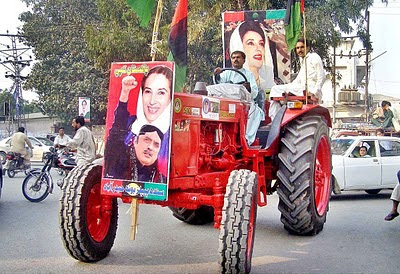 A key indicator of growing rural economy is the double digit increase in the sale of tractors. Millat Tractors Limited, the largest supplier of tractors in Pakistan, had record sales of 41,500 tractors in the calendar year 2010, an increase of nearly 11% over 37,537 tractors sold in 2009. Of these 41,500 tractors, a record 5000 tractors were sold in the month of Dec, 2010 alone, acording to The Nation newspaper. Millat sold 10,000 units under Benazir Tractor Scheme and 5,000 units under the Sindh government tractor scheme in the last fiscal year. Another 10,000 units were sold as part of the Punjab government scheme, 70 per cent of the units were sold, according to Dawn News.
Earlier, the sales of Fiat and Massey Ferguson tractors grew to 1,632 and 3,194 units in September 2010 from 537 and 3,100 in August 2010. The overall sales of these tractors rose to 13,931 during July-September 2010 as compared to 12,690 units in the same period of 2009, according to Dawn news.
Over 50 per cent of the motorcycles and 40-45 per cent of cars in Pakistan are purchased by people living in rural areas. Total car sales in July-September 2010(including Suzuki Bolan) rose by 12 per cent to 30,030 units as compared to 26,812 units in the same period of 2009, according to Pakistan Automotive Manufactureres Association PAMA). Furqan Punjani of Topline Securities said car sales are expected to reach 154,000 units by the end of June 2011.
In addition to rising demand for cars and tractors, there is also an upward trend in two-wheeler sales. The cumulative sales of motorcycles in July-September 2010 rose to 126,701 units from 105,862 units in the same period of 2009.
While it is good to see Pakistan's rural farm economy perk up, it is also important to recognize that the overall national economic outlook can not improve significantly unless the growing budget deficits and rising inflation are brought under control. And this will require the ruling feudal elite to pitch in by paying their fair share of income tax on their rising farm incomes. It is time for them to lead by example.
Related Links:
Haq's Musings
Pakistan's Exports and Remittances Rise to New Highs
Sugar Crisis in Pakistan
Pakistan's Rural Economic Survey
Pakistan's KSE Outperforms BRIC Exchanges in 2010
High Cost of Failure to Aid Flood Victims
Karachi Tops Mumbai in Stock Performance
India and Pakistan Contrasted in 2010
Pakistan's Decade 1999-2009
Musharraf's Economic Legacy
Copper, Gold Deposits Worth $500 Billion at Reko Diq, Pakistan
China's Trade and Investment in South Asia
India's Twin Deficits
Pakistan's Economy 2008-2010
A key indicator of growing rural economy is the double digit increase in the sale of tractors. Millat Tractors Limited, the largest supplier of tractors in Pakistan, had record sales of 41,500 tractors in the calendar year 2010, an increase of nearly 11% over 37,537 tractors sold in 2009. Of these 41,500 tractors, a record 5000 tractors were sold in the month of Dec, 2010 alone, acording to The Nation newspaper. Millat sold 10,000 units under Benazir Tractor Scheme and 5,000 units under the Sindh government tractor scheme in the last fiscal year. Another 10,000 units were sold as part of the Punjab government scheme, 70 per cent of the units were sold, according to Dawn News.
Earlier, the sales of Fiat and Massey Ferguson tractors grew to 1,632 and 3,194 units in September 2010 from 537 and 3,100 in August 2010. The overall sales of these tractors rose to 13,931 during July-September 2010 as compared to 12,690 units in the same period of 2009, according to Dawn news.
Over 50 per cent of the motorcycles and 40-45 per cent of cars in Pakistan are purchased by people living in rural areas. Total car sales in July-September 2010(including Suzuki Bolan) rose by 12 per cent to 30,030 units as compared to 26,812 units in the same period of 2009, according to Pakistan Automotive Manufactureres Association PAMA). Furqan Punjani of Topline Securities said car sales are expected to reach 154,000 units by the end of June 2011.
In addition to rising demand for cars and tractors, there is also an upward trend in two-wheeler sales. The cumulative sales of motorcycles in July-September 2010 rose to 126,701 units from 105,862 units in the same period of 2009.
While it is good to see Pakistan's rural farm economy perk up, it is also important to recognize that the overall national economic outlook can not improve significantly unless the growing budget deficits and rising inflation are brought under control. And this will require the ruling feudal elite to pitch in by paying their fair share of income tax on their rising farm incomes. It is time for them to lead by example.
Related Links:
Haq's Musings
Pakistan's Exports and Remittances Rise to New Highs
Sugar Crisis in Pakistan
Pakistan's Rural Economic Survey
Pakistan's KSE Outperforms BRIC Exchanges in 2010
High Cost of Failure to Aid Flood Victims
Karachi Tops Mumbai in Stock Performance
India and Pakistan Contrasted in 2010
Pakistan's Decade 1999-2009
Musharraf's Economic Legacy
Copper, Gold Deposits Worth $500 Billion at Reko Diq, Pakistan
China's Trade and Investment in South Asia
India's Twin Deficits
Pakistan's Economy 2008-2010
 A key indicator of growing rural economy is the double digit increase in the sale of tractors. Millat Tractors Limited, the largest supplier of tractors in Pakistan, had record sales of 41,500 tractors in the calendar year 2010, an increase of nearly 11% over 37,537 tractors sold in 2009. Of these 41,500 tractors, a record 5000 tractors were sold in the month of Dec, 2010 alone, acording to The Nation newspaper. Millat sold 10,000 units under Benazir Tractor Scheme and 5,000 units under the Sindh government tractor scheme in the last fiscal year. Another 10,000 units were sold as part of the Punjab government scheme, 70 per cent of the units were sold, according to Dawn News.
Earlier, the sales of Fiat and Massey Ferguson tractors grew to 1,632 and 3,194 units in September 2010 from 537 and 3,100 in August 2010. The overall sales of these tractors rose to 13,931 during July-September 2010 as compared to 12,690 units in the same period of 2009, according to Dawn news.
Over 50 per cent of the motorcycles and 40-45 per cent of cars in Pakistan are purchased by people living in rural areas. Total car sales in July-September 2010(including Suzuki Bolan) rose by 12 per cent to 30,030 units as compared to 26,812 units in the same period of 2009, according to Pakistan Automotive Manufactureres Association PAMA). Furqan Punjani of Topline Securities said car sales are expected to reach 154,000 units by the end of June 2011.
In addition to rising demand for cars and tractors, there is also an upward trend in two-wheeler sales. The cumulative sales of motorcycles in July-September 2010 rose to 126,701 units from 105,862 units in the same period of 2009.
While it is good to see Pakistan's rural farm economy perk up, it is also important to recognize that the overall national economic outlook can not improve significantly unless the growing budget deficits and rising inflation are brought under control. And this will require the ruling feudal elite to pitch in by paying their fair share of income tax on their rising farm incomes. It is time for them to lead by example.
Related Links:
Haq's Musings
Pakistan's Exports and Remittances Rise to New Highs
Sugar Crisis in Pakistan
Pakistan's Rural Economic Survey
Pakistan's KSE Outperforms BRIC Exchanges in 2010
High Cost of Failure to Aid Flood Victims
Karachi Tops Mumbai in Stock Performance
India and Pakistan Contrasted in 2010
Pakistan's Decade 1999-2009
Musharraf's Economic Legacy
Copper, Gold Deposits Worth $500 Billion at Reko Diq, Pakistan
China's Trade and Investment in South Asia
India's Twin Deficits
Pakistan's Economy 2008-2010
A key indicator of growing rural economy is the double digit increase in the sale of tractors. Millat Tractors Limited, the largest supplier of tractors in Pakistan, had record sales of 41,500 tractors in the calendar year 2010, an increase of nearly 11% over 37,537 tractors sold in 2009. Of these 41,500 tractors, a record 5000 tractors were sold in the month of Dec, 2010 alone, acording to The Nation newspaper. Millat sold 10,000 units under Benazir Tractor Scheme and 5,000 units under the Sindh government tractor scheme in the last fiscal year. Another 10,000 units were sold as part of the Punjab government scheme, 70 per cent of the units were sold, according to Dawn News.
Earlier, the sales of Fiat and Massey Ferguson tractors grew to 1,632 and 3,194 units in September 2010 from 537 and 3,100 in August 2010. The overall sales of these tractors rose to 13,931 during July-September 2010 as compared to 12,690 units in the same period of 2009, according to Dawn news.
Over 50 per cent of the motorcycles and 40-45 per cent of cars in Pakistan are purchased by people living in rural areas. Total car sales in July-September 2010(including Suzuki Bolan) rose by 12 per cent to 30,030 units as compared to 26,812 units in the same period of 2009, according to Pakistan Automotive Manufactureres Association PAMA). Furqan Punjani of Topline Securities said car sales are expected to reach 154,000 units by the end of June 2011.
In addition to rising demand for cars and tractors, there is also an upward trend in two-wheeler sales. The cumulative sales of motorcycles in July-September 2010 rose to 126,701 units from 105,862 units in the same period of 2009.
While it is good to see Pakistan's rural farm economy perk up, it is also important to recognize that the overall national economic outlook can not improve significantly unless the growing budget deficits and rising inflation are brought under control. And this will require the ruling feudal elite to pitch in by paying their fair share of income tax on their rising farm incomes. It is time for them to lead by example.
Related Links:
Haq's Musings
Pakistan's Exports and Remittances Rise to New Highs
Sugar Crisis in Pakistan
Pakistan's Rural Economic Survey
Pakistan's KSE Outperforms BRIC Exchanges in 2010
High Cost of Failure to Aid Flood Victims
Karachi Tops Mumbai in Stock Performance
India and Pakistan Contrasted in 2010
Pakistan's Decade 1999-2009
Musharraf's Economic Legacy
Copper, Gold Deposits Worth $500 Billion at Reko Diq, Pakistan
China's Trade and Investment in South Asia
India's Twin Deficits
Pakistan's Economy 2008-2010
Riaz Haq
Here's a market research report on Pakistan's agriculture sector:
Pakistan Agribusiness service provides proprietary medium term price forecasts for key commodities, including corn, wheat, rice, sugar, cocoa, coffee, soy and milk; in addition to newly-researched competitive intelligence on leading agribusiness producers, traders and suppliers; in-depth analysis of latest industry developments; and essential industry context on Pakistan's agribusiness service.
Pakistan's agricultural output has steadily declined in its contribution to GDP in the past decade, down from 24.0% in 2000/01 to 20.9% in 2010/11. That said, the sector still employs the largest number of workers in the population and we expect the industry to remain a government priority as the country deals with issues of food security and the vulnerability to natural disasters. Over the long term, we foresee the dairy, poultry and wheat industries as benefiting the most from increased investment.
However, despite the existing network of irrigation systems across the country, we believe that significant improvements in infrastructure and better supply chains will have to be implemented in order for the country to reap the full benefits of its fertile soil.
Key Trends
- Rice production out to 2015/16: 7.5% to 7.3mn tonnes. We expect the country to increase its share in the basmati rice trade as production expands over our forecast period.
- Wheat consumption out to 2016: 14.2% to 25.3mn tonnes. Consumption growth will be driven by rising incomes and population growth, as well as increased access to good-quality milk.
- Sugar production out to 2015/16: 35.1% to 4.8mn tonnes. Large-scale consumers such as confectioners, candy makers and soft drink manufacturers account for about 60% of the total sugar demand and will be the main drivers of growth.
- 2012 Real GDP Growth: 3.8% (up from 2.4% y-o-y in 2011; forecast to average 3.7% from 2011 to 2016).
- Consumer Price Inflation: 11.2% average in 2012 (down from 13.7% in 2011).
- Central Bank Policy Rate: 12.0% (lower than 14.0% in 2011)
----------
South Asia rice exporters should benefit the most from the recent rice trade disruptions out of Thailand. So far, traders report that more than 100,000 tonnes of rice for export have been stalled as a result of the country's worst flooding in decades. Some sources estimate that this could rise to more than 300,000 tonnes. Given these developments, the spotlight has now turned to South Asia to meet demand for the grain in the near term.
Despite the recent floods, which destroyed approximately 20-30% of the sugarcane crop in the Sindh region, we forecast 2011/12 sugar output from Pakistan at 4.1mn tonnes, 2.5% up from our previous estimates. This is largely due to an overall 5-8% increase in sugarcane yields, area harvested and favourable monsoon rains during the growing season. Sugar crushing is estimated at 82% and sugar recovery at 8.8%. According to provincial reports, higher sugar prices farmers received last year, coupled with strong demand from the industrial sector, have boosted planting in the provinces of Punjab, Sindh and Khyber Pakhtunkhawah.
http://www.researchandmarkets.com/research/b503cb/pakistan_agribusin
Jan 13, 2012
Riaz Haq
Here's an Express Tribune report on Psakistan's fruits and vegetables exported to Sri Lanka:
A Pakistan trade delegation, visiting Sri Lanka these days, has proposed setting up a body under the title Horticulture Export Marketing Access with the objective of facilitating export of agricultural produce to Sri Lankan markets.
The proposal was floated by the leader of the six-member delegation, Faqir Nusrat Husain, at a ceremony held in Colombo.
The delegation, sponsored by the Trade Development Authority of Pakistan, is on a week-long visit aimed at exploring ways and means to enhance bilateral trade in fruits and vegetables, flowers and other agricultural produce.
Team members include prominent agriculturalists from across the country, who have specialised in production and export of various fruits and vegetables including guava, chikoo, mango, citrus, berry, potato, dry fruits, gur, tobacco (cigar) and fresh and dry dates.
Faqir Husain told Sri Lankan agriculturalists that Pakistan’s fruits and vegetables had good quality and were also cheaper, adding Pakistan provided an ideal alternative to Sri Lanka, which imported these items from far-off countries.
Eager to reap maximum benefits from the free trade agreement (FTA) with Sri Lanka, the delegation also planned to explore opportunities in the tea industry. In this regard, it will visit Kandy to interact with the local chamber of commerce and the Tea Research Board. It will also visit tea factories and spice gardens.
The team members plan to hold meetings with Sri Lankan fruit and dry fruit importers as well as other stakeholders to explore possibilities of enhancing bilateral trade.
Sri Lanka, which imported $300 million worth of agriculture produce from Pakistan last year, was the first country to sign an FTA with Pakistan. Since the agreement came into effect in June 2005, bilateral trade has strengthened and Pakistan is the second largest trade partner of Sri Lanka in the South Asian region.
http://tribune.com.pk/story/328188/pakistan-proposes-export-facilit...
Jan 28, 2012
Riaz Haq
Here's a special CNN report on a Pakistani village by Wajahat Ali: This is a story affecting millions of Pakistanis — and it does not involve suicide bombings, honor killings, extremism or President Zardari's mustache.
"What would you like to be when you grow up?" I asked Sakafat, a boisterous 12-year-old girl, while visiting a remote Pakistani village in the Sindh province.
"A scientist!" she immediately replied. "Why can't we be scientists? Why not us?"
The confident Sakafat lives in Abdul Qadir Lashari village, which is home to 500 people in Mirpur Sakro. It is in one of the most impoverished regions of Pakistan.
There was a characteristic resilience and optimism in this particular village. This should come as no surprise to anyone who knows anything about Pakistan's often dysfunctional, surreal yet endearing daily existence.
The 500 villagers live in 48 small huts, except for the one "wealthy" family who recently built a home made of concrete. The village chief, Abdul Qadir Lashari, proudly showed off his village's brand-new community toilets, paved roads, and water pump that brings fresh water to the village.
These simple, critical amenities, taken for granted by most of us in the West, resulted from the direct assistance of the Rural Support Programmes Network, Pakistan's largest nongovernmental organization. RSPN has worked with thousands of similar Pakistani villages to help them achieve economic self-sufficiency.
I visited the Sindh village with RSPN to witness the results of using community organizing to alleviate poverty. The staff told me its goal was to teach villagers to "fish for themselves."
Every household in the Abdul Qadir Lashari village was able to reach a profit by the end of 2011 as a result of professional skills training, financial management, community leadership workshops and microloans.
Specifically, a middle-aged, illiterate woman proudly told me how she learned sewing and financial management and was thus able to increase her household revenue, manage her bills, and use a small profit to purchase an extra cow for the family. She was excited to introduce me to her cow, but sadly due to lack of time I was unable to make the bovine acquaintance.
--------
Asked what single thing she felt was most important most for her village, she replied education. Upon asking another elderly lady what she wishes for Pakistan, she repeated one word three times: "sukoon," which means peace.
When it was time to depart, the people of the village presented me with a beautiful handmade Sindhi shawl, an example of the craftwork the villagers are now able to sell for profit.
As I left the village with the dark red, traditional Sindhi shawl adorned around my neck, my thoughts returned to the 12-year-old girl, Sakafat, who passionately asked why she couldn't become a scientist.
I looked in her eyes and could only respond with the following: "You're right. You can be anything you want to be. And I have every confidence you will, inshallah ("God willing"), reach your manzil ("desired destination").
By focusing on education and local empowerment to lift the next generation out of poverty, Sakafat's dream could indeed one day become a reality for all of Pakistan.
http://www.cnn.com/2012/05/13/world/asia/pakistan-empowerment/index...
May 13, 2012
Riaz Haq
Here's an ET story on Engro supply chain in Pakistan: Have you ever wondered where the milk in packaged dairy products comes from? In case you assumed that big food companies maintained their own dairy farms that generated thousands of litres of milk daily and remained insulated from fluctuations in open market rates, you are wide of the mark.
In fact, only 5% of about 1.2 million litres of milk that Engro Foods collects every day for its dairy segment during the flush season – from January to April each year when fodder is available in abundance and milk production is high – comes from its own corporate farm located in Sukkur.
The rest of the milk supplies during the flush season and the summer, when milk production drops by roughly 50%, comes from about 15,000 small farmers scattered between Sanghar and Jhang districts, an area of 135,000 square kilometres.
Streamlined under Engro Milk Automation Network (EMAN), Engro Foods maintains a sales force of 1,500 people across 1,200 villages in Sindh and Punjab. They collect milk, mostly in small quantities, from farmers between 6:00am and 9:30am every day, which is then transported for further processing.
But why would a villager with just a few cattle sell the excess quantity of milk to Engro Foods instead of the traditional milk contractors known as dodhis?
According to Aamir Khawas, who works as head of milk procurement and agri services at Engro Foods, doing business with a large food company offers small farmers a number of benefits. “Animals are susceptible to diseases. Our network of veterinarians ensures sick animals receive immediate treatment. That’s a benefit no traditional milk contractor can offer,” he said.
Moreover, the moment a farmer sells milk to an Engro representative, in whatever small quantity, the transaction is recorded electronically in a centralised database by swiping the EMAN card that each of the 15,000 suppliers carries.
The availability of real-time data ensures that money is transferred to the farmer the day the transaction takes place. This is in contrast to the past practice of issuing receipts on paper that took at least a week before a transaction was recorded and payment processed.
In addition, Engro’s advisory service helps farmers increase milk production. “There’re two ways for a farmer to increase his revenue. If he gets Rs41 instead of Rs40 per litre, his revenue increases by Re1. But if the milk output increases by one litre, his revenue increases by Rs40. We help him do the latter,” Khawas said.
So how does Engro ensure that the milk is pure? “It’s very easy. We pay farmers not on the litres of milk they bring to us. Rather, the basis of payment is total solid contents of the milk,” he said, explaining that milk consists of three things – water, fat and solid non-fat (SNF). Total solid contents are the sum of fat and SNF.
“It’s hard to adulterate when the quantity is low. So no matter how much water you add, the solid contents can easily be determined by running a few tests,” he said.
A total of 13 tests are carried out when a farmer hands over milk to an Engro representative. It is picked up from there by an Engro van that carries out another 20 tests on the collected milk. It then reaches the regional office where 30 more tests are done to check its quality. Eventually, milk is taken to the Engro plant where the final 40 tests take place before it is processed, packaged and dispatched to the retail market.
With the demand of milk increasing by 15% annually and supply rising by just 2% a year in Pakistan, the dairy sector looks like a heaven for investment. The Sukkur farm of Engro Foods has already grown 10 times since its inception with about 3,000 cows. “Yet we’re looking for a major expansion in the near future.”
http://tribune.com.pk/story/378282/the-benefits-of-business-with-a-...
May 14, 2012
Riaz Haq
Here's a Daily Times story on Pak mango exports:
Mango farmers across Pakistan continue their partnership with USAID to maximise yields, improve product quality, introduce better packaging and create market linkages.
Seven mango farms from Sindh are already scheduled to send commercial shipments to high-end markets across the globe in June of this year.
All these advancements are helping Pakistani mango growers tap into new export markets with each passing season. As the mango season for 2012 begins, this partnership continues to bear fruit. Ghulam Sarwar Abro said a private farm in Kotri Sindh has been a partner with USAID’s Mango Programme.
“We are confident with USAID’s support, all of the ground work has been done. We have the required standards, infrastructure and linkages to tap the international markets on a competitive footing.” More farms will participate in commercial shipments as soon as harvesting begins in Punjab. USAID has signed Infrastructure Upgrade Agreements (IUAs) with 15 mango farmers across Pakistan on a cost-sharing basis to build pack houses.
USAID has also provided assistance to 15 farmers in achieving GlobalGAP certification under a similar cost-share agreement and has planned to increase this number by the end of this season by adding another 12 certified farms.
The USAID Mango Programme is currently in its third year and this year the programme is specifically concentrating on enhancing the market linkages for Pakistan’s mango sector.
He said this project is designed to help the Pakistani economy achieve its export potential. The project has three main areas of interest including an improved Pakistan trade environment through improved regulation, policies, systems and capacity, facilitation of trade at Pakistani borders and establishment of sustainable and competitive Special Economic Zones, including Reconstruction Opportunity Zones.
The project emphasises capacity-building activities that facilitate increased exports from industry, services and agriculture enterprises.
http://www.dailytimes.com.pk/default.asp?page=2012\05\25\story_25-5-2012_pg5_9
May 24, 2012
Riaz Haq
Here's a Daily Times story on hot water treatment of Pak mangoes for export:
Pakistan’s largest hot water treatment plant for removal of various diseases in mango was inaugurated on Saturday. It has been established under the public-private partnership according to the standard of United States Department of Agriculture (USDA), World Health Organisation (WHO) and International Quarantine Standards by the name of Pakistani Horti Fresh Processing (Pvt) Ltd.
The project which was completed in record period of 20 months with its inception has helped to open three new markets for mangoes including Mauritius, Lebanon and South Korea while the Australia is expected to be approved soon which would greatly help boosting Pakistan’s mango exports during the coming ongoing season.
Pakistani mangoes have nine diseases in common, which was unacceptable in the international market but with the start of the operational activities of the new plant, importers have expressed their keenness to place large-scale order for the most desired fruit of the summer season.
It may be recalled here that majority of countries have placed strict conditions regarding import of fruits from across-the-globe and in case of mango, they have requirement of their hot water treatment on 48 degree centigrade for 65 minutes, which makes the fruit acceptable for import purpose.
Currently, Pakistan’s total average mango export stands at 150,000 tonnes which is hardly 8.0 percent of the total annual production of 1.6 million tonnes, which was usually attributed by the exporters on account of limited market access to Pakistani exporters.
Durrani Associates has established the project in collaboration with Ministry of Commerce. Its chief executive highlighting salient features of the project, said that the plant installed has the capacity to process 15 tonnes of the fruit per hour pn 48 C for 60 to 65 minutes.
Similarly for the first time, Ethylene Chamber facility was also used which give colour to mango by food graded Ethylene having no harmful impact on human health as compared to carbide which is widely used in the country for ripening fruit and is spelling harmful diseases for fruit consumers.
He claimed that the biggest breakthrough created by the Pakistan Horti Fresh processing is that now mangoes can be shipped by sea for destinations as far as UK and Canada with shelf life of 35 days.
As compared to by air freight of mangoes to UK which costs Rs 137 per kilogramme (kg) charged by Emirates Airline, the new technology would cost a mere Rs 12 per kg, which would herald new life in exports of fruits to different countries across the globe.
http://www.dailytimes.com.pk/default.asp?page=2012\06\10\story_10-6-2012_pg5_14
Jun 9, 2012
Riaz Haq
Here's Daily Times on mango export processing in Pakistan:
Pakistan is considered as a country, lagging behind the developed world regarding science and technology, but the situation was not as much worst as seen, because Pakistan has an edge in treatment of mangoes and its shelving.
Mango is a well-regarded fruit and is known as ‘King of fruits’. Mango appears in local markets as the summer season commences.
Globally, it is one of the most eaten fruits. As many as 11 countries, including Pakistan export mangoes. To meet the global standards, mangoes are treated before export. There are four ways of treatment, out of which three are recognised across the world: hot water treatment (HWT), vapor heat treatment (VHT) and radiation.
There are nine types of bacteria that prevail in mangoes. To kill all of those, in most common way of hot water treatment, mangoes are treated with hot water for one hour, during which the temperature is managed at 75 degree centigrade. Resultantly, the pores at mangoes surface get rupture and its shelving become difficult.
Pakistan has a double edge in regard with treatment and shelving of mangoes. The country has a capacity to treat 15 tonnes of mangoes per hour. Besides this, Pakistani private sector has ability of shelving mangoes for 35 days after treatment, however, the rest of exporter countries could shelve mangoes for maximum seven days.
Recently, Pakistan has achieved another significant achievement in export of mangoes sector. Pakistani has recently initiated to export mangoes to China, which itself is the second largest producer and one among the largest consumers of mangoes.
Though China itself produce mangoes in massive quantity, it still is a vast market for Pakistani mangoes as locally produced mango is small in size and less sweet, however, Chinese people like larger in size and sweeter mangoes and Pakistani types of mangoes all their desired qualities.
AQ Khan Durrani, the owner of treatment plants in Pakistan and exporter of mangoes to China, said while talking to the Daily Times that China is biggest country in term of population and is 2nd largest producer of mango in the world with production of 4.5 million tonnes of mangoes annually. Chinese people like mangoes a lot and while exploring this big market of ‘mango lovers’, Pakistan can earn millions of dollar in fruit sector.
“China can be the biggest market of Pakistan mangoes and within three years Pakistani export can be doubled,” he added.
It is pertinent to mention here that the Pakistan produces 1.6 to two million tons of mangoes annually and was ranked fourth to fifth among producer countries of mango. The dire need of hour is that the government should follow and respond to the achievements and strive of private sector, which is going to explore even largest producer countries of mango as consumer market.
Pakistan would become the largest producer and exporter of mangoes due to the quality of local mango, if the government supports the sector. This also would result in very positive impacts on local economy and the position of the country as well.
http://www.dailytimes.com.pk/default.asp?page=2012\07\09\story_9-7-2012_pg7_16
Jul 8, 2012
Riaz Haq
Here's a BR report on PM Raja talking about PPP's pro-farmer policies:
Prime Minister Raja Pervez Ashraf Tuesday said prudent and farmers-friendly policies of the PPP led government has helped injection of Rs500 billion in the rural economy ultimately benefiting the farming community in the country.
"Due to our pro-farming policies and due payments of agriculture produce of the farmers specially in wheat production, Pakistan once an wheat importing country has now become an exporting country and we are self sufficient in wheat production", the Prime Minister said while addressing APP regularization certificate distribution ceremony to distribute letters among the contract and daily wages employees of Associated Press of Pakistan (APP), here at the Prime Minister Secretariat today.
http://www.brecorder.com/top-news/1-front-top-news/66940-pro-farmer...
Jul 10, 2012
Riaz Haq
Here's a BR report on Pakistani mangoes:
Pakistan produces over 150 varieties of mango and among these Chaunsa and Sindhri have great potential for finding buyers in the international markets.
Talking to APP on Monday Secretary Agriculture Punjab Muhammad Mushtaq Ahmed said Punjab holds 67 percent of the total area and produces 80 percent of country's mango.
He said total production of mangoes in Punjab during 2011-12 was 1.304 tons and Pakistan is of high quality with good aroma, excellent appearance, special taste and flavor along with sufficient quantity of fiber content thus enjoying a prominent position in the international market.
To a question, he said Pakistan produces over 1.75 million tons of mangoes out of which 127 tons are exported, currently only 5 percent of the total mango produce is processed in to value added items like pulp for use in drinks and ice cream, canned mangoes and dried mangoes.
He said Pakistan exported mangoes worth $ 29 million to the Middle East and EU in 2009 and Malaysia, China and Hong Kong are other valuable trading partners.
http://www.brecorder.com/pakistan/business-a-economy/68148-pakistan...
Jul 16, 2012
Riaz Haq
Here's an ET report on Pak mangoes exports to US made unprofitable by irradiation restrictions:
Pakistani exporters are abandoning much-publicised mango exports to the United States after just a year because American requirements made profit margins too narrow, members of the industry said Monday.
In 2011, Pakistani growers exported five tons of the country’s signature fruit to the United States and had hoped for a higher yield this year.
But if exports grind to a halt, it could prove embarrassing for efforts dubbed “mango diplomacy” in 2010 when US Secretary of State Hillary Clinton offered to help Pakistan export the fruit in a bid to ease anti-Americanism.
The US embassy was unavailable for comment, but announced in January that US support had helped select mango growers increase regional exports by more than 60 percent and revenue by more than $4 million over the past year.
Pakistani officials confirmed the assistance, but said sending mangoes to the United States was not cost effective.
“Pakistan cannot export mangoes to the United States this season because of certain restrictions, which the growers feel makes the business unprofitable,” Kashif Niazi, an official at the commerce ministry, told AFP.
An official at the Trade Development Authority of Pakistan, which regulates exports, said producers had been annoyed by compulsory US irradiation in Chicago that ate into their profits.
Although Pakistan has its own irradiation plant, it has not been approved by the United States. Transporting the mangoes to the United States has been another expense and complication, the Pakistanis added.
Asif Iqbal, a mango grower in Sargodha district of Punjab province, told AFP that unless the irradiation issue was resolved and more US markets found “it will never be profitable for us to do business with America”.
A Pakistani official speaking to AFP on condition of anonymity confirmed that US aid had helped modernise mango production and improve exports, particularly to the Gulf.
http://tribune.com.pk/story/418256/pakistan-to-halt-mango-exports-t...
Here's Pakistan Times on Benazir Tractor Scheme:
ISLAMABAD: All arrangements have been finalized to hold balloting of Benazir Tractors Scheme to provide subsidized tractors for growers.
The balloting for the scheme is expected to be held on September 6.This was stated by the Federal Minister for Food and Agriculture (MinFA), Nazar Muhammad Gondal responding to the live calls of the people after inaugurating the radio programme “Aaj Mandi key Bhao”, here on Monday.
The minister said that preparations had been finalized to provide 10,000 tractors to farmers under Benazir Tractor Scheme.
It may be recalled that about 355,000 printed application forms had been provided to farmers through the ZTBL branches in addition to those who applied on-line.
About 340,000 application were received, of which 277,106 were finalized for balloting of the scheme.
For Punjab province 5000 tractors, Sindh 2000, NWFP 1200 and for Balochistan 850 tractors would be allocated.
In AJK, FATA 350 tractors each while FANA 200 tractors and Federal Capital 50 tractors quota is fixed.
http://www.pakistantimes.net/pt/detail.php?newsId=3863
Aug 6, 2012
Riaz Haq
Here's Express Tribune on Pakistani mangoes exports to China:
After years of struggle, Pakistan finally added one of the world’s largest markets for its mangoes – China. The development, a major breakthrough in mango exports, will add millions of dollars to the country’s foreign reserves.
“Pakistan’s mangoes have become a centre of attraction in the largest retail chain of China – Walmart – where the king of fruit is being offered for sale,” Durrani Associates, one of the largest fruit exporters, said in a statement on Saturday.
The exporter was able to access the Chinese market, currently dominated by Taiwanese, Filipino and Thai varieties, after a sample of mangoes, shipped by sea a month ago, earned overwhelming success at Walmart stores.
The shipment contained two containers with 40 tons of mangoes. Firm’s Chairman Abdul Qadir Khan Durrani also visited China at that time and met with representatives of Walmart, which had 370 stores in 140 cities and four municipalities of China by March 1.
“It took us a while before we got clearance from Beijing,” Durrani said. The containers were held at the port and 20 cartons each were taken from both the containers for inspection, he said. After a week-long process, the Quarantine Department cleared the shipment by declaring that the mangoes were free from all diseases.
According to the statement, a three-member team of Chinese importers will visit Pakistan next week to strike an agreement for purchase of 100 tons of mangoes for Walmart stores in the running season.
The delegation will also visit the hot water treatment (HWT) plant – a facility set up for the processing and treatment of mangoes to meet international standards. They will inspect the arrangements for quality control.
---------
In China, mangoes of Thailand are selling at $1.5 per mango, the amount the company pays in air freight alone, making it impossible to compete, Durrani said.
“Exporting mangoes by sea to China is a big breakthrough,” Abdul Qadir Khan Durrani, the chairman, said because it will bring freight cost down to $0.75 per mango, which means Pakistan’s mangoes can sell for about $1.25 in Chinese stores.
China is one of the countries that applies global standards on mango imports. To meet the standards, mangoes are treated before export. There are four known ways of treatment, out of which three are recognised across the world – HWT, vapour heat treatment (VHT) and radiation.
------------
Pakistan has a capacity to treat 15 tons of mangoes per hour. The private sector has the ability to shelve mangoes for 35 days after treatment while other exporting countries could shelve mangoes for maximum seven days, the statement claimed.
According to the chairman, Pakistan is world’s 5th largest producer of mango, which can produce up to 2 million tons. Mango varieties particularly Sindhri, Chaunsa and Sunehri can beat others because of their taste, he said.
“China can be the biggest market of Pakistani mangoes and within three years exports can be doubled,” he added.
http://tribune.com.pk/story/423993/new-destination-pakistani-mangoe...
Aug 18, 2012
Riaz Haq
Here's an ET report on HWT technology to increase shelf life and exports of fruits and veggies in Pakistan:
The establishment of Karachi’s hot water treatment (HWT) plant – a facility for post-harvest treatment and processing of fruits and vegetables – is a very good example of how the country’s agriculture sector can benefit by investing in technological advancements. It is because of this technology that Pakistan has been able to venture into some of the world’s largest markets for its mango over the past couple of months.
In order to expand mango exports, Durrani Associates, one of Pakistan’s largest mango exporters, in partnership with the government, set up the Rs220 million HWT plant, which is officially known as Pakistan Horti Fresh Processing (Pvt) Limited. This investment, according to Durrani Associates’ Director Babar Khan Durrani, can be recovered within five years.
Durrani told The Express Tribune that they were already exporting mangoes to Tesco in the United Kingdom and Carrefour in the rest of Europe – two of the world’s largest retail chains – but HWT facility has opened new markets for the exporters. The exporters can use the facility and ship their products via sea now, which will enable them to sell at competitive prices.
HWT increases shelf life of mangoes to 35 days, thus they can now be shipped by sea to remote destinations, a major development, which reduces freight charges to a great extent.
Take the example of China, Durrani said, where air freight alone costs more than $1.25 per kg of mangoes. The processed mangoes can be shipped by sea, he said, bringing the cost down to $0.20 per kg. As a result, the Pakistani exporter was able to impress Walmart China, which, in a week’s time, will strike a contract for supply of another 100 tons of mangoes.
-------------
Talking about how this technology has helped expand mango exports, Durrani said fruits and vegetables processed by HWT facility meet requirements of the United States Department of Agriculture (USDA), World Health Organisation (WHO) and International Quarantine Standards, thus making them globally acceptable.
In the past, Pakistan’s mangoes were denied access to several key markets including the US and China because of nine diseases. HWT kills anthicolas, a major disease that results in black spots on mango skin.
“The skin of our mango is rough but its taste is very good,” company’s Chairman Abdul Qadir Khan Durrani said. “HWT improves the skin while killing all diseases after treating at 50 degrees for an hour,” he added.
He claimed Pakistan has world’s largest HWT plant having capacity to treat 15 tons of mangoes per hour. The second largest plant is in Mexico that treats 4.5 tons of mangoes per hour, he said.
Besides the $2,200 per ton market of Europe, the $1,600 per ton market of China could prove to be the largest importer of Pakistan’s mangoes, Durrani said.
--------------
By contrast, the mango exports are 8% of the production or less than 50% of the export potential, a strong indication that there is still a huge space for more investment on the technology front. “We need more than 10 such plants for meeting mango demand of North American markets,” Director Durrani said.
“Our agriculture sector lacks technology. People shy away from using technology.” It will take a while before all farmers adopt new technologies, he said.
-------------
“About 30% to 40% of our fruits and vegetables are wasted because they are not processed,” Durrani said. “Given the HWT plant can process almost every fruit and vegetable that we produce, we can save our produce from being wasted,” he added.
http://tribune.com.pk/story/424992/fountain-of-youth-technological-...
Aug 23, 2012
Riaz Haq
Here's a FreshPlaza story on peach farming in Pakistan:
The United States Agency for International Development’s (USAID) Firms Project has successfully trained 449 peach farm SMEs in Swat, Pakistan under a USD 600,000 revitalization program, that aims to facilitate them in gaining access to greater revenues and market linkages; and make overall infrastructure improvements to strengthen the sector.
Swat relies heavily on the horticulture sector with 67 percent of the total peaches produced in Pakistan coming from Swat. In recent years however, calamities have wreaked havoc on agriculture, affecting sales and jobs in the region. The main constraints to growth include lack of infrastructure, poor access to inputs, market linkages, credit facilities, untrained workforce, and poor management practices affecting the quality and yield of the produce.
USAID’s assistance to the Pakistan's peach sector includes trainings, infrastructure, supplies, technical support, tools, and certifications for peach farm SMEs of Swat, under a cost sharing agreement. 449 peach farm SMEs that signed agreements with USAID Firms Project earlier this month received pre and post harvest trainings as part of the capacity building component of this assistance. 150 SMEs have received in-kind support in the form of pruning kits, harvesting kits, and corrugated cartons. Distribution to the remaining 299 will finish by the end of July. The tools and equipment will help ensure minimum damage to fruit during harvest, thereby reducing losses to the growers. To coordinate the effort, cluster leaders have been appointed who ensure a smooth flow of operations with farm SMEs within their clusters and work with them to increase output.
Together these interventions will help peach farm SMEs in adopting best management practices and peach farming techniques, attaining larger scale production, increasing yield, and tapping into competitive new markets. Atta Ullah, a local peach grower from Swat said, “These pruning and harvesting kits and all the other assistance from USAID will benefit the smaller farms and increase the revenue for these SMEs by 10 percent.” Another grower explained “We have learnt so many things we can do better. The training brings new management practices to us and is helping us access gains which were not possible before”.
To further strengthen the sector, USAID Pakistan Firms Project is providing assistance to these SMEs for competitive marketing and product placement, and creating linkages between SMEs from Swat and large-scale buyers and retailers. An existing peach pulping unit in Swat will also be up-graded with modern infrastructure to meet the demand of peach pulp.
http://www.freshplaza.com/news_detail.asp?id=100449
Sep 5, 2012
Riaz Haq
Here's a Dawn report on Pakistan's rising citrus exports:
The exports of Pakistani citrus have registered an increase of 70 per cent in a year, Minister for Commerce Makhdoom Amin Fahim told National Assembly on Wednesday.
In a written reply to the question of Ms Nighat Parveen Mir, he said the exports of citrus have been increased up to US$162.6 million from July to March in the year 2011-12 compared to US$95.8 million during the corresponding period last year.
The country has also exported 247,909 metric ton mangoes to various countries from 2008 to 2010-11. In the year 2008-09, as many as 73,437 metric ton mangoes were exported, while 84,921 MT mangoes were exported in 2009-10, and 89,551 MT mangoes were exported in 2010-11.
In a written reply to another question he said, European Union – the union of 27 European countries is the largest business partner of Pakistan. EU had already announced concession on 75 products for Pakistan subject to waiver. The matter is now with European Parliament for legislation before implementation. Pakistan is making diplomatic efforts for getting concessions on 75 products.
He said Pakistan will qualify for duty free access to EU from January 1, 2014 as the country has ratified all the 27 international conventions.
In reply to another question he said, Pakistan and India are in the process of normalizing bilateral trade relations under resumed composite dialogue. As a first step, negative list of 1,209 tariff lines have been notified.
With the phasing out of negative list by December 31, 2012, complete trade normalization with India will be in place subject to the removal of the non-tariff barriers by the Indian government.
In written reply to question he said, country’s imports stands at $34.82 million during 2008-09, $34.71 million in 2009-10, $ US 40.41 million in 2010-11, and $44.91 million in 2011-12.
The volume of trade between Pakistan and Africa was $2.4 billion and $3.09 billion respectively.
http://dawn.com/2012/09/05/citrus-exports-register-70-percent-incre...
Sep 5, 2012
Riaz Haq
Here's an excerpt of a Nation report on Pakistan's wheat harvest:
In 2011-12 Pakistan farms produced 23.3m tons of wheat. The total value of that harvest is over Rs611 billion or $6.4 billion; and 20pc of our national agricultural GDP is from wheat. Combining these figures illustrate the vital importance of wheat farming to the food security, income, and economic growth of Pakistan. He said that our future food security and economic growth depend on more science and more innovation coordination nationally and internationally. He said that the rust diseases of wheat are of special concern to this community and we are aware of the threat of wheat rusts, including stem rust Ug99, to the productivity of wheat in Pakistan. Wheat Productivity Enhancement Programme (WPEP), is supporting this meeting and our national efforts to protect and enhance the productivity of wheat through the application of science to ensure wheat rusts do not hurt our wheat and that our farm productivity increases. Wheat is the leading crop of the country occupying the largest area (8.7million hectares) under any single crop. Annual wheat planning meeting has been a regular feature and always helpful in discussing research findings and formulation future strategies for enhanced wheat production. The coordination mechanism like the annual wheat meetings has been a regular activity for a long time and with the launching of the WPEP (Wheat Productivity Enhancement Programme) of Pakistan. It will further enhance and strengthen the already existing linkages between the stake holders. WPEP and USDA funded project aims to enhance and protect the productivity of wheat in Pakistan.
http://www.nation.com.pk/pakistan-news-newspaper-daily-english-onli...
Sep 15, 2012
Riaz Haq
Here's a News excerpt on tractor sales in Pakistan:
Tractor sales increased immensely, by 190 percent YoY, to 2,855 units in comparison with the sale of 957 units in the same period last year. However, August 2012 sales (2,855 units) went slightly higher as compared to July 2012 sales (2,828 units). Al-Ghazi tractors registered a sales growth of 300 percent YoY but a sales decline of 28 percent MoM to 1,216 units. Millat tractors sales boosted by 151 percent YoY and 44 percent MoM to 1,639 units, the data said.
On cars:
Pakistan Automotive Manufacturers Association (PAMA) has recorded a decline of 30 percent year-on-year (YoY) in automobile manufacturing to 20,820 units in August 2012, according to the PAMA data released for the same month.
A month-on-month (MoM) analysis of the sector demonstrates a comparatively steady performance with the sector’s sales down by a modest 0.5 percent to 10,385 units. This can primarily be attributed to the low base effect of July 2012, owing to fiscal year-end phenomenon and implementation of taxes in the federal budget 2012-13.
Segment-wise breakup shows that car sales in August 2012 went down by 13 percent YoY to 8,467 units while the 1300cc and above segment shrunk by 17.6 percent YoY. Sales of light commercial vehicles (LCV) and 4x4 registered an 18.3 percent YoY declined in August 2012, mainly due to a decrease in sales volume of Bolan, Ravi and Hilux.
Pakistan Suzuki Motor Company Limited (PSMC) registered a sales decline of five percent YoY to 6,002 units but continued its performance as a market leader. However, in August 2012, its market share dropped by six percent YoY to 56 percent. The reason behind this decrease was the discontinuation of its brand Alto, which was PSMC’s leading brand in 1,000cc category.
A better picture can be seen on MoM basis as it shows a seven percent improvement in sales volume of the company, the PAMA data said. This was mainly accounted for the base effect of lower sales volume in July 2012.
PSMC has been successful in attracting its Alto customers towards Mehran, Cultus and Swift models, which registered YoY enormous sales growth of 40 percent, 21 percent, and 16 percent respectively in August 2012 while other models including Liana, Bolan and Ravi showed YoY decline of 26 percent, 10 percent and 34 percent respectively.
Indus Motor Company Limited (INDU) experienced sales contraction of 28 percent YoY during August 2012 to 3,092 units. During this period, sales went down by 30 percent YoY to 6,179 units. The main reason behind this was a 10-day production halt in July-August 2012 due to higher inventory and pre-buying of buyers and road side dealers in June 2012.
Corolla’s sales decreased by five percent YoY to 2,800 units in August 2012 while Hilux sales improved by three percent YoY to 282 units. MoM sales of the Corolla grew by 14 percent while sales of Hilux drastically decreased by 50 percent, the data said.
Imported Japanese second hand cars are becoming major competitor for INDU flagship brand Corolla as during FY12 about 55,000 units of used Japanese cars were imported in the country.
Hence, it has become a serious threat for INDU as all eyes will now be on the upcoming Auto Industrial Development Program (AIDP 2012-17), which will set the course for future direction for imported cars in the country.
Honda Atlas Cars Pakistan Limited (HCAR’s) experienced a sales drop of 14 percent YoY to 1,241 units in August 2012. The period under consideration portrays an improved picture as sales increases by 20 percent YoY.
http://www.thenews.com.pk/Todays-News-3-131559-PAMA-records-30pc-de...
Sep 30, 2012
Riaz Haq
Here's a BR report on subsidized tractors in Punjab:
Tractor manufacturers have more than 10,000 tractors of various makes in their stocks for immediate delivery under the Punjab government's Green Tractor Scheme 2012-13 to the farmers before sowing of Rabi crops, a senior tractor industry executive told Business Recorder, here on Friday.
The Punjab government has completed the process of providing 10,000 tractors to farmers through transparent computerised balloting of 0.275 million applicants of 18 to 35 years age having land holding of 2 and a half acres to 25 acres irrigable and 50 acres arid land across the province. The Punjab government is providing subsidy of Rs 200,000 on each tractor. The provincial government has so far provided 30,000 tractors during the past four years under the Green Tractor scheme to the small farmers with a subsidy of Rs 6 billion to boost agriculture production in the province.
The executives said though the auto manufactures have increased prices of cars t recently yet the tractor industry is not only maintaining June 2012 prices but also giving one percent discount on the sale of tractors under the Green Tractors Scheme. They however suggested that the government should not delay payment of Rs 200,000 to the tractor manufacturers given as subsidy on the Green tractors. The prices of tractors manufactured in Pakistan are still the most competitive in the region despite severe electricity load-shedding and increased cost of production, they emphasised.
They said that small farmers suffered huge financial losses due to rain floods in Sindh and Balochistan in the out-going monsoon season this year, therefore the government should not increase the proposed rate of General Sales Tax from 5 percent to 10 percent in January next year as it would put an additional burden on the agriculture sector.
They said that the tractor industry sold 5,675 tractors in the first two months of the current financial year as against 2,000 of the previous year. President Farmers Associates of Pakistan (FAP) Dr Tariq Bucha has appreciated the Punjab government's Green Tractors Scheme and said the government should make immediate arrangements for delivery of the tractors to the lucky farmers so that they could be used them for preparing the fields before sowing of the Rabi crops seeds in time. Bucha demanded of the government to also provide subsidy and reduce the rate of GST on accessories such as trolleys, ploughs, etc.
http://www.brecorder.com/agriculture-a-allied/183/1245125/
Oct 22, 2012
Riaz Haq
Here's Daily Times on USAID effort to enhance rural productivity in Pakistan:
US assists rural Pakistan increase productivity
Staff Report
ISLAMABAD: United States Agency for International Development (USAID)’s Pakistan Strategy Support Programme (PSSP) launched a 2-day First Annual Conference entitled ‘Productivity, Growth and Poverty Reduction in Rural Pakistan’ on Thursday.
The aim of this conference is to review the first year’s results from PSSP activities. The International Food Policy Research Institute (IFPRI) implements the PSSP. This is a four-year USAID funded, multi-dimensional, multi-partner initiative under the Pakistan Planning Commission’s framework for economic growth.
USAID is proud to support the Planning Commission’s efforts to achieve high standards of excellence in policy formulation and research through capacity building of researchers and analysts in Pakistan, said USAID Deputy Director Rodger Garner at the inaugural session of the conference. These efforts will contribute to a stronger, brighter future for all Pakistan, he added.
A National Advisory Committee chaired by Dr Nadeem ul Haque Deputy Chairman of the Planning Commission of Pakistan with members including Abdul Wajid Rana, Principal Officer and Secretary of Finance government of Pakistan supervises PSSP.
USAID assistance will enable Pakistan to modernise its policy formulation by improving research based policy analysis. This will create a more favourable enabling environment for investments and enterprise growth, Dr Nadeem ul Haque said.
USAID’s other economic growth activities include creating over 200,000 acres of irrigated land by the end of 2013, as well as increasing the incomes of 250,000 farmers and female agricultural workers by increasing their production and connecting them with markets throughout the country to improve sales and ultimately expand their businesses.
http://www.dailytimes.com.pk/default.asp?page=2012\12\14\story_14-12-2012_pg5_14
Dec 13, 2012
Riaz Haq
Here's a Forbes piece on Millat tractors in Pakistan:
Almost a year after floods devastated Pakistan, swamping 5.8 million acres of farmland and displacing millions of people, Ashaq Malik, who grows cotton, sugarcane and wheat on 865 acres in Punjab province, has reason to feel optimistic. After nearly a third of his land was inundated, today he is seeing a strong harvest. "As soon as the water level fell down, we started reconstructing the houses and working on the fields," says Malik. "Today there is no problem with the crops."
Companies that service the agriculture sector are also thriving in the rebound, none more than Millat Tractors of Lahore, which also manufactures other farm gear. Last year Millat earned 2.3 billion rupees ($29 million) on sales of $263 million, a 40% increase from the previous year. In the first quarter of 2011 profits grew 52% from the same period a year earlier..
To buy his 150,000 shares, Ansari--then a 39-year-old general manager--sold a plot of land, liquidated his retirement funds and borrowed money from his father. "It was a lot of money to me back then," he says. "Today it's like a lottery coming your way. The value has increased many, many fold since then."
Today the public, including Millat's 1,600 employees, owns 42% of the company; management and kin 28%; and banks and other institutions the rest. Employees are prosperous because of stock dividends and their salaries. Most of Millat's employees pay income tax--a sign of affluence in Pakistan--and have their own cars.
..
http://www.forbes.com/global/2011/0912/best-under-a-billion-11-mill...
Dec 16, 2012
Riaz Haq
Here's Fresh Plaza on Pak potato export effort:
Pakistan's first state of the art potato washing and grading machine was installed in Karachi and is hoped to boost the dwindling export of potatoes.
The machine was imported at a cost of Rs 10 million and is of Indian and Mexican construction.
Abdul Wahid a leading fruit exporter and former Chairman of All Pakistan Fruit and Vegetable Importers and Exporters Association said that, despite bumper crops, a lack of modern processing and grading of the potato hindered its export.
The lack of modern equipment, for washing, for one thing, has limited export to a few markets, including Sri Lanka, Malaysia and some Gulf Countries.
The lucrative European, Central Asian and Russian markets have so far remained out of reach, with few exceptions.
The new machine is thought to be the first in the country that will wash and grade the potatoes, preparing them to a standard suitable for international trade.
To have a real impact there will need to be many more such machines imported into the country.
http://www.freshplaza.com/news_detail.asp?id=105326
Jan 25, 2013
Riaz Haq
Here's Daily Times on crop insurance for small farmers in Pakistan:
ISLAMABAD: The Pakistan Poverty Alleviation Fund (PPAF) has launched the first-ever indexed and hybrid weather micro-insurance products to facilitate and compensate small farmers in Pakistan.
Presided over by Securities and Exchange Commission of Pakistan Commissioner Muhammad Asif Arif, a simple ceremony to this effect was arranged at a local hotel, which was attended by representatives of State Bank of Pakistan, the World Bank, International Fund for Agricultural Development (IFAD), KfW, German Development Bank, UKAID, Tameer Microfinance Bank, National Disaster Management Authority, Pakistan Microfinance Network, government bodies, insurance companies and others.
Addressing the occasion, Arif said that micro-insurance stands at a critical juncture in Pakistan. He commended PPAF on for introducing revolutionary indexed crop and livestock insurance products in Pakistan. As regulator, he said, SECP has remained committed to promoting micro insurance in the country through research, introducing pivotal regulations and promoting a healthy policy environment.
PPAF Board of Directors Member Zubyr Soomro said that the need for micro-insurance has been felt over the years and it is the tipping point to upscale it. He said that we would have to make the most of this opportunity. He said that sincere efforts are needed to make micro-insurance sustainable.
In his remarks, PPAF Chief Executive Qazi Azmat Isa said that micro-insurance initiative is the result of close collaboration between PPAF and IFAD. He lauded the role of insurance companies and SECP as a regulator to make micro-insurance a success. He said that farmers are badly affected by climate change, fluctuation in the prices of their produce and poor quality of agri inputs. He said that micro-insurance would prove to be a vital instrument in fight against poverty.
State Bank of Pakistan Agricultural Credit and Microfinance Department Senior Joint Director Kamran Bakshi said that by launching indexed and hybrid weather micro-insurance PPAF has provided a unique platform to market leaders to serve the poor, particularly the farmers. He said that the focus must be on protecting the borrowers.
PPAF’s Senior Group Head Ahmad Jamal said that PPAF is committed to grassroots development and micro-insurance would prove to be one of the instruments to alleviate poverty. He said that PPAF would capitalise on its outreach so that maximum people could benefit from micro-insurance.
PPAF’s Financial Services Group Head Yasir Ashfaq highlighted that these products will lead the new era for micro insurance in Pakistan. He said indexed insurance products are easy to administer, transparent, innovative and significantly reduce any chances of moral hazard or fraud. He said PPAF envisions scaling up these products at a national level, preparing detailed indices for various districts with the support of stakeholders including government agencies, donors, MFIs and insurance companies.
The weather-indexed crop and ‘live-weight’ livestock insurance products have been designed by PPAF, with support from IFAD through a strategic partnership with SECP.
These products have been prepared in collaboration with Meteorological Department, Livestock Research Institute and are based on needs of small and marginal income farmers. PPAF has launched these products as a pilot in collaboration with local insurance companies in districts Khushab and Chakwal.
The pilot projects have received overwhelming response and showcased significant potential in providing efficient and transparent form of risk mitigation for small and marginal income farmers and livestock owners across the country.
http://www.dailytimes.com.pk/default.asp?page=2013\01\30\story_30-1-2013_pg5_9
Jan 29, 2013
Riaz Haq
Here's an ET Op Ed by LUMS' Professor Rasul Bukhsh Rais:
I have a serious problem with the cynic brigade that writes and comments on social, developmental and political issues along familiar lines. What is their familiar line? The Taliban are coming, extremism is on the rise, corruption is pervasive and life is miserable. This is a partial truth, not the whole truth. That nothing can change is a viewpoint that conflicts with history and the evolution of societies.
Cynicism in hard times like ours and in a climate of fear, insecurity and violence, sells and viewers and readers readily embrace the dark side of things rather than looking at what is bright and shining. The other issue is the habit of most of my colleagues and columnists to write from the comfort of their offices or homes. They tend to look at the big picture that gives a disturbing spectre rather than examining achievements at local levels, and by dedicated individuals and communities. If there is any meaningful and real change in Pakistan, it is taking place at these levels in every aspect of the social and economic life of this country. By missing details of development and positive change at the smaller scale, we may draw a big picture of a society and country that may not be in agreement with reality. This is what is unfortunately happening.
One of my social beliefs is that only by changing at the local level will Pakistan change for the better at the national level. The national in spatial terms is nothing but local. By often travelling through the villages, mostly in Punjab, I have seen thousands of positive contributions and developments that are neither documented nor narrated. Never has our regular cynic brigade opened its eyes and minds to what this change is and how it is becoming a catalyst for more and larger changes.
Let me share one man’s gigantic contribution at a government agricultural research farm in Bahawalpur. I had heard about Mushtaq Alvi for his collection of berries and date palm trees for some years. Last weekend, I had the opportunity to visit this fabulous farm, which may not be noticed from outside the walls. Mr Alvi, as a young man with his first job, started the plantation in 1985. He went to every place in Pakistan to collect the best local species of date palms, berries, mangoes, guavas and pomegranates. Today, he has 35 species of date palms, 20 of berries, 20 of mangoes and five of pomegranates, and almost every of guavas. Never has his search for new findings ended.
While the collection continues to expand, the farm has supported thousands of farmers and households that would like to have various species of these trees. Every season, thousands of berry plants and hundreds of date palms are distributed. Then there are private collectors of these trees that have developed their own farms and would like to sell plants to new farmers. Each new tree becomes a source for saplings leading to further proliferation.
Scientists like Mr Alvi and many of his colleagues may move on to other research stations or retire but what they have done is something remarkable. This is just one example of ordinary Pakistanis making a difference to society. Unfortunately, our media, commentators and pseudo intellectuals cannot lift their eyes from what is wrong in society and shift their attention, even for a moment, to what is right and working.
Recognition and celebration of achievements by individuals and communities encourages positive change, positive attitudes and stimulates energies for innovation and more contribution. While grieving about the many things that are troubling us, let us not ignore the pleasing side of changing Pakistan. Go out and see it.
http://tribune.com.pk/story/509088/changing-pakistan/
Feb 18, 2013
Riaz Haq
Here's a Nation news report on India's pervasive non-tariff barriers (NTBs):
India has one of the most restrictive trade regimes in the world, according to the World Trade Organisation (WTO).
Economists and WTO experts, quoting an annual report of the WTO, stated that the Indian government around seven years back initiated 191 safeguard actions compared to just 171 by China, a much larger economy. In fact, this was even higher than the number of actions initiated by the EU, also a much larger economic bloc.
And a new study conducted by the United States Agency for International Development (USAID) has revealed that India stands at the top in South Asian countries on the basis of trade restrictions imposed on neighboring countries, according to criteria set by the World Bank.
Experts pointed out that India is accused of using both tariff and non-tariff barriers to discourage imports from neighboring countries. It is no surprise, then, that trade between India and Pakistan is so skewed right now. The volume of trade is growing, but not in a way that seems to be of any real benefit to Pakistan. In 2006-07, Pakistan exported goods worth $342.9 million to India, against imports of $1.24 billion. In 2010-11, Pakistan’s exports to India had dropped to $264.3 million, while imports from India had surged to $1.74 billion.
Giving an example, sources said that if the MFN status is granted to India without completion of infrastructure at the Wagha border, the prices of goods coming from India, will double due to the choking of trucks and the purpose of cheaper goods supply to people will not be served.
Experts maintained that a level playing field must be created for Pakistan’s textile products relative to Indian products through implementing a uniform tax regime before the MFN status is granted to India.
The negative list lays restrictions on imports of 1,209 items from India, which includes 78 textile and apparel items. Pakistan’s farmers fear that there is not a single agriculture item on the negative list or the sensitive list of Pakistani imports from India, except Tobacco and its different forms.
Insiders claim that phasing out of the negative list or MFN status to India will not have any negative impact on Pakistani agriculture as only one item, i.e. Tobacco will suffer from the grant of MFN status to India.
Pakistan will have to be mindful of the pitfalls of allowing completely unfettered and unhindered imports from a much larger and much more developed economy. The USAID report suggests that Pakistan should actually enhance the sensitive list to protect the local industry and agriculture sector following granting MFN status to India.
This year will see some major shifts, with some local industries having to suck it up and see the end of their life inside the bubble of protectionism. This will bring benefits for the local consumer, who will have access to more choices and cheaper products.
But it will also bring in threats to other industries which do not have the same benefits, or are as developed as their counterparts in India.
For a long time the governments were always lacking political will to grant Most Favoured Nation (MFN) status to India but industrialists, traders and civil society activists continued to advocate increasing trade with India, saying this would be a great way to forge better relations and solidify peace overtures between the two nations.
Currently the trade volume between India and Pakistan is about $2.5 billion and it is expected that this can be enhanced to $8 billion in the next two years.
http://www.nation.com.pk/pakistan-news-newspaper-daily-english-onli...
Feb 24, 2013
Riaz Haq
Here's Daily Times on rising rice exports:
KARACHI: The total rice exports from Pakistan including basmati and non-basmati rice have risen above the $1 billion mark during seven months of this fiscal year (July 2012 to February 24, 2013), which in terms of weight stands at 2.142 million tonnes.
The full fiscal year’s export target of $2 billion seems achievable as up till now more than $1 billion exports have been met.
“Efforts of the Rice Exports Corporation of Pakistan to boost export of Pakistani rice has started yielding positive results as Tanzania has emerged as a potential market for Pakistan’s non-basmati rice,” said Rice Export Corporation of Pakistan (REAP) Acting Chairman Rafique Suleman. During the last seven months of the current fiscal year a total quantity of 95,349 metric tonnes has been exported to Tanzania, whereas last year during the same period the export was 25,484 metric tonnes.
It may be recalled that recently Pakistan’s rice export to China has marked an increase as record volume of non-basmati rice 72,623 metric tonnes to China worth $30 million in just one month (January 2013) was exported during the current fiscal year.
“China has become a major market for Pakistani non-basmati rice over the period of time, which
has greatly encouraged exporters of the commodity to accomplish further success in that territory.”
Similarly Pakistani rice export to countries like Sri Lanka and Kenya has also showed marked improvement.
Basmati rice is in great demand in Sri Lanka and Sri Lankan exporters are willing to import more basmati rice from Pakistan.
Suleman said that efforts are underway to push export of Pakistani rice to substantial level as it is fast gaining popularity across the globe, which is evident from the fact that it is currently exported to more than 100 countries.
Furthermore, exporters are also endeavouring to explore many new markets to enhance and increase the export and in this regard REAP chairman and vice chairman, and leading rice exporters visited Gulfood, Dubai (February 25 to 28, 2013) to explore new business opportunities and promotion of Pakistani basmati rice.
He thanked the commercial sections of Pakistan in East African Countries and especially High Commissioner for Pakistan in Tanzania Tajammul Altaf for his efforts for the promotion of Pakistani rice exports into East African countries. As per the official statement of Tanzania Ministry, they will be able to cover the consumption by local production up to 2018. Altaf informed on phone that last year the total imports from Pakistan were worth $50 million and this year we have achieved $100 million.
http://www.dailytimes.com.pk/default.asp?page=2013\03\02\story_2-3-2013_pg5_13
Mar 1, 2013
Riaz Haq
Here's a PakistanToday report on raising wheat yield in Pakistan:
American scientists and Pakistani wheat experts are collaborating to increase Pakistan’s wheat harvest and ensure greater prosperity to farmers nationwide.
A bi-national team of scientists, sponsored by the US Department of Agriculture (USDA), met in Faisalabad last week to evaluate wheat varieties for disease-resistance, according to a statement issued by the US Embassy.
In order to determine which wheat varieties will perform best in Pakistan’s unique ecosystem, US and Pakistani researchers studied the effects of heat and other types of environmental stress on the different varieties of wheat that can be planted in Pakistan.
USDA, through its Wheat Productivity Enhancement Project (WPEP), currently helps evaluate 60 wheat varieties planted in 115 wheat trials throughout Pakistan. In order to increase the quality of this joint research, last week USDA also provided Pakistani research institutions specialized wheat planting and harvesting equipment. The new machines, which replaced equipment over 25 years old, will allow scientists to study more wheat varieties each year and more rapidly improve Pakistani farmers’ harvest yields.
“Wheat is critical to the food security of both Pakistan and the United States,” said USDA Plant Health Advisor Ian Winborne after a ceremony at Ayub Agricultural Research Institute (AARI) celebrating the handover of the new equipment. He added, “Lasting links between Pakistani and US scientists can help improve and protect agricultural harvests in both our countries.”
WPEP facilitates scientific collaboration between USDA, the International Maize and Wheat Improvement Center (CIMMYT), and Pakistan’s national wheat programs. WPEP funds scientific exchanges to develop, introduce, and test disease-resistant wheat varieties; improve agronomic practices; and upgrade research capacity in Pakistan.
This initiative is just one part of a comprehensive US economic growth assistance program which includes expanding irrigation by more than 200,000 acres near the Gomal Zam and Satpara dams; constructing more than 1,000 km of roads to connect communities and facilitate trade; modernizing dairy farms in Punjab; and launching private equity investment funds to help small and medium businesses grow.
http://www.pakistantoday.com.pk/2013/03/20/news/profit/us-pakistani...
Mar 20, 2013
Riaz Haq
Here's a Bloomberg story on Pakistan govt's politically motivated decision to export more sugar:
A shipping subsidy and lower excise tax linked to the export of as much as 1.2 million metric tons of sugar by Pakistan may lead to low inventory and high domestic prices, a unit of the U.S. Department of Agriculture said.
The decision by Pakistan’s Economic Coordination Committee of the cabinet and the Federal Board of Revenue “is being heavily criticized as a politically motivated move by the government to garner support from the sugar industry in the upcoming elections,” the USDA’s Foreign Agricultural Service said in a report posted today on its website.
Stockpiles may drop to a “precariously low level” of 400,000 tons, down from an average of 1 million tons in the past five years, according to the report.
On March 6, the coordination committee approved an inland freight subsidy of about $18 a ton on exports of as much as 1.2 million tons after previously setting the quota at 895,000, according to the report. The federal excise duty on domestic sales was lowered to 0.5 percent from 8 percent to provide an increased incentive to export, according to the report.
“The government efforts to increase the competitiveness of Pakistani sugar in the international market by means of providing direct payment to millers for export could be a violation” of World Trade Organization obligations under an agriculture accord, according to the report.
The government of President Asif Ali Zardari became the first civilian administration to complete its full term. General elections are scheduled for May.
http://www.bloomberg.com/news/2013-03-25/pakistan-sugar-policy-may-...
Mar 25, 2013
Riaz Haq
Here's how PPP boasts of its record of the last 5 years, as reported by PakistanToday:
The Pakistan People’s Party on Saturday released a 29-point report on its five year performance, highlighting major achievements during the period.
It makes special mention of the constitutional reforms, particularly the 18th, 19th and 20th amendments which provided provincial autonomy, transfer of presidential powers to parliament, smooth installation of caretaker governments and striking down of president’s power to dissolve the assemblies.
Munir Ahmad Khan, the PPP in-charge policy and planning cell, presented the report before the media at a press conference. He said that credit goes to the PPP for ensuring independence granted to the Election Commission of Pakistan.
Khan also came up with a list of important decisions and steps taken by the PPP government to mitigate sufferings of the people despite terrorism in the country.
In this regard, he mentioned a record increase in wheat production, increase in salaries of govt officials up to 158 percent, disbursement of Rs 70 billion among 7.5 million deserving families through the Benazir Income Support Programmed and financial help to 135,000 deserving people by Pakistan Baitul Maal.
On steps taken by the government for economic revival, Khan cited the Pak-Iran agreement on the gas pipeline, agreement with China on Gwadar Port, increase in foreign exchange reserves from $6 billion in 2008 to $16 billion in 2013, increase in export from $18 billion in 2008 to $29 billion in 2012, boost in stock market from 5,220 points in 2008 to 18,185 points in 2013 and reduction in interest rate from 17 percent in 2008 to 9 percent in 2013.
He believed that these measures would help improve the economy and ameliorate the people.
Talking about the measures taken to increase production of electricity, the PPP leader told reporters that the PPP-led government added 3,600MW of electricity to the system besides initiating additional work on Mangla and Tarbela dams for increase of 4,500MW in the system.
The previous government, he added, also got $3.5 billion for Basha Dam, initiated Neelum-Jhelum, Gomal and Satpara dams and Thar Coal project to get electricity from coal besides Jamphar project to get electricity out of air.
He said further the PPP government also reinstated thousands of government servants who were dismissed during the last 13 years and also regularised thousands of contract employees.
Among steps taken by the government for welfare of the masses, Munir Khan listed resumption of trade union activities, distribution of shares among 500,000 industrial workers, cheep tractors to farmers through Benazir Tractor Scheme, increase rural economy from 50 billion in 2008 to 800 billion rupees in 2013.
He said Faisalabad-Multan Motorway and construction of thousands of kilometres of roads.
http://www.pakistantoday.com.pk/2013/03/30/news/national/ppp-releas...
Mar 30, 2013
Riaz Haq
Here's a Nation newspaper report on US help for Pak agriculture:
“Since the 1950s, the United States has been working to support agriculture in Pakistan by introducing the orange and helping to double the country’ wheat production. Today, we continue our support because improving crop yields protecting food sources from disease and boosting milk production will increase incomes of the farmers which would ultimately strengthen Pakistan’s prosperity, US ambassador said addressing a gathering of government officials, researchers and farmers during his visit to the National Agriculture Research Center (NARC) here on Wednesday.
Ambassador Olson said that the US government is committed to help the small farmers of Pakistan through projects that enhance agricultural productivity.
The introduction of this wheat variety helps protect Pakistan against UG 99 a dangerous wheat disease in the region that poses a threat to country’ farming community, he claimed.
Olson added that US government has provided new harvesting machine to support the Wheat Productivity Enhancement Project and also is also providing specialized training opportunities to Pakistani wheat scientists to fight against wheat diseases.
While talking on the occasion, Dr. Muhammad Imtiaz, Country Liaison Officer for the International Maize and Wheat Improvement Center, noted that without disease-resistant varieties of wheat experts estimate that Pakistan’s annual wheat harvest could be reduced by 50 percent if when UG 99 arrives.
“Agriculture contributes 21 percent to the GDP of Pakistan and employs 45 percent of the labor force, making it one of the most significant economic drivers of Pakistan,” Dr. Imtiaz said.
http://www.nation.com.pk/pakistan-news-newspaper-daily-english-onli...
May 8, 2013
Riaz Haq
Here's a National Geographic story on sustainable farming in Pakistan:
Zacky Farms, just outside Lahore, is the brainchild of Zafar Khan, a Caltech-educated software engineer who runs one of the most successful information technology companies in Pakistan named Sofizar. What started off as a recreational venture is now a side-business supplying sustainably produced organic milk, vegetables and meat to nearby Lahore suburbs. The farm is modeled on a cyclical model of minimal wastes and multiple product usage. The cows are fed pesticide-free oats, clover and grass and their manure is used to fuela biogas plant which runs the dairy facility. In an era of electricity load-shedding, such an alternative source of energy at a local industrial scale is immensely valuable to replicate as a development path. The residue of the biogas is used to fertigate the fodder fields and vegetable tunnels, which along with green manuring obviates the use of fertilizers. Free-range chickens grace the fields and there is even a fish farm on site. Zafar and his Ukrainian-born wife are committed to sharing their experiences with other farming entrepreneurs in the country.
Further south in a more rural and remote part of Punjab, famed writer and erstwhile lawyer, Daniyal Mueenudin, maintains a mid-size farm which is exemplifying other kinds of innovations. The farm does not boast ecological farming practices, apart from tunnel farming that can help with land conservation and humidity control. However, Daniyal has changed the social landscape of his area through implementing a “living wage” for all his employees. Noting the high level of inequality in Pakistan’s hinterland, the Yale-educated former director of the university’s Lowenstein Human Rights Clinic, is practicing what he preached. He also owns a farm in Wisconsin and could have a comfortable life in the States but his social obligations keep him ensconced in Pakistan for most of the year.
Raising the wage several-fold for works and farm manager, and also offering bonus incentives for performance, has led to positive competition that can help to erode the feudal levels of income disparity which exist in this part of Pakistan. At the same time, Daniyal is also committed to providing new livelihood paths for the agrarian workers as automation reduces farm employment in some areas. He has has fully funded a school and provided a merit-based scholarship for advanced degrees to students from the nearby village. One of the children from this school (the first in her family to even go to school) is now making his way through medical school in Lahore!
Zafar and Daniyal’s stories of commitment to constructive farming for social and ecological good may appear to be outliers but they are catching on and provide hope to a country which is all too often shadowed by despair. In the suburbs of Islamabad, tax incentives and planning rules to encourage farming by urbanites are leading to a growing culture of reconnecting with the land in residential farms. In rural areas, the disaster caused by the floods of 2010 brought forth numerous aid agencies with new ideas for sustainable farming. The Pakistani diaspora, often known in the West for professions ranging from taxi-driving to engineering, may well find opportunities for reconnecting to their land in far more literal ways. With growing commitment from land-owners it just might be possible to use the existential shock of recent natural disasters that have befallen the country into a proverbial opportunity for positive change.
http://newswatch.nationalgeographic.com/2012/02/23/farming-pakistan/
Jul 22, 2013
Riaz Haq
The trend of online shopping has witnessed rapid growth recently with several retail market portals springing up.
But, a recent increase in their penetration into far-flung areas has also boosted future prospects of the e-commerce market. What used to be limited to metropolitan cities has now spread to semi-urban and rural areas of the country. This is another potential market not only for shopping portals but also for fast moving consumer good (FMCG) companies, due to better availability of internet facilities throughout the country.
Online shopping portal, Daraz.pk, claims that online shopping websites have penetrated into the rural areas. In a recent survey, they revealed that around 48% of all orders placed in the first six months of 2014 were outside of Pakistan’s biggest cities – Karachi, Lahore and Islamabad.
“Half the world’s population will have internet access by 2017, showcasing the potential of e-commerce in the future,” said Daraz.pk co-founder Muneeb Idrees. “It is also expected that the number of mobile-connected devices will surpass the number of people. These statistics represent the expanding ecosphere of e-commerce.”
Established in August 2012, Daraz.pk is a project of Rocket Internet, the world’s largest incubator. The portal is currently offering over 400 brands in 200 cities across Pakistan. After the initial success, other venture capital firms took notice and starting initiating contact with local businessmen in the industry to fund entrepreneurs.
The website gets receives their highest number of orders (six per cent) from Ghotki, a semi-urban area in Sindh. The highest basket size across the country was from Lala Musa in Punjab, doubling the average order size of Lahore.
“In general, more than half our orders are from outside Karachi, Lahore and Islamabad,” said Idrees. “People in smaller towns have access to social media and television. They learn about new products, but don’t have malls in their cities to buy these products.”
The e-commerce market in Pakistan is estimated at around $25-30 million, in comparison to the total retail market of approximately $42 billion. Internet availability, along with introduction of branchless banking through cellular technology, has done wonders for the market.
According to estimates, branchless banking transactions have witnessed a growth of 327% during 2011-13. Daraz.pk is one of the few businesses utilising mobile commerce in Pakistan with great numbers. The management said that 20% of the transactions of the portal take place via mobile phones.
FMCG giant Unilever recently entered in an agreement with Daraz.pk to use its marketing reach all over Pakistan for its beauty and personal care products. The management thinks that this deal could be vital for the retail industry as previously no FMCG had seriously looked into the e-commerce sector. http://tribune.com.pk/story/749770/e-commerce-online-shopping-makin...
Aug 18, 2014
Riaz Haq
The export prospects of citrus fruits have improved as production is up and exporters anticipate sending larger shipments to a widening foreign market. Exporters expect kinnow alone to fetch $200m this season, up from about $175m last year, as they see a real boost in orders from Indonesia.
During a week-long visit to Indonesian cities last month, a 15-member delegation of the Sargodha Chamber of Commerce and Industry found that the demand for kinnow is rising there. Kinnow exports to Indonesia surged last year after a mutual recognition agreement on sanitary and phyto sanitary measures for agricultural products became effective. Besides this, the waiver of customs duty on purchase of Pakistani kinnow under the preferential trade agreement should continue to boost exports to Indonesia.
Meanwhile, the recent Russian move to ban imports of fruits and vegetables from the US and the EU is also fuelling optimism among kinnow exporters, who believe that the ban would eventually benefit fruit and vegetable exporters of Pakistan and other Asian nations. Last year, Russia had lifted the ban it had imposed earlier on Pakistani citrus fruits, but only after the export season had already peaked. Exporters anticipate a real rise this season.
They also expect larger orders from Malaysia, UAE, Saudi Arabia and other GCC nations, in addition to some European countries, because of improved processing, grading and packaging of citrus fruits.
After the successful launching of mango farm tracking earlier this year, Pakistan is now replicating this initiative with citrus fruits. Relevant officials began surveying kinnow farms in Punjab from early October. The survey is aimed at identifying the farms eligible for certification and standardisation for EU markets.
A higher projected production of 2.1-2.2m tonnes, up slightly from last year, is sure to enhance export volumes, say officials of the Pakistan Horticulture Development and Export Company.
Final official figures for last season’s exports are not available, but exporters claim they surpassed the target of 300,000 tonnes. This season’s target remains the same, and leading exporters claim that actual shipments will reach 400,000 tonnes.
http://www.freshplaza.com/article/132677/Pakistan-eyeing-citrus-fru...
Dec 15, 2014
Riaz Haq
Addressing the “Fruit and Vegetable Promotion Conference” in Karachi on Friday, Federal Minister for National Food Security and Research Sikandar Hayat Khan Bosan said that the dream of boosting exports of fruits and vegetables has been materialised thanks to the introduction of new technologies by the agriculture scientists.
“I am proud of the agriculture scientists, whose untiring efforts in research helped boost the exports of fruits, especially mango and vegetables from the country,” the minister said, adding that country’s mango was facing severe problems of fruit-fly disease, resulting in rejection of several consignments and consequently defaming the country besides inflicting huge financial losses to the national exchequer.
However, scientists of the Department of Plant Protection (DPP) PARC in collaboration with All Pakistan Fruit and Vegetable Exporters, Importers and Merchants Association managed to control the disease by introducing hot water treatment technology which resulted in export enhancement. He said that due to these efforts, the country has now become able to export mango and several other fruits and vegetables, opening up new avenues for country exports in the markets of USA, European Union, Japan and other countries.
The conference was organised by the DPP PARC in collaboration with All Pakistan Fruit and Vegetable Exporters, Importers and Merchants Association with an aim to promote agriculture production and exports.
Speaking on the occasion, Ministry of National Food Security and Research Secretary Seerat Asghar said that the ministry was taking all best possible measures to promote research and development in the agriculture sector.
http://www.pakistantoday.com.pk/2015/04/24/business/new-technology-...
May 7, 2015
Riaz Haq
Australian government would invest US$ 13 million under its Agriculture Sector Linkages Programme (ASLP) Phase-II to improve living standards of small farmers in Pakistan.
The first phase of this programme was launched in 2005 for the support of Pakistan’s agriculture sector which remained successful.
While commenting on the Phase II of the programme, Australian High Commissioner in Pakistan, Margaret Adamson said recently, it has been the cornerstone of Australia’s support to Pakistan’s agriculture sector.
She also highlighting the achievements of the ASLP Phase I and said it included the uptake of furrow irrigation by nearly 1000 citrus farmers in Khyber Pakhtunkhwa, resulting in up to 40 per cent reductions in water usage, and the first successful shipment of mangoes to Europe by a farmer’s consortium.
The High Commissioner informed that Australia is now importing fruit from Pakistan and termed it one of the achievements of the programme.
She said that collaboration between government, business and research bodies, supported by Australian expertise, led by Australian Centre for International Agricultural Research (ACIAR) has been a leading force in the dairy, citrus and mango sectors in Pakistan, and has provided a model for future engagement in agriculture and water between the two countries.
Margaret Adamson said that ASLP will be followed by a similar program that will be known as the Agriculture Value Chain Collaborative Research (AVCCR) programme.
Under design at the moment, it will draw on Australian expertise to assist Pakistan improve agricultural productivity, add value to raw agricultural products and improve access to markets for those products.
AVCCR will complement Australian government’s engagement with other investments in agriculture to provide strategic support to the Pakistan Government in the agriculture sector,” she added.
The High Commissioner said, “Our common climatic conditions, ecological diversity and federal systems of government are an obvious platform of mutual interest to share knowledge and to establish research and technical linkages between our two countries aimed at a sustainable future, food security,environmental protection and economic prosperity for our people.
“We are working closely with the Ministry of Commerce and the World Bank through a $10 million investment in the Pakistan Trade and Investment Policy Program to spearhead national efforts to promote and bolster exports and trade,” she added.
http://en.dailypakistan.com.pk/business/australia-to-invest-13-mill...
Oct 18, 2015
Riaz Haq
Auto sales rise 41pc YoY in July
https://www.thenews.com.pk/print/222765-Auto-sales-rise-41pc-YoY-in...
KARACHI: Sales of locally assembled cars, including vans, jeeps, and light commercial vehicle (LCVs), reached 19,577 units in July 2017, registering an increase of 41 percent year-on-year (YoY) basis, the latest industry figures showed on Thursday.
“These numbers are in-line with our estimates. We attribute this apparently large increase to low-base effect due to lower number of working days last year (eid holidays fell in July 2016),” said Rai Omar Basharat, an analyst at Topline Securities, in an auto sector research report.
The figures showed that sales of Pak Suzuki Motor Company (PSMC) increased by 37 percent YoY in the period under review driven by the strong demand for Wagon-R as its sales shot up 77 percent YoY.
“With the launch of its new model, sales of Cultus increased by 66 percent YoY, whereas Ravi, which witnessed a jump of 41 percent YoY, also contributed to the growth of the company sales,” Basharat said.
He added that sales of Honda (HCAR) outperformed its peers, posting 113 percent YoY growth drawing strength from the success of the new Civic and a new SUV variant BR-V.
The report said that Indus Motors (INDU) sold 4,618 units in the outgoing month, up 11 percent YoY. “The company’s focus remained on production of higher margin Fortuner, which showed stellar growth of 543 percent YoY,” Basharat added.
Also, according to the Topline analyst, buyers were postponing their purchase of Toyota corolla, waiting for the face-lift model, which has just arrived. According to the figures released by automakers, tractor sales continued to exhibit upward trajectory with sales growing by 125 percent YoY in period under review.
“We expect the lower GST, improving crop yield due to Punjab government Kissan Package and continuation of fertiliser subsidy to improve farmers’ purchasing
power, thus improving the overall tractor sales going forward,” the analysts said in the report.
It must be noted that in the budget FY18, the Sindh government had set aside Rs2 billion in subsidy for farmers on tractor purchase. Moreover, truck and bus sales of Pakistan Automotive Manufacturers Association (PAMA) member companies in July 2017 remained strong, growing by 13 percent YoY.
“We foresee this trend to continue, fueled by China-Pakistan Economic Corridor (CPEC) led growth, higher road connectivity, lower financing rate and change & enforcement of axle load limit per truck on highways by National Highway Authority (NHS),” the Topline analyst said.
Finally, the sales of two and three wheeled vehicles grew strongly in July, up 42 percent YoY, owing to a rise in disposable income of lower middle class. “Sazgar Engineering Works Limited (SAZEW) outperformed broader 3-wheeler industry during the outgoing month, exhibiting 58 percent growth in sales YoY,” the report added.
Aug 15, 2017
Riaz Haq
Eid ul Azha Observance in Pakistan Transfers Billions of Dollars From Urban to Rural Population
http://www.riazhaq.com/2017/09/eid-ul-azha-observance-in-pakistan.html
An often overlooked benefit of buying and sacrificing millions of animals during Eid ul Azha celebration is the massive transfer of wealth from relatively rich urban population to the comparatively poor village population. In other words, it helps create jobs and redistribute wealth to alleviate poverty in a similar way as zakat, taxes and sadaqa (charity) do. Here's a blog post I wrote last year (2016) on this subject and I am reproducing it below:
Pakistanis are spending about $3.5 billion on Eid ul Azha this year, according to analysts. This includes $2.8 billion worth of livestock and another $700 million on clothes, shoes, jewelry and various services. This amount represent a huge transfer of wealth from urban to rural population in the country.
Sep 9, 2017
Riaz Haq
Blessings and bane that come with rain
Zulfiqar Kunbhar September 3, 2017
http://tns.thenews.com.pk/blessings-bane-come-rain/#.WbSExtOGN-U
Sindh’s Thar Desert has witnessed severe drought in the past four years. The long dry spell caused acute shortage — of food for humans, fodder for livestock and water for wildlife. During this worst drought in the recent history, hundreds of infants have died of malnutrition. The famine like situation has killed not just livestock, an important source of livelihood, but also wild species.
But the recent monsoon rains had a magical effect on the desert which has turned green from brown, promising good times ahead not just for humans but wildlife as well.
At the same time poaching and trafficking of baby wild animals including peafowl, deer, partridge and wild rabbit in the region is picking up. Thar Desert is home to around 300 species of mammals, birds and reptiles.
Prolonged drought had impacted the economy, society and environment of Thar Desert. Natural water ponds (locally known as Tarae) dried up and ground water level deepened, affecting all forms of life. There was no cultivation. Green pastures, which are the main source of food for livestock and wildlife, had depleted. Locals would spend most of their time in search of food and water. In the drought years, almost half of the total population of locals migrated along with their cattle to the neighbouring barrage areas in search of food. So did the wildlife species.
Although last year there were some rains in the desert they were not on time, hence not beneficial for locals as they could not cultivate crop due to delayed rains. Also, there was no greenery.
This year monsoon arrived on time. The desert received the first rain in the beginning of July that continued for several days, restoring the beauty of the desert.
Rain has provided the much-awaited relief to the living beings and natural habitat. Thar Desert is recovering from the bad impacts of drought. Wetter Thar means greenery and pastures all around as this part is considered the most fertile desert. There is greenery on vast areas of sand dunes locally called ‘Bhit’. That also means better food supply to flora and fauna of the area.
Much of Thar Desert’s portion lies in Tharparkar district of Sindh, stretching over 22,000 square kilometres. 300 kilometres east of Karachi, along Indian border, it has faced persistent but periodic droughts for the past several decades.
Sep 9, 2017
Riaz Haq
#Pakistan PM to open 363 Km Kachhi canal to irrigate 72,000 acres farmland in Dear Bugti, #Balochistan. #agriculture
http://nation.com.pk/multan/14-Sep-2017/pm-inaugurates-kachhi-canal...
Quetta - Prime Minister Shahid Khaqan Abbasi is scheduled to arrive in Balochistan today (Thursday) for the inauguration of Kachhi Canal Project upon its completion in Dera Bugti.
As per reports, Premier Abbasi will arrive in Dera Bugti to formally inaugurate Kachhi Canal Project on Thursday for which all preparations have been finalised and he will also address a gathering of Pakistan Muslim League-Nawaz (PML-N) workers and supporters in Sui where a large number of tribal elites are expected to join the PML-N fold.
Tight security arrangements have been made for prime minister’s scheduled visit to Balochistan.
It merits mentioning here that the Kachhi Canal Project was kicked off in 2002 but delay in its completion made the cost of the project go high and the project kept on moving on a snail’s pace. After 15 years, its preliminary phase has been completed, while in the second phase the canal will irrigate more areas.
The 363-km long Kachhi Canal Project is located in Punjab whose 281 km part is in Punjab and 80 km falls in Balochistan. The canal originates from Taunsa Barrage at Indus River. The Kachhi Canal will provide sustainable irrigation water supply to 72,000 acres of agricultural land thus bringing green revolution in Balochistan.
The project embraces significant position in Balochistan water infrastructure and agriculture sector which will fuel financial progress in the province.
Balochistan Governor Muhammad Khan Achakzai, Chief Minister Nawab Sanaullah Zehri and other ministers, MPAs and security officials will be present at the inaugural ceremony of Kachhi Canal Project.
Sep 13, 2017
Riaz Haq
PM to inaugurate Kachhi canal project today
https://www.pakistantoday.com.pk/2017/09/14/pm-to-inaugurate-kachhi...
DERA BUGTI: Prime Minister Shahid Khaqan Abbasi will be paying a one day visit to Dera Bugti’s Sui area to inaugurate the Kachhi canal project on Thursday. He will also be addressing the gathering at the inauguration ceremony.
The pm will be accompanied by Chief Minister Balochistan Nawab Sanaullah Zehri, Home Minister Balochistan Mir Sarfaraz Bugti and other leaders who are also expected to address the gathering.
In consideration of the occasion, a local holiday has been declared in the district of Dera Bugti today.
Kachhi canal project is of strategic importance for the development of irrigated agriculture in Balochistan. The total estimated cost of the project is around Rs80 billion. The 363km long main canal (of which 351km is lined canal) stretches from Taunsa Barrage in Muzaffargarh to Dera Bugti district.
Sep 13, 2017
Riaz Haq
#Pakistan #wheat and #sugar #exports jump 100% in July 2017. #tobacco exports up 835%. Vegetable exports up 27% http://www.blackseagrain.net/novosti/pakistan-wheat-sugar-exports-i... …
The exports of wheat and sugar from the country during the first month of current financial year witnessed 100 percent increased as compared the corresponding month of last year.
During the month of july, 2017, about 353 metric tons of wheat valuing US$ 114,000 exported as against the export of the same month last year.
According the data of Pakistan Bureau of Statistics 58,555 metric tons of sugar worth of US$ 27.584 million were also exported from the country during the period under review.
Meanwhile, about 188 metric tons of tobacco valuing US$ 730,000 exported as compared the exports of 24 metric tons worth of US$ 78,000 of same period last year.
The exports of tobacco from the country registered 835.90 percent increase during first month of current financial year as compared the same month of last year, it added
During the period under review, about 24,393 metric tons of fresh fruits worth US$ 19.483 million exported as compared the exports of the corresponding period of last year.
On the other hand about 32,702 metric tons of vegetables valuing US$ 10.330 million exported.
During the period under review fruit exports decreased by 16.10 percent, where as vegetables exports increased by 26.80 percent respectively, it added.
Sep 22, 2017
Riaz Haq
Value Added Sector Helps #Pakistan’s #Exports Upsurge. Textiles up 11.8%, non-textiles up 23.5% - https://pakwired.com/value-added-sector-behind-pakistans-exports-up... … via @pakwired
According to a recent report by the Pakistan Bureau of Statistics (PBS), Pakistan’s exports have shown a positive trend backed by rising exports via the value added sector. The growth pattern has been observed during the first two months of the current fiscal year 2017-18. The upward trend in the value added sector has given a significant boost to cummulative export numbers as the New Year kicked off.
Total exports during the two month period, July-August, increased to $3.49 billion as compared to $3.12 billion showing a growth of 11.8%. While the increase in non-textile goods has been registered at 23.5% reaching $1.31 billion during July-August 2017-18 versus $1.06 billion during the same period last year.
PERFORMANCE OF VALUE AND NON-VALUE ADDED TEXTILE EXPORTS
Readymade garments have given a major upward push to the overall exports pie increasing by 15.65% on a yearly basis reaching $418.63 million during July-August period. Garments in general have also surged by 16.4% showing volume based growth.
Another integral value-added product, knitwear managed to go up by 7.53% to reach $439 million during July-August. The volume based increase of knitwear exports was 8.23%. Additionally, bed wear exports grew by 8% amounting to $384.32 million while its quantity wise growth stood at 8.79%. Furthermore, the value based growth of towel exports showed 0.67% rise while its volume based growth was registered at 0.03%.
Conversely, the picture has not been equally nice for the intermediate goods like cotton yarn, as their exports slumped by 4% (value) and by 3.3% (volume). Deteriorating demand of cotton yarn and fabric from China is considered a crucial reason for their low sales. Another slump has been seen in the exports of cotton cloth, down by 7.8% in terms of value and quantity. Exports of raw cotton have also seen a downward trend with 14.7% in value and 14.15% in volume during July-August 2017-18.
A major blow has emanated from exports of non-value added products such as cotton carded, which dropped by a whopping 100% in value and volume. In addition, exports of tents and canvas declined by 22% in terms of value. On the other hand, exports of yarn slumped by 0.2% in value but increased in terms of volume.
Quick Read: When will Pakistani companies really value their human resource?
A GLANCE AT NON-TEXTILE EXPORTS
From the non-textile related goods, rice exports grew by a significant 40% during the two months. Basmati and other types of rice exports took a major leap.
From the food category, a major jump was seen in exports of wheat, sugar, fruits during the given period. Crude petroleum and petroleum naphtha registered a growth of 100% and 404% accordingly. Nonetheless, exports of sports goods and carpets saw a downward trend.
Value added leather products increased by 5.8% which was witnessing continuous slump during the last two years. Footwear showed a feeble growth of 0.1% during July-August 2017-18. Furthermore, surgical and engineering goods managed to rise by 26% and 23% respectively.
Sep 22, 2017
Riaz Haq
#Pakistan exported #food commodities worth $500m in July-Aug 2017. #exports #rice #wheat #fish #sugar
https://www.geo.tv/latest/159391-pakistan-exported-commodities-worth
The country earned US$ 512.3 million by exporting different food commodities during the first two months of the current financial year as compared the earnings of the corresponding period of last year.
During the period from July to August 2017, food group exports from the country increased by 30.6 percent as compared the exports of the same period of last year.
According to the data of Pakistan Bureau of Statistics, since the last two months exports of rice grew by 40 percent as around 428,993 metric tons of rice worth US$ 223.97 million were exported.
The rice exports, during first two months of last financial year, were recorded at 3810,861 metric tons, which were worth US$ 159.54 million, it added.
Meanwhile, the exports of basmati rice grew by 10.35 percent and about 59,433 metric tons of basmati rice, worth US$ 62.741 million, were exported as compared the exports of 59,192 metric tons, valuing US$ 56.857 million, in the same period, last year.
The exports of rice other than basmati also witnessed an increase of 58.98 percent, around 369.580 metric tons of rice costing US$ 161.198 million exported as compared to the exports of 251,669 metric tons worth US$ 102.888 million last year.
From July-August, 2017-18, fruit and vegetable exports increased by 8.74 percent and reached at 56,280 metric tons worth of US$ 20.58 million against the exports of 73,751 metric tons of US$ 18.88 million of the same period last year, it added.
The other commodities which witnessed an increase in their exports during the period under review include fish and fish production, which increased by 19.63 percent, wheat and sugar increased by 100 percent respectively.
It may be recalled here that imports of the food commodities into the country also witnessed an increase of 27.18 percent and about US$ 1.123 billion was spent on the import of different food items to fulfill the domestic requirements.
Sep 22, 2017
Riaz Haq
THE EXPRESS TRIBUNE > BUSINESS
Balochistan can earn Pakistan up to $1 billion a year
https://tribune.com.pk/story/1543268/2-balochistan-can-earn-pakista...
Balochistan alone has the potential to earn Pakistan up to $1 billion a year from fruit and vegetable exports, according to initial findings of All Pakistan Fruit and Vegetable Exporters, Importers & Merchants Association (PFVA).
But this will happen if international good practices are adopted, added the representative organisation of fresh food exporters that has recently completed a consultative process with stakeholders in Balochistan to develop a road map for the sector.
“The PFVA’s vision would provide long-lasting solutions of problems like food security,” a press release quoted former PFVA chairman Waheed Ahmed as saying.
A PFVA delegation recently met Balochistan Governor Mohammad Khan Achakzai, growers and trade organisations and briefed them about the vision of the association to develop a national policy of horticulture.
The PFVA is gathering support throughout the country for its upcoming “National conference on Horticulture” which will be organised in February 2018.
The association briefed the governor and held consultative meetings at the Quetta Chamber of Commerce to increase the participation of farmers and other stakeholders in highlighting issues of the sector.
The current share of export volume of fruits and vegetables from the province is $45 million, which can be enhanced to $1 billion by establishing Research and Development facilities, Ahmed said.
Pakistan suffers due to low volume of exports overall, aggravating economic issues like a widening trade and current account deficit. Experts have time and again highlighted the need to increase exports and tap sectors other than textile to address economic issues.
The PFVA says that the establishment of grading, processing and packing plants as common facilities in various parts of Balochistan is imminent to achieve this objective. The governor assured to render full support and assistance is setting up common facilities centres in Balochistan, the release added.
Pakistan exported $641 million worth of horticulture products in fiscal year 2016. However, PFVA officials say the country can touch a volume of up to $7 billion within a decade if the federal and provincial governments frame friendlier policies.
Oct 28, 2017
Riaz Haq
Pakistani farmers fast adopting tunnel farming techniques
November 11, 2017 By:Samaa Web Desk Published in Blogs Be the first to comment!
https://www.samaa.tv/blogs/2017/11/pakistani-farmers-fast-adopting-...
Tunnel farming is not less than a windfall for farmers in Punjab and other upper parts of Pakistan as vegetables grown two months ahead of the actual time window fetch three to five times more price.
Recent uppish trends in the prices of the kitchen crops especially tomatoes and onions have made off-season veggies technology more popular among the farmers.
“I sold cucumbers grown at my farm at a rate of Rs 50 per kilogram last month. But these are now fetching now Rs 22 per kilogram in the whole sale market, almost twice the prices these are sold for in season,” says Allah Rakha, an owner of a farm in Kharianwala in Central Pakistan province of Punjab.
Tunnels, the structures comprising steel pipes covered by plastic sheets have lately mushroomed in Pakistan’s plains, mostly in central Punjab districts of Sheikhupura, Nankana Sahib and Gujranwala, following the suit of farms in Khyber Pakhtun Khawa, the north-western province.
Besides Cucumbers, other high-value vegetables grown in Pakistan through tunnel farming include- tomatoes, chilies, Caspicum (Shimla Mirch) and gourds.
The nurseries of tomatoes, chilies and caspcus are being transplanted these days in Punjab and the crop is expected to be at fruiting stage by February.
The technology not only helps produce the crop at least two months earlier than the traditional cultivation season but also saves the crop from all sorts of severe weather and handling related problems. In Punjab, the provincial government is providing subsidy for the purchase of drip irrigation gadgets while USAID is providing technical and financial assistance to growers in Khyber Pakhtun Khawa. But due to lack of awareness, the area under tunnel farms in Punjab is not more than 350 acres which is just iota when compared to millions of acres of agriculture land in the province.
“More and more growers should turn to this technology; We are ready to provide all sorts of assistance,” says Dr. Zafaryab Hyder , Director General Agriculture Extension, Punjab.
In spite all the constraints, the new technology has opened new vistas of prosperity for the farmers who had been victim of subsistence culture over the last several decades. Just a decade ago, the people of Punjab had to relish on the vegetables grown in the neighboring provinces of Sindh, Khyber PakhtunKhawa and Balochistan at exorbitant prices. The vegetables like bitter gourd, okra, peas , tomatoes, chilies , cucumbers from other provinces fetched atleast twice as compared to those produced in the Punjab just a couple of months later. However, the introduction of tunnel farming has produced new array of opportunities, initially for the progressive farmers who can get price for tomatoes, capsicum (Bell Peppers) thrice in early time window than the traditional season of cultivation. The owners of land tracts with tunnel farming are mostly educated youth, mostly agriculture graduates and Masters’ in Business Administration. They are no more being exploited by the middle man.
Rather, they provide high-value off-season vegetables directly to hotels and departmental stores. Besides vegetables, even the growers of strawberry in Lahore and Sheikhupura districts have adopted the tunnel farming to protect their crops from the severe weather conditions. With the passage of every day, the future of this new technology is becoming more and more bright especially the fertile agricultural lands of Punjab. The future of tunnel farming seems bright in Pakistan as growers have started embracing the technology lately.
However, the ongoing smoggy weather in the Central Pakistan has cast ill-effects on the crop with hindering the photosynthesis process much needed for the plant growth. Growers fear that per acre yield may decline drastically if the unfavorable weather conditions continue.
Nov 11, 2017
Riaz Haq
THE EXPRESS TRIBUNE > BUSINESS
Rags to riches: Tunnel farming: the swift money maker
Tunnel farming is a low-tech, but highly unconventional vegetable growing technique that started in the early 2000s in Pakistan. Currently, it is centred in the districts of Arifwala, Vehari and Mailsi in central Punjab with little emerging pockets in Faisalabad, Jhang, Multan and Rahim Yar Khan.
According to estimates of the Punjab agricultural department, there are more than 200,000 acres of tunnel farms in Punjab and the trend is growing. A very high urbanisation rate in Pakistan keeps creating greater demand for vegetables in the urban centres.
Currently, most tunnel farms remain between 10 to 20 acres in size and begin cultivation in autumn. That’s when support structures made out of bamboos, steel or aluminum pipes and steel wire ropes are erected around the plantation. These structures form rows that are 4 to 5 feet wide and have a height that’s between 3 to 12 feet. Known as low tunnels, walk through tunnels or high tunnels in their parlance. The higher the structure the more expensive it is to erect. Polythene sheets are spread on top of the structures, creating tunnel like cocoons within which vegetables are grown.
The winter sunshine passes through the transparent polythene sheets and its heat is trapped inside; while in the cold weather, the frost and the winter rains are kept well outside. This makeshift greenhouse deceives the vegetables into believing that it’s time to flower and fruit. As the weather warms up, the polythene sheets are removed.
The vegetables from tunnel farms arrive two to three months earlier than the same varieties grown conventionally in the open. Consumers no longer have to wait till April; they can savor their favourite vegetables in early spring or even in the middle of winters. Off-season arrival ensures that they command higher prices. This remains the single most important economic driver for tunnel farming.
Tunnel farmers routinely achieve an astonishing 500% yield over conventional farmers. Surprisingly, it’s not done by using exotic seeds or fertilisers. Instead, tunnel farmers adopt low-tech methods. All of their inputs such as the bamboo sticks, metal pipes, steel wire ropes, and polythene sheets, fishing lines, seeds, fertilisers and insecticides remain mundanely commonplace. What’s surprising is the innovative use that they put these inputs to; and with stunning results.
Mulching is one such technique in which they cover the ground with black polythene sheets and puncture evenly-spaced holes in it. Vegetable seeds are sown into these holes. This eliminates weeds that consume and ultimately waste the nutrients. Devoid of sunlight, nothing else apart from the plant itself can grow. The sheet also trap moisture in the ground and prevents its rapid evaporation. Conventional farming loses up to 50% of its water to rapid evaporation, tunnel arming doesn’t.
While within each row, thin fishing lines are strung as mesh to provide vertical space for the vegetables to grow. Most vegetables have indeterminate growth, much like creepers and vines. These mesh provide vertical pathways for the plant to grow. Depending on the height of the tunnel, each plant therefore grows at least three to five times larger in size and its reach than its conventionally grown, on ground twin. Consequently, it also bears more fruits.
Tunnel farmers also apply three to five times more chemical fertilisers and micro nutrients than conventional farmers. Every day, they patrol their tunnels much like a spinning mill owner would patrol his spindle frames. The ripe vegetables are identified, picked, weighed and sold daily under their watchful eyes.
----------------
Within a single season, he not only recovers his initial investment but can easily double his land holding for the next growing season. That’s the well-trodden path most beginners have taken in their rags to riches stories. In the process, they have also inspired countless others to follow their footsteps.
For the smart and the nimble, tunnel farming has opened up new opportunities where the barriers to new entrants remain surprisingly low. Where little investment and a lot of knowledge and innovation together with hard work can create unprecedented upward mobility.
Karachi has the largest demand in the country for vegetables. It also has the highest disposable income in the hands of its consumers. Most of Karachi’s off season vegetable demand is met from tunnel farms of central Punjab.
Karachi’s young and educated entrepreneurs can make use of this opportunity. They can lease cheap and plentiful land from absent land lords in lower Sindh, where prices remain at 1/4th the level of Punjab. By creating tunnel farms, they can replicate the success of their Punjabi counterparts, much closer to home.
The writer is an entrepreneur who has worked in Bangladesh’s garment sector
Nov 11, 2017
Riaz Haq
USAID helping boost Pakistan’s chili production
https://www.thenews.com.pk/latest/246635-usaid-helping-boost-pakist...
The U.S.-Pakistan Partnership for Agricultural Market Development (AMD), along with the Trade Development Authority of Pakistan (TDAP) and Government of Sindh held a conference in Karachi that brought together public-private stakeholders to discuss issues and challenges pertaining to Pakistan’s chili sector.
USAID Deputy Mission Director Oghale Oddo, Federal Secretary Ministry of National Food Security & Research, Fazal Abbas Mekan, and Secretary Agriculture, Government of Sindh, Sajid Jamal Abro, participated.
“We are proud of the role USAID has played for many years to support the development of Pakistan’s agriculture sector. The U.S. government is hopeful that these efforts will help Pakistan emerge as a major player in the international market,” said Deputy Mission Director Oghale Oddo. “We are confident that we can help Pakistani chili exports become more competitive in the international arena by introducing innovative technology and providing technical assistance.”
Through discussions and interaction during the conference, stakeholders reviewed and endorsed AMD’s efforts and shared solutions to problems faced by the industry.
USAID launched the U.S.-Pakistan Partnership for Agricultural Market Development in February 2015 to improve the ability of Pakistan's commercial agriculture and livestock sectors to compete in international and national markets in the four target product lines; meat, high value and off season vegetables, mangoes, and citrus.
This partnership acts as a catalyst for development and investment in the target product lines, helps improve the quality and increase the quantity of exportable agricultural produce, and promotes cooperation among farmers, processers, exporters, and buyers of Pakistani agricultural products in international (non-U.S.) markets thus resulting in increased incomes and generating employment opportunities for Pakistani people working in the targeted product line.
Nov 20, 2017
Riaz Haq
#Pakistan develops two new varieties of #banana. These high-yielding varieties will have more shelf life, a basic requirement for #export. Banana is cultivated over an area of 80,000 acres in Pakistan but per acre yields are low- Profit by Pakistan Today https://profit.pakistantoday.com.pk/2020/11/19/pakistan-develops-tw...
Pakistan has achieved a breakthrough in banana production, as the country’s apex agricultural research institution has developed two varieties of the fruit for cultivation in Sindh.
“The new varieties — NIGAB-1 and NIGAB-2 — will boost banana production in the country, which will further help in meeting domestic requirements as well as export targets,” said Pakistan Agricultural Research Council (PARC) Chairman Dr Muhammad Azeem Khan. He lauded the scientists involved in the development of NIGAB varieties.
According to details, the new varieties of banana were developed at the National Institute for Genomic and Advanced Biotechnology (NIGAB) of the National Agricultural Research Centre, where 300,000 disease-free plants have so far been produced through tissue culture.
These high-yielding varieties will have more shelf life, a basic requirement for export.
The two varieties have been approved by the Sindh Seed Council for commercial cultivation in the province, which is the largest grower of the fruit in the country.
Statistics showed that banana is cultivated over an area of 80,000 acres in Pakistan. However, according to the Food and Agriculture Organization (FAO) of the United Nations, per-acre yield in Pakistan is lower when compared to India and China, which produce more than ten tonnes per acre.
Bananas are the world’s most exported fresh fruit with the volume of $10 billion per year. They are an essential source of income for thousands of rural households in developing countries. However, agrochemical-intensive production along with declining producer prices has given rise to many environmental and social challenges.
As per the FAO, global production of bananas and tropical fruits is projected to grow at 1.8pc per year between 2019 and 2028, after registering 2.3pc per year growth in the previous decade. Under the baseline scenario, production is expected to slightly exceed 255 million tonnes by 2028.
Dec 5, 2020