PakAlumni Worldwide: The Global Social Network
Improving Quality of Primary Education in Pakistan
Tell me and I forget, show me and I remember, involve me and I understand.
Improving quality of education is just as important as broadening access to it for Pakistan to reap full demographic dividend of its young population. Inquiry-based learning is an important pillar of the efforts undertaken by Pakistan Science Foundation (PSF) and The Citizens Foundation (TCF) to improve quality of education.
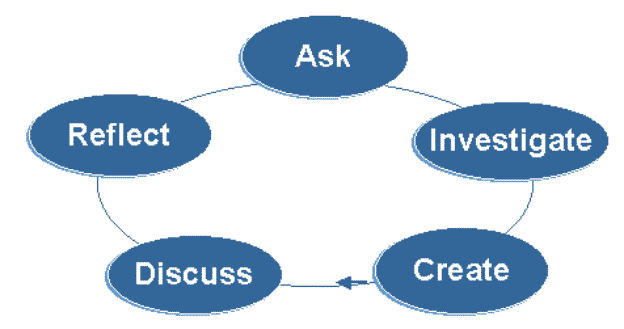
Inquiry-based learning is a method developed during the discovery learning movement of the 1960s. It came in response to a perceived failure of more traditional rote learning. Inquiry-based learning is a form of active learning, where progress is assessed by how well students develop experimental, analytical and critical thinking skills rather than how many facts they have memorized.
Pakistan Science Foundation (PSF) has initiated “La Main a La Pate” – an Inquiry-Based Learning program in Pakistan with the support of the French government. First launched in France in 1996, the program is aimed at renovating and revitalizing the teaching of science in primary schools. In Pakistan, the PSF has organized three workshops to train teachers since the Pakistan launch of “La Main a La Pate” in 2010. The most recent workshop was in December 2011 that was conducted by two French trainers, Michel Ouliac and Patrick Marcel. It was attended by 30 teachers from Islamabad, Kot Addu, Rawalpindi and Karachi, according to a report in The Express Tribune newspaper.
A similar inquiry-based teaching effort has been undertaken by The Citizens Foundation (TCF), a non-profit organization running 730 schools serving over 100,000 students in different parts of Pakistan. It is described in a recent book "Back to Pakistan: A Fifty-Year Journey" by Leslie Noyes Mass. Mass was in US Peace Corp who served as a young volunteer back in 1960s in Pakistan. The well-written book is about her return to Pakistan and her impressions of the country 50 years later. In 2009, Mass found a very different Pakistan: more education for children, a much larger population, and a place not nearly as friendly to the United States as it was when she first went there in 1960s.
Here's how Mass describes inquiry-based methods used at a summer science camp for TCF children at primary and secondary levels:
"Inquiry is a form of active learning where progress is assessed by how well students develop experimental and analytical skills rather than by how much knowledge they possess. In a science curriculum, this means that students are presented with a problem and the teacher guides them to solve it without making the solution explicit. This requires students to work together, to think critically, and to search for solutions based on the evidence rather than the predefined "correct" answer."
Then she goes on to describe the details of the experiments used to teach primary and secondary students.
Both PSF and TCF deserve kudos for promoting inquiry-based methods to encourage more active learning and critical thinking at an early age. These skills are essential to prepare Pakistani youngsters to be capable of facing the challenges of living in a highly competitive world in which the wealth of nations is defined in terms of human capital.
Related Links:
Intellectual Wealth of Nations
Pakistan Primary Education Crisis
Indian Students' Poor Performance on PISA and TIMSS
Pakistan's Demographic Dividend
India Shining, Bharat Drowning
Teaching Facts versus Reasoning
Poor Quality of Education in South Asia
Infections Cause Low IQs in South Asia, Africa?
Riaz Haq
Science Education in Pakistan to transform as AKU and The Dawood Foundation join hands | The Aga Khan University News
https://www.aku.edu/news/Pages/News_Details.aspx?nid=NEWS-002899
The Dawood Foundation's MagnifiScience Centre (MSC) and Aga Khan University (AKU) signed a Memorandum of Understanding (MOU) in pursuit of their common goal of equitable human advancement by launching projects in teacher training, innovation in science, education, informal learning, healthcare, learning technologies and the environment.
As per the terms of the MOU, both institutions will synergize through knowledge sharing, exchange of students and professionals, provision of trainings, consultations and workshops and implementation of research to foster the development of the youth and advancement of professionals.
“This collaboration will prove to be a great asset for the advancement in science education and environment. Together with AKU, we aim to provide people of our society with platforms where they can learn and prosper" said Syed Fasihuddin Biyabani, Chief Executive Officer of The Dawood Foundation.
Education that fosters problem-solving, creativity, and innovation is known to prepare youth for the fast-changing, increasingly global and technological world. I am grateful to the Dawood Foundation for joining hands with us to achieve excellence in providing such an education." said Dr. Anjum Halai, Vice Provost of Aga Khan University.
Both organisations agreed to designate their institutional representatives to implement programmes through this Memorandum of Understanding over a five-year term, to fulfil their aim of transforming science education in Pakistan.
The MagnifiScience Centre is an inclusive space to provide scientific exposure with hands-on learning experiences to everyone, irrespective of demographics and socio-economic backgrounds.
Dec 26, 2022
Riaz Haq
Athar Osama PIF Facebook post
Today we embark upon a 6-month long learning journey with 60 Pakistani Teachers and 6 Indonesian Teacher Trainers on Holistic Science Teaching.
This is an innovative approach to Teaching Science in a manner that is connected with other branches of knowledge such as History, Philosophy, Ethics, Religion and the Liberal Arts being piloted, to our knowledge, for the first time in the Muslim World.
Over 3 years, we will 6 workshops in Pakistan, Indonesia, and the Arab World - very different cultures, education systems, languages but the same objective: Train Teachers to create Curious Classrooms!
6-8 Grade Science Teachers may register to attend a future workshop at
http://pif.org.pk/scienceteaching/
World Science Collaborative Ltd, in collaboration with, Lahore University of Management Sciences (LUMS), The Aga Khan University – Institute of Education Development (AKU-IED), South East Asian Ministerial Organisation (SEAMEO), Indonesia, and Qatar University, Qatar, as well as partners Khawarzimi Science Society (KSS), Lahore; Pakistan Innovation Foundation, Pakistan, and STEMx – STEM School for the World, Islamabad presents a unique workshop to enable teachers to explore and learn how to teach science holistically.
In our society, teaching of science is often extremely siloed and compartmentalised whereby the science teacher delivers the content in the classroom but does not relate what is being taught to the real world nor brings forth (or draws upon) the diverse body of knowledge available in disciplines such as history, philosophy, religion and ethics. In doing so, he/she runs the risk, at the very least, of leaving the scientific learning unconnected, or much worse, leaving the students more confused than informed.
It is absolutely critical, therefore, to teach science holistically i.e. connect the learning in the classroom with the real world, for example, by:
* Bringing together knowledge from diverse sources and disciplines such as science, history, philosophy, religion, and ethics?
* Using hands-on experiments and play to bring inspiration and insight in the science classroom?
* Planning lessons that adequately address the curious minds of students and encourage critical inquiry?
* Addressing Big Philosophical Questions that stem from scientific discoveries such as Big Bang, Multiverses, Genetics, Evolution, Artificial Intelligence, etc.
The Holistic Teaching of Science Workshop is OPEN to ALL Teachers of Science in Middle School (Grades 6-8) at any public, private, or religious (madrassa) school who struggles with teaching modern science in the classroom and wants to do better.
The Holistic Science Teaching Online (Hybrid) Workshop is 1 of 6 Workshops that will be carried out in Pakistan, Indonesia, and Qatar between Dec 2022 and July 2025.
Jul 9, 2023
Riaz Haq
Rs3.4b NIETE project to build human capital
Planning minister says teacher quality key to URAAN's economic transformation
https://tribune.com.pk/story/2625174/rs34b-niete-project-to-build-h...
ISLAMABAD:
Planning Minister Ahsan Iqbal said on Friday that education remained the backbone of a nation's development and prosperity, and that Pakistan's path to progress fundamentally depends on quality education and the preparation of highly capable teachers.
Every nation must equip its young generation with quality knowledge while developing their productive capacity, creativity and problem-solving skills, he said.
The minister expressed these views during his visit to the National Institute of Excellence in Teacher Education (NIETE), where he was briefed on the institute's various programmes, teacher training activities and progress under the project.
Iqbal said during 2013-2018, four major projects were assigned to the Ministry of Education aimed at reforms in curriculum, the examination system and teacher training. He said he was pleased to see the National Institute of Excellence in Teacher Education (NIETE) taking shape as a functional and growing institution, adding that it was a seed planted by the Ministry of Planning now growing into a strong institution.
The curriculum could only become effective and relevant when teachers were equipped with modern knowledge and updated teaching methodologies, he said.
"Teaching is not merely a job; it is a mission and an instrument of nation-building," he said.
The minister said Pakistan must move beyond rote and copy-paste learning and promote creativity and critical thinking among students. The objective should not merely be to produce a generation that reads books, but one that writes research and generates new ideas.
Alongside modern science and technology education, the younger generation must also be familiarised with Pakistan's national identity, heritage and culture, he said.
"We have to prepare future generations to become confident ambassadors of Pakistan," he said.
Iqbal said URAAN Pakistan aimed not merely to expand education but to build human capital capable of driving a productive, competitive and knowledge-based economy. He stressed that strong foundations in literacy, numeracy and problem-solving must be laid in schools, making teacher quality fundamental to Pakistan's economic development.
The minister said the core idea behind establishing NIETE was that the quality of education could not be improved without improving the quality of teachers. A high-quality teacher education institution could not remain confined to its building; its real laboratory had to be the school and the classroom.
He said research should move from the classroom to evidence, from evidence to policy, and back to improved teaching practices. He stressed that artificial intelligence and modern technology should support teachers while complementing, not replacing, effective teaching.
Iqbal said he wanted to develop a state-of-the-art teacher training institution of the highest international standards, which could become the best such institution in South Asia and serve as a model for Pakistan and the wider world.
The current CDWP-level NIETE project is an extension of the original project launched by the Ministry of Federal Education and Professional Training in 2023 under Iqbal's guidance to promote excellence in teacher quality in Pakistan.
The revised project, estimated at Rs3.4 billion, expands the scope of the initiative in line with the education emergency declared by the prime minister and is aligned with URAAN Pakistan's Five Es National Economic Transformation Plan and Sustainable Development Goal 4. The initiative follows a National Consultative Meeting held in July 2022 on revamping teacher education in Pakistan, which focused on modernising teacher education in line with international standards and integrating technology into training, assessment and quality management.
yesterday