Pakistan has more shale oil than Canada, according to the US Energy Information Administration (EIA) report released on June 13, 2013.
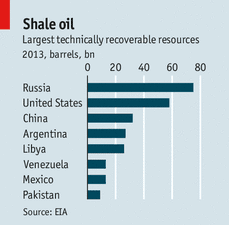
The US EIA report estimates Pakistan's total shale oil reserves at 227 billion barrels of which 9.1 billion barrels are technically recoverable with today's technology. In addition, the latest report says Pakistan has 586 trillion cubic feet of shale gas of which 105 trillion cubic feet (up from 51 trillion cubic feet reported in 2011) is technically recoverable with current technology.
The top ten countries by shale oil reserves include Russia (75 billion barrels), United States (58 billion barrels), China (32 billion barrels), Argentina (27 billion barrels), Libya (26 billion barrels), Venezuela (13 billion barrels), Mexico (13 billion barrels), Pakistan (9.1 billion barrels), Canada (8.8 billion barrels) and Indonesia (7.9 billion barrels).
Pakistan's current annual consumption of oil is only 150 million barrels. Even if it more than triples in the next few years, the 9.1 billion barrels currently technically recoverable would be enough for over 18 years. Similarly, even if Pakistan current gas demand of 1.6 trillion cubic feet triples in the next few years, it can be met with 105 trillion cubic feet of technically recoverable shale gas for more than 20 years. And with newer technologies on the horizon, the level of technically recoverable shale oil and gas resources could increase substantially in the future.
As can be seen in the shale resource map, most of Pakistan's shale oil and gas resources are located in the lower Indus basin region, particularly in Ranikot and Sembar shale formations.
Since the middle of the 18th century, the Industrial Revolution has transformed the world. Energy has become the life-blood of modern economies. Energy-hungry machines are now doing more and more of the work at much higher levels of productivity than humans and animals who did it in pre-industrial era. Every modern, industrial society in history has gone through a 20-year period where there was extremely large investment in the power sector, and availability of ample electricity made the transition from a privilege of an urban elite to something every family would have. If Pakistan wishes to join the industrialized world, it will have to do the same by having a comprehensive energy policy and large investments in the power sector. Failure to do so would condemn Pakistanis to a life of poverty and backwardness.
The availability of large domestic shale oil and gas expands the opportunity to reduce Pakistan's dependence on imports to overcome the current energy crisis and to fuel the industrial economy. But it'll only be possible with high priority given to investments in developing the energy sector of the country.
Here's a summary of a market research report on developing oil and gas resources in Asia Pacific, including Pakistan:
The new Asia Pacific shale gas report from OGANALYSIS noted that soaring demand, rapidly escalating LNG prices are forcing countries to look for possibility of shale gas production. In particular, China and India are witnessing rapid rise in demand and accordingly are planning to realize shale production earlier than planned. Australia is also planning to exploit its shale reserves to supply feed gas for its planned liquefaction terminals.
Success of the US shale and ongoing activities in Europe are encouraging Asian players to develop policy and frameworks for shale gas development. While China is allowing foreign companies to participate in shale exploration, India is planning to launch first bids in 2013. Over 10 companies are actively perusing shale operations in Australia and Pakistan and Bangladesh are in plans of identifying their reserve potential.
The report analyzes the current status, potential and feasibility of shale development, ongoing activities, government stance and companies operating in each of the key Asian shale markets including Australia, china, India, Pakistan and Bangladesh. The research work also identifies the top trends of Asia Pacific shale market. Key drivers and challenges faced by countries along with feasibility of first commercial production are also discussed in detail. Further, the Asia Pacific shale gas report from OGANALYSIS discusses physical characteristics of major basins in each country along with their reservoir properties and resource characteristics. Further, shale formations and key plays in each basin are discussed in detail. Basin wise company information along with the current status of activities in permits awarded is analyzed. In addition, company wise shale activities are provided for leading ten companies.
Here's an ET report on a partnership for off-shore drilling for oil in Pakistan:
State-run Pakistan Petroleum Limited (PPL) and Singapore-based oil and gas company Orion Energy are likely to form a joint venture for offshore drilling in Pakistan. Orion Energy, an independent oil and gas company headquartered in Singapore and with offices in London, is currently exploring scores of opportunities in Latin America.
According to sources, Orion had expressed interest in investing in Pakistan at the Pakistan Exploration Bidding Round 2012, held in London in December 2012 by the Pakistan Peoples Party-led coalition government.
On the sidelines of the event, Orion Energy Director David M Thomas, and his lawyer Nadim Khan, met the PPL managing director. The interaction was followed by another meeting between representatives of PPL and Orion, chaired by the director general of petroleum concessions. In the Petroleum Policy 2012, the government had increased the gas price for Offshore Shallow Zone to $7 per million British thermal units (mmbtu), for Offshore Deep Zone to $8 per mmbtu and for Offshore Ultra Deep Zone to $9 per mmbtu. A bonanza of $1 per mmbtu will be given to exploration companies for the first three offshore discoveries under the policy.
Orion Energy had expressed interest in exploring offshore areas in Pakistan in partnership with PPL because of the latter’s good reputation and extensive experience in exploration and production of gas.
Following extensive technical discussions and encouraging feedback from PPL, the two companies agreed to initially undertake a joint study to evaluate prospects of offshore drilling and identify prospective areas for comprehensive exploration work.
Orion Energy had also expressed a desire to come to Pakistan for technical discussions with PPL on offshore exploration and on matters pertaining to forming a joint venture to carry out the joint study. Both sides had also finalised a joint study agreement, which had been ready to be signed by officials.
However, the visit was delayed due to general elections in Pakistan. It was only later, in the first week of June, that an Orion team reached here.
Technical staff from Orion and PPL will undertake the study, based on the geological data available with the two companies and the directorate general of petroleum concessions. The study will be completed in about four months, and its main objective will be to identify potential offshore areas for detailed evaluation through an exploration work programme and the financial obligations that will entail.
Pakistan’s Tribal Areas (FATA) and Frontier Regions (FR) are believed to have massive reserves of oil and natural gas—which Pakistani officials have suddenly become very keen to demonstrate. But this is a highly restive, war-torn area where one right move could make all the difference, and one wrong move could ignite a conflict with irreversible consequences.
For now, the area remains unexplored and it was only in 2008 when Pakistani geologists began to study the area in earnest, with the support of the local authorities in the Federally Administered Tribal Areas (Fata) and the Frontier Region (FR). The results of this research were collected, processed and digitized in June 2012. The geologists discovered seven new oil and gas seepages during the mapping. The geologists also claim that 11 oil and gas exploration companies have already reserved 16 blocks in Fata.
The potential:
• Pakistani geologists say Fata in particular is poised to become a “new oil state” whose production could rival Dubai’s in only five years • The FR is bursting at the seams with gas, so they say
Here’s what the interest looks like so far:
• 17 companies have initiated operations in Fata/FR (in Khyber, Orakzai, North and South Waziristan, Peshawar, Kohat, Bannu, Tank and DI Khan) • Tullow has been active in Pakistan since 1991,…
Here's an Express Tribune piece on oil and gas prospects in FATA:
The Federally Administered Tribal Areas (Fata) and Frontier Regions (FR) have enormous reserves of minerals, oil and natural gas that can augment economic activity in the war-torn areas, a research project concluded. Talking to The Express Tribune ‘Source Rock Mapping and Investigation of Hydrocarbon Potential (SRMIHP)’ Project Coordinator Dr Fazal Rabi Khan said that exploration and excavation of oil and gas will introduce a new era of development and prosperity in the tribal areas.
“There can be many job opportunities created for people in the tribal belt if mineral exploration and extraction is pursued properly,” said Khan, who is also the chairman of the Geology Department in Abdul Wali Khan University Mardan (Palosa Campus).
The project was launched in 2008 under an agreement between the Fata Development Authority and National Centre of Excellence in Geology University of Peshawar. The project, which was completed at an estimated cost Rs40 million, was completed in June 2012.
Khan said that their objectives include identifying hydrocarbon generating rocks and its distribution in the region, preparing a geo-database regarding hydrocarbon potential and generating a systematic data to attract oil and gas companies for exploration.
The project has successfully collected, processed and digitised the data as a result of which, 80% of the project area has been mapped digitally. “This mapping has led to the discovery of seven new oil and gas seepages.” He added that 11 oil and gas exploration companies have reserved 16 blocks in Fata, which go across from FR Peshawar and Kohat to Khyber, Orakzai, Bannu, Tank and up to North and South Waziristan.
He said that recently 17 oil and gas exploration companies initiated their operations in Khyber, Orakzai, North and South Waziristan agencies as well as in FR Peshawar, Kohat, Bannu, Tank and DI Khan. Khan said that Mari Gas Company, HYCARBEX Inc, Oil and Gas Development Company, Tullow, Saif Energy, MOL Pakistan Oil and Gas, Orient Petroleum International, Pakistan Petroleum, ZHEN, ZAVER and others are currently working in Fata.
Oil and Gas Development Company (OGDC) will start drilling in these areas for the exploration of oil and gas reservoirs. The chairman said that the foreign oil company, Tullow, has obtained a licence for the exploration of oil and gas in North Waziristan Agency and Bannu, while MOL has shown interest in Khyber Agency, Kohat and Peshawar.
“Although law and order problems can become a hindrance, the project can be managed considering its importance,” he added.....
Here's a report on an on-shore discovery by Pakistan Petroleum (PPL) in Sindh province:
Karachi’s Pakistan Petroleum has reported flow test success from a deeper reservoir at its Adam X-1 gas and condensate find onshore Pakistan. The state player said that it had evaluated the potential of lower basal sands at a depth of 3450 metres at the Block 2568-13 probe over the past two months.
The Sanghar district, Sindh province well is to be put into production immediately after flowing 14.3 million cubic feet per day of gas and 125 barrels per day of condensate, the explorer said.
Pakistan Petroleum operates the licence on a 65% working interest with compatriot Mari Petroleum on 35%.
Here's a News report on rising oil production and declining gas production in Pakistan:
<i>KARACHI: Pakistan’s oil production in the fiscal year ended June 30, 2013 saw sharpest growth in 22 years of 14 percent. However, gas production decreased by almost three percent.
“The country’s FY13 oil production grew by 14 percent to average 76,000 barrels per day, which is well above historical 10-year oil production at cumulative average growth rate of one percent,” Atif Zafar at JS Global said. “But, the same was largely overshadowed by gas shortages in the country since gas production shrank by three percent to 4,100 million metric cubic feet per day (mmcfd).”
The decline is the rampant since 1987 mainly owing to natural depletion of existing fields.Pakistan’s proven recoverable oil and gas reserves stand enough only for 13 and 18 years, respectively, he said. However, analysts expect upgrade of reserves in the upcoming reserve appraisal.
The Oil and Gas Development Company (OGDC) recorded the highest production gains – based on barrels of oil equivalent – (up by three percent), whereas production of Pakistan Petroleum Limited (PPL) and Pakistan Oilfields Limited (POL) fell four percent and nine percent, respectively.
Based on provisional numbers for the last quarter of the fiscal year, the country’s oil production is up by only one percent, while gas production decreased by seven percent.
During the quarter, oil production of POL increased by 13 percent and gas by three percent, while OGDC’s oil production went up by two percent and gas by nine percent. Additionally, PPL’s oil production scaled up by four percent, while gas output was down by nine percent in the last quarter.
“We expect further improvement in oil production by an estimated 11 percent in the current fiscal year. However, additional gas production will largely be offset by natural depletion,” Zafar said.</i>
US is where the shale gas extraction technology was developed. Almost all of the world's shale gas today is being produced in the US.
However, other companies elsewhere, particular Polish companies, are very active in starting to do shale and tight gas exploration. Here's one example in Pakistan:
KARACHI - Pakistan is expected to start producing 30 Million Cubic Feet per day (MMCFD) of tight gas in July-August this year from Sajawal gas field located in the district of Dadu. According to media reports quoting government officials this would be first time the country would be producing tight gas. Pakistan has estimate tight gas reserves of about 40 Trillion Cubic Feet (TCF). The first tight gas sales and purchase agreement was signed on November 13, 2012 in Islamabad for production from a tight gas reservoir in Pakistan from Kirthar Block in Dadu, Sindh. The Kirthar Block is jointly owned by Polish Oil and Gas Company (PGNiG), which has 70 percent stake and Pakistan Petroleum Limited owns 30 percent. For the implementation of this project, SSGC has been awarded a contract for the construction of 52-km pipeline from Kirthar Block’s Rehman Gas Field which will be integrated into SSGC’s system at Naing Valve Assembly through the Bhit gas pipeline.
Here's an excerpt of a paper describing the difference between shale gas and tight gas:
All Shale Gas reservoirs are not the same. There are no typical Tight Gas reservoirs. These two statements can be found numerous times in the literature on shale gas and tight gas reservoirs. The one common aspect of developing these unconventional resources is that wells in both must be ‘hydraulically fractured’ in order to produce commercial amounts of gas. Operator challenges and objectives to be accomplished during each phase of the Asset Life Cycle (Exploration, Appraisal, Development, Production, and Rejuvenation) of both shale gas and tight gas are similar. Drilling, well design, completion methods and hydraulic fracturing are somewhat similar; but formation evaluation, reservoir analysis, and some of the production techniques are quite different.
Much of the experience in shale and tight gas has been developed in the US and in Canada, to a lesser extent; and most of the technologies that have been developed by operators and service companies are transferable to other parts of the world....
Pakistan's Sui Southern Gas Co (SSGC) signs first ever tight gas agreement with PPL and Polish Gas consortium for 20 million cubic feet of gas per day starting in 2013:
Pakistan joins the Tight Gas Club - A landmark achievement by SSGC SSGC is now ready to receive its first gas delivery from Rehman Gas Field. The major scope of this project, Pakistan’s first ever Tight Gas Project, involved construction of 6”/8” dia x 52 Km pipelines that include flow lines and export pipeline. This project was conducted in one of the hardest terrains and under toughest climatic conditions where temperature soared to as high as 50oC. A maximum of 20 mmcfd will be injected in the SSGC’s system through the Field.
Other salient features of the project:
· Objective: This achievement is also in line with MD’s strategic objective of FY 2012-13
· Agreement: The project commenced after the agreement signed between SSGC and a consortium of Polish Oil and Gas Company and Pakistan Petroleum Ltd. (PPL) in November 2012.
· Main Departments involved in commissioning: Planning and Development, Projects and Construction, Legal, Finance, HSEQA and L&EM Departments.
· Tendering Process: SSGC participated in the competitive bidding process last year and won the pipeline project bid (Rs 235 million).
· Resources: The Company utilized in-house resources, engaging the manpower and equipments for a period of 6 months since SSGC had no major transmission project for construction during this time.
· The Project enriched SSGC’s portfolio as an enterprising company.
Here's an Upstream report on the start of tight gas production by Polish firm PGNiG in Pakistan:
Polish explorer PGNiG has commenced production in Pakistan for the first time, bringing two wells online at the Rehman field in southern Pakistan. The Kirhtar licence area wells are producing on test at an expected rate of around 100 million cubic metres of gas per year.
The gas is being fed directly to the Pakistani transmission system, with the field’s entire output being sold to Pakistani authorities, the Warsaw-headquartered explorer said.
Test output is due to last 22 months, with total gas resources at the licence area estimated at around 12 billion cubic metres.
Situated in the western part of Sindh province, the Kirthar licence is operated by PGNiG on a 70% stake, with Pakistan Petroleum on 30%.
Pakistan is the explorer’s second international location for operated production after Norway.
Here's an ET story on pricing of domestic shale gas in Pakistan:
Pakistan Petroleum Limited (PPL) and Italy’s Eni have calculated that the price of shale gas should be $14 per million British thermal units (mmbtu), which has been rejected by the government as too much for the country’s existing tariff regime to absorb, an official told The Express Tribune.
The price was determined on the basis of expenditure required to drill for hard-to-reach shale gas reservoirs following a rise in interest in tapping this potential on the back of reports that Pakistan has massive reserves.
“There has to be a steady transition from conventional gas to tight and then finally to shale gas,” said Moin Raza Khan, Deputy Managing Director of PPL and head of its exploration operation. “This has to be a slow process because of the economics involved in the operations.”
Almost all the 4,000 million cubic feet per day (mmcfd) of gas produced in Pakistan comes from conventional gas fields, which can be reached relatively easily. Tight gas is trapped in impermeable rocks whereas gas trapped in shale formation is called shale gas. Average consumer gas price is around $4 per mmbtu, undermining the prospects for shale gas to be brought into the system at this stage, Khan said.
“One reason why the US produces shale gas in abundance is because of the economies of scale. We would have to do that to make it feasible and this can’t happen overnight,” he said.
So for the time being exploration firms including PPL are focusing on tight gas, for which the government has increased the price by 40% through a separate petroleum policy. First tight gas flows entered the transmission and distribution system in June this year as production of 15 mmcfd started from Kirthar block, which is a joint venture between a Polish firm and PPL.
Sui dilemma
For more than 57 years, Sui gas field fuelled the economy, so much that natural gas became synonymous with Sui gas. And now it has depleted.
“If you ask me I think the gas pressure will sustain for another 10 to 12 years,” Khan said. “The pressure used to be 1,300 psi (pounds per square inch), which has come down to only 300 psi.”
To tackle that problem, the company regularly installs compressor plants on the wells to maintain the pressure. “We are considering installing equipment for 100 psi and even 50 psi.”
Offshore expedition
PPL along with its local and foreign partners plans to drill a well in offshore Block-G in the Indus, the world’s second largest delta after the Bay of Bengal.
“Having a discovery offshore is very important,” he said, referring to the successive past failures. “So far, 13 wells have been drilled in Indus. Gas was found only in one and that wasn’t commercially feasible to take out.”
Pakistan has a coastline spread over 1,990 km and sub-divided into Indus and Makran deltas. Indus delta alone is spread over 1.1 million square kilometres. Pakistan’s area covers over 240,000 sq km of this....
NEW YORK — US proved oil reserves grew by a record amount in 2011, according to a government report Thursday, in the latest indicator of the North American energy boom.
The US added 3.8 billion barrels of crude in 2011, a 15 percent increase, according to the US Energy Information Administration. The amount represents a record volumetric increase in oil reserves for the second year in a row, EIA said.
Proved oil reserves stood at 29.0 billion barrels in 2011 (vs 257 billion barrels in Saudi Arabia), the highest volume since 1985.
"Horizontal drilling and hydraulic fracturing in shale and other tight rock formations continued to increase oil and natural gas reserves," said EIA Administrator Adam Sieminski.
"Higher oil prices helped drive record increases in crude oil reserves, while natural gas reserves grew strongly despite slightly lower natural gas prices in 2011."
The data came as US petroleum producers continue to push oil output to levels not seen since the early 1990s.
Energy companies have also boosted natural gas output in recent years due to the shale boom. While natural gas output varies monthly somewhat due to incremental investment decisions, US natural gas production has been at record levels in recent years.
The US added 31.2 trillion cubic feet (0.9 trillion cubic meters) of natural gas reserves in 2011, an increase of 9.8 percent, the EIA said. The 2011 natural gas volumetric increase was the second largest in US history after the 2010 rise.
Here's a China Daily report on what China can learn from US shale energy development:
WASHINGTON -- The surging shale energy output in recent years has been centering in North America, but it can also happen in other places like China, a US energy expert said Friday. Shale gas will come to play a more important role in China's energy mix in the long term, said IHS Cambridge Energy Research Associates Chairman Daniel Yergin at a seminar on energy boom in North America.
"China has great potential for shale gas but it will take perhaps five to 10 years to develop, due to the lack of infrastructure and logistic capabilities," Yergin told Xinhua.
He added that Chinese energy companies among others are learning the necessary technologies from their American counterparts to unlock the unconventional energy including shale oil and gas.
The energy industry was concerned a decade ago that US energy output had hit the ceiling and started to go down, but now the United States is about to overtake Russia in terms of oil and gas production, said Yergin.
The United States produced the equivalent of 22 million barrels a day of oil, natural gas and related fuels in July, according to figures from the Energy Department.
The shale energy bonanza reduced US imports of natural gas and crude oil by 32 percent and 15 percent respectively in the past five years.
However, the environmental implications of shale gas extraction, a process that includes hydraulic fracturing, remain uncertain.
Hydraulic fracturing involves pumping water, sand and chemicals deep underground into horizontal gas wells at high pressure to crack open hydrocarbon-rich shale and extract natural gas.
Accelerated shale gas drilling and hydrofracking in recent years has fueled concerns about contamination in nearby drinking water supplies.
Here's a News story on US agreeing to help Pakistan with shale gas development:
ISLAMABAD: In a major development the US has agreed to extend the technical help for the exploration of shale gas reserves in Pakistan and to this effect a US company is all set to initiate a study for an exact assessment of oil and gas reserves – particularly the shale gas – available in Pakistan, an official told The News.
The study is to take nine months to be completed, reveals one of the senior officials – who were part of the high level delegation that recently visited the US and held dialogues on energy in Washington and Houston between November 12 and 16.
The delegation – headed by the Minister for Petroleum and Natural Resources Shahid Khaqan Abbasi – comprised of secretaries and heads of public sector entities.
Later, the petroleum ministry signed an agreement with the US consultant Advanced Engineering Associates International, Inc (AEAI) that would embark on the strategic study to assess the actual reserves of shale gas in Pakistan and then with the help of the US experts four methods would be formulated to exploit the shale gas reserves.
The Director General Petroleum Concession Saeed Ullah Shah said the study will be completed in nine months. To a question, he said that the USAID would finance the study.
The EIA (Energy Information Administration) — US federal authority on energy statistics and analysis – in June last said that Pakistan was estimated to have fresh recoverable shale gas reserves of 105 trillion cubic feet (TCF) and more than nine billion barrels of oil.
The official said Pakistan has conventional gas reserves of just 23 TCF and conventional oil reserves of 286 million barrel per day. “We have set the date to AEAI for the exact identification and authentication of shale gas reserves,” he said.
“Shale gas had seen tremendous developments in the United States and a couple of other countries were trying to use the latest energy source. Pakistan was also encouraging exploration and production companies to venture into the field,” said the official. Secretary petroleum and natural resources Abid Saeed said that US officials showed willingness to help Pakistan in coping with energy crisis and extend the technical expertise and training to Pakistan’s officials in shale gas exploitation. USAID has already helped Pakistan in formulating the shale gas policy.
ISLAMABAD, Dec 3: About 1.3 billion people in the world are living without electricity; two-thirds of them being in 10 countries and four of them, including Pakistan, in the Asia Pacific region, says a report of the United Nations.
According to the Statistical Yearbook for Asia and the Pacific-2013 released by a UN commission on Tuesday, an estimated 60 per cent of capacity-addition efforts in future will be focused on mini-grids and off-grid connections in which renewable energy sources will play a vital role.
In the generation of electricity from renewable sources, the Asian and Pacific region led the world in 2010. But this amounted to only 15.8 per cent of the region’s total electricity, which is below the world average of 19.4 per cent.
With less than 400 kilowatt-hours per capita, the annual household electricity consumption in the region is the second lowest among the world’s regions, after Africa where it is 200kwh.
About 2.6bn people in the world and 1.8bn in the region use solid fuels for cooking. The WHO estimates that more than 1.45 million people die prematurely each year from indoor air pollution caused by burning solid fuels with insufficient ventilation.
Women’s economic empowerment
The report says that despite its economic growth, the region lags behind in economic empowerment of women. It calls for targeted policy measures to facilitate women’s economic empowerment.
Women still bear the burden of unremunerated productive work, shouldering the major share of household management and care-giving responsibilities.
The report says that in Pakistan women spend 5.5 hours a day on housework and 1.2 hours on childcare whereas men spend 2.5 hours on housework and 0.9 hours on childcare.
It also says that women are overrepresented in sectors and positions that are vulnerable, poorly paid and less secure. For instance, 42 per cent of working women/girls belonged to agriculture sector in 2012 compared with 36.0 per cent of male workers.
Here's a Marketwatch report on oil and gas find in Pakistan:
CALGARY, ALBERTA, Feb 18, 2014 (Marketwired via COMTEX) -- Jura Energy Corporation ("Jura") CA:JEC +18.37% today announced a gas and condensate discovery at the Ayesha-1 exploration well in the Badin IV South block.
The Ayesha-1 well was completed in the 'B' Sands of the Lower Goru Formation of Cretaceous age. During a short test on 32/64 inch choke, the well flowed gas with a heating value of approximately 1,000 Btu/Scf at a rate of 11.34 MMcf/d and a wellhead flowing pressure of 1,998 psi. The condensate to gas ratio was in the range of 10-12 bbl/MMcf with minimal water cut production. Detailed testing of Ayesha-1 will continue over the next few days.
Anticipated future production from the Ayesha-1 discovery is expected to be entitled to a gas price of US$6 per MMBtu under Pakistan s Petroleum (Exploration & Production) Policy, 2012.
Shahid Hameed, CEO of Jura, commented on the Ayesha-1 test results saying: "We are delighted with the successful test results. Given Ayesha-1's proximity to existing processing and pipeline infrastructure, this commercial discovery could be brought into production on a fast-track basis. Our Badar and Guddu fields are already in production and first gas production is anticipated from Zarghun South in the first half of 2014."
The drilling rig has now been released from Ayesha-1 and mobilized for the drilling of another exploration well, Haleema-1, in the Badin IV South block. The drilling of Haleema-1 is expected to commence in the first week of March 2014.
Jura holds a 27.5% working interest in the Badin IV South block, which is operated by Petroleum Exploration (Pvt) Limited.
Pakistan has sent samples of shale gas to the United States to determine the prospects of reserves of this untapped energy source following encouraging estimates given by the US Energy Information Administration (EIA), officials say. According to the EIA assessment, Pakistan holds massive shale gas reserves estimated at 51 trillion cubic feet (tcf), close to the conventional gas reserves of 58 tcf.
At present, the government is conducting a study with the technical assistance of US Agency for International Development to prove the presence of huge shale gas deposits in the country. Sources disclose that USAID has provided $1.8 million in technical assistance for undertaking the study. “Some samples have been sent to the US and research work will be completed in one year,” an official said, adding they were also looking for adopting US technology.
Washington is also imparting technical training to Pakistani officials and employees and engineers of public sector oil and gas companies.
The Ministry of Petroleum and Natural Resources has sent a summary to the Economic Coordination Committee (ECC) of the cabinet, seeking the go-ahead for initiating a pilot project to search and consume the shale gas potential. The move is aimed at gradually bridging the yawning gap between demand and supply of energy.
Shale gas is natural gas that is found trapped within shale formations. It has low permeability compared to conventional reserves, that’s why it does not come out easily and a specific amount of investment and pricing are required to encourage its exploitation.
At present, Pakistan is not producing shale gas and needs to undertake significant initial work to tap this energy resource.
The US, after the discovery of massive shale gas deposits there in recent years, has become a gas-exporting country. In future, reports say, it will experience a boom in shale oil production as well and will become the largest oil producer.
Officials point out that Pakistan will offer $12 per million British thermal units (mmbtu) to gas exploration and production companies under the pilot programme, a price that is close to the cost of gas to be imported from Iran under the Iran-Pakistan pipeline project.
“A policy framework has been prepared and its approval will be sought from the ECC in its upcoming meeting,” an official of the petroleum ministry told The Express Tribune.
According to the official, exploration companies have already found some traces of shale gas during the search for conventional gas as 10% to 12% of shale gas appears on upper faces of conventional gas.
Experts suggest that Pakistan has consumed around 40% of conventional gas reserves and shale gas is the most viable option to meet growing energy needs.
A study conducted by a group of exploration and production companies says the production of shale gas will be economical at about 80% of the price of Brent crude, but this will have to be brought down to 70%.
Apart from shale gas, the government is also planning to drill 400 wells in the next four years in an effort to enhance the country’s oil and gas production.
Though in the past one year new gas deposits had been found, total production of the country stood at almost the same level at four billion cubic feet per day because of depletion of reserves in old fields.
According to officials, the country has added 500 million cubic feet of gas per day (mmcfd) from new finds, but a quantity more than that has been depleted. Therefore, the impact of additional 500 mmcfd is not reflected in overall production.
However, oil output has risen to near 100,000 barrels per day compared to 74,000 barrels per day earlier.
Here's a Texas news story about Pakistan seeking help of a Pakistani-American oilman in Midland, Tx to develop Pakistani shale oil and gas:
Among those drawn to the Permian Basin is Jalil Abbas Jilani, Pakistan’s ambassador to the United States, who made a brief trip to Midland Wednesday.
“Pakistan has huge oil and gas reserves and we’re looking at this area for investors interested in joint ventures,” explained the ambassador, speaking by phone as he headed to the airport to fly to Houston. He was accompanied by Afzaal Mahmood, general consul for Pakistan stationed in Houston.
Jilani said he was impressed “by the things happening in Midland” and that he was warmly received at the luncheon attended by local oil men, including Don Evans as well as Midland Mayor Jerry Morales and Jose Cuevas, owner of JumBurrito. He said he hopes local businesses will consider participating in what he described as significant opportunities in Pakistan.
It’s estimated Pakistan holds total conventional and unconventional reserves of about 160 trillion cubic feet equivalent.
Anwar, a native of Pakistan, explained that the ambassador was making an “exculpatory” visit to Midland to gauge interest in helping Pakistan develop its unconventional hydrocarbons.
“They have an acute shortage of natural gas. They used to have conventional gas reserves, but with population growth and economic expansion,” they’re experiencing a shortfall, Anwar said.
The U.S. Energy Information Administration cited a Pakistani government report that the country had a natural gas shortfall of 912 billion cubic feet in 2013, though its dry natural gas production has grown by over 80 percent over the last decade to 1,462 Bcf in 2012.
Edward L. Morse in Foreign Affairs Magazine on declining cost of finding and extracting shale oil and gas fueling the shale revolution:
Despite its doubters and haters, the shale revolution in oil and gas production is here to stay. In the second half of this decade, moreover, it is likely to spread globally more quickly than most think. And all of that is, on balance, a good thing for the world.
The recent surge of U.S. oil and natural gas production has been nothing short of astonishing. For the past three years, the United States has been the world’s fastest-growing hydrocarbon producer, and the trend is not likely to stop anytime soon. U.S. natural gas production has risen by 25 percent since 2010, and the only reason it has temporarily stalled is that investments are required to facilitate further growth. Having already outstripped Russia as the world’s largest gas producer, by the end of the decade, the United States will become one of the world’s largest gas exporters, fundamentally changing pricing and trade patterns in global energy markets. U.S. oil production, meanwhile, has grown by 60 percent since 2008, climbing by three million barrels a day to more than eight million barrels a day. Within a couple of years, it will exceed its old record level of almost ten million barrels a day as the United States overtakes Russia and Saudi Arabia and becomes the world’s largest oil producer. And U.S. production of natural gas liquids, such as propane and butane, has already grown by one million barrels per day and should grow by another million soon.
What is unfolding in reaction is nothing less than a paradigm shift in thinking about hydrocarbons. A decade ago, there was a near-global consensus that U.S. (and, for that matter, non-OPEC) production was in inexorable decline. Today, most serious analysts are confident that it will continue to grow. The growth is occurring, to boot, at a time when U.S. oil consumption is falling. (Forget peak oil production; given a combination of efficiency gains, environmental concerns, and substitution by natural gas, what is foreseeable is peak oil demand.) And to cap things off, the costs of finding and producing oil and gas in shale and tight rock formations are steadily going down and will drop even more in the years to come.
The evidence from what has been happening is now overwhelming. Efficiency gains in the shale sector have been large and accelerating and are now hovering at around 25 percent per year, meaning that increases in capital expenditures are triggering even more potential production growth. It is clear that vast amounts of hydrocarbons have migrated from their original source rock and become trapped in shale and tight rock, and the extent of these rock formations, like the extent of the original source rock, is enormous -- containing resources far in excess of total global conventional proven oil reserves, which are 1.5 trillion barrels. And there are already signs that the technology involved in extracting these resources is transferable outside the United States, so that its international spread is inevitable.
In short, it now looks as though the first few decades of the twenty-first century will see an extension of the trend that has persisted for the past few millennia: the availability of plentiful energy at ever-lower cost and with ever-greater efficiency, enabling major advances in global economic growth.
WHY THE PAST IS PROLOGUE
The shale revolution has been very much a “made in America” phenomenon. In no other country can landowners also own mineral rights. In only a few other countries (such as Australia, Canada, and the United Kingdom) is there a tradition of an energy sector featuring many independent entrepreneurial companies, as opposed to a few major companies or national champions. And in still fewer countries are there capital markets able and willing to support financially risky exploration and production.
This powerful combination of indigenous factors will continue to drive U.S. efforts. A further 30 percent increase in U.S. natural gas production is plausible before 2020, and from then on, it should be possible to maintain a constant or even higher level of production for decades to come. As for oil, given the research and development now under way, it is likely that U.S. production could rise to 12 million barrels per day or more in a few years and be sustained there for a long time. (And that figure does not include additional potential output from deep-water drilling, which is also seeing a renaissance in investment.)
Two factors, meanwhile, should bring prices down for a long time to come. The first is declining production costs, a consequence of efficiency gains from the application of new and growing technologies. And the second is the spread of shale gas and tight oil production globally. Together, these suggest a sustainable price of around $5.50 per thousand cubic feet for natural gas in the United States and a trading range of $70–$90 per barrel for oil globally by the end of this decade.
These trends will provide a significant boost to the U.S. economy. Households could save close to $30 billion annually in electricity costs by 2020, compared to the U.S. Energy Information Administration’s current forecast. Gasoline costs could fall from an average of five percent to three percent of real disposable personal income. The price of gasoline could drop by 30 percent, increasing annual disposable income by $750, on average, per driving household. The oil and gas boom could add about 2.8 percent in cumulative GDP growth by 2020 and bolster employment by some three million jobs.
Beyond the United States, the spread of shale gas and tight oil exploitation should have geopolitically profound implications. There is no longer any doubt about the sheer abundance of this new accessible resource base, and that recognition is leading many governments to accelerate the delineation and development of commercially available resources. Countries’ motivations are diverse and clear. For Saudi Arabia, which is already developing its first power plant using indigenous shale gas, the exploitation of its shale resources can free up more oil for exports, increasing revenues for the country as a whole. For Russia, with an estimated 75 billion barrels of recoverable tight oil (50 percent more than the United States), production growth spells more government revenue. And for a host of other countries, the motivations range from reducing dependence on imports to increasing export earnings to enabling domestic economic development.
RISKY BUSINESS?
Skeptics point to three problems that could lead the fruits of the revolution to be left to wither on the vine: environmental regulation, declining rates of production, and drilling economics. But none is likely to be catastrophic.
Hydraulic fracturing, or “fracking” -- the process of injecting sand, water, and chemicals into shale rocks to crack them open and release the hydrocarbons trapped inside -- poses potential environmental risks, such as the draining or polluting of underground aquifers, the spurring of seismic activity, and the spilling of waste products during their aboveground transport. All these risks can be mitigated, and they are in fact being addressed in the industry’s evolving set of best practices. But that message needs to be delivered more clearly, and best practices need to be implemented across the board, in order to head off local bans or restrictive regulation that would slow the revolution’s spread or minimize its impact.
As for declining rates of production, fracking creates a surge in production at the beginning of a well’s operation and a rapid drop later on, and critics argue that this means that the revolution’s purported gains will be illusory. But there are two good reasons to think that high production will continue for decades rather than years. First, the accumulation of fracked wells with a long tail of production is building up a durable base of flows that will continue over time, and second, the economics of drilling work in favor of drilling at a high and sustained rate of production.
Finally, some criticize the economics of fracking, but these concerns have been exaggerated. It is true that through 2013, the upstream sector of the U.S. oil and gas industry has been massively cash-flow negative. In 2012, for example, the industry spent about $60 billion more than it earned, and some analysts believe that such trends will continue. But the costs were driven by the need to acquire land for exploration and to pursue unproductive drilling in order to hold the acreage. Now that the land-grab days are almost over, the industry’s cash flow should be increasingly positive.
It is also true that traditional finding and development costs indicate that natural gas prices need to be above $4 per thousand cubic feet and oil prices above $70 per barrel for the economics of drilling to work -- which suggests that abundant production might drive prices down below what is profitable. But as demand grows for natural gas -- for industry, residential and commercial space heating, the export market, power generation, and transportation -- prices should rise to a level that can sustain increased drilling: the $5–$6 range, which is about where prices were this past winter. Efficiency gains stemming from new technology, meanwhile, are driving down break-even drilling costs. In the oil sector, most drilling now brings an adequate return on investment at prices below $50 per barrel, and within a few years, that level could be under $40 per barrel.
THINK GLOBALLY
Since shale resources are found around the globe, many countries are trying to duplicate the United States’ success in the sector, and it is likely that some, and perhaps many, will succeed. U.S. recoverable shale resources constitute only about 15 percent of the global total, and so if the true extent and duration of even the U.S. windfall are not yet measurable, the same applies even more so for the rest of the world. Many countries are already taking early steps to develop their shale resources, and in several, the results look promising. It is highly likely that Australia, China, Mexico, Russia, Saudi Arabia, and the United Kingdom will see meaningful production before the end of this decade. As a result, global trade in energy will be dramatically disrupted.
A few years ago, hydrocarbon exports from the United States were negligible. But by the start of 2013, oil, natural gas, and petrochemicals had become the single largest category of U.S. exports, surpassing agricultural products, transportation equipment, and capital goods. The shift in the U.S. trade balance for petroleum products has been stunning. In 2008, the United States was a net importer of petroleum products, taking in about two million barrels per day; by the end of 2013, it was a net exporter, with an outflow of more than two million barrels per day. By the end of 2014, the United States should overtake Russia as the largest exporter of diesel, jet fuel, and other energy products, and by 2015, it should overtake Saudi Arabia as the largest exporter of petrochemical feedstocks. The U.S. trade balance for oil, which in 2011 was −$354 billion, should flip to +$5 billion by 2020.
By then, the United States will be a net exporter of natural gas, on a scale potentially rivaling both Qatar and Russia, and the consequences will be enormous. The U.S. gas trade balance should shift from −$8 billion in 2013 to +$14 billion by 2020. U.S. pipeline exports to Mexico and eastern Canada are likely to grow by 400 percent, to eight billion cubic feet per day, by 2018, and perhaps to ten billion by 2020. U.S. exports of liquefied natural gas (LNG) look likely to reach nine billion cubic feet per day by 2020.
Sheer volume is important, but not as much as two other factors: the pricing basis and the amount of natural gas that can be sold in a spot market. Most LNG trade links the price of natural gas to the price of oil. But the shale gas revolution has delinked these two prices in the United States, where the traditional 7:1 ratio between oil and gas prices has exploded to more than 20:1. That makes LNG exports from the United States competitive with LNG exports from Qatar or Russia, eroding the oil link in LNG pricing. What’s more, traditional LNG contracts are tied to specific destinations and prohibit trading. U.S. LNG (and likely also new LNG from Australia and Canada) will not come with anticompetitive trade restrictions, and so a spot market should emerge quickly. And U.S. LNG exports to Europe should erode the Russian state oil company Gazprom’s pricing hold on the continent, just as they should bring down prices of natural gas around the world.
In the geopolitics of energy, there are always winners and losers. OPEC will be among the latter, as the United States moves from having had a net hydrocarbon trade deficit of some nine million barrels per day in 2007, to having one of under six million barrels today, to enjoying a net positive position by 2020. Lost market share and lower prices could pose a devastating challenge to oil producers dependent on exports for government revenue. Growing populations and declining per capita incomes are already playing a central role in triggering domestic upheaval in Iraq, Libya, Nigeria, and Venezuela, and in that regard, the years ahead do not look promising for those countries.
At the same time, the U.S. economy might actually start approaching energy independence. And the shale revolution should also lead to the prevalence of market forces in international energy pricing, putting an end to OPEC’s 40-year dominance, during which producers were able to band together to raise prices well above production costs, with negative consequences for the world economy. When it comes to oil and natural gas, we now know that though much is taken, much abides -- and the shale revolution is only just getting started.
As oil prices have fallen, the cost of production from US shale has emerged as a critical question for investors.
In a downturn, higher-cost supply is most at risk, and the need for horizontal wells and hydraulic fracturing – “fracking” – in shale reserves means they are more expensive to develop than many oilfields in the Middle East.
If oil prices fall further, however, US production costs are likely to fall too, providing a safety valve to reduce the pressure on producers.
There is no single answer to the break-even price for shale developments: it varies from area to area and well to well.
Even with US crude prices of about $100 a barrel earlier in the year, the small and midsized exploration and production companies that led the US shale revolution were running large cash deficits.
If oil remains at its present level of roughly $82 per barrel, it will put back the point at which they will be able to cover their capital spending from their cash flows.
However, their costs have already fallen sharply, and could fall further. The median North American shale development needs a US crude price of $57 a barrel to break even today, compared with $70 a barrel in the summer of last year, according to IHS, the research company.
EOG Resources, one of the most successful of the shale oil producers, cut its cost per well in the Leonard shale on the border of Texas and New Mexico from $6.9m in 2011 to $5m this year, while raising average production from each well.
Melissa Stark, a managing director at Accenture, the consultancy, says the industry still has a lot of room for improvement.
With more than 18,000 horizontal wells set to be drilled in the US this year, she argues that improving the “manufacturing model” of repeated similar projects could deliver large savings.
Accenture believes the average cost of a US shale well could be cut by up to 40 per cent by better management of factors such as planning, logistics, and relationships with suppliers.
David Vaucher of IHS says that if prices remain at around today’s levels, rates charged to oil producers for fracking and other services are likely to remain about where they are.
However, he adds, the indications recently have been that productivity per well is still improving. Production from new wells per working drilling rig has been rising in the Bakken of North Dakota and the Eagle Ford and Permian Basin of Texas, the three main shale regions, according to the US government’s Energy Information Administration.
The effort companies are putting into each well is rising. ConocoPhillips and others have been using much more proppant – the sand or similar material used in fracking to hold open cracks in the rock so the oil can flow out – to increase production.
Companies are also fracking wells in more stages: up from an average of 18 sections per horizontal well in 2012 to an expected 23 per well next year, according to Pac West, another consultancy.
Even so, costs per barrel are probably still falling.
Downward pressure on costs will heighten if the oil price continues to fall. Drilling rigs and other equipment such as pumps for fracking tend not to be tied up on long-term contracts, meaning that producers can adjust their spending quickly in response to oil price movements.
In a deepening slump, the service companies providing services such as drilling and hydraulic fracturing are likely to come off worst, according to Steve Wood of Moody’s, the rating agency.
“Exploration and production companies have a product that people will still want to buy,” he says.
“But service companies are dependent on the E & P’s capital spending, which can be cut back.”
Service companies would be hit both by lower activity, and by the greater leverage that their customers will have to bargain their charges down.
Halliburton, the world’s second-largest oil services company by market capitalisation, told analysts on a call this week that activity in the US continued to “surge higher”.
Dave Lesar, chief executive, said: “We do not see momentum slowing any time soon”, and added that he believed oil prices at their present levels were “not sustainable”.
However, he acknowledged that it was important for the company to “deliver the lowest cost per barrel to our customers, which in turn positions them and Halliburton to perform best in volatile markets.”
There could be a parallel for US oil in shale gas production. When prices fell to a 10-year low in 2012, it seemed that most US shale production would be uneconomic and output would collapse.
New extraction techniques and high oil prices boost US oil production
As it turned out, production did fall in higher-cost areas such as the Haynesville shale of Louisiana and Texas, but it continued to rise in the Marcellus Shale of Pennsylvania.
The best companies were able to produce at costs that were much lower than many people had expected. Cabot Oil and Gas, for example, says it has a cash cost in the Marcellus of just 75 cents per thousand cubic feet, compared with a benchmark US gas price of about $3.70.
If oil-focused- shale companies can follow that example, US output will be a lot more resilient than its competitors in other oil-producing countries would hope.
Pakistan’s exclusive economic zone has grown by 150 nautical miles, adding around 50,000 square kilometres of international waters to its territory. A United Nations commission has accepted Pakistan’s claim for extension of its continental shelf limits from 200 nautical miles to 350 nautical miles, according to a statement issued by the Pakistan Navy on Friday. “This adds over 50,000 sq kms of continental shelf to the existing 240,000 sq kms of EEZ under Pakistan’s jurisdiction,” its added. Pakistan now enjoys exclusive rights over the seabed and subsoil resources, allowing it to drill for petroleum or lay submarine cables or pipelines in the added area. Article 76 of the UN Convention on the Law of the Sea allows coastal states to extend their continental shelf beyond 20 nautical miles. However, the state is required to prove its case through technical data to the UN Commission on the Limits of the Continental Shelf – a body of 21 experts in geology, geophysics, hydrography and related disciplines. In 2005, the navy and the National Institute of Oceanography with the science and technology ministry had started this project. After years of processing technical data, a submission was made to the UN on April 30, 2009. A seven-member commission after over a year-long scrutiny, adopted the recommendations for extension of the country’s continental shelf. Pakistan’s delegation gave the final presentation on March 10. The UN has now announced the adoption of Pakistan’s claim. The navy statement termed the decision a landmark in the country’s history which would bring vast economic benefits through the exploitation of extensive natural resources.
#Pakistan confirms it has 105 trillion cubic ft #shale gas, 58 billion barrels of shale oil reserves #energy http://www.dawn.com/news/1220955
Pakistan has confirmed recoverable reserves of around 200 trillion cubic feet (TCF) of natural gas and around 58 billion barrels of oil in its shale structure — many times larger than existing conventional gas reserves of around 20 TCF and 385 million barrels of oil.
This was stated by Minister for Petroleum and Natural Resources Shahid Khaqan Abbasi at a press conference held here on Thursday to explain main findings of a recently concluded Shale Gas Study based on actual data of existing wells.
“The conclusion (of the study) is that Pakistan has huge potential of shale gas and oil which is much bigger than previous estimates of the United States Energy Information Administration (USEIA) and technology is available at home to produce this resource,” he said.
Also read: Oil and gas reserves found in Mianwali
Mr Abbasi said the country had a massive potential of 10,159 TCF shale gas and 2.3tr barrels of oil. He said the USEIA had reported in April 2011 the presence of 206 TCF shale gas in lower Indus Basin out of which 51 TCF was termed technically recoverable.
However, in June 2013 the USEIA revised the shale gas resource in Pakistan at 586 TCF in place out of which 105 TCF was tipped as risked technically recoverable and also included 9.1bn barrels of shale oil risked technically recoverable out of 227bn barrels shale oil in place.
He said a shale gas study initiated in January 2014 with the support of USAID had been completed. It proved that Pakistan had 10,159 TCF of shale gas resource and 2,323bn barrels of shale oil.
He said the findings were reached when recoverable data of 1,611 wells were collected and shale formation of 1,312 wells through drill was examined. The study covered lower and middle Indus Basin, geographically spread over Sindh, southern Punjab and eastern Balochistan. He said 70 per cent of wells data were used to develop the study.
The minister said the samples were sent to New Tech Laboratory in Houston to verify shale gas and oil resource in place. The study confirmed that Pakistan had the potential of shale gas and oil which was more than expectations.
He said Pakistan had the technology for exploring conventional oil and gas that could be used for exploiting shale oil and gas. However, the country requires more technology for exploiting shale oil and gas resource on a larger scale. He said that real challenges were environmental issues, availability of water and higher cost of drilling. He said one well required 3-8m barrels of water.
Shale gas will cost $10 per Million British Thermal Unit. “We have assigned OGDCL and PPL to explore shale gas and oil from one well to determine cost of extracting them.”
Responding to a question, Mr Abbasi said the natural gas would be available only for domestic consumers in Punjab and even they would not get it between 10pm and 5am. The demand of gas in domestic sector in Punjab is about 950mmcfd, but supplies will be around 650 mmcfd and the difference would need to be met through pressure management.
He said the power plants and fertiliser units would be run on LNG. “CNG sector may also get LNG if supply is available,” he said, adding that captive power plants would also be switched to LNG.
In reply to another question, he said a transparent process had been followed in awarding LNG contract and all required information and record were provided to the National Accountability Bureau. “I have been engaged personally in process of LNG and, therefore, take full responsibility and am available for any questioning or accountability,” he said.
He said that a summary had also been moved to the Council of Common Interests to approve regulation of LPG prices to provide relief to consumers but the CCI had not met for 10 months.
Pakistan has massive deposits of 10,159 trillion cubic feet (tcf) of shale gas and 2.3 trillion barrels of oil – estimates that are several times higher than figures given by the US Energy Information Administration (EIA), reveals a study conducted with the help of US Agency for International Development (USAID).
EIA had reported in April 2011 that 206 tcf of shale gas was present in the lower Indus Basin, of which 51 tcf were technically recoverable.
However, in June 2013, EIA revised the estimate upwards to 586 tcf, of which 105 tcf were tipped as technically recoverable. Apart from gas, EIA also saw the presence of 9.1 billion barrels of shale oil that were technically recoverable out of the estimated deposits of 227 billion barrels.
Speaking at a press conference, Petroleum and Natural Resources Minister Shahid Khaqan Abbasi said the study was undertaken with the support of USAID in January 2014, and was completed in November this year.
He said the study confirmed that Pakistan had 10,159 tcf of shale gas and 2,323 billion barrels of oil reserves.
“Risked technically recoverable resource is 95 trillion cubic feet of shale gas and 14 billion barrels of shale oil,” Abbasi said, adding the data of 1,611 wells had been collected and shale formation of 1,312 wells was done through drilling.
He said 70% of data was used to develop the study and samples were sent to the New Tech laboratory in Houston, US for assessment. “Pakistan has the potential to produce shale gas and oil, which is more than expectations,” he remarked.
Abbasi insisted that the technology in Pakistan for exploring conventional oil and gas deposits could also be used for extracting shale reserves. Still, more technology was required for producing shale oil and gas on a large scale.
He cited environmental issues, provision of water and high cost of drilling as the real challenges. A well requires 3 to 8 million barrels of water.
“We have water but the real issue is its disposal,” he said, adding shale gas would cost $10 per million British thermal units. However, the cost will come down with the increase in recovery of untapped deposits.
He said the world was exploring shale gas and oil and Pakistan also wanted to harness that potential. “We have asked OGDC (Oil and Gas Development Company) and PPL (Pakistan Petroleum Limited) to extract shale gas and oil from a well in order to determine its cost.”
A policy for shale deposits will be formulated after the cost of drilling is determined.
According to Abbasi, Pakistan has 20 trillion cubic feet of conventional gas and 385 million barrels of oil. “Gas is enough to meet the needs for 15 years at the existing pace of production,” he said.
Adviser to Ministry of Petroleum Zaid Muzaffar revealed that OGDC was working on one conventional gas well in a bid to find shale gas and oil. “We hope it will get results in two to three months.”
A well needs $2 to $3 million of additional cost to reach the shale reserves.
Gas supply in winter
Abbasi said gas would be available in Punjab to domestic consumers only and liquefied natural gas (LNG) would be consumed to run power and fertiliser plants.
Compressed natural gas (CNG) stations may get LNG if it was available and captive power plants would also be switched to this fuel, he said.
The minister stressed that the petroleum ministry had followed a transparent process in the award of LNG contract. It has provided all information to the National Accountability Bureau, which has asked for a presentation.
He revealed that the ministry had sent a summary to the Economic Coordination Committee for deregulating oil prices, but it was turned down. “We are looking at the petroleum situation again to assess whether it should be deregulated or not.”
The state-owned Exploration and Production (E&P) companies; Pakistan Petroleum Limited (PPL) and Oil and Gas Development Company Limited (OGDCL), have started drilling of country''s first ever shale oil/gas well in Sindh. This was stated by Federal Minister for Petroleum and Natural Resources Shahid Khaqan Abbasi, who was flanked by State Minister for Petroleum Jam Kamal Khan and Advisor Petroleum Ministry Zahid Muzafar, while addressing a press conference here ion Thursday.
He said that in a new study undertaken by Director General Petroleum Concession (DGPC) with financial support from United States Agency for International Development (USAID) the shale gas revised in place resources of the country stand at 10,159 Trillion Cubic Feet (TCF) against previous estimated resources of 586 TCF. The minister said that out of this an estimated 200 TCF of shale gas resources are recoverable against 105 TCF of previous study.
Advisor Petroleum Ministry Zahid Muzafar, who is also Chairman Board of Directors OGDCL, in response to a question on the completion of first shale oil/gas well of the country said that it would be completed within four to five months and after the completion of first well the government will be in a position to determine wellhead price for shale gas/oil. He added that it would be around $10 per Million British Thermal Unit and on the basis of the pilot project the government will devise shale oil/gas policy to formally invite the local as well as international E&P companies to invest in the sector. Abbasi said that the new study had put the shale oil resources at 2,323 Billions of Stock Tank Barrels (BSTB) of which technically recoverable resources were 58 BSTB and risked technically recoverable resources estimated at 14 BSTB.
----
Talking to reporters on the occasion DGPC Saeedullah Shah said that the US Energy Information Administration (USEIA) in April 2011 reported presence of 206 TCF Shale Gas in Place Resource in Lower Indus Basin out of which 51 TCF were technically recoverable. However, in June 2013, USEIA revised Shale Gas resource in Pakistan as 586 TCF in place out of which 105 TCF were tipped as risked technically recoverable and also included 9.1 Billion Barrel Shale Oil risked technically recoverable resource out of 227 Billion Barrel Shale Oil in place.
The DGPC added that to get authenticate Shale Gas Resources in the country, Shale Gas Study with financial support from USAID was initiated in January 2014. The objectives of the study were to (i) validate Shale Gas Resource estimate of USEIA, (ii) assess availability of required technology and infrastructure for Shale Gas operations and (iii) formulate guidelines for Shale Gas Policy. The study was completed in November 2015 with a total cost of $2.2 millions. The study covered lower and middle Indus basin which geographically spread over Sindh and southern part of Punjab and eastern part of Balochistan province. Total area under the study was 271,700 km, which constitutes 33 percent of total sedimentary area of Pakistan. Under the study, detailed analysis of 124 wells were carried out including laboratory analysis on Shale Cores and Cuttings in USA. The study has confirmed presence of substantial Shale Gas and Shale Oil as under:
In place resource: Free gas (TCF), 3,778, adsorbed gas (TCF), 6,381Total gas (TCF), 10,159 and Oil (BSTB), 2,323 of which technically recoverable resource include free gas 188 TCF and Oil 58 BSTB. Risked technically recoverable resources are free gas 95 TCF and oil 14 BSTB.
Pak shale gas, oil reserve far higher than past estimate
Pakistan has around 200 trillion cubic feet of recoverable reserve of natural gas and around 58 billion barrels of oil in its shale structure which is higher than estimated previously, Minister for Petroleum and Natural Resources said.
Sharing findings of a recent Shale Gas Study, Minister for Petroleum and Natural Resources Shahid Khaqan Abbasi said the new data shows that reserves were many times larger than existing conventional gas reserves of around 20 trillion cubic feet (TCF) and 385 million barrels of oil.
A shale gas study initiated in January 2014 with the support of United States Agency for International Development (USAID) had been completed, proving that Pakistan had 10,159 TCF of shale gas resource and 2,323 billion barrels of shale oil.
“The conclusion (of the study) is that Pakistan has huge potential of shale gas and oil which is much bigger than previous estimates of the United States Energy Information Administration (USEIA) and technology is available at home to produce this resource,” he said.
He also said the USEIA had reported in April 2011 the presence of 206 TCF shale gas in lower Indus Basin out of which 51 TCF was termed technically recoverable.
USEIA in June 2013 revised it saying that the shale gas resource was at 586 TCF, out of which 105 TCF was tipped as risked technically recoverable.
It also included 9.1 billion barrels of shale oil risked technically recoverable out of 227 billion barrels shale oil in place.
Abbasi said Pakistan’s conventional oil and gas exploration technology could be used for exploiting shale oil and gas but it still needed more advanced technology for exploiting shale oil and gas resource on a larger scale.
He said that the exploration of shale reserves involves huge cost and two local companies Oil and gas Development Corporation Limited and Pakistan petroleum were asked to explore shale gas and oil from one well to determine the cost.
Once exploited, the new reserves will change the economic landscape of Pakistan, which is suffering massive energy shortages.–PTI
#Hungary's MOL makes it an even dozen #oil & #gas discoveries in #Pakistan http://upi.com/6332948t via @crudeoilprices
Hungarian energy company MOL said Friday it made a new discovery of oil and gas in Pakistan, bringing the total there so far to an even dozen.
Operating through a national subsidiary in Pakistan, the company said its discovery in the so-called TAL block in Pakistan is No. 8 so far in that basin and No. 12 in its history in the country. MOL has worked in Pakistan for the last 17 years.
"We are very proud of our 8th discovery in the MOL-operated TAL block," Berislav Gaso, MOL's chief officer for exploration and production, said in a statement. "This new discovery will help to improve the energy security of the country."
Pakistan consumes most of the natural gas it produces and the country has faced power issues because of aging infrastructure. According to the Asian Development Bank, addressing chronic energy issues is one of the ways in which Pakistan can ensure its economic growth remains on course.
Pakistan's economy is expected to expand from a 4.2 percent growth rate in 2015 to 4.8 percent by next year. A net importer of energy resources, the ADB said lower oil prices and soft inflationary pressures were pushing Pakistan's economy forward.
MOL said it was producing around 80,000 barrels of oil equivalent per day from the TAL block so far. Reserves flowed from the latest confirmed discovery at a test rate of around 2,000 barrels of oil per day and 900 barrels of oil equivalent in natural gas per day.
Pakistan has made the highest number of oil and gas discoveries in the current month as exploration companies found fresh hydrocarbon deposits in six wells that will add 50.1 million cubic feet per day (mmcfd) of gas and 2,359 barrels per day (bpd) of oil to the existing production levels.
Of these, major discoveries have been made in Sindh that already has a big share in total gas output in the country.
Gas utilities: World Bank recommends single transmission firm
Petroleum and Natural Resources Minister Shahid Khaqan Abbasi, while speaking during a meeting of the National Assembly Standing Committee on Petroleum and Natural Resources chaired by Bilal Ahmed Virk on Tuesday, said four discoveries were made in Sindh and the remaining two in Khyber-Pakhtunkhwa.
Of these, Oil and Gas Development Company made two finds, MOL Pakistan two and Petroleum Exploration Limited and United Energy Pakistan one each. The discoveries have shown presence of 31.6 mmcfd of gas and 339 bpd of crude oil in Sindh and 18.5 mmcfd of gas and 2,020 bpd of oil in K-P.
Sui Northern Gas Pipelines Limited (SNGPL) Managing Director Amjad Latif warned that the country’s gas reserves were depleting and no gas was available for the domestic consumers in Punjab. He pointed out that the purchasing cost of gas for domestic consumers stood at Rs510 per million British thermal units (mmbtu) but the consumers coming under the first slab were receiving it at Rs110 per mmbtu.
Eighty-five per cent of domestic consumers were paying less than 50% of the cost of gas and the industrial and commercial consumers were cross-subsiding the domestic consumers, he said.
However, now industrial and commercial consumers were being provided imported liquefied natural gas (LNG), so the burden of cross-subsidy had been shifted to SNGPL that was feeling the strain on its finances.
Though the gas production was declining, Latif told the committee that the company would lay pipelines over 8,000 km in the current year. At present, 1.5 million applications for new gas connections are awaiting approval of the company.
The country was facing gas shortages as politicians were using it as a tool to win elections.
During the meeting, National Assembly member Mian Tariq Mehmood, who belonged to the ruling PML-N, alleged that SNGPL had provided 100 gas meters in his constituency to please his political rival Imtiaz Safdar Warraich, though his requests for new meters were turned down repeatedly.
He insisted that the provision of gas meters to his opponent had damaged his political image. NA Standing Committee Chairman Bilal Ahmed Virk accused Director General Petroleum Concession Saeedullah Shah of not responding to the committee for the last two years.
Sui lease extension: PPL to pay 10% bonus to Balochistan
Describing Shah’s attitude as non-sense, he said he was not cooperating with the committee and sought the record of past meetings to show response of the director general of petroleum concession.
The committee also took up for review the issuance of licences for liquefied petroleum gas (LPG) stations to the defaulters that were previously running CNG stations.
It recommended that rules of Oil and Gas Regulatory Authority (Ogra) should be amended to ensure the clearance of outstanding bills of SNGPL, Water and Power Development Authority and banks before issuing licences for setting up LPG stations.
A review of Pakistani shales for shale gas exploration and comparison to North American shale plays Author links open overlay panel Ghulam Mohyuddin Sohail a, Ahmed E. Radwan b, Mohamed Mahmoud c
Recent advancements in technologies to produce natural gas from shales at economic rates has revealed new horizons for hydrocarbon exploration and development worldwide. The importance of shale oil and gas has aroused worldwide interest after the great success of production in North America. In this study, different marine source rocks of Pakistan are evaluated for their shale gas potential using analogs selected from various North American shales for which data have been published. Pakistani formations reviewed are the Datta (shaly sandstone), Hangu (sandy shale), Patala (sandy shale), Ranikot (shaly sandstone), Sembar (sandy shale) and Lower Goru (shaly sandstone) formations, all of which are known source rocks in the Indus Basin. Available geological data of twenty-six wells (e.g., geological age, depositional environment, lithology and thickness), geochemical data (e.g., total organic carbon (TOC), vitrinite reflectance (Ro), rock pyrolysis analysis and maturity), petrophysical data (e.g., porosity and permeability) and dynamic elastic parameters estimated from logs (Young’s modulus and Poisson’s ratio) have been investigated. According to this study, the Pakistani shales are explicitly correlated with the most active shale gas plays of North America. The burial depths or geological position of the Pakistani shales are generally comparable to or slightly higher than the North American shales based on the available data. The thicknesses of the Pakistani (except for the Sembar shale) and North American shales fall in similar ranges. In terms of mineralogical composition, all of the Pakistani shales except the Ranikot and Hangu shales have quartz contents in the 40% to 50% range (approximately), which is similar to most of the North American shales. The high maximum TOC of the Hangu and Sembar shales (10%) is comparable to the New Albany, Antrim and Duvernay shales. The maximum TOC values for the Ranikot (3%), Lower Goru (1.5%) and Datta (2%) shales are lower than all North American shales. The TOC of Patal Shale ( 5%–10%) is comparable to Fayetteville and Eagle Ford shales. The geological and geochemical parameters of all the Pakistani shales reviewed in this work are promising regarding their shale gas prospects. However, geomechanical data are required before conclusions on these shales’ economic production can be made with confidence.
-------------------
The exploitation of shale gas reservoirs may enhance gas production and reduce the severity of the ongoing energy crisis. The main challenge in Pakistan is to evaluate the shales using limited data and samples. That is why only a few companies are working on shale gas reservoirs in Pakistan now. The researchers need to assess and rank prospective Pakistani shales to entice companies to consider shale gas development. The geological characterization of Pakistani shales has been investigated by several authors (e.g., Warwick et al., 1995, Kazmi and Abbasi, 2008, Ahmad et al., 2012, Hakro and Baig, 2013, Jalees, 2014), but detailed work is required on geochemical, petrophysical and geomechanical characterization for assessing the actual potential of shales in Pakistan (Abbasi et al., 2014).
First offshore bidding round since 2007 draws 23 block awards Four local-led consortiums win exploration rights Turkish national oil company TPAO among foreign partners Possible $750 million–$1 billion investment if drilling proceeds
KARACHI, Oct 31 (Reuters) - Pakistan said it has awarded 23 offshore exploration blocks to four consortiums led by local energy companies, some partnered with foreign firms including Turkey's national oil company TPAO. In Pakistan's first such bidding round in nearly two decades, its energy ministry said on Friday that bids were awarded for 23 of 40 offshore blocks offered, covering around 53,500 square kilometres.
The energy ministry listed state-run Oil and Gas Development Co. Ltd (OGDCL)(OGDC.PSX), opens new tab, Pakistan Petroleum Ltd (PPL) (PPL.PSX), opens new tab and MariEnergies (MARE.PSX), opens new tab, along with privately-owned Prime Energy, which is backed by Pakistan's Hub Power Company (Hubco) (HPWR.PSX), opens new tab, among the successful bidders.
----------- Turkish Petroleum acquires 25% stake in Pakistan’s $1B offshore oil exploration field - Türkiye Today
ürkiye’s national oil and gas company, Turkish Petroleum (TPAO), has secured a 25% stake and operating rights in Pakistan’s Eastern Offshore Indus Block-C as part of Islamabad’s newly relaunched offshore energy exploration drive, Pakistan’s Ministry of Energy announced Thursday.
The move extends Türkiye’s energy footprint beyond its domestic and Mediterranean operations, aligning with Ankara’s broader strategy to diversify exploration partnerships and secure new hydrocarbon resources abroad.
The Offshore Bid Round 2025, Pakistan’s first in 18 years for the grant of petroleum exploration licenses, covers 40 offshore blocks across the Indus and Makran basins.
The process, which began in January 2025, was designed to attract both domestic and foreign investors through a Model Production Sharing Agreement (MPSA) that sets out transparent contractual and fiscal terms for exploration activities.
According to the statement, bids were received for 23 blocks covering about 53,500 square kilometers (20,656.4 square miles)—an area roughly the size of Costa Rica—reflecting renewed investor confidence in Pakistan’s energy sector, local media reported.
The ministry said these activities represent around $80 million in initial investment, which could rise to between $750 million and $1 billion if exploratory drilling proceeds.
Among the winning bidders were Pakistan’s national energy companies OGDCL, PPL, Mari Energies, and Prime Energy, joined by international and regional partners including Turkish Petroleum (TPAO), United Energy, Orient Petroleum, and Fatima Petroleum.
OGDCL has finished the first phase of Pakistan’s shale gas pilot, confirming shale formations and drilling feasibility. The company now plans horizontal drilling and fracking for commercial viability, targeting 800–900 MMscfd if successful.
ISLAMABAD: Pakistan could produce an estimated 800 to 900 million cubic feet of shale gas daily after Oil and Gas Development Company Limited (OGDCL) successfully completed the first phase of the country’s maiden shale gas pilot project, paving the way for commercial viability testing.
According to industry sources, the progress of the landmark project was reviewed during a meeting chaired by Federal Minister for Petroleum Ali Pervaiz Malik, where an OGDCL delegation led by Managing Director and Chief Executive Officer Ahmed Hayat Lak briefed the minister on the latest developments and the project’s future roadmap.
During the briefing, the OGDCL team informed the minister that Pakistan possesses substantial shale gas resources and that the pilot project is aimed at exploring and exploiting these reserves in a sustainable and technically viable manner.
Sources said the first phase of the pilot project, involving vertical drilling, has been successfully completed, confirming both the presence of shale formations and the technical feasibility of their exploitation.
The company has now finalized plans for the second phase, which will determine the commercial viability of shale gas production through horizontal drilling and hydraulic fracturing (fracking). The phase has been designed by a team of OGDCL experts with support from external technical specialists.
According to the project timeline, deployment of the drilling rig is scheduled for September 2026, while hydraulic fracturing operations are expected to commence in December 2026.
The pilot wells will be drilled in the Hyderabad and Sanghar districts, where the company aims to evaluate the commercial potential of Pakistan’s shale gas resources.
OGDCL informed the minister that, if the pilot project proves commercially successful, Pakistan would enter the full-scale development phase, the industry sources said.
During the development stage, the company plans to drill 60 to 70 wells annually to achieve optimum production levels estimated at 800 to 900 million standard cubic feet per day (MMscfd), a volume that could substantially increase indigenous gas supplies and help reduce reliance on imported energy.
Petroleum Minister Ali Pervaiz Malik appreciated the efforts of OGDCL’s technical professionals in advancing the country’s first shale gas initiative and described the project as a potentially transformative development for Pakistan’s energy sector.
Riaz Haq
Here's a summary of a market research report on developing oil and gas resources in Asia Pacific, including Pakistan:
The new Asia Pacific shale gas report from OGANALYSIS noted that soaring demand, rapidly escalating LNG prices are forcing countries to look for possibility of shale gas production. In particular, China and India are witnessing rapid rise in demand and accordingly are planning to realize shale production earlier than planned. Australia is also planning to exploit its shale reserves to supply feed gas for its planned liquefaction terminals.
Success of the US shale and ongoing activities in Europe are encouraging Asian players to develop policy and frameworks for shale gas development. While China is allowing foreign companies to participate in shale exploration, India is planning to launch first bids in 2013. Over 10 companies are actively perusing shale operations in Australia and Pakistan and Bangladesh are in plans of identifying their reserve potential.
The report analyzes the current status, potential and feasibility of shale development, ongoing activities, government stance and companies operating in each of the key Asian shale markets including Australia, china, India, Pakistan and Bangladesh. The research work also identifies the top trends of Asia Pacific shale market. Key drivers and challenges faced by countries along with feasibility of first commercial production are also discussed in detail. Further, the Asia Pacific shale gas report from OGANALYSIS discusses physical characteristics of major basins in each country along with their reservoir properties and resource characteristics. Further, shale formations and key plays in each basin are discussed in detail. Basin wise company information along with the current status of activities in permits awarded is analyzed. In addition, company wise shale activities are provided for leading ten companies.
Read more here: http://www.sacbee.com/2013/06/18/5505941/asia-pacific-shale-gas-mar...
Jun 20, 2013
Riaz Haq
Here's an ET report on a partnership for off-shore drilling for oil in Pakistan:
State-run Pakistan Petroleum Limited (PPL) and Singapore-based oil and gas company Orion Energy are likely to form a joint venture for offshore drilling in Pakistan.
Orion Energy, an independent oil and gas company headquartered in Singapore and with offices in London, is currently exploring scores of opportunities in Latin America.
According to sources, Orion had expressed interest in investing in Pakistan at the Pakistan Exploration Bidding Round 2012, held in London in December 2012 by the Pakistan Peoples Party-led coalition government.
On the sidelines of the event, Orion Energy Director David M Thomas, and his lawyer Nadim Khan, met the PPL managing director. The interaction was followed by another meeting between representatives of PPL and Orion, chaired by the director general of petroleum concessions.
In the Petroleum Policy 2012, the government had increased the gas price for Offshore Shallow Zone to $7 per million British thermal units (mmbtu), for Offshore Deep Zone to $8 per mmbtu and for Offshore Ultra Deep Zone to $9 per mmbtu. A bonanza of $1 per mmbtu will be given to exploration companies for the first three offshore discoveries under the policy.
Orion Energy had expressed interest in exploring offshore areas in Pakistan in partnership with PPL because of the latter’s good reputation and extensive experience in exploration and production of gas.
Following extensive technical discussions and encouraging feedback from PPL, the two companies agreed to initially undertake a joint study to evaluate prospects of offshore drilling and identify prospective areas for comprehensive exploration work.
Orion Energy had also expressed a desire to come to Pakistan for technical discussions with PPL on offshore exploration and on matters pertaining to forming a joint venture to carry out the joint study. Both sides had also finalised a joint study agreement, which had been ready to be signed by officials.
However, the visit was delayed due to general elections in Pakistan. It was only later, in the first week of June, that an Orion team reached here.
Technical staff from Orion and PPL will undertake the study, based on the geological data available with the two companies and the directorate general of petroleum concessions. The study will be completed in about four months, and its main objective will be to identify potential offshore areas for detailed evaluation through an exploration work programme and the financial obligations that will entail.
http://tribune.com.pk/story/565694/exploration-and-production-ppl-o...
Jun 26, 2013
Riaz Haq
Here's an OilPrice editorial on oil and gas potential in FATA:
Pakistan’s Tribal Areas (FATA) and Frontier Regions (FR) are believed to have massive reserves of oil and natural gas—which Pakistani officials have suddenly become very keen to demonstrate. But this is a highly restive, war-torn area where one right move could make all the difference, and one wrong move could ignite a conflict with irreversible consequences.
For now, the area remains unexplored and it was only in 2008 when Pakistani geologists began to study the area in earnest, with the support of the local authorities in the Federally Administered Tribal Areas (Fata) and the Frontier Region (FR). The results of this research were collected, processed and digitized in June 2012. The geologists discovered seven new oil and gas seepages during the mapping. The geologists also claim that 11 oil and gas exploration companies have already reserved 16 blocks in Fata.
The potential:
• Pakistani geologists say Fata in particular is poised to become a “new oil state” whose production could rival Dubai’s in only five years
• The FR is bursting at the seams with gas, so they say
Here’s what the interest looks like so far:
• 17 companies have initiated operations in Fata/FR (in Khyber, Orakzai, North and South Waziristan, Peshawar, Kohat, Bannu, Tank and DI Khan)
• Tullow has been active in Pakistan since 1991,…
http://oilprice.com/Energy/Crude-Oil/Tapping-into-Pakistans-Massive...
Jun 26, 2013
Riaz Haq
Here's an Express Tribune piece on oil and gas prospects in FATA:
The Federally Administered Tribal Areas (Fata) and Frontier Regions (FR) have enormous reserves of minerals, oil and natural gas that can augment economic activity in the war-torn areas, a research project concluded.
Talking to The Express Tribune ‘Source Rock Mapping and Investigation of Hydrocarbon Potential (SRMIHP)’ Project Coordinator Dr Fazal Rabi Khan said that exploration and excavation of oil and gas will introduce a new era of development and prosperity in the tribal areas.
“There can be many job opportunities created for people in the tribal belt if mineral exploration and extraction is pursued properly,” said Khan, who is also the chairman of the Geology Department in Abdul Wali Khan University Mardan (Palosa Campus).
The project was launched in 2008 under an agreement between the Fata Development Authority and National Centre of Excellence in Geology University of Peshawar. The project, which was completed at an estimated cost Rs40 million, was completed in June 2012.
Khan said that their objectives include identifying hydrocarbon generating rocks and its distribution in the region, preparing a geo-database regarding hydrocarbon potential and generating a systematic data to attract oil and gas companies for exploration.
The project has successfully collected, processed and digitised the data as a result of which, 80% of the project area has been mapped digitally. “This mapping has led to the discovery of seven new oil and gas seepages.”
He added that 11 oil and gas exploration companies have reserved 16 blocks in Fata, which go across from FR Peshawar and Kohat to Khyber, Orakzai, Bannu, Tank and up to North and South Waziristan.
He said that recently 17 oil and gas exploration companies initiated their operations in Khyber, Orakzai, North and South Waziristan agencies as well as in FR Peshawar, Kohat, Bannu, Tank and DI Khan.
Khan said that Mari Gas Company, HYCARBEX Inc, Oil and Gas Development Company, Tullow, Saif Energy, MOL Pakistan Oil and Gas, Orient Petroleum International, Pakistan Petroleum, ZHEN, ZAVER and others are currently working in Fata.
Oil and Gas Development Company (OGDC) will start drilling in these areas for the exploration of oil and gas reservoirs. The chairman said that the foreign oil company, Tullow, has obtained a licence for the exploration of oil and gas in North Waziristan Agency and Bannu, while MOL has shown interest in Khyber Agency, Kohat and Peshawar.
“Although law and order problems can become a hindrance, the project can be managed considering its importance,” he added.....
http://tribune.com.pk/story/484440/new-hope-springs-fata-fr-regions...
Jun 27, 2013
Riaz Haq
Here's a report on an on-shore discovery by Pakistan Petroleum (PPL) in Sindh province:
Karachi’s Pakistan Petroleum has reported flow test success from a deeper reservoir at its Adam X-1 gas and condensate find onshore Pakistan.
The state player said that it had evaluated the potential of lower basal sands at a depth of 3450 metres at the Block 2568-13 probe over the past two months.
The Sanghar district, Sindh province well is to be put into production immediately after flowing 14.3 million cubic feet per day of gas and 125 barrels per day of condensate, the explorer said.
Pakistan Petroleum operates the licence on a 65% working interest with compatriot Mari Petroleum on 35%.
http://www.upstreamonline.com/live/article1331313.ece
Jul 2, 2013
Riaz Haq
Here's a News report on rising oil production and declining gas production in Pakistan:
<i>KARACHI: Pakistan’s oil production in the fiscal year ended June 30, 2013 saw sharpest growth in 22 years of 14 percent. However, gas production decreased by almost three percent.
“The country’s FY13 oil production grew by 14 percent to average 76,000 barrels per day, which is well above historical 10-year oil production at cumulative average growth rate of one percent,” Atif Zafar at JS Global said. “But, the same was largely overshadowed by gas shortages in the country since gas production shrank by three percent to 4,100 million metric cubic feet per day (mmcfd).”
The decline is the rampant since 1987 mainly owing to natural depletion of existing fields.Pakistan’s proven recoverable oil and gas reserves stand enough only for 13 and 18 years, respectively, he said. However, analysts expect upgrade of reserves in the upcoming reserve appraisal.
The Oil and Gas Development Company (OGDC) recorded the highest production gains – based on barrels of oil equivalent – (up by three percent), whereas production of Pakistan Petroleum Limited (PPL) and Pakistan Oilfields Limited (POL) fell four percent and nine percent, respectively.
Based on provisional numbers for the last quarter of the fiscal year, the country’s oil production is up by only one percent, while gas production decreased by seven percent.
During the quarter, oil production of POL increased by 13 percent and gas by three percent, while OGDC’s oil production went up by two percent and gas by nine percent. Additionally, PPL’s oil production scaled up by four percent, while gas output was down by nine percent in the last quarter.
“We expect further improvement in oil production by an estimated 11 percent in the current fiscal year. However, additional gas production will largely be offset by natural depletion,” Zafar said.</i>
http://www.thenews.com.pk/Todays-News-3-187125-Oil-production-at-22...
Jul 4, 2013
Riaz Haq
US is where the shale gas extraction technology was developed. Almost all of the world's shale gas today is being produced in the US.
However, other companies elsewhere, particular Polish companies, are very active in starting to do shale and tight gas exploration. Here's one example in Pakistan:
KARACHI - Pakistan is expected to start producing 30 Million Cubic Feet per day (MMCFD) of tight gas in July-August this year from Sajawal gas field located in the district of Dadu. According to media reports quoting government officials this would be first time the country would be producing tight gas. Pakistan has estimate tight gas reserves of about 40 Trillion Cubic Feet (TCF). The first tight gas sales and purchase agreement was signed on November 13, 2012 in Islamabad for production from a tight gas reservoir in Pakistan from Kirthar Block in Dadu, Sindh. The Kirthar Block is jointly owned by Polish Oil and Gas Company (PGNiG), which has 70 percent stake and Pakistan Petroleum Limited owns 30 percent. For the implementation of this project, SSGC has been awarded a contract for the construction of 52-km pipeline from Kirthar Block’s Rehman Gas Field which will be integrated into SSGC’s system at Naing Valve Assembly through the Bhit gas pipeline.
http://www.pakistantoday.com.pk/2013/05/14/news/profit/pakistans-fi...
Here's an excerpt of a paper describing the difference between shale gas and tight gas:
All Shale Gas reservoirs are not the same. There are no typical Tight Gas reservoirs. These two statements can be found numerous times in the literature on shale gas and tight gas reservoirs. The one common aspect of developing these unconventional resources is that wells in both must be ‘hydraulically fractured’ in order to produce commercial amounts of gas. Operator challenges and objectives to be accomplished during each phase of the Asset Life Cycle (Exploration, Appraisal, Development, Production, and Rejuvenation) of both shale gas and tight gas are similar. Drilling, well design, completion methods and hydraulic fracturing are somewhat similar; but formation evaluation, reservoir analysis, and some of the production techniques are quite different.
Much of the experience in shale and tight gas has been developed in the US and in Canada, to a lesser extent; and most of the technologies that have been developed by operators and service companies are transferable to other parts of the world....
http://www.onepetro.org/mslib/app/Preview.do?paperNumber=SPE-160855-MS
Jul 5, 2013
Riaz Haq
Pakistan's Sui Southern Gas Co (SSGC) signs first ever tight gas agreement with PPL and Polish Gas consortium for 20 million cubic feet of gas per day starting in 2013:
Pakistan joins the Tight Gas Club - A landmark achievement by SSGC
SSGC is now ready to receive its first gas delivery from Rehman Gas Field. The major scope of this project, Pakistan’s first ever Tight Gas Project, involved construction of 6”/8” dia x 52 Km pipelines that include flow lines and export pipeline. This project was conducted in one of the hardest terrains and under toughest climatic conditions where temperature soared to as high as 50oC. A maximum of 20 mmcfd will be injected in the SSGC’s system through the Field.
Other salient features of the project:
· Objective: This achievement is also in line with MD’s strategic objective of FY 2012-13
· Agreement: The project commenced after the agreement signed between SSGC and a consortium of Polish Oil and Gas Company and Pakistan Petroleum Ltd. (PPL) in November 2012.
· Main Departments involved in commissioning: Planning and Development, Projects and Construction, Legal, Finance, HSEQA and L&EM Departments.
· Tendering Process: SSGC participated in the competitive bidding process last year and won the pipeline project bid (Rs 235 million).
· Resources: The Company utilized in-house resources, engaging the manpower and equipments for a period of 6 months since SSGC had no major transmission project for construction during this time.
· The Project enriched SSGC’s portfolio as an enterprising company.
http://www.ssgc.com.pk/ssgc/media_center/pdf/2012_12_december.pdf
Jul 6, 2013
Riaz Haq
Here's an Upstream report on the start of tight gas production by Polish firm PGNiG in Pakistan:
Polish explorer PGNiG has commenced production in Pakistan for the first time, bringing two wells online at the Rehman field in southern Pakistan.
The Kirhtar licence area wells are producing on test at an expected rate of around 100 million cubic metres of gas per year.
The gas is being fed directly to the Pakistani transmission system, with the field’s entire output being sold to Pakistani authorities, the Warsaw-headquartered explorer said.
Test output is due to last 22 months, with total gas resources at the licence area estimated at around 12 billion cubic metres.
Situated in the western part of Sindh province, the Kirthar licence is operated by PGNiG on a 70% stake, with Pakistan Petroleum on 30%.
Pakistan is the explorer’s second international location for operated production after Norway.
http://www.upstreamonline.com/live/article1330879.ece
Jul 8, 2013
Riaz Haq
Here's an ET story on pricing of domestic shale gas in Pakistan:
Pakistan Petroleum Limited (PPL) and Italy’s Eni have calculated that the price of shale gas should be $14 per million British thermal units (mmbtu), which has been rejected by the government as too much for the country’s existing tariff regime to absorb, an official told The Express Tribune.
The price was determined on the basis of expenditure required to drill for hard-to-reach shale gas reservoirs following a rise in interest in tapping this potential on the back of reports that Pakistan has massive reserves.
“There has to be a steady transition from conventional gas to tight and then finally to shale gas,” said Moin Raza Khan, Deputy Managing Director of PPL and head of its exploration operation. “This has to be a slow process because of the economics involved in the operations.”
Almost all the 4,000 million cubic feet per day (mmcfd) of gas produced in Pakistan comes from conventional gas fields, which can be reached relatively easily. Tight gas is trapped in impermeable rocks whereas gas trapped in shale formation is called shale gas.
Average consumer gas price is around $4 per mmbtu, undermining the prospects for shale gas to be brought into the system at this stage, Khan said.
“One reason why the US produces shale gas in abundance is because of the economies of scale. We would have to do that to make it feasible and this can’t happen overnight,” he said.
So for the time being exploration firms including PPL are focusing on tight gas, for which the government has increased the price by 40% through a separate petroleum policy.
First tight gas flows entered the transmission and distribution system in June this year as production of 15 mmcfd started from Kirthar block, which is a joint venture between a Polish firm and PPL.
Sui dilemma
For more than 57 years, Sui gas field fuelled the economy, so much that natural gas became synonymous with Sui gas. And now it has depleted.
“If you ask me I think the gas pressure will sustain for another 10 to 12 years,” Khan said. “The pressure used to be 1,300 psi (pounds per square inch), which has come down to only 300 psi.”
To tackle that problem, the company regularly installs compressor plants on the wells to maintain the pressure. “We are considering installing equipment for 100 psi and even 50 psi.”
Offshore expedition
PPL along with its local and foreign partners plans to drill a well in offshore Block-G in the Indus, the world’s second largest delta after the Bay of Bengal.
“Having a discovery offshore is very important,” he said, referring to the successive past failures. “So far, 13 wells have been drilled in Indus. Gas was found only in one and that wasn’t commercially feasible to take out.”
Pakistan has a coastline spread over 1,990 km and sub-divided into Indus and Makran deltas. Indus delta alone is spread over 1.1 million square kilometres. Pakistan’s area covers over 240,000 sq km of this....
http://tribune.com.pk/story/577736/too-hot-to-handle-govt-rejects-s...
Jul 18, 2013
Riaz Haq
Here's a Saudi Gazette story on US oil reserves:
NEW YORK — US proved oil reserves grew by a record amount in 2011, according to a government report Thursday, in the latest indicator of the North American energy boom.
The US added 3.8 billion barrels of crude in 2011, a 15 percent increase, according to the US Energy Information Administration. The amount represents a record volumetric increase in oil reserves for the second year in a row, EIA said.
Proved oil reserves stood at 29.0 billion barrels in 2011 (vs 257 billion barrels in Saudi Arabia), the highest volume since 1985.
"Horizontal drilling and hydraulic fracturing in shale and other tight rock formations continued to increase oil and natural gas reserves," said EIA Administrator Adam Sieminski.
"Higher oil prices helped drive record increases in crude oil reserves, while natural gas reserves grew strongly despite slightly lower natural gas prices in 2011."
The data came as US petroleum producers continue to push oil output to levels not seen since the early 1990s.
Energy companies have also boosted natural gas output in recent years due to the shale boom. While natural gas output varies monthly somewhat due to incremental investment decisions, US natural gas production has been at record levels in recent years.
The US added 31.2 trillion cubic feet (0.9 trillion cubic meters) of natural gas reserves in 2011, an increase of 9.8 percent, the EIA said. The 2011 natural gas volumetric increase was the second largest in US history after the 2010 rise.
http://www.saudigazette.com.sa/index.cfm?method=home.regcon&con...
Aug 3, 2013
Riaz Haq
A news story in Pakistan's Express Tribune claims that US EIA estimates of Pakistan shale oil and gas reserves are "exaggerated".
http://tribune.com.pk/story/597544/hold-your-barrels-eia-report-exa...
I find such claims by journalists and the people they quote totally ridiculous.
Their opinion is not based on any knowledge about shale geology and methods of assessment of oil and gas reserves.
Americans know more about shale oil and gas based on actual experience of the ongoing shale revolution in America.
Opinions of US EIA experts are much more reliable in this regard.
Aug 30, 2013
Riaz Haq
Here's a China Daily report on what China can learn from US shale energy development:
WASHINGTON -- The surging shale energy output in recent years has been centering in North America, but it can also happen in other places like China, a US energy expert said Friday.
Shale gas will come to play a more important role in China's energy mix in the long term, said IHS Cambridge Energy Research Associates Chairman Daniel Yergin at a seminar on energy boom in North America.
"China has great potential for shale gas but it will take perhaps five to 10 years to develop, due to the lack of infrastructure and logistic capabilities," Yergin told Xinhua.
He added that Chinese energy companies among others are learning the necessary technologies from their American counterparts to unlock the unconventional energy including shale oil and gas.
The energy industry was concerned a decade ago that US energy output had hit the ceiling and started to go down, but now the United States is about to overtake Russia in terms of oil and gas production, said Yergin.
The United States produced the equivalent of 22 million barrels a day of oil, natural gas and related fuels in July, according to figures from the Energy Department.
The shale energy bonanza reduced US imports of natural gas and crude oil by 32 percent and 15 percent respectively in the past five years.
However, the environmental implications of shale gas extraction, a process that includes hydraulic fracturing, remain uncertain.
Hydraulic fracturing involves pumping water, sand and chemicals deep underground into horizontal gas wells at high pressure to crack open hydrocarbon-rich shale and extract natural gas.
Accelerated shale gas drilling and hydrofracking in recent years has fueled concerns about contamination in nearby drinking water supplies.
http://usa.chinadaily.com.cn/business/2013-10/12/content_17027019.htm
Oct 12, 2013
Riaz Haq
Here's a News story on US agreeing to help Pakistan with shale gas development:
ISLAMABAD: In a major development the US has agreed to extend the technical help for the exploration of shale gas reserves in Pakistan and to this effect a US company is all set to initiate a study for an exact assessment of oil and gas reserves – particularly the shale gas – available in Pakistan, an official told The News.
The study is to take nine months to be completed, reveals one of the senior officials – who were part of the high level delegation that recently visited the US and held dialogues on energy in Washington and Houston between November 12 and 16.
The delegation – headed by the Minister for Petroleum and Natural Resources Shahid Khaqan Abbasi – comprised of secretaries and heads of public sector entities.
Later, the petroleum ministry signed an agreement with the US consultant Advanced Engineering Associates International, Inc (AEAI) that would embark on the strategic study to assess the actual reserves of shale gas in Pakistan and then with the help of the US experts four methods would be formulated to exploit the shale gas reserves.
The Director General Petroleum Concession Saeed Ullah Shah said the study will be completed in nine months. To a question, he said that the USAID would finance the study.
The EIA (Energy Information Administration) — US federal authority on energy statistics and analysis – in June last said that Pakistan was estimated to have fresh recoverable shale gas reserves of 105 trillion cubic feet (TCF) and more than nine billion barrels of oil.
The official said Pakistan has conventional gas reserves of just 23 TCF and conventional oil reserves of 286 million barrel per day. “We have set the date to AEAI for the exact identification and authentication of shale gas reserves,” he said.
“Shale gas had seen tremendous developments in the United States and a couple of other countries were trying to use the latest energy source. Pakistan was also encouraging exploration and production companies to venture into the field,” said the official. Secretary petroleum and natural resources Abid Saeed said that US officials showed willingness to help Pakistan in coping with energy crisis and extend the technical expertise and training to Pakistan’s officials in shale gas exploitation. USAID has already helped Pakistan in formulating the shale gas policy.
http://www.thenews.com.pk/Todays-News-3-215321-US-to-provide-techni...
Nov 20, 2013
Riaz Haq
Here's a Dawn report on UNESCAP Statistical Year Book 2013:
ISLAMABAD, Dec 3: About 1.3 billion people in the world are living without electricity; two-thirds of them being in 10 countries and four of them, including Pakistan, in the Asia Pacific region, says a report of the United Nations.
According to the Statistical Yearbook for Asia and the Pacific-2013 released by a UN commission on Tuesday, an estimated 60 per cent of capacity-addition efforts in future will be focused on mini-grids and off-grid connections in which renewable energy sources will play a vital role.
In the generation of electricity from renewable sources, the Asian and Pacific region led the world in 2010. But this amounted to only 15.8 per cent of the region’s total electricity, which is below the world average of 19.4 per cent.
With less than 400 kilowatt-hours per capita, the annual household electricity consumption in the region is the second lowest among the world’s regions, after Africa where it is 200kwh.
About 2.6bn people in the world and 1.8bn in the region use solid fuels for cooking. The WHO estimates that more than 1.45 million people die prematurely each year from indoor air pollution caused by burning solid fuels with insufficient ventilation.
Women’s economic empowerment
The report says that despite its economic growth, the region lags behind in economic empowerment of women. It calls for targeted policy measures to facilitate women’s economic empowerment.
Women still bear the burden of unremunerated productive work, shouldering the major share of household management and care-giving responsibilities.
The report says that in Pakistan women spend 5.5 hours a day on housework and 1.2 hours on childcare whereas men spend 2.5 hours on housework and 0.9 hours on childcare.
It also says that women are overrepresented in sectors and positions that are vulnerable, poorly paid and less secure. For instance, 42 per cent of working women/girls belonged to agriculture sector in 2012 compared with 36.0 per cent of male workers.
http://www.dawn.com/news/1060369/pakistan-among-10-countries-facing...
http://www.unescap.org/stat/data/syb2013/ESCAP-syb2013.pdf
Dec 4, 2013
Riaz Haq
Here's a Marketwatch report on oil and gas find in Pakistan:
CALGARY, ALBERTA, Feb 18, 2014 (Marketwired via COMTEX) -- Jura Energy Corporation ("Jura") CA:JEC +18.37% today announced a gas and condensate discovery at the Ayesha-1 exploration well in the Badin IV South block.
The Ayesha-1 well was completed in the 'B' Sands of the Lower Goru Formation of Cretaceous age. During a short test on 32/64 inch choke, the well flowed gas with a heating value of approximately 1,000 Btu/Scf at a rate of 11.34 MMcf/d and a wellhead flowing pressure of 1,998 psi. The condensate to gas ratio was in the range of 10-12 bbl/MMcf with minimal water cut production. Detailed testing of Ayesha-1 will continue over the next few days.
Anticipated future production from the Ayesha-1 discovery is expected to be entitled to a gas price of US$6 per MMBtu under Pakistan s Petroleum (Exploration & Production) Policy, 2012.
Shahid Hameed, CEO of Jura, commented on the Ayesha-1 test results saying: "We are delighted with the successful test results. Given Ayesha-1's proximity to existing processing and pipeline infrastructure, this commercial discovery could be brought into production on a fast-track basis. Our Badar and Guddu fields are already in production and first gas production is anticipated from Zarghun South in the first half of 2014."
The drilling rig has now been released from Ayesha-1 and mobilized for the drilling of another exploration well, Haleema-1, in the Badin IV South block. The drilling of Haleema-1 is expected to commence in the first week of March 2014.
Jura holds a 27.5% working interest in the Badin IV South block, which is operated by Petroleum Exploration (Pvt) Limited.
http://www.marketwatch.com/story/jura-announces-gas-and-condensate-...
Feb 20, 2014
Riaz Haq
Pakistan has sent samples of shale gas to the United States to determine the prospects of reserves of this untapped energy source following encouraging estimates given by the US Energy Information Administration (EIA), officials say.
According to the EIA assessment, Pakistan holds massive shale gas reserves estimated at 51 trillion cubic feet (tcf), close to the conventional gas reserves of 58 tcf.
At present, the government is conducting a study with the technical assistance of US Agency for International Development to prove the presence of huge shale gas deposits in the country.
Sources disclose that USAID has provided $1.8 million in technical assistance for undertaking the study. “Some samples have been sent to the US and research work will be completed in one year,” an official said, adding they were also looking for adopting US technology.
Washington is also imparting technical training to Pakistani officials and employees and engineers of public sector oil and gas companies.
The Ministry of Petroleum and Natural Resources has sent a summary to the Economic Coordination Committee (ECC) of the cabinet, seeking the go-ahead for initiating a pilot project to search and consume the shale gas potential. The move is aimed at gradually bridging the yawning gap between demand and supply of energy.
Shale gas is natural gas that is found trapped within shale formations. It has low permeability compared to conventional reserves, that’s why it does not come out easily and a specific amount of investment and pricing are required to encourage its exploitation.
At present, Pakistan is not producing shale gas and needs to undertake significant initial work to tap this energy resource.
The US, after the discovery of massive shale gas deposits there in recent years, has become a gas-exporting country. In future, reports say, it will experience a boom in shale oil production as well and will become the largest oil producer.
Officials point out that Pakistan will offer $12 per million British thermal units (mmbtu) to gas exploration and production companies under the pilot programme, a price that is close to the cost of gas to be imported from Iran under the Iran-Pakistan pipeline project.
“A policy framework has been prepared and its approval will be sought from the ECC in its upcoming meeting,” an official of the petroleum ministry told The Express Tribune.
According to the official, exploration companies have already found some traces of shale gas during the search for conventional gas as 10% to 12% of shale gas appears on upper faces of conventional gas.
Experts suggest that Pakistan has consumed around 40% of conventional gas reserves and shale gas is the most viable option to meet growing energy needs.
A study conducted by a group of exploration and production companies says the production of shale gas will be economical at about 80% of the price of Brent crude, but this will have to be brought down to 70%.
Apart from shale gas, the government is also planning to drill 400 wells in the next four years in an effort to enhance the country’s oil and gas production.
Though in the past one year new gas deposits had been found, total production of the country stood at almost the same level at four billion cubic feet per day because of depletion of reserves in old fields.
According to officials, the country has added 500 million cubic feet of gas per day (mmcfd) from new finds, but a quantity more than that has been depleted. Therefore, the impact of additional 500 mmcfd is not reflected in overall production.
However, oil output has risen to near 100,000 barrels per day compared to 74,000 barrels per day earlier.
http://tribune.com.pk/story/751990/samples-sent-us-to-assess-potent...
Aug 21, 2014
Riaz Haq
Here's a Texas news story about Pakistan seeking help of a Pakistani-American oilman in Midland, Tx to develop Pakistani shale oil and gas:
Among those drawn to the Permian Basin is Jalil Abbas Jilani, Pakistan’s ambassador to the United States, who made a brief trip to Midland Wednesday.
“Pakistan has huge oil and gas reserves and we’re looking at this area for investors interested in joint ventures,” explained the ambassador, speaking by phone as he headed to the airport to fly to Houston. He was accompanied by Afzaal Mahmood, general consul for Pakistan stationed in Houston.
Jilani said he was impressed “by the things happening in Midland” and that he was warmly received at the luncheon attended by local oil men, including Don Evans as well as Midland Mayor Jerry Morales and Jose Cuevas, owner of JumBurrito. He said he hopes local businesses will consider participating in what he described as significant opportunities in Pakistan.
It’s estimated Pakistan holds total conventional and unconventional reserves of about 160 trillion cubic feet equivalent.
Anwar, a native of Pakistan, explained that the ambassador was making an “exculpatory” visit to Midland to gauge interest in helping Pakistan develop its unconventional hydrocarbons.
“They have an acute shortage of natural gas. They used to have conventional gas reserves, but with population growth and economic expansion,” they’re experiencing a shortfall, Anwar said.
The U.S. Energy Information Administration cited a Pakistani government report that the country had a natural gas shortfall of 912 billion cubic feet in 2013, though its dry natural gas production has grown by over 80 percent over the last decade to 1,462 Bcf in 2012.
http://www.mrt.com/business/oil/article_79b35ca8-2e55-11e4-81d8-001...
Aug 27, 2014
Riaz Haq
Oct 21, 2014
Riaz Haq
As oil prices have fallen, the cost of production from US shale has emerged as a critical question for investors.
In a downturn, higher-cost supply is most at risk, and the need for horizontal wells and hydraulic fracturing – “fracking” – in shale reserves means they are more expensive to develop than many oilfields in the Middle East.
IN OIL & GAS
If oil prices fall further, however, US production costs are likely to fall too, providing a safety valve to reduce the pressure on producers.
There is no single answer to the break-even price for shale developments: it varies from area to area and well to well.
Even with US crude prices of about $100 a barrel earlier in the year, the small and midsized exploration and production companies that led the US shale revolution were running large cash deficits.
If oil remains at its present level of roughly $82 per barrel, it will put back the point at which they will be able to cover their capital spending from their cash flows.
However, their costs have already fallen sharply, and could fall further. The median North American shale development needs a US crude price of $57 a barrel to break even today, compared with $70 a barrel in the summer of last year, according to IHS, the research company.
EOG Resources, one of the most successful of the shale oil producers, cut its cost per well in the Leonard shale on the border of Texas and New Mexico from $6.9m in 2011 to $5m this year, while raising average production from each well.
Melissa Stark, a managing director at Accenture, the consultancy, says the industry still has a lot of room for improvement.
With more than 18,000 horizontal wells set to be drilled in the US this year, she argues that improving the “manufacturing model” of repeated similar projects could deliver large savings.
Accenture believes the average cost of a US shale well could be cut by up to 40 per cent by better management of factors such as planning, logistics, and relationships with suppliers.
David Vaucher of IHS says that if prices remain at around today’s levels, rates charged to oil producers for fracking and other services are likely to remain about where they are.
However, he adds, the indications recently have been that productivity per well is still improving. Production from new wells per working drilling rig has been rising in the Bakken of North Dakota and the Eagle Ford and Permian Basin of Texas, the three main shale regions, according to the US government’s Energy Information Administration.
The effort companies are putting into each well is rising. ConocoPhillips and others have been using much more proppant – the sand or similar material used in fracking to hold open cracks in the rock so the oil can flow out – to increase production.
Companies are also fracking wells in more stages: up from an average of 18 sections per horizontal well in 2012 to an expected 23 per well next year, according to Pac West, another consultancy.
Even so, costs per barrel are probably still falling.
Downward pressure on costs will heighten if the oil price continues to fall. Drilling rigs and other equipment such as pumps for fracking tend not to be tied up on long-term contracts, meaning that producers can adjust their spending quickly in response to oil price movements.
In a deepening slump, the service companies providing services such as drilling and hydraulic fracturing are likely to come off worst, according to Steve Wood of Moody’s, the rating agency.
“Exploration and production companies have a product that people will still want to buy,” he says.
“But service companies are dependent on the E & P’s capital spending, which can be cut back.”
Service companies would be hit both by lower activity, and by the greater leverage that their customers will have to bargain their charges down.
Halliburton, the world’s second-largest oil services company by market capitalisation, told analysts on a call this week that activity in the US continued to “surge higher”.
Dave Lesar, chief executive, said: “We do not see momentum slowing any time soon”, and added that he believed oil prices at their present levels were “not sustainable”.
However, he acknowledged that it was important for the company to “deliver the lowest cost per barrel to our customers, which in turn positions them and Halliburton to perform best in volatile markets.”
There could be a parallel for US oil in shale gas production. When prices fell to a 10-year low in 2012, it seemed that most US shale production would be uneconomic and output would collapse.
Interactive map
Mapping the US oil boom
New extraction techniques and high oil prices boost US oil production
As it turned out, production did fall in higher-cost areas such as the Haynesville shale of Louisiana and Texas, but it continued to rise in the Marcellus Shale of Pennsylvania.
The best companies were able to produce at costs that were much lower than many people had expected. Cabot Oil and Gas, for example, says it has a cash cost in the Marcellus of just 75 cents per thousand cubic feet, compared with a benchmark US gas price of about $3.70.
If oil-focused- shale companies can follow that example, US output will be a lot more resilient than its competitors in other oil-producing countries would hope.
http://www.ft.com/intl/cms/s/0/0a25ecf4-5937-11e4-9546-00144feab7de...
Oct 22, 2014
Riaz Haq
Pakistan’s exclusive economic zone has grown by 150 nautical miles, adding around 50,000 square kilometres of international waters to its territory.
A United Nations commission has accepted Pakistan’s claim for extension of its continental shelf limits from 200 nautical miles to 350 nautical miles, according to a statement issued by the Pakistan Navy on Friday. “This adds over 50,000 sq kms of continental shelf to the existing 240,000 sq kms of EEZ under Pakistan’s jurisdiction,” its added.
Pakistan now enjoys exclusive rights over the seabed and subsoil resources, allowing it to drill for petroleum or lay submarine cables or pipelines in the added area.
Article 76 of the UN Convention on the Law of the Sea allows coastal states to extend their continental shelf beyond 20 nautical miles. However, the state is required to prove its case through technical data to the UN Commission on the Limits of the Continental Shelf – a body of 21 experts in geology, geophysics, hydrography and related disciplines.
In 2005, the navy and the National Institute of Oceanography with the science and technology ministry had started this project. After years of processing technical data, a submission was made to the UN on April 30, 2009.
A seven-member commission after over a year-long scrutiny, adopted the recommendations for extension of the country’s continental shelf. Pakistan’s delegation gave the final presentation on March 10. The UN has now announced the adoption of Pakistan’s claim.
The navy statement termed the decision a landmark in the country’s history which would bring vast economic benefits through the exploitation of extensive natural resources.
http://tribune.com.pk/story/856716/territorial-waters-pakistans-sea...
Mar 21, 2015
Riaz Haq
#Pakistan confirms it has 105 trillion cubic ft #shale gas, 58 billion barrels of shale oil reserves #energy http://www.dawn.com/news/1220955
Pakistan has confirmed recoverable reserves of around 200 trillion cubic feet (TCF) of natural gas and around 58 billion barrels of oil in its shale structure — many times larger than existing conventional gas reserves of around 20 TCF and 385 million barrels of oil.
This was stated by Minister for Petroleum and Natural Resources Shahid Khaqan Abbasi at a press conference held here on Thursday to explain main findings of a recently concluded Shale Gas Study based on actual data of existing wells.
“The conclusion (of the study) is that Pakistan has huge potential of shale gas and oil which is much bigger than previous estimates of the United States Energy Information Administration (USEIA) and technology is available at home to produce this resource,” he said.
Also read: Oil and gas reserves found in Mianwali
Mr Abbasi said the country had a massive potential of 10,159 TCF shale gas and 2.3tr barrels of oil. He said the USEIA had reported in April 2011 the presence of 206 TCF shale gas in lower Indus Basin out of which 51 TCF was termed technically recoverable.
However, in June 2013 the USEIA revised the shale gas resource in Pakistan at 586 TCF in place out of which 105 TCF was tipped as risked technically recoverable and also included 9.1bn barrels of shale oil risked technically recoverable out of 227bn barrels shale oil in place.
He said a shale gas study initiated in January 2014 with the support of USAID had been completed. It proved that Pakistan had 10,159 TCF of shale gas resource and 2,323bn barrels of shale oil.
He said the findings were reached when recoverable data of 1,611 wells were collected and shale formation of 1,312 wells through drill was examined. The study covered lower and middle Indus Basin, geographically spread over Sindh, southern Punjab and eastern Balochistan. He said 70 per cent of wells data were used to develop the study.
The minister said the samples were sent to New Tech Laboratory in Houston to verify shale gas and oil resource in place. The study confirmed that Pakistan had the potential of shale gas and oil which was more than expectations.
He said Pakistan had the technology for exploring conventional oil and gas that could be used for exploiting shale oil and gas. However, the country requires more technology for exploiting shale oil and gas resource on a larger scale. He said that real challenges were environmental issues, availability of water and higher cost of drilling. He said one well required 3-8m barrels of water.
Shale gas will cost $10 per Million British Thermal Unit. “We have assigned OGDCL and PPL to explore shale gas and oil from one well to determine cost of extracting them.”
Responding to a question, Mr Abbasi said the natural gas would be available only for domestic consumers in Punjab and even they would not get it between 10pm and 5am. The demand of gas in domestic sector in Punjab is about 950mmcfd, but supplies will be around 650 mmcfd and the difference would need to be met through pressure management.
He said the power plants and fertiliser units would be run on LNG. “CNG sector may also get LNG if supply is available,” he said, adding that captive power plants would also be switched to LNG.
In reply to another question, he said a transparent process had been followed in awarding LNG contract and all required information and record were provided to the National Accountability Bureau. “I have been engaged personally in process of LNG and, therefore, take full responsibility and am available for any questioning or accountability,” he said.
He said that a summary had also been moved to the Council of Common Interests to approve regulation of LPG prices to provide relief to consumers but the CCI had not met for 10 months.
Nov 19, 2015
Riaz Haq
#Pakistan has 10,159 trillion cubic feet of #shale gas & 3.2 trillion barrels of shale oil reserves: #USAID #energy http://tribune.com.pk/story/994883/hydrocarbon-presence-pakistan-ha... …
Pakistan has massive deposits of 10,159 trillion cubic feet (tcf) of shale gas and 2.3 trillion barrels of oil – estimates that are several times higher than figures given by the US Energy Information Administration (EIA), reveals a study conducted with the help of US Agency for International Development (USAID).
EIA had reported in April 2011 that 206 tcf of shale gas was present in the lower Indus Basin, of which 51 tcf were technically recoverable.
However, in June 2013, EIA revised the estimate upwards to 586 tcf, of which 105 tcf were tipped as technically recoverable. Apart from gas, EIA also saw the presence of 9.1 billion barrels of shale oil that were technically recoverable out of the estimated deposits of 227 billion barrels.
Speaking at a press conference, Petroleum and Natural Resources Minister Shahid Khaqan Abbasi said the study was undertaken with the support of USAID in January 2014, and was completed in November this year.
He said the study confirmed that Pakistan had 10,159 tcf of shale gas and 2,323 billion barrels of oil reserves.
“Risked technically recoverable resource is 95 trillion cubic feet of shale gas and 14 billion barrels of shale oil,” Abbasi said, adding the data of 1,611 wells had been collected and shale formation of 1,312 wells was done through drilling.
He said 70% of data was used to develop the study and samples were sent to the New Tech laboratory in Houston, US for assessment. “Pakistan has the potential to produce shale gas and oil, which is more than expectations,” he remarked.
Abbasi insisted that the technology in Pakistan for exploring conventional oil and gas deposits could also be used for extracting shale reserves. Still, more technology was required for producing shale oil and gas on a large scale.
He cited environmental issues, provision of water and high cost of drilling as the real challenges. A well requires 3 to 8 million barrels of water.
“We have water but the real issue is its disposal,” he said, adding shale gas would cost $10 per million British thermal units. However, the cost will come down with the increase in recovery of untapped deposits.
He said the world was exploring shale gas and oil and Pakistan also wanted to harness that potential. “We have asked OGDC (Oil and Gas Development Company) and PPL (Pakistan Petroleum Limited) to extract shale gas and oil from a well in order to determine its cost.”
A policy for shale deposits will be formulated after the cost of drilling is determined.
According to Abbasi, Pakistan has 20 trillion cubic feet of conventional gas and 385 million barrels of oil. “Gas is enough to meet the needs for 15 years at the existing pace of production,” he said.
Adviser to Ministry of Petroleum Zaid Muzaffar revealed that OGDC was working on one conventional gas well in a bid to find shale gas and oil. “We hope it will get results in two to three months.”
A well needs $2 to $3 million of additional cost to reach the shale reserves.
Gas supply in winter
Abbasi said gas would be available in Punjab to domestic consumers only and liquefied natural gas (LNG) would be consumed to run power and fertiliser plants.
Compressed natural gas (CNG) stations may get LNG if it was available and captive power plants would also be switched to this fuel, he said.
The minister stressed that the petroleum ministry had followed a transparent process in the award of LNG contract. It has provided all information to the National Accountability Bureau, which has asked for a presentation.
He revealed that the ministry had sent a summary to the Economic Coordination Committee for deregulating oil prices, but it was turned down. “We are looking at the petroleum situation again to assess whether it should be deregulated or not.”
Nov 19, 2015
Riaz Haq
Drilling of first #shale oil& gas wells starts in #Sindh, #Pakistan: Minister Abbasi | Business Recorder http://www.brecorder.com/fuel-a-energy/193:pakistan/1248354:drillin... …
The state-owned Exploration and Production (E&P) companies; Pakistan Petroleum Limited (PPL) and Oil and Gas Development Company Limited (OGDCL), have started drilling of country''s first ever shale oil/gas well in Sindh. This was stated by Federal Minister for Petroleum and Natural Resources Shahid Khaqan Abbasi, who was flanked by State Minister for Petroleum Jam Kamal Khan and Advisor Petroleum Ministry Zahid Muzafar, while addressing a press conference here ion Thursday.
He said that in a new study undertaken by Director General Petroleum Concession (DGPC) with financial support from United States Agency for International Development (USAID) the shale gas revised in place resources of the country stand at 10,159 Trillion Cubic Feet (TCF) against previous estimated resources of 586 TCF. The minister said that out of this an estimated 200 TCF of shale gas resources are recoverable against 105 TCF of previous study.
Advisor Petroleum Ministry Zahid Muzafar, who is also Chairman Board of Directors OGDCL, in response to a question on the completion of first shale oil/gas well of the country said that it would be completed within four to five months and after the completion of first well the government will be in a position to determine wellhead price for shale gas/oil. He added that it would be around $10 per Million British Thermal Unit and on the basis of the pilot project the government will devise shale oil/gas policy to formally invite the local as well as international E&P companies to invest in the sector. Abbasi said that the new study had put the shale oil resources at 2,323 Billions of Stock Tank Barrels (BSTB) of which technically recoverable resources were 58 BSTB and risked technically recoverable resources estimated at 14 BSTB.
----
Talking to reporters on the occasion DGPC Saeedullah Shah said that the US Energy Information Administration (USEIA) in April 2011 reported presence of 206 TCF Shale Gas in Place Resource in Lower Indus Basin out of which 51 TCF were technically recoverable. However, in June 2013, USEIA revised Shale Gas resource in Pakistan as 586 TCF in place out of which 105 TCF were tipped as risked technically recoverable and also included 9.1 Billion Barrel Shale Oil risked technically recoverable resource out of 227 Billion Barrel Shale Oil in place.
The DGPC added that to get authenticate Shale Gas Resources in the country, Shale Gas Study with financial support from USAID was initiated in January 2014. The objectives of the study were to (i) validate Shale Gas Resource estimate of USEIA, (ii) assess availability of required technology and infrastructure for Shale Gas operations and (iii) formulate guidelines for Shale Gas Policy. The study was completed in November 2015 with a total cost of $2.2 millions. The study covered lower and middle Indus basin which geographically spread over Sindh and southern part of Punjab and eastern part of Balochistan province. Total area under the study was 271,700 km, which constitutes 33 percent of total sedimentary area of Pakistan. Under the study, detailed analysis of 124 wells were carried out including laboratory analysis on Shale Cores and Cuttings in USA. The study has confirmed presence of substantial Shale Gas and Shale Oil as under:
In place resource: Free gas (TCF), 3,778, adsorbed gas (TCF), 6,381Total gas (TCF), 10,159 and Oil (BSTB), 2,323 of which technically recoverable resource include free gas 188 TCF and Oil 58 BSTB. Risked technically recoverable resources are free gas 95 TCF and oil 14 BSTB.
Nov 20, 2015
Riaz Haq
Pak shale gas, oil reserve far higher than past estimate
Pakistan has around 200 trillion cubic feet of recoverable reserve of natural gas and around 58 billion barrels of oil in its shale structure which is higher than estimated previously, Minister for Petroleum and Natural Resources said.
Sharing findings of a recent Shale Gas Study, Minister for Petroleum and Natural Resources Shahid Khaqan Abbasi said the new data shows that reserves were many times larger than existing conventional gas reserves of around 20 trillion cubic feet (TCF) and 385 million barrels of oil.
A shale gas study initiated in January 2014 with the support of United States Agency for International Development (USAID) had been completed, proving that Pakistan had 10,159 TCF of shale gas resource and 2,323 billion barrels of shale oil.
“The conclusion (of the study) is that Pakistan has huge potential of shale gas and oil which is much bigger than previous estimates of the United States Energy Information Administration (USEIA) and technology is available at home to produce this resource,” he said.
He also said the USEIA had reported in April 2011 the presence of 206 TCF shale gas in lower Indus Basin out of which 51 TCF was termed technically recoverable.
USEIA in June 2013 revised it saying that the shale gas resource was at 586 TCF, out of which 105 TCF was tipped as risked technically recoverable.
It also included 9.1 billion barrels of shale oil risked technically recoverable out of 227 billion barrels shale oil in place.
Abbasi said Pakistan’s conventional oil and gas exploration technology could be used for exploiting shale oil and gas but it still needed more advanced technology for exploiting shale oil and gas resource on a larger scale.
He said that the exploration of shale reserves involves huge cost and two local companies Oil and gas Development Corporation Limited and Pakistan petroleum were asked to explore shale gas and oil from one well to determine the cost.
Once exploited, the new reserves will change the economic landscape of Pakistan, which is suffering massive energy shortages.–PTI
http://www.indiapost.com/pak-shale-gas-oil-reserve-far-higher-than-...
Nov 20, 2015
Riaz Haq
#Hungary's MOL makes it an even dozen #oil & #gas discoveries in #Pakistan http://upi.com/6332948t via @crudeoilprices
Hungarian energy company MOL said Friday it made a new discovery of oil and gas in Pakistan, bringing the total there so far to an even dozen.
Operating through a national subsidiary in Pakistan, the company said its discovery in the so-called TAL block in Pakistan is No. 8 so far in that basin and No. 12 in its history in the country. MOL has worked in Pakistan for the last 17 years.
"We are very proud of our 8th discovery in the MOL-operated TAL block," Berislav Gaso, MOL's chief officer for exploration and production, said in a statement. "This new discovery will help to improve the energy security of the country."
Pakistan consumes most of the natural gas it produces and the country has faced power issues because of aging infrastructure. According to the Asian Development Bank, addressing chronic energy issues is one of the ways in which Pakistan can ensure its economic growth remains on course.
Pakistan's economy is expected to expand from a 4.2 percent growth rate in 2015 to 4.8 percent by next year. A net importer of energy resources, the ADB said lower oil prices and soft inflationary pressures were pushing Pakistan's economy forward.
MOL said it was producing around 80,000 barrels of oil equivalent per day from the TAL block so far. Reserves flowed from the latest confirmed discovery at a test rate of around 2,000 barrels of oil per day and 900 barrels of oil equivalent in natural gas per day.
Jun 17, 2016
Riaz Haq
#Pakistan’s discoveries add 50 million cubic ft per day (mmcfd) of #gas, 2,359 barrels per day (bpd) of #oil levels.
http://tribune.com.pk/story/1132448/pakistans-oil-gas-discoveries-t...
Pakistan has made the highest number of oil and gas discoveries in the current month as exploration companies found fresh hydrocarbon deposits in six wells that will add 50.1 million cubic feet per day (mmcfd) of gas and 2,359 barrels per day (bpd) of oil to the existing production levels.
Of these, major discoveries have been made in Sindh that already has a big share in total gas output in the country.
Gas utilities: World Bank recommends single transmission firm
Petroleum and Natural Resources Minister Shahid Khaqan Abbasi, while speaking during a meeting of the National Assembly Standing Committee on Petroleum and Natural Resources chaired by Bilal Ahmed Virk on Tuesday, said four discoveries were made in Sindh and the remaining two in Khyber-Pakhtunkhwa.
Of these, Oil and Gas Development Company made two finds, MOL Pakistan two and Petroleum Exploration Limited and United Energy Pakistan one each. The discoveries have shown presence of 31.6 mmcfd of gas and 339 bpd of crude oil in Sindh and 18.5 mmcfd of gas and 2,020 bpd of oil in K-P.
Sui Northern Gas Pipelines Limited (SNGPL) Managing Director Amjad Latif warned that the country’s gas reserves were depleting and no gas was available for the domestic consumers in Punjab. He pointed out that the purchasing cost of gas for domestic consumers stood at Rs510 per million British thermal units (mmbtu) but the consumers coming under the first slab were receiving it at Rs110 per mmbtu.
Eighty-five per cent of domestic consumers were paying less than 50% of the cost of gas and the industrial and commercial consumers were cross-subsiding the domestic consumers, he said.
However, now industrial and commercial consumers were being provided imported liquefied natural gas (LNG), so the burden of cross-subsidy had been shifted to SNGPL that was feeling the strain on its finances.
Though the gas production was declining, Latif told the committee that the company would lay pipelines over 8,000 km in the current year. At present, 1.5 million applications for new gas connections are awaiting approval of the company.
The country was facing gas shortages as politicians were using it as a tool to win elections.
During the meeting, National Assembly member Mian Tariq Mehmood, who belonged to the ruling PML-N, alleged that SNGPL had provided 100 gas meters in his constituency to please his political rival Imtiaz Safdar Warraich, though his requests for new meters were turned down repeatedly.
He insisted that the provision of gas meters to his opponent had damaged his political image. NA Standing Committee Chairman Bilal Ahmed Virk accused Director General Petroleum Concession Saeedullah Shah of not responding to the committee for the last two years.
Sui lease extension: PPL to pay 10% bonus to Balochistan
Describing Shah’s attitude as non-sense, he said he was not cooperating with the committee and sought the record of past meetings to show response of the director general of petroleum concession.
The committee also took up for review the issuance of licences for liquefied petroleum gas (LPG) stations to the defaulters that were previously running CNG stations.
It recommended that rules of Oil and Gas Regulatory Authority (Ogra) should be amended to ensure the clearance of outstanding bills of SNGPL, Water and Power Development Authority and banks before issuing licences for setting up LPG stations.
Jun 29, 2016
Riaz Haq
A review of Pakistani shales for shale gas exploration and comparison to North American shale plays
Author links open overlay panel Ghulam Mohyuddin Sohail a, Ahmed E. Radwan b, Mohamed Mahmoud c
https://www.sciencedirect.com/science/article/pii/S235248472200840X
Recent advancements in technologies to produce natural gas from shales at economic rates has revealed new horizons for hydrocarbon exploration and development worldwide. The importance of shale oil and gas has aroused worldwide interest after the great success of production in North America. In this study, different marine source rocks of Pakistan are evaluated for their shale gas potential using analogs selected from various North American shales for which data have been published. Pakistani formations reviewed are the Datta (shaly sandstone), Hangu (sandy shale), Patala (sandy shale), Ranikot (shaly sandstone), Sembar (sandy shale) and Lower Goru (shaly sandstone) formations, all of which are known source rocks in the Indus Basin. Available geological data of twenty-six wells (e.g., geological age, depositional environment, lithology and thickness), geochemical data (e.g., total organic carbon (TOC), vitrinite reflectance (Ro), rock pyrolysis analysis and maturity), petrophysical data (e.g., porosity and permeability) and dynamic elastic parameters estimated from logs (Young’s modulus and Poisson’s ratio) have been investigated. According to this study, the Pakistani shales are explicitly correlated with the most active shale gas plays of North America. The burial depths or geological position of the Pakistani shales are generally comparable to or slightly higher than the North American shales based on the available data. The thicknesses of the Pakistani (except for the Sembar shale) and North American shales fall in similar ranges. In terms of mineralogical composition, all of the Pakistani shales except the Ranikot and Hangu shales have quartz contents in the 40% to 50% range (approximately), which is similar to most of the North American shales. The high maximum TOC of the Hangu and Sembar shales (10%) is comparable to the New Albany, Antrim and Duvernay shales. The maximum TOC values for the Ranikot (3%), Lower Goru (1.5%) and Datta (2%) shales are lower than all North American shales. The TOC of Patal Shale (
5%–10%) is comparable to Fayetteville and Eagle Ford shales. The geological and geochemical parameters of all the Pakistani shales reviewed in this work are promising regarding their shale gas prospects. However, geomechanical data are required before conclusions on these shales’ economic production can be made with confidence.
-------------------
The exploitation of shale gas reservoirs may enhance gas production and reduce the severity of the ongoing energy crisis. The main challenge in Pakistan is to evaluate the shales using limited data and samples. That is why only a few companies are working on shale gas reservoirs in Pakistan now. The researchers need to assess and rank prospective Pakistani shales to entice companies to consider shale gas development. The geological characterization of Pakistani shales has been investigated by several authors (e.g., Warwick et al., 1995, Kazmi and Abbasi, 2008, Ahmad et al., 2012, Hakro and Baig, 2013, Jalees, 2014), but detailed work is required on geochemical, petrophysical and geomechanical characterization for assessing the actual potential of shales in Pakistan (Abbasi et al., 2014).
Jun 7, 2023
Riaz Haq
Pakistan awards first offshore oil exploration blocks for decades | Reuters
https://www.reuters.com/business/energy/pakistan-awards-first-offsh...
First offshore bidding round since 2007 draws 23 block awards
Four local-led consortiums win exploration rights
Turkish national oil company TPAO among foreign partners
Possible $750 million–$1 billion investment if drilling proceeds
KARACHI, Oct 31 (Reuters) - Pakistan said it has awarded 23 offshore exploration blocks to four consortiums led by local energy companies, some partnered with foreign firms including Turkey's national oil company TPAO.
In Pakistan's first such bidding round in nearly two decades, its energy ministry said on Friday that bids were awarded for 23 of 40 offshore blocks offered, covering around 53,500 square kilometres.
The energy ministry listed state-run Oil and Gas Development Co. Ltd (OGDCL)(OGDC.PSX), opens new tab, Pakistan Petroleum Ltd (PPL) (PPL.PSX), opens new tab and MariEnergies (MARE.PSX), opens new tab, along with privately-owned Prime Energy, which is backed by Pakistan's Hub Power Company (Hubco) (HPWR.PSX), opens new tab, among the successful bidders.
-----------
Turkish Petroleum acquires 25% stake in Pakistan’s $1B offshore oil exploration field - Türkiye Today
https://www.turkiyetoday.com/business/turkish-petroleum-acquires-25...
ürkiye’s national oil and gas company, Turkish Petroleum (TPAO), has secured a 25% stake and operating rights in Pakistan’s Eastern Offshore Indus Block-C as part of Islamabad’s newly relaunched offshore energy exploration drive, Pakistan’s Ministry of Energy announced Thursday.
The move extends Türkiye’s energy footprint beyond its domestic and Mediterranean operations, aligning with Ankara’s broader strategy to diversify exploration partnerships and secure new hydrocarbon resources abroad.
The Offshore Bid Round 2025, Pakistan’s first in 18 years for the grant of petroleum exploration licenses, covers 40 offshore blocks across the Indus and Makran basins.
The process, which began in January 2025, was designed to attract both domestic and foreign investors through a Model Production Sharing Agreement (MPSA) that sets out transparent contractual and fiscal terms for exploration activities.
According to the statement, bids were received for 23 blocks covering about 53,500 square kilometers (20,656.4 square miles)—an area roughly the size of Costa Rica—reflecting renewed investor confidence in Pakistan’s energy sector, local media reported.
The ministry said these activities represent around $80 million in initial investment, which could rise to between $750 million and $1 billion if exploratory drilling proceeds.
Among the winning bidders were Pakistan’s national energy companies OGDCL, PPL, Mari Energies, and Prime Energy, joined by international and regional partners including Turkish Petroleum (TPAO), United Energy, Orient Petroleum, and Fatima Petroleum.
Oct 31, 2025
Riaz Haq
OGDCL eyes 800-900 MMscfd shale gas production
https://richpakistan.com/2026/07/10/ogdcl-eyes-800-900-mmscfd-shale...
OGDCL has finished the first phase of Pakistan’s shale gas pilot, confirming shale formations and drilling feasibility. The company now plans horizontal drilling and fracking for commercial viability, targeting 800–900 MMscfd if successful.
ISLAMABAD: Pakistan could produce an estimated 800 to 900 million cubic feet of shale gas daily after Oil and Gas Development Company Limited (OGDCL) successfully completed the first phase of the country’s maiden shale gas pilot project, paving the way for commercial viability testing.
According to industry sources, the progress of the landmark project was reviewed during a meeting chaired by Federal Minister for Petroleum Ali Pervaiz Malik, where an OGDCL delegation led by Managing Director and Chief Executive Officer Ahmed Hayat Lak briefed the minister on the latest developments and the project’s future roadmap.
During the briefing, the OGDCL team informed the minister that Pakistan possesses substantial shale gas resources and that the pilot project is aimed at exploring and exploiting these reserves in a sustainable and technically viable manner.
Sources said the first phase of the pilot project, involving vertical drilling, has been successfully completed, confirming both the presence of shale formations and the technical feasibility of their exploitation.
The company has now finalized plans for the second phase, which will determine the commercial viability of shale gas production through horizontal drilling and hydraulic fracturing (fracking). The phase has been designed by a team of OGDCL experts with support from external technical specialists.
According to the project timeline, deployment of the drilling rig is scheduled for September 2026, while hydraulic fracturing operations are expected to commence in December 2026.
The pilot wells will be drilled in the Hyderabad and Sanghar districts, where the company aims to evaluate the commercial potential of Pakistan’s shale gas resources.
OGDCL informed the minister that, if the pilot project proves commercially successful, Pakistan would enter the full-scale development phase, the industry sources said.
During the development stage, the company plans to drill 60 to 70 wells annually to achieve optimum production levels estimated at 800 to 900 million standard cubic feet per day (MMscfd), a volume that could substantially increase indigenous gas supplies and help reduce reliance on imported energy.
Petroleum Minister Ali Pervaiz Malik appreciated the efforts of OGDCL’s technical professionals in advancing the country’s first shale gas initiative and described the project as a potentially transformative development for Pakistan’s energy sector.
Aug 8