PakAlumni Worldwide: The Global Social Network
The Global Social Network
Pakistan's $8.2 Billion Rail Upgrade to Link with China, Russia, Central Asia & Europe
Pakistan government has approved an $ 8.2 billion project to upgrade the 1,872 km Karachi - Peshawar rail track, bridges, tunnels, and culverts, according to International Railway Journal.
The new track will support increased axle load of up to 25 tons, up from 22.8 tons which is now the norm in South Asian countries. The higher axle load capacity will allow heavier freight trains carrying more freight per train for greater trade overland.
China will provide 85% of the financing for the project. It will be done in two phases, with the first due for completion in December 2017 and the second in 2021.
It will be part of an international rail link that will connect Pakistan with China, Russia, Central Asia and Europe. It will extend south from the city of Kashgar in the Xinjiang Uygur autonomous region in Western China to Pakistan's deep-sea Gwadar Port on the Arabian Sea, according to Zhang Chunlin, director of Xinjiang's regional development and reform commission.
|
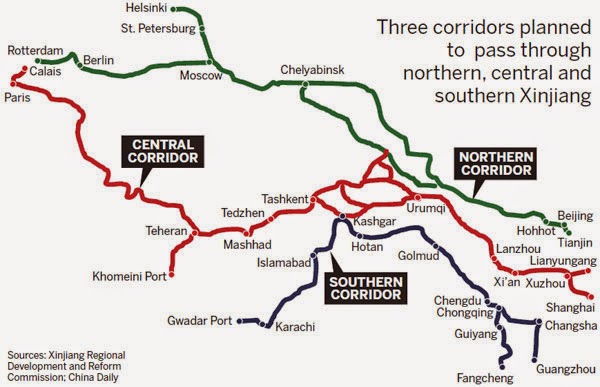
A study for the plans for this international rail link was first presented in 2014 at a two-day International Seminar on the Silk Road Economic Belt in Urumqi, Xinjiang's capital, according to China Daily.
"The 1,800-kilometer China-Pakistan railway is planned to also pass through Pakistan's capital of Islamabad and Karachi," Zhang Chunlin said. "Although the cost of constructing the railway is expected to be high due to the hostile environment and complicated geographic conditions, the study of the (international rail link) project has already started," Zhang said. "China and Pakistan will co-fund the railway construction. Building oil and gas pipelines between Gwadar Port and China is also on the agenda," Zhang added.
The Pak-China link announcement was part of the discussion on China's broader effort to revive the historic Silk Route by building three main corridors through southern, central and northern Xinjiang to connect China with Russia, Europe and Pakistan. The Silk Road Economic Belt International seminar which concluded on Friday in Urumqi, Xinjinag was jointly sponsored by the State Council Information Office, China International Publishing Group (CIPG), China Academy of Social Sciences (CASS) and Xinjiang Academy of Social Sciences.
In a 2013 report, China's State-owned Xinhua News Agency articulated China's motivation to expand land trade in addition to building its navy to protect its sea trade. Here's what it said:
“As a global economic power, China has a tremendous number of economic sea lanes to protect. China is justified to develop its military capabilities to safeguard its sovereignty and protect its vast interests around the world."
The Xinhua report has for the first time shed light on China's growing concerns with US pivot to Asia which could threaten China's international trade and its economic lifeline of energy and other natural resources it needs to sustain and grow its economy. This concern has been further reinforced by the following:
1. Frequent US statements to "check" China's rise. For example, former US Defense Secretary Leon Panetta said in a 2011 address to the Naval Postgraduate School in California: "We try everything we can to cooperate with these rising powers and to work with them, but to make sure at the same time that they do not threaten stability in the world, to be able to project our power, to be able to say to the world that we continue to be a force to be reckoned with." He added that "we continue to confront rising powers in the world - China, India, Brazil, Russia, countries that we need to cooperate with. We need to hopefully work with. But in the end, we also need to make sure do not threaten the stability of the world."
|
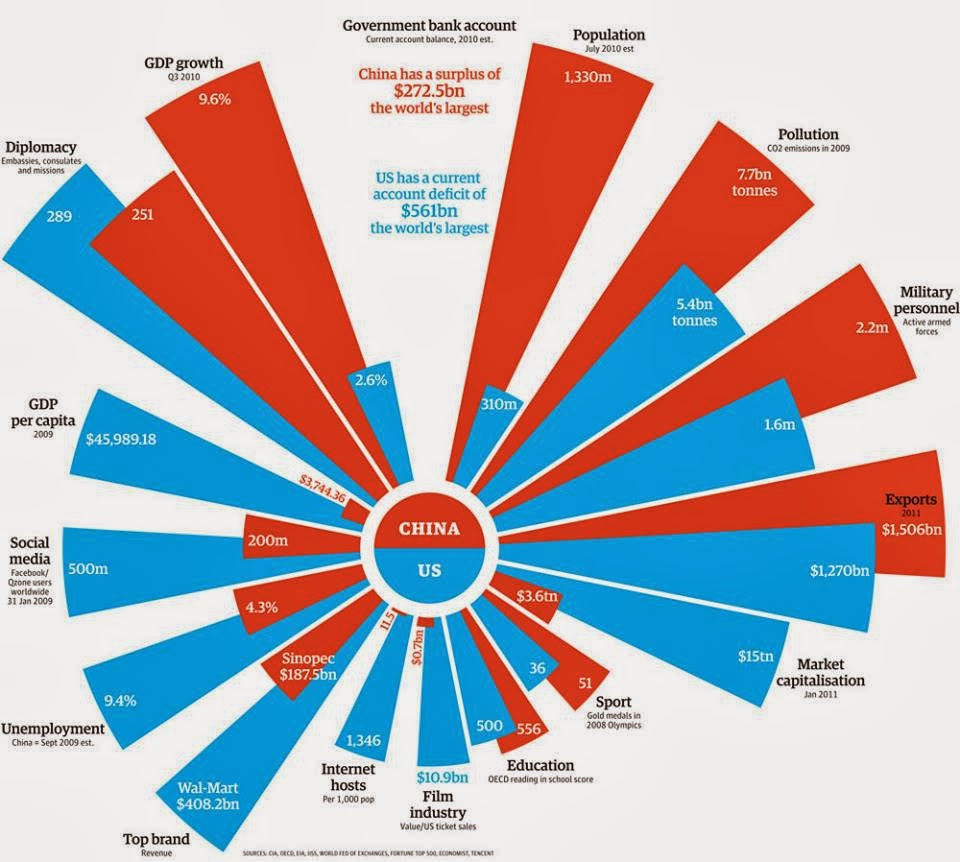
2. Chinese strategists see a long chain of islands from Japan in the north, all the way down to Australia, all United States allies, all potential controlling chokepoints that could block Chinese sea lanes and cripple its economy, business and industry.

|
Karakoram Highway-World's Highest Paved International Road at 15000 ft. |

Chinese Premier's emphasis on "connectivity and maritime sectors" and "China-Pakistan economic corridor project" is mainly driven by their paranoia about the US intentions to "check China's rise" It is intended to establish greater maritime presence at Gwadar, located close to the strategic Strait of Hormuz, and to build land routes (motorways, rail links, pipelines) from the Persian Gulf through Pakistan to Western China. This is China's insurance to continue trade with West Asia and the Middle East in case of hostilities with the United States and its allies in Asia.
|
Pakistan's Gawadar Port- located 400 Km from the Strait of Hormuz |

As to the benefits for Pakistanis, expanded trade and the Chinese investment in "connectivity and maritime sectors" and "China-Pakistan economic corridor project" will help build infrastructure, stimulate Pakistan's economy and create millions of badly needed jobs.
Clearly, China-Pakistan ties have now become much more strategic than the US-Pakistan ties, particularly since 2011 because, as American Journalist Mark Mazzetti of New York Times put it, the Obama administration's heavy handed policies "turned Pakistan against the United States". A similar view is offered by a former State Department official Vali Nasr in his book "The Dispensable Nation".
Related Links:
Comparison of Chabahar and Gwadar
How Strategic Are Pak-China Ties?
China-Pakistan Industrial Corridor
US-Pakistan Ties and New Silk Route
Views: 1916
-
Comment by Riaz Haq 7 hours ago
-
Pakistan and Islamic Development Bank (IsDB) advanced on Thursday $5.6 billion cooperation in infrastructure development, enhanced trade and polio eradication, an official statement read.
https://www.brecorder.com/news/amp/40444381
“Welcoming the MCPS, which envisages approximately $5.6 billion in indicative IsDB Group financing, the minister emphasised the importance of translating the indicative financing envelope into a concrete pipeline of well-prepared projects, with clear timelines for financing approvals, disbursements and implementation,” the statement read.
The minister appreciated IsDB’s $475 million financing for the M-6 Sukkur–Hyderabad Motorway and welcomed its support for Pakistan’s polio eradication programme, including the recent approval of $100 million for Phase V.
Highlighting the strategic importance of the ML-1 Railway Upgradation Project for modernising Pakistan’s railway network, strengthening connectivity and enhancing economic competitiveness, he sought enhanced IsDB support for the project and urged close coordination with the Asian Development Bank and other co-financiers to advance project preparation and expedite implementation.
To further strengthen development cooperation and mobilise trade and private capital, the minister called for a coordinated, whole-of-Group approach involving IsDB, ITFC, ICD, ICIEC and the IsDB Institute to expand opportunities in export finance, SMEs, infrastructure, public-private partnerships and energy transition.
He also highlighted the mobilisation of over $1 billion in trade financing through ITFC during FY2025–26 and sought more competitive terms for future facilities, reflecting Pakistan’s improving macroeconomic and credit profile.
“H.E. Dr. Jasser commended the Government of Pakistan for its ambitious Economic Development vision and affirmed IsDB Group’s commitment to contribute to the attainment of Pakistan’s development priorities.
“Both sides reaffirmed the importance of a strong, results-oriented partnership focused on transformational investments, effective implementation and measurable development outcomes,” the statement said.
Pakistan, World Bank commit to accelerating partnership framework implementation
Pakistan and the World Bank have committed to accelerating implementation of the Country Partnership Framework 2026-2035, with a focus on project preparedness, concessional financing and investments in human development and climate resilience.
Federal Minister for Economic Affairs and Pakistan’s Governor to the World Bank Group (WBG), Ahad Khan Cheema, met Anna Bjerde, Managing Director of Operations, World Bank, on the sidelines of the 2026 World Bank Group–IMF Annual Meetings in Bangkok to discuss implementation of Pakistan’s Country Partnership Framework (CPF) 2026–2035.
The minister underscored the government’s resolve to translate the CPF’s objectives into tangible development outcomes, calling for enhanced technical and financial support, integrated multisectoral programs and digital monitoring systems to track progress and measure impact.
He emphasised the importance of stronger project preparedness through dedicated Project Readiness Facilities (PRFs), predictable financing and enhanced implementation support to expedite project approvals and execution.
The minister emphasised that concessional resources must be deployed efficiently to maximise development impact while safeguarding debt sustainability.
Discussions also covered WBG’s support for sectors critical to human development, climate resilience, water and sanitation and economic transformation, with the minister highlighting the importance of investments in sectors with high job-creation potential to expand employment opportunities and promote inclusive growth.
Comment
- ‹ Previous
- 1
- 2
- 3
- 4
- Next ›
Twitter Feed
Live Traffic Feed
Sponsored Links
South Asia Investor Review
Investor Information Blog
Haq's Musings
Riaz Haq's Current Affairs Blog
Please Bookmark This Page!
Blog Posts
AI Revolution in Pakistan: Multiple AI Apps Launched for Farmers
With the expansion of the internet access in rural areas, several local language AI applications have recently been launched for downloads by farmers in Pakistan. These apps help with crop planning, soil sensing, personalized fertilizer recommendations, disease diagnoses, weather forecasts and market prices. A couple of these have been downloaded by half a million or more farmers in the country. Some of these apps use open source large language models (LLMs) like…
ContinuePosted by Riaz Haq on October 14, 2026 at 1:00pm — 1 Comment
Tata's Boardroom Crisis: Will it Impact Philanthropy in India?
India's Tata Group is going through a major boardroom crisis. Noel Tata, the Chairman of the Tata holding company, has been removed from the Tata Group's board by N. Chandrasekaran, chairman of Tata Sons. Noel Tata has declared the decision illegal, a stance the board disputes. The crisis has been precipitated by a 2022 decision by India’s central bank to order the company to seek a stock market listing for Tata Sons, to comply with new rules governing systemically important…
Continue
© 2026 Created by Riaz Haq.
Powered by


You need to be a member of PakAlumni Worldwide: The Global Social Network to add comments!
Join PakAlumni Worldwide: The Global Social Network