PakAlumni Worldwide: The Global Social Network
The Global Social Network
Where's the Real Population "Disaster in the Making"? Pakistan or the West?
Multiple western newspaper headlines are screaming of a "disaster in the making" in Pakistan after the latest population census in the country. These headlines beg the following questions: Is Pakistan's total fertility rate of 2.62 children per woman a bigger disaster than the sub-replacement level of less than 2 children per woman in the West? Are the rapidly aging western societies and declining working population less of a disaster than Pakistan with its younger population and a growing percentage of it in the work force? To answer these questions, let's consider the following quote:
“So where will the children of the future come from? Increasingly they will come from people who are at odds with the modern world. Such a trend, if sustained, could drive human culture off its current market-driven, individualistic, modernist course, gradually creating an anti-market culture dominated by fundamentalism - a new dark ages.” ― Philip Longman, The Empty Cradle: How Falling Birthrates Threaten World Prosperity ...
Fear of Population Bomb:
The above quote captures the true essence of the West's racist fears about what some of them call the "population bomb": East will dominate the West economically and politically for centuries if the growing colored populations of developing Asia and Africa turn the West's former colonies into younger and more dynamic nations with rising education and better living standards.
Much of the developed world has already fallen below the "replacement" fertility rate of 2.1. Fertility rates impact economic dynamism, cultural stability and political and military power in the long run.
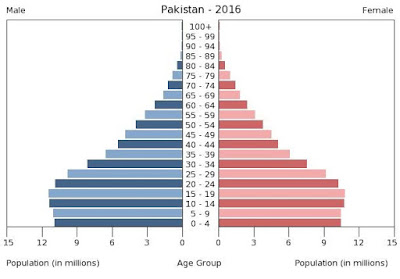 |
| Pakistan Population Pyramid by Age/Gender. Source: Theodora via CIA |
Pakistan Population Growth:
Pakistani women's fertility rates have declined significantly from about 4.6 in 2000 to 2.62 babies per woman in 2017, a drop of 43% in 17 years. It is being driven drown by the same forces that have worked in the developed world in the last century: increasing urbanization, growing incomes, greater participation in the workforce and rising education. Pakistan now ranks 65 among 108 countries with TFR of 2.1 (replacement rate) or higher.
The latest Census 2017 results show that Pakistan's population growth rate has declined to 2.34% between 1998 and 2017, down from 2.61% (from 1981 to 1998) and 3.4% (from 1961-81). Life expectancy has increased from about 62 years in 1998 to 66.5 years now. The total fertility rate has declined from 4.6 children per woman in 1998 to to 2.62 children per woman in 2017. At the same time, Pakistan's labor force is growing at a rate of 3.6% a year, faster than the 2.34% overall population growth. Given Pakistan's human capital growth in recent years, it is a welcome situation that is expected to produce significant demographic dividend for the country.
Labor Force Expansion:
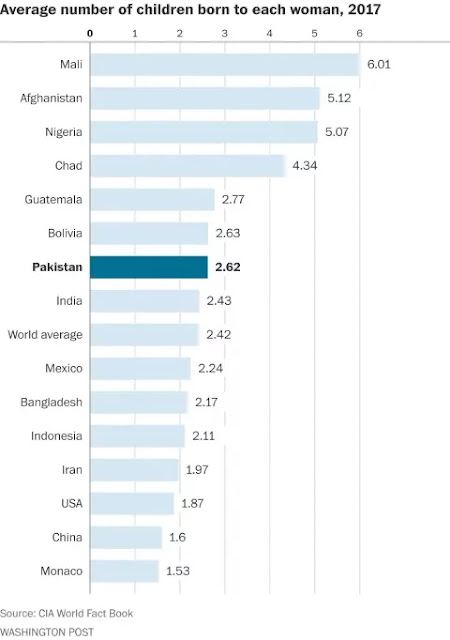 |
| Pakistan's Total Fertility Rate 2.62 Children Per Woman. Source: Wa... |
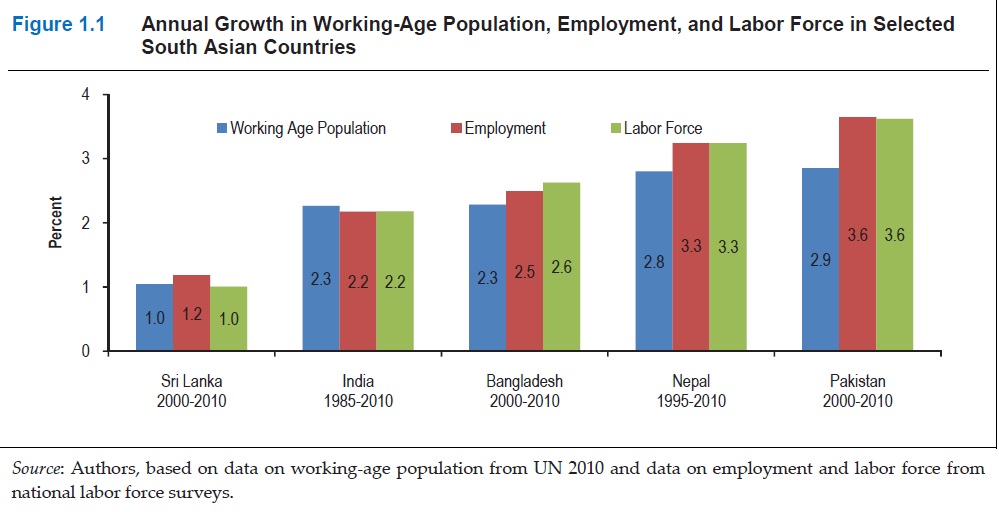 |
| Source: World Bank Report "More and Better Jobs in South Asia" |
Pakistan's working age population in 15-64 years age bracket is expected to increase by 27.5 million people to 147.1 million in 10 years, according to Bloomberg News' analysis of data reported in UN World Population Prospects 2017. Pakistan's increase of 27.5 million is the third largest after India's 115.9 million and Nigeria's 34.2 million increase in working age population of 15-64 years old. China's working age population in 15-64 years age group will decline by 21 million in the next 10 years.
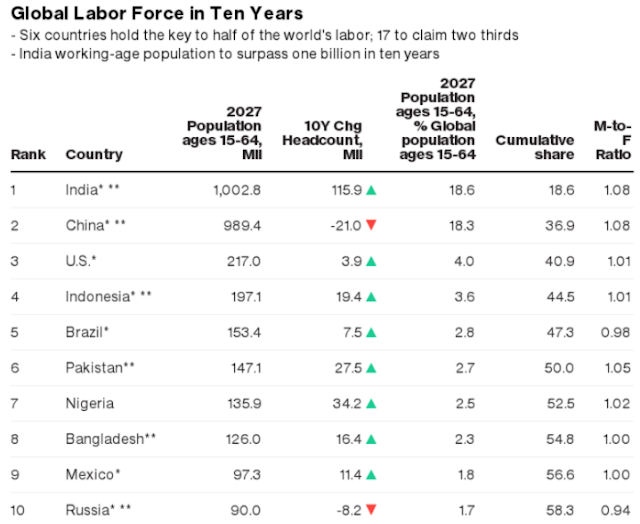 |
| Source: Bloomberg |
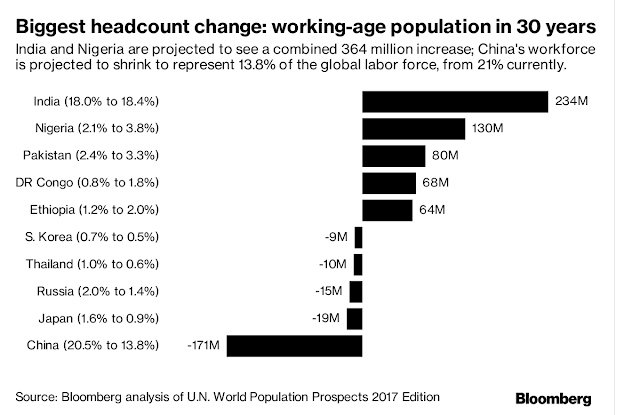
Pakistan's labor force growth will continue by adding 80 million workers n 30 years' time, third only to India's 234 million and Nigeria's 130 million additional workers in 15-64 years age group. China's work force will decline by 171 million workers in this time period.
 |
| Source: Bloomberg |
Savings, Investment and GDP Growth:
Currently, about a third of Pakistan's population is below the age of 15, dependent on working age adults. This high ratio of dependent population results in low savings, low investment and consequent slower economic growth and sub-par socio-economic development.
 |
| Source: State Bank of Pakistan |
Pakistan's national savings was about 10% of GDP in 1960s. It increased to above 15% in 2000s in Musharraf years, but declined afterwards. It is well below the savings rates in South Asia region with India's 30%, Bangladesh's 28%, and Sri Lanka's 24.5%.
 |
| Source: State Bank of Pakistan |
Higher levels of inequality in India, Bangladesh and Sri Lanka account at least partially for their higher savings rates than Pakistan's because people in higher income groups tend to save more of what they earn. But the other probably more important reason for Pakistan's lower savings rate is the larger percentage of children under the age of 15 who do not work and depend on their parents' incomes.
Rising working age population and growing workforce participation of both men and women in Pakistan will boost domestic savings and investments, just as it has in other South Asian nations.
 |
| Projected World Population. Source: Nikkei |
Countries With Declining Populations:
115 countries, including China (1.55), Hong Kong (1.17), Taiwan (1.11) and Singapore (0.8) are well below the replacement level of 2.1 TFR. Their populations will sharply decline in later part of the 21st century along with the economic growth rates.
United States is currently at 1.87 TFR, below the replacement rate but still better than China and other developed nations mainly due to immigration. "We don't take a stance one way or the other on whether it's good or bad," said Mark Mather, demographer with the Population Reference Bureau. Small year-to-year changes like those experienced by the United States don't make much difference, he noted. But a sharp or sustained drop over a decade or more "will certainly have long-term consequences for society," he told Utah-based Desert News National.
Japan (1.4 TFR) and Russia (1.6 TFR) are experiencing among the sharpest population declines in the world. One manifestation in Japan is the data on diaper sales: Unicharm Corp., a major diaper maker, has seen sales of adult diapers outpace infant diapers since 2013, according to New York Times.
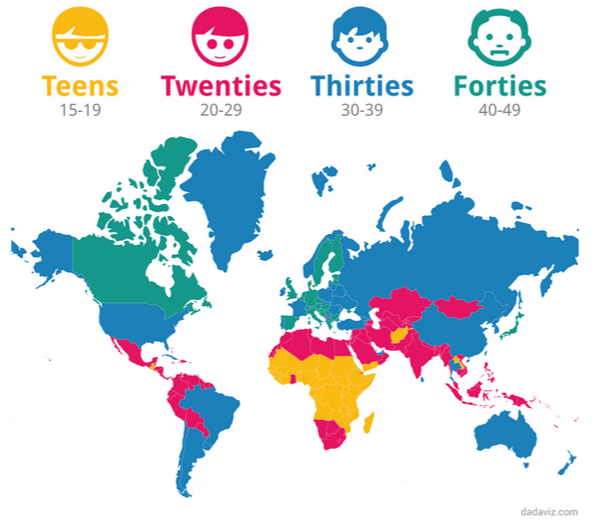 |
| Median Age Map: Africa in teens, Pakistan in 20s, China, South America and US in 30s, Europe, Canada and Japan in 40s. |
The Russian population grew from about 100 million in 1950 to almost149 million by the early 1990s. Since then, the Russian population has declined, and official reports put it at around 144 million, according to Yale Global Online.
 |
| Lancet Population Projection For Top 5 Countries |
Reversing Trends:
Countries, most recently China, are finding that it is far more difficult to raise low fertility than it is reduce high fertility. The countries in the European Union are offering a variety of incentives, including birth starter kits to assist new parents in Finland, cheap childcare centers and liberal parental leave in France and a year of paid maternity leave in Germany, according to Desert News. But the fertility rates in these countries remain below replacement levels.
Summary:
Overzealous Pakistani birth control advocates need to understand what countries with sub-replacement fertility rates are now seeing: Low birth rates lead to diminished economic growth. "Fewer kids mean fewer tax-paying workers to support public pension programs. An "older society", noted the late Nobel laureate economist Gary Becker, is "less dynamic, creative and entrepreneurial." Pakistan's labor force growth is forecast to be the 3rd biggest in the world after India's and Nigeria's, according to UN World Population Prospects 2017. Rising working age population and growing workforce participation of both men and women in developing nations like Pakistan will boost domestic savings and investment, according to Global Development Horizons (GDH) report. Escaping the low savings low investment trap will help accelerate the lagging GDP growth rate in Pakistan as will increased foreign investment such as Chinese investment in China-Pakistan Economic Corridor over the next several decades.
Here's a discussion on this and other subjects:
https://youtu.be/ucopTLFQdKY
Related Links:
Haq's Musings
Pakistan's Labor Force Expansion on Saving, Investments and GDP Growth
Pakistan's Population Growth: Blessing or Curse?
Pakistan's Expected Demographic Dividend
World Bank Report on Job Growth in Pakistan
Underinvestment Hurting Pakistan's GDP Growth
China-Pakistan Economic Corridor
Musharraf Accelerated Growth of Pakistan's Financial and Human Capital
Working Women Seeding a Silent Revolution in Pakistan
Views: 952
-
Comment by Riaz Haq 6 hours ago
-
India’s surprise baby bust is a warning to the world
It is not just rich places that are becoming less fertile
https://www.economist.com/leaders/2026/06/04/indias-surprise-baby-b...
You are having too many babies. For decades that crude message was drilled into the minds of Indians by their rulers, abetted by inept foreign donors. In the 1960s slogans on school buildings chided parents, telling them: “Two or three children, enough”. By the 1970s officials had taken a crueller turn, overseeing the sterilisation of millions of young adults, usually the poor, many forcibly. But when Indian school textbooks are reprinted this summer, they will carry a very different message. They will warn not of the dangers of having too many babies, but of the risks of having too few.
That’s because the world’s most populous country is experiencing a baby bust. India has a total fertility rate (tfr), a measure of children per woman, of 1.9 and falling. This is below the replacement rate, of 2.1 or so, needed for a stable long-term population. In several Indian states the tfr now matches the sputtering rates you find in rich European countries. Tamil Nadu, an industrialised state in the south, and West Bengal, a populous one in the east, each have the same fertility rate (1.3) as Finland. Maharashtra, a big western state encompassing Mumbai, is on a par with Norway (1.4). If you think of Indian demography, Scandinavia is not the natural reference point. Increasingly, it will be.
----------------
AF Post
@AFpost
India’s fertility rate has fallen below replacement for the first time in the country’s history, declining from a TFR of 2.3 to 1.9 in just a decade.
Delhi’s fertility rate now sits at 1.2, lower than Finland’s.
Follow:
@AFpost
https://x.com/AFpost/status/2063209643212517781?s=20
Comment
- ‹ Previous
- 1
- 2
- 3
- Next ›
Twitter Feed
Live Traffic Feed
Sponsored Links
South Asia Investor Review
Investor Information Blog
Haq's Musings
Riaz Haq's Current Affairs Blog
Please Bookmark This Page!
Blog Posts
Growing Fan Base of Cockroach Janata Party in India
"Indians live like cockroaches and die like cockroaches", argued Jayant Bhandari in an X post in April this year. "They vote for bottom of the barrel cockroaches as rulers, who rightly treat them as cockroaches", he added, faulting the people of India for this state of affairs. More recently, Indian Supreme Court Chief Justice Surya Kant said during a hearing that certain unemployed youth were "like cockroaches" who enter professions with fake degrees or become social media…
ContinuePosted by Riaz Haq on June 2, 2026 at 1:30pm — 5 Comments
Iron Brothers China and Pakistan Celebrate 75 Years of "Unbreakable" Friendship
President Xi Jinping and Prime Minister Shehbaz Sharif have met today in Beijing to reaffirm the "unbreakable" bond between their two "iron brother" countries on the 75th anniversary of the establishment of the China-Pakistan diplomatic ties. "No matter how the international landscape may evolve, China will always place priority on the development of China-Pakistan relations in its diplomacy with neighboring countries," he said. Over 7 decades of friendship witnessed Pakistan help…
ContinuePosted by Riaz Haq on May 25, 2026 at 8:30pm — 7 Comments
© 2026 Created by Riaz Haq.
Powered by


You need to be a member of PakAlumni Worldwide: The Global Social Network to add comments!
Join PakAlumni Worldwide: The Global Social Network