PakAlumni Worldwide: The Global Social Network
The Global Social Network
Growing China-Pakistan Collaboration in Science and Technology
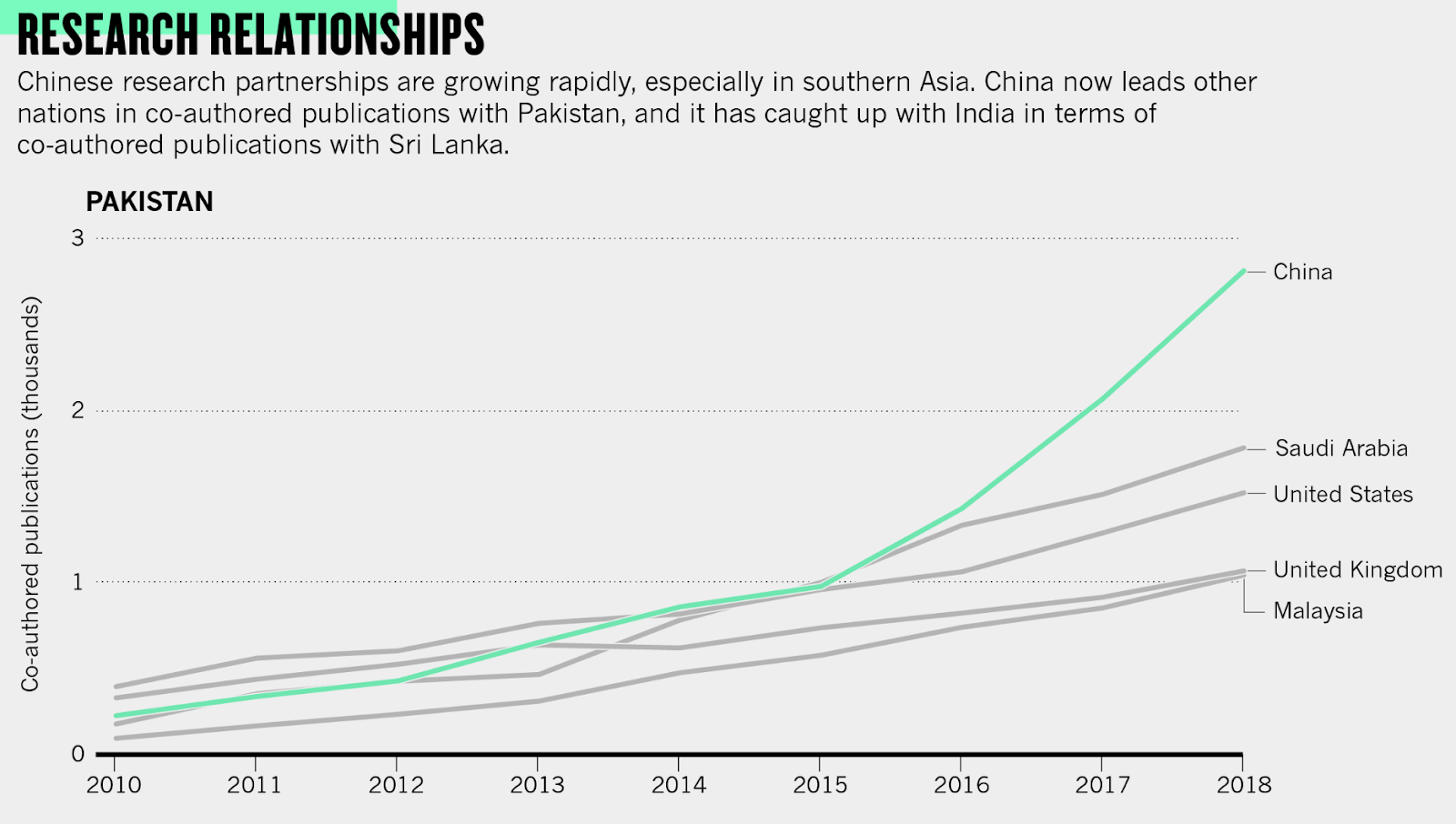
With 6,000 Pakistanis working on their PhDs in China, the two countries are enjoying rapid growth in scientific and technological collaboration, according to Journal Nature. Pakistan's scientific output is now growing at the fastest rate in the world. With nearly 3,000 papers jointly authored and published by Chinese and Pakistani researcher, China has now emerged as Pakistan's top partner in scientific collaborations, surpassing Saudi Arabia (about 1,500 papers) and the United States (about 1,200 papers) in 2018, according to an analysis of co-authored papers from Elsevier’s Scopus database. China is co-sponsoring a range of research centers in Pakistan that are studying topics from rice agriculture to artificial intelligence and railway engineering.
Pakistan-China ties are rapidly growing well beyond the economy and the military with tens of thousands of Chinese and Pakistani citizens regularly traveling between the two countries. More Pakistanis than ever are learning the Chinese language. China with its world class educational institutions is emerging as one of the top destinations for Pakistanis studying abroad. Currently, 6,156 Pakistani students are studying in Ph.D., 3,600 in Masters, 11,100 in Bachelors and 3,000 in Short Term Exchange Programs across China. Pakistan ranks third in the number of international students currently studying in China with 28,023 Pakistani students, according to a statement issued by China’s Ministry of Education. It is becoming a truly multi-dimensional relationship which will help Pakistan rise with China on the world stage.
|
Typical of the new Sinophile generation of Pakistani scientists is Dr. Iqbal Choudhary, director of the International Centre for Chemical and Biological Sciences at the University of Karachi. Choudhary’s center is one of the oldest — it celebrated its 50th birthday just a few years ago — and largest institutes in Asia dedicated to the chemistry and biology of natural products.
|
China's Top Collaborators in Science and Technology Research. Sourc... |

Among the Belt Road Initiative member nations, Pakistan has emerged as the second strongest Chinese partner for science and technology collaboration in terms of Probabilistic Affinity Index (PAI), according to the Journal Nature. So far, China Academy of Sciences (CAS) has invested more than 1.8 billion yuan (almost US$268 million) in science and technology projects as part of the BRI.
CAS is supporting the Digital Belt and Road (Digital BRI), a platform for participating countries to share the data obtained as part of their collaborative projects with each other and with China. These data include satellite images as well as quantitative data on natural hazards, water resources and cultural heritage sites.
As part of Digital BRI/CPEC, an 820-kilometer long China-Pakistan fiber optic cable has already been laid between the city of Rawalpindi, Pakistan in the south and the Khunjerab Pass, China in the north and operational since July, 2018.
By 2020, the 6,299 kilometers of underwater cables will extend to Djibouti from Gwadar and form the Digital Silk Route between Asia and Africa. At the same time, a space-based Silk Road will provide satellite navigation support to all BRI countries. The first Beidou base station of the Space Silk Road is already operational in Pakistan since 2017. BeiDou is making rapid progress with 30 BRI countries already linked up.
Related Links:
China-Pakistan Defense Production Coop Irks West
Pakistan's Research Output Growing Fastest in the World
AI Research at NED University Funded By Silicon Valley NEDians
Pakistan Hi-Tech Exports Exceed A Billion US Dollars in 2018
Rising College Enrollment in Pakistan
Pakistani Universities Listed Among Asia's Top 500 Jump From 16 to ...
Genomics and Biotech Research in Pakistan
Human Capital Growth in Pakistan
Views: 771
-
Comment by Riaz Haq on October 20, 2025 at 8:09pm
-
Mario Nawfal
@MarioNawfal
🚨🇵🇰 PAKISTAN JUST LAUNCHED ITS FIRST-EVER EARTH OBSERVATION SATELLITE
Pakistan just entered a new space era with the successful launch of PRSC HS-1, its first hyperspectral Earth observation satellite.
The satellite lifted off from China’s Jiuquan Satellite Launch Centre on a Kinetica-1 rocket.
PRSC HS-1 can analyse Earth’s surface in hundreds of spectral bands, tracking crops, water, minerals, pollution, and more with scientific precision.
This marks a major leap for SUPARCO and Pakistan’s growing space program.
Think of it as Earth’s MRI scanner, and Pakistan now has the tech.
Source:
@OSPSF
https://x.com/MarioNawfal/status/1980046305335390214
--------------
AI Overview
A hyperspectral satellite is an Earth observation satellite that uses advanced imaging technology to capture hundreds of narrow, contiguous spectral bands of light, creating a detailed "spectral fingerprint" for every point on the ground. This allows it to analyze the physical and chemical composition of materials and detect subtle differences invisible to the naked eye or traditional cameras. Applications include agriculture, environmental monitoring, geology, and disaster management.
How it works
Hundreds of bands: Unlike RGB cameras that see red, green, and blue, or even multispectral sensors that use up to 36 broad bands, a hyperspectral sensor captures data across hundreds of very narrow bands of the electromagnetic spectrum.
Spectral fingerprint: By stacking these hundreds of narrow images, the satellite creates a 3D "spectral cube" for each pixel, where the third dimension is the spectral information. This provides a unique spectral signature for every material, from types of plants to minerals to water.
Detailed analysis: This high spectral resolution allows for the identification and analysis of specific materials based on their unique light-reflecting properties. For example, a hyperspectral satellite can distinguish between different tree species or detect the early signs of drought stress in a crop.
Key applications
Agriculture: Monitoring crop health, assessing soil conditions, and detecting drought stress or disease before they are visible.
Geology: Mapping mineral deposits, providing precise geochemical data, and reducing exploration costs.
Environmental monitoring: Tracking water quality, detecting pollutants, and monitoring changes in land use.
Disaster management: Assessing damage from natural disasters and monitoring geohazard risks.
Other areas: Forestry, climate change research, defense, and security.
-
-
Pakistan Space and Upper Atmosphere Research Commission (Suparco) on Thursday announced “Jinnah-1” as the official name of the country’s first lunar rover.
https://www.dawn.com/news/2022575
The rover is scheduled to be sent to the Moon in 2029 as part of China’s Chang’e-8 mission, where it will conduct scientific research at the lunar south pole, Suparco said.
The Moon’s south pole is known for its challenging terrain and potential to yield significant scientific discoveries.
In a ceremony held in Islamabad, Suparco said that the name was selected from 4,000 proposals received in a countrywide competition.
Seven participants had proposed the name “Jinnah-1” and the winner was selected through a lucky draw, according to a statement from Suparco.
Tayyab Karim, a 17-year-old from Bahawalnagar, was declared the winner for proposing the name, Suparco said.
The name pays tribute to Quaid-i-Azam Muhammad Ali Jinnah and symbolises “Pakistan’s resolve, progress and new space horizons”, Suparco Chairman said.
Jinnah-1 will study plasma, radiation and the lunar surface’s geology, as well as conduct key experiments related to future lunar research and the prospect of human presence on the Moon, Suparco said.
Suparco announced the collaboration with China’s Chang’e-8 mission in 2024.
“This collaboration marks a significant milestone for Pakistan’s space programme, as Suparco’s indigenous rover will be part of the mission to explore the lunar surface,” the space agency said at the time.
Nasa is targeting 2028 for the first-ever landing of astronauts on the Moon’s south pole, as part of Artemis IV, seeking to beat China’s planned crewed mission, Chang’e-8, to the same lunar region.
In 2023, India managed to land a craft — the unmanned Chandrayaan-3 — near the Moon’s south pole.
Its landing came days after a Russian probe crashed in the same region and four years since the previous Indian attempt failed at the last moment.
-
-
Sushant Singh
@SushantSin
We ought to learn to tamper the rhetoric and look at the reality. And it is not always great, even in space rocket launches.
https://x.com/SushantSin/status/2090663533373747224?s=20
-----------------------
India’s Rocket Launch Costs Over $13k Per Kg, Four Times Higher Than US
The findings highlight a challenge for India's commercial space ambitions, even as private companies begin entering the launch market
https://www.outlookbusiness.com/deeptech/indias-rocket-launch-costs...
ndia’s average rocket launch cost stood at $13,302 per kg, the highest among six major space markets
The figure was more than four times the US cost of $3,225 per kg
Limited launch frequency and smaller rocket payload capacities are key factors behind the gap
India has the highest rocket launch costs among six major spacefaring markets, with the average cost of placing payload into low Earth orbit estimated at $13,302 per kg at the end of 2025 — more than four times the US figure of $3,225 per kg, according to a study published in the peer-reviewed journal Economics Letters.
First reported by Mint, the study by Alessio Terzi of the University of Cambridge and Francesco Nicoli of Politecnico di Torino placed India above the European Union, Russia, China and Japan in terms of launch costs.
Europe was the next most expensive market at $9,897 per kg, followed by Russia at $6,682, China at $5,809 and Japan at $5,287, the study said.The research analysed more than 6,740 rocket launches between 1960 and 2025 to assess how accumulated experience and launch activity affect costs.
India's estimates were based on launches coordinated by NewSpace India Ltd (NSIL), the commercial arm of the Indian Space Research Organisation (Isro), using a mix of domestic launch vehicles, as per Mint.
The findings highlight a challenge for India's commercial space ambitions, even as private companies begin entering the launch market. Skyroot Aerospace's first private commercial rocket launch on July 18 marked an important milestone, but lower costs may take time to materialise.
Skyroot chief executive Pawan Kumar Chandana had told Mint in October 2025 that the company expected to generate at least $4 million from each launch of its Vikram-1 rocket. At its maximum payload capacity of 350 kg to low Earth orbit, this would translate to about $11,000 per kg.
Scale and launch frequency remain major advantages for the US. According to the study, the United States accounted for more than 80% of global payload sent to orbit in 2025.
The researchers also found that since 2010, only the US and Europe had demonstrated statistically significant reductions in costs linked to accumulated launch experience, with the US improving faster.
SpaceX's reusable Falcon 9 can carry up to 22,800 kg to low Earth orbit, compared with the 10,000-kg capacity of India's LVM3, which was not reusable. India completed four successful launches in 2025, while SpaceX reportedly carried out eight successful missions in August alone.
The study suggests that increasing launch frequency, payload capacity and technological capability will be crucial if India is to narrow its cost gap and build a competitive commercial launch market.
"The very high figure for India might be counterintuitive as it stands in stark contrast with the narrative of the country’s frugal space programme. However, this is a result of focussing on small rocket sizes, which implies that, albeit being low by international standards, fixed costs get amortised over a limited payload," Terzi and Nicoli wrote, as per Mint.
-
-
Pakistan's Satellites, Every Spacecraft in Orbit and the Rockets That Put Them There
Pakistan has 13 spacecraft in orbit as of October 2026, and 10 of its 13 satellite launches rode Chinese rockets. Here is every one, from Badr-1 to PRSC-EO3, and what SUPARCO plans next.
https://keeptrack.space/deep-dive/pakistans-satellites
Pakistan has 13 spacecraft in orbit as of October 2026. KeepTrack’s catalog files 10 of them under Pakistan’s country codes. Three more launched in 2025 and 2026 are tracked but not yet attributed to Pakistan in the catalog (PRSC-S1, PRSC-HS1, and PRSC-EO2). Ten of the 13 orbital launches that carried Pakistani satellites flew on Chinese rockets, and the country has no orbital launcher of its own.
Below is every Pakistani satellite, what each one does, how it got to orbit, and where the Space and Upper Atmosphere Research Commission (SUPARCO) is taking the program next.
How many satellites does Pakistan have?
Pakistan has 13 satellites in orbit as of October 2026, and most of them are still working. The country’s hub page shows the catalog’s live figures, which currently stand at 11 objects ever cataloged under Pakistan’s codes, 10 in orbit, and 7 active. The three recent spacecraft missing from that count are all Earth-observation satellites, which is why the fleet is bigger than the hub page shows.Satellite tracker app
For a country of 240 million people, that is a small fleet. Iran, a frequent comparison, has launched more satellites, though most of its domestic ones have already fallen back to Earth. What Pakistan has instead is a fast-rising cadence. Eight of its 13 satellites in orbit launched in May 2024 or later.
Every Pakistani satellite has flown on a foreign rocket, and the two that mattered most for the country’s communications and mapping were built in China. That pattern is changing at the satellite level, where SUPARCO now designs its own imagers, but not at the launch pad.
1990-07
Badr-1
Pakistan's first satellite, built by SUPARCO, launches on a Long March 2E from Xichang. It reenters that December.
2001-12
Badr-B
A small technology satellite flies on a Zenit-2 from Baikonur. It is still in orbit, long dead.
2011-08
Paksat-1R
Pakistan's first owned communications satellite reaches geostationary orbit on a Long March 3B.
2018-07
PRSS-1 and PakTES-1A
A Chinese-built imaging satellite and a SUPARCO-built test satellite share a Long March 2C from Jiuquan.
2024-05
iCube-Qamar and PakSat-MM1
A cubesat rides Chang'e-6 to the Moon, and a new communications satellite replaces Paksat-1R.
2025-01
PRSC-EO1
SUPARCO launches what it calls Pakistan's first indigenous electro-optical satellite.Satellite tracker app
2026-04
PRSC-EO3
The third EO satellite flies on a Long March 6 from Taiyuan, the sixth Pakistani satellite launched since January 2025.
Every Pakistani satellite in orbit
The table lists every Pakistani spacecraft still in orbit as of October 2026, with the launch vehicle and site from the KeepTrack launch record. Status reflects the catalog’s operational flag.
-
-
Satellite Launched Rocket and site Job Status
Badr-B Dec 10, 2001 Zenit-2, Baikonur Technology demo Dead
Paksat-1R Aug 11, 2011 Long March 3B, Xichang GEO communications Retired
PakTES-1A Jul 9, 2018 Long March 2C, Jiuquan Technology and imaging Active
PRSS-1 Jul 9, 2018 Long March 2C, Jiuquan Remote sensing Active
iCube-Qamar May 3, 2024 Long March 5, Wenchang Lunar cubesat Listed active
PakSat-MM1 May 30, 2024 Long March 3B, Xichang GEO communications Active
PAUSAT-1 Jan 14, 2025 Falcon 9, Vandenberg University imaging cubesat Active
PRSC-EO1 Jan 17, 2025 Long March 2D, Jiuquan Electro-optical imaging Active
PRSC-S1 Jul 31, 2025 Kuaizhou-1A, Xichang Earth observation Active
PRSC-HS1 Oct 19, 2025 Kinetica-1, Jiuquan Hyperspectral imaging Not yet identified in catalog
PRSC-EO2 Feb 12, 2026 Jielong-3, sea platform off Yangjiang Electro-optical imaging Not yet identified in catalog
PRSC-EO3 Apr 25, 2026 Long March 6, Taiyuan Imaging and technology demo Active
iCube-1 Nov 21, 2013 Dnepr, Yasny Student cubesat Dead
Pakistan's satellites in orbit (October 2026)
Source: KeepTrack catalog and GCAT launch records, October 2026
iCube-1, built by students at the Institute of Space Technology, is still in orbit but has been silent for years. Badr-1, the first satellite, reentered on December 8, 1990, five months after launch
https://keeptrack.space/deep-dive/pakistans-satellites
Badr, the start
Badr-1 launched on July 16, 1990, on a Long March 2E from Xichang. It was a small SUPARCO-built experimental satellite, and it showed Pakistan could design and operate a spacecraft. It also set the template that still holds. China put it in orbit.
Its successor took 11 years. Badr-B flew as a secondary payload on a Zenit-2 from Baikonur on December 10, 2001, a 69 kg technology satellite. It still circles Earth at about 1,000 km, and the catalog lists it as nonoperational.
Paksat and the geostationary slot
Pakistan’s communications satellites sit at 38 degrees east in geostationary orbit. Paksat-1R took the slot in 2011, launched on a Long March 3B from Xichang under a contract with China Great Wall Industry Corporation. Its catalog launch mass is 5,100 kg. It replaced a leased satellite that had operated there as PAKSAT-1.
PakSat-MM1 followed on May 30, 2024, again on a Long March 3B from Xichang, with a launch mass of 5,400 kg. The “MM” stands for multimission. The Chinese-built satellite handles TV broadcasting and broadband, and it carries a navigation augmentation payload. Paksat-1R is now flagged as retired in the catalog.Satellite tracker app
PRSS-1 and the remote sensing push
On July 9, 2018, a Long March 2C from Jiuquan carried two satellites that gave Pakistan its first operational eyes in orbit. PRSS-1, the Pakistan Remote Sensing Satellite, was built by the China Academy of Space Technology. Dawn reported that it was the 17th satellite CAST had built for an overseas buyer. PakTES-1A, flying alongside it, was a 285 kg technology demonstrator designed and built by SUPARCO engineers, with an optical payload of its own.
PRSS-1 did the operational work while PakTES-1A gave SUPARCO flight experience. SUPARCO has since moved the domestic design work up from demonstrators to operational imagers.
-
-
The PRSC satellites, 2025 to 2026
Since January 2025, SUPARCO has put five satellites in orbit under the PRSC name, five of the 14 satellites Pakistan has launched since 1990.
PRSC-EO1 launched on January 17, 2025, on a Long March 2D from Jiuquan, and SUPARCO billed it as Pakistan’s first indigenous electro-optical satellite. Its catalog mass is 500 kg. Three days earlier, Air University’s PAUSAT-1 had flown on SpaceX’s Transporter-12 rideshare from Vandenberg, the only Pakistani payload to launch on an American rocket.Satellite tracker app
PRSC-S1 followed on July 31, 2025, on a Kuaizhou-1A from Xichang. The hyperspectral PRSC-HS1 launched on October 19, 2025, on a Kinetica-1 from Jiuquan. In February 2026, PRSC-EO2 reached orbit on a Jielong-3 fired from a sea platform off Yangjiang. China Great Wall Industry Corporation said SUPARCO designed and developed the satellite, with propulsion supplied by a CAST institute. Then PRSC-EO3 launched on April 25, 2026, on a Long March 6 from Taiyuan. Dawn reported that it carries experimental payloads, including an onboard AI processor.
https://keeptrack.space/deep-dive/pakistans-satellites
The catalog lag matters for anyone counting. PRSC-S1 is in the catalog, but under a Chinese country code with SUPARCO as owner. PRSC-HS1 and PRSC-EO2 still sit among unidentified objects from their launches, which is common for rideshare and multi-payload flights. Until those records are corrected, Pakistan’s count on the hub page reads three low.
iCube-Qamar, a cubesat at the Moon
The most unusual entry on the list is iCube-Qamar, a cubesat built by the Institute of Space Technology with China’s Shanghai Jiao Tong University and SUPARCO. It rode China’s Chang’e-6 sample-return mission, which launched on a Long March 5 from Wenchang on May 3, 2024, and was released into lunar orbit on May 8. Dawn called it “Pakistan’s maiden lunar mission.” The catalog still lists it in a high orbit, which is why it shows up in Pakistan’s count even though it circles the Moon rather than Earth.Space visualization software
Why China launches almost everything
Ten of the 13 launches that carried Pakistani satellites used Chinese rockets. The exceptions are Badr-B on a Zenit, iCube-1 on a Russian Dnepr, and PAUSAT-1 on a Falcon 9. Pakistan has flown sounding rockets since the 1960s, but it has never built an orbital launcher, and nothing in SUPARCO’s public plans points to one soon.
The China link runs deeper than launch contracts. China built PRSS-1, Paksat-1R, and PakSat-MM1, the satellites that carry most of Pakistan’s imaging and communications load, and China is flying Pakistan’s lunar payloads.
That dependence buys speed. Pakistan went from two imaging satellites in orbit to eight in 15 months by buying rides on China’s crowded commercial manifest, which now includes Kuaizhou, Kinetica-1, and sea-launched Jielong-3 flights alongside the Long March family. It also means Pakistan’s access to orbit depends on a single partner’s politics and schedule.
What SUPARCO plans next
SUPARCO’s long-range plan dates to a space program approved in 2011 that set out a run of remote sensing and communications satellites. Its next public milestones are both Chinese partnerships. A Pakistani rover is set to fly on China’s Chang’e-8 lunar mission, which Geo News reported is “set for launch in 2028,” and SUPARCO says its engineers designed and built the rover themselves. Two Pakistani astronaut candidates have also been training in Beijing for a roughly weeklong visit to the Tiangong space station. As of early October 2026, China had not said which of the two will fly or when.Space visualization software
On current form, expect more PRSC imaging satellites on Chinese rockets, at a pace of two or three a year, and a growing share of the hardware designed in Pakistan. The launch pad will stay in China.
Comment
- ‹ Previous
- 1
- 2
- 3
- Next ›
Twitter Feed
Live Traffic Feed
Sponsored Links
South Asia Investor Review
Investor Information Blog
Haq's Musings
Riaz Haq's Current Affairs Blog
Please Bookmark This Page!
Blog Posts
AI Revolution in Pakistan: Multiple AI Apps Launched for Farmers
With the expansion of the internet access in rural areas, several local language AI applications have recently been launched for downloads by farmers in Pakistan. These apps help with crop planning, soil sensing, personalized fertilizer recommendations, disease diagnoses, weather forecasts and market prices. A couple of these have been downloaded by half a million or more farmers in the country. Some of these apps use open source large language models (LLMs) like…
ContinuePosted by Riaz Haq on October 14, 2026 at 1:00pm — 2 Comments
Tata's Boardroom Crisis: Will it Impact Philanthropy in India?
India's Tata Group is going through a major boardroom crisis. Noel Tata, the Chairman of the Tata holding company, has been removed from the Tata Group's board by N. Chandrasekaran, chairman of Tata Sons. Noel Tata has declared the decision illegal, a stance the board disputes. The crisis has been precipitated by a 2022 decision by India’s central bank to order the company to seek a stock market listing for Tata Sons, to comply with new rules governing systemically important…
Continue
© 2026 Created by Riaz Haq.
Powered by


You need to be a member of PakAlumni Worldwide: The Global Social Network to add comments!
Join PakAlumni Worldwide: The Global Social Network