PakAlumni Worldwide: The Global Social Network
The Global Social Network
Hindu Rashtra: Will Modi's Hindutva Lead to Multiple Partitions of India?
Sheikh Alam, a Muslim leader of Mamta Banerjee's Trinamool Congress Party, has recently been quoted in the Indian media as saying: "We (Muslims) are 30% and they (Hindus) are 70% They will come to power with the support of the 70%, they should be ashamed. If our Muslim population moves to one side then we can create four new Pakistans. Where will 70% of the population go?"
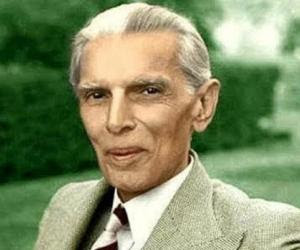
Quaid-e-Azam's Demand For Pakistan:
TMC leader Sheikh Alam's words today are a reminder of the demand for Pakistan in 1940s. It arose from the majoritarian tyranny of the Hindu-dominated Indian National Congress after 1937 elections in India. Speaking in Lucknow in October 1937, Quaid-e-Azam Mohammad Ali Jinnah said the following:
"The present leadership of the Congress, especially during the last ten years, has been responsible for alienating the Musalmans of lndia more and more, by pursuing a policy which is exclusively Hindu; and since they have formed the Governments in six provinces where they are in a majority they have by their words, deeds, and programme shown more and more that the Musalmans cannot expect any justice or fair play at their hands. Whenever they are in majority and wherever it suited them, they refused to co-operate with the Muslim League Parties and demanded unconditional surrender and signing of their pledges."
Ex PM Manmohan Singh's Fears:
Former India Prime Minister Mr. Manmohan Singh's fears of India's disintegration are much more tangible now than ever before. In an interview on BBC's Hard Talk with Indian journalist Karan Thapar in 1999, Mr. Singh: "Great Nations like the Soviet Union have perished. If we continue to mis-manage our economy and continue to divide our country on the basis of religion, caste or other sectarian issues there is a danger of that sort of thing happening".
Today, the rise of Hindutva forces is tearing India apart along caste and religious lines as the country celebrates its Republic Day. Hindu mobs are lynching Muslims and Dalits. A Pew Research report confirms that the level of hostility against religious minorities in India is "very high", giving India a score of 9.5 on a scale from 0 to 10. Pakistan's score on this scale is 7 while Bangladesh's is 7.5.
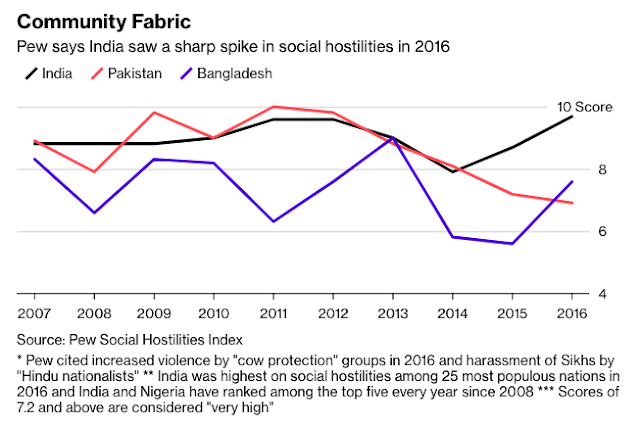 |
| Chart Courtesy of Bloomberg |
Will India Break Up?
In a book entitled "The Raisina Model", British-Indian author Lord Meghnad Desai asks: "A country of many nations, will India break up?" The Hindu Nationalists who are blamed for deepening divisions are themselves divided on the key questions of caste, religion and trade. Professor Walter Anderson, co-author of "The RSS: The View to the Inside" raises the specter of "a battle between Hindutva and Hinduism".

The Raisina Model:
In "The Raisina Model", Lord Meghand Desai says that India's breakup can not be ruled out. Specifically, he points to three issues that could lead to it:
1. Cow protection squads are killing Muslims and jeopardizing their livelihoods. The current agitation about beef eating and gau raksha is in the Hindi belt just an excuse for attacking Muslims blatantly. As most slaughterhouses in UP are Muslim-owned, owners and employees of these places are prime targets.
2. India has still not fashioned a narrative about its nationhood which can satisfy all. The two rival narratives—secular and Hindu nation—are both centred in the Hindi belt extending to Gujarat and Maharashtra at the most. This area comprises 51% of the total population and around 45% of the Muslims in India.
3. India has avoided equal treatment of unequal units. Representation in the Rajya Sabha (Upper House of Parliament) is proportional to population size. If anything, it is the smaller states that may complain about being marginalized, though so far none has. The larger states thus dominate both Houses of Parliament. It would be difficult for small states to object, much less initiate reform. In future, small states could unite to present their case for better treatment. Except for Punjab and Nagaland, there has been no attempt to challenge the status quo.
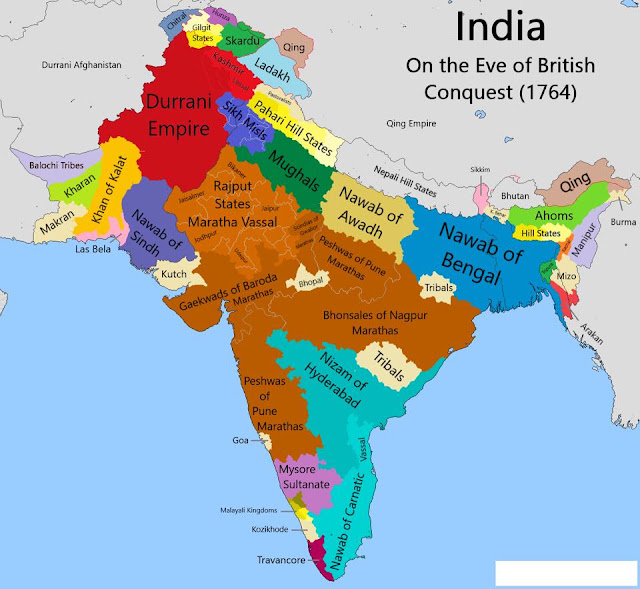 |
| Map of India(s) on the eve of British conquest in 1764 |
In "The RSS: The View to the Inside", the author Walter Anderson brings out several areas which could lead to a split within the Hindu Nationalists. These disagreements have to do with low caste Hindus, Muslims and foreign trade and investment policies.
1. The leadership of the Rashtriya Swayamsevak Sangh (RSS) is drawn entirely from the upper caste Brahmins. The RSS founder Golwalkar never spoke against the caste system. The RSS opposes affirmative action, called reservations, to benefit low caste Hindus. At the same time, they want to integrate Dalits and OBCs (Other backward classes of which Prime Minister Modi is a member) into the organization to promote Hindu unity.
Anderson believes that it will be extremely difficult to reconcile Hindutva embrace of lower castes with the entrenched Hindu caste system. He says the following:
"..there will eventually be a battle between Hindutva and Hinduism. Hindutva emphasizes the oneness of Hindus, whereas ground realities are very different. Let me give an example. Following the egalitarian ideology, Tarun Vijay, an RSS ideologue and former editor of Panchjanya and Organiser, once led some Dalits into a temple in central India, where they had not been before. He was beaten up, but few in the RSS family vocally supported him. They kept mostly quiet. As one important RSS functionary put it to me, the key question is: how do we keep our organisation intact if we do move towards an egalitarian Hindu society?"
2. When RSS leader MD Deoras invited Indian Muslims to join the RSS, he argued that Muslims were mostly India-born, and therefore Indian. But he made the Muslim entry into the RSS conditional upon accepting India’s “historic culture”. RSS leaders argue that South Indian Muslims, or Indonesian Muslims are ideal Muslims. South Indian Muslims speak the regional languages; and Indonesia, a primarily Muslim country, has the Ramayana as its national epic.
3. Many RSS ideologues oppose Prime Minister Modi's policies of promoting foreign trade and investment. They view Modi's economic policies with great skepticism.
Summary:
Sheikh Alam's talk of carving "four Pakistans" out of India is a reminder of Quaid-e-Azam's words after 1937 elections during the British Raj. Dr. B.R. Ambedkar's fears of War on Indian Muslims are also becoming reality. Former India PM Manmohan Singh has warned: "Great Nations like the Soviet Union have perished. If we continue to mis-manage our economy and continue to divide our country on the basis of religion, caste or other sectarian issues there is a danger of that sort of thing happening". The rise of RSS and its affiliates in India is deepening divisions in the country along multiple fault lines, the most important being caste and religion. The RSS leadership itself is not unified on how to deal with the divisions they have created and promoted. This situation has raised the social hostilities in India to very high levels. Pew scores social hostilities against minorities in India at 9.5 on a scale from 0 to 10. Professor Walter Anderson, co-author of "The RSS: The View to the Inside" has raised the specter of "a battle between Hindutva and Hinduism". And it has caused Lord Meghnad Desai, author of The Raisina Model, to ask the question: Will India break up?

Disintegration of India
Dalit Death Shines Light on India's Caste Apartheid
India's Hindu Nationalists Going Global
Rape: A Political Weapon in Modi's India
Trump's Dog Whistle Politics
Funding of Hate Groups, NGOs, Think Tanks: Is Money Free Speech?
Riaz Haq Youtube Channel
PakAlumni: Pakistani Social Network
Views: 1024
-
Comment by Riaz Haq 2 hours ago
-
Divya Dwivedi is a philosophy and literature professor at the Indian Institute of Technology (IIT) Delhi who has generated widespread public and academic debate regarding her critical views on caste, Mahatma Gandhi, and the conceptualization of Hinduism in India. [1, 2, 3, 4]
Core Arguments and Claims
20th-Century Political Invention: Dwivedi argued during a 2019 NDTV debate—and in subsequent academic commentary—that "Hinduism" as a singular, unified religious and political identity was largely formalized in the early 20th century. [1, 2]
The "False Hindu Majority": She claims that an all-encompassing Hindu majority was constructed by upper-caste leaders (including, in her view, a theologized political role played by Mahatma Gandhi) to mask the actual numerical dominance of lower-caste populations and Scheduled Castes/Tribes in India. [1, 2, 3]
Distinction from Ancient Texts: Dwivedi has clarified that her critique targets "Hinduism" as a modern political-religious construct and institutional majority framework rather than ancient spiritual philosophies or texts like the Vedas. [1]
Vision for an Egalitarian Future: In international forums (such as interviews with foreign media), she has described an "India of the past" marked by caste and racialized hierarchies, contrasting it with an envisioned future India free from caste oppression and structured Hindu political dominance. [1]
Controversy and Public Reaction
Criticism from the Hindu Right: Her statements drew fierce backlash from Hindu nationalist groups, social media commentators, and conservative organizations (such as The Jaipur Dialogues), who accused her of attacking Hindu identity, spreading misinformation about Sanatan Dharma, and disparaging India abroad. [1, 2]
Academic & International Reception: In academic circles (such as discussions highlighted in the Los Angeles Review of Books), her work is seen as part of a postcolonial and anti-caste critique that challenges upper-caste institutional hegemony and nationalist historiography. [1, 2]
Personal Backlash: Following her remarks, Dwivedi faced targeted online abuse and death threats, leading her to step back from live television debates while continuing her scholarly writing on caste, philosophy, and politics. [1, 2]
——-
https://x.com/khalsasarkar__/status/2115742883781513572?a=5Q4x_cK9G...
Comment
- ‹ Previous
- 1
- …
- 4
- 5
- 6
- Next ›
Twitter Feed
Live Traffic Feed
Sponsored Links
South Asia Investor Review
Investor Information Blog
Haq's Musings
Riaz Haq's Current Affairs Blog
Please Bookmark This Page!
Blog Posts
Kashmir: Farooq Abdullah Lauds Pakistan's Diplomatic Support
Speaking at an event in the Indian Occupied Kashmir, veteran Kashmiri leader Farooq Abdullah has lauded Pakistan's support for Kashmiris' rights. “They (Indian leaders in Delhi) are silent today because there is noise in the world, and our neighbor (Pakistan) is constantly behind this. Everywhere they say, ‘the decision regarding Kashmir has not been made’. That is what is saving us. Otherwise, their intentions are not good", he said. He warned that Kashmiris risked losing their…
ContinuePosted by Riaz Haq on October 29, 2026 at 6:00pm — 1 Comment
Can Pakistan Scale Up Affordable Energy Availability to Achieve Prosperity?
Pakistan is currently classified as a lower middle-income country, with the ambition to become a high-income country. Its policymakers now recognize that no country has transitioned from middle-income to high-income status without generating substantial electricity at affordable rates. The link between energy and prosperity has been well-established since the advent of the Industrial Revolution. The AI Revolution has further reinforced it. Can Pakistan make the…
ContinuePosted by Riaz Haq on October 21, 2026 at 6:00pm — 10 Comments
© 2026 Created by Riaz Haq.
Powered by


You need to be a member of PakAlumni Worldwide: The Global Social Network to add comments!
Join PakAlumni Worldwide: The Global Social Network