PakAlumni Worldwide: The Global Social Network
The Global Social Network
Pakistan Prime Minister Imran Khan Demonstrated Effectiveness as Crisis Leader
Prime Minister Imran Khan has effectively led Pakistan through multiple crises in the last 4 years. Khan inherited dangerously low forex reserves in 2018 which are now at $23 billion, near the highest level in the nation's history. The COVID pandemic that hampered Pakistan's recovery has been handled well with the fully vaccinated rate for the eligible population at more than 75%. Not only has Khan deftly navigated his nation through these crises but his government has also revived the country's economy and grown exports by 26%. Domestic savings rate recovered to nearly 17% after plunging to a low of 12% in 2018. The year 2021 was a banner year for Pakistan's technology startups that raised over $350 million in funding, more than the amount raised in the previous 5 years. Manufacturing and construction industries are enjoying a boom last seen during the Musharraf years in 2000-2007.
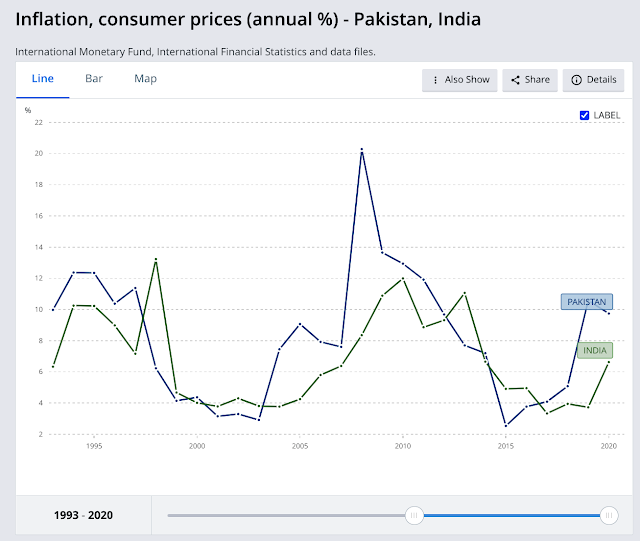 |
| Historic Inflation Rates in India & Pakistan. Source: World Bank |
 |
| Pakistan Exports in First 8 Months (July 21-Feb 22) in FY 22. Sourc... |
 |
| Pakistan Employment By Sectors. Source: Pakistan Bureau of Statistics |
For the first time in recorded history, the labor force participation rate in Pakistan is now higher than in India, according to the ILO/World Bank estimates.
 |
| Labor Participation Rates in India and Pakistan. Source: World Bank... |
 |
| Unemployment Rate in India and Pakistan. Source: ILO/World Bank |
 |
| Pakistan Savings Rate. Source: Global Economy |


 |
| QIM Index 2019-22. Source: APP |
 |
| Pakistan Large Scale Manufacturing Index. Source: Mettis Global |
 |
| Cement shipments in Pakistan. Source: All Pakistan Cement Manufactu... |
 |
| Pakistan Startup Investments. Source: Aljazeera |
Views: 1669
-
Comment by Riaz Haq on July 2, 2026 at 8:08pm
-
$390m Reko Diq bridge loan for ML-3 - Newspaper - DAWN.COM
• 996-km project will upgrade Rohri-Sibi-Quetta-Koh-i-Taftan rail line to support transportation from Reko Diq copper and gold project
• Officials say upgraded corridor will boost mineral exports, strengthen regional connectivity with Iran and Turkiye, improve access to Gwadar PortISLAMABAD: Owing to financial constraints, Pakistan Railways’ 996-kilometre Main Line-3 (ML-3) project covering the Rohri-Sibi-Quetta-Koh-i-Taftan section, estimated to cost about Rs280 billion, will be financed through a special $390 million (over Rs112bn) bridge loan from Reko Diq Mining Company (RDMC), repayable in a lump-sum (bullet) payment within two years.
The financing arrangement, its foreign exchange exposure, and the project’s security costs — estimated at around Rs46.38bn, or nearly 17 per cent of the total cost — have come under scrutiny by the Planning Commission. The commission has also raised concerns over inadequate planning for post-completion security.
The $892 million ML-3 upgrade is primarily intended to support transportation linked to the multi-billion-dollar Reko Diq copper and gold project. RDMC is a joint venture in which Canada’s Barrick Gold Corporation holds a 50pc stake, while the remaining 50pc is equally owned by the Balochistan government and three federal state-owned entities — OGDCL, PPL and GHPL.
—————According to Pakistan Railways, the Rs278.62 billion project will ultimately be financed through the PSDP, with interim funding provided through RDMC and the federal government. The project includes track renewal, rehabilitation of embankments and bridges, replacement of turnouts, and construction of 11 new railway stations between Spezand and Taftan.
Implementation has been divided into two phases. Phase-I (2026-2030), estimated at $585 million, will focus on critical infrastructure works, while the remaining priority works will be completed during Phase-II (2031-2033) at an estimated cost of $145 million. Security arrangements during construction alone are expected to cost about $162 million.
Comment
- ‹ Previous
- 1
- …
- 5
- 6
- 7
- Next ›
Twitter Feed
Live Traffic Feed
Sponsored Links
South Asia Investor Review
Investor Information Blog
Haq's Musings
Riaz Haq's Current Affairs Blog
Please Bookmark This Page!
Blog Posts
Tata's Boardroom Crisis: Will it Impact Philanthropy in India?
India's Tata Group is going through a major boardroom crisis. Noel Tata, the Chairman of the Tata holding company, has been removed from the Tata Group's board by N. Chandrasekaran, chairman of Tata Sons. Noel Tata has declared the decision illegal, a stance the board disputes. The crisis has been precipitated by a 2022 decision by India’s central bank to order the company to seek a stock market listing for Tata Sons, to comply with new rules governing systemically important…
ContinueXi-Trump Summit: US-China G2 Rapprochement to Avoid Thucydides Trap
The summit meeting of the leaders of China and the United States in Washington appears to signal a rapprochement between the two superpowers. President Trump has repeatedly referred to what he calls "G2", without mentioning "G7" or "G20", the groups that include many more countries. This development is seen as positive for world peace but it diminishes India's significance as a "counterweight to China" and the benefits Indians expected to flow from the US-China confrontation in…
ContinuePosted by Riaz Haq on September 25, 2026 at 5:30pm — 5 Comments
© 2026 Created by Riaz Haq.
Powered by


You need to be a member of PakAlumni Worldwide: The Global Social Network to add comments!
Join PakAlumni Worldwide: The Global Social Network