PakAlumni Worldwide: The Global Social Network
The Global Social Network
Ukraine War: Time For India To Rethink its Military Doctrine Modeled On Russia's?
India's Russian-equipped and trained military is watching with great concern Russia's losses in the Ukraine war. Moscow has lost 20,000 soldiers, nearly 500 main battle tanks and a large warship so far, according to media reports. Ukraine's use of Turkish drones, US-made anti-tank guided missiles (ATGMs) Javelins and Ukrainian anti-ship Neptune missiles has taken a heavy toll on the Russian Army and Navy. It is notable that India's Cold Start Doctrine against Pakistan is modeled on the Russian formation known as the “operational maneuver group” (OMG).
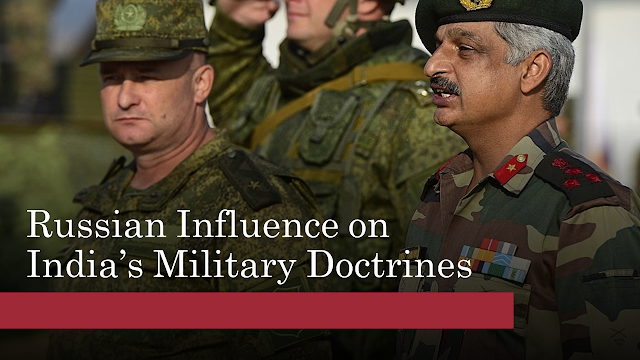 |
| Russian Influence On Indian Military Doctrine. Source: Air Universi... |
Russian Influence on Indian Military Doctrine:
It is well known that the Indian Army relies on Russian tanks, artillery, rockets, and ammunition. The Indian Navy uses Russian ships, submarines and missiles and the Russian Su-30 MKI forms the backbone of the Indian Air Force. Like Russia, the Indian military doctrine is based on deploying large platforms (tanks, artillery, ships and fighter-bombers) with massive firepower. Here's an excerpt of an article by Dr. Vipin Narang, an Indian-American analyst, on the subject:
"In terms of doctrine and strategy, although it may be difficult to trace direct influence and lineage between Russia and India, there are several pieces in India’s conventional and nuclear strategy that at least mirror Russia’s behavior. On the conventional side, the core formation in the quick-strike concept known as “Cold Start” or “proactive strategy options” was modeled on the Russian formation known as the “operational maneuver group” (OMG). The idea was to have a formation that could be rapidly assembled from tank and armored divisions that could break through reinforced defenses—NATO for Russia, and Pakistan’s I and II Corps in the plains and desert sectors for India.
"On the nuclear side, India is currently seized with the same dilemma as the Soviet Union was during the Cold War: both NATO and Pakistan threaten battlefield nuclear weapons against conventional thrusts (India, at least, presumably would be retaliating following a Pakistan-backed provocation). While both states refined their conventional concept of operations, there may have also been corresponding adjustments to their nuclear strategies. It was long believed that, in response to NATO threats to use nuclear weapons first on the battlefield, the Soviet Union had strong preemptive counterforce elements in its strategy to try to at least disarm the United States of its strategic nuclear weapons for damage limitation. It is increasingly evident that at least some serious Indian officials are interested in developing the same sort of option: preemptive counterforce against Pakistan’s strategic nuclear forces, both for damage limitation and to reopen India’s conventional superiority. It is no surprise perhaps, then, that India chose to go ahead with acquiring Russia’s S-400 missile and air defense system, despite the threat of Countering America's Adversaries Through Sanctions Act (CAATSA) sanctions from the United States: the S-400 is key to India’s damage limitation strategy, capable of potentially intercepting residual ballistic and cruise missiles that a counterforce strike might miss".
 |
| Pakistani Military Official in Ukraine. Source: New York Times |
Turkish Drones:
Turkish Bayraktar TB2 has been highly effective in destroying Russian tanks and armor in Ukraine. It is playing a key role in Ukraine's counter offensives against Russia's invasion. It is proving so effective that "Ukrainian forces are singing its praises, literally", according to a CNN report.
Indian Army has nearly 6,000 tanks of Russian origin. These tanks are just as vulnerable to drone and anti-tank missiles as the Russian tanks that perished in Ukraine.
Pakistan has developed Baktar Shikan, a second-generation man-portable anti-tank guided missile (ATGM) system which uses optical aiming, IR tracking, remotely controlled and wire transmitted guidance signals. It can also be mounted on attack helicopters and Armored Personnel Carriers (APCs). Its long range, penetration power and a powerful anti-jamming capability form a potent defense against armored targets.
Pakistan is also reported to have already acquired Turkish Bayraktar TB2 drones recently. It was displayed in the Pakistan Day Parade on March 23, 2022, along with other military equipment acquired recently by the Pakistani defense forces.
Anti-Ship Missiles:
Ukraine claims that its Neptune anti-ship missiles hit and sank Moskva in Black Sea. It was a large 10,000-ton guided missile cruiser of the Russian Navy that was launching cruise missiles on targets in Eastern and Southern Ukraine. It is the largest warship to have been sunk in action since WWII.
Vast majority of Indian Navy ships, including its aircraft carriers and missile frigates, are designed, built and equipped by Russians.
Pakistan recently showcased its anti-ship missile Harbah at DIMDEX 2022, a defense expo in Qatar. It is a medium range ship launched subsonic cruise missile system capable of targeting sea as well as land targets in “all weather operation” at a maximum range of 280 kilometers, according to a report in NavalNews. The missile is fire and forget type. It relies on inertial navigation technologies with GPS and GLONASS systems. According to its manufacturer GIDS, the missile features the following guidance systems: a DSMAC camera, imaging infrared seeker, and radar seeker.
Summary:
The war in Ukraine is forcing a defense strategy rethink in countries such as India which rely on Russian equipment and training. Hindustan Times has quoted an unnamed former Indian Army Chief as saying: “War videos available show that the Russian Army has tactical issues in Ukraine war. Tell me, which tank formation goes to war in a single file without air or infantry cover when the opponent is equipped with the best anti-tank guided missile like Javelin or Turkish Bayraktar TB2 missile firing drones? There is question on Russian air supremacy with Ukraine Army armed with shoulder fired Stinger surface to air missiles as well as the night fighting capability of the Russian Air Force.”
Related Links:
Haq's Musings
South Asia Investor Review
Pakistan-China Defense Industry Collaboration Irks West
Pakistan's Cyber Attack and Defense Capability
Is India a Paper Elephant?
Pakistan's Aircraft Exports
Pakistan Navy Modernization
West's Technological Edge in Geopolitical Competition
Pakistan Defense Industry
Silicon Valley Book Launch of "Eating Grass"
Ukraine's Lesson For Pakistan: Never Give Up Nukes!
Pakistan Economy Nears Trillion Dollars
Pakistan's Sea-Based Second Strike Capability
Riaz Haq Youtube Channel
VPOS Youtube Channel
Views: 2081
-
Comment by Riaz Haq 6 hours ago
-
Pakistan’s Eight Hangor Submarines Could Strain India’s Navy, Former Admiral Warns
Former Indian vice admiral Sanjay Mahindru warns that Pakistan’s planned eight-boat Hangor fleet could force India to devote more ships, aircraft and sensors to tracking concealed threats.
https://defencesecurityasia.com/en/pakistan-hangor-submarines-india...
India’s Delayed Submarine Replacement Magnifies the Hangor Window
Pakistan’s first Hangor entered service eleven years after the 2015 order, while India’s Project 75I programme for six air-independent propulsion submarines remained unsigned by mid-2026, illustrating how acquisition tempo can alter regional risk before fleet totals decisively change.
Project 75I has spent roughly two decades in planning and negotiation, with German Type 214-derived proposals widely discussed, but even a near-term contract would likely place the first completed Indian submarine around 2032–2033 under optimistic industrial and testing assumptions.
Meanwhile, several Sindhughosh-class Kilo and Shishumar-class HDW submarines are approaching retirement, creating a late-2020s readiness window in which hull availability, refit schedules, and crew pipelines may matter more than nominal Indian fleet strength displayed on paper
India’s six Kalvari-class Scorpène submarines provide modern conventional capability, but they entered service without air-independent propulsion, while plans to integrate an indigenous AIP plug during future refits remain subject to engineering validation, schedule risk, and availability costs.
This mismatch explains Mahindru’s “lost decade” description because submarine construction cannot be accelerated instantly; specialised steel, pressure-hull fabrication, combat-system integration, sea trials, certification, crew training, and dockyard capacity impose long lead times after political approval.Explore History
Simply ordering more boats would therefore leave an immediate surveillance deficit, whereas investments in seabed sensors, unmanned underwater vehicles, deployable arrays, maritime patrol aviation, and networked processing could improve detection coverage before new Indian submarines become operational.
India must also protect anti-submarine warfare availability by maintaining P-8I mission systems, stocking sonobuoys and lightweight torpedoes, expanding MH-60R support, and ensuring surface combatants possess reliable towed-array sonars, trained operators, and sufficient operational flying hours.
Force posture becomes central because sensors concentrated near major bases may leave patrol gaps elsewhere, while widely dispersed systems require secure communications, common acoustic libraries, automated correlation, and command arrangements capable of converting detections into timely operational decisions.ASW technology training
Pakistan faces parallel constraints, including Chinese CHD620 diesel-engine reliability after German export restrictions blocked planned MTU engines, local construction delays, infrastructure expansion, crew generation, and the challenge of sustaining high readiness across eleven eventual AIP-equipped submarines.
The undersea balance will consequently depend less upon ceremonial commissioning totals than deployable boats, trained crews, maintenance throughput, weapon readiness, sensor integration, and each navy’s ability to regenerate patrols after failures, losses, or prolonged wartime operations.
(CLICK HERE): India’s 200-Warship Surge Targets China as Pakistan’s Hangor Submarines Reshape the Indian Ocean
Underwater Domain Awareness Will Decide Whether Hangor Changes the Balance
Mahindru’s proposed remedy places underwater domain awareness above platform-for-platform competition because a submarine that can be continuously detected becomes containable, whereas an unlocated boat can influence fleet behaviour, harbour activity, and political decision-making without firing a weapon.Submarine fleet analysis
Comment
- ‹ Previous
- 1
- …
- 10
- 11
- 12
- Next ›
Twitter Feed
Live Traffic Feed
Sponsored Links
South Asia Investor Review
Investor Information Blog
Haq's Musings
Riaz Haq's Current Affairs Blog
Please Bookmark This Page!
Blog Posts
Tata's Boardroom Crisis: Will it Impact Philanthropy in India?
India's Tata Group is going through a major boardroom crisis. Noel Tata, the Chairman of the Tata holding company, has been removed from the Tata Group's board by N. Chandrasekaran, chairman of Tata Sons. Noel Tata has declared the decision illegal, a stance the board disputes. The crisis has been precipitated by a 2022 decision by India’s central bank to order the company to seek a stock market listing for Tata Sons, to comply with new rules governing systemically important…
ContinueXi-Trump Summit: US-China G2 Rapprochement to Avoid Thucydides Trap
The summit meeting of the leaders of China and the United States in Washington appears to signal a rapprochement between the two superpowers. President Trump has repeatedly referred to what he calls "G2", without mentioning "G7" or "G20", the groups that include many more countries. This development is seen as positive for world peace but it diminishes India's significance as a "counterweight to China" and the benefits Indians expected to flow from the US-China confrontation in…
ContinuePosted by Riaz Haq on September 25, 2026 at 5:30pm — 5 Comments
© 2026 Created by Riaz Haq.
Powered by


You need to be a member of PakAlumni Worldwide: The Global Social Network to add comments!
Join PakAlumni Worldwide: The Global Social Network