PakAlumni Worldwide: The Global Social Network
The Global Social Network
Rural Pakistan: New Infrastructure Driving Socioeconomic Revolution in Tharparkar
In a 2018 New York Times Op Ed titled "How Not to Engage With Pakistan", ex US Ambassador to Pakistan Richard G. Olson wrote: "Its (CPEC's) magnitude and its transformation of parts of Pakistan dwarf anything the United States has ever undertaken". Among the parts of Pakistan being transformed by China Pakistan Economic Corridor (CPEC) are some of the least developed regions in Balochistan and Sindh, specifically Gwadar and Thar Desert. Over 70% of Thar desert's population is Hindu.
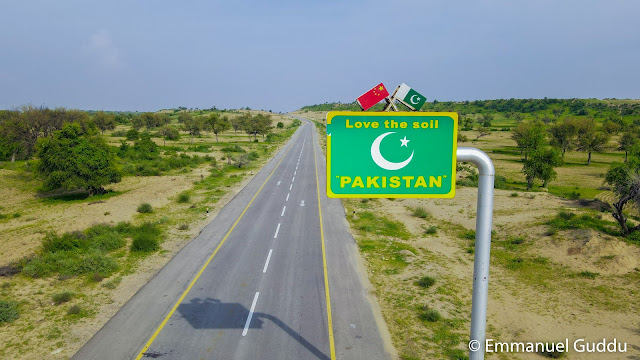 |
| Tharparkar: Road Built Under CPEC. Source: Emmanuel Guddu |
More recently, Pakistani architect and social activist Arif Hasan has detailed the socioeconomic impact of new infrastructure in Tharparkar district, further reinforcing what Ambassador Olson wrote about how CPEC is transforming Pakistan's least developed areas. In his book titled "Tharparkar: Drought, Development, and Social Change", author Arif Hasan has highlighted the following (excerpted from Arif Hasan's recent piece published in Dawn):
1. New roads, airports, solar panels, cell towers and mobile phones are opening up opportunities for employment, entrepreneurship, education and healthcare for the Thari population.
2. New infrastructure is empowering Thari women to challenge the long established patriarchy in Tharparkar. A major change has occurred in gender relations — males are less restrictive; there is an increase in education and hygiene; women now move around without male escorts. Women are giving up old traditional clothes for more fashionable dresses.
3. Road construction in Thar that started in the Musharraf era (2000-2008) has made transportation cheaper and easier. Before these new roads, the old six-wheeler kekra (WW II era American Army truck) was the only mode of vehicular transportation in the desert. It was slow and expensive. It has now been replaced by normal Bedford trucks which are cheaper to run.
4. Bank loans to buy taxis are now available. Number of taxis operating in Thar has increased from 150 to over 400, while the qingqis in Mithi have increased from over 150 to over 300 since 2013.
5. The old kekras (old American Army 6-wheelers) have been converted into water tankers; people can now actually order one by phone, to pick up potable water from Mithi and deliver it to villages.
6. The new roads have helped substantially increase trade and commerce. Thar’s agricultural produce now reaches distant markets — six to seven trucks per day carry onions from Nagarparkar to Lahore, and vegetables and fruit from other parts of Sindh and Punjab are now easily available in Thar.
7. Roads have helped in the increase of salt and china clay mining. These have created more jobs, especially for those villages that are next to the mines. The lives of the families who have benefitted from this growth in the job market have changed and the first investments they make is in the building of pakka houses, with steel channel and brick-tiled roofs. Another important investment is in motorbikes, which makes flexible and faster mobility possible. People have sold their camels and donkeys to buy motorbikes.
8. Thari men now work in the garment industry in Karachi, where they save and send home Rs 10-12,000 a month.
9. Tourist traffic has grown in Thar with tens of thousands of people visiting the area every year after the rains and for the many religious festivals that the desert celebrates. Women producing traditional handicrafts are able to sell their wares to the tourists. This creates economic opportunities for the local population.
10. Dozens of carpentry workshops are now operating in Mithi. The carpenters have moved in from the rural areas of Thar, where they worked for the rural population, who paid them in grain.
11. Number of retail stores has also increased — in Mithi there were 20 to 25 grocery stores in 2015, as opposed to seven or eight 10 years earlier. Earlier, the store owners used to travel to Hyderabad to buy goods but, today, because of the road and mobile phone, they just order the items from Karachi and the transporter delivers them. The clients at the stores are both rural and urban.
12. Access to healthcare units in district capital Mithi is a lot easier and faster, and has been of special importance in maternity-related cases.
13. With the construction of new roads, the villagers are now more willing to send their children to school, including girls, because schools are easier to access.
Back in 2018, I wrote a post titled "CPEC is Transforming Least Developed Parts of Pakistan". Below is an except that talks about Thar development:
Thar Desert:
Thar, one of the least developed regions of Pakistan, is seeing unprecedented development activity in energy and infrastructure projects. New roads, airports and buildings are being built along with coal mines and power plants as part of China-Pakistan Economic Corridor (CPEC). There are construction workers and machinery visible everywhere in the desert. Among the key beneficiaries of this boom are Thari Hindu women who are being employed by Sindh Engro Coal Mining Company (SECMC) as part of the plan to employ locals. Highlighted in recent news reports are two Hindu women in particular: Kiran Sadhwani, an engineer and Gulaban, a truck driver.
 |
| Kiran Sadhwani, a Thari Hindu Woman Engineer. Source: Express Tribune |
Thar Population:
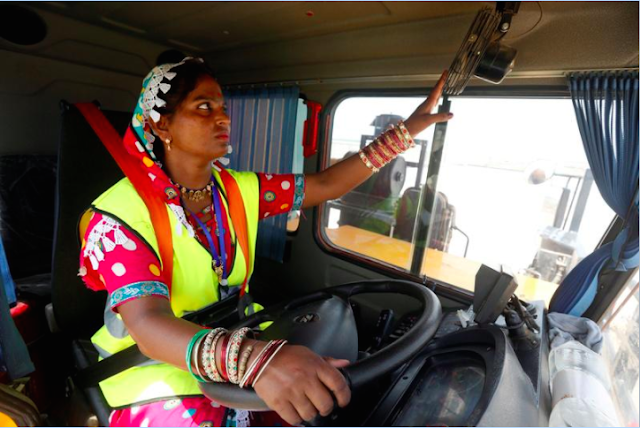 |
| Hindu Woman Truck Driver in Thar, Pakistan. Source: Reuters |
Some of them are now being employed in development projects. A recent report talked of an underground coal gasification pilot project near the town of Islamkot where "workers sourced from local communities rested their heads after long-hour shifts".
 |
| Hindu Woman Truck Driver in Thar, Pakistan. Source: Reuters |
In the first phase, Sindh Engro Coal Mining Company (SECMC) is relocating 5 villages that are located in block II. SECMC is paying villagers for their homes and agricultural land.
Thar Drought
China-Pakistan Economic Corridor
Abundant, Cheap Coal Electricity For Pakistan
Pakistan Health Indicators
Pakistan Sees Robust Growth in Consumption of Energy, Cement and Steel
Moringa Tree to Fight Malnutrition in Sindh
Pakistan's Social Sector Indicators
CPEC Transforming Least Developed Parts of Pakistan
China-Pakistan Economic Corridor FDI
Mobile Broadband Subscriptions and Smartphone Sales
Pakistan in MSCI Emerging Market Index
Views: 744
-
Comment by Riaz Haq on October 29, 2025 at 4:26pm
-
China to build hospitals in Balochistan: envoy - Pakistan - DAWN.COM
https://www.dawn.com/news/1951898
AI Overview
4VOrqvvl9E9PugzwVkf7DxzeNaKAAAAAAElFTkSuQmCC
wJhqwoESLWQaYBU7Q1CKWdt7v4EqFPN0PQ8aKjIDjLFkCbUilMaYDusByxmtTz4MSFq50MAgGwymfjVMVkAAAAASUVORK5CYII=
+1
China plans to build 100 hospitals and establish new economic zones in Balochistan to create jobs and improve water resource management, according to Chinese Ambassador Jiang Zaidong. The initiatives were announced during a meeting with Pakistan's Pakistan-China Friendship Group and are part of the broader China-Pakistan Economic Corridor (CPEC). These projects are intended to boost the local economy and healthcare access, though specific timelines and formal agreements are still pending.
Key details of the plan
Hospitals: 100 hospitals are planned to be built to improve healthcare access for the local population.
Economic Zones: New economic zones will be established to generate employment opportunities.
Water Management: The projects are also aimed at improving water resource management in the province.
Education: The plans also include expanding student exchange and technical training programs.
Context: The announcement was made by Chinese Ambassador Jiang Zaidong during a meeting with Pakistani senators. The initiative is part of the CPEC framework, which includes several projects in Balochistan.
-
-
New Connectivity Plan Proposed to Boost Internet in Remote Areas
The federal government wants to bridge the digital divide. Federal Minister for Economic Affairs Ahad Cheema recently chaired a crucial meeting. He discussed the proposed National Connectivity Plan. Minister for IT & Telecom Shaza Fatima Khawaja and several senior officials also attended this session. Primarily, the meeting focused on expanding high-speed internet access. The government wants to connect villages, remote areas, and small towns. Consequently, this move will unlock massive new economic opportunities across the country.
A Connectivity Plan to Empower Freelancers & Digital Professionals
Currently, slow and unreliable internet creates major hurdles for remote workers. Therefore, Federal Minister Ahad Cheema highlighted the government’s top priority. Authorities aim to facilitate freelancers, e-commerce entrepreneurs, and other digital professionals living in remote regions. The government will take all necessary measures to ensure affordable, high-speed internet services. As a result, every citizen can fully participate in the growing digital economy.
Furthermore, the session highlighted the critical importance of 5G infrastructure. Next-generation fiber-to-the-home (FTTH) networks will also drive national economic growth. Ultimately, these crucial upgrades will create jobs and foster nationwide digital inclusion.
Ambitious Infrastructure Targets
Pakistan is already experiencing strong momentum in digital development. Officials noted steady growth in FTTH subscriptions, which currently stand at 2.8 million. Moreover, the country boasts a robust fiber footprint of 234,000 kilometers. The current infrastructure includes 5.1 million house passes and six operational submarine cables.
To build upon this solid foundation, the government outlined highly ambitious national targets. The plan seeks to expand the infrastructure to 10 million house passes. Additionally, the government aims to raise average fixed broadband download speeds to 85 Mbps. Authorities also plan to increase tower fiberization to 60 percent. Consequently, these specific efforts aim to secure the country a spot among the world’s top 50 countries for broadband performance.
Strategic Reforms & Tax Relief
The meeting placed a massive emphasis on digital affordability. Participants actively considered targeted tax relief for internet users living in remote areas. This key decision will significantly expand digital participation.
Additionally, officials discussed several strategic reforms. The government plans to abolish right-of-way fees. Authorities will also launch a single-window approval portal and introduce district-level licensing. Furthermore, the plan makes fixed broadband connectivity mandatory across all public institutions, schools, and health facilities.
To ensure swift execution, the government will finalize the National Connectivity Plan expeditiously through comprehensive stakeholder consultation. Cheema stressed the need for a highly structured and sequenced approach. The government will prioritize essential regulatory reforms and enforce clear operator obligations. Moreover, officials will link financial support directly to verified performance milestones. This strategy will accelerate nationwide fiber deployment. At the same time, it will successfully safeguard public resources and ensure long-term commercial viability.
-
-
USF Connects 16.2m People, Deploys 10,400km OFC in Five Years.
The projects expanded broadband access across thousands of underserved areas. Fibre deployment also connected 947 previously unserved
https://www.techjuice.pk/usf-connects-16-2m-people-deploys-10400km-...
The Universal Service Fund (USF) has expanded voice and broadband access to more than 16.2 million people. The projects covered over 9,400 underserved and unserved mauzas during the last five fiscal years.
The figures were shared by Minister for Information Technology and Telecommunication Shaza Fatima Khawaja. She provided the details in a written reply to the National Assembly.
During FY2022-26, USF projects delivered voice and broadband data services across more than 9,400 mauzas. The programme also helped bring broadband to areas where telecom operators lacked a strong business case.
USF also expanded coverage along more than 1,000 kilometres of unserved roads. These included sections of national highways and motorways. The projects also covered eight tourist destinations and around 50 kilometres of access routes.
The fund deployed more than 10,400 kilometres of optic fibre cable (OFC) during the same five-year period. This work connected 947 unserved tehsil headquarters, union councils and towns.
Since its launch, USF has reached more than 38.4 million people across over 22,100 mauzas. It has also covered more than 2,500 kilometres of previously unserved road segments.
The fund has connected eight tourist destinations and about 50 kilometres of access routes. Its total OFC deployment has also crossed 18,300 kilometres since inception.
USF was established under Section 33(A)(1) of the Pakistan Telecommunication (Re-organization) Act, 1996. Its main goal is to extend telecom services to rural, remote and underserved communities.
The programme initially focused on voice and basic data services through 2G networks. It later expanded to high-speed broadband through 3G and 4G networks.
The government said better connectivity is also supporting education, healthcare and emergency services. It is helping improve financial inclusion, e-governance and access to economic opportunities.
The ministry said USF remains important in areas where commercial telecom deployment is difficult. It will continue targeting unserved and underserved communities through broadband and fibre projects.
-
-
Pakistan expands Thar coal mine as US-Iran war deepens energy import risks
https://www.arabnews.pk/pakistan/pakistan-expands-thar-coal-mine-as...
Phase III raises Thar Block II mine capacity by 47 percent to 11.2 million tons annually
Additional coal will supply 660 MW Lucky plant as Pakistan seeks to reduce fuel imports
KARACHI: Pakistan on Monday inaugurated a major expansion of its Thar coal mine, increasing domestic fuel supplies for power generation as the Iran war disrupts regional energy markets and sharpens the country’s exposure to costly imports.
The third phase of the Thar Block II mine in the southern Sindh province increases annual production capacity by 47 percent, from 7.6 million to 11.2 million tons, according to the provincial government. The additional 3.6 million tons will supply the 660-megawatt Lucky Electric Power Company plant near Karachi, which has historically relied largely on imported coal.
The expansion comes as Pakistan, a net energy importer with limited foreign-exchange buffers, faces higher fuel costs amid the US-Iran war and disruption to energy supplies and shipping through the Strait of Hormuz. Replacing imported coal and other fuels with domestic resources has consequently become increasingly important to Islamabad’s energy-security strategy.
Pakistan has already significantly expanded the use of coal from Thar, a desert region bordering India that contains one of the world’s largest lignite deposits. Six power projects with combined capacity of 3,960 MW used Thar coal either wholly or partly in the last fiscal year, generating 16,447 gigawatt-hours of electricity and consuming 13.8 million tons of the local fuel, according to government data published last month.
“Today, we are saving $1.6 billion of foreign reserves in Pakistan because of Thar coal,” Bilawal Bhutto Zardari, chairman of the Pakistan Peoples Party that rules Sindh and a former foreign minister, said as he inaugurated the expansion.
The Sindh government said the Phase III project, completed entirely through self-financing, was expected to save another $220 million annually in foreign exchange and Rs15 billion ($53 million) a year in power-generation costs.
The additional production will allow more Thar coal to be supplied to Lucky Electric, whose 660 MW plant at Port Qasim near Karachi has traditionally run on imported coal. During the last fiscal year, Thar coal accounted for 33 percent of the plant’s coal use, with imported fuel making up the remaining 67 percent, according to official data.
Regular supplies of Thar coal to the Lucky plant began on Sept. 1, data shows, underscoring efforts to substitute imported coal at existing power stations rather than add new generation capacity.
Three power plants with combined capacity of 1,320 MW were already supplied entirely by the Block II mine before the latest expansion. The addition of Lucky means the mine can support plants with combined capacity of 1,980 MW, according to the Sindh government.
Pakistan began commercial power generation from Thar coal in 2019 after decades of attempts to exploit the desert’s vast lignite reserves. Four plants with a combined capacity of 2,640 MW were classified by the country’s power regulator as local-coal generators in the previous fiscal year, while another 4,620 MW of installed coal-fired capacity was categorized as relying on imported coal, according to the National Electric Power Regulatory Authority.
Bhutto Zardari said officials in Islamabad had once dismissed the resource as commercially unviable and called for its use to be expanded beyond electricity generation.
Pakistan in February advanced a $1.12 billion project to convert Thar lignite into urea, part of a broader effort to reduce dependence on imported fertilizer and natural gas.
Sindh Chief Minister Murad Ali Shah said authorities were also working on converting Thar coal into gas and aimed eventually to raise Block II’s annual mining capacity to 20 million tons.
Comment
- ‹ Previous
- 1
- 2
- 3
- 4
- Next ›
Twitter Feed
Live Traffic Feed
Sponsored Links
South Asia Investor Review
Investor Information Blog
Haq's Musings
Riaz Haq's Current Affairs Blog
Please Bookmark This Page!
Blog Posts
Tata's Boardroom Crisis: Will it Impact Philanthropy in India?
India's Tata Group is going through a major boardroom crisis. Noel Tata, the Chairman of the Tata holding company, has been removed from the Tata Group's board by N. Chandrasekaran, chairman of Tata Sons. Noel Tata has declared the decision illegal, a stance the board disputes. The crisis has been precipitated by a 2022 decision by India’s central bank to order the company to seek a stock market listing for Tata Sons, to comply with new rules governing systemically important…
ContinueXi-Trump Summit: US-China G2 Rapprochement to Avoid Thucydides Trap
The summit meeting of the leaders of China and the United States in Washington appears to signal a rapprochement between the two superpowers. President Trump has repeatedly referred to what he calls "G2", without mentioning "G7" or "G20", the groups that include many more countries. This development is seen as positive for world peace but it diminishes India's significance as a "counterweight to China" and the benefits Indians expected to flow from the US-China confrontation in…
ContinuePosted by Riaz Haq on September 25, 2026 at 5:30pm — 5 Comments
© 2026 Created by Riaz Haq.
Powered by


You need to be a member of PakAlumni Worldwide: The Global Social Network to add comments!
Join PakAlumni Worldwide: The Global Social Network