PakAlumni Worldwide: The Global Social Network
The Global Social Network
World Happiness Report 2023: India Among World's Saddest Nations
India occupies 126th position among 137 nations ranked in the World Happiness Report 2023 released by the Sustainable Development Solutions Network. In South Asia, Pakistan (score 4.555) ranks 108, Sri Lanka 112, Bangladesh (4.282) 118 and India 126 (4.036). Only Taliban-ruled Afghanistan ranks worse at 137. Finland is the happiest nation in the world, followed by Denmark and Iceland in 2nd and 3rd place.
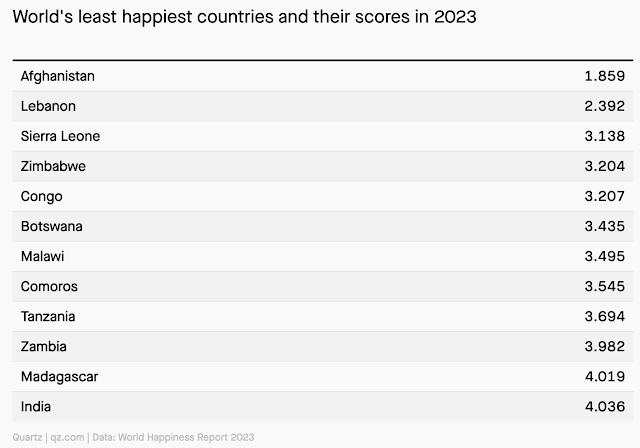 |
| Least Happy Countries in 2023. Source: Quartz |
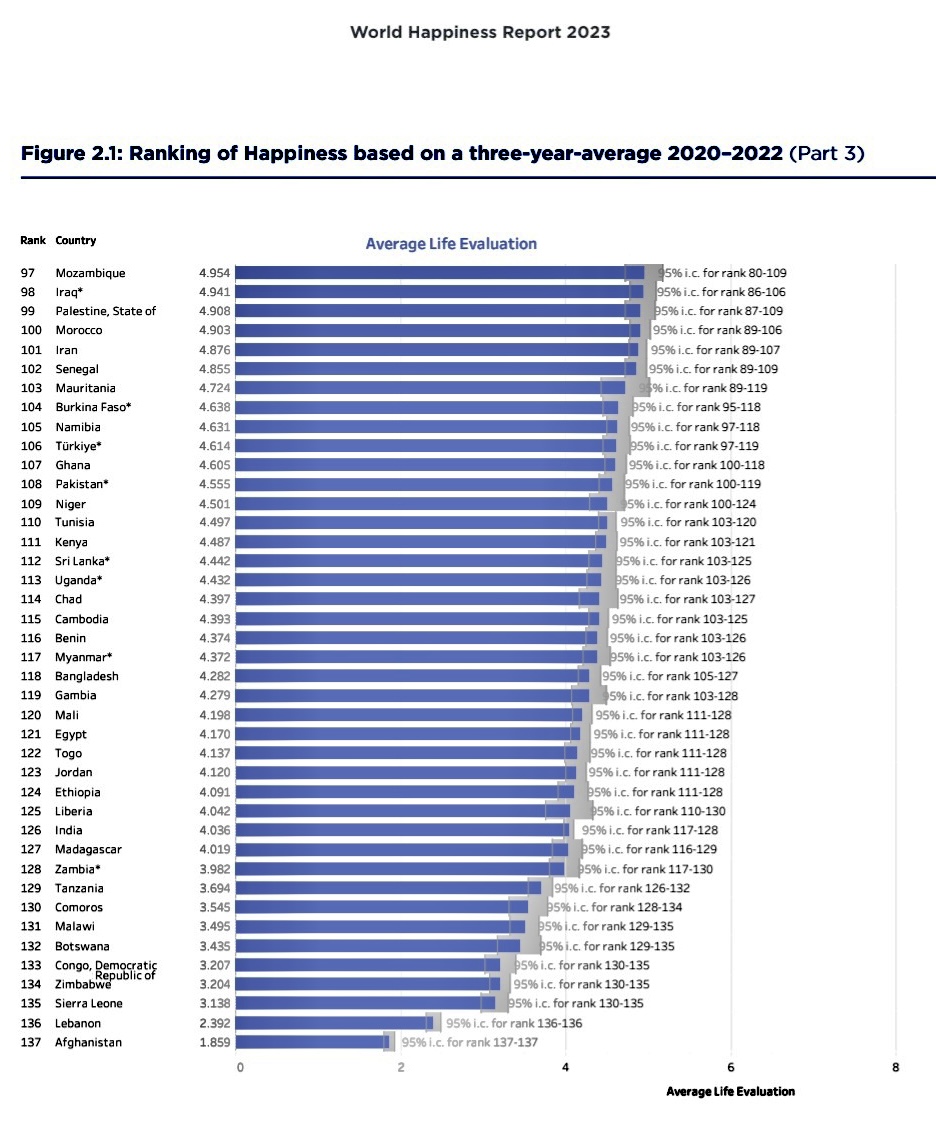 |
| Bottom Third Countries in World Happiness Rankings. Source: World H... |
The latest country rankings show life evaluations (answers to the Cantril ladder question) for each country, averaged over a 3 year period from 2020-2022. The Cantril ladder asks respondents to think of a ladder, with the best possible life for them being a 10 and the worst possible life being a 0. They are then asked to rate their own current lives on that 0 to 10 scale. The rankings are from nationally representative samples for the years 2020-2022.
 |
| World Happiness Map 2023. Source: Visual Capitalist |
Happiness Scores Trend:
After climbing to a high of 5.65 in 2019, Pakistan's happiness scores have declined in recent years, reaching a low of 4.52 during the Covid pandemic. The most recent value is 4.555 for 2023.
 |
| Recent Happiness Scores in Pakistan. Source: The Global Economy |
India's happiness scores have been declining every year since 2013, reaching a low of 3.78 during the Covid pandemic. The most recent value is 4.036 for 2023.
 |
| Recent Happiness Scores in India. Source: The Global Economy |
Causes of Unhappiness:
Lack of social connections during covid lockdown, along with severe unemployment, high inflation and healthcare worries, took a toll on mental health of Indians, according to the experts quoted by the Indian media.
 |
| Suicide Rates in India and Pakistan. Source: World Bank |
Rising Suicides:
Indian experts' observations are supported by the Indian government data showing a marked increase in suicide rate in India. India saw the highest suicide rate (of 12 suicides per 100,000 population) since the beginning of this century, according to The Hindu. Experts say a lot of suicides would have gone unreported and that the numbers and suicide rates could have gone up in 2022 as well.
 |
| Suicide Rate in India. Source: The Hindu |
High Unemployment:
India's unemployment rate rose to 7.45% in February 2023 from 7.14% in the previous month, according to data from the Centre for Monitoring Indian Economy (CMIE). CMIE’s weekly labor market analysis showed a marginal improvement in India’s labor participation rate to 39.92% in February compared to 39.8% in January 2023 resulting in an increase in the labour force from 440.8 million to 442.9 million.
"India’s LPR is much lower than global levels. According to the World Bank, the modeled ILO estimate for the world in 2020 was 58.6 per cent. The same model places India’s LPR at 46 percent. India is a large country and its low LPR drags down the world LPR as well. Implicitly, most other countries have a much higher LPR than the world average. According to the World Bank’s modeled ILO estimates, there are only 17 countries worse than India on LPR. Most of these are middle-eastern countries. These are countries such as Jordan, Yemen, Algeria, Iraq, Iran, Egypt, Syria, Senegal and Lebanon. Some of these countries are oil-rich and others are unfortunately mired in civil strife. India neither has the privileges of oil-rich countries nor the civil disturbances that could keep the LPR low. Yet, it suffers an LPR that is as low as seen in these countries".
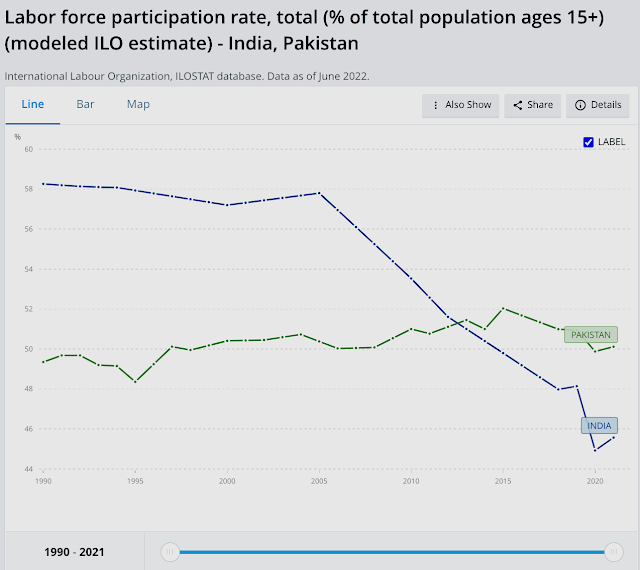 |
| Labor Participation Rates in India and Pakistan. Source: World Bank... |
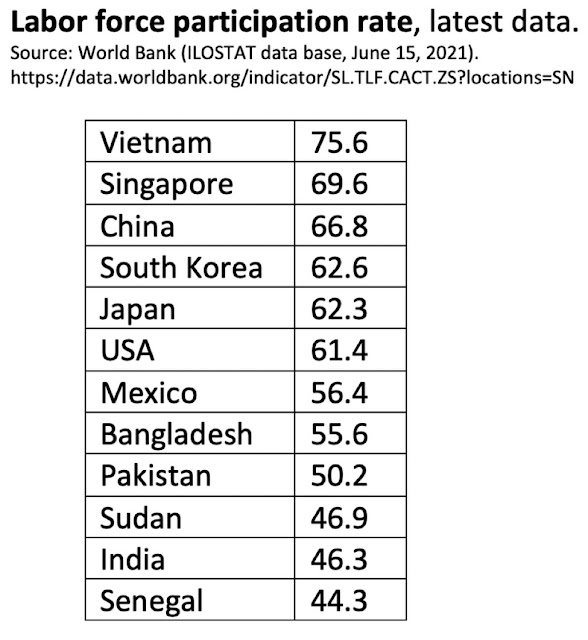 |
| Labor Participation Rates for Selected Nations. Source: World Bank/ILO |
Youth unemployment for ages15-24 in India is 24.9%, the highest in South Asia region. It is 14.8% in Bangladesh 14.8% and 9.2% in Pakistan, according to the International Labor Organization and the World Bank.
 |
| Youth Unemployment in Bangladesh, India and Pakistan. Source: ILO, WB |
In spite of the headline GDP growth figures highlighted by the Indian and world media, the fact is that it has been jobless growth. The labor participation rate (LPR) in India has been falling for more than a decade. The LPR in India has been below Pakistan's for several years, according to the International Labor Organization (ILO).
 |
| Indian GDP Sectoral Contribution Trend. Source: Ashoka Mody |
 |
| Indian Employment Trends By Sector. Source: CMIE Via Business Standard |
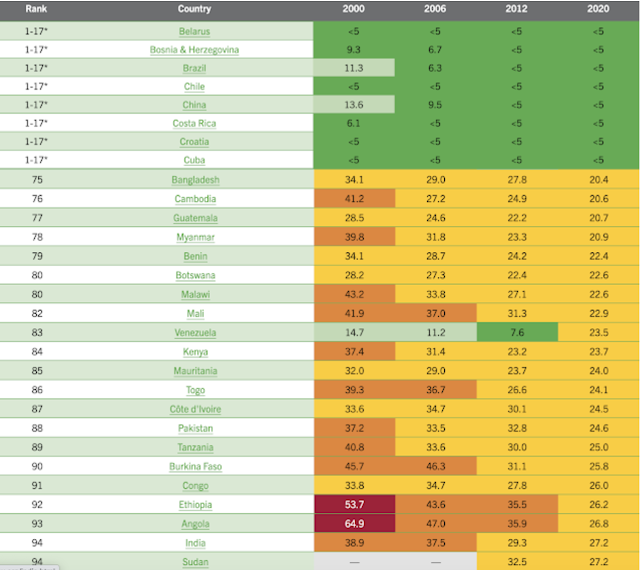 |
| World Hunger Rankings 2020. Source: World Hunger Index Report |
Hunger and malnutrition are worsening in parts of sub-Saharan Africa and South Asia because of the coronavirus pandemic, especially in low-income communities or those already stricken by continued conflict.
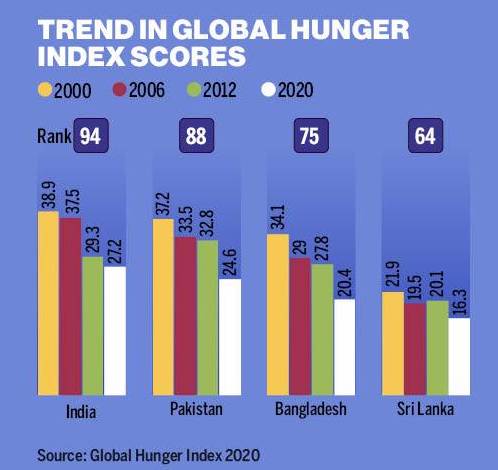
India has performed particularly poorly because of one of the world's strictest lockdowns imposed by Prime Minister Modi to contain the spread of the virus.
Related Links:
Haq's Musings
South Asia Investor Review
Pakistan Among World's Largest Food Producers
Food in Pakistan 2nd Cheapest in the World
Indian Economy Grew Just 0.2% Annually in Last Two Years
Pakistan to Become World's 6th Largest Cement Producer by 2030
Pakistan's 2012 GDP Estimated at $401 Billion
Pakistan's Computer Services Exports Jump 26% Amid COVID19 Lockdown
Coronavirus, Lives and Livelihoods in Pakistan
Vast Majority of Pakistanis Support Imran Khan's Handling of Covid1...
Pakistani-American Woman Featured in Netflix Documentary "Pandemic"
Incomes of Poorest Pakistanis Growing Faster Than Their Richest Cou...
Can Pakistan Effectively Respond to Coronavirus Outbreak?
How Grim is Pakistan's Social Sector Progress?
Pakistan Fares Marginally Better Than India On Disease Burdens
Trump Picks Muslim-American to Lead Vaccine Effort
COVID Lockdown Decimates India's Middle Class
Pakistan Child Health Indicators
Pakistan's Balance of Payments Crisis
How Has India Built Large Forex Reserves Despite Perennial Trade De...
Conspiracy Theories About Pakistan Elections"
PTI Triumphs Over Corrupt Dynastic Political Parties
Strikingly Similar Narratives of Donald Trump and Nawaz Sharif
Nawaz Sharif's Report Card
Riaz Haq's Youtube Channel
Views: 624
-
Comment by Riaz Haq 12 hours ago
-
Former finance secretary Subhash Chandra Garg says there is a lot of distress among the wage earning class where incomes don't seem to have grown in real terms over the years. The other really sad development is 8 to 9 crore crore youth are out of the employment market. Therefore there is a new to investigate whether GDP is actually growing at the rate officially claimed.
https://youtu.be/ReWkJTEcQd4?is=1i5gdFSEk81oH5ih
---------
Subhash Chandra Garg
@Subhashgarg1960
I explain analytical base of my conclusion that GDP growth in Q1 in 2026-27 in current price is 2.6% and in real terms close to 0. There are still messier distortions in sectoral performance with manufacturing and consumption witnessing negative growth.
https://x.com/Subhashgarg1960/status/2095074164814258439?s=20
-----------------
@Manoj_216
Last year, Q1 2025-26:
Nominal GDP was ₹86 trillion (everyone celebrated)
It was then conveniently revised down to ₹80 trillion (almost a 7% downward revision) (after celebrations were over).
This quarter, Q1 2026-27:
Nominal GDP is ₹88.27 trillion rupees.
This may also get conveniently revised down later after the celebrations are over.
Compare unrevised (₹86 trillion) vs unrevised (₹88.27 trillion), we have grown only by 2.6%
Oops! too much of a number game going on !
https://x.com/manoj_216/status/2094990270337290344?s=46&t=Uy6jy...
-------------
India's 20 years of GDP misestimation: New evidence
Abhishek Anand (Madras Institute of Development Studies), Josh Felman (JH Consulting) and Arvind Subramanian (PIIE)
Working Paper 26-3
March 2026
Photo Credit: REUTERS/Amit Dave
https://www.piie.com/publications/working-papers/2026/indias-20-yea...
KEY TAKEAWAYS
India’s annual economic growth during the boom years between 2005 and 2011 may have been underestimated by about 1–1½ percentage points on average, and subsequent growth between 2012 and 2023 may have been overestimated by about 1½-2 percentage points.
The first methodological issue leading to the misestimation is that the economy’s formal sector has been used as a proxy for the vast informal sector, even though the latter was disproportionately hit after 2015 by demonetization, the introduction of the goods and services tax, and the COVID-19 pandemic.
The second methodological issue causing misestimation is that the deflators for many sectors have been based on commodity prices, which have moved sharply relative to others.
------------
Ex-finance secretary raises concerns
Former Finance Secretary Subhash Chandra Garg told India Today that the real GDP data in the new series for the first quarter of the financial year 2025-’26 was not available as it had been released based on the old series at the time.
“So, the number which has now been used as a base for 2025-’26 Q1 is the number that [the government] has come out with for the first time,” he said. “Therefore, comparing it with that base should be taken with a little bit of a pinch of salt.”
Garg said that the GDP growth analysis is done in terms of current prices and that the government had “drastically revised” the gross domestic product at current prices for the first quarter of 2025-’26.
“It’s such a massive, drastic reduction in the base year’s Q1 GDP at current prices that the growth is now 10.3%,” he told the news channel. “If you had taken the numbers – and the current prices don’t change – which were put out last year as the GDP at current prices, the growth would be less than 2.5% in current prices – nominal GDP.”
https://scroll.in/latest/1095427/pms-economic-adviser-denies-allega...
Comment
- ‹ Previous
- 1
- 2
- 3
- Next ›
Twitter Feed
Live Traffic Feed
Sponsored Links
South Asia Investor Review
Investor Information Blog
Haq's Musings
Riaz Haq's Current Affairs Blog
Please Bookmark This Page!
Blog Posts
Nepal Tragedy Raises Fears of Massive Glacier Melt in Pakistani Mountains
Northern Pakistan is home to over 13,000 glaciers which pose a risk of catastrophic flash floods similar to the recent flash floods in Nepal. Pakistani officials have warned that shifts in glacier behavior are increasing the risk of glacial lake outburst floods (GLOF), particularly in Gilgit-Baltistan and Khyber Pakhtunkhwa, where communities face growing exposure to sudden flooding and landslides. …
ContinueAI on Wheels: My Experience With Tesla Full Self Drive (FSD)

Posted by Riaz Haq on August 24, 2026 at 5:00pm
© 2026 Created by Riaz Haq.
Powered by


You need to be a member of PakAlumni Worldwide: The Global Social Network to add comments!
Join PakAlumni Worldwide: The Global Social Network