PakAlumni Worldwide: The Global Social Network
The Global Social Network
Pakistan's Lady Health Workers "Best in the World"
“It’s one of the best community-based health systems in the world,” said Dr. Donald Thea, a Boston University researcher about Pakistan's Lady Health Workers Program. Thea is one of the authors of a recent Lancet study on child pneumonia treatment in Pakistan. He talked with the New York Times about the study.
Published in British medical journal "The Lancet" this month, the study followed 1,857 children who were treated at home with oral amoxicillin for five days and 1,354 children in a control group who were given standard care: one dose of oral cotrimoxazole and instructions to go to the nearest hospital or clinic. The home-treated group had only a 9 percent treatment-failure rate, while the control group children failed to improve 18 percent of the time.
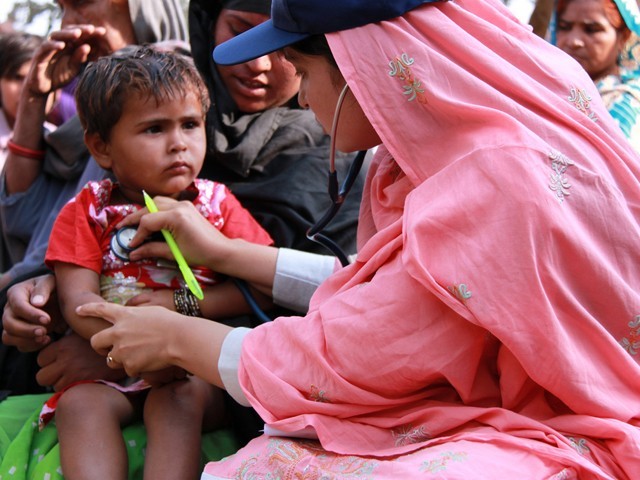
Launched in 1994 by former Prime Minister Benazir Bhutto's government, Pakistan’s Lady Health Workers’ program has trained over 100,000 women to provide community health services in rural areas. The program website introduces it as follows: "This country wide initiative with community participation constitutes the main thrust of the extension of outreach health services to the rural population and urban slum communities through deployment of over 100,000 Lady Health Workers (LHWs) and covers more than 65% of the target population. The Programme contributes directly to MDG goals number 1, 4, 5 & 6 and indirectly to goal number 3 & 7. The National Programme for Family Planning and Primary Health Care is funded by the Government of Pakistan. International partners offer support in selected domains in the form of technical assistance, trainings or emergency relief."
A recent comprehensive review of the program found that as compared to communities not served by the LHWs, the served households were 11% more likely to use modern family planning methods, 13% were more likely to have had a tetanus toxoid vaccination, 15% more were likely to have received a medical check-up within 24 hours of a birth, and 15% more were likely to have immunized children below three years. The improvements in health indicators among the populations covered by the LHWs were not entirely attributable to the program alone; researchers noted that other positive changes such as economic growth, increased provision of health services and better education services helped to enhance the impact. While the program had managed to sustain its impact despite its large expansion, evaluators found that serious weaknesses in the provision of supplies, and equipment and referral services need to be urgently addressed.
The program is now a major employer of women in the non-agricultural formal sector in rural areas, and is being more than doubled in size if budget allocations can be sustained. If universal coverage is achieved, every community in the country will have at least one lady health worker, one working woman and potential leader, who could serve as a catalyst for positive change for women in her community. The health officials say that unlike the mid-1990s when it was difficult to recruit women because of the minimum 8th grade education requirement, now there are large numbers of women who meet the requirement lining up for interviews in spite of low stipend of just Rs. 7000 per month.
Private sector is also helping the LHW program. Mobile communications service provider Mobilink has recently partnered up with the United Nations Population Fund (UNFPA), Pakistan's Ministry of Health (MoH) and GSMA Development Fund in an innovative pilot project which offers low cost mobile handsets and shared access to voice (PCOs) to LHWs in remote parts of the country. Mobilink hopes to bridge the communication gap between the LHW and their ability to access emergency health care and to help the worker earn extra income through the Mobilink PCO (Public Call Office).

Due to economic downturn and security challenges in several conflict areas since 2008, Pakistan's chances of achieving its Millennium Development Goals (MDGs) by 2015 appear to be slim. However, significant timely expansion in the LHW program and making it more effective can still help Pakistan get close to its MDGs on important health indicators like the infant mortality rate (IMR) and the maternal mortality rate (MMR).
Related Links:
Government to Hire 300,000 Lady Health Workers
South Asia Lags in Millennium Development Goals
Explore the World--Gapminder.org
UN Millennium Development Goals Report 2010
India and Pakistan Off-Track, Off-Target
India is Home to the World's Largest Population of Poor, Hungry and...
Views: 1207
-
Comment by Riaz Haq on March 9, 2021 at 10:32am
-
To provide survivor-centered care, health workers in Pakistan learn to ask about gender-based violence with empathy
https://www.who.int/news-room/feature-stories/detail/to-provide-sur...
Early in her career, Dr Rukhsana Bashir, a clinician in Pakistan, was used to seeing women in her clinic with symptoms of pain, headaches, insomnia and depression. She would listen and treat each symptom, but the underlying causes went unnoticed.
She did not know that some of those women were experiencing gender-based violence (GBV) – a pervasive health challenge throughout the country and world, and one she personally had experienced.
Approximately, 34% of ever married women in Pakistan have experienced spousal violence, either physical, sexual or emotional, in their lifetime, with rates increasing as high as 52% in Khyber Paktunkhwa Province.
“It never came to my mind that these women might be experiencing gender-based violence,” says Dr Bashir, who works at the Family Planning Association of Pakistan’s Family Health Hospital in the city of Lahore.
Now years later, Dr Bashir has been trained by WHO to use its clinical and policy guidelines: Responding to intimate partner violence and sexual violence against women. She further trains health workers how to provide survivor-centered care including how to ask about violence and how to provide first-line support.
Dr Bashir is one of more than 1000 doctors, nurses, hospital administrators and community health workers, including midwives who were trained between 2018-2020 as part of the roll out of the clinical and policy guideline package by Pakistan’s Ministry of National Health Services Regulation and Coordination and provincial health departments, with technical support from WHO and sister UN agencies, to strengthen the country’s health systems response to gender-based violence.
Thanks to the training she received, Dr Bashir has changed her practice. Unexplained symptoms of chronic pain or headaches, insomnia or depression, lead her to ask more questions to women about potential violence at home.
“When women come to the clinic, they don’t think that they are going to discuss the problem [of violence], but I have to ask them a few bold questions. In the beginning they are afraid and don’t want to tell me anything, but you have to identify their problems. Only then can you offer better services and treatment.”
A decade long effort to support survivors
The training Dr Bashir completed is part of a decade long effort WHO’s Pakistan office to work with the Government to strengthen the health and multisectoral response to gender-based violence. However, in order to strengthen the health sector response, the country needed manuals, job aids and trainings for health workers. In 2010 there were none.
In response, the Government developed a national protocol for medico-legal care for gender-based violence survivors in 2011. This was accompanied by ongoing policy dialogues and advocacy to strengthen health sector response to gender-based violence.
In 2017, the WHO clinical handbook: Health care for women subjected to intimate partner violence or sexual violence, was adapted and piloted in selected provinces and districts. The adaptation process, led by the Government and WHO, included multiple stakeholders, such as provincial ministries of health, UN Women, UNFPA, non-governmental organizations, medical associations and health workers.
As a result, the Pakistani clinical handbook for health workers on the management of sexual and gender-based violence, and localized job aids and materials for training providers were produced. The Government and WHO conducted 30 trainings for master trainers, health workers, and medico-legal experts in four provinces.
-
-
Lancet Study: Non-infectious diseases cause early death in Pakistan
BY MUNIR AHMED, ASSOCIATED PRESS - 01/19/23 4:04 AM ET
https://thehill.com/homenews/ap/ap-health/ap-study-non-infectious-d...
Pakistan has considerable control over infectious diseases but now struggles against cardiovascular diseases, diabetes and cancer as causes of early deaths, according to a new study published Thursday.
The Lancet Global Health, a prestigious British-based medical journal, reported that five non-communicable diseases — ischaemic heart disease, stroke, congenital defects, cirrhosis, and chronic kidney disease — were among the 10 leading causes of early deaths in the impoverished Islamic nation.
However, the journal said some of Pakistan’s work has resulted in an increase in life expectancy from 61.1 years to 65.9 over the past three decades. The change is due, it said, “to the reduction in communicable, maternal, neonatal, and nutritional diseases.” That’s still 7.6 years lower than the global average life expectancy, which increased over 30 years by 8% in women and 7% in men.
The study says “despite periods of political and economic turbulence since 1990, Pakistan has made positive strides in improving overall health outcomes at the population level and continues to seek innovative solutions to challenging health and health policy problems.”
The study, which was based on Pakistan’s health data from 1990 to 2019, has warned that non-communicable diseases will be the leading causes of death in Pakistan by 2040.
It said Pakistan will also continue to face infectious diseases.
“Pakistan urgently needs a single national nutrition policy, especially as climate change and the increased severity of drought, flood, and pestilence threatens food security,” said Dr. Zainab Samad, Professor and Chair of the Department of Medicine at Aga Khan University, one of the authors of the report.
“What these findings tell us is that Pakistan’s baseline before being hit by extreme flooding was already at some of the lowest levels around the globe,” said Dr. Ali Mokdad, Professor of Health Metrics Sciences at IHME. “Pakistan is in critical need of a more equitable investment in its health system and policy interventions to save lives and improve people’s health.”
The study said with a population approaching 225 million, “Pakistan is prone to the calamitous effects of climate change and natural disasters, including the 2005 Kashmir earthquake and catastrophic floods in 2010 and 2022, all of which have impacted major health policies and reform.”
It said the country’s major health challenges were compounded by the ongoing COVID-19 pandemic and last summer’s devastating flooding that killed 1,739 people and affected 33 million.
Researchers ask Pakistan to “address the burden of infectious disease and curb rising rates of non-communicable diseases.” Such priorities, they wrote, will help Pakistan move toward universal health coverage.”
The journal, considered one of the most prestigious scientific publications in the world, reported on Pakistan’s fragile healthcare system with the Institute for Health Metrics and Evaluation at the University of Washington’s School of Medicine. The study was a collaboration with a Karachi-based prestigious Aga Khan University and Pakistan’s health ministry.
The study also mentioned increasing pollution as one of the leading contributors to the overall disease burden in recent years. Pakistan’s cultural capital of Lahore was in the grip of smog on Thursday, causing respiratory diseases and infection in the eyes. Usually in winter, a thick cloud of smog envelops Lahore, which in 2021 earned it the title of the world’s most polluted city.
Comment
- ‹ Previous
- 1
- 2
- 3
- 4
- Next ›
Twitter Feed
Live Traffic Feed
Sponsored Links
South Asia Investor Review
Investor Information Blog
Haq's Musings
Riaz Haq's Current Affairs Blog
Please Bookmark This Page!
Blog Posts
Trump Administration Seeks Pakistan's Help For Promoting “Durable Peace Between Israel and Iran”
US Secretary of State Marco Rubio called Pakistan Prime Minister Shehbaz Sharif to discuss promoting “a durable peace between Israel and Iran,” the State Department said in a statement, according to Reuters. Both leaders "agreed to continue working together to strengthen Pakistan-US relations, particularly to increase trade", said a statement released by the Pakistan government.…
ContinuePosted by Riaz Haq on June 27, 2025 at 8:30pm — 4 Comments
Clean Energy Revolution: Soaring Solar Energy Battery Storage in Pakistan
Pakistan imported an estimated 1.25 gigawatt-hours (GWh) of lithium-ion battery packs in 2024 and another 400 megawatt-hours (MWh) in the first two months of 2025, according to a research report by the Institute of Energy Economics and Financial Analysis (IEEFA). The report projects these imports to reach 8.75 gigawatt-hours (GWh) by 2030. Using …
ContinuePosted by Riaz Haq on June 14, 2025 at 10:30am — 3 Comments
© 2025 Created by Riaz Haq.
Powered by


You need to be a member of PakAlumni Worldwide: The Global Social Network to add comments!
Join PakAlumni Worldwide: The Global Social Network