PakAlumni Worldwide: The Global Social Network
The Global Social Network
Are Diseases and Malnutrition Lowering IQs in South Asia?

In the range of DALYs/1000 capita from 13 (lowest) to 289 (highest), WHO's latest data indicates that India is at 65 while Pakistan is slightly better at 58. In terms of total number of deaths per year from disease, India stands at 2.7 million deaths while Pakistani death toll is 318, 400 people. Among other South Asian nations, Afghanistan's DALYs/1000 is 255, Bangladesh 64 and Sri Lanka 61. By contrast, the DALYs/1000 figures are 14 for Singapore and 32 for China.
Recent research shows that there are potentially far reaching negative consequences for nations carrying high levels of disease burdens causing lower average intelligence among their current and future generations.
Published by the University of New Mexico and reported by Newsweek, new research shows that there is a link between lower IQs and prevalence of infectious diseases. Comparing data on national “disease burdens” (life years lost due to infectious diseases or DALYs) with average intelligence scores, the authors found a striking inverse correlation—around 67 percent. They also found that the cognitive ability is rising in some countries than in others, and IQ scores have risen as nations develop—a phenomenon known as the “Flynn effect.”
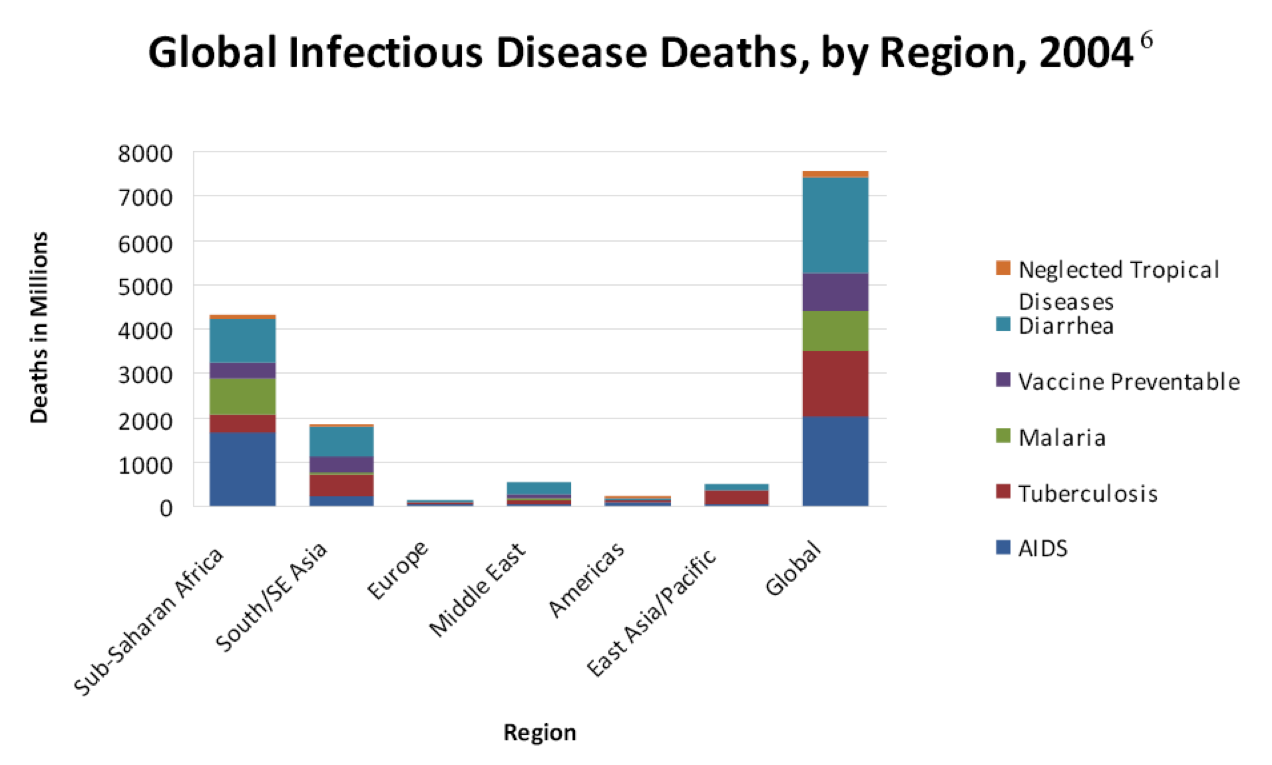
According to the UNM study's author Christopher Eppig and his colleagues, the human brain is the “most costly organ in the human body.” The Newsweek article adds that the "brainpower gobbles up close to 90 percent of a newborn’s energy. It stands to reason, then, that if something interferes with energy intake while the brain is growing, the impact could be serious and longlasting. And for vast swaths of the globe, the biggest threat to a child’s body—and hence brain—is parasitic infection. These illnesses threaten brain development in several ways. They can directly attack live tissue, which the body must then strain to replace. They can invade the digestive tract and block nutritional uptake. They can hijack the body’s cells for their own reproduction. And then there’s the energy diverted to the immune system to fight the infection. Out of all the parasites, the diarrheal ones may be the gravest threat—they can prevent the body from getting any nutrients at all".
Looking at the situation in South Asia, it appears from the WHO data that Pakistan is doing a bit better than India in 12 out of 14 disease groups ranging from diarrhea to heart disease to intentional injuries, and it is equal for the remaining two (Malaria and Asthma).
A detailed WHO report on World Health Statistics for 2010 assesses and compares its member nations on the basis of nine criteria including mortality and burden of disease, cause-specific mortality, selected infectious diseases, health service coverage, risk factors, health workforce-infrastructure, health expenditures and demographic and socioeconomic statistics. It shows that both India and Pakistan have some serious challenges to overcome to have any chance of meeting health-related Millennium Development Goals (MDGs 4, 5 and 6).
Related Links:
Haq's Musings
Infectious Diseases Kill Millions in South Asia
Infectious Diseases Cause Low IQ
Malnutrition Challenge in India and Pakistan
Hunger: India's Growth Story
WHO Report 2010 Blogger Analysis
Syeda Hamida of Indian Planning Commission Says India Worse Than Pa...
Global Hunger Index Report 2009
Grinding Poverty in Resurgent India
WRI Report on BOP Housing Market
Food, Clothing and Shelter For All
India's Family Health Survey
Is India a Nutritional Weakling?
Asian Gains in World's Top Universities
South Asia Slipping in Human Development
Views: 403
-
Comment by Riaz Haq on May 8, 2012 at 9:18am
-
There's a report in ET claiming research at UAF that Pakistanis are now 4 in shorter than in 1960s.
This finding does not appear to be credible.
All anecdotal evidence suggests that most Pakistani children are growing up to be taller than their parents. All one has to do is keep one's eyes open & observe.
The average height in Pakistan of 20 yrs old males is now 5' 6" vs 5' 4" in India. If one is to believe this "research", then one must also believe that the avg height in Pakistan in 1960s was 5' 10'' which is simply untrue based on all known evidence, anecdotal or otherwise.
In addition, if worsening malnutrition were indeed an issue, the life expectancy in Pakistan would not have doubled since independence. Published data shows that life expectancy in Pakistan has jumped from 32 years in 1947 to 67 years in 2009, and per Capita inflation-adjusted PPP income has risen from $766 in 1948 to $2603 in 2009.
http://www.interbasket.net/news/4385/2009/09/average-height-by-coun...
http://tribune.com.pk/story/375257/height-of-pakistanis-has-fallen-...
-
-
Here's a TOI story on link between low IQ and poverty:
Poverty and the all-consuming fretting that comes with it require so much mental energy that the poor have little brain power left to devote to other areas of life, according to the findings of an international study published on Thursday.
The mental strain could be costing poor people up to 13 IQ (intelligence quotient) points and means they are more likely to make mistakes and bad decisions that amplify and perpetuate their financial woes, researchers found.
"Our results suggest that when you are poor, money is not the only thing in short supply. Cognitive capacity is also stretched thin," said Harvard economist Sendhil Mullainathan, part of an international team that conducted the study.
In a series of experiments, researchers from Harvard, Princeton and other universities in North America and from Britain's University of Warwick found that pressing financial worries had an immediate impact on poor people's ability to perform well in cognitive and logic tests.
Far from signalling that poor people are stupid, the results suggest those living on a tight budget have their effective brain power, or what the researchers called "mental bandwidth", dramatically limited by the stress of making ends meet.
On average, someone weighed down by money woes showed a drop in cognitive function in one part of the study that was comparable to a 13 point dip in IQ, and similar to the performance deficit expected from someone who has missed a whole night's sleep.
"Previous views of poverty have blamed (it) on personal failings, on an environment that is not conducive to success," said Jiaying Zhao, an assistant professor of psychology at the University of British Columbia in Canada.
"We are arguing that the lack of financial resources itself can lead to impaired cognitive function," she said. ...
---
The researchers studied two very different groups - shoppers at a mall in New Jersey in the United States, and sugar cane farmers in rural India.In the mall study, they gathered dozens of low and middle-income shoppers and subjected them to a battery of tests to measure IQ and impulse control.
Half of the participants were first asked to think about what they would do if their car broke down and the repair cost $1,500 - designed to kick off worries about money. It was among these people that performance dipped significantly.
In India, the researchers found that farmers had diminished cognitive performance before getting paid for their harvest compared to afterwards, when their coffers have been replenished.
"One month after the harvest, they're pretty rich, but the month before - when the money has run out - they're pretty poor," Mullainathan said in a report of the research, which was published on Thursday in the journal Science.
"What we see is that IQ goes up, (when they are rich)... errors go way down, and response times go way down."
He said the effect in India was about two-thirds the size of the effect in the mall study - equal to around nine or 10 IQ points difference from one month to the next.
http://timesofindia.indiatimes.com/home/science/Poverty-reduces-bra...
Comment
Twitter Feed
Live Traffic Feed
Sponsored Links
South Asia Investor Review
Investor Information Blog
Haq's Musings
Riaz Haq's Current Affairs Blog
Please Bookmark This Page!
Blog Posts
Tata's Boardroom Crisis: Will it Impact Philanthropy in India?
India's Tata Group is going through a major boardroom crisis. Noel Tata, the Chairman of the Tata holding company, has been removed from the Tata Group's board by N. Chandrasekaran, chairman of Tata Sons. Noel Tata has declared the decision illegal, a stance the board disputes. The crisis has been precipitated by a 2022 decision by India’s central bank to order the company to seek a stock market listing for Tata Sons, to comply with new rules governing systemically important…
ContinueXi-Trump Summit: US-China G2 Rapprochement to Avoid Thucydides Trap
The summit meeting of the leaders of China and the United States in Washington appears to signal a rapprochement between the two superpowers. President Trump has repeatedly referred to what he calls "G2", without mentioning "G7" or "G20", the groups that include many more countries. This development is seen as positive for world peace but it diminishes India's significance as a "counterweight to China" and the benefits Indians expected to flow from the US-China confrontation in…
ContinuePosted by Riaz Haq on September 25, 2026 at 5:30pm — 5 Comments
© 2026 Created by Riaz Haq.
Powered by


You need to be a member of PakAlumni Worldwide: The Global Social Network to add comments!
Join PakAlumni Worldwide: The Global Social Network