PakAlumni Worldwide: The Global Social Network
The Global Social Network
Campaign of Fear, Uncertainty and Doubt (FUD) About CPEC
An unrelenting campaign of fear, uncertainty and doubt (FUD) about China-Pakistan Economic Corridor (CPEC) has been unleashed in the media in recent weeks. This strategy harkens back to the aggressive marketing techniques used by the American computer giant IBM in the 1970s to fight competition. As in IBM's case, the greatest fear of the perpetrators of FUD is that CPEC will succeed and lift Pakistan up along with rising China.
Fear, Uncertainty and Doubt (FUD):
A definition of FUD that captures its essence is offered by Roger Irwin as follows: "Unable to respond with hard facts, scare-mongering is used via 'gossip channels' to cast a shadow of doubt over the competitors offerings and make people think twice before using it".
A number of articles in western and Indian media have attempted to use FUD against China-Pakistan Economic Corridor. Some Pakistani journalists and commentators, some unwittingly, have also joined in the campaign. As expected, these detractors ignore volumes of data and evidence that clearly contradict their claims.
Part of the motivation of those engaged in FUD against CPEC appears to be to check China's rise and Pakistan's rise with its friend and neighbor to the north. Their aim is to preserve and protect the current world order created by the Western Powers led by the United States at the end of the second world war.
Growing Infrastructure Gap:
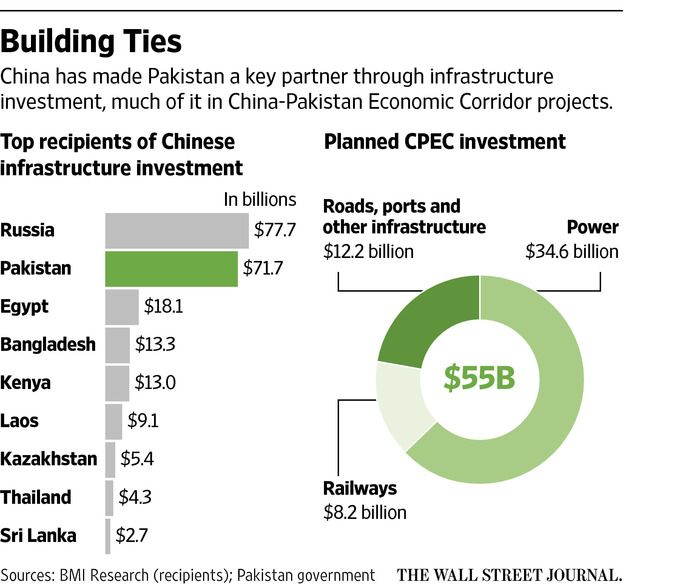
Development of physical infrastructure, including electricity and gas infrastructure, is essential for economic and social development of a country such as Pakistan. China-Pakistan Economic Corridor financing needs to be seen in the context of the large and growing infrastructure gap in Asia that threatens social and economic progress.
Rich countries generally raise funds for infrastructure projects by selling bonds while most developing countries rely on loans from international financial institutions such as the World Bank and the Asian Development Bank to finance infrastructure projects.
The infrastructure financing needs of the developing countries far exceed the capacity of the World Bank and the regional development banks such as ADB to fund such projects. A recent report by the Asian Development Bank warned that there is currently $1.7 trillion infrastructure gap that threatens growth in Asia. The 45 countries surveyed in the ADB report, which covers 2016-2030, are forecast to need investment of $26 trillion over 15 years to maintain growth, cut poverty and deal with climate change.

Chinese CPEC Loans to Pakistan:
About 80% of the $55 billion of the Chinese money for CPEC is private investment while the rest is composed of soft loans to the government, according to Shanghai Business Review.
The Chinese soft loans for CPEC infrastructure projects carry an interest rate of just 1.6%, far lower than similar loans offered by the World Bank at rates of 3.8% or higher.
Chinese companies investing in Pakistan are getting loans from China's ExIm Bank at concessional rates and from China Development Bank at commercial rates. These loans will be repaid by the Chinese companies from their income from these investments, not by Pakistani taxpayers.
Rising Confidence in Pakistan:
Pakistani economy is already beginning to reap the benefits of the current and expected investments as seen in the 5.2% GDP growth in the current fiscal year, the highest in 9 years.
The World Bank's Pakistan Development Update of May 2017 says that "Pakistan’s economy continues to grow strongly, emerging as one of the top performers in South Asia".
Rapidly expanding middle class and rising demand for consumer durables like vehicles and home appliances attest to the positive impact of CPEC. Consumer confidence in Pakistan has reached its highest level since 2008, according to Nielsen.
US-based consulting firm Deloitte and Touche estimates that China-Pakistan Economic Corridor (CPEC) projects will create some 700,000 direct jobs during the period 2015–2030 and raise its GDP growth rate to 7.5%, adding 2.5 percentage points to the country's current GDP growth rate of 5%.
|
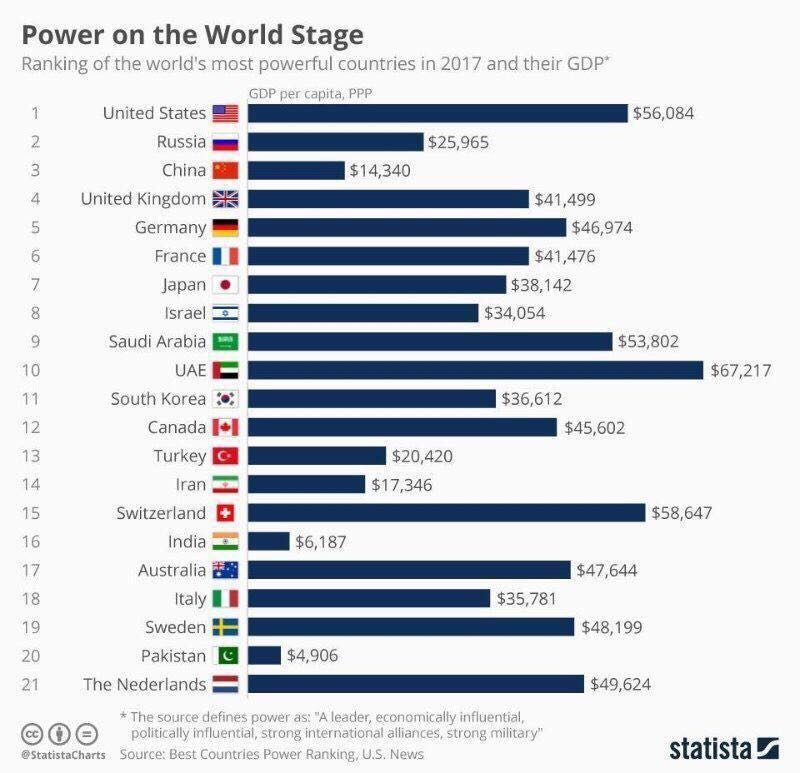
US News Ranks Pakistan Among World's 20 Most Powerful Nations |
Countering FUD:
Pakistani government should respond to the FUD campaign against CPEC by countering it with facts and data and increasing transparency in how CPEC projects are being financed, contracted and managed. It is particularly important in a low-trust society like Pakistan's where people can be easily persuaded to believe the worst about their leaders and institutions.
Summary:
An unrelenting campaign of fear, uncertainty and doubt (FUD) about China-Pakistan Economic Corridor (CPEC) has been unleashed in the media in recent weeks. This strategy harkens back to the aggressive marketing techniques used by the American computer giant IBM in the 1970s to fight competition. Part of the motivation of those engaged in FUD against CPEC appears to be to check China's rise and Pakistan's rise with its friend and neighbor to the north. As in IBM's case, the greatest fear of the perpetrators of FUD is that CPEC will succeed and lift Pakistan up along with rising China. Their aim is to preserve and protect the current world order created by the Western Powers led by the United States at the end of the second world war. Pakistani government should respond to the FUD campaign against CPEC by countering it with facts and data and increasing transparency in how CPEC projects are being financed, contracted and managed.
Related Links:
Views: 1618
-
Comment by Riaz Haq on April 26, 2025 at 8:09am
-
Pakistan’s Leap Forward Has A Chinese Engine – OpEd
By Advocate Mazhar Siddique Khan
https://www.eurasiareview.com/26042025-pakistans-leap-forward-has-a...
The China-Pakistan Economic Corridor (CPEC), often reduced to a symbol of debt diplomacy by skeptics, is in fact something far more vital: the foundation of a 21st-century Pakistan. With its vast network of roads, energy projects, industrial zones, and digital infrastructure, CPEC isn’t merely about construction—it’s about transformation. Pakistan is not just building highways; it’s building pathways to sustainable growth.
Pakistan’s transformation hinges on bold collaboration. And China’s role is not transactional—it’s transformational.
Through strategic investments in power generation, telecommunications, and transport, China has enabled Pakistan to leapfrog over structural deficiencies that once seemed insurmountable. Energy shortages that crippled industries for decades are slowly being replaced by stability. Power plants—from hydropower to renewables—are being installed with the help of Chinese expertise, addressing one of Pakistan’s most persistent bottlenecks. Every watt added to the grid is more than a statistic; it’s another hour a factory can run, another student who can study at night, another village that enters the digital age.
Critics may point to loans and liabilities, but overlook the value of infrastructure that outlasts repayment cycles. Roads that cut cross-country travel times in half. Fiber-optic backbones that connect rural towns to global markets. Special Economic Zones that bring foreign capital closer to local opportunity. These are investments not just in steel and silicon—but in Pakistan’s future.
And the future belongs to the young. With China’s investments in technical education and higher learning, Pakistan’s youth are being equipped not just to participate in the Fourth Industrial Revolution—but to shape it. Joint research initiatives, scholarships, and vocational training programs are bridging the skills gap that has long held the country back.
Pakistan is not just building highways; it’s building pathways to sustainable growth.
Pakistan’s transformation hinges on bold collaboration. And China’s role is not transactional—it’s transformational.
Through strategic investments in power generation, telecommunications, and transport, China has enabled Pakistan to leapfrog over structural deficiencies that once seemed insurmountable. Energy shortages that crippled industries for decades are slowly being replaced by stability. Power plants—from hydropower to renewables—are being installed with the help of Chinese expertise, addressing one of Pakistan’s most persistent bottlenecks. Every watt added to the grid is more than a statistic; it’s another hour a factory can run, another student who can study at night, another village that enters the digital age.
Critics may point to loans and liabilities, but overlook the value of infrastructure that outlasts repayment cycles. Roads that cut cross-country travel times in half. Fiber-optic backbones that connect rural towns to global markets. Special Economic Zones that bring foreign capital closer to local opportunity. These are investments not just in steel and silicon—but in Pakistan’s future.
And the future belongs to the young. With China’s investments in technical education and higher learning, Pakistan’s youth are being equipped not just to participate in the Fourth Industrial Revolution—but to shape it. Joint research initiatives, scholarships, and vocational training programs are bridging the skills gap that has long held the country back.
With China’s support, Pakistan isn’t waiting for change—it’s leading it. The economic corridor is not a shortcut—it’s a launchpad. And Pakistan’s leap forward, powered by Chinese engines and Pakistani resolve, may yet redefine the economic geography of South Asia.
-
-
Evolving Scope of the China-Pakistan Economic Corridor
The two countries have launched the China-Pakistan Information Corridor to counter ‘misleading narratives,’ expand cultural exchanges, and strengthen think tank cooperation.
https://thediplomat.com/2026/10/evolving-scope-of-the-china-pakista...
On October 25, Pakistan’s Foreign Minister Ishaq Dar met Chinese Ambassador Jiang Zaidong in Islamabad to review progress on the China-Pakistan Economic Corridor (CPEC).
According to a statement issued by Pakistan’s Foreign Office, the discussions centered on advancing trade, investment, regional connectivity, agricultural modernization, and people-to-people exchanges. Dar also stressed the need for sustained high-level engagements to advance what the Pakistani officials describe as a “Pakistan-China Community of Shared Future in the New Era.” The meeting comes as both countries seek to fast-track the second phase of CPEC.
It appears to be part of the two countries’ ongoing effort to accelerate CPEC-related work and clarify the project’s second phase.
Phase one of the project is known for largely delivering energy projects, roads, and basic connectivity infrastructure. Phase two, on the other hand, is expected to emphasize industrial cooperation, mining, critical minerals, agriculture, and technology. Moreover, information sharing and people-to-people exchanges, long described as pillars of the corridor’s long-term vision, along with opening the mineral sector, are increasingly framed as part of the second phase.
On the ground, the path being taken to accelerate the second phase already looks different from the large-scale infrastructure focus that defined the early years of development.
Pakistan and China recently launched the China-Pakistan Information Corridor (CPIC), to counter what officials have called “misleading narratives,” expand cultural exchanges, and strengthen think tank cooperation.
From the Pakistani and Chinese perspectives, such narratives have often portrayed CPEC as little more than a debt burden or a strategic liability rather than a development partnership. The new information corridor, it seems, is intended to present a more coordinated account of the relationship. Moreover, a closer think tank engagement could, in principle, help policymakers in both countries better align priorities and reduce the informational friction that has occasionally complicated implementation. In that sense, CPIC seems linked to the practical needs of CPEC rather than standing apart from them.
-
-
volving Scope of the China-Pakistan Economic Corridor
The two countries have launched the China-Pakistan Information Corridor to counter ‘misleading narratives,’ expand cultural exchanges, and strengthen think tank cooperation.
https://thediplomat.com/2026/10/evolving-scope-of-the-china-pakista...
n his address to inaugurate CPIC, Pakistan’s Information Minister Ataullah Tarar captured the intended shift when he observed that the first phase of CPEC connected lands, while the next would “connect our minds.” He said the information corridor will act as a bridge between the peoples of the two countries.
Arguably, this renewed emphasis on information sharing and narrative alignment is based on the fact that public perceptions and policy coordination matter as much as physical infrastructure at this stage.
Whether the issue of misinformation has undermined cooperation in the past remains open to debate. However, the decision to institutionalize fact-checking mechanisms and joint media working groups suggests that both countries now treat the issue as one that needs addressing now rather than deferred as a secondary concern.
Pakistan and China are also focusing on mapping, regulating, and opening Pakistan’s mineral sector, particularly in Khyber Pakhtunkhwa (KP) province. CPEC’s phase two is expected to prioritize industrial cooperation, mining, and the excavation of critical minerals as well. Special economic zones, which are being set up, are more likely to succeed if the industries located in them can process local resources rather than simply assemble or package imported inputs.
In this regard, Rashakai Special Economic Zone (RSEZ) in KP offers a useful illustration of such cooperation between Pakistan and China. The project is operated through a joint venture involving the China Road and Bridge Corporation (CRBC) and Khyber Pakhtunkhwa’s Economic Zone and Management Company. The SEZ was designed from the outset around value-addition industries, with mineral processing listed among its core designated sectors.
Provincial authorities in KP have recently intensified this message, particularly on mineral extraction and refining in the province. KP Governor Faisal Karim Kundi recently said that the province’s mineral resources would be extracted and sold to promote economic prosperity. He urged foreign companies to invest through joint ventures.
The timing of Kundi’s statement is particularly notable. The renewed emphasis on mineral governance comes amid a recent provincial leadership change in KP following the imposition of governor’s rule, which has shifted administrative authority from the Pakistan Tehreek-e-Insaf (PTI)-led provincial government to the federal government. Under this arrangement, Islamabad could now exercise more influence over provincial regulatory affairs, including strategic mineral assets.
This administrative shift has temporarily softened long-standing frictions between the federal and provincial governments over resource management and joint investment frameworks.
These developments point to a CPEC phase that appears to be less about infrastructure and more about information coordination, industrial networks, and the organized development of Pakistan’s mineral base.
Similarly, the approach of Pakistan and China in the second phase is different from the first phase as it appears to rest on the idea that closer policy alignment and people-to-people understanding will make the economic partnership under CPEC more viable over the long run.
Comment
- ‹ Previous
- 1
- …
- 5
- 6
- 7
- Next ›
Twitter Feed
Live Traffic Feed
Sponsored Links
South Asia Investor Review
Investor Information Blog
Haq's Musings
Riaz Haq's Current Affairs Blog
Please Bookmark This Page!
Blog Posts
Kashmir: Farooq Abdullah Lauds Pakistan's Diplomatic Support
Speaking at an event in the Indian Occupied Kashmir, veteran Kashmiri leader Farooq Abdullah has lauded Pakistan's support for Kashmiris' rights. “They (Indian leaders in Delhi) are silent today because there is noise in the world, and our neighbor (Pakistan) is constantly behind this. Everywhere they say, ‘the decision regarding Kashmir has not been made’. That is what is saving us. Otherwise, their intentions are not good", he said. He warned that Kashmiris risked losing their…
ContinuePosted by Riaz Haq on October 29, 2026 at 6:00pm — 1 Comment
Can Pakistan Scale Up Affordable Energy Availability to Achieve Prosperity?
Pakistan is currently classified as a lower middle-income country, with the ambition to become a high-income country. Its policymakers now recognize that no country has transitioned from middle-income to high-income status without generating substantial electricity at affordable rates. The link between energy and prosperity has been well-established since the advent of the Industrial Revolution. The AI Revolution has further reinforced it. Can Pakistan make the…
ContinuePosted by Riaz Haq on October 21, 2026 at 6:00pm — 10 Comments
© 2026 Created by Riaz Haq.
Powered by


You need to be a member of PakAlumni Worldwide: The Global Social Network to add comments!
Join PakAlumni Worldwide: The Global Social Network