PakAlumni Worldwide: The Global Social Network
The Global Social Network
China and US Battle For Influence in Pakistan
Top US and Chinese diplomats have visited Pakistan to meet with the country's new prime minister Mr. Imran Khan within days of his assuming office. The US Secretary of State Mike Pompeo was the first to call on Prime Minister Imran Khan in Islamabad. Pompeo's visit was soon followed by a three-day visit by Chinese Foreign Minister Wang Yi. What is at stake in the battle between China and the United States in Pakistan is the prize of global superpower status, according to the US-based Wall Street Journal.
There is a lot of speculation in the western media about the objectives of Pakistan policies being pursued by the two great powers and their impact on the US-China competition for world dominance. Such speculations have centered on the debt related to China-Pakistan Economic Corridor (CPEC) and the US leverage in potential IMF bailout of Pakistan.
American business publication Wall Street Journal has produced a short video explaining how its staff sees what it describes as "US-China conflict brewing in Pakistan". What is at stake in the battle between China and the United States in Pakistan is the prize of global superpower status. Here are the key points it makes:
1. The US-China conflict brewing in Pakistan is about global dominance sought by the two great powers.
2. If China succeeds, it could become the new center of global trade. If the US wins, it could frustrate China's push to become a global power. The impact of it will be felt around the world for decades.
3. China has already surpassed the United States as the world's biggest exporter of goods and services.
4. The biggest project in China's Belt and Road Initiative (BRI) is China-Pakistan Economic Corridor (CPEC) in which China is investing heavily and providing massive loans.
5. China could use the infrastructure built in Pakistan under CPEC to gain access to the Indian Ocean and supplant the United States in Pakistan.
6. CPEC-related spending is sinking Pakistan deeper in debt to China. It could force Pakistan to seek $8 billion to $12 billion bailout by IMF where US is the biggest shareholder with veto power.
7. US does not want the IMF bailout money to be used to repay Chinese debt. Not bailing out Pakistan is not an option because it could cost US an important ally in the region.
8. US could, however, use IMF bailout to limit what Pakistan can borrow from China. Such a condition will achieve the US objective of significantly slowing down CPEC and BRI.
9. Pakistan's dilemma is that it needs both the infrastructure improvements financed by China and the IMF bailout to ease pressure on its dwindling foreign exchange reserves.
10. Whoever wins in Pakistan will become the number one global superpower.
|
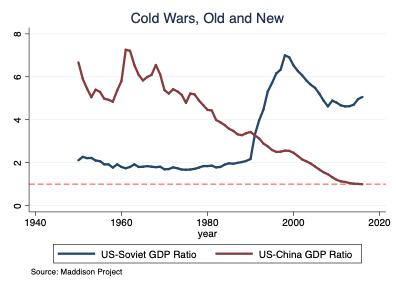
Can US "Spend Them (Chinese) Into Oblivion"? |
Here's the Wall Street Journal video:
Related Links:
Can Pakistan Avoid Recurring Balance of Payment Crisis?
Pakistan Economy Hobbled By Underinvestment
Can Indian Economy Survive Without Western Capital Inflows?
Pakistan-China-Russia Vs India-Japan-US
Chinese Yuan to Replace US $ as Reserve Currency?
Remittances From Overseas Pakistanis
Views: 1602
-
Comment by Riaz Haq on July 27, 2026 at 5:40pm
-
Pakistan’s Great Game
By Christophe Jaffrelot
https://www.institutmontaigne.org/en/expressions/pakistans-great-ga...
Conclusion: A Temporary Return to Favor or a Structural Turning Point?
History has accustomed us to seeing Pakistan return to the forefront of the international stage in a more or less fleeting manner. In 1980, General Zia, who had been universally despised following the 1977 coup, suddenly became acceptable again following the Soviet invasion of Afghanistan. In 2001, General Musharraf, who had also been a pariah since his forceful seizure of power in 1999, experienced the same windfall following the September 11 attacks. In 2026, Pakistan appears useful once again, no longer to wage war against the USSR or terrorism, but to make peace. This puts it back in the role of mediator that it has also filled in the past between the United States and China.
In 2026, Pakistan appears useful once again, no longer to wage war against the USSR or terrorism, but to make peace.
Each time, these glorious episodes were very short-lived and came to an end due to criticism of the Pakistani regime’s authoritarianism - with the military always remaining in power, even when civilians are in the forefront; its ties to Islamists accused of terrorist activities - particularly in India; or accusations of nuclear proliferation. Will the same be true tomorrow, once the war in Iran is over and the United States no longer needs Pakistan?
Everything will, of course, depend on the outcome of the conflict and the role Pakistan plays in resolving it-for it will be harder to send Islamabad back home if the world owes it something resembling peace.
India’s ability to isolate Pakistan-the strategy Narendra Modi has pursued for more than a decade-is another important variable, though its significance may be undermined by New Delhi’s drift toward authoritarianism and ethnocracy, as well as by the economic and social crisis threatening the country.
A more significant factor entering the equation relates to regional balances of power: Pakistan will continue to serve as a "net security provider" for Middle Eastern countries such as Saudi Arabia if those countries continue to fear the rise of Israel - a potential regional hegemon - and if they doubt Washington’s intentions, or even its mere reliability. There is no doubt that Pakistan itself will do everything in its power to prevent Israel from asserting itself on the regional stage and to gain influence over Iran-which is what the Israeli-American plan for regime change in Iran might have entailed. At the very least, faced with the risk of Israeli hegemony based on force and repeated military interventions, Pakistan could emerge as the architect of a resistance front bringing together not only Saudi Arabia, Turkey, and Egypt, but also Iran.
Alongside these hypothetical scenarios, one thing is certain: Pakistan has reached a turning point through the recognition of its military capabilities, as reflected in the mutual defense agreement it signed with Saudi Arabia. This point of no return is largely due to the close ties it has forged with China, to which Pakistan owes a significant portion of its strike capability. While the relationship between Pakistan and the United States remains subject to uncertainty due to its tactical nature, the relationship between Pakistan and China is strategic in nature. Since Iran is an important partner of China, in the short term, Pakistan will be all the more inclined to resist attempts to destabilize its neighbor-which it has feared from the very first day of the war anyway. While Islamabad welcomes Iran’s weakening and the setback to its nuclear program, maintaining the current regime is the lesser of two evils (especially since Tehran no longer trusts New Delhi as much as it once did).
-
-
The US Can’t Buy Pakistan. It Can Rent It - The National Interest
https://nationalinterest.org/blog/silk-road-rivalries/the-us-cant-b...
Washington can leverage Islamabad’s hedging strategy to keep it from growing too close to China.
Since 1947, Washington has courted Pakistan with aid packages and coerced it with sanctions. It has designated Pakistan a major non-NATO ally and also threatened to bomb it “back to the Stone Age”—sometimes within the same decade.
Several American administrations have entered office believing they could transform Pakistan into a reliable American ally. Even more have left convinced they had been betrayed, frustrated by China’s growing influence over the world’s only Muslim-majority nuclear power. Washington’s consistent mistake has been believing it was buying Pakistan.
Islamabad is not for sale. It is, however, for rent.
The good news for the United States is that it holds a structural advantage over China in this competition. America rents Pakistan by choice. China rents Pakistan by necessity.
The US-Iran conflict illustrated this dynamic. Trusted by both Tehran and Washington, Islamabad helped broker the cease-fire that briefly reopened the Strait of Hormuz. Traditional treaty allies such as France, Germany and the United Kingdom could not have played that role. A hedging power could.
For Pakistan, hedging between Washington and Beijing, or between Riyadh and Tehran, is not indecision awaiting resolution but foreign policy itself. Rather than viewing Pakistan’s balancing act as evidence of unreliability, Washington should see it as a strategic reality it can exploit.
Consider Pakistan’s hedge beyond the mediation effort. In June 2025, Pakistan and Azerbaijan signed a deal worth up to $4.6 billion under which Islamabad would supply 40 JF-17fighter jets to Baku. The aircraft is built on a Chinese airframe, powered by a Russian engine and sold by an American ally to a country Washington is actively courting. The transaction monetizes Pakistan’s relationship with China within a Western-facing market. Pakistan’s strategy is to maximize its strategic value to both Washington and Beijing.
More recently, after helping broker talks during the Iran conflict, Islamabad reportedly asked Washington to establish a $10 billion exchange-stabilization facility to strengthen its foreign-exchange reserves. Pakistan was again converting geopolitical relevance into economic support without abandoning its relationship with China.
Washington, however, has leverage. Beijing cannot walk away from Pakistan without weakening its Eurasian strategy. America can engage only when its interests require it.
The reason lies in geography. Under Xi Jinping, China has sought to reduce its dependence on vulnerable maritime routes through the Strait of Hormuz and the Strait of Malacca. The Belt and Road Initiative reflects that broader ambition by building overland pipelines, railways and trade corridors that cannot easily be disrupted by naval power.
China has many partners. It has very few Pakistans. Pakistan’s geography places it at the intersection of China’s continental and maritime strategies, linking western China to the Arabian Sea. It is also Beijing’s largest defense export market, forcing India to divide its military attention. Those strategic advantages are difficult to replicate elsewhere.
The United States is different. It needs Pakistan only episodically—for Iran diplomacy, the Board of Peace, or even Nobel Peace Prize nominations. America can afford to think transactionally because its interests are narrower.
-
-
The US Can’t Buy Pakistan. It Can Rent It - The National Interest
https://nationalinterest.org/blog/silk-road-rivalries/the-us-cant-b...
The United States is different. It needs Pakistan only episodically—for Iran diplomacy, the Board of Peace, or even Nobel Peace Prize nominations. America can afford to think transactionally because its interests are narrower.
Washington has undervalued Pakistan’s hedge when, in fact, it is the cheapest strategic asset it can pay for. It should use a handful of levers to tilt it toward America’s interests.
Pakistan’s longstanding reliance on international financial institutions such as the IMF and World Bank is one area where American influence remains decisive. Beijing, with its higher-interest bilateral loans and reluctance to finance the Pakistani state itself, cannot readily substitute for that role.
The United States can also expand professional military education, officer exchanges, joint exercises, and counterterrorism cooperation to mitigate China’s growing influence over Pakistan’s defense establishment.
Pakistan’s largest export market is the United States. Trade preferences and market access encourage better behavior more effectively than aid ever could.
Pakistan’s leadership places a premium on international prestige, which bolsters its domestic legitimacy. White House visits, Pentagon invitations, and State Department strategic dialogues cost Washington little but can yield outsized diplomatic returns.
By contrast, demanding that Pakistan abandon the China-Pakistan Economic Corridor is a nonstarter. An astute hedger will never accept a demand that forces it to choose sides.
Washington should judge Pakistan not by whether it reduces ties with China, but by whether it prevents China from monopolizing those ties.
If Washington is generous with prestige, pragmatic on conditionality, and focused on military and economic cooperation, it can turn Pakistan’s hedging strategy into an American advantage.
Critics will argue that deeper US-Pakistan engagement would unsettle India. Yet the alternative is worse. An exclusively Chinese Pakistan is worse for India than one that retains meaningful military, economic and diplomatic ties with the United States.
If Pakistan’s leaders believed they had diversified external partnerships rather than relying on China, and had greater economic opportunities through trade and investment, as well as international recognition and prestige, they might feel less need to define Pakistan primarily in terms of confrontation with India.
Comment
- ‹ Previous
- 1
- …
- 7
- 8
- 9
- Next ›
Twitter Feed
Live Traffic Feed
Sponsored Links
South Asia Investor Review
Investor Information Blog
Haq's Musings
Riaz Haq's Current Affairs Blog
Please Bookmark This Page!
Blog Posts
AI Revolution in Pakistan: Multiple AI Apps Launched for Farmers
With the expansion of the internet access in rural areas, several local language AI applications have recently been launched for downloads by farmers in Pakistan. These apps help with crop planning, soil sensing, personalized fertilizer recommendations, disease diagnoses, weather forecasts and market prices. A couple of these have been downloaded by half a million or more farmers in the country. Some of these apps use open source large language models (LLMs) like…
ContinuePosted by Riaz Haq on October 14, 2026 at 1:00pm — 2 Comments
Tata's Boardroom Crisis: Will it Impact Philanthropy in India?
India's Tata Group is going through a major boardroom crisis. Noel Tata, the Chairman of the Tata holding company, has been removed from the Tata Group's board by N. Chandrasekaran, chairman of Tata Sons. Noel Tata has declared the decision illegal, a stance the board disputes. The crisis has been precipitated by a 2022 decision by India’s central bank to order the company to seek a stock market listing for Tata Sons, to comply with new rules governing systemically important…
Continue
© 2026 Created by Riaz Haq.
Powered by


You need to be a member of PakAlumni Worldwide: The Global Social Network to add comments!
Join PakAlumni Worldwide: The Global Social Network