PakAlumni Worldwide: The Global Social Network
The Global Social Network
Development Boom in Pakistan's Thar Desert
Thar, one of the least developed regions of Pakistan, is seeing unprecedented development activity in energy and infrastructure projects. New roads, airports and buildings are being built along with coal mines and power plants. There are construction workers and machinery visible everywhere in the desert. Along with renewed hopes for the region and its people, development boom is also raising concerns about the environment and its impact on the residents.
|
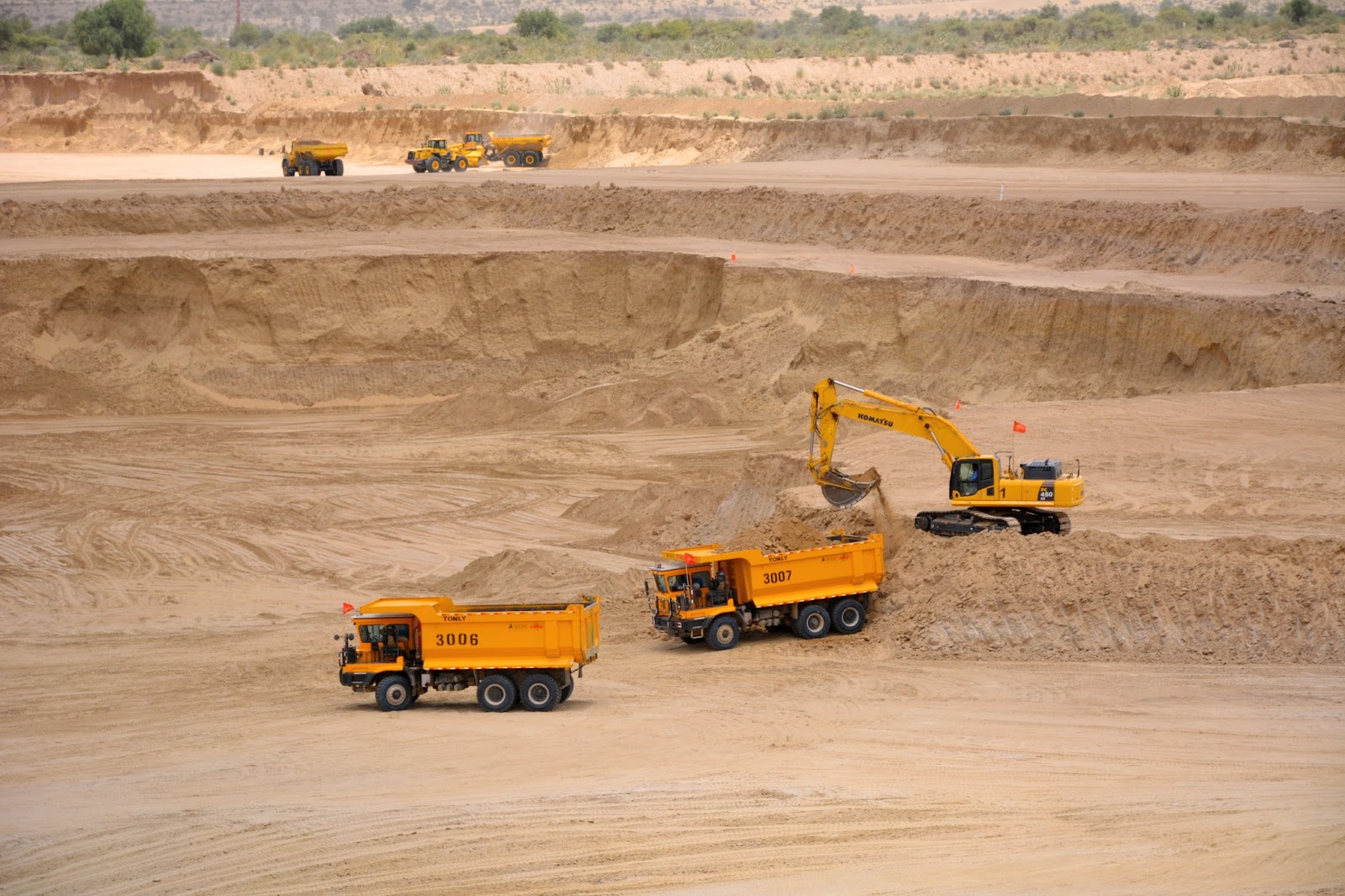
Thar Development Projects:
The Tharparker District or simply the Thar Desert is located in the southeastern province of Sindh. It is receiving a lot of attention because the desert sands hide an estimated 175 billion tons of coal underneath.
In December 2015, China agreed to invest $1.2 billion to develop Thar coal and establish a 660 MW coal-fired power plant.
The coal deposits are divided into 12 blocks, each containing approximately 2 billion tons. In the first phase the Sindh provincial government has allocated block II to Pakistan's Sindh Engro Coal Mining Company (SECMC) to excavate 1.57 billion tons of coal and build a 660 megawatt power plant. The plant is expected to provide power to the Pakistani national grid by June 2019. Later expansion to produce 1,320 MW of power is also planned.
Muhammad Makki, a doctoral student at the University of Queensland in Australia, recently visited the region. Makki saw "signs of a resource boom already animating the dull landscape of the region – roads, airports, site offices, power lines, guest houses and rising real estate price are evident".
Thar Population:
The region has a population of 1.6 million. Most of the residents are cattle herders. Majority of them are Hindus. The area is home to 7 million cows, goats, sheep and camel. It provides more than half of the milk, meat and leather requirement of the province. Many residents live in poverty. They are vulnerable to recurring droughts. About a quarter of them live where the coal mines are being developed, according to a report in The Wire.
 |
| Hindu Woman Truck Driver in Thar, Pakistan. Source: Reuters |
Some of them are now being employed in development projects. Makki saw an underground coal gasification pilot project near the town of Islamkot where "workers sourced from local communities rested their heads after long-hour shifts".
 |
| Hindu Woman Truck Driver in Thar, Pakistan. Source: Reuters |
In the first phase, Sindh Engro Coal Mining Company (SECMC) is relocating 5 villages that are located in block II. SECMC is paying villagers for their homes and agricultural land.
SECMC’s chief executive officer, Shamsuddin Ahmed Shaikh, says his company "will construct model towns with all basic facilities including schools, healthcare, drinking water and filter plants and also allocate land for livestock grazing,” according to thethirdpole.net He says that the company is paying villagers above market prices for their land – Rs. 185,000 ($ 1,900) per acre.
Impact to Date:
Islamabad-based Pakistani economist Dr. Pervez Tahir recently visited and found that "the impact of the road, augmented by mobile connectivity, is multidimensional" Here's an excerpt of what he wrote in The Express Tribune:
"Walking long distances has given way to motorbikes and overloaded buses have taken the place of kekras, the rickety shuttle truck-bus of the World War II vintage. Children suffering from malnutrition and other ailments are reported directly to the media as well as the hospital in Mithi on mobile phones. The high numbers of the suffering children had always existed; only the media was late in discovering these cases. The media attention did bring politicians and bureaucrats to the region, facilitated of course by the road. The hospital in Mithi is now much better staffed and well-stocked with medicines. It is now a thriving town with a good number of schools and a college. Even an English-medium private school was in evidence. A sub-campus of a university is also coming up. Locals complained about the lack of girls schools, especially at the post-primary level. This is a sign of growing awareness. There was also frustration that the locals are not given the party tickets for the National and Provincial assembly seats. Mobile connectivity and the road have linked the famous craftswomen of Thar with the main markets much more effectively. At a community meeting in Islam Kot, women were quoting prices that broadly corresponded with the prices charged in Karachi’s Zeb un Nisa Street."
Summary:
Thar development boom is part of Pakistan's efforts to solve its energy crisis as part of China-Pakistan Economic Corridor (CPEC) projects. It is stimulating a lot of economic activity in Tharparker region that will impact the local population and the environment. Sindh government and the companies working there claim that they are trying to maximize benefits for the region and the country while mitigating any problems associated with it. It's important that they live up to their claims.
Here's a video report by Amar Guriro:
Pakistan’s coal expansion brings misery to villagers in Thar desert from thethirdpole on Vimeo.
Related Links:
China-Pakistan Economic Corridor
Abundant, Cheap Coal Electricity For Pakistan
Mobile Connectivity in Pakistan
Pakistan Sees Robust Growth in Consumption of Energy, Cement and Steel
Politcal Stability Returns to Pakistan
Auto and Cement Demand Growth in Pakistan
Pakistan's Red Hot Air Travel Market
China-Pakistan Economic Corridor FDI
Views: 3726
-
Comment by Riaz Haq on September 1, 2024 at 9:38am
-
Climate Change and Potential Demise of the Indian Deserts
P. V. Rajesh, B. N. Goswami
First published: 31 July 2023
https://agupubs.onlinelibrary.wiley.com/doi/full/10.1029/2022EF003459
Abstract
In contrast to the “wet gets wetter and dry gets drier” paradigm, here, using observations and climate model simulations, we show that the mean rainfall over the semi-arid northwest parts of India and Pakistan has increased by 10%–50% during 1901–2015 and is expected to increase by 50%–200% under moderate greenhouse gas (GHG) scenarios. The GHG forcing primarily drives the westward expansion of the Indian summer monsoon rainfall (ISMR) and is facilitated by a westward expansion of the Indian Ocean (IO) warm pool. Mechanistically, the westward expansion of ISMR is a consequence of the episodic genesis over IO and the northward propagation of an expanded Inter-Tropical Convergence Zone on a sub-seasonal time scale. While an adaptation strategy to increased hydrological disasters is a must, harnessing the augmented rainfall would lead to a substantial boost in food productivity, bringing transformative changes in the socio-economic condition of people in the region.
Key Points
Global warming could potentially cause a westward expansion of the Indian monsoon
Rainfall in northwest India and Pakistan has increased and will continue to rise due to greenhouse gases
Increased monsoon rainfall can improve food productivity and socio-economic conditions in the region
Plain Language Summary
An apparent eastward shift of the Indian monsoon has led to the arid conditions in the west and north-west regions of India where monsoon was once active, and the Indus Valley civilizations thrived (5,300–3,300-year BP). A reversal of the process and a westward expansion of the present-day Indian monsoon would transform the west and north-west India to a humid “monsoonal” climate and provide food security to the expanding population of the country. The present study shows that the Indian monsoon is indeed expanding to the west with 10% decrease of mean rainfall in the northeast and 25% increase in the west and north-west during the historical period with a potential of 50%–100% increase in the north-west under SSP2–4.5. Harvesting the increased rainfall has the potential for significant increase in food productivity bringing in transformative changes in the socio-economic condition of people of the region.
-
-
Pakistan’s leading fertilizer manufacturer Fauji Fertilizer Company Limited (FFC) has signed the Front-End Engineering Design (FEED) agreement with a Chinese company, for what it termed as Pakistan’s first coal-to-fertilizer project under the China-Pakistan Economic Corridor (CPEC) 2.0 framework.
https://www.brecorder.com/news/amp/40422885
Pakistan advances $1.1 billion Thar coal-to-urea project to cut fertilizer imports | Arab News PK
https://www.arabnews.pk/node/2633799/pakistan
Thar lignite to be converted into urea under Pakistan’s flagship Coal-to-Fertilizer plan
Sindh administration says the initiative will create thousands of jobs, generate exports
Updated 20 February 2026
NAIMAT KHAN
February 20, 2026 16:24
ISLAMABAD: Pakistan has moved forward with a $1.12 billion coal-to-fertilizer project in the desert region of Thar, an official statement said on Friday, as it aims to use domestic coal to produce urea and reduce reliance on imported fertilizer and costly natural gas.
The initiative is part of Pakistan’s broader push to tap the vast coal reserves in Tharparkar district in southern Sindh province. Thar is home to one of the world’s largest untapped lignite coal deposits, discovered in the 1990s, and has in recent years become central to the country’s coal-based power generation expansion.
“This project is of immense importance not only for Sindh but for the entire country,” Shah said, according to the statement. “It will reduce reliance on imported fertilizer, create jobs, generate exports and add value to our indigenous coal resources.”
Pakistan traditionally produces urea using natural gas as feedstock. However, declining domestic gas reserves and rising liquefied natural gas (LNG) imports have increased production costs and placed pressure on foreign exchange reserves.
Under the Coal-to-Fertilizer (C2F) initiative, Thar coal will be converted into synthesis gas through a process known as coal gasification. The hydrogen extracted from that gas will then be used to produce ammonia, which is combined with carbon dioxide to manufacture urea.
The project is designed to produce around 717,000 tons of urea annually, with roughly half intended for domestic use and the remainder for export. Officials estimate annual export revenues of up to $260 million.
Once operational, the statement said, the project could create more than 3,500 direct jobs and about 7,000 indirect jobs, while generating royalties for the provincial government through coal extraction.
-
-
@SputnikInt
🇨🇳🇵🇰 China is powering Pakistan’s coal boom: Here’s what you need to know
Coal is now Pakistan's top source of electricity. In April 2026, it supplied 30% of the country's power – the highest ever. Why? Massive coal mining in the Thar desert, backed by Chinese investment under CPEC 2.0.
🔸More coal, less gas: Coal's share of Pakistan's electricity has more than doubled since 2018 (from under 10% to over 22% on average this year).
🔸Huge reserves: Thar holds 175 billion tonnes of coal – the 16th largest stash in the world. Experts say it could power 200,000 megawatts for a full century.
🔸China's investment: Nearly $1.9 billion through a joint mining venture. Six CPEC coal projects (totaling 3,300 MW) run purely on local Thar coal. Pakistan also wants to turn coal into liquid fuel, gas, and fertilizers.
🔸Climate downside: Water use for mining has created a salt lake and caused health problems. Pakistan is now asking China for a "just transition" – possibly retiring some coal plants early.
Can increased coal production help solve Pakistan’s energy security dilemma?
https://x.com/sputnikint/status/2060360763655757901?s=61&t=mgTx...
-
-
Tree planting campaigns in Tharparkar are .Major Initiatives and Organizations
- Thar Foundation & IUCN Pakistan: Collaborative projects have driven over a million tree plantations, established Pakistan's first desert-region Flora Conservation Station at Thar Coal Block II, and promoted saline agriculture and biodiversity. According to Dawn, “Over the past few years, it has become home to one of Pakistan's most ambitious community-driven biodiversity conservation efforts, led by Thar Foundation and IUCN Pakistan.”
- SECMC & Thar Million Tree Nursery: The Sindh Engro Coal Mining Company developed a massive nursery and used the dense Miyawaki forest technique across 100 acres in Thar Block-2.
- Local & Government Drives: Local authorities, including Additional Deputy Commissioner-I Hashim Masood, have led meetings reviewing monsoon tree-planting targets and survival rates across the district. Community groups like the Participatory Village Development Programme (PVDP) with their "Cool the Earth" initiative and the Young Social Reformers (YSR) continue local drives in areas like Mithi.
-
-
Pakistan expands Thar coal mine as US-Iran war deepens energy import risks
https://www.arabnews.pk/pakistan/pakistan-expands-thar-coal-mine-as...
Phase III raises Thar Block II mine capacity by 47 percent to 11.2 million tons annually
Additional coal will supply 660 MW Lucky plant as Pakistan seeks to reduce fuel imports
KARACHI: Pakistan on Monday inaugurated a major expansion of its Thar coal mine, increasing domestic fuel supplies for power generation as the Iran war disrupts regional energy markets and sharpens the country’s exposure to costly imports.
The third phase of the Thar Block II mine in the southern Sindh province increases annual production capacity by 47 percent, from 7.6 million to 11.2 million tons, according to the provincial government. The additional 3.6 million tons will supply the 660-megawatt Lucky Electric Power Company plant near Karachi, which has historically relied largely on imported coal.
The expansion comes as Pakistan, a net energy importer with limited foreign-exchange buffers, faces higher fuel costs amid the US-Iran war and disruption to energy supplies and shipping through the Strait of Hormuz. Replacing imported coal and other fuels with domestic resources has consequently become increasingly important to Islamabad’s energy-security strategy.
Pakistan has already significantly expanded the use of coal from Thar, a desert region bordering India that contains one of the world’s largest lignite deposits. Six power projects with combined capacity of 3,960 MW used Thar coal either wholly or partly in the last fiscal year, generating 16,447 gigawatt-hours of electricity and consuming 13.8 million tons of the local fuel, according to government data published last month.
“Today, we are saving $1.6 billion of foreign reserves in Pakistan because of Thar coal,” Bilawal Bhutto Zardari, chairman of the Pakistan Peoples Party that rules Sindh and a former foreign minister, said as he inaugurated the expansion.
The Sindh government said the Phase III project, completed entirely through self-financing, was expected to save another $220 million annually in foreign exchange and Rs15 billion ($53 million) a year in power-generation costs.
The additional production will allow more Thar coal to be supplied to Lucky Electric, whose 660 MW plant at Port Qasim near Karachi has traditionally run on imported coal. During the last fiscal year, Thar coal accounted for 33 percent of the plant’s coal use, with imported fuel making up the remaining 67 percent, according to official data.
Regular supplies of Thar coal to the Lucky plant began on Sept. 1, data shows, underscoring efforts to substitute imported coal at existing power stations rather than add new generation capacity.
Three power plants with combined capacity of 1,320 MW were already supplied entirely by the Block II mine before the latest expansion. The addition of Lucky means the mine can support plants with combined capacity of 1,980 MW, according to the Sindh government.
Pakistan began commercial power generation from Thar coal in 2019 after decades of attempts to exploit the desert’s vast lignite reserves. Four plants with a combined capacity of 2,640 MW were classified by the country’s power regulator as local-coal generators in the previous fiscal year, while another 4,620 MW of installed coal-fired capacity was categorized as relying on imported coal, according to the National Electric Power Regulatory Authority.
Bhutto Zardari said officials in Islamabad had once dismissed the resource as commercially unviable and called for its use to be expanded beyond electricity generation.
Pakistan in February advanced a $1.12 billion project to convert Thar lignite into urea, part of a broader effort to reduce dependence on imported fertilizer and natural gas.
Sindh Chief Minister Murad Ali Shah said authorities were also working on converting Thar coal into gas and aimed eventually to raise Block II’s annual mining capacity to 20 million tons.
-
-
118 households in Tharparkar, 22 in Ghotki receive solar home system Kits
As part of the ‘Roshan Ghar – Roshan Sindh’ initiative, 118 eligible households in District Tharparkar and 22 in District Ghotki have been provided with solar home system kits.
https://www.app.com.pk/sindh/118-households-in-tharparkar-22-in-gho...
SUKKUR, Jun 17 (APP): As part of the ‘Roshan Ghar – Roshan Sindh’ initiative, 118 eligible households in District Tharparkar and 22 in District Ghotki have been provided with solar home system kits.
Distribution ceremonies were held in Taluka Mithi and Mirpur Mathelo on Wednesday.
These activities are being carried out under the Solar Home System (On-grid/Off-grid) Project, which is financially supported by the Government of Sindh’s Energy Department and being implemented by the Sindh Rural Support Organization (SRSO).
The objective of the Solar Home System Project is to provide reliable, affordable, and sustainable energy solutions through on-grid and off-grid solar technology to 275,000 households across 30 districts of Sindh, selected through a transparent process.
In this phase, solar home system kits were distributed to eligible beneficiaries after a transparent verification and validation process. All beneficiaries underwent prior survey, verification, and approval in accordance with the eligibility criteria set by the Government of Sindh’s Solar Energy Programme.
Prior to distribution, beneficiaries were given awareness training on the proper installation, use, and maintenance of solar home systems to ensure they derive maximum benefit from the facility and that the longevity and sustainability of the provided equipment is ensured.
-
-
Pakistan's Thar coal project has crossed in cumulative foreign exchange savings by replacing expensive imported fuel with indigenous coal. [1, 2]Key Savings & Financial Breakdown
- Power Generation Costs: The Phase-III expansion of Thar Block-II reduces generation costs by Rs 15 billion annually. [1]
- Coal Tariff Reduction: Levelised coal tariffs are projected to drop from $36.72 to $32.01 per tonne as production scales up. [1]
Production & Capacity Growth- Block-II Expansion: Phase-III raises annual production capacity by 47%—from 7.6 million tonnes to 11.2 million tonnes. [1]
- Household Reach: The expanded power supply provides electricity to roughly 4.5 million householdsdaily. [1]
Would you like more details on specific Thar coal blocks (such as Block-I or Block-II) or data on upcoming industrial coal-to-gas/urea conversion projects?
Comment
- ‹ Previous
- 1
- …
- 6
- 7
- 8
- Next ›
Twitter Feed
Live Traffic Feed
Sponsored Links
South Asia Investor Review
Investor Information Blog
Haq's Musings
Riaz Haq's Current Affairs Blog
Please Bookmark This Page!
Blog Posts
AI Revolution in Pakistan: Multiple AI Apps Launched for Farmers
With the expansion of the internet access in rural areas, several local language AI applications have recently been launched for downloads by farmers in Pakistan. These apps help with crop planning, soil sensing, personalized fertilizer recommendations, disease diagnoses, weather forecasts and market prices. A couple of these have been downloaded by half a million or more farmers in the country. Some of these apps use open source large language models (LLMs) like…
ContinuePosted by Riaz Haq on October 14, 2026 at 1:00pm — 1 Comment
Tata's Boardroom Crisis: Will it Impact Philanthropy in India?
India's Tata Group is going through a major boardroom crisis. Noel Tata, the Chairman of the Tata holding company, has been removed from the Tata Group's board by N. Chandrasekaran, chairman of Tata Sons. Noel Tata has declared the decision illegal, a stance the board disputes. The crisis has been precipitated by a 2022 decision by India’s central bank to order the company to seek a stock market listing for Tata Sons, to comply with new rules governing systemically important…
Continue
© 2026 Created by Riaz Haq.
Powered by


You need to be a member of PakAlumni Worldwide: The Global Social Network to add comments!
Join PakAlumni Worldwide: The Global Social Network