PakAlumni Worldwide: The Global Social Network
The Global Social Network
Digital Pakistan 2023: Technology Transforming Women's Lives in Rural Pakistan
Growing access to smartphones and Internet connectivity is transforming the lives of women in rural Pakistan. They are acquiring knowledge, accessing healthcare and finding economic opportunities. A recent UNDP report titled "DigitAll: What happens when women of Pakistan get access to digital and tech tools? A lot!" written by Javeria Masood describes the socioeconomic impact of technology in Pakistan in the following words:
"The world as we know it has been and is rapidly changing. Technology has proven to be one of the biggest enablers of change. There has been a significant emphasis on digital trainings, tech education, and freelancing in the last several years especially during the pandemic, through initiatives from the government, private and development sectors. Covid-19 acted as a big disrupter and accelerated the digital uptake many folds. In Pakistan, we saw the highest number of digital wallets, online services, internet-based services and adaptability out of need and demand".
 |
| Pakistani Women in South Punjab. Photo by Shuja Hakim UNDP Pakistan |
Digital Transformation:
The report cites the example of Ayesha Abushakoor from Zawar Wala in South Punjab who is a Quran teacher. She is teaching students remotely in and outside Pakistan. She uses digital wallets to receive payments. The same report also cites the case of Samina, from Muzafargharh, who is getting training online to start a livestock business. Another woman Mujahida Perveen from UC Pega in Dera Ghazi Khan is managing her thyroid disease by watching YouTube videos.
Telehealth is helping more women access healthcare in remote areas of Pakistan. Startups like Sehat Kahani are employing women doctors who work from home to provide healthcare services. Sehat Kahani was founded by Dr. Sara Khurram and Dr. Iffat Zafar who raised seed funding of US$ 500,000 in 2018, followed by a pre-series of $1 million in March 2021.
Expansion of Digital Services:
The year 2022 was a very rough year for Pakistan. The nation was hit by devastating floods that badly affected tens of millions of people. Macroeconomic indicators took a nose dive as political instability reached new heights. In the middle of such bad news, Pakistan saw installation of thousands of kilometers of new fiber optic cable, inauguration of a new high bandwidth PEACE submarine cable connecting Karachi with Africa and Europe, and millions of new broadband subscriptions. Broadband penetration among 140 million (59% of 236 million population) Pakistanis in the 15-64 years age group reached almost 90%. This new digital infrastructure helped grow technology adoption in the country.
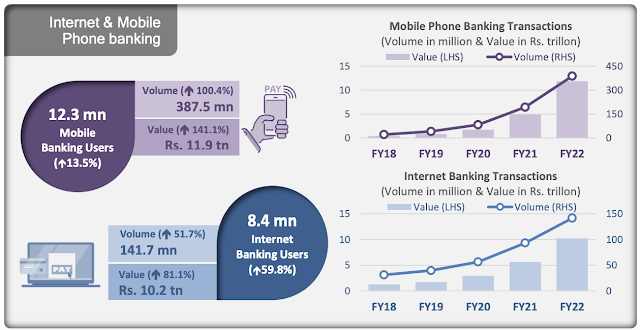 |
| Internet and Mobile Phone Banking Growth in 2021-22. Source: State ... |
Fintech:
Mobile phone banking and internet banking grew by 141.1% to Rs. 11.9 trillion while Internet banking jumped 81.1% to reach Rs10.2 trillion. E-commerce transactions also accelerated, witnessing similar trends as the volume grew by 107.4% to 45.5 million and the value by 74.9% to Rs106 billion, according to the State Bank of Pakistan.
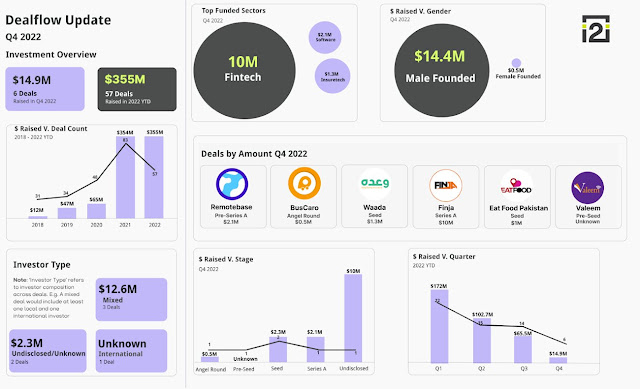 |
| Pakistan Startup Funding in 2022. Source: i2i Investing |
Fintech startups continued to draw investments in the midst of a slump in venture funding in Pakistan. Fintech took $10 million from a total of $13.5 million raised by tech startups in the fourth quarter of 2022, according to the data of Invest2Innovate (i2i), a startups consultancy firm. In Q3 of 2022, six out of the 14 deals were fintech startups, compared to two deals of e-commerce startups. Fintech startups raised $38 million which is 58% of total funding ($65 million) in Q3 2022, compared to e-commerce startups that raised 19% of total funding. The i2i data shows that in Q3 2022, fintech raised 37.1% higher than what it raised in Q2 2022 ($27.7 million). Similarly, in Q2 2022, the total investment of fintech was 63% higher compared to what it raised in Q1 2022 ($17 million).
 |
| E-Commerce in Pakistan. Source: State Bank of Pakistan |
E-Commerce:
E-commerce continued to grow in the country. Transaction volume soared 107.4% to 45.5 million while the value of transactions jumped 75% to Rs. 106 billion over the prior year, according to the State Bank of Pakistan.
 |
| Pakistan Among World's Top 10 Smartphone Markets. Source: NewZoo |
PEACE Cable:
Pakistan and East Africa Connecting Europe (PEACE) cable, a 96 TBPS (terabits per second), 15,000 km long submarine cable, went live in 2022. It brought to 10 the total number of submarine cables currently connecting or planned to connect Pakistan with the world: TransWorld1, Africa1 (2023), 2Africa (2023), AAE1, PEACE, SeaMeWe3, SeaMeWe4, SeaMeWe5, SeaMeWe6 (2025) and IMEWE. PEACE cable has two landing stations in Pakistan: Karachi and Gwadar. SeaMeWe stands for Southeast Asia Middle East Western Europe, while IMEWE is India Middle East Western Europe and AAE1 Asia Africa Europe 1.
 |
| Mobile Data Consumption Growth in Pakistan. Source: ProPakistan |
Fiber Optic Cable:
The first phase of a new high bandwidth long-haul fiber network has been completed jointly by One Network, the largest ICT and Intelligent Traffic and Electronic Tolling System operator in Pakistan, and Cybernet, a leading fiber broadband provider. The joint venture has deployed 1,800 km of fiber network along motorways and road sections linking Karachi to Hyderabad (M-9 Motorway), Multan to Sukkur (M-5 Motorway), Abdul Hakeem to Lahore (M-3 Motorway), Swat Expressway (M-16), Lahore to Islamabad (M-2 Motorway) and separately from Lahore to Sialkot (M-11 Motorway), Gujranwala, Daska and Wazirabad, according to Business Recorder newspaper.
Mobile telecom service operator Jazz and Chinese equipment manufacturer Huawei have commercially deployed FDD (Frequency Division Duplexing) Massive MIMO (Multiple Input and Output) solution based on 5G technology on a large scale in Pakistan. Jazz and Huawei claim it represents a leap into the 4.9G domain to boost bandwidth.
 |
| Pakistan Telecom Indicators November 2022. Source: PTA |
 |
| Pakistan's RAAST P2P System Taking Off. Source: State Bank of Pakistan |
Broadband Subscriptions:
Pakistan has 124 million broadband subscribers as of November, 2022, according to Pakistan Telecommunications Authority. Broadband penetration among 140 million (59% of 236 million) Pakistanis in 15-64 years age bracket is 89%. Over 20 million mobile phones were locally manufactured/assembled in the country in the first 11 months of the year.
 |
| Bank Account Ownership in Pakistan. Source: Karandaaz |
 |
| Financial Inclusion Doubled In Pakistan in 5 Years. Source: Karandaaz |
Documenting Pakistan Economy:
Pakistan's unbanked population is huge, estimated at 100 million adults, mostly women. Its undocumented economy is among the world's largest, estimated at 35.6% which represents approximately $542 billion at GDP PPP levels, according to World Economics. The nation's tax to GDP ratio (9.2%) and formal savings rates (12.72%) are among the lowest. The process of digitizing the economy could help reduce the undocumented economy and increase tax collection and formal savings and investment in more productive sectors such as export-oriented manufacturing and services. Higher investment in more productive sectors could lead to faster economic growth and larger export earnings. None of this can be achieved without some semblance of political stability.
Related Links:
2021: A Banner Year For Tech Startups in Pakistan
Pakistan Projected to Be World's 6th Largest Economy By 2075
Digital Pakistan 2022: Broadband Penetration Soars to 90% of 15+ Po...
Working Women Seeding a Silent Revolution in Pakistan
Socioeconomic Impact of New Infrastructure in Rural Pakistan
Pakistan Gets First Woman Supreme Court Judge
Pakistan at 75
Growing Presence of Pakistani Women in Science and Technology
Riaz Haq's Youtube Channel
Views: 568
-
Comment by Riaz Haq on August 30, 2026 at 6:21pm
-
AI cooperation with China brings hope to Pakistan's small farmers
https://www.bignewsnetwork.com/news/279275714/ai-cooperation-with-c...
For many small farmers in Pakistan's Punjab province, the country's most populous province, farming has always felt like a roll of the dice against the whims of the weather. But local farmers may soon see their fortunes change.
Syed Muhammad Ashiq Hussain Shah, Punjab's agriculture minister, is attending the 2026 China International Big Data Industry Expo, which runs through Sunday, in Guiyang, capital of southwest China's Guizhou Province. He said his delegation has a clear mission: to find Chinese partners who can help bring AI-powered farming tools to millions of smallholders back home.
According to the Pakistani official, many small farmers in Punjab province lack access to reliable, timely information. Meanwhile, climate change is making weather patterns increasingly erratic, with sudden downpours, prolonged droughts and scorching heat waves adding new risks to agricultural production
Punjab's agricultural authorities are now developing an AI-powered digital monitoring network designed to deliver weather forecasts, crop monitoring and real-time data on soil, water and pest control directly to farmers.
"We want to use AI to monitor the weather, soil and water, and to digitally track crops as well," Shah said. "We also want to use AI for pest control, so that a farmer can simply send a picture of a plant and get help identifying the problem. "
"If farmers can receive this information through a digital platform, they can make better decisions and reduce losses. That is why we see AI as an important tool for improving agricultural productivity and supporting farmers in Punjab," he said.
"That is exactly why we are here -- to find partners and learn from China's experience," he added.
In fact, China and Pakistan, including Punjab, have already shared a solid foundation in agricultural cooperation. Shah said Punjab signed at least six memorandums of understanding following previous visits to China and has been actively following through on them.
Chinese companies have also played a significant role in Punjab's high-tech farm mechanization program. Shah estimated that about 90 percent of the machinery acquired under the program -- including harvesters and tractors -- came from China. Now, this partnership is evolving beyond hardware to include smart technologies and intelligence.
Ali Mustafa Dar, adviser to the chief minister of Punjab on artificial intelligence and special initiatives, observed that China does not treat AI as something separate from economic development, but integrates it across manufacturing, logistics, cities, agriculture, transport and public services.
"China thinks long term. It builds the infrastructure. It experiments and learns. And when something works, it has the capacity to take it to extraordinary scale," he said.
As China's first national comprehensive big data pilot zone, Guizhou offers precisely the kind of experience Punjab is looking for. Dar said Guizhou is particularly interesting because it demonstrates that AI begins with strong data foundations.
Guizhou is a key hub for China's national "East Data, West Computing" project. This national strategy operates similarly to a power grid, shifting the heavy data processing demands of China's economically bustling eastern coast to resource-rich western regions. Crucially, the project utilizes the western region's abundant green energy such as wind and hydropower, making it a major milestone in green technology and carbon reduction.
By late July 2026, Guizhou housed 50 key data centers, with total computing capacity reaching 176.57 EFLOPS. Nearly 98.4 percent of this capacity was dedicated specifically to AI-related computing.
Dar said he is keen to understand how Guizhou has built its data ecosystem -- from infrastructure, data centers and standards to governance, industry and the applications built on top.
-
-
Pakistan to fiberise 10m homes
Sets 2029 target; fragmented networks, low FTTH threaten broadband ambitions
https://tribune.com.pk/story/2580911/pakistan-to-fiberise-10m-homes
KARACHI:
Pakistan, long criticised for inadequate public service delivery, now sees a rare opportunity to leap into modern governance through technology. But its race towards a digitally enabled future depends on whether it can overcome deep connectivity gaps, high infrastructure costs, and sluggish fibre-to-the-home penetration, as the government rolls out an ambitious National Fiberisation Plan aimed at delivering high-speed broadband to 10 million households by 2029.
While the initiative promises 100 Mbps fixed internet for every user and aims to elevate the country into the top 50 global speed rankings, experts warn that fragmented networks, limited fibre density, spectrum inefficiencies, and cybersecurity vulnerabilities could stall progress unless policy, investment, and execution align at scale.
The country is also targeting 80% fiberisation of mobile towers to enhance network capacity and reliability, and to improve Pakistan's standing in the top 50 countries on the Ookla global speed rankings.
The initiative is being led by the Ministry of Information Technology and Telecommunication (MoITT) in collaboration with the World Bank, as part of the Digital Economy Enhancement Project (DEEP). The main objective of the programme is to enhance the government's capacity to deliver digitally enabled public services for citizens and businesses.
To achieve its targets, the ministry is currently seeking to hire a consultancy firm to develop a roadmap for attracting investment within the existing policy framework.
The plan will also explore how Administrative Incentive Pricing (AIP) can be used as a complementary policy tool to promote efficient spectrum use and incentivise fibre deployment for backhaul and middle-mile connectivity, particularly to support 4G densification and 5G readiness. It will also clarify the complementary roles of fibre (long-haul, middle-mile, and deep access) and spectrum (last-mile wireless), ensuring that AIP discourages spectrum hoarding while encouraging sustainable, long-term investment in fibre-based infrastructure.
Syed Muhammad Taha Owais, a fibre-optic infrastructure specialist, said demand for high-speed internet is rising sharply in urban areas for both commercial and domestic use, which could boost business productivity and output.
"Pakistan ranks among the lowest globally for internet speeds due to obsolete infrastructure and the slow adoption of new technologies, particularly FTTH (fibre-to-the-home)," he said. All stakeholders, including the government and the private sector, should fast-track fibre deployment nationwide to improve connectivity and support the digitisation of business and governance systems.
Owais, a senior official at Optix Pakistan, underscored the importance of high-speed internet, adding that the deployment of fibre optic in commercial areas and posh localities has increased the uptake of internet and increased the performance of the businesses.
At present, Pakistan has over 211,000 kilometres of deployed optical fibre, including 75,967 km of long-haul and 135,506 km of metro fibre.
"For a technopreneur, fibre is not infrastructure; it is oxygen and digital power," he said. This fiberisation plan is Pakistan's launchpad. Every startup, every smart city, every digital service depends on it.
Comment
- ‹ Previous
- 1
- 2
- 3
- 4
- Next ›
Twitter Feed
Live Traffic Feed
Sponsored Links
South Asia Investor Review
Investor Information Blog
Haq's Musings
Riaz Haq's Current Affairs Blog
Please Bookmark This Page!
Blog Posts
AI Revolution in Pakistan: Multiple AI Apps Launched for Farmers
With the expansion of the internet access in rural areas, several local language AI applications have recently been launched for downloads by farmers in Pakistan. These apps help with crop planning, soil sensing, personalized fertilizer recommendations, disease diagnoses, weather forecasts and market prices. A couple of these have been downloaded by half a million or more farmers in the country. Some of these apps use open source large language models (LLMs) like…
ContinuePosted by Riaz Haq on October 14, 2026 at 1:00pm
Tata's Boardroom Crisis: Will it Impact Philanthropy in India?
India's Tata Group is going through a major boardroom crisis. Noel Tata, the Chairman of the Tata holding company, has been removed from the Tata Group's board by N. Chandrasekaran, chairman of Tata Sons. Noel Tata has declared the decision illegal, a stance the board disputes. The crisis has been precipitated by a 2022 decision by India’s central bank to order the company to seek a stock market listing for Tata Sons, to comply with new rules governing systemically important…
Continue
© 2026 Created by Riaz Haq.
Powered by


You need to be a member of PakAlumni Worldwide: The Global Social Network to add comments!
Join PakAlumni Worldwide: The Global Social Network