PakAlumni Worldwide: The Global Social Network
The Global Social Network
Do Indian Aircraft Carriers Pose a Serious Threat to Pakistan's Security?
India has recently inducted INS Vikrant, the South Asian nation's second aircraft carrier. This "indigenous" ship of the Indian Navy is powered by four American-made General Electric LM2500 marine gas turbines built in the US state of Ohio. It is a relatively small aircraft carrier with a displacement of 40,000 tons, top speed of 28 knots, cruise speed of 18 knots and 7,500 nautical miles (8,630 miles) range. INS Vikrant can carry up to 30 fixed-wing and rotary aircraft and 1600 sailors. India plans to equip it with Russian MiG-29K fighter jets and Westland Sea King helicopters, a British license-built version of the American Sikorsky S-61 helicopter of the same name. Does this latest addition to the Indian Navy pose a serious threat to Pakistan's security? Can Pakistan defend against it?
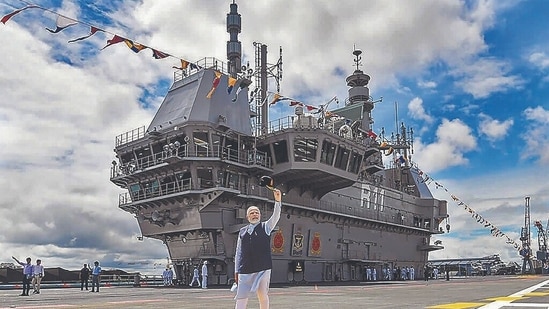 |
| Indian PM Modi Launched INS Vikrant Aircraft Carrier |
In a 2017 paper for the US Naval War College Review, defense analyst Ben Wan Beng Ho discussed how India might use its aircraft carriers against Pakistan and how the latter would respond. Here are some key excerpts from it:
"(I)t is doubtful that any attack force launched from an Indian carrier would pack a significant punch. “With aircraft available for strike duties barely numbering into the double digits, the Indian carrier simply cannot deliver a substantial ‘pulse’ of combat power against its adversary.”
“In any attempt to impose sea control in the northern Arabian Sea and to interdict Pakistani seaborne commerce by enforcing a blockade of major Pakistani maritime nodes, Indian carrier forces would have to devote a portion of their already meager airpower to attacking Pakistani vessels, thereby exacerbating the conundrum alluded to earlier. What is more, Pakistani ships are likely to operate relatively close to their nation’s coast, to be protected by Islamabad’s considerable access-denial barrier.”
Indian-American defense analyst Ashley Tellis has also raised serious questions about the Indian naval doctrine. He believes that the land-based fighter aircraft with refueling to extend range are a better option. He also says that aircraft carriers are highly vulnerable to sinking by stealthy submarines.
There are lessons for the Indian military from Ukraine-Russia war. In April this year, Ukraine's Neptune anti-ship missiles hit and sank Moskva in Black Sea. It was a large 10,000-ton guided missile cruiser of the Russian Navy that was launching cruise missiles on targets in Eastern and Southern Ukraine. It is the largest warship to have been sunk in action since WWII.
Pakistan has recently showcased its anti-ship missile Harbah at DIMDEX 2022, a defense expo in Qatar. It is a medium range ship launched subsonic cruise missile system capable of targeting sea as well as land targets in “all weather operation” at a maximum range of 280 kilometers, according to a report in NavalNews. The missile is fire and forget type. It relies on inertial navigation technologies with GPS and GLONASS systems. According to its manufacturer GIDS, the missile features the following guidance systems: a DSMAC camera, imaging infrared seeker, and radar seeker. More recently, Pakistan's ally China has successfully demonstrated its carrier-buster missile. A single round has to be slung underneath the fuselage. And its primary prey is likely to be enemy aircraft carriers. For this reason, it has been widely dubbed a ‘carrier killer’, according to Naval News.
In a YouTube video, Indian journalist Shekhar Gupta noted that the Indian Navy hid its aircraft carriers from Pakistan Navy submarines in both 1965 and 1971 wars. He also recalled that Pakistani Navy warships destroyed Indian Naval Base at Dwarka in 1965, and Pakistani sub Hangor sank an Indian warship INS Khukri in 1971 war.
General Kidwai on Pakistan's 2nd Strike Capability
Military Lessons From Russia-Ukraine War
Vast Majority of Indians Believe Nuclear War Against Pakistan is "W...
Pakistan Navy Modernization
Hindutva: The Legacy of the British Rulers "Divide and Rule" Project
Will Modi's Hindutva Lead to Multiple Partitions of India?
Riaz Haq Youtube Channel
PakAlumni: Pakistani Social Network
Views: 731
-
Comment by Riaz Haq on September 13, 2026 at 9:40am
-
Mohsin Ali
@Mohsin_o2
Indian Navy Vice Admiral (R) says Pakistan’s eight Hangor-class submarines will be a “massive headache” for India.
“Pakistan’s eight Hangors are going to be a BIG headache for us. I would love to be the operational commander on the Pakistani side.”
— Vice Admiral (Retd.) Sanjay Mahindru
https://x.com/Mohsin_o2/status/2099077809209803157?s=20
---------------
Defence Insider
@defence_insider
The Indian Navy has long viewed Pakistan 🇵🇰 Navy’s submarine modernisation with serious concern, and the Type 039B Hangor programme is clearly raising the stakes.
Eight Hangor class submarines, alongside the AGOSTA 90B modernisation, will significantly strengthen Pakistan 🇵🇰 Navy’s undersea warfare capability.
Just wait and see what weapon systems and combat capabilities Pakistan 🇵🇰 Navy has procured alongside its new submarines. The undersea balance in the Arabian Sea could look very different in the coming years. https://x.com/mohsin_o2/status/2099077809209803157/video/1
https://x.com/defence_insider/status/2099081389509693510?s=20
----------------
Ramandeep Bajwa
@Ramandeep_Bajwa
Neglect of air force saw unpleasant surprises in 2019 and 2025 when lack of critical assets like AWACS, aerial tankers, electronic warfare aircraft, missing multiple domain warfare capability allowed the adversary to hold its own against much larger numbers.
https://x.com/Ramandeep_Bajwa/status/2099062064912470384?s=20
-
-
Current Submarine Fleet Overview
- Hangor-class (Type 039A/041 Yuan-class derivative):
- Status: 1 commissioned (PNS/M Hangor, inducted in April 2026), with 7 more on order (4 built in China, 4 built locally at Karachi Shipyard) as part of a $5 billion program expected to be completed by 2028.
- Features: Equipped with Air-Independent Propulsion (AIP) for extended underwater endurance, advanced sensors, torpedoes, and anti-ship cruise missiles (which conducted a live-fire strike in September 2026). [1, 2, 3, 4, 5]
- Agosta-90B class (Khalid class):
- Status: 3 active units (PNS Khalid, PNS Saad, PNS Hamza).
- Features: French-designed diesel-electric attack submarines featuring modern combat and AIP or upgraded systems.
- Agosta-70 class (Hashmat class):
- Status: 2 active units (PNS Hashmat, PNS Hurmat).
- Features: Legacy French-built diesel-electric attack submarines. [1]
- Cosmos class (Mini-submarines):
- Status: 3 active MG110/Cosmos-class midget/mini-submarines used for specialized shallow-water and special operations. [1]
Fleet Expansion & Roadmap- Once all 8 Hangor-class submarines are completed and commissioned by 2028, Pakistan's active major submarine strength will scale up significantly to 13 primary combat submarines (alongside mini-submarines), strengthening its sea-denial and minimum credible deterrence posture in the Arabian Sea.[1]
- Hangor-class (Type 039A/041 Yuan-class derivative):
-
-
Pakistan’s Eight Hangor Submarines Could Strain India’s Navy, Former Admiral Warns
Former Indian vice admiral Sanjay Mahindru warns that Pakistan’s planned eight-boat Hangor fleet could force India to devote more ships, aircraft and sensors to tracking concealed threats.
https://defencesecurityasia.com/en/pakistan-hangor-submarines-india...
India’s Delayed Submarine Replacement Magnifies the Hangor Window
Pakistan’s first Hangor entered service eleven years after the 2015 order, while India’s Project 75I programme for six air-independent propulsion submarines remained unsigned by mid-2026, illustrating how acquisition tempo can alter regional risk before fleet totals decisively change.
Project 75I has spent roughly two decades in planning and negotiation, with German Type 214-derived proposals widely discussed, but even a near-term contract would likely place the first completed Indian submarine around 2032–2033 under optimistic industrial and testing assumptions.
Meanwhile, several Sindhughosh-class Kilo and Shishumar-class HDW submarines are approaching retirement, creating a late-2020s readiness window in which hull availability, refit schedules, and crew pipelines may matter more than nominal Indian fleet strength displayed on paper
India’s six Kalvari-class Scorpène submarines provide modern conventional capability, but they entered service without air-independent propulsion, while plans to integrate an indigenous AIP plug during future refits remain subject to engineering validation, schedule risk, and availability costs.
This mismatch explains Mahindru’s “lost decade” description because submarine construction cannot be accelerated instantly; specialised steel, pressure-hull fabrication, combat-system integration, sea trials, certification, crew training, and dockyard capacity impose long lead times after political approval.Explore History
Simply ordering more boats would therefore leave an immediate surveillance deficit, whereas investments in seabed sensors, unmanned underwater vehicles, deployable arrays, maritime patrol aviation, and networked processing could improve detection coverage before new Indian submarines become operational.
India must also protect anti-submarine warfare availability by maintaining P-8I mission systems, stocking sonobuoys and lightweight torpedoes, expanding MH-60R support, and ensuring surface combatants possess reliable towed-array sonars, trained operators, and sufficient operational flying hours.
Force posture becomes central because sensors concentrated near major bases may leave patrol gaps elsewhere, while widely dispersed systems require secure communications, common acoustic libraries, automated correlation, and command arrangements capable of converting detections into timely operational decisions.ASW technology training
Pakistan faces parallel constraints, including Chinese CHD620 diesel-engine reliability after German export restrictions blocked planned MTU engines, local construction delays, infrastructure expansion, crew generation, and the challenge of sustaining high readiness across eleven eventual AIP-equipped submarines.
The undersea balance will consequently depend less upon ceremonial commissioning totals than deployable boats, trained crews, maintenance throughput, weapon readiness, sensor integration, and each navy’s ability to regenerate patrols after failures, losses, or prolonged wartime operations.
(CLICK HERE): India’s 200-Warship Surge Targets China as Pakistan’s Hangor Submarines Reshape the Indian Ocean
Underwater Domain Awareness Will Decide Whether Hangor Changes the Balance
Mahindru’s proposed remedy places underwater domain awareness above platform-for-platform competition because a submarine that can be continuously detected becomes containable, whereas an unlocated boat can influence fleet behaviour, harbour activity, and political decision-making without firing a weapon.Submarine fleet analysis
-
-
Are Aircraft Carriers Obsolete? | Ask The Professor (Mearsheimer)
https://youtu.be/dFcCJtCE4Ig?is=dXEu-lo6za7RIlmB
————————————————————
PODCASTS
Spotify: https://open.spotify.com/show/0A...
Apple: https://podcasts.apple.com/podca...
————————————————————
DESCRIPTION
@JerryMcLaughlin-r8w asked whether drones, cruise missiles and ballistic missiles have made U.S. aircraft carriers obsolete, and whether the Navy saw it coming.
Carriers have always been vulnerable near large landmasses, which is why we didn’t use them against Nazi Germany or plan to in a Cold War fight in Europe. The threat is now far greater, and the cost exchange favors cheap missiles and drones over a carrier and its battlegroup. In a fight with China over Taiwan or the South China Sea, I think carriers are basically useless. Against Iran they’d have to operate even farther out as Iranian weapons improve.
The Navy knows all this, but carriers are bound up with its identity, so reducing our reliance on them will be hard. Looking at it purely strategically, I think we’d be better off spending much less on carriers and much more on submarines.
—————
Aircraft carriers are not completely useless, though their vulnerability and cost-effectiveness in modern high-end conflicts are heavily debated.
Arguments That Carriers Are Losing Value (Vulnerabilities & Cost)
• High Costs: Supercarriers like the U.S. Nimitz and Ford classes cost between $6.2 billion and over $13 billion to build, making them massive financial targets.
• Cost Exchange Ratio: Inexpensive threats—such as anti-ship cruise missiles, low-cost drones, and hypersonic or ballistic missiles ($30 million to $40 million)—heavily favor the attacker economically.
• Anti-Access/Area Denial (A2/AD): Long-range sensors, artificial intelligence-driven tracking, and anti-ship ballistic missiles (such as those developed by China) can force carriers to operate far from target zones, limiting their air wing's reach and sortie generation.
• Production Delays: Programs like the USS Gerald R. Ford and USS John F. Kennedy have faced multi-year schedule delays and billions in cost overruns.
Arguments That Carriers Remain Valuable (Strategic Strengths)
• Mobile Air Bases: Unlike fixed land bases that can be easily targeted and destroyed by enemy strikes, carriers move continuously and operate within a multi-layered defense bubble (destroyers, cruisers, and air wings).
• Crisis Response and Diplomacy: They serve as vital instruments for political signaling, global deterrence, and humanitarian assistance where local airfields are unavailable.
• Adaptability: Rather than remaining static like old battleships, modern carriers are adapting through longer-range unmanned aerial vehicles, updated network-centric sensors, and standoff strike tactics.
-
-
Pakistan’s Hangor submarine successfully fires anti-ship cruise missile in Arabian Sea weapon test
https://www.arabnews.pk/pakistan/pakistans-hangor-submarine-success...
Hangor engaged the designated target with precision, validating its weapon systems, combat readiness, operational effectiveness
The demonstration comes nearly two weeks after a collision involving Pakistani and Indian naval ships in the northern Arabian Sea
ISLAMABAD: Pakistan Navy’s newly inducted submarine, Hangor, has successfully fired an anti-ship cruise missile during its maiden live weapon test in the northern Arabian Sea, the Pakistani military said on Sunday, describing the exercise as a demonstration of the vessel’s combat readiness and operational capability.
In June this year, Pakistan’s navy announced the arrival of PNS/M Hangor, the first of a new class of submarines being acquired under a major defense collaboration with China. The move is expected to strengthen the country’s maritime deterrence and undersea warfare capabilities.
In a major demonstration of operational readiness, the submarine accurately engaged a designated long-range target with an anti-ship cruise missile in the North Arabian Sea on Sunday, according to the Inter-Services Public Relations (ISPR), the Pakistani military’s media arm.
Pakistan’s Chief of Naval Staff Admiral Naveed Ashraf witnessed the firing and praised the submarine’s combat power, emphasizing the strategic importance of enhancing subsurface capabilities of the force for credible maritime deterrence.
“Hangor engaged the designated target with precision, validating its weapon systems, combat readiness and operational effectiveness,” Pakistan Navy said in a separate statement.
“The successful firing marked an important milestone in the operationalization of PNS/M HANGOR and demonstrated the growing strength of Pakistan Navy’s subsurface warfare capabilities.”
The demonstration comes nearly two weeks after a collision involving Pakistani and Indian naval ships in northern Arabian Sea, which prompted both countries to summon the other’s top diplomat and protest it.
The collision occurred on Sept. 15 when Pakistan Navy was undertaking its biennial exercise SEASPARK-26 and an Indian vessel carried out “aggressive maneuvers in dangerously close proximity of Pakistani naval ship” that resulted in contact between the two vessels, according to the Pakistani foreign ministry.
India earlier summoned Pakistan’s top diplomat over the collision, its external affairs ministry said, describing the incident as “unacceptable and unprofessional” and asking Pakistan to ensure its military units exercise caution.
This was the first overt military tension between the nuclear-armed neighbors since they engaged in a fierce, four-day military conflict last year that raised fears of a wider war before a ceasefire was reached.
Pakistan’s Hangor submarine is equipped with advanced combat systems, modern sensors, air independent propulsion (AIP) technology, and enhanced stealth features, according to Pakistan Navy. Its induction is expected to expand the navy’s warfare capabilities as it seeks to safeguard sea lanes and strategic maritime interests.
“The milestone underscores the Pakistan Navy’s commitment to maintaining a modern, combat-ready force to safeguard national maritime frontiers and regional peace,” Pakistan Navy said, following Sunday’s live weapon test.
———
Pakistan has conducted key tests of its submarine-launched missile capabilities, most notably the Babur-3(SLCM) nuclear-capable cruise missile, as well as recent live-fire anti-ship missile tests from its newly inducted Hangor-class submarine. [1, 2, 3]
-
-
Pakistan’s new stealthy Hangor class submarine
On October 26, 2006, a Chinese People's Liberation Army Navy (PLAN) Song-class (Type 039, same as Pakistan’s Hangor Class) diesel-electric attack submarine surfaced undetected within five nautical miles of the aircraft carrier USS Kitty Hawk (CV-63) while it was operating with its strike group east of Okinawa, Japan. [1, 2, 3]
Key Details of the Incident
The Stalking and Surface: The Chinese submarine shadowed the U.S. carrier battle group—which included a dozen surface combatants, an attack submarine, and anti-submarine helicopters—without being detected by the fleet's defensive screen. It then surfaced within torpedo range (inside 5 miles) before being spotted visually by a routine aircraft surveillance flight. [1, 2, 3, 4]
Why it wasn't detected: The Song-class is a diesel-electric submarine that runs on quiet battery power during slow operations, producing very low acoustic signatures compared to nuclear-powered submarines that U.S. anti-submarine warfare (ASW) systems were primarily tuned to find. [1, 2]
Strategic Impact: Viewed as a watershed moment for China's naval modernization, the event shocked U.S. military planners and demonstrated the growing capability of non-nuclear submarines to challenge surface action groups in the Western Pacific. [1, 2]
—————
Pakistan’s Hangor-class submarine is an export variant based on China’s Type 039 (specifically the Type 039A/B or Yuan-class/S26 design). [1, 2, 3]
Key Details:
Base Design: It is developed by China Shipbuilding Industry Corporation (CSIC) as a derivative of the Chinese Type 039B / Yuan-class diesel-electric attack submarine. [1, 2]
Propulsion: It features a Stirling-cycle Air-Independent Propulsion (AIP) system, allowing it to stay submerged for much longer periods than traditional diesel-electric boats. [1, 2]
Production Program ("4+4" Model):
The first four submarines are built in China.
The remaining four are built locally in Pakistan at the Karachi Shipyard & Engineering Works (KSEW) via a technology transfer agreement. [1, 2]
Lead Vessel: The first-in-class boat, PNS Hangor, was commissioned in April 2026 and arrived in Pakistan later that summer. [1, 2]
https://youtu.be/d1F96TuwcyQ?is=jD4OLuyz1hxNivfL
Comment
- ‹ Previous
- 1
- 2
- 3
- Next ›
Twitter Feed
Live Traffic Feed
Sponsored Links
South Asia Investor Review
Investor Information Blog
Haq's Musings
Riaz Haq's Current Affairs Blog
Please Bookmark This Page!
Blog Posts
How Significant is Pakistan's Fa'az Air-to-Air Missile Flight Test?
Pakistan's recent successful flight test of Fa'az, its indigenous air-to-air missile, has garnered significant international attention. What is its significance? First, it is a major breakthrough for its national defense industry, elevating Pakistan into an elite, relatively small group of nations possessing the complex engineering expertise required to build weapons capable of hunting fighter jets. Second, it enhances the country's self-reliance and makes it less vulnerable…
ContinuePosted by Riaz Haq on November 6, 2026 at 10:30am — 5 Comments
Kashmir: Farooq Abdullah Lauds Pakistan's Diplomatic Support
Speaking at an event in the Indian Occupied Kashmir, veteran Kashmiri leader Farooq Abdullah has lauded Pakistan's support for Kashmiris' rights. “They (Indian leaders in Delhi) are silent today because there is noise in the world, and our neighbor (Pakistan) is constantly behind this. Everywhere they say, ‘the decision regarding Kashmir has not been made’. That is what is saving us. Otherwise, their intentions are not good", he said. He warned that Kashmiris risked losing their…
ContinuePosted by Riaz Haq on October 29, 2026 at 6:00pm — 1 Comment
Switch to the Mobile Optimized View
© 2026 Created by Riaz Haq.
Powered by


You need to be a member of PakAlumni Worldwide: The Global Social Network to add comments!
Join PakAlumni Worldwide: The Global Social Network