PakAlumni Worldwide: The Global Social Network
The Global Social Network
Dubai Expo: India Prominently Displays Controversial Ayodhya Ram Mandir at Pavilion Entrance
India's pavilion at Dubai Expo 2020 has a large and prominent display of a miniature model of the controversial Ram Mandir at its entrance. Ram Mandir will replace the Mughal-era Babri Masjid that was destroyed by a Hindu mob in 1992. It represents Prime Minister Narendra Modi's vision of India as a Hindu Rastra built on the ruins of the country's Muslim past. Inaugurating the Indian pavilion, the country's trade minister Piyush Goyal told the media that "Prime Minister Narendra Modi personally gave us ideas and a lot of guidance on how to showcase India".
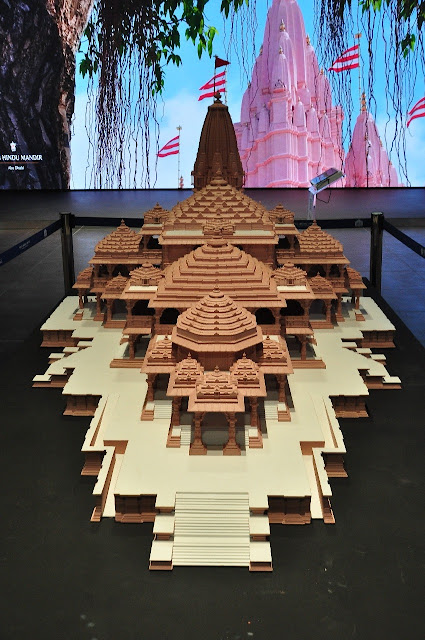 |
| Model of Controversial Ram Mandir at Dubai Expo |
 |
| Pakistani Pavilion at Dubai Expo |
Related Links:
Haq's Musings
South Asia Investor Review
Pakistan Tech Exports Soaring
Pakistan is the 7th Largest Source of Migrants in OECD Nations
Pakistanis Mini-Invasion of China
Modi's Hindu Rashtra
Pakistan Remittance Soar 21X
Pakistan's Growing Human Capital
Babri Masjid Destruction in India
Pakistan Most Urbanized in South Asia
Hindu Population Growth Rate in Pakistan
Do South Asian Slums Offer Hope?
How "Illiterate" Are Pakistan's "Illiterate" Cell Phone Users?
Views: 1032
-
Comment by Riaz Haq 3 hours ago
-
Sadanand Dhume
@dhume
.
@VirSanghvi
: “A society that distorts and devalues the past in an effort to promote the politics of the present damages itself and all those who live in it.” [On the Allahabad High Court giving credence to a crackpot theory about the Taj Mahal.]
https://theprint.in/opinion/even-modi-govt-rejected-the-taj-mahal-c...
https://x.com/dhume/status/2075197760324714696?s=20
------------
Even Modi govt rejected the Taj Mahal conspiracy. Why is Allahabad HC taking it seriously?
A society that distorts and devalues the past in an effort to promote the politics of the present damages itself and all those who live in it.
Vir Sanghvi
VIR SANGHVI
What happens when the lunatics take over the asylum? I guess we may find out because something like that could be happening.
A few days ago, the Allahabad High Court finally took a petition about the origins of the Taj Mahal seriously and asked the Archaeological Survey of India and the central government to respond to it. The petitioners had been trying, since 2015, to get the case going, only to have court after court dismiss it.
Why did the courts refuse to take it seriously? Well, it could be for the same reason that most sensible people have regarded its basis as nonsense: the petition enshrines an old conspiracy theory about the Taj Mahal that has consistently been laughed out of historical circles.
According to this theory, the Taj is actually a Hindu structure that was appropriated by the Mughals. The petitioners not only subscribe to this theory, but they also want the courts to authorise inspections inside the building and eventually to bar Muslims from offering prayers there.
I will spare you the details of the ‘arguments’ in favour of this demand except to tell you that very little about the claim is new. It is so outlandish that the Archaeological Survey of India has opposed it, as has the Government of India, which, everyone will concede, is hardly run by Hindu-haters determined to give undeserved credit to the Mughals.
The fantastic tales of the fringe
I first heard the claim about the Taj many decades ago when, as a credulous schoolboy, I came across the work of PN Oak, who was head of a society called the Institute for Rewriting Indian History.
At that age, conspiracy theories hold a certain fascination. Just as I was taken with Erich von Däniken’s view that our gods were actually astronauts from faraway planets, or that the Bermuda Triangle opened the door to another dimension, or that Paul McCartney was dead and had been replaced by a double, I wondered about the Taj.
Then I read more of Oak and others like him and noticed that he had many other conspiracy theories, including the claim that Fatehpur Sikri was actually a Hindu city.
Almost all the theories I read were dedicated to a peculiar worldview in which hardworking Hindus built many glorious structures, all of which were appropriated by nasty Muslim rulers who renamed them and took the credit.
--------
The mainstreaming of lunacy
The problem is that bigotry and politics have invaded what should be the realm of serious historians. The Hindu right is committed to claiming that the Harappan people were Hindus despite the absence of any compelling evidence to this effect. The Hindutva lobby is worried that if it can be demonstrated that these people followed another religion, then Hinduism is not the original religion of India. Which means that Hinduism entered India later, perhaps through a migration of people.
Comment
- ‹ Previous
- 1
- …
- 3
- 4
- 5
- Next ›
Twitter Feed
Live Traffic Feed
Sponsored Links
South Asia Investor Review
Investor Information Blog
Haq's Musings
Riaz Haq's Current Affairs Blog
Please Bookmark This Page!
Blog Posts
Pakistan Needs to Address Its Significant Data Quality Challenges
Policy-makers need data to formulate good policies. Good data produced by government agencies can be expected to lead to good policies and desirable outcomes. But data collection and statistical analyses require adequate methodologies and resources. Unfortunately, Pakistan's data quality gets a "C" grade by international agencies like the International Monetary Fund (IMF). Clearly the country faces significant data quality challenges. These challenges range from estimation of the size…
ContinuePakistan Electricity Consumption Up 21% in Just Two Years
Pakistan is experiencing soaring demand for electricity across all of the sectors of its economy. The new demand is being met by rapidly growing deployment of distributed solar, estimated at 38 GW as of June, 2025. In 2025, 44% of solar deployment was residential, followed by industry (26%), agriculture (21%) and commercial users (9%). The expansion of distributed solar has enhanced electrification across the economy, lifting Pakistan's electrification rate to 21.7%…
ContinuePosted by Riaz Haq on June 30, 2026 at 1:30pm — 2 Comments
© 2026 Created by Riaz Haq.
Powered by


You need to be a member of PakAlumni Worldwide: The Global Social Network to add comments!
Join PakAlumni Worldwide: The Global Social Network